

Microsoft’s Ignite 2025 felt less like a product parade and more like a strategic course correction: the company is repositioning AI from a parade of impressive features into an enterprise-grade governance-first platform that treats AI agents as auditable, identity-bound services rather than ephemeral assistants. This shift — visible across announcements such as Agent 365, Entra Agent ID, Copilot Studio enhancements, Work IQ, Fabric IQ and Foundry control-plane investments — maps directly to a market where buyers are reallocating spend toward compliance, security, and operational assurance rather than pure novelty. The question for CIOs and CISOs is no longer whether Microsoft understands the problem; it is whether the company’s governance fabric is mature enough to meet enterprise risk, vertical regulation, and measurable ROI expectations.
Microsoft staged Ignite 2025 (Nov 18–21) as an “AI-first” conference focused on moving generative AI from demos into production-ready operations. The narrative cohered around a simple thesis: if agents will perform multi-step work across systems, then identity, telemetry, policy enforcement and lifecycle controls must come first. Microsoft framed a set of product and partner announcements as the architectural pieces required to deliver that outcome: identity-bound agents, a control plane for discovery & governance, data-grounding layers for safer reasoning, and orchestration tooling to build and measure agents at scale. Several independent industry write-ups and session summaries confirm the same product pillars and roadmap emphasis at Ignite.
However, strategy and product announcements are the beginning, not the end. The decisive tests will be operational: can Microsoft and its partners deliver audited, SIEM-integrated, vertical-ready governance artifacts that reduce regulatory and audit risk in measurable terms? Can Agent 365 scale discovery, quarantine and lifecycle automation without adding unbearable complexity? Until those proof points — third-party audits, customer ROI case studies, and polished SOC integrations — are visible, organizations should proceed with a mixture of ambition and caution: pilot aggressively on low-risk workloads, require identity-bound agents and strong audit trails, and insist on contractual and vertical assurances before delegating high-impact decisions to agentic systems.
Microsoft’s pivot from AI hype to governance-first productization is real and market-aligned. The difference between a successful transition and a missed opportunity will be measured not in marketing lines but in the operational evidence Microsoft and its partners produce — audit-ready, risk-controlled agents running within governed estates. That is the standard enterprise buyers will hold every vendor to in the next phase of AI adoption.
Source: UC Today Microsoft Ignite 2025: Is Microsoft Pivoting From AI Hype to Proper Governance?
 Background / Overview
Microsoft staged Ignite 2025 (Nov 18–21) as an “AI-first” conference focused on moving generative AI from demos into production-ready operations. The narrative cohered around a simple thesis: if agents will perform multi-step work across systems, then identity, telemetry, policy enforcement and lifecycle controls must come first. Microsoft framed a set of product and partner announcements as the architectural pieces required to deliver that outcome: identity-bound agents, a control plane for discovery & governance, data-grounding layers for safer reasoning, and orchestration tooling to build and measure agents at scale. Several independent industry write-ups and session summaries confirm the same product pillars and roadmap emphasis at Ignite.Why this matters now
- AI adoption has moved from experimentation to board-level risk management; organizations now prioritize safe deployment over novelty.
- Agents that act autonomously change threat models: token theft, uncontrolled data exfiltration, and non-compliant decision automation become enterprise-level concerns.
- Buyers are demanding measurable governance metrics — audit trails, identity mapping, policy enforcement, and termination controls — not just hours saved or draft time reduced.
What Microsoft announced at Ignite 2025 — the governance fabric in brief
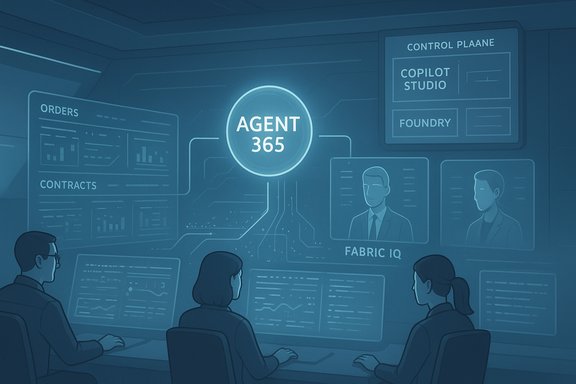
Microsoft’s messaging, and the product primitives it showcased, can be organized into four pillars:- Identity & lifecycle: Entra Agent ID and agent-bound identities to treat agents like workforce identities for access reviews, termination, and conditional access.
- Governance & observability: Agent 365, positioned as a control plane — registry, access control templates, telemetry, and quarantine capabilities for managed and third-party agents.
- Data grounding & semantics: Work IQ, Fabric IQ and Foundry IQ to provide agents with semantically meaningful, labeled, and governed data context so decisions and actions are traceable to business entities.
- Build & runtime: Copilot Studio, Azure AI Foundry / Foundry Control Plane, and Agent Factory to author, host, and meter agent lifecycles, offering toolchains for pro-code and low-code development.
Market context: buyer intent is shifting to risk & governance
Third-party buyer-signal datasets referenced in coverage show a measurable reallocation of enterprise intent away from devices, XR and analytics into security, compliance, automation and “safe AI” investments. Reported uplifts included mid-single-digit to low-double-digit percentage jumps in security/compliance research and automation interest across tens of thousands of firms, while categories like devices/XR/analytics trended down. Microsoft’s governance messaging at Ignite is directly targeted at this market movement — customers want demonstrable controls and procurement-grade assurances before accepting agentic automation into their estates.Technical verification: what we can corroborate — and what needs more proof
Several of the load-bearing claims made at Ignite and in subsequent reporting are verifiable across independent reporting and Microsoft’s public materials. Key verifications:- Agent 365 exists as a governance/control-plane concept and was presented as an early-access/Frontier offering designed to register and govern agents across tenant estates. Multiple independent summaries describe it as a registry + lifecycle manager leveraging Entra, Purview and Defender integrations.
- Identity-bound agents and the notion of an Entra Agent ID are real product primitives Microsoft is promoting to enable agent lifecycle actions (deprovisioning, access reviews, conditional access). These appear repeatedly in Ignite coverage as a central governance mechanism.
- Microsoft’s data-grounding layers — Work IQ and Fabric IQ — were described as the semantic glue that lets agents reason about business entities (orders, tickets, contracts) rather than raw tables or documents. This reduces the probability of generic, unsafe outputs when mappings and labels are complete.
- Copilot Studio and Azure AI Foundry are being pushed toward lifecycle tooling (authoring, testing, telemetry, and hosting) for agent workloads, rather than ad-hoc prototypes, and Microsoft highlighted multi-model support in Foundry. Independent write-ups confirm these product directions and preview availability.
- Market projections cited at Ignite (for example, an IDC Info Snapshot estimating 1.3 billion AI agents by 2028) are useful planning signals but come with important caveats: they are industry forecasts and, in Microsoft’s messaging, sometimes originate from sponsored research. Treat such numbers as scenario guidance rather than deterministic outcomes.
- Broad promises of “governance by default” are aspirational until Microsoft delivers documented SLAs, third‑party audited controls, and transparent logging that security teams can ingest into existing SIEM/SOAR stacks. Agent 365 is a control plane — but its effectiveness depends on integration depth (API, log formats, retention policies), partner SLAs, and contractual commitments that are still being finalized in early access.
Strengths: where Microsoft is doing the right things
- Governance-first framing: Microsoft has moved governance from a footnote to a central theme, aligning product messaging with buyer demand for compliance, auditability, and controlled automation. That narrative shift is necessary and timely given enterprise risk appetites.
- End-to-end intent: Linking identity (Entra), data classification (Purview), telemetry (Defender/Sentinel), and a control plane (Agent 365) is the right architecture for enterprise adoption. The ability to map agents to identities enables lifecycle actions enterprises already know how to manage (deprovisioning, access reviews, conditional access).
- Ecosystem openness: Foundry’s multi-model approach and announced vendor relationships indicate Microsoft is building model choice and routing capabilities, which reduces single‑vendor model risk and helps enterprises tailor model behaviour by use case. This supports safer operations when paired with governance.
- Partnerization and operational playbooks: Partner showcases and market programs (Agent Factory, partner templates) aim to shrink demo-to-production friction — an important gap for enterprises that need repeatable patterns and governance artifacts.
Gaps, risks and where Microsoft still needs to prove its credentials
- Feature fatigue vs. governance focus
- Microsoft continues to ship many Copilot and device enhancements at Ignite, which risks diluting the governance message if partners and buyers interpret the event as innovation-first rather than controls-first. Enterprises must watch whether governance features receive parity in documentation, SLAs, and contractual commitments.
- Measurable ROI and regulatory assurance are underdeveloped
- Buyers increasingly demand quantifiable reductions in audit friction, regulatory exposure, and incident response time — not only productivity metrics. Microsoft’s messaging still leans heavily on productivity narratives in places; the vendor needs to provide case studies and ROI benchmarks that show governance reduces audit costs and regulatory fines.
- Vertical depth versus horizontal breadth
- Competitors and partners are already building verticalized governance frameworks (finance, healthcare, government) with domain-specific metrics and regulatory mapping. Microsoft’s approach is broad and foundational but must be matched with vertical templates and compliance attestations for regulated industries. Enterprises in finance, healthcare, and public sector should ask for vertical-specific controls and audit evidence.
- Complexity & sprawl risk from large agent portfolios
- Ironically, the more agents enterprises deploy to automate tasks, the larger the governance burden becomes. Microsoft announced dozens of agent variants and enables third-party agents, which could result in a proliferation of identity-bound yet poorly instrumented agents unless Agent 365 enforces discovery, policy baseline templates, and lifecycle automation by default. This is a classic scale problem: governance tooling must scale with the number of agents to avoid becoming a manual bottleneck.
- Operational integration: logs, retention, and SIEM readiness
- For audit and SOC workflows, the real test is whether agent telemetry can be ingested into existing SIEM/SOAR systems with consistent events, explainable traces, and retention schedules aligned with legal/regulator expectations. Early access might not yet provide the polished integrations enterprises demand.
Practical guidance for CIOs, CISOs and procurement teams
The following is a pragmatic checklist to evaluate Microsoft’s agentic stack and control-plane claims before broad rollout:- Require identity-bound agents and enforce lifecycle automation
- Demand Entra Agent ID for any agent allowed to act on production systems. Ensure deprovisioning processes are automated as part of offboarding.
- Validate audit trails end-to-end
- Confirm that Agent 365 and Foundry expose immutable activity trails that include: who invoked the agent, agent identity, input dataset IDs/labels, model routing, outputs, and any automatic changes applied. Ensure logs are consumable by your SIEM.
- Start small, measure governance ROI
- Run low-risk pilots (read-only, suggested actions) tied to measurable governance outcomes: reduced manual audit hours, fewer policy exceptions, decreased incident triage time. Require Microsoft/partner case studies that show baseline metrics.
- Demand vertical-specific artifacts
- For regulated industries, ask for vertical audit packs: policy templates, mapping to specific regulations (e.g., HIPAA, PCI-DSS, GDPR/UK Data Protection), and partner references with successful vertical deployments.
- Insist on explicit model and data residency guarantees
- Confirm where inference runs, where logs are stored, and whether telemetry containing PII is retained off-region or processed in-region. Vendor model diversity increases flexibility but also complicates sovereignty; insist on contractual clarity.
- Avoid “agent sprawl” through policy templates
- Enforce baseline templates in Agent 365 for allowed capabilities per agent classification (e.g., “read-only research,” “workflow suggestion,” “action execution”) and require periodic access reviews.
- Integrate agent telemetry into SOC playbooks
- Update SOC runbooks, incident response plans and threat models to include agent failure modes (compromised credentials, prompt-injection patterns, lateral automation risks). Simulate incidents involving agents and validate rollback and quarantine processes.
Competitive and ecosystem implications
Microsoft’s governance push will raise competitive pressure across cloud and SaaS vendors. The company’s advantage is an integrated stack (identity, productivity, cloud, security), but standards and interop (Model Context Protocol, agent-to-agent patterns) will determine whether enterprises are locked into one stack or can orchestrate agents across multi-cloud and open-source models. Early partner activity — vertical playbooks, managed services and co-sell programs — will be decisive in converting platform primitives into repeatable business outcomes. Enterprises should favor vendors and partners that demonstrate clear governance playbooks and third-party verification over vendors that focus only on features.Where Microsoft must deliver next — a short roadmap of required proof points
- Transparent audit and telemetry contracts: log formats, retention, export APIs and SIEM integration playbooks.
- Third-party and independent audits of Agent 365 controls, especially for regulated-use cases.
- Clear, measurable ROI case studies showing reduced audit cost, lower regulatory exposure and demonstrable SOC improvements.
- Vertical compliance templates and attestation packs.
- Default-deny, policy-first agent templates that scale with discovery and remediation automation.
Short-term signals to watch (next 6–12 months)
- Early customer case studies and co-sell references that quantify governance outcomes and cost models.
- Security advisories or vulnerability disclosures tied to agent runtimes (OAuth token theft, agent chaining exploits) and Microsoft’s mitigation timelines.
- Availability of vertical-specific governance templates and audit packs, particularly for finance, healthcare, and public sector.
- Productization of Agent 365 APIs for SIEM/SOAR ingestion and retention policy enforcement.
Conclusion — the pivot is real, but the proof will be operational
Microsoft’s messaging at Ignite 2025 marks a meaningful pivot: the company now positions AI governance, identity-bound agents, and an agent control plane as core to enterprise adoption rather than peripheral features. This alignment with buyer intent is necessary; customers have moved from “How do we adopt AI?” to “How do we control it?” and Microsoft’s new primitives respond directly to that question.However, strategy and product announcements are the beginning, not the end. The decisive tests will be operational: can Microsoft and its partners deliver audited, SIEM-integrated, vertical-ready governance artifacts that reduce regulatory and audit risk in measurable terms? Can Agent 365 scale discovery, quarantine and lifecycle automation without adding unbearable complexity? Until those proof points — third-party audits, customer ROI case studies, and polished SOC integrations — are visible, organizations should proceed with a mixture of ambition and caution: pilot aggressively on low-risk workloads, require identity-bound agents and strong audit trails, and insist on contractual and vertical assurances before delegating high-impact decisions to agentic systems.
Microsoft’s pivot from AI hype to governance-first productization is real and market-aligned. The difference between a successful transition and a missed opportunity will be measured not in marketing lines but in the operational evidence Microsoft and its partners produce — audit-ready, risk-controlled agents running within governed estates. That is the standard enterprise buyers will hold every vendor to in the next phase of AI adoption.
Source: UC Today Microsoft Ignite 2025: Is Microsoft Pivoting From AI Hype to Proper Governance?
