

Microsoft’s Ignite 2025 made one thing unmistakably clear: the company is betting the enterprise future on agentic AI — fleets of purpose-built Copilot agents that plan, act and operate under identity-aware governance — and it wants IT, security and data teams to treat agents as production services, not experiments.
Microsoft staged Ignite 2025 as an “AI‑first” event where the product narrative focused less on single‑pane chat assistants and more on specialized agents, orchestration plumbing, and hardened controls that let those agents operate at scale across Azure, Microsoft 365, Windows and Cloud PCs. The roadmap presented at the event stitches together Copilot Studio, Azure AI Foundry, the Azure AI Agent Service, a Model Context Protocol (MCP) for interoperability, and governance integrations with Entra, Purview and Sentinel.
This is not a UI refresh. It’s an architectural shift: agents are being positioned as first‑class, identity‑bound actors that can perform multi‑step automation for deployment, migration, optimization, observability, resiliency and troubleshooting — and they’ll be discoverable on endpoints (taskbar agents), scalable in the cloud (Windows 365 for Agents), and controllable via enterprise policy.
Key platform pieces announced or emphasized:
For IT teams, this introduces new device‑management considerations:
At the same time, the hard work shifts from vendor capability checklists to operational fundamentals: label your sensitive data, bind agents to identities with least privilege, stage pilots with conservative action modes, integrate agent logs into SOC workflows, and insist on contractual clarity where third‑party models or off‑region storage are involved. The potential productivity and automation gains are real — but they will hinge on rigorous identity, telemetry and procurement discipline more than on any single product demo.
Enterprises that adopt a measured, security‑first approach — treat agents as production services, instrument them fully, and align legal and procurement early — will capture the upside while limiting exposure. For everyone else, the agent era will be a cautionary tale of promising automation deployed without sufficient guardrails.
Source: UC Today https://www.uctoday.com/unified-communications/microsoft-ignite-2025-ai-agents-copilot/
 Background
Microsoft staged Ignite 2025 as an “AI‑first” event where the product narrative focused less on single‑pane chat assistants and more on specialized agents, orchestration plumbing, and hardened controls that let those agents operate at scale across Azure, Microsoft 365, Windows and Cloud PCs. The roadmap presented at the event stitches together Copilot Studio, Azure AI Foundry, the Azure AI Agent Service, a Model Context Protocol (MCP) for interoperability, and governance integrations with Entra, Purview and Sentinel.This is not a UI refresh. It’s an architectural shift: agents are being positioned as first‑class, identity‑bound actors that can perform multi‑step automation for deployment, migration, optimization, observability, resiliency and troubleshooting — and they’ll be discoverable on endpoints (taskbar agents), scalable in the cloud (Windows 365 for Agents), and controllable via enterprise policy.
What Microsoft announced at Ignite 2025
The agent family and orchestration vision
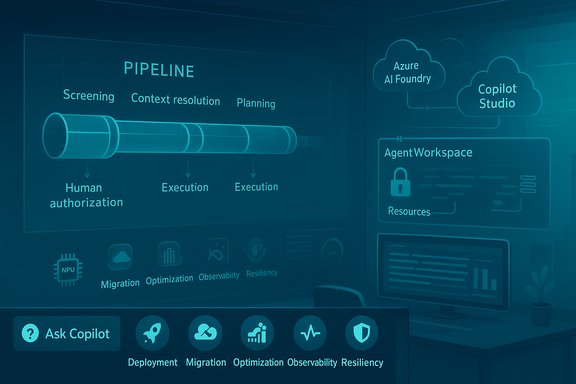
Microsoft unveiled an agentic interface driven by Azure Copilot and a family of specialized agents for core operational domains: Deployment, Migration, Optimization, Observability, Resiliency and Troubleshooting. These agents are orchestrated through a central pipeline that interprets intent, selects the right agent(s), enforces policy checks and either proposes playbooks or executes actions under the initiating user’s identity. The orchestration pattern intentionally keeps a human in the loop for authorization while enabling agents to plan and enact multi‑step workflows.Key platform pieces announced or emphasized:
- Azure AI Agent Service and Azure AI Foundry tooling for designing, testing, deploying and governing agents at scale.
- Copilot Studio as the low‑code/no‑code environment and developer toolkit for building Copilot experiences and agents.
- Model Context Protocol (MCP) and Agent‑to‑Agent (A2A) standards to enable discovery and interoperable tool access between agents and services.
- Identity and governance integrations tying agents to Entra identities, RBAC, Azure Policy and audit logging to limit what agents can do and to record what they did.
Endpoint and Windows integration
Ignite previewed a new user experience that surfaces agents on the Windows taskbar via the Ask Copilot experience and compact floating interfaces, increasing discoverability and supporting background work with progress badges and hover previews. Microsoft also described an Agent workspace — an isolated runtime where agents operate under constrained identities and connectors to avoid credential leakage. In parallel, Microsoft announced Windows 365 for Agents (a Cloud PC variant tuned for agent workloads) and continued to push the “Copilot+ PC” hardware concept for local inferencing on endpoint NPUs.Security, identity and compliance investments
Security was part of the backbone: Microsoft tied agent controls into Security Copilot, Azure Sentinel, Entra and Purview, stressing telemetry fabrics, provenance, runtime policy enforcement and short‑lived agent credentials. The company framed this as turning agents into auditable, identity‑aware services rather than opaque tools. Microsoft also emphasized integrations with Defender, Purview label enforcement, and DLP mechanisms for Copilot-driven flows.Ecosystem, models and interop
Microsoft highlighted multi‑model support and an ambition to avoid agent silos by promoting interoperability (MCP/A2A), and an Agent Store/Marketplace for discovering, approving and procuring first‑ and third‑party agents. The pitch is full‑stack: low‑code Copilot Studio, runtime scale with Azure AI Foundry, identity and policy via Entra and Purview, and commercial flows through the Marketplace.How the Azure Copilot agent architecture works (practical view)
Orchestration pipeline and human-in-the-loop flows
The agent orchestration pattern described at Ignite follows a predictable pipeline:- Screening: incoming prompts are scanned for safety, compliance and relevance.
- Context resolution: the system inspects the active portal context, resource graph, telemetry and role permissions.
- Selection and planning: one or more specialized agents and toolchains are chosen and a stepwise plan is proposed.
- Human authorization: agents either require explicit user/admin approval or run in limited read/suggest modes.
- Execution and recording: actions are executed under the initiating user’s identity, with audit logs and artifacts retained.
Agent identity, connectors and the Agent workspace
Each agent runs under a distinct agent identity with minimized permissions and uses secure connectors to reach resources — a design intended to reduce blast radius and make audits simpler. The Agent workspace isolates execution, preventing agents from directly inheriting the full privileges of the logged‑in user or system, and provides a controlled surface for UI automation, file access and external tool invocation.Model, tool and data linkages
Agents are designed to compose models, connectors and knowledge sources: Azure AI Foundry provides model catalogs, Copilot Studio binds agents to Dataverse/SharePoint/Fabric knowledge stores, and Azure AI Search provides agentic retrieval for RAG scenarios. Microsoft also emphasized the ability to bring or route to multiple model providers under governance boundaries.Security and identity: strengths and unresolved challenges
Strengths Microsoft showcased
- Integrated security stack: tying agents into Entra, Purview, Sentinel and Security Copilot gives enterprises a familiar control plane for telemetry, conditional access, classification and IR playbooks. This is a material advantage for customers already invested in Microsoft security tooling.
- Identity‑first controls: assigning identities to agents and using short‑lived credentials addresses a key enterprise ask and eases auditing.
- Agent traceability: tracing, artifact capture and action logs are baked into the agent lifecycle to help compliance and eDiscovery.
Hard open questions and risks
- Demo‑to‑production gap: agents that perform well in controlled demos may behave unpredictably in complex, heterogeneous enterprise environments. Observability and robust test harnesses are still essential.
- Data exfiltration and over‑indexing: if permissions, Purview labels or tenant configurations are weak, agents can surface or act on data they should not. Microsoft acknowledges this and recommends deployment blueprints and staged rollouts, but the operational workload to get it right is nontrivial.
- Model and telemetry governance: routing agent calls to third‑party models, or storing prompts/logs in non‑compliant regions, raises legal and procurement questions that must be contractually enforced.
Data, compliance and legal implications
Agentic automation changes the compliance calculus: agents read, synthesize and may write to documents, tickets and systems across the estate, creating new categories of machine‑generated artifacts and evidence. Enterprises must answer several concrete questions before scaling agents:- Where are agent logs, prompts and intermediate artifacts stored, and in which regions?
- Can regulated data be redacted or tokenized before ingestion?
- How will eDiscovery and records retention treat agent outputs?
Endpoints and Windows: how user experience is changing
Windows is being reframed as an agentic operating surface: Ask Copilot on the taskbar, wake‑word voice activation, Copilot Vision, and compact floating agent interactions aim to normalize agents as background collaborators in the user’s workflow. The taskbar is a deliberate UX placement to increase discoverability and reduce context switching.For IT teams, this introduces new device‑management considerations:
- Copilot+ PCs with NPUs and on‑device models require new hardware inventories and update patterns.
- Agents running locally or on Cloud PCs must be governed by endpoint policy and telemetry pipelines to avoid shadow IT and unmanaged agent instances.
Economics, procurement and operational advice
The new spending model
Agent workloads blend seat licensing with consumption metering. Expect a hybrid cost profile composed of:- Per‑user Copilot/Copilot Studio licensing,
- Tenant or pooled compute credits for model inference,
- Consumption‑based billing for agent calls and long‑running tasks.
Practical rollout checklist (staged safe adoption)
- Start with a focused pilot: select low‑risk agents (read‑only summarizers, knowledge retrieval) and a narrow user group. Measure time saved, error rates and trust metrics.
- Harden identity and permissions: use Entra to assign agent identities, enforce conditional access, and issue short‑lived credentials for connectors.
- Apply data hygiene: classify and label sensitive content with Purview and set DLP policies to prevent leakage during agent operations.
- Define human‑in‑the‑loop thresholds: require manual approval for actions touching legal, financial or regulatory artifacts.
- Integrate telemetry: stream agent actions into Sentinel or your SIEM, retain audit logs with appropriate retention, and surface agent lifecycle events in SOC workflows.
- Budget for consumption: set tenant caps, prepaid credits and cost alerts to prevent runaway bills. Assign agents to cost centers and require ROI reviews.
Risks and failure modes IT leaders must anticipate
- Hallucinations and incorrect automation: agents that synthesize plans and propose changes can be wrong; the safety line is both human review and conservative default actions (suggest vs. execute).
- Prompt injection and model‑level attacks: agents that accept external content must be treated as potentially targetable entry points; detection rules and model‑specific guards are required.
- Machine identity compromise: agent identities with excessive permissions can be abused like any service principal; include them in standard identity threat models and periodic access reviews.
- Cost overruns: unmetered or poorly supervised agent fleets can generate significant inference bills; enforce caps and monitoring.
Competitive and ecosystem perspective
Microsoft aims to own a full stack — from low‑code builders to model catalogs, identity and security, and commercial channels — which gives it an advantage for integrated enterprise offerings. But standards and interop work (MCP/A2A) are crucial to avoid vendor lock‑in and to allow enterprises to use agents across multi‑cloud or open‑source model deployments. The move also ramps competitive pressure on Google, Salesforce and smaller platform vendors to advance their own agent frameworks and governance offerings.Conclusion — a pragmatic posture for IT and security teams
Ignite 2025 signals that agentic AI is no longer an academic or pilot problem — it’s becoming the mainstream operational model Microsoft is selling to enterprises. The platform pieces are maturing: agent runtime and tooling, identity and governance controls, endpoint UX and cloud scale. These are meaningful advances for teams that can mobilize cross‑functional governance, procurement and monitoring to treat agents as auditable, billed components of the infrastructure.At the same time, the hard work shifts from vendor capability checklists to operational fundamentals: label your sensitive data, bind agents to identities with least privilege, stage pilots with conservative action modes, integrate agent logs into SOC workflows, and insist on contractual clarity where third‑party models or off‑region storage are involved. The potential productivity and automation gains are real — but they will hinge on rigorous identity, telemetry and procurement discipline more than on any single product demo.
Enterprises that adopt a measured, security‑first approach — treat agents as production services, instrument them fully, and align legal and procurement early — will capture the upside while limiting exposure. For everyone else, the agent era will be a cautionary tale of promising automation deployed without sufficient guardrails.
Source: UC Today https://www.uctoday.com/unified-communications/microsoft-ignite-2025-ai-agents-copilot/
