

Microsoft and the hyperscalers are double‑downing on infrastructure as the AI era shifts from experiments to industrial‑scale deployment, and the market is pricing a generational CapEx cycle that could reshape datacenters, energy policy, and competitive moats across the cloud stack.
Background
The headline narrative for late‑2025 is simple but seismic: a cluster of analysts and industry reports now describe the market entering an Industrial AI Era — a phase where production‑grade AI services (especially agentic and reasoning models) drive sustained demand for specialized, low‑latency inference capacity rather than episodic training runs. That shift has hyperscalers planning record capital expenditure to add racks, power, and next‑generation accelerators at scale. Estimates for the combined CapEx of the largest hyperscalers in calendar 2026 have moved into the high hundreds of billions — with several analyst houses and industry trackers pointing to a figure north of $600 billion. This feature drills into the mechanics of that shift, why Microsoft and Azure are widely perceived as the market leader today, what the hardware and energy consequences look like, and where investors, IT teams, and policy makers should focus as the supercycle unfolds.Overview: What changed — from training to test‑time compute
The "Inference Inflection Point"
Through 2023–2024 the industry’s headline problem was training: larger models, bigger datasets, and the need for dense exascale clusters. By late‑2025 the story evolved: for many production use cases — conversational assistants, agentic workflows, real‑time customization for millions of users — the cost of serving (inference or test‑time compute) at scale has become the dominant ongoing expense. Researchers and sell‑side analysts have documented that new reasoning models often require substantially more compute during inference per request than earlier chat models, changing cost curves and architecture requirements. This “inference inflection” elevates memory bandwidth, interconnect, and low‑latency orchestration to first‑order concerns, not just raw training FLOPS. Key implications:- Data centers optimized for reasoning will prioritize high‑bandwidth memory subsystems, massive HBM pools, and ultra‑fast network fabric over pure TFLOPS per rack.
- Hyperscalers must shift procurement mix toward inference‑optimized racks and invest heavily in capacity to meet persistent, recurring demand.
- Operational costs (power, cooling, tokenized pricing models) become the bottleneck for profitable AI service delivery.
Why Microsoft appears poised to lead
Azure: growth, product strategy, and capacity signals
Throughout 2025 Microsoft’s cloud results repeatedly pointed to outsized AI‑attached growth inside Azure. Management and multiple market reports have highlighted Azure’s acceleration and the lift coming from AI services embedded across Microsoft 365, Copilot, and enterprise partners. Microsoft has also pushed a single‑stack strategy — combining Azure infrastructure, its Azure AI Foundry developer platform, and a close partnership with OpenAI — to capture both supply and demand sides of the new market. Microsoft publicly describes Foundry as used by tens of thousands of enterprises and cites broad model availability on the platform. Concretely:- Microsoft disclosed an increasing AI contribution to Azure growth in 2025, and multiple market write‑ups have treated Azure AI revenue as a discrete, fast‑growing line item. Some market summaries project an Azure AI annual run‑rate in the tens of billions of dollars by late‑2025; however, the exact figure varies by outlet and calculation method. Where official, company‑level run‑rate figures exist they have been updated through 2025, but analysts diverge on the precise dollar value. Treat such aggregate run‑rate numbers as estimates unless explicitly broken out in Microsoft filings.
The $120 billion CapEx figure — what it represents (and what’s uncertain)
A central plank of the market narrative is that Microsoft will materially accelerate capital spending to secure a global, fungible fleet of AI‑optimized datacenters and racks. Several post‑earnings summaries and analyst notes in 2025 report that Microsoft’s guidance for fiscal 2026 CapEx rose to the order of $120 billion, reflecting both large frontline data‑center builds (e.g., the Fairwater campus) and fleet modernization. These reports quote management remarks and earnings‑call signals that quarterly CapEx run‑rates would surge and that Microsoft expects sustained elevated spending to meet demand. While multiple reputable outlets and commentaries relay the same guidance figure, this is a company guidance item that should be validated against Microsoft’s formal investor materials and 10‑Q/K filings for precise timing, accounting treatment, and whether the figure reflects fiscal or calendar year framing. Analysts and news summaries corroborate the magnitude; treat the exact headline number as a high‑confidence market estimate with nuance in fiscal accounting.The scaling race: hardware, partners, and the emerging "moats"
NVIDIA as the oxygen — Blackwell Ultra / B300 and the Rubin line
The hardware story is straightforward: GPUs remain the dominant commodity for both training and inference at hyperscaler scale, and NVIDIA continues to be the leading supplier. In 2025 NVIDIA expanded the Blackwell family into the Blackwell Ultra / B300 product family, delivering rack‑level systems designed for reasoning workloads; NVIDIA’s own messaging frames this as an explicit optimization for test‑time scaling and agentic AI. Industry press and vendor briefs also point to later‑generation architectures codenamed under Rubin/Vera Rubin for targeted 2026 rollouts, which are positioned as further lifting inference throughput. These product roadmaps and partner allocation priorities give early purchasers a practical head‑start in test‑time performance. Important caveats:- Vendor performance claims (e.g., "2x inference performance vs prior generation") should be read as manufacturer projections and need independent benchmark validation for specific model families and workloads.
- Supply allocation, packaging (CoWoS), and HBM configurations materially change price/performance; early allocations favor the largest cloud buyers.
AWS, Oracle, and the silicon diversification play
Not every hyperscaler sees vendor‑lockin with the same appetite. AWS continues to promote its custom silicon strategy — Trainium for training and Inferentia for inference — as a way to control TCO and margin over time. AWS has successfully placed Trainium‑based instances into production and emphasized fine‑tuning and inference on its silicon family to lower running costs and preserve elasticity. The risk/reward is clear: in‑house silicon can pay off on repeated, high‑volume inference but requires long lead times and deep integration with orchestration frameworks. Oracle, positioned as a smaller but aggressive provider, has invested in specialized AI clusters and supercomputing scale in selective markets. OCI has sought to win high‑performance and sovereign workloads by offering tightly integrated hardware stacks and competitive pricing. That said, the economics of renting top‑tier GPUs is squeezing margins for some entrants — a trend that underlines how capital intensity and chip costs are shaping strategic positioning.The datacenter story: Fairwater and "AI factories"
Fairwater: Microsoft’s Wisconsin AI superfactory
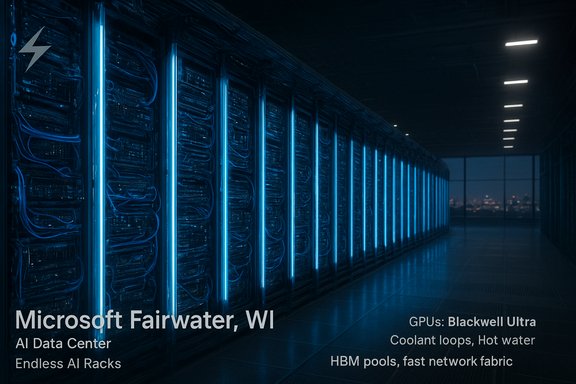
Microsoft’s Fairwater campus in Wisconsin is emblematic of the new data‑center archetype. Microsoft frames Fairwater as an AI‑optimized campus: huge contiguous floorplates designed to operate as a single, flat network, interconnecting hundreds of thousands of GPUs with dense fiber, advanced closed‑loop cooling, and dedicated power infrastructure. Microsoft’s own descriptions and site tours underscore the scale and engineering choices that differentiate such facilities from multi‑tenant enterprise datacenters. Fairwater is slated to come online as a significant capacity anchor in early 2026. What sets these new facilities apart:- Large, contiguous AI racks designed for single‑system-of-systems operation rather than multitenant VM hosting.
- High HBM capacity per node, specialized cooling (hot‑water / closed loops), and fiber interconnects to minimize latency jitter across GPU pools.
- Integration with procurement roadmaps (early access to the newest accelerators) to remain at the head of the performance curve.
Energy, sovereignty, and geopolitics
Power as a bottleneck — "AI Power Sovereignty"
Massive inference fleets create durable, concentrated electrical demand — and that has policy consequences. Analysts and portfolio managers are increasingly flagging the need for new long‑term power contracts, energy storage, and even dedicated generation sources to supply the new AI campuses without destabilizing grids. Some operators and regions are already discussing modular nuclear reactors and accelerated grid modernization to secure long‑term AI capacity. This trend elevates energy policy into infrastructure strategy and creates a nexus between cloud expansion and regional economic planning.Sovereign clouds and air‑gapped AI
Governments and large enterprises are demanding “sovereign clouds” — air‑gapped regions that meet strict residency, audit, and compliance demands. The combination of strategic national priorities and the critical nature of agentic AI deployments is pushing hyperscalers to offer dedicated sovereign regions and turnkey on‑prem/off‑cloud hybrids — an emerging high‑value market in 2026 planning. Microsoft has highlighted digital sovereignty capabilities across many countries, and the concept is becoming an explicit revenue and product axis.Financial math: CapEx, margins, and the Year of ROI
CapEx magnitude and investor expectations
The market’s reaction to elevated CapEx guidance is mixed. On one hand, investors appreciate that capacity constraints can throttle revenue in a growth‑hot environment; on the other, rapid asset buildup creates depreciation and margin pressure that must be offset by scalable, high‑margin AI services. Several sell‑side and market commentators note that hyperscaler bond issuance and corporate debt plans have expanded to fund the CapEx wave, with analysts updating models to reflect multi‑year, high‑repayment cycles. The central investor question for 2026 is whether new AI services (agentic productivity platforms, sovereign deployments, AI‑attached SaaS) will scale fast enough and at sufficient price points to justify the elevated asset base.The capacity glut vs. persistent shortage debate
Two hard scenarios exist:- Capacity glut: If hyperscalers overbuild and enterprise adoption for high‑end agentic workloads lags, the market could face downward pricing pressure and capacity idling — a painful re‑pricing for upstream suppliers and secondary cloud providers.
- Persistent shortage: If demand for low‑latency reasoning compute remains structurally high (driven by consumer apps, enterprise agents, and sovereign projects), supply will be chronically constrained and premiums for the most advanced capacity will persist.
Technical validation: what the engineers and procurement teams should confirm
- Verify vendor performance claims with independent benchmarks for the specific model families you plan to run (vendor numbers often reflect idealized workloads).
- Quantify end‑to‑end latency budgets (network, CPU/GPU transfer, model inference) for target SLAs; reasoning models can be throughput‑sensitive.
- Model energy consumption and PUE (Power Usage Effectiveness) under sustained inference at scale — don’t assume training‑era PUE numbers translate one‑for‑one.
- Confirm compatibility of toolchains (CUDA vs ROCm vs vendor SDKs) and porting cost if you switch between NVIDIA and alternative silicon.
Risks and unresolved questions
Claims that need caution or further verification
- Specific headline numbers such as “Azure AI annual run‑rate of $26 billion” and precise CapEx line items (e.g., Microsoft’s $120 billion fiscal guidance) are widely reported by market outlets and analyst notes, but they may be calculated differently across sources (fiscal vs. calendar year, inclusion/exclusion of partner commitments, RPO accounting). These figures should be validated against official company filings, investor presentations, and the formal earnings‑call transcript to understand the accounting framing and time horizon. Treat third‑party aggregates as high‑signal but confirm with primary filings for precise modeling.
- Product codenames and expectation setting — including projected performance uplifts for next‑gen accelerators (e.g., Rubin/R100 claims) — are manufacturer roadmaps and early press reporting. Customers should assume vendor claims require independent validation on their own workloads.
Structural and regulatory risks
- Energy constraints: Local grid capacity and permitting for large power draws will become gating factors for region selection and timelines.
- Supply chain/geopolitical risk: GPU allocation, packaging capacity (CoWoS), and export controls can alter vendor timelines and availability.
- Regulatory scrutiny: Agentic systems performing business‑critical functions will attract algorithmic accountability rules, procurement controls, and possibly sectoral restrictions (finance, healthcare, defense).
- Margin compression: If hyperscalers cannot monetize agentic services at scale or if enterprises push for multi‑cloud price arbitrage, gross margins could be under pressure even as revenues rise.
Tactical takeaways for Windows enthusiasts, IT leaders, and investors
- For enterprise IT teams: prioritize application‑level optimization (model choice, quantization, KV cache strategies) before committing to significant on‑prem hardware — efficient deployment patterns can reduce inference spend materially.
- For procurement: demand multi‑vendor, performance‑verified quotes and define workload‑specific benchmarks; ensure power and networking requirements are scoped early.
- For investors and CFOs: stress test models for both a high‑demand case and a capacity‑glut case; evaluate CapEx commitments in the context of contracted backlog and multiyear RPOs.
- For policy makers: treat AI‑scale datacenters as critical infrastructure requiring integrated planning across energy, workforce, and cybersecurity domains.
Conclusion
The market transition from training‑centric scaling to an inference‑dominated phase is real, and it changes the architecture of opportunity across cloud providers, chipmakers, and power markets. Microsoft’s Azure, backed by deep product integration with OpenAI, a rapidly growing Foundry ecosystem, and large purpose‑built campuses like Fairwater, is widely viewed as well‑positioned to capture the early phases of this industrialization. NVIDIA’s platform leadership and partnerships with the hyperscalers remain central to performance gains, while AWS’s silicon program and Oracle’s targeted clusters illustrate alternative strategic responses.But the math is unforgiving: large CapEx commitments — whether in the low hundreds of billions industry‑wide or the tens of billions for individual providers — must be matched by durable AI monetization. The most credible near‑term outcome is a continued scramble for high‑end reasoning compute, ongoing consolidation among top providers, and fierce pressure on energy and supply chains. Where that ends — capacity glut, sustained shortage, or a delicate balance — will determine whether the current wave of spending becomes a generational value creation or a costly overshoot.
Read every bold guidance figure in earnings transcripts and investor filings rather than headlines; validate hardware claims with independent tests; and plan capacity and energy with regional sovereignty and resiliency in mind. The AI supercycle is underway, but converting silicon and data center steel into long‑term returns will require execution at a scale and pace that is unprecedented in cloud history.
Source: FinancialContent https://markets.financialcontent.co...as-big-tech-capex-projections-surge-for-2026/
