

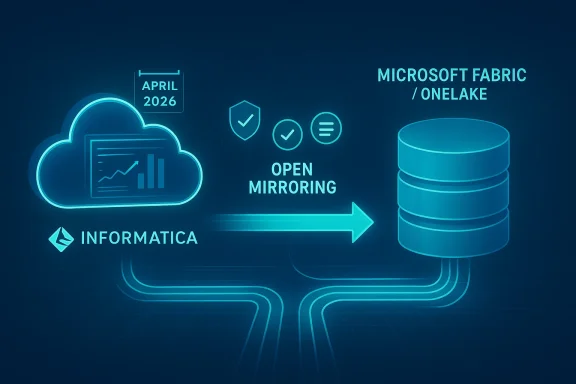
Informatica’s expanding Microsoft Fabric story is becoming more than a connector tale; it is turning into a platform-level alignment that reflects where enterprise data engineering is headed in 2026. The headline change is Informatica IDMC adding support for Microsoft Fabric Open Mirroring, with general availability slated for April 2026, a move that positions Informatica as a deeper operational feed into Fabric’s OneLake-centered analytics model. For Microsoft customers, that matters because the appeal of Fabric is no longer just a single analytics workspace; it is an increasingly open data foundation that can ingest operational change streams with less custom plumbing. For Informatica, it is a chance to keep IDMC at the center of governed data movement even as more workloads shift toward Microsoft’s unified lakehouse and mirroring architecture.
Background — full context
Microsoft Fabric has evolved quickly from a bundled analytics platform into a broader data operating system that spans ingestion, transformation, storage, governance, and real-time analytics. Mirroring has been one of the most important pieces of that strategy because it lets data land in OneLake in near real time and then be used across Fabric experiences such as SQL analytics, notebooks, and Direct Lake. Microsoft’s own Fabric documentation describes open mirroring as a way to create a mirrored database with a landing zone in OneLake, where applications can push Parquet or delimited files and Fabric continuously monitors the folder for new tables and changes. (learn.microsoft.com)In parallel, Informatica has been working to make IDMC feel native to Microsoft’s stack rather than simply adjacent to it. Over the last two years, Informatica has repeatedly expanded support for Fabric-related workloads, including connectors for Fabric Data Warehouse and support for Microsoft-focused blueprints around AI, analytics, and open table formats. In May 2025, Informatica announced new innovations with Microsoft Fabric and Azure OpenAI Service, including support for Iceberg open table scenarios in Fabric and additional trusted-data capabilities across Microsoft’s AI and analytics estate. (informatica.com)
That history matters because Open Mirroring is more ambitious than a one-off connector. Microsoft’s documentation shows that open mirroring is built around metadata, landing-zone conventions, key columns, incremental updates, and support for table lifecycle operations such as add, drop, and rename. In other words, this is not a simple file drop into object storage; it is a structured replication pattern that requires disciplined handling of schema, update markers, and operational semantics. (learn.microsoft.com)
Informatica’s role, then, is not merely to move bytes. It is to bridge the operational world of enterprise systems with Fabric’s analytics model while preserving governance, consistency, and scale. That is exactly the kind of problem IDMC is designed to solve: data integration, data quality, metadata management, and orchestration under one umbrella. The likely appeal to enterprise buyers is that they can keep using Informatica’s control plane while extending their Microsoft estate into Fabric without reinventing pipelines for each source system.
The broader market context also helps explain the move. Microsoft has been steadily widening Fabric’s mirroring ecosystem, with partner coverage and new source types expanding over time. Microsoft Learn’s open mirroring partner pages now explicitly reference an ecosystem of supported partners, including tools like Qlik Replicate and Striim, which reinforces the idea that Fabric wants to become the destination layer for many upstream operational systems rather than only Microsoft-native sources. (learn.microsoft.com)
What Informatica is actually adding
Open Mirroring support is the key story
At the center of this announcement is Open Mirroring support in IDMC for Microsoft Fabric. The practical meaning is that Informatica can participate in Fabric’s mirrored database model by landing data into the OneLake-backed landing zone in the format Fabric expects. Microsoft’s open mirroring requirements specify file and folder conventions, a_metadata.json file for key columns, optional _partnerEvents.json metadata, and row-marker behavior for incremental changes. (learn.microsoft.com)This is significant because it broadens the range of sources that can reach Fabric through a more standardized path. Instead of forcing enterprises into ad hoc copy jobs or brittle custom scripts, Informatica can serve as the governed conduit from databases, applications, and operational streams into Fabric’s mirrored database layer.
GA in April 2026 signals maturity, not just experimentation
The planned April 2026 GA matters because enterprise buyers treat GA as a procurement and production threshold. In practice, GA means more confidence for rollout planning, support expectations, and architectural standardization. It also implies that Informatica and Microsoft have worked through enough implementation detail to move beyond lab-style adoption and into repeatable production use.In a market where preview features are often useful but risky, GA is the inflection point that changes internal conversations. It becomes easier for platform teams to justify standardization, easier for security teams to approve, and easier for data teams to treat the capability as part of the base architecture rather than a special-case integration.
This is about OneLake-centered analytics
Fabric’s architectural promise is that operational data can be mirrored into a shared analytics substrate and then accessed across multiple experiences. Microsoft’s mirroring documentation emphasizes that mirrored databases land in OneLake and can then be used with Fabric’s analytics and query layers. The value is not just replication; it is unification of operational and analytical access without maintaining separate copy pipelines for every downstream tool. (learn.microsoft.com)For Informatica, that makes IDMC a better fit for organizations that already standardize on Microsoft for analytics. It turns the company from “the ETL provider in front of Fabric” into a more strategic partner in the Fabric ecosystem.
Why this matters now
Microsoft Fabric is becoming more operationally ambitious
Fabric started as an umbrella for analytics, but it is increasingly moving into operationally adjacent territory through mirroring, real-time intelligence, and expanded partner integrations. Microsoft’s own Fabric blog and Learn documentation show a steady push toward broader mirroring support, open mirroring onboarding, and more flexible ingestion patterns. (microsoft.com)That shift changes the competitive stakes. Once Fabric becomes the place where current-state data lives, the platform must ingest changes from a far wider set of systems. Informatica’s addition of Open Mirroring support helps Fabric compete as a destination for governed operational data rather than only a reporting and BI environment.
Customers want less ETL sprawl
A key enterprise pain point is pipeline sprawl. The more systems a company owns, the more connectors, scripts, schedules, retry rules, and schema exceptions it must manage. If Informatica can reduce the number of bespoke paths needed to bring data into Fabric, customers gain not just convenience but operational simplification. That can lower maintenance costs, reduce breakage, and improve data freshness.Governance is becoming a differentiator
The modern data platform conversation is no longer only about speed. It is also about trust, lineage, quality, and control. Informatica’s strengths in these areas are relevant because open mirroring, by design, can become a raw landing zone if not wrapped in proper governance. The enterprise value lies in pairing near-real-time movement with the discipline of managed metadata and data-quality controls.How open mirroring works under the hood
Fabric expects a landing zone, not a black box
Microsoft’s documentation makes clear that open mirroring works through a landing zone in OneLake. The mirrored database item receives a unique storage location, and applications land data there using the expected folder layout. Fabric then monitors those files, reads new tables, and applies changes. (learn.microsoft.com)This design is powerful because it opens the door to many source systems. It is also demanding, because the producer must follow the contract precisely. That means handling metadata correctly, using the right file layout, and respecting change semantics.
Key columns and row markers matter
The_metadata.json file defines key columns, and Microsoft says update/delete operations depend on that metadata being present. For incremental changes, the __rowMarker__ column becomes mandatory when applying updates and deletes. Without it, the initial file is treated as an insert. (learn.microsoft.com)This detail is one of the reasons Informatica’s involvement is meaningful. Many organizations can export data, but fewer can reliably maintain the semantics Fabric needs for ongoing change application.
The model supports lifecycle changes, but not casually
Microsoft documents support for table add, drop, and rename operations, but schema changes still require care. Dropping and recreating folders is the supported path for several schema-level changes, including column renames and type changes. That means open mirroring is flexible, but not magical. It rewards sources and integration layers that are disciplined about schema evolution. (learn.microsoft.com)Partner ecosystem signals a platform pattern
The partner ecosystem pages also underscore that Microsoft is intentionally encouraging a broader replication network. By continuously streaming data changes into the open mirroring landing zone, partners can remove ETL complexity while aligning with Fabric’s model. That places Informatica alongside other enterprise data movers rather than in a silo. (learn.microsoft.com)What Informatica brings to the partnership
Trusted data management
Informatica’s strongest selling point is not just transport. It is trusted data management. IDMC already spans integration, quality, governance, and metadata capabilities that are highly relevant when organizations move data into a shared analytics substrate. That makes the company a natural fit for Fabric environments that need more than raw replication.Enterprise-grade source diversity
Many enterprises live in heterogeneous environments. Even if the destination is Microsoft Fabric, the source landscape may include Oracle, SQL Server, SaaS apps, mainframes, and cloud-native operational stores. Informatica’s value is that it can connect across that diversity and feed Fabric with less custom engineering.A cleaner bridge to Microsoft’s AI ambitions
Microsoft’s Fabric roadmap is increasingly tied to AI readiness. Informatica’s May 2025 announcement explicitly linked Fabric and Azure OpenAI Service with trusted data foundations. That framing matters because AI initiatives fail quickly when underlying data is stale, inconsistent, or poorly governed. Informatica’s role is therefore not just to feed analytics, but to help create the data conditions that make AI initiatives credible. (informatica.com)Alignment with Microsoft’s open-data message
Microsoft’s latest Fabric messaging continues to emphasize open data flow, OneLake shortcuts, mirroring sources, and connected data experiences. Informatica fits into that story because it helps enterprise customers bring legacy and operational systems into the open-data era without rewriting their entire integration fabric. (blogs.microsoft.com)The competitive landscape
Fabric is attracting a partner ecosystem
Microsoft is not trying to do everything itself. The expansion of partner pages and open mirroring guidance suggests a deliberate ecosystem play. That creates both opportunity and pressure for Informatica. The opportunity is to become a preferred enterprise-grade path into Fabric. The pressure is that it must compete with other replication and integration vendors offering similar promises. (learn.microsoft.com)The real competition is complexity
The market rivalry here is not only between vendors; it is between managed architecture and DIY integration. If Informatica can help organizations avoid stitching together file drops, custom metadata handling, and brittle schema change logic, it will win deals on simplicity and reliability rather than on feature checklists alone.Open mirroring also raises the bar
Because open mirroring exposes a visible contract—folders, files, metadata, key columns, and change markers—it becomes easier for enterprises to compare offerings. That is healthy for the market, but it means vendors must prove they can manage the hard edge cases, not just the happy path.The enterprise use cases most likely to benefit
Operational analytics at scale
Enterprises that need near-real-time analytics on transactional data are the obvious beneficiaries. That includes finance, retail, logistics, telecom, and manufacturing environments where freshness matters and operational latency can affect decisions.AI-ready feature stores and semantic layers
As Microsoft and Informatica both emphasize trusted data for AI, the next logical use case is feeding AI pipelines with more current enterprise data. If Fabric can hold mirrored operational data and Informatica can govern its movement, the result is a more dependable substrate for model features, retrieval, and semantic enrichment.Cross-system consolidation
Organizations with multiple copies of the same business entity across systems can use Fabric as a consolidation layer. This works best when upstream systems are stable enough for mirroring and downstream users are aligned around a common definition of truth.Regulated data environments
Healthcare, financial services, and public sector organizations often need strong control over data lineage and access. Informatica’s governance heritage may make it more attractive here than lighter-weight integration tools, especially when compliance teams want a managed bridge into Fabric rather than a loosely governed one.Strengths and Opportunities
The combination of Informatica IDMC and Microsoft Fabric Open Mirroring has several clear strengths.- Operational freshness: data can arrive in Fabric much closer to real time than batch ETL allows.
- Reduced integration sprawl: fewer custom pipelines are needed to maintain source-to-Fabric movement.
- Better governance: Informatica can layer quality and control into the path to OneLake.
- Microsoft alignment: the partnership fits Fabric’s broader ecosystem strategy.
- AI readiness: trusted, current data improves downstream analytics and model workflows.
- Enterprise credibility: GA in April 2026 should help procurement and architecture teams standardize on the capability.
- Flexibility for heterogeneous sources: Informatica can bridge complex operational landscapes into a Microsoft-centric analytics stack.
- OneLake centralization: mirrored data can be accessed within Fabric’s broader experiences, simplifying downstream consumption.
Risks and Concerns
The announcement is promising, but there are still real risks.- Implementation complexity: open mirroring has precise requirements for metadata, keys, and incremental change handling.
- Schema-change fragility: column renames, type changes, and table reorganizations still require disciplined operational handling.
- Governance drift: if organizations treat mirroring as a shortcut, they may land messy data faster rather than better data.
- Cost confusion: even when mirroring itself is positioned as low-friction, surrounding storage, compute, and downstream query costs still matter.
- Partner overlap: Informatica will face competition from other vendors in the Fabric ecosystem.
- Preview-to-GA expectations: customers may expect seamless transition, but the hard work often lies in edge cases and scale.
- Operational dependency: if enterprises become dependent on a mirroring path for critical workloads, they will need strong SLAs and observability.
- Vendor lock-in concerns: deeper alignment with Microsoft may be strategically welcome, but it can also intensify platform dependence.
What to Watch Next
April 2026 GA details
The most obvious milestone is the actual GA release in April 2026. Buyers will want to know what sources are supported, what limitations remain, and what operational guarantees Informatica will provide.Source coverage and breadth
A critical question is how broad the open mirroring support will be in practice. Enterprises will want to see whether the capability is limited to select sources or generalized enough to matter in multi-platform estates.Observability and admin tooling
If the feature is going to be production-grade, customers will need strong monitoring, error visibility, replay handling, and schema-change diagnostics. The quality of the admin experience may determine adoption as much as the data path itself.Security and permissions
Microsoft’s mirroring documentation already emphasizes permissions and managed identity considerations for mirrored databases. Expect enterprises to scrutinize how Informatica handles access control, write permissions, and operational separation. (learn.microsoft.com)Ecosystem positioning
Watch how Microsoft markets the partner ecosystem, and whether Informatica is presented as a preferred enterprise route into Fabric. If the partnership gets prominent placement, that could influence customer mindshare quickly.Real customer stories
The most meaningful evidence will be production case studies. Look for evidence that enterprises are using Informatica to feed Fabric for analytics, operational reporting, and AI workloads at scale rather than just in pilot projects.Broader strategic interpretation
This announcement should be read as part of a larger industry trend: the collapse of the boundary between integration, storage, and analytics. Microsoft Fabric is pushing the center of gravity toward a unified experience, while Informatica is trying to remain the trusted movement and governance layer feeding that center. The two strategies are complementary, but only if the integration is robust enough to survive enterprise reality.It also suggests a subtle but important shift in how vendors talk about value. The old pitch was “we move data.” The new pitch is “we move trusted, governed, operationally current data into the place where analytics and AI actually happen.” That distinction is crucial, because it reflects the maturity of the market. Enterprises are no longer impressed merely by connectivity. They want data products, data trust, and platform coherence.
For Microsoft customers, the upside is that Fabric becomes more usable as a central hub. For Informatica customers, the upside is that IDMC becomes more relevant in a Microsoft-first world. For both, the success of the partnership will depend on whether open mirroring remains elegant under enterprise pressure.
Conclusion
Informatica IDMC adding Microsoft Fabric Open Mirroring, with GA expected in April 2026, is more than another integration announcement. It is a sign that the enterprise data stack is consolidating around a new center of gravity: governed operational data flowing into an open, OneLake-based analytics environment that is increasingly tied to AI. If Informatica executes well, the partnership could give customers a practical path from fragmented source systems to a more unified Microsoft data estate without sacrificing control or quality. The opportunity is real, the architecture is promising, and the next year will show whether this becomes a foundational enterprise pattern or just another feature in a crowded integration market.Source: channellife.co.nz https://channellife.co.nz/story/informatica-deepens-microsoft-fabric-ties-adds-swiss-pod/
Last edited:
