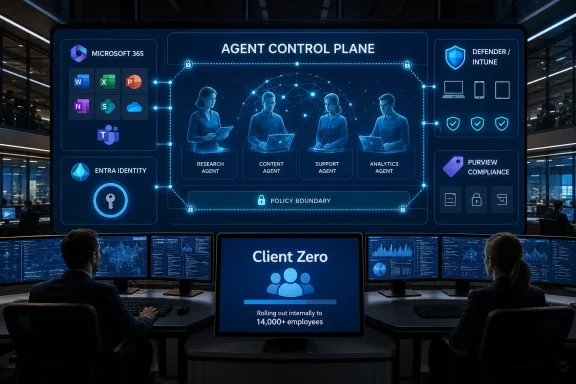
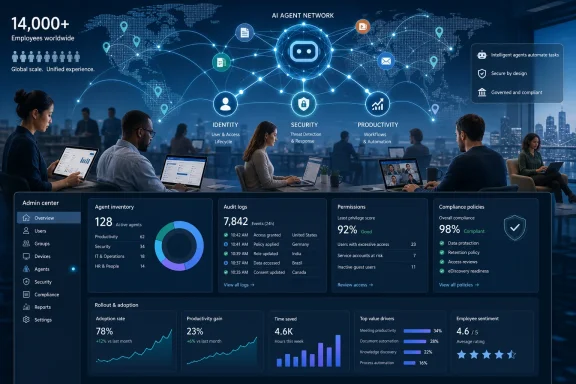
Insight Enterprises said on July 1, 2026, that it will offer Microsoft 365 E7 to customers as a launch partner while deploying the AI-heavy enterprise suite across its own workforce, turning Microsoft’s newest premium Microsoft 365 bundle into both a resale motion and an internal operating bet. The announcement matters less because another Microsoft partner has a new SKU to sell, and more because Insight is volunteering itself as a proof point for Microsoft’s most consequential productivity gamble in years. E7 is not just “E5 plus Copilot”; it is Microsoft’s attempt to make AI agents, identity, endpoint management, security, compliance, and office work feel like a single enterprise control plane. That is a bold pitch, and it arrives precisely when IT departments are still trying to determine whether Copilot is a productivity platform, a budget line item, or a governance problem with a chatbot attached.
The simplest reading of Insight’s announcement is that a major Microsoft partner has joined the E7 launch parade. That is true, but it undersells the strategic choreography. Microsoft does not merely need resellers to quote Microsoft 365 E7; it needs credible enterprise operators to show that an AI-first Microsoft 365 deployment can survive contact with real procurement, real security policy, and real employee behavior.
Insight is useful in that role because it sits in the middle of the market Microsoft wants to influence. It is not a tiny boutique consultancy whose internal deployment can be waved away as a lab exercise, and it is not Microsoft itself, whose internal success stories often sound inevitable. Insight is a large solutions integrator with customers, partner incentives, services revenue, and its own complicated technology estate.
That makes the “leading by example” framing more than boilerplate. If Insight can standardize on E7 internally and package that experience for clients, Microsoft gets a case study with commercial teeth. If the deployment proves messy, customers will learn something just as valuable: E7 is not a magic switch for agentic productivity, even when implemented by a company whose business is helping others implement Microsoft technology.
The timing also matters. Microsoft 365 E7 became generally available on May 1, 2026, after Microsoft announced the suite in March as its “Frontier Suite.” By July, the product had moved from keynote language into partner execution. Insight’s announcement is part of that second phase, where the question shifts from what Microsoft has bundled to whether enterprises will reorganize purchasing, governance, and user enablement around it.
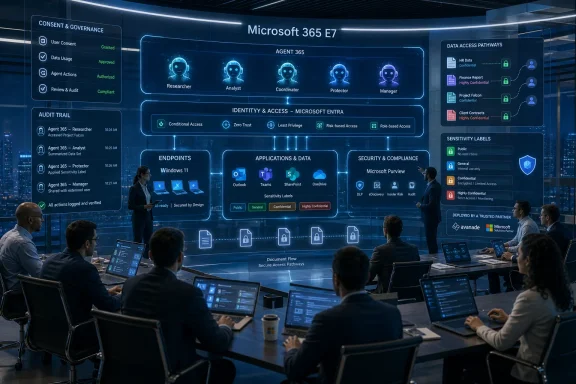
The package brings together Microsoft 365 E5, Microsoft 365 Copilot, Agent 365, Entra Suite capabilities, and the broader governance and security tooling Microsoft says organizations need to run AI at scale. In Microsoft’s preferred vocabulary, this is about moving from AI pilots to “frontier transformation.” In plainer IT language, it is about turning scattered Copilot experiments into a managed estate with identity, compliance, endpoint, and agent oversight attached.
That bundling strategy is both rational and self-serving. Rational, because enterprises already know that AI tools create security and compliance questions the moment they touch mailboxes, calendars, Teams chats, SharePoint files, CRM data, or line-of-business workflows. Self-serving, because Microsoft’s answer to that sprawl is to buy a bigger Microsoft bundle.
For many customers, the math will be uncomfortable but legible. E5 already occupies the premium end of Microsoft 365 licensing, Copilot has carried its own per-user premium, and Agent 365 introduces the idea that autonomous or semi-autonomous AI workers need their own management layer. E7 says: stop assembling the stack à la carte and buy the whole control plane.
That is exactly why Insight’s internal deployment is commercially important. Customers will ask whether E7 is a tidy licensing wrapper or a practical architecture. Insight is positioning itself to answer that question from experience, not just from a partner playbook.
That is where Microsoft wants E7 to feel inevitable. If an employee can ask an AI agent to reconcile records, prepare a customer response, update a project plan, or summarize a contract repository, IT needs to know who created that agent, what data it can touch, whether it is behaving normally, and how it can be revoked. These are not optional controls in regulated industries or large enterprises. They are the difference between automation and unsupervised risk.
Microsoft’s pitch is that Agent 365 gives organizations visibility and management for agents across Microsoft 365 and beyond. The ambition is obvious: make agents first-class enterprise identities, or at least governed resources, rather than shadow IT scripts wearing a friendly Copilot icon. That is a smart direction, because every wave of enterprise productivity tooling has eventually become an identity and governance problem.
The catch is that governance tools do not make organizations governed. They provide mechanisms. Someone still has to define acceptable use, decide which business processes are safe for agentic automation, review permissions, monitor data exposure, and train users not to treat AI output as institutional truth. E7 may make those tasks easier to centralize, but it also makes them harder to avoid.
This is where Insight’s dual role becomes interesting. As a customer, Insight must live with the operational reality of giving employees access to Microsoft’s AI stack. As a partner, it can turn the pain of that operational reality into consulting offerings, managed services, readiness assessments, and deployment accelerators. That is not cynical; it is how enterprise technology adoption usually works. The best services businesses are often built around the gaps between vendor promise and customer execution.
That argument will resonate with security teams that have spent the last few years watching SaaS adoption outrun policy. AI magnifies the problem. A user who copies sensitive data into an unapproved tool creates one kind of risk; an agent with broad permissions and recurring tasks can create another. The difference is persistence, scale, and the illusion that automation is somehow more objective than the person who configured it.
Microsoft’s advantage is that it already owns many of the surfaces where enterprise work happens. Outlook, Teams, SharePoint, OneDrive, Word, Excel, PowerPoint, Windows, Entra ID, Defender, Intune, and Purview form a dense mesh of activity, identity, and data. E7 turns that mesh into the foundation for AI orchestration.
That is also the lock-in concern. The more organizations rely on Microsoft’s integrated AI governance story, the harder it becomes to evaluate best-of-breed alternatives on equal footing. A third-party AI assistant may be better at a particular workflow, but if it cannot plug into the same identity, compliance, and agent management model, it may look riskier to the enterprise buyer. Microsoft does not have to win every feature comparison if it wins the architecture argument.
Insight, as a partner, is likely to benefit from that consolidation. Customers do not merely need licenses; they need migration paths, data hygiene, permission cleanup, adoption campaigns, security baselines, and measurement frameworks. E7’s complexity creates demand for exactly the kind of integration work Insight sells.
For admins, that means the endpoint becomes part of the AI governance perimeter. Device compliance, conditional access, browser controls, data protection, and endpoint detection are no longer merely about stopping malware or enforcing policy. They are part of the trust chain that determines whether AI tools should be allowed to retrieve, summarize, transform, or act on enterprise data.
This changes the practical meaning of “Copilot readiness.” In 2023 and 2024, many readiness discussions focused on licensing eligibility, data access in Microsoft Graph, and whether users would find value in Copilot for Office apps. In the E7 era, readiness is more structural. It includes identity hygiene, least-privilege access, SharePoint sprawl, sensitivity labels, endpoint posture, agent inventory, and whether the organization can explain who is accountable when an AI-mediated workflow goes wrong.
Windows enthusiasts may see E7 as a cloud subscription story, but IT pros will recognize the familiar pattern. Microsoft introduces a cloud-first capability, then ties its most powerful management and security assumptions back into the Microsoft ecosystem. The endpoint remains a governed participant, even when the flashy demo happens in Teams or Outlook.
That is not necessarily bad. A well-managed Windows estate can give organizations a stronger baseline for AI adoption than a fragmented collection of unmanaged devices and consumer-grade assistants. But it also means the cost of being “AI-ready” is not limited to the E7 license. It includes the operational maturity required to make the license safe.
A salesperson with clean CRM data, well-maintained account notes, and a standardized proposal workflow may extract value quickly. A project manager buried in inconsistent Teams channels and outdated SharePoint folders may get polished summaries of organizational chaos. A finance analyst may benefit from document synthesis but still need strict validation before any number reaches a customer, regulator, or board deck.
E7 does not remove that variability. It may amplify it. By bundling AI into a broader enterprise platform, Microsoft makes it easier for companies to deploy broadly, but broad deployment can expose uneven returns. The difference between a successful E7 rollout and an expensive AI blanket will be whether organizations map the technology to work that actually benefits from automation, synthesis, and governed delegation.
Insight’s own deployment will be worth watching for that reason. The meaningful metrics will not be “number of employees enabled” or “licenses assigned.” Those are rollout statistics, not productivity evidence. The more useful questions are how many workflows changed, how many processes were retired, how much time was saved without shifting review burden elsewhere, and whether security teams gained more visibility than complexity.
That last tradeoff matters. AI tools can reduce drudgery while increasing oversight demands. If every business unit creates agents and every agent requires policy review, audit interpretation, and exception handling, the enterprise may simply move labor from end users to administrators. The winning deployments will be the ones that automate governance as aggressively as they automate work.
Insight’s announcement fits neatly into that channel strategy. The company can advise customers on whether E7 makes sense, sell the licenses, deploy the tooling, clean up the prerequisites, train users, and offer managed services around the resulting environment. The internal deployment gives Insight a narrative advantage: it can say it has walked the path before asking clients to follow.
There is an obvious incentive problem, of course. Partners that profit from Microsoft licensing and services are not neutral observers of Microsoft’s bundle economics. Customers should listen to their deployment expertise while still doing independent cost-benefit analysis. The right question is not “Does Insight believe in E7?” but “Which users, departments, and workflows justify E7, and which can stay on cheaper plans?”
That segmentation may become one of the central enterprise licensing debates of the next year. Microsoft’s broadest vision is an AI-enabled organization where agents and Copilot are normal tools for everyone. Budget owners may prefer a narrower model: E7 for power users and regulated workflows, E5 or E3 for everyone else, and selective Copilot add-ons where value is proven.
The tension between those models will define adoption. Microsoft wants platform standardization. CFOs want measurable returns. CISOs want control. Employees want tools that help without adding rituals. Partners like Insight will be judged by whether they can reconcile those interests rather than simply accelerate the upsell.
That price will produce different reactions depending on the customer’s starting point. An organization already paying for E5, Copilot, advanced identity tools, and security add-ons may see E7 as consolidation. A company on E3 with limited Copilot adoption may see it as a cliff. A heavily regulated enterprise may value the governance story enough to tolerate the premium; a cost-sensitive midmarket firm may decide that the bundle is aspirational.
Microsoft’s challenge is that AI economics remain unsettled. Vendors are spending heavily on infrastructure, customers are experimenting with uncertain returns, and users are still learning where AI helps and where it hallucinates, overgeneralizes, or slows the work down. E7 shifts some of that uncertainty into a predictable subscription model, which Microsoft likes. Customers may not.
This is why internal deployments by partners matter. They give the market more evidence, even if the evidence is filtered through commercial interests. If Insight can demonstrate concrete improvements in sales operations, service delivery, knowledge management, security response, or internal productivity, E7 becomes easier to defend. If the story remains abstract, E7 risks becoming another premium SKU whose value is clearest in Microsoft’s slide decks.
That is both the opportunity and the danger. AI can help employees find institutional knowledge that was previously buried. It can also reveal overshared documents, stale plans, confidential material, and contradictory versions of the truth. The first time a user asks Copilot for customer strategy and receives a sensitive file they should never have been able to access, the organization learns that its AI problem was actually an access-control problem.
E7’s governance stack is Microsoft’s answer to that problem, but tooling arrives after years of accumulated entropy. Customers deploying E7 should expect a cleanup phase, not just an enablement phase. The work will include reviewing SharePoint permissions, tightening group membership, applying sensitivity labels, rationalizing Teams sprawl, and deciding where agents can operate without creating unacceptable risk.
This is also where services firms can make or break trust. A superficial E7 deployment will assign licenses and run training sessions. A serious deployment will confront the organization’s information architecture. The latter is harder, slower, and less glamorous, but it is the only version likely to survive audit, incident response, and executive scrutiny.
That does not make the strategy hollow. Microsoft has often succeeded precisely because its bundles solve enough adjacent problems to become the default choice. Office won because it integrated the work people already did. Microsoft 365 won because it connected productivity, identity, device management, and cloud services. E7 is trying to win by making AI feel like the next layer of that same continuity.
The risk is that “frontier” language can outrun operational reality. Enterprises do not become agent-operated because they buy a suite. They become more automated when they redesign workflows, assign accountability, document controls, train staff, and measure outcomes. The product can support that change, but it cannot substitute for it.
Insight’s announcement should therefore be read as a market signal, not a verdict. A major Microsoft partner is willing to align its own company and customer offerings around E7. That strengthens Microsoft’s story. It does not prove that every enterprise should follow at the same speed.
 Insight Is Selling the Thing Microsoft Most Needs Customers to Believe
The simplest reading of Insight’s announcement is that a major Microsoft partner has joined the E7 launch parade. That is true, but it undersells the strategic choreography. Microsoft does not merely need resellers to quote Microsoft 365 E7; it needs credible enterprise operators to show that an AI-first Microsoft 365 deployment can survive contact with real procurement, real security policy, and real employee behavior.Insight is useful in that role because it sits in the middle of the market Microsoft wants to influence. It is not a tiny boutique consultancy whose internal deployment can be waved away as a lab exercise, and it is not Microsoft itself, whose internal success stories often sound inevitable. Insight is a large solutions integrator with customers, partner incentives, services revenue, and its own complicated technology estate.
That makes the “leading by example” framing more than boilerplate. If Insight can standardize on E7 internally and package that experience for clients, Microsoft gets a case study with commercial teeth. If the deployment proves messy, customers will learn something just as valuable: E7 is not a magic switch for agentic productivity, even when implemented by a company whose business is helping others implement Microsoft technology.
The timing also matters. Microsoft 365 E7 became generally available on May 1, 2026, after Microsoft announced the suite in March as its “Frontier Suite.” By July, the product had moved from keynote language into partner execution. Insight’s announcement is part of that second phase, where the question shifts from what Microsoft has bundled to whether enterprises will reorganize purchasing, governance, and user enablement around it.
E7 Turns Microsoft 365 Into an AI Licensing Argument
Microsoft 365 E7 is expensive enough that nobody should pretend it is just another tier on the familiar E3-to-E5 ladder. At $99 per user per month list price, Microsoft is asking organizations to treat AI as a default productivity and security layer rather than as a selective add-on for executives, analysts, and enthusiastic early adopters. That is the whole point of the bundle.The package brings together Microsoft 365 E5, Microsoft 365 Copilot, Agent 365, Entra Suite capabilities, and the broader governance and security tooling Microsoft says organizations need to run AI at scale. In Microsoft’s preferred vocabulary, this is about moving from AI pilots to “frontier transformation.” In plainer IT language, it is about turning scattered Copilot experiments into a managed estate with identity, compliance, endpoint, and agent oversight attached.
That bundling strategy is both rational and self-serving. Rational, because enterprises already know that AI tools create security and compliance questions the moment they touch mailboxes, calendars, Teams chats, SharePoint files, CRM data, or line-of-business workflows. Self-serving, because Microsoft’s answer to that sprawl is to buy a bigger Microsoft bundle.
For many customers, the math will be uncomfortable but legible. E5 already occupies the premium end of Microsoft 365 licensing, Copilot has carried its own per-user premium, and Agent 365 introduces the idea that autonomous or semi-autonomous AI workers need their own management layer. E7 says: stop assembling the stack à la carte and buy the whole control plane.
That is exactly why Insight’s internal deployment is commercially important. Customers will ask whether E7 is a tidy licensing wrapper or a practical architecture. Insight is positioning itself to answer that question from experience, not just from a partner playbook.
The Agent Layer Is the Real Product
Copilot remains the visible face of Microsoft’s AI push, but E7’s deeper significance is Agent 365. Chatbots made generative AI feel approachable; agents make it operationally dangerous and potentially valuable. Once software begins taking action across email, documents, workflows, meetings, support systems, and business applications, the problem stops being prompt quality and starts being authority.That is where Microsoft wants E7 to feel inevitable. If an employee can ask an AI agent to reconcile records, prepare a customer response, update a project plan, or summarize a contract repository, IT needs to know who created that agent, what data it can touch, whether it is behaving normally, and how it can be revoked. These are not optional controls in regulated industries or large enterprises. They are the difference between automation and unsupervised risk.
Microsoft’s pitch is that Agent 365 gives organizations visibility and management for agents across Microsoft 365 and beyond. The ambition is obvious: make agents first-class enterprise identities, or at least governed resources, rather than shadow IT scripts wearing a friendly Copilot icon. That is a smart direction, because every wave of enterprise productivity tooling has eventually become an identity and governance problem.
The catch is that governance tools do not make organizations governed. They provide mechanisms. Someone still has to define acceptable use, decide which business processes are safe for agentic automation, review permissions, monitor data exposure, and train users not to treat AI output as institutional truth. E7 may make those tasks easier to centralize, but it also makes them harder to avoid.
This is where Insight’s dual role becomes interesting. As a customer, Insight must live with the operational reality of giving employees access to Microsoft’s AI stack. As a partner, it can turn the pain of that operational reality into consulting offerings, managed services, readiness assessments, and deployment accelerators. That is not cynical; it is how enterprise technology adoption usually works. The best services businesses are often built around the gaps between vendor promise and customer execution.
Microsoft Is Collapsing Productivity, Security, and Compliance Into One Upsell
For years, Microsoft’s enterprise story has been that productivity and security are strongest when bought together. E5 pushed that logic by combining Office apps, Windows enterprise rights, security tooling, compliance features, analytics, and voice capabilities into a premium package. E7 extends the same argument into AI: if Copilot and agents are going to operate across the Microsoft 365 estate, then AI governance belongs inside the same bundle as identity, endpoint management, data loss prevention, and threat detection.That argument will resonate with security teams that have spent the last few years watching SaaS adoption outrun policy. AI magnifies the problem. A user who copies sensitive data into an unapproved tool creates one kind of risk; an agent with broad permissions and recurring tasks can create another. The difference is persistence, scale, and the illusion that automation is somehow more objective than the person who configured it.
Microsoft’s advantage is that it already owns many of the surfaces where enterprise work happens. Outlook, Teams, SharePoint, OneDrive, Word, Excel, PowerPoint, Windows, Entra ID, Defender, Intune, and Purview form a dense mesh of activity, identity, and data. E7 turns that mesh into the foundation for AI orchestration.
That is also the lock-in concern. The more organizations rely on Microsoft’s integrated AI governance story, the harder it becomes to evaluate best-of-breed alternatives on equal footing. A third-party AI assistant may be better at a particular workflow, but if it cannot plug into the same identity, compliance, and agent management model, it may look riskier to the enterprise buyer. Microsoft does not have to win every feature comparison if it wins the architecture argument.
Insight, as a partner, is likely to benefit from that consolidation. Customers do not merely need licenses; they need migration paths, data hygiene, permission cleanup, adoption campaigns, security baselines, and measurement frameworks. E7’s complexity creates demand for exactly the kind of integration work Insight sells.
The Windows Angle Is Quiet but Important
E7 is branded as Microsoft 365, not Windows, but Windows users and administrators should not treat it as someone else’s story. Microsoft’s AI strategy increasingly assumes that the productivity suite, the identity layer, the endpoint, and the security stack are one operational fabric. Windows is still where much of that fabric touches the employee.For admins, that means the endpoint becomes part of the AI governance perimeter. Device compliance, conditional access, browser controls, data protection, and endpoint detection are no longer merely about stopping malware or enforcing policy. They are part of the trust chain that determines whether AI tools should be allowed to retrieve, summarize, transform, or act on enterprise data.
This changes the practical meaning of “Copilot readiness.” In 2023 and 2024, many readiness discussions focused on licensing eligibility, data access in Microsoft Graph, and whether users would find value in Copilot for Office apps. In the E7 era, readiness is more structural. It includes identity hygiene, least-privilege access, SharePoint sprawl, sensitivity labels, endpoint posture, agent inventory, and whether the organization can explain who is accountable when an AI-mediated workflow goes wrong.
Windows enthusiasts may see E7 as a cloud subscription story, but IT pros will recognize the familiar pattern. Microsoft introduces a cloud-first capability, then ties its most powerful management and security assumptions back into the Microsoft ecosystem. The endpoint remains a governed participant, even when the flashy demo happens in Teams or Outlook.
That is not necessarily bad. A well-managed Windows estate can give organizations a stronger baseline for AI adoption than a fragmented collection of unmanaged devices and consumer-grade assistants. But it also means the cost of being “AI-ready” is not limited to the E7 license. It includes the operational maturity required to make the license safe.
The Copilot Adoption Problem Has Not Magically Disappeared
Microsoft’s E7 pitch implicitly acknowledges a problem: many organizations have experimented with Copilot without yet proving broad, measurable productivity gains. That does not mean Copilot is a failure. It means enterprise productivity is hard to measure, work varies wildly by role, and AI value often depends on data quality, process design, and user training rather than model capability alone.A salesperson with clean CRM data, well-maintained account notes, and a standardized proposal workflow may extract value quickly. A project manager buried in inconsistent Teams channels and outdated SharePoint folders may get polished summaries of organizational chaos. A finance analyst may benefit from document synthesis but still need strict validation before any number reaches a customer, regulator, or board deck.
E7 does not remove that variability. It may amplify it. By bundling AI into a broader enterprise platform, Microsoft makes it easier for companies to deploy broadly, but broad deployment can expose uneven returns. The difference between a successful E7 rollout and an expensive AI blanket will be whether organizations map the technology to work that actually benefits from automation, synthesis, and governed delegation.
Insight’s own deployment will be worth watching for that reason. The meaningful metrics will not be “number of employees enabled” or “licenses assigned.” Those are rollout statistics, not productivity evidence. The more useful questions are how many workflows changed, how many processes were retired, how much time was saved without shifting review burden elsewhere, and whether security teams gained more visibility than complexity.
That last tradeoff matters. AI tools can reduce drudgery while increasing oversight demands. If every business unit creates agents and every agent requires policy review, audit interpretation, and exception handling, the enterprise may simply move labor from end users to administrators. The winning deployments will be the ones that automate governance as aggressively as they automate work.
The Partner Channel Becomes Microsoft’s AI Reality Check
Microsoft can announce the future from Redmond, but partners have to make it billable. That is why the E7 launch partner ecosystem matters. A product like E7 is too broad to sell solely as software. It is a licensing construct, a security architecture, an adoption program, a data governance project, and a change-management exercise.Insight’s announcement fits neatly into that channel strategy. The company can advise customers on whether E7 makes sense, sell the licenses, deploy the tooling, clean up the prerequisites, train users, and offer managed services around the resulting environment. The internal deployment gives Insight a narrative advantage: it can say it has walked the path before asking clients to follow.
There is an obvious incentive problem, of course. Partners that profit from Microsoft licensing and services are not neutral observers of Microsoft’s bundle economics. Customers should listen to their deployment expertise while still doing independent cost-benefit analysis. The right question is not “Does Insight believe in E7?” but “Which users, departments, and workflows justify E7, and which can stay on cheaper plans?”
That segmentation may become one of the central enterprise licensing debates of the next year. Microsoft’s broadest vision is an AI-enabled organization where agents and Copilot are normal tools for everyone. Budget owners may prefer a narrower model: E7 for power users and regulated workflows, E5 or E3 for everyone else, and selective Copilot add-ons where value is proven.
The tension between those models will define adoption. Microsoft wants platform standardization. CFOs want measurable returns. CISOs want control. Employees want tools that help without adding rituals. Partners like Insight will be judged by whether they can reconcile those interests rather than simply accelerate the upsell.
The Price Is a Strategy, Not Just a Number
The $99-per-user-per-month list price is designed to do several things at once. It anchors E7 as a premium enterprise suite, makes bundled purchasing look more attractive than buying components separately, and signals that Microsoft sees AI not as a feature but as a new monetization layer across the workday. It also tests how much budget organizations are willing to move from labor, consulting, security tooling, and point solutions into Microsoft 365.That price will produce different reactions depending on the customer’s starting point. An organization already paying for E5, Copilot, advanced identity tools, and security add-ons may see E7 as consolidation. A company on E3 with limited Copilot adoption may see it as a cliff. A heavily regulated enterprise may value the governance story enough to tolerate the premium; a cost-sensitive midmarket firm may decide that the bundle is aspirational.
Microsoft’s challenge is that AI economics remain unsettled. Vendors are spending heavily on infrastructure, customers are experimenting with uncertain returns, and users are still learning where AI helps and where it hallucinates, overgeneralizes, or slows the work down. E7 shifts some of that uncertainty into a predictable subscription model, which Microsoft likes. Customers may not.
This is why internal deployments by partners matter. They give the market more evidence, even if the evidence is filtered through commercial interests. If Insight can demonstrate concrete improvements in sales operations, service delivery, knowledge management, security response, or internal productivity, E7 becomes easier to defend. If the story remains abstract, E7 risks becoming another premium SKU whose value is clearest in Microsoft’s slide decks.
The Hidden Work Is Data Hygiene
Every serious enterprise AI deployment eventually runs into the same unglamorous obstacle: the data estate is a mess. Permissions are too broad, old files linger in shared locations, Teams channels multiply, naming conventions decay, sensitive documents are inconsistently labeled, and business-critical knowledge lives in inboxes or human memory. Copilot and agents do not eliminate that mess; they make it searchable, summarizable, and sometimes actionable.That is both the opportunity and the danger. AI can help employees find institutional knowledge that was previously buried. It can also reveal overshared documents, stale plans, confidential material, and contradictory versions of the truth. The first time a user asks Copilot for customer strategy and receives a sensitive file they should never have been able to access, the organization learns that its AI problem was actually an access-control problem.
E7’s governance stack is Microsoft’s answer to that problem, but tooling arrives after years of accumulated entropy. Customers deploying E7 should expect a cleanup phase, not just an enablement phase. The work will include reviewing SharePoint permissions, tightening group membership, applying sensitivity labels, rationalizing Teams sprawl, and deciding where agents can operate without creating unacceptable risk.
This is also where services firms can make or break trust. A superficial E7 deployment will assign licenses and run training sessions. A serious deployment will confront the organization’s information architecture. The latter is harder, slower, and less glamorous, but it is the only version likely to survive audit, incident response, and executive scrutiny.
Microsoft’s Frontier Language Hides a Very Familiar Enterprise Pattern
The phrase “Frontier Suite” sounds like a clean break from the old productivity era, but the underlying pattern is familiar. Microsoft is using a technology shift to pull customers into a higher-value bundle, then surrounding that bundle with partner programs, migration incentives, governance narratives, and executive transformation language. The AI details are new; the enterprise software playbook is not.That does not make the strategy hollow. Microsoft has often succeeded precisely because its bundles solve enough adjacent problems to become the default choice. Office won because it integrated the work people already did. Microsoft 365 won because it connected productivity, identity, device management, and cloud services. E7 is trying to win by making AI feel like the next layer of that same continuity.
The risk is that “frontier” language can outrun operational reality. Enterprises do not become agent-operated because they buy a suite. They become more automated when they redesign workflows, assign accountability, document controls, train staff, and measure outcomes. The product can support that change, but it cannot substitute for it.
Insight’s announcement should therefore be read as a market signal, not a verdict. A major Microsoft partner is willing to align its own company and customer offerings around E7. That strengthens Microsoft’s story. It does not prove that every enterprise should follow at the same speed.
The Lesson From Insight’s E7 Bet Is Discipline, Not Hype
Insight’s move gives IT leaders a useful lens for evaluating Microsoft 365 E7: treat it as a platform decision, not an AI toy purchase. The customers most likely to benefit are those that already understand their Microsoft 365 estate, have executive sponsorship for workflow change, and are prepared to govern agents as seriously as they govern users and devices.- Microsoft 365 E7 is best understood as Microsoft’s premium AI, security, compliance, and agent-management bundle, not as a simple Copilot upgrade.
- Insight’s enterprise-wide deployment matters because it turns a partner sales motion into a public test of whether E7 can operate at organizational scale.
- Agent 365 is the strategic center of the suite because autonomous and semi-autonomous agents need identity, visibility, policy, and lifecycle management.
- The real deployment work will involve permissions, data hygiene, endpoint posture, sensitivity labels, and business-process redesign.
- Customers should evaluate E7 by workflow value and governance requirements, not by the excitement of giving every employee access to the newest AI tools.
- Microsoft’s bundling may reduce integration friction, but it also deepens dependence on the Microsoft 365 ecosystem.
References
- Primary source: Demócrata
Published: Thu, 02 Jul 2026 13:28:24 GMT
Insight launches Microsoft 365 E7, the Frontier Suite drives | Demócrata
With a Microsoft 365 Copilot adoption rate of 91% across its global workforce, Insight is rolling out Microsoft's Frontier Suite throughout its enterprisewww.democrata.es - Official source: microsoft.com
Powering Frontier Transformation with Copilot and agents | Microsoft 365 Blog
Wave 3 of Microsoft 365 Copilot introduces Copilot Cowork, multi‑model intelligence, and enterprise‑ready AI—built to get real work done.www.microsoft.com - Official source: partner.microsoft.com
Lead Frontier Transformation with Microsoft 365 E7, now generally available
Guide customers through Frontier Transformation—moving them from AI pilots to secure, governed scale with Microsoft 365 E7 and Microsoft Agent 365.partner.microsoft.com
- Related coverage: marketscreener.com
- Official source: news.microsoft.com
Introducing the Frontier Suite - Source EMEA
 news.microsoft.com
- Official source: microsoftpartners.microsoft.com
- Related coverage: etworks.com
Microsoft 365 E7: A Guide to the New Frontier Suite | ET Works
Discover Microsoft 365 E7, the new Frontier Suite launching in May 2026. Learn how Microsoft 365 E7 integrates Copilot and Agent 365 to power a secure, agent-operated enterprise.www.etworks.com - Official source: microsoftnegotiations.com
Microsoft 365 E7 Frontier Suite: The Complete Guide (2026) | Microsoft Negotiations
Microsoft 365 E7 Frontier Suite launched 1 May 2026 at $99/user, bundling E5 + Copilot + Agent 365 + Entra Suite. The complete enterprise analysis. microsoftnegotiations.com
- Official source: techcommunity.microsoft.com
- Related coverage: windowscentral.com
Microsoft 365 eyes a $99 per month bundle with E7 tier | Windows Central
Rumors suggest Microsoft may launch an AI-powered Microsoft 365 suite that could include Copilot and Agent 365.www.windowscentral.com - Related coverage: techradar.com
Microsoft 365 confirms new premium tier focused on AI and productivity | TechRadar
Microsoft adds new E7 plan to cope with AI usagewww.techradar.com - Related coverage: itpro.com
Everything you need to know about the new E7 Microsoft 365 tier, including features, pricing, and release date | IT Pro
The new premium bundle for Microsoft 365 adds AI capabilities to traditional tierswww.itpro.com - Official source: marketingassets.microsoft.com
D365_Illustration Elements_CMYK_D365_Impact_Purple_OnDarkBG
Mixed group of business people sitting around a table and talkingmarketingassets.microsoft.com
- Official source: cdn-dynmedia-1.microsoft.com
- Related coverage: troutman.com
When E5 and Copilot Aren’t Enough, Microsoft’s Latest E7 SKU Is on the AI ‘Frontier’
PDF documentwww.troutman.com
- Official source: adoption.microsoft.com
- Related coverage: insight.com
Technology Press Releases | IT Press Releases | Insight
Read Insight’s press releases to see the latest company announcements and learn how we’re providing intelligent technology solutions. Read more today. www.insight.com
- Related coverage: ca.insight.com
Technology Press Releases | IT Press Releases | Insight Canada
Read Insight’s press releases to see the latest company announcements and learn how we’re providing intelligent technology solutions. Read more today. ca.insight.com
- Related coverage: gurufocus.com
Insight to Offer Microsoft 365 E7 AI-Powered Frontier Suite to M
[url="]Insight Enterprises[/url] (NASDAQ: NSIT) today announced it has signed an agreement to formalize its role as a launch partner for Microsoft 365 E7, Micrwww.gurufocus.com - Official source: blogs.microsoft.com
Introducing the First Frontier Suite built on Intelligence + Trust - The Official Microsoft Blog
Today Microsoft is announcing: Wave 3 of Microsoft 365 Copilot Expanded model diversity with Claude and next-gen OpenAI models available today General availability of Agent 365 on May 1 for $15 per user General availability of the new Microsoft 365 E7: The Frontier Suite on May 1 for $99 per...blogs.microsoft.com - Related coverage: ips.insight.com
Newsroom | Technology News & Press Releases | Insight
Explore Insight’s latest company announcements and news coverage, or connect with our media resources to find out how we’re helping businesses run smarter. ips.insight.com
- Related coverage: investor.insight.com
Insight Enterprises, Inc. - Insight Signs New Microsoft Global Strategic Partnership Framework Agreement to Accelerate Cloud Growth
Multibillion dollar agreement reinforces Insight’s commitment to driving digital transformation with Microsoft cloud technologies Insight Enterprises (NASDAQ: NSIT), a global Solutions Integrator driving client success through digital transformation, today announced it has entered into a new...investor.insight.com
- Related coverage: licensingschool.co.uk