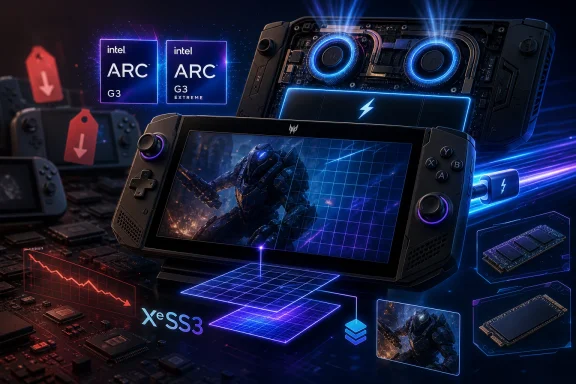
Intel on Thursday introduced Arc G3 and Arc G3 Extreme, two Panther Lake-based processors for Windows 11 gaming handhelds, with Acer’s Predator Atlas 8, MSI’s Claw 8 EX AI+, and OneXPlayer devices named as early hardware partners arriving in the coming months. The move is less a routine chip launch than Intel’s latest attempt to make Windows handhelds feel like a first-class PC category instead of a collection of clever compromises. AMD has owned that conversation because it showed up early, shipped into desirable devices, and benefited from a simple message: console-like portability with PC flexibility. Intel is now arguing that the next phase will be decided not just by frames per second, but by batteries, drivers, upscaling, ports, and whether Windows 11 can stop acting like a desktop OS trapped in a gamepad shell.
For years, Intel’s presence in PC gaming handhelds has felt incidental. Its chips powered some devices, and the MSI Claw gave the company a visible platform, but AMD’s Ryzen Z-series parts became the default language of the category. The Steam Deck set the cultural baseline, Asus expanded the premium Windows tier, Lenovo pushed into detachable-controller weirdness, and Intel mostly looked like a company waiting for the market to become large enough to justify a tailored answer.
Arc G-Series is that answer, at least on paper. Intel is not merely saying that a laptop chip can fit inside a handheld chassis if the thermal envelope is forgiving enough. It is branding a handheld-first product family, giving OEMs a clearer platform, and tying the launch to Panther Lake, Intel 18A, Xe graphics, Wi-Fi 7, Bluetooth 6, Thunderbolt 4, and Day-0 game-driver support.
That matters because handheld PCs are no longer novelty machines for hobbyists willing to tolerate rough edges. They are becoming a mainstream buying decision for people who might otherwise purchase a console, a gaming laptop, or nothing at all. Once a category reaches that stage, platform discipline starts to matter more than raw enthusiasm.
Intel’s thesis is blunt: the Windows handheld market needs a second major silicon pole, and Intel wants that pole to be Arc-branded. The company is betting that its graphics brand, manufacturing story, and PC ecosystem relationships can offset AMD’s head start. Whether that becomes real competition depends on the parts Intel did not announce as much as the ones it did.
That core layout is overkill if all a handheld ever does is play a single game at a capped frame rate. But Windows handhelds are not closed consoles. They run launchers, overlays, anti-cheat, cloud sync tools, capture utilities, storefronts, Discord, browsers, and occasionally a full desktop workload when the owner docks the device.
That is the quiet reason Intel’s design could make sense. A handheld chip has to survive both gaming and the messiness of Windows. AMD’s APUs have handled that job well, but Intel is arguing that a more explicitly tiered CPU design can keep background work from stealing too much power from the GPU.
The graphics split is more straightforward. Arc G3 uses integrated Arc B370 graphics with 10 Xe cores, while Arc G3 Extreme steps up to Arc B390 graphics with 12 Xe cores. Those numbers will not mean much to buyers walking through a store, but they tell enthusiasts that Intel is not hiding a token iGPU behind a gaming badge. This is the company bringing its modern Arc architecture into the smallest and most thermally constrained gaming PC form factor.
The problem is that handheld performance is won in the gray areas. A benchmark at 30 watts tells only part of the story if the device becomes loud, hot, or expensive. A great 1080p result means less if the battery drains before a commute ends. Intel’s announcement is a credible architectural pitch, not proof of a better handheld.
That is why Intel’s Cyberpunk 2077 demonstration is both impressive and incomplete. A Panther Lake laptop reportedly reaching up to 170 frames per second with XeSS 3 says something about the upside of the graphics architecture and software stack. It does not say what a shipping handheld will deliver at sane power limits, on battery, after twenty minutes of heat soak, in a living room full of wireless interference.
Still, upscaling is not a gimmick in this class of device. It is the technology that makes modern handheld PC gaming viable at all. Steam Deck owners already understand the trade: render lower, reconstruct intelligently, cap frames, and preserve battery. Intel is entering a market where players are more tolerant of tuned settings than desktop purists, as long as the end result feels consistent.
The challenge for Intel is game coverage. AMD benefits from a larger installed base in handheld PCs and broad support for its own technologies, while Nvidia owns much of the high-end mindshare around frame generation on laptops and desktops. Intel needs XeSS 3 to be more than a demo-stage advantage. It needs it to appear where handheld owners actually spend their time: big single-player releases, live-service games, emulation front ends, and older PC titles that were never designed for tiny screens.
Day-0 driver support is therefore not a throwaway line. It is the hinge of the whole launch. Handheld buyers forgive a lot when a device is cheaper, novel, or clearly experimental. They forgive less when a new game stutters, crashes, or launches with missing graphics options on a premium device that promised console-like convenience.
The 80Wh battery is the more revealing specification. That is a laptop-sized battery in a handheld body, and it signals that Acer does not expect magic from silicon alone. If users want high refresh rates, modern games, wireless networking, fast storage, and Windows overhead, physics still demands a large energy reservoir.
Acer is also using two fans, including one described as metal, which suggests the Atlas 8 is chasing sustained performance rather than a thin-and-quiet illusion. That is the right instinct for a Windows handheld. The wrong instinct would be to design around a few short benchmark runs and let real users discover that the device throttles after the first boss fight.
The Atlas 8 also includes two Thunderbolt 4 ports and a UHS-II microSD card reader, which may sound like spec-sheet filler but matters in practice. Thunderbolt turns a handheld into a dockable PC with serious expansion potential. Fast removable storage matters when modern games treat 100GB installs as routine rather than exceptional.
But every premium feature pushes Acer toward the trap that has haunted Windows handhelds since the first wave of Aya Neo and GPD devices: price. The more a handheld resembles a tiny gaming laptop, the harder it becomes to sell against an actual gaming laptop. If the Atlas 8 lands near laptop pricing, Intel’s technical win may become a niche enthusiast product rather than a category-shifting moment.
The Steam Deck is the center of that gravity even though it is not a Windows handheld by default. Valve made the category legible. It proved that players would accept lower settings, Linux compatibility layers, and a non-traditional PC interface if the overall experience felt coherent. That coherence gave AMD a halo because AMD silicon powered the device that made handheld PC gaming feel real.
Windows handhelds then borrowed the dream but inherited the mess. Asus, Lenovo, MSI, and others built more powerful machines with brighter screens, faster chips, and wider game compatibility. They also shipped devices that depended on custom launchers, firmware updates, driver packages, and user patience to paper over the fact that Windows 11 was not designed around thumbsticks.
That is where Intel’s road gets difficult. A faster or more efficient chip will not automatically fix Windows handheld friction. If a player has to tap through tiny dialog boxes, fight update prompts, and troubleshoot sleep behavior, the silicon vendor gets only partial credit for success and plenty of blame for failure.
Microsoft’s deeper push into handheld gaming, including Xbox-branded PC handheld partnerships, makes the timing more interesting. Intel is entering just as Windows handhelds are searching for a more console-like software layer. If Microsoft can improve the front-end experience and Intel can improve the silicon consistency, the Windows side of the market becomes more credible. If either half underdelivers, AMD’s existing lead becomes harder to shake.
Valve’s reported Steam Deck OLED price hike is a warning flare for the whole category. When even the company with the most mature handheld PC supply chain has to raise prices sharply, newer Windows devices with premium screens, large batteries, and cutting-edge processors face an even harder equation. The economics of handheld gaming are not immune to the same supply shocks hitting laptops, desktops, and data center hardware.
This is especially dangerous for Intel’s launch narrative. A new platform can survive being expensive if it is clearly faster, quieter, longer-lasting, or more versatile. It struggles if buyers see only a high price, uncertain benchmarks, and the promise of future driver maturity.
The Acer Predator Atlas 8’s configurable 24GB LPDDR5x memory and up to 1TB NVMe storage sound appropriate for a high-end Windows handheld. They also sound like the ingredients of a device that will not be cheap. Enthusiasts may accept that. Mainstream buyers comparing it to a console, Steam Deck, or discounted gaming laptop may not.
Intel and its partners therefore need to be careful with the word “handheld.” The form factor suggests portability and convenience, but the bill of materials increasingly suggests premium PC economics. If the category drifts too far upward, it risks becoming a boutique market for people who already own better gaming hardware.
That contradiction defines Windows handhelds. Their appeal is that they run almost everything. Their frustration is that “everything” includes installer pop-ups, launchers, anti-cheat services, driver utilities, and control schemes that assume a desk.
Intel can help by delivering better power management, graphics drivers, connectivity, and dockability. OEMs can help with control layers, quick settings, thermal profiles, and sensible default performance modes. Microsoft has to do the harder work of making the operating system feel less like a workaround.
The best version of this future is not a Windows device that pretends to be a console all the time. It is a Windows device that knows when to hide the desktop and when to expose it. A handheld should boot into a game-friendly shell, resume reliably, update predictably, and still become a real PC when docked.
That is the value proposition Intel is implicitly chasing with Thunderbolt, Wi-Fi 7, Bluetooth 6, and a real CPU core mix. The Arc G-Series handheld is not just a game machine. It is a pocketable PC that wants to be dock, couch, airplane, hotel-room, and desktop-adjacent hardware all at once. That ambition is compelling, but it raises the standard for polish.
That history follows Arc G-Series into handhelds. Gaming handheld owners are not patient in the same way desktop tinkerers can be patient. A desktop user may swap drivers, test overlays, and compare frametime graphs. A handheld user often wants to press a button and play in bed.
Intel’s promise of ongoing Day-0 driver support is therefore a strategic necessity. New game launches are social events, and the first week of performance discourse shapes buyer perception. If Arc G3 handhelds become known as devices that need a few patches before major releases behave, AMD will not need to win every benchmark.
The flip side is that handhelds may be an ideal proving ground for Intel’s maturing graphics stack. The target resolutions are lower, upscaling is expected, and users already tune power profiles. If Intel can deliver consistent frametimes and good battery behavior in that environment, Arc’s image improves beyond the handheld market.
This is why independent testing will matter more than announcement slides. Buyers need to see battery life at 15 watts, 20 watts, and 28 watts. They need frametime graphs, fan noise readings, suspend-and-resume behavior, docked performance, driver update cadence, and compatibility with the messy long tail of PC games. Intel has made a platform claim; reviewers now have to test it as a platform.
For Intel, the first goal is breadth. Acer, MSI, and OneXPlayer give the company recognizable partners across mainstream gaming, established Windows handheld experimentation, and enthusiast portable PC design. That is a stronger opening lineup than a single showcase device.
The second goal is differentiation. If every Arc G-Series handheld looks like an 8-inch black slab with similar controls, similar thermals, similar battery life, and a premium price, Intel’s platform will blur into the rest of the Windows handheld pile. The market needs distinct answers: one device tuned for price, one for performance, one for dockability, one for battery life, and perhaps one that finally treats ergonomics as more than an afterthought.
The third goal is humility. Intel should avoid declaring victory over AMD before public benchmarks exist. The handheld community is unusually good at exposing weak claims because users test everything: fan curves, BIOS updates, Linux support, emulation, frame pacing, USB-C docks, charger compatibility, and sleep drain. Marketing claims survive only until the first spreadsheet lands.
Computex will also show whether AMD has to respond immediately or simply keep executing. AMD does not need to panic if Intel’s first wave is expensive and supply-limited. It does need to pay attention if Intel delivers comparable battery life, stronger upscaling, better docked expansion, and OEM enthusiasm in the same generation.
Valve attacked the problem by controlling the software experience and accepting hardware limits. Windows OEMs attacked it by shipping more powerful hardware and leaning on compatibility. Intel is now attacking it by trying to provide a more purpose-built silicon foundation for the Windows side.
Those strategies are not mutually exclusive, and the eventual winner may be the company that blends them best. A great handheld needs efficient silicon, a comfortable body, a bright and sensible display, stable drivers, good suspend behavior, a coherent launcher, fair pricing, and enough battery to make portability meaningful. Remove any two of those and the whole product starts to feel compromised.
Intel’s entrance raises the competitive floor. AMD can no longer assume that Windows handheld OEMs will default to Ryzen by inertia. Microsoft has more reason to optimize Windows handheld behavior across multiple silicon vendors. OEMs gain leverage in negotiations and more design options.
But platform wars are won by defaults. Steam Deck became the default recommendation because it was understandable. Asus ROG Ally became a default Windows alternative because it was visible, powerful, and retail-friendly. Intel’s Arc G-Series devices need that kind of clarity. “Panther Lake-based Arc G3 Extreme with B390 graphics” is not a consumer story. “This runs your PC games smoothly for longer and costs less than a gaming laptop” might be.
A $599 handheld with decent 800p performance is judged generously. A $999 handheld with strong 1080p performance faces a harsher audience. A $1,399 handheld, if pricing ever drifts that high, is fighting gaming laptops, desktops, consoles, tablets, and the buyer’s own sense of sanity.
Battery life is just as decisive. Intel’s claim that gamers will not need to trade battery life for graphics is exactly the kind of sentence that invites scrutiny. Every handheld makes tradeoffs. The question is whether those tradeoffs feel intelligently managed or hidden behind marketing.
The Atlas 8’s 80Wh battery gives Acer room to deliver impressive runtimes, but it may also increase weight and cost. Two fans could sustain performance, but they could also make the device louder. A 120Hz display is excellent for smoothness, but only if the chip can feed it or variable refresh rate can mask the gaps.
This is why the first reviews will shape the whole Arc G-Series story. If the Atlas 8 delivers strong battery life and quiet performance, Intel will look like it has finally found a gaming form factor where its hybrid architecture and graphics ambitions converge. If it ships hot, expensive, or driver-sensitive, the launch becomes another reminder that handheld PCs punish overconfidence.
 Intel Finally Stops Treating Handheld Gaming as a Side Quest
For years, Intel’s presence in PC gaming handhelds has felt incidental. Its chips powered some devices, and the MSI Claw gave the company a visible platform, but AMD’s Ryzen Z-series parts became the default language of the category. The Steam Deck set the cultural baseline, Asus expanded the premium Windows tier, Lenovo pushed into detachable-controller weirdness, and Intel mostly looked like a company waiting for the market to become large enough to justify a tailored answer.Arc G-Series is that answer, at least on paper. Intel is not merely saying that a laptop chip can fit inside a handheld chassis if the thermal envelope is forgiving enough. It is branding a handheld-first product family, giving OEMs a clearer platform, and tying the launch to Panther Lake, Intel 18A, Xe graphics, Wi-Fi 7, Bluetooth 6, Thunderbolt 4, and Day-0 game-driver support.
That matters because handheld PCs are no longer novelty machines for hobbyists willing to tolerate rough edges. They are becoming a mainstream buying decision for people who might otherwise purchase a console, a gaming laptop, or nothing at all. Once a category reaches that stage, platform discipline starts to matter more than raw enthusiasm.
Intel’s thesis is blunt: the Windows handheld market needs a second major silicon pole, and Intel wants that pole to be Arc-branded. The company is betting that its graphics brand, manufacturing story, and PC ecosystem relationships can offset AMD’s head start. Whether that becomes real competition depends on the parts Intel did not announce as much as the ones it did.
Panther Lake Gives Intel a Cleaner Handheld Story
The Arc G3 and Arc G3 Extreme are built around a 14-core CPU layout that reflects the current Intel strategy of splitting work across different classes of cores. Each chip has two performance cores for bursty foreground tasks, eight efficient cores for heavier threaded work, and four low-power efficient cores for lighter background and everyday computing. Intel is claiming peak clocks around the mid-4GHz range, with the Extreme variant slightly higher on paper.That core layout is overkill if all a handheld ever does is play a single game at a capped frame rate. But Windows handhelds are not closed consoles. They run launchers, overlays, anti-cheat, cloud sync tools, capture utilities, storefronts, Discord, browsers, and occasionally a full desktop workload when the owner docks the device.
That is the quiet reason Intel’s design could make sense. A handheld chip has to survive both gaming and the messiness of Windows. AMD’s APUs have handled that job well, but Intel is arguing that a more explicitly tiered CPU design can keep background work from stealing too much power from the GPU.
The graphics split is more straightforward. Arc G3 uses integrated Arc B370 graphics with 10 Xe cores, while Arc G3 Extreme steps up to Arc B390 graphics with 12 Xe cores. Those numbers will not mean much to buyers walking through a store, but they tell enthusiasts that Intel is not hiding a token iGPU behind a gaming badge. This is the company bringing its modern Arc architecture into the smallest and most thermally constrained gaming PC form factor.
The problem is that handheld performance is won in the gray areas. A benchmark at 30 watts tells only part of the story if the device becomes loud, hot, or expensive. A great 1080p result means less if the battery drains before a commute ends. Intel’s announcement is a credible architectural pitch, not proof of a better handheld.
XeSS 3 Is the Frame-Rate Multiplier Intel Needs
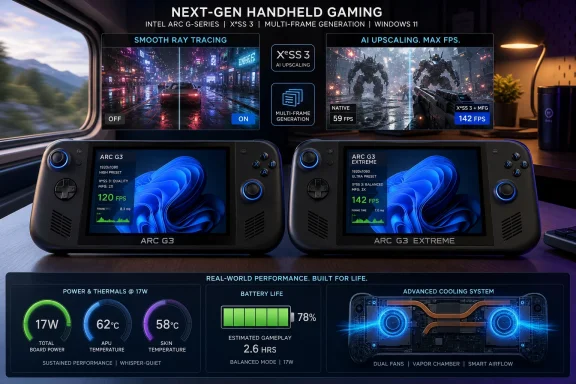
Intel’s most important gaming claim may not be native rendering performance at all. XeSS 3, the company’s latest version of its upscaling and frame-generation technology, is central to the Arc G-Series pitch because handhelds live in the gap between what players want and what tiny batteries can sustain. If Intel can make more games feel smooth without forcing the GPU to brute-force every pixel, it has a path to competing above its thermal weight.That is why Intel’s Cyberpunk 2077 demonstration is both impressive and incomplete. A Panther Lake laptop reportedly reaching up to 170 frames per second with XeSS 3 says something about the upside of the graphics architecture and software stack. It does not say what a shipping handheld will deliver at sane power limits, on battery, after twenty minutes of heat soak, in a living room full of wireless interference.
Still, upscaling is not a gimmick in this class of device. It is the technology that makes modern handheld PC gaming viable at all. Steam Deck owners already understand the trade: render lower, reconstruct intelligently, cap frames, and preserve battery. Intel is entering a market where players are more tolerant of tuned settings than desktop purists, as long as the end result feels consistent.
The challenge for Intel is game coverage. AMD benefits from a larger installed base in handheld PCs and broad support for its own technologies, while Nvidia owns much of the high-end mindshare around frame generation on laptops and desktops. Intel needs XeSS 3 to be more than a demo-stage advantage. It needs it to appear where handheld owners actually spend their time: big single-player releases, live-service games, emulation front ends, and older PC titles that were never designed for tiny screens.
Day-0 driver support is therefore not a throwaway line. It is the hinge of the whole launch. Handheld buyers forgive a lot when a device is cheaper, novel, or clearly experimental. They forgive less when a new game stutters, crashes, or launches with missing graphics options on a premium device that promised console-like convenience.
Acer’s Predator Atlas 8 Shows the Real Shape of the Bet
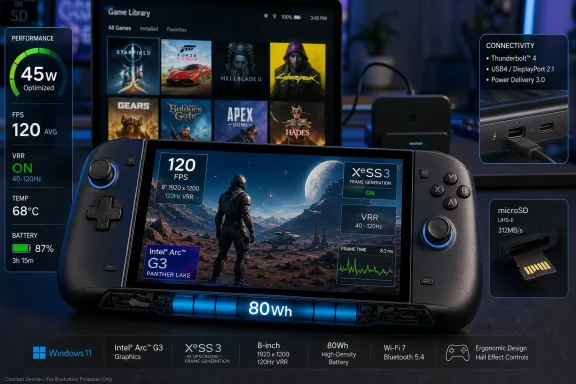
The Acer Predator Atlas 8 is the first concrete expression of Intel’s Arc G-Series ambitions, and it looks like exactly the sort of machine that reveals both the promise and the danger of this category. An 8-inch, 120Hz, 1920-by-1200 display with variable refresh rate support sounds like a sensible target for a premium Windows handheld. It is sharper than the Steam Deck’s screen, smoother than older 60Hz panels, and large enough to make desktop interfaces less absurd.The 80Wh battery is the more revealing specification. That is a laptop-sized battery in a handheld body, and it signals that Acer does not expect magic from silicon alone. If users want high refresh rates, modern games, wireless networking, fast storage, and Windows overhead, physics still demands a large energy reservoir.
Acer is also using two fans, including one described as metal, which suggests the Atlas 8 is chasing sustained performance rather than a thin-and-quiet illusion. That is the right instinct for a Windows handheld. The wrong instinct would be to design around a few short benchmark runs and let real users discover that the device throttles after the first boss fight.
The Atlas 8 also includes two Thunderbolt 4 ports and a UHS-II microSD card reader, which may sound like spec-sheet filler but matters in practice. Thunderbolt turns a handheld into a dockable PC with serious expansion potential. Fast removable storage matters when modern games treat 100GB installs as routine rather than exceptional.
But every premium feature pushes Acer toward the trap that has haunted Windows handhelds since the first wave of Aya Neo and GPD devices: price. The more a handheld resembles a tiny gaming laptop, the harder it becomes to sell against an actual gaming laptop. If the Atlas 8 lands near laptop pricing, Intel’s technical win may become a niche enthusiast product rather than a category-shifting moment.
AMD’s Lead Is Not Just Silicon
Intel’s obvious target is AMD, but AMD’s advantage is not reducible to a few Ryzen Z-series SKUs. AMD has benefited from a feedback loop. More handhelds use its chips, which means more reviewers test against AMD baselines, more users share tuning advice, more accessory makers design around those devices, and more game performance expectations are shaped by AMD-powered systems.The Steam Deck is the center of that gravity even though it is not a Windows handheld by default. Valve made the category legible. It proved that players would accept lower settings, Linux compatibility layers, and a non-traditional PC interface if the overall experience felt coherent. That coherence gave AMD a halo because AMD silicon powered the device that made handheld PC gaming feel real.
Windows handhelds then borrowed the dream but inherited the mess. Asus, Lenovo, MSI, and others built more powerful machines with brighter screens, faster chips, and wider game compatibility. They also shipped devices that depended on custom launchers, firmware updates, driver packages, and user patience to paper over the fact that Windows 11 was not designed around thumbsticks.
That is where Intel’s road gets difficult. A faster or more efficient chip will not automatically fix Windows handheld friction. If a player has to tap through tiny dialog boxes, fight update prompts, and troubleshoot sleep behavior, the silicon vendor gets only partial credit for success and plenty of blame for failure.
Microsoft’s deeper push into handheld gaming, including Xbox-branded PC handheld partnerships, makes the timing more interesting. Intel is entering just as Windows handhelds are searching for a more console-like software layer. If Microsoft can improve the front-end experience and Intel can improve the silicon consistency, the Windows side of the market becomes more credible. If either half underdelivers, AMD’s existing lead becomes harder to shake.
The Memory Crunch Makes Every Handheld More Expensive
The Arc G-Series launch is arriving into an ugly hardware market. Memory pricing has become a visible pressure point across consumer electronics, driven in large part by AI demand for high-bandwidth and advanced memory supply. That matters because handheld PCs are memory-sensitive devices: system RAM feeds the CPU, integrated GPU, background Windows processes, and games.Valve’s reported Steam Deck OLED price hike is a warning flare for the whole category. When even the company with the most mature handheld PC supply chain has to raise prices sharply, newer Windows devices with premium screens, large batteries, and cutting-edge processors face an even harder equation. The economics of handheld gaming are not immune to the same supply shocks hitting laptops, desktops, and data center hardware.
This is especially dangerous for Intel’s launch narrative. A new platform can survive being expensive if it is clearly faster, quieter, longer-lasting, or more versatile. It struggles if buyers see only a high price, uncertain benchmarks, and the promise of future driver maturity.
The Acer Predator Atlas 8’s configurable 24GB LPDDR5x memory and up to 1TB NVMe storage sound appropriate for a high-end Windows handheld. They also sound like the ingredients of a device that will not be cheap. Enthusiasts may accept that. Mainstream buyers comparing it to a console, Steam Deck, or discounted gaming laptop may not.
Intel and its partners therefore need to be careful with the word “handheld.” The form factor suggests portability and convenience, but the bill of materials increasingly suggests premium PC economics. If the category drifts too far upward, it risks becoming a boutique market for people who already own better gaming hardware.
Windows 11 Remains the Unfinished Handheld Platform
The awkward truth is that Intel’s new chips may be arriving before Windows handheld software has fully caught up. Windows 11 is powerful, familiar, and compatible with more games than any console operating system. It is also still a desktop OS whose default assumptions are keyboard, mouse, window chrome, background services, and decades of accumulated UI behavior.That contradiction defines Windows handhelds. Their appeal is that they run almost everything. Their frustration is that “everything” includes installer pop-ups, launchers, anti-cheat services, driver utilities, and control schemes that assume a desk.
Intel can help by delivering better power management, graphics drivers, connectivity, and dockability. OEMs can help with control layers, quick settings, thermal profiles, and sensible default performance modes. Microsoft has to do the harder work of making the operating system feel less like a workaround.
The best version of this future is not a Windows device that pretends to be a console all the time. It is a Windows device that knows when to hide the desktop and when to expose it. A handheld should boot into a game-friendly shell, resume reliably, update predictably, and still become a real PC when docked.
That is the value proposition Intel is implicitly chasing with Thunderbolt, Wi-Fi 7, Bluetooth 6, and a real CPU core mix. The Arc G-Series handheld is not just a game machine. It is a pocketable PC that wants to be dock, couch, airplane, hotel-room, and desktop-adjacent hardware all at once. That ambition is compelling, but it raises the standard for polish.
Intel’s Driver Promise Carries the Weight of Arc’s Reputation
Intel’s Arc graphics journey has been defined by improvement under pressure. Early Arc desktop GPUs suffered from uneven game compatibility and driver immaturity, especially in older DirectX titles. Over time, Intel’s driver team delivered meaningful gains, but the reputation tax never disappeared entirely.That history follows Arc G-Series into handhelds. Gaming handheld owners are not patient in the same way desktop tinkerers can be patient. A desktop user may swap drivers, test overlays, and compare frametime graphs. A handheld user often wants to press a button and play in bed.
Intel’s promise of ongoing Day-0 driver support is therefore a strategic necessity. New game launches are social events, and the first week of performance discourse shapes buyer perception. If Arc G3 handhelds become known as devices that need a few patches before major releases behave, AMD will not need to win every benchmark.
The flip side is that handhelds may be an ideal proving ground for Intel’s maturing graphics stack. The target resolutions are lower, upscaling is expected, and users already tune power profiles. If Intel can deliver consistent frametimes and good battery behavior in that environment, Arc’s image improves beyond the handheld market.
This is why independent testing will matter more than announcement slides. Buyers need to see battery life at 15 watts, 20 watts, and 28 watts. They need frametime graphs, fan noise readings, suspend-and-resume behavior, docked performance, driver update cadence, and compatibility with the messy long tail of PC games. Intel has made a platform claim; reviewers now have to test it as a platform.
Computex Becomes the First Real Trial
Intel says more details will come at Computex in Taipei, and that timing is not accidental. Computex is where PC companies turn component announcements into ecosystems. A chip by itself is a promise; a wall of devices makes it feel inevitable.For Intel, the first goal is breadth. Acer, MSI, and OneXPlayer give the company recognizable partners across mainstream gaming, established Windows handheld experimentation, and enthusiast portable PC design. That is a stronger opening lineup than a single showcase device.
The second goal is differentiation. If every Arc G-Series handheld looks like an 8-inch black slab with similar controls, similar thermals, similar battery life, and a premium price, Intel’s platform will blur into the rest of the Windows handheld pile. The market needs distinct answers: one device tuned for price, one for performance, one for dockability, one for battery life, and perhaps one that finally treats ergonomics as more than an afterthought.
The third goal is humility. Intel should avoid declaring victory over AMD before public benchmarks exist. The handheld community is unusually good at exposing weak claims because users test everything: fan curves, BIOS updates, Linux support, emulation, frame pacing, USB-C docks, charger compatibility, and sleep drain. Marketing claims survive only until the first spreadsheet lands.
Computex will also show whether AMD has to respond immediately or simply keep executing. AMD does not need to panic if Intel’s first wave is expensive and supply-limited. It does need to pay attention if Intel delivers comparable battery life, stronger upscaling, better docked expansion, and OEM enthusiasm in the same generation.
The Handheld PC Is Becoming a Real Platform War
The most interesting thing about Arc G-Series is that it treats handheld gaming as a platform war rather than a gadget trend. That is the correct read. The category now sits at the intersection of console habits, PC libraries, laptop components, cloud saves, subscription services, and living-room expectations.Valve attacked the problem by controlling the software experience and accepting hardware limits. Windows OEMs attacked it by shipping more powerful hardware and leaning on compatibility. Intel is now attacking it by trying to provide a more purpose-built silicon foundation for the Windows side.
Those strategies are not mutually exclusive, and the eventual winner may be the company that blends them best. A great handheld needs efficient silicon, a comfortable body, a bright and sensible display, stable drivers, good suspend behavior, a coherent launcher, fair pricing, and enough battery to make portability meaningful. Remove any two of those and the whole product starts to feel compromised.
Intel’s entrance raises the competitive floor. AMD can no longer assume that Windows handheld OEMs will default to Ryzen by inertia. Microsoft has more reason to optimize Windows handheld behavior across multiple silicon vendors. OEMs gain leverage in negotiations and more design options.
But platform wars are won by defaults. Steam Deck became the default recommendation because it was understandable. Asus ROG Ally became a default Windows alternative because it was visible, powerful, and retail-friendly. Intel’s Arc G-Series devices need that kind of clarity. “Panther Lake-based Arc G3 Extreme with B390 graphics” is not a consumer story. “This runs your PC games smoothly for longer and costs less than a gaming laptop” might be.
The Atlas 8 Will Be Judged by the Things Intel Did Not Announce
No benchmarks were released. No pricing was released. Those omissions are normal for a pre-Computex platform announcement, but they are not minor. In the handheld market, performance and price are not separate questions; they are the same question expressed from different directions.A $599 handheld with decent 800p performance is judged generously. A $999 handheld with strong 1080p performance faces a harsher audience. A $1,399 handheld, if pricing ever drifts that high, is fighting gaming laptops, desktops, consoles, tablets, and the buyer’s own sense of sanity.
Battery life is just as decisive. Intel’s claim that gamers will not need to trade battery life for graphics is exactly the kind of sentence that invites scrutiny. Every handheld makes tradeoffs. The question is whether those tradeoffs feel intelligently managed or hidden behind marketing.
The Atlas 8’s 80Wh battery gives Acer room to deliver impressive runtimes, but it may also increase weight and cost. Two fans could sustain performance, but they could also make the device louder. A 120Hz display is excellent for smoothness, but only if the chip can feed it or variable refresh rate can mask the gaps.
This is why the first reviews will shape the whole Arc G-Series story. If the Atlas 8 delivers strong battery life and quiet performance, Intel will look like it has finally found a gaming form factor where its hybrid architecture and graphics ambitions converge. If it ships hot, expensive, or driver-sensitive, the launch becomes another reminder that handheld PCs punish overconfidence.
The First Arc Handhelds Will Tell Us Whether Windows Can Travel Light
Intel’s announcement gives the Windows handheld market a needed jolt, but it does not settle the argument. The concrete facts are promising, and the unanswered questions are large enough to determine whether Arc G-Series becomes a genuine AMD challenger or another interesting branch in a fragmented device tree.- Intel has introduced Arc G3 and Arc G3 Extreme as Panther Lake-based processors aimed specifically at Windows 11 gaming handhelds.
- The chips pair a 14-core hybrid CPU design with Arc B370 or Arc B390 integrated graphics, depending on the model.
- Acer’s Predator Atlas 8 is the headline launch device, with an 8-inch 120Hz display, an 80Wh battery, Thunderbolt 4 ports, and configurations up to 24GB of LPDDR5x memory.
- MSI’s Claw 8 EX AI+ and OneXPlayer devices are also expected to adopt the new Intel handheld platform.
- Intel’s claims around XeSS 3, battery life, and Day-0 driver support will need independent testing before buyers can treat them as more than launch positioning.
- Pricing may become the category’s hardest problem, especially as memory costs and broader supply pressures push portable gaming hardware upward.
References
- Primary source: PCMag
Published: Thu, 28 May 2026 15:10:40 GMT
Intel to Power Windows 11 Gaming Handhelds With Arc G-Series Chips | PCMag
The Arc G-Series is heading to Acer's new Windows-based Predator Atlas 8 handheld. MSI and OneXPlayer plan on adopting the chips, too.www.pcmag.com - Related coverage: gamesradar.com
The first Intel Arc G3 handhelds could emerge tomorrow, including an Acer portable I'd deemed vaporware | GamesRadar+
Leaks suggest Intel will unveil its Arc G3 handheld lineup on May 28, and the expected MSI Claw sequel could be joined by a revitalised Acer Predator portable.www.gamesradar.com - Related coverage: tomshardware.com
Acer is reportedly working on a 'Predator Atlas 8' handheld featuring Intel's Arc G3 chips — Panther Lake-based handhelds expected to be revealed at Computex 2026 | Tom's Hardware
The Arc G3 series would compete directly against AMD's Ryzen Z2 platform.www.tomshardware.com - Related coverage: hothardware.com
Acer Predator Atlas 8 Handheld Packs Intel's New Arc G-Series Panther Lake Chips | HotHardware
Acer is one of the first out of the gate with a gaming handheld designed around Intel's new Arc G-Series system-on-chip silicon, which is basically Panther Lake ported to handhelds.hothardware.com
- Related coverage: newsroom.intel.com
Intel Arc G-Series Processors Set a New Standard for Handheld PC Gaming - Intel Newsroom
Intel® Arc™ G-Series processors combine leadership performance and power efficiency to deliver smooth, immersive gameplay with exceptional battery lifenewsroom.intel.com - Related coverage: notebookcheck.net
Acer launching new Windows handheld globally with Arc B390 graphics and 120 Hz display - Notebookcheck News
Acer has unveiled a new Windows handheld backed by a 120 Hz display and an 80 Wh battery. Featuring up to Intel Arc B390 graphics and 24 GB of RAM, the Predator Atlas 8 is confirmed to be releasing globally in 2026. www.notebookcheck.net
- Related coverage: phoronix.com
Intel Arc G-Series Processors Announced For Handheld Gaming Devices - Phoronix
Ahead of Computex, Intel today announced the introduction of the Arc G-Serieswww.phoronix.com
- Related coverage: pcworld.com
Acer’s new Intel gaming handheld picked a terrible time to show up | PCWorld
The Predator Atlas 8 would have made a lot more sense about a year ago.www.pcworld.com - Related coverage: techtimes.com
Intel Arc G3 Arrives Before Computex: First Dedicated Handheld Chip Challenges AMD Ryzen Z2
Intel Arc G3 and Arc G3 Extreme are the first chips designed exclusively for gaming handhelds, announced May 28 ahead of Computex 2026. Built on the Intel 18A process, the Arc G3 Extreme powers the MSI Claw 8 EX AI+ and Acer Predator Atlas 8, challenging AMD Ryzen Z2 devices with strong benchmark www.techtimes.com
- Related coverage: stuff.tv
Acer's Predator Atlas 8 gaming handheld is taking on the Steam Deck with Intel Arc power | Stuff
The 8in pocket rocket is one of the first with an Intel Arc G3 Extreme processor. Acer's Predator Atlas 8 has top triggers toowww.stuff.tv - Related coverage: spacemoney.com.br
Acer Predator Atlas 8 chega à Computex 2026 - SpaceMoney
Acer Predator Atlas 8 com Intel Arc G3 será apresentado na Computex 2026.www.spacemoney.com.br - Related coverage: pcgamer.com
Intel announces two Arc G-Series chips for handheld gaming PCs, promising 'seamless gaming experiences on the go' | PC Gamer
The G stands for "Grrrrr." Okay, I made that up.www.pcgamer.com - Related coverage: tomsguide.com
Intel Arc G3 is here to shake up handheld gaming, and AMD should be terrified — Acer Predator Atlas 8, a new MSI Claw and more launching soon | Tom's Guide
The rumors are true! Intel Arc G3 and G3 Extreme are here, and gaming handhelds will never be the same again. Here’s how they stack up against the competition.www.tomsguide.com - Related coverage: windowscentral.com
Here's everything announced for Windows 11 in June 2025 | Windows Central
Windows 11 is regularly updated as Microsoft modifies and expands its operating system with new features and apps, so I’m tracking the latest news as of June 2025.www.windowscentral.com - Related coverage: download.intel.com