

MSI unveiled the Claw 8 EX AI+ at Computex 2026 in Taipei on June 1, positioning the Windows 11 handheld as its next-generation premium portable gaming PC and the first announced gaming handheld built around Intel’s new Arc G3 Extreme processor. The announcement is more than another spec bump in a crowded category. It is MSI’s attempt to turn the Claw line from an early Intel experiment into a serious rival to AMD-powered handhelds. For Windows users, the real question is whether better silicon and an “Xbox Mode” can finally make handheld PC gaming feel less like a tiny laptop with thumbsticks.
The original MSI Claw arrived with a difficult job: prove that Intel could compete in a handheld PC market that had rapidly standardized around AMD Ryzen APUs. It was not enough for MSI to make a smaller gaming laptop. The company had to show that Intel’s graphics drivers, power management, and low-wattage performance could survive the brutal conditions of a handheld, where every frame competes with battery life, heat, noise, and ergonomics.
The Claw 8 EX AI+ is MSI’s answer to that first-generation skepticism. Instead of merely refreshing the chassis or tuning the software, MSI is leaning into a new Intel platform explicitly aimed at handheld gaming. That matters because the handheld PC market has matured past novelty; buyers now expect credible AAA performance, fast resume behavior, good thermals, and a console-like experience from hardware that still runs Windows.
The phrase “premium Windows 11 gaming handheld” carries a lot of baggage. Premium cannot simply mean a higher price, an aggressive color, and a bigger spec sheet. In this category, premium means fewer compromises between the PC games people already own and the console-like ease they increasingly expect.
That is the space MSI is trying to occupy with the Claw 8 EX AI+. It is not chasing the cheapest route into handheld PC gaming. It is betting that the next wave of buyers will pay for better graphics architecture, improved responsiveness, a larger 8-inch display, and controls that feel less like an afterthought.
A handheld chip has to deliver usable graphics performance at power levels where a gaming laptop would barely be stretching. It must scale down gracefully, avoid wild frame pacing, and cooperate with modern upscaling techniques. It also needs drivers that can handle the messy reality of PC game launchers, anti-cheat systems, shader compilation, sleep states, and game-specific quirks.
Intel’s pitch for Arc G3 Extreme centers on graphics improvement, power efficiency, high-frame-rate gaming, smoother responsiveness, and support for features such as XeSS 3 and Multi-Frame Generation. Those claims should be treated as claims until independent testing lands, but they show the strategic direction. Intel is not merely trying to match AMD frame-for-frame; it wants to use AI-assisted rendering and tighter platform design to make the handheld experience feel better than raw wattage alone would suggest.
For MSI, that is both opportunity and risk. If Arc G3 Extreme delivers, the Claw 8 EX AI+ could become the device that reframes Intel as a credible handheld gaming supplier. If it stumbles, MSI owns the most visible example of the stumble.
That is why MSI’s “Xbox Mode” reference matters almost as much as the processor. The company says the Claw 8 EX AI+ includes an intuitive Xbox Mode for quick game launching and seamless resuming of saved games. If that sounds like a software layer doing work the operating system itself should already do, that is because it is.
Windows handhelds have always had a contradiction at their center. They offer compatibility, launchers, mods, Game Pass, anti-cheat support, and access to the full PC ecosystem. But they also inherit Windows’ desktop assumptions: small UI targets, background services, update prompts, launcher sprawl, inconsistent controller navigation, and sleep behavior that can feel unpredictable compared with a console.
The emergence of Xbox-branded or Xbox-inspired modes is Microsoft’s tacit admission that Windows needs a handheld shell. MSI is not alone in reaching for that answer, but the Claw 8 EX AI+ shows how quickly the market is converging on the same idea: the hardware can be PC-like under the hood, but the front door has to feel like a console.
The 120Hz refresh rate is not just a marketing number. In a handheld, variable refresh rate can be more meaningful than chasing a locked high frame rate in every title. VRR helps smooth the experience when performance moves between thresholds, which is exactly what happens when a portable device balances battery, thermals, and game demands.
This is where Intel’s efficiency claims and MSI’s display choice meet. A 120Hz panel is only useful if the hardware can feed it often enough, or if VRR can make inconsistent frame rates feel less distracting. The best handheld gaming experiences are not always about maximum frames per second. They are about consistent pacing, fast response, and avoiding the jarring drops that make a game feel worse than the average FPS suggests.
MSI’s decision to emphasize smoothness and responsiveness is therefore the right language for the product. The mistake would be to sell this device as a pocket desktop replacement. The better pitch is that it can make demanding games feel believable on battery-powered hardware.
Hall-effect sticks and triggers are now a premium expectation because players have become more aware of drift, wear, and long-term reliability. In a handheld PC, replacing a controller is not as simple as buying another gamepad. The controls are the device, so durability and feel have direct consequences for ownership.
The D-pad matters for a different reason. Many Windows handhelds sell themselves on AAA games, but a large share of handheld play happens in platformers, fighting games, emulation, retro collections, and indie titles where D-pad precision is not optional. A bad D-pad can make a technically powerful handheld feel cheap within minutes.
The linear motor is another sign that handheld PCs are borrowing more from consoles and smartphones than laptops. Haptics are not a spec-sheet war in the same way as GPU cores, but they contribute to the feeling that a device has been designed as a gaming object rather than assembled from PC parts.
MSI’s announcement points to XeSS 3 and Multi-Frame Generation support, which places the Claw 8 EX AI+ in the same broad conversation as DLSS and FSR: use smarter reconstruction to make limited hardware punch above its native rendering weight. In a desktop tower, frame generation can be a luxury. In a handheld, it can be the difference between a game that feels borderline and one that feels comfortably playable.
The caveat is latency. Frame generation can improve perceived smoothness, but handheld gaming is especially sensitive to input response because the screen, controls, and player are physically fused into one object. MSI and Intel’s promise of improved responsiveness will need to survive real testing in twitchy games, not just cinematic benchmarks.
There is also the matter of game support. Upscaling ecosystems improve over time, but they are uneven across titles. A buyer should not assume that every game in a Steam library, Game Pass queue, or Epic backlog will benefit equally from XeSS 3 or Multi-Frame Generation. The technology is promising, but the user experience will depend on implementation, driver maturity, and per-game tuning.
But Windows also imposes friction that handheld makers keep trying to hide. On a desktop, a launcher update is mildly annoying. On a handheld, it can interrupt the illusion that the device is ready for quick play. On a laptop, a small dialog box is manageable. On an 8-inch screen controlled by sticks and touch, it can become a small act of penance.
This is why MSI’s Xbox Mode should not be dismissed as a minor feature. The industry knows Windows needs a gaming-first surface on handhelds. The deeper question is whether these shells can become integrated enough that users rarely fall through to the desktop during normal play.
For IT-minded readers, this also raises the manageability question. Windows handhelds are PCs, which means they inherit Windows security, updates, accounts, drivers, and administrative complexity. That can be an advantage for power users, but it also means the console dream is always one bad driver update away from becoming a support session.
The Void Purple finish is a small but telling choice. MSI wants this device to feel distinct, not merely like a black Windows tablet with controllers attached. Color and industrial design matter in a category where the hardware is visible in public, held for hours, and judged by touch as much as by benchmarks.
Still, the market will not grade MSI on color first. It will grade the Claw 8 EX AI+ on whether the price feels justified by performance, battery life, display quality, fan noise, build quality, software polish, and driver reliability. A premium handheld can survive being expensive. It cannot survive feeling unfinished.
That is the shadow cast by MSI’s first Claw generation. Early adopters can forgive ambition; they are less forgiving when the second act does not show lessons learned. The Claw 8 EX AI+ has to prove that MSI is not just iterating, but correcting.
The real test will not be whether the Claw 8 EX AI+ can run a demanding game at an impressive frame rate for a short demo. The test will be whether it can deliver a balanced profile that ordinary users actually choose: quiet enough, cool enough, smooth enough, and long-lasting enough to feel portable.
That balance is where handhelds separate themselves from laptops. A gaming laptop can brute force performance when plugged in. A handheld must be satisfying away from the wall, because portability is the product’s emotional promise.
If Intel’s Arc G3 Extreme can improve performance per watt, MSI gains room to tune the device more intelligently. If not, the Claw 8 EX AI+ risks becoming another premium handheld that performs well only when treated like a tiny plugged-in PC.
That broader lineup matters because MSI is presenting itself as a premium PC brand across categories: handheld gaming, extreme gaming laptops, and creator/productivity machines. The Claw 8 EX AI+ is therefore not a side project. It is part of MSI’s argument that AI-era PCs, gaming PCs, and portable devices are converging into a new tier of expensive, specialized hardware.
The Titan 18 HX Dragon Edition Draco Epic represents the old MSI confidence: big chassis, huge GPU, maximalist gaming identity. The Artisan Collection represents the industry’s current obsession with AI productivity and design-conscious laptops. The Claw 8 EX AI+ sits between those worlds, asking whether a handheld can carry the same premium halo without the same thermal or physical scale.
That is a difficult brand trick. Enthusiast laptops can justify excess because their size announces purpose. Handhelds must justify restraint. MSI has to convince buyers that the Claw 8 EX AI+ is powerful not because it is huge, but because its platform is better matched to its job.
That perception includes drivers. Intel’s Arc graphics have improved substantially over time, but handheld gaming punishes driver immaturity. A desktop user may tolerate occasional game-specific weirdness; a handheld buyer expects the device to wake, launch, and play. The more console-like the form factor, the less patience users have for PC-style troubleshooting.
If Arc G3 Extreme performs well, the competitive impact could be significant. More viable silicon suppliers mean more design diversity, more pricing pressure, and faster innovation. AMD would no longer be the default answer for every serious Windows handheld.
But Intel does not get to win with one launch claim. It has to sustain driver updates, game compatibility, power profiles, and OEM support after reviews publish and early adopters move on. The handheld market is full of users who compare firmware notes, BIOS updates, TDP profiles, and real-world battery charts. Marketing fades quickly in that crowd.
An Xbox-style interface on third-party Windows handhelds gives Microsoft a way to shape the experience without manufacturing every device. If it works, Windows handhelds become more approachable, Game Pass becomes more visible, and Microsoft gets a console-like surface on hardware built by partners. If it fails, users will blame both the OEM and Windows.
For MSI, Xbox Mode is a practical necessity. The Claw 8 EX AI+ cannot rely on raw Windows alone, because raw Windows is still too mouse-and-keyboard-minded for a handheld-first experience. Quick game launching and seamless resume are not luxuries in this market; they are table stakes borrowed from consoles and the Steam Deck.
The challenge is that “mode” can mean many things. It can be a deep shell that controls power, input, library management, notifications, and resume behavior. Or it can be a friendlier launcher sitting on top of the same old desktop. The closer MSI and Microsoft get to the former, the stronger the Claw 8 EX AI+ becomes.
The same is true for performance profiles. Handheld users increasingly expect granular control over TDP, fan curves, frame caps, resolution scaling, and per-game presets. A device can have impressive hardware and still disappoint if its control software is clumsy.
MSI’s Center M software on previous Claw models was part of that story, and the company will need to show polish here. The best handheld management tools make power tuning understandable without burying users in laptop-style utilities. The worst ones remind everyone that Windows handhelds are still stitched together from several software layers.
There is also a support angle. Premium buyers expect firmware updates, driver cadence, and clear communication. If MSI wants the Claw 8 EX AI+ to be a flagship, it must treat post-launch support as part of the product, not as cleanup.
If it succeeds, it will validate a model where Windows handhelds are not merely portable PCs, but curated gaming devices with specialized silicon, console-like shells, and AI-assisted rendering. That would make the category more credible to mainstream buyers who like PC game libraries but do not want PC maintenance rituals.
If it falls short, it will reinforce the argument that Windows remains too heavy, too inconsistent, or too desktop-bound for truly seamless handheld play. That would not kill the category, but it would keep it tilted toward enthusiasts willing to tweak settings and forgive rough edges.
For WindowsForum readers, the interest is broader than one MSI device. This is a preview of where Windows client computing is being stretched: smaller screens, controller-first navigation, AI rendering, platform-specific silicon, and a renewed fight over whether Windows can be made to feel appliance-like without losing its PC identity.
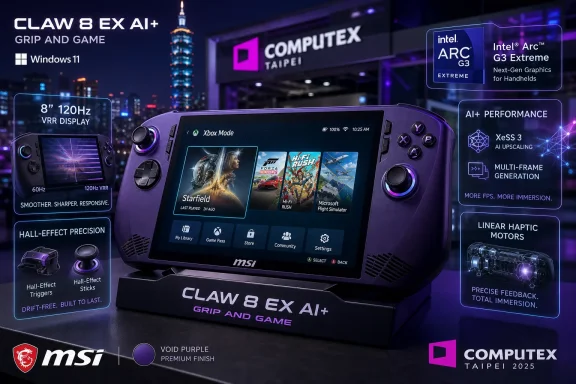 MSI Is No Longer Just Defending the First Claw
The original MSI Claw arrived with a difficult job: prove that Intel could compete in a handheld PC market that had rapidly standardized around AMD Ryzen APUs. It was not enough for MSI to make a smaller gaming laptop. The company had to show that Intel’s graphics drivers, power management, and low-wattage performance could survive the brutal conditions of a handheld, where every frame competes with battery life, heat, noise, and ergonomics.The Claw 8 EX AI+ is MSI’s answer to that first-generation skepticism. Instead of merely refreshing the chassis or tuning the software, MSI is leaning into a new Intel platform explicitly aimed at handheld gaming. That matters because the handheld PC market has matured past novelty; buyers now expect credible AAA performance, fast resume behavior, good thermals, and a console-like experience from hardware that still runs Windows.
The phrase “premium Windows 11 gaming handheld” carries a lot of baggage. Premium cannot simply mean a higher price, an aggressive color, and a bigger spec sheet. In this category, premium means fewer compromises between the PC games people already own and the console-like ease they increasingly expect.
That is the space MSI is trying to occupy with the Claw 8 EX AI+. It is not chasing the cheapest route into handheld PC gaming. It is betting that the next wave of buyers will pay for better graphics architecture, improved responsiveness, a larger 8-inch display, and controls that feel less like an afterthought.
Intel’s Arc G3 Extreme Is the Announcement Behind the Announcement
The headline feature is Intel Arc G3 Extreme, which MSI describes as the first Intel platform specifically optimized for handheld gaming. That wording is important. Intel has been in portable PCs forever, but handheld gaming PCs have a different set of constraints than ultrabooks, laptops, or mini PCs.A handheld chip has to deliver usable graphics performance at power levels where a gaming laptop would barely be stretching. It must scale down gracefully, avoid wild frame pacing, and cooperate with modern upscaling techniques. It also needs drivers that can handle the messy reality of PC game launchers, anti-cheat systems, shader compilation, sleep states, and game-specific quirks.
Intel’s pitch for Arc G3 Extreme centers on graphics improvement, power efficiency, high-frame-rate gaming, smoother responsiveness, and support for features such as XeSS 3 and Multi-Frame Generation. Those claims should be treated as claims until independent testing lands, but they show the strategic direction. Intel is not merely trying to match AMD frame-for-frame; it wants to use AI-assisted rendering and tighter platform design to make the handheld experience feel better than raw wattage alone would suggest.
For MSI, that is both opportunity and risk. If Arc G3 Extreme delivers, the Claw 8 EX AI+ could become the device that reframes Intel as a credible handheld gaming supplier. If it stumbles, MSI owns the most visible example of the stumble.
The Handheld Market Has Become a Platform War
The handheld PC market once looked like a niche for tinkerers. Valve’s Steam Deck changed that by proving that PC gaming could be made handheld-friendly if the operating environment was shaped around the use case. Since then, Windows handhelds from Asus, Lenovo, MSI, and others have chased the larger Windows game library while trying to patch over the fact that Windows was never designed first for thumbsticks and sleep-resume gaming.That is why MSI’s “Xbox Mode” reference matters almost as much as the processor. The company says the Claw 8 EX AI+ includes an intuitive Xbox Mode for quick game launching and seamless resuming of saved games. If that sounds like a software layer doing work the operating system itself should already do, that is because it is.
Windows handhelds have always had a contradiction at their center. They offer compatibility, launchers, mods, Game Pass, anti-cheat support, and access to the full PC ecosystem. But they also inherit Windows’ desktop assumptions: small UI targets, background services, update prompts, launcher sprawl, inconsistent controller navigation, and sleep behavior that can feel unpredictable compared with a console.
The emergence of Xbox-branded or Xbox-inspired modes is Microsoft’s tacit admission that Windows needs a handheld shell. MSI is not alone in reaching for that answer, but the Claw 8 EX AI+ shows how quickly the market is converging on the same idea: the hardware can be PC-like under the hood, but the front door has to feel like a console.
The 8-Inch Screen Says MSI Knows Where the Category Is Going
The Claw 8 EX AI+ uses an 8-inch 120Hz VRR display, and that combination is now close to the sweet spot for premium Windows handhelds. Seven-inch devices helped define the category, but they also exposed the limits of Windows scaling, modern game interfaces, and dense RPG or strategy UI elements. An 8-inch panel gives players more room without turning the device into a luggable slab.The 120Hz refresh rate is not just a marketing number. In a handheld, variable refresh rate can be more meaningful than chasing a locked high frame rate in every title. VRR helps smooth the experience when performance moves between thresholds, which is exactly what happens when a portable device balances battery, thermals, and game demands.
This is where Intel’s efficiency claims and MSI’s display choice meet. A 120Hz panel is only useful if the hardware can feed it often enough, or if VRR can make inconsistent frame rates feel less distracting. The best handheld gaming experiences are not always about maximum frames per second. They are about consistent pacing, fast response, and avoiding the jarring drops that make a game feel worse than the average FPS suggests.
MSI’s decision to emphasize smoothness and responsiveness is therefore the right language for the product. The mistake would be to sell this device as a pocket desktop replacement. The better pitch is that it can make demanding games feel believable on battery-powered hardware.
Controls Are Where Premium Claims Survive Contact With Hands
MSI is also leaning on physical controls: Hall-effect triggers and sticks, a responsive D-pad, ergonomic grips, and a new linear motor for refined haptic feedback. These may sound like accessory details next to a new Intel processor, but they are central to whether a handheld becomes a daily device or a drawer device.Hall-effect sticks and triggers are now a premium expectation because players have become more aware of drift, wear, and long-term reliability. In a handheld PC, replacing a controller is not as simple as buying another gamepad. The controls are the device, so durability and feel have direct consequences for ownership.
The D-pad matters for a different reason. Many Windows handhelds sell themselves on AAA games, but a large share of handheld play happens in platformers, fighting games, emulation, retro collections, and indie titles where D-pad precision is not optional. A bad D-pad can make a technically powerful handheld feel cheap within minutes.
The linear motor is another sign that handheld PCs are borrowing more from consoles and smartphones than laptops. Haptics are not a spec-sheet war in the same way as GPU cores, but they contribute to the feeling that a device has been designed as a gaming object rather than assembled from PC parts.
“AI+” Is Branding, but AI-Assisted Rendering Is Real
The Claw 8 EX AI+ name continues the industry’s habit of attaching AI to nearly everything, but in handheld gaming the AI angle is not entirely decorative. Upscaling, frame generation, and power-aware rendering techniques can matter enormously when the hardware has little thermal headroom.MSI’s announcement points to XeSS 3 and Multi-Frame Generation support, which places the Claw 8 EX AI+ in the same broad conversation as DLSS and FSR: use smarter reconstruction to make limited hardware punch above its native rendering weight. In a desktop tower, frame generation can be a luxury. In a handheld, it can be the difference between a game that feels borderline and one that feels comfortably playable.
The caveat is latency. Frame generation can improve perceived smoothness, but handheld gaming is especially sensitive to input response because the screen, controls, and player are physically fused into one object. MSI and Intel’s promise of improved responsiveness will need to survive real testing in twitchy games, not just cinematic benchmarks.
There is also the matter of game support. Upscaling ecosystems improve over time, but they are uneven across titles. A buyer should not assume that every game in a Steam library, Game Pass queue, or Epic backlog will benefit equally from XeSS 3 or Multi-Frame Generation. The technology is promising, but the user experience will depend on implementation, driver maturity, and per-game tuning.
Windows 11 Is Still Both the Selling Point and the Problem
The Claw 8 EX AI+ runs Windows 11, which remains the most powerful and most awkward operating system for handheld PC gaming. Its strength is obvious: users get access to the broadest PC gaming ecosystem, including multiple stores, launchers, cloud services, mods, productivity apps, streaming tools, and traditional Windows software. For many buyers, that compatibility is the whole reason to choose a Windows handheld over a more console-like alternative.But Windows also imposes friction that handheld makers keep trying to hide. On a desktop, a launcher update is mildly annoying. On a handheld, it can interrupt the illusion that the device is ready for quick play. On a laptop, a small dialog box is manageable. On an 8-inch screen controlled by sticks and touch, it can become a small act of penance.
This is why MSI’s Xbox Mode should not be dismissed as a minor feature. The industry knows Windows needs a gaming-first surface on handhelds. The deeper question is whether these shells can become integrated enough that users rarely fall through to the desktop during normal play.
For IT-minded readers, this also raises the manageability question. Windows handhelds are PCs, which means they inherit Windows security, updates, accounts, drivers, and administrative complexity. That can be an advantage for power users, but it also means the console dream is always one bad driver update away from becoming a support session.
MSI Is Selling a Premium Mood Before It Sells a Price
The Claw 8 EX AI+ will arrive in a Void Purple finish later in the year, with pricing promised closer to launch. That pricing silence is not unusual at Computex, but it leaves the most important commercial question unanswered. Premium handhelds are becoming expensive enough that buyers will compare them not only with other handhelds, but with gaming laptops, consoles, desktop GPUs, and existing devices they already own.The Void Purple finish is a small but telling choice. MSI wants this device to feel distinct, not merely like a black Windows tablet with controllers attached. Color and industrial design matter in a category where the hardware is visible in public, held for hours, and judged by touch as much as by benchmarks.
Still, the market will not grade MSI on color first. It will grade the Claw 8 EX AI+ on whether the price feels justified by performance, battery life, display quality, fan noise, build quality, software polish, and driver reliability. A premium handheld can survive being expensive. It cannot survive feeling unfinished.
That is the shadow cast by MSI’s first Claw generation. Early adopters can forgive ambition; they are less forgiving when the second act does not show lessons learned. The Claw 8 EX AI+ has to prove that MSI is not just iterating, but correcting.
Battery Life Is the Unspoken Benchmark
MSI’s announcement talks about power efficiency and long AAA gaming sessions, which is exactly what buyers want to hear. But battery life remains the most slippery claim in handheld PC marketing. It depends on wattage settings, screen brightness, game engine behavior, wireless use, background tasks, upscaling, frame caps, and the player’s tolerance for lower settings.The real test will not be whether the Claw 8 EX AI+ can run a demanding game at an impressive frame rate for a short demo. The test will be whether it can deliver a balanced profile that ordinary users actually choose: quiet enough, cool enough, smooth enough, and long-lasting enough to feel portable.
That balance is where handhelds separate themselves from laptops. A gaming laptop can brute force performance when plugged in. A handheld must be satisfying away from the wall, because portability is the product’s emotional promise.
If Intel’s Arc G3 Extreme can improve performance per watt, MSI gains room to tune the device more intelligently. If not, the Claw 8 EX AI+ risks becoming another premium handheld that performs well only when treated like a tiny plugged-in PC.
Computex Shows MSI Wants the Whole Premium Stack
MSI did not announce the Claw 8 EX AI+ in isolation. At Computex 2026, the company also showed the Titan 18 HX Dragon Edition Draco Epic, a desktop-replacement gaming laptop with an Intel Core Ultra 9 290HX Plus and an NVIDIA GeForce RTX 5090 Laptop GPU with 24GB of GDDR7 memory. It also announced new premium AI productivity laptops under the MSI Artisan Collection.That broader lineup matters because MSI is presenting itself as a premium PC brand across categories: handheld gaming, extreme gaming laptops, and creator/productivity machines. The Claw 8 EX AI+ is therefore not a side project. It is part of MSI’s argument that AI-era PCs, gaming PCs, and portable devices are converging into a new tier of expensive, specialized hardware.
The Titan 18 HX Dragon Edition Draco Epic represents the old MSI confidence: big chassis, huge GPU, maximalist gaming identity. The Artisan Collection represents the industry’s current obsession with AI productivity and design-conscious laptops. The Claw 8 EX AI+ sits between those worlds, asking whether a handheld can carry the same premium halo without the same thermal or physical scale.
That is a difficult brand trick. Enthusiast laptops can justify excess because their size announces purpose. Handhelds must justify restraint. MSI has to convince buyers that the Claw 8 EX AI+ is powerful not because it is huge, but because its platform is better matched to its job.
The AMD Comparison Will Be Inevitable
Even when MSI and Intel avoid naming competitors, the market will not. AMD-powered handhelds have dominated the Windows side of the category because Ryzen APUs delivered the right mix of CPU performance, integrated graphics, efficiency, and developer familiarity. Intel has to overcome not just performance gaps, but perception.That perception includes drivers. Intel’s Arc graphics have improved substantially over time, but handheld gaming punishes driver immaturity. A desktop user may tolerate occasional game-specific weirdness; a handheld buyer expects the device to wake, launch, and play. The more console-like the form factor, the less patience users have for PC-style troubleshooting.
If Arc G3 Extreme performs well, the competitive impact could be significant. More viable silicon suppliers mean more design diversity, more pricing pressure, and faster innovation. AMD would no longer be the default answer for every serious Windows handheld.
But Intel does not get to win with one launch claim. It has to sustain driver updates, game compatibility, power profiles, and OEM support after reviews publish and early adopters move on. The handheld market is full of users who compare firmware notes, BIOS updates, TDP profiles, and real-world battery charts. Marketing fades quickly in that crowd.
Xbox Mode Is Microsoft’s Handheld Moment by Proxy
The most intriguing software detail is Xbox Mode, because it points to a wider shift in Microsoft’s Windows gaming strategy. Microsoft has spent years trying to make Windows, Xbox, Game Pass, and cloud gaming feel like parts of one ecosystem. Handheld PCs are now forcing that ecosystem to become more tangible.An Xbox-style interface on third-party Windows handhelds gives Microsoft a way to shape the experience without manufacturing every device. If it works, Windows handhelds become more approachable, Game Pass becomes more visible, and Microsoft gets a console-like surface on hardware built by partners. If it fails, users will blame both the OEM and Windows.
For MSI, Xbox Mode is a practical necessity. The Claw 8 EX AI+ cannot rely on raw Windows alone, because raw Windows is still too mouse-and-keyboard-minded for a handheld-first experience. Quick game launching and seamless resume are not luxuries in this market; they are table stakes borrowed from consoles and the Steam Deck.
The challenge is that “mode” can mean many things. It can be a deep shell that controls power, input, library management, notifications, and resume behavior. Or it can be a friendlier launcher sitting on top of the same old desktop. The closer MSI and Microsoft get to the former, the stronger the Claw 8 EX AI+ becomes.
Enthusiasts Will Ask the Questions MSI Has Not Answered Yet
The announcement leaves several practical details unresolved. MSI has confirmed the processor family, display class, controls, Windows 11, Xbox Mode, color, and later-year availability, but the buying decision will depend on finer details. Storage configurations, memory capacity, battery size, weight, dimensions, port selection, cooling design, repairability, and regional pricing will all matter.The same is true for performance profiles. Handheld users increasingly expect granular control over TDP, fan curves, frame caps, resolution scaling, and per-game presets. A device can have impressive hardware and still disappoint if its control software is clumsy.
MSI’s Center M software on previous Claw models was part of that story, and the company will need to show polish here. The best handheld management tools make power tuning understandable without burying users in laptop-style utilities. The worst ones remind everyone that Windows handhelds are still stitched together from several software layers.
There is also a support angle. Premium buyers expect firmware updates, driver cadence, and clear communication. If MSI wants the Claw 8 EX AI+ to be a flagship, it must treat post-launch support as part of the product, not as cleanup.
The Claw 8 EX AI+ Makes the Windows Handheld Bet More Serious
The biggest thing the Claw 8 EX AI+ changes is not that MSI has another handheld. It is that Intel, MSI, and Microsoft’s gaming interface ambitions are now visibly intersecting in one device. That makes the product a test case for the next phase of Windows handhelds.If it succeeds, it will validate a model where Windows handhelds are not merely portable PCs, but curated gaming devices with specialized silicon, console-like shells, and AI-assisted rendering. That would make the category more credible to mainstream buyers who like PC game libraries but do not want PC maintenance rituals.
If it falls short, it will reinforce the argument that Windows remains too heavy, too inconsistent, or too desktop-bound for truly seamless handheld play. That would not kill the category, but it would keep it tilted toward enthusiasts willing to tweak settings and forgive rough edges.
For WindowsForum readers, the interest is broader than one MSI device. This is a preview of where Windows client computing is being stretched: smaller screens, controller-first navigation, AI rendering, platform-specific silicon, and a renewed fight over whether Windows can be made to feel appliance-like without losing its PC identity.
The Useful Truths Hidden Under the Purple Shell
The Claw 8 EX AI+ is still months from ordinary buyers’ hands, so the smart stance is neither hype nor dismissal. The announcement gives us enough to see MSI’s strategy, but not enough to crown the device. What matters now is how the claims translate into measured performance, reliable software, and a price that does not outrun the category.- MSI has positioned the Claw 8 EX AI+ as a premium Windows 11 handheld rather than an entry-level Steam Deck rival.
- Intel Arc G3 Extreme is the central bet, and its performance-per-watt behavior will determine whether the device feels genuinely next-generation.
- The 8-inch 120Hz VRR display suggests MSI is prioritizing smoothness and readability over the smallest possible footprint.
- Xbox Mode signals that Windows handheld makers now see a console-like software layer as essential, not optional.
- Hall-effect controls, improved haptics, and ergonomic grips show that MSI understands handheld quality is judged in the hands as much as on benchmark charts.
- Pricing, battery life, thermals, driver maturity, and software polish remain the unanswered questions that will decide whether the Claw 8 EX AI+ is a flagship or just an expensive curiosity.
References
- Primary source: EFTM
Published: 2026-06-02T00:10:24.701301
MSI show off the Claw 8 EX AI+, its new generation premium Windows 11 gaming handheld
At Computex 2026, MSI has unveiled the Claw 8 EX AI+, its “next generation” gaming handheld, the first gaming handheld to be powered by Intel Arc G3eftm.com - Related coverage: windowscentral.com
"The upgrade I've been waiting for": Intel's new Arc G-Series gaming handheld chips are taking the fight straight to AMD Ryzen | Windows Central
Intel has followed through on its promise to shake up the handheld gaming market with new specialized SoCs.www.windowscentral.com - Related coverage: tomshardware.com
Acer is reportedly working on a 'Predator Atlas 8' handheld featuring Intel's Arc G3 chips — Panther Lake-based handhelds expected to be revealed at Computex 2026 | Tom's Hardware
The Arc G3 series would compete directly against AMD's Ryzen Z2 platform.www.tomshardware.com - Related coverage: pcgamer.com
Intel announces two Arc G-Series chips for handheld gaming PCs, promising 'seamless gaming experiences on the go' | PC Gamer
The G stands for "Grrrrr." Okay, I made that up.www.pcgamer.com - Related coverage: techradar.com
MSI Claw 8 EX AI+ with Intel Arc G3 Extreme inside revealed at Computex 2026 | TechRadar
True MFG for the handheld PC gaming marketwww.techradar.com - Related coverage: msi.com
MSI Unveils Claw 8 EX AI+ and New AI Laptops at COMPUTEX 2026
MSI introduces the Claw 8 EX AI+, the world’s first handheld powered by Intel® Arc™ G3 Extreme processors, alongside the Titan 18 HX Dragon Edition Draco Epic and new AI-powered laptops at COMPUTEX 2026.www.msi.com
- Related coverage: ru.msi.com
MSI дебютирует портативную игровую консоль Claw 8 EX AI+ с Intel® Arc G3 Extreme и Titan 18 HX Dragon Edition Draco Epic на COMPUTEX 2026
Заряженная первыми процессорами Intel процессорами для портативных консолей, Claw 8 EX AI+ обеспечивает производительность нового уровня в AAA-играх с отличной энергоэффективностью. Новый Titan 18 HX Dragon Edition Draco Epic вместе с новой линейкой ноутбru.msi.com - Related coverage: gizguide.com
Computex 2026: MSI Claw 8 EX AI+ debuts with Intel's first handheld chip
GIZGUIDE is one of the leading and most trusted technology-based websites in the Philippines providing the latest news, gadget reviews, and tutorials.www.gizguide.com
- Related coverage: sg.msi.com
MSI Unveils Claw 8 EX AI+ and New AI Laptops at COMPUTEX 2026
MSI introduces the Claw 8 EX AI+, the world’s first handheld powered by Intel® Arc™ G3 Extreme processors, alongside the Titan 18 HX Dragon Edition Draco Epic and new AI-powered laptops at COMPUTEX 2026.sg.msi.com - Related coverage: mynewsdesk.com
MSI Debuts Claw 8 EX AI+ Handheld with Intel® Arc G3 Extreme and Titan 18 HX Dragon Edition Draco Epic at COMPUTEX 2026 | Swipe Right
Powered by Intel’s first handheld-optimized processors, the Claw 8 EX AI+ delivers next-level AAA gaming performance with exceptional efficiency, while the...www.mynewsdesk.com - Related coverage: tomsguide.com
I just tested the MSI Claw 8 EX AI+ — it leaves ROG Xbox Ally in the dust with breakthrough Intel Arc G3 power | Tom's Guide
I just got an early hands-on with the MSI Claw 8 EX AI+. In short, believe the hype — Intel Arc G3 is the next generation of gaming on-the-go unlike anything you’ve seen before.www.tomsguide.com - Related coverage: hothardware.com
MSI Claw 8 EX AI+ Debuts With Intel Arc G3 Extreme For June 23 Launch | HotHardware
The next-gen MSI Claw 8 EX AI+ debuted at Computex, powered by the new Intel Arc G3 Extreme.hothardware.com
- Related coverage: europapress.es
MSI impulsa los videojuegos con Claw 8 EX AI+ y el procesador Intel Arc G3 Extreme
MSI ha presentado el equipo de juego portátil Claw 8 EX AI+, que está equipada con el procesador Intel...www.europapress.es
- Related coverage: storage-asset.msi.com
