

Intel announced its Arc G-Series processors on May 28, 2026, led by Arc G3 and Arc G3 Extreme chips for Windows 11 gaming handhelds using Panther Lake-era Core Ultra Series 3 architecture and Xe3 graphics. The launch matters less because Intel has invented a new category than because it has finally admitted the category needs silicon, software, and Windows to be tuned together. In the handheld PC market, a faster integrated GPU is only half the product. The other half is whether Windows can stop behaving like a laptop that has been squeezed into a seven-inch screen.
That is why the most interesting line in Intel’s announcement is not ray tracing, XeSS 3, or Thunderbolt 4. It is support for Microsoft’s new Xbox-style Windows 11 gaming interface, the console-like full-screen experience that Microsoft has been trying to make into the missing front door for handheld PCs. Intel is not just selling a processor family here; it is trying to sell OEMs on a complete handheld platform at the exact moment Windows is trying to look less like Windows.
For the past few years, the Windows handheld PC has been an impressive contradiction. Devices like the ROG Ally, Lenovo Legion Go, MSI Claw, and OneXPlayer models have shown that PC games can run acceptably on portable hardware, but they have also made painfully clear that Windows was never designed around thumbsticks, suspend-and-resume rituals, small batteries, and impatient players.
Intel’s Arc G-Series is a direct answer to that contradiction. The company is positioning Arc G3 and Arc G3 Extreme as processors tuned for portable gaming systems rather than ordinary laptop chips repackaged for a smaller chassis. That distinction is marketing, certainly, but it is also the right marketing. Handheld PCs are not thin-and-light notebooks without keyboards; they are thermal envelopes with controls attached.
The chips are based on Intel’s Core Ultra Series 3 architecture, codenamed Panther Lake, and use Xe3 graphics. That gives Intel a modern graphics block to pitch against AMD’s long-running advantage in handheld APUs. AMD has benefited from the fact that its Ryzen Z-series silicon became the default choice for many Windows gaming handhelds, while Valve’s Steam Deck used a custom AMD APU and escaped the Windows problem altogether by running SteamOS.
Intel is now trying to compress several years of catch-up into a platform story. Arc G3 is not merely a CPU label. It is a way to tell Acer, MSI, OneXPlayer, and other device makers that Intel has a handheld roadmap, a graphics roadmap, and enough software glue to make both matter.
The move to Xe3 graphics is equally important. Integrated graphics have become the center of gravity for handheld PCs because discrete GPUs are mostly impractical in this form factor. The GPU must share memory, power, cooling, and physical space with the rest of the system, and any inefficiency shows up immediately as fan noise, warmth, or a battery warning.
Intel’s story is that Arc G3 and Arc G3 Extreme will deliver the right mix of CPU and GPU capability for portable play. The company is talking about real-time ray tracing, XeSS 3, multi-frame generation, and low-latency features, which places the chips squarely in the same marketing vocabulary as desktop GPUs. But handheld gaming is a cruel place for desktop promises. A feature that looks terrific in a keynote can become irrelevant if it works only at settings and power levels that destroy battery life.
That does not make Intel’s claims empty. XeSS 3 is particularly relevant in this class of device because upscaling and frame generation can help small screens punch above their raw rendering weight. A handheld does not need to render every game at native resolution with brute force if the display, viewing distance, and latency management cooperate. The trick is making those technologies broadly useful rather than selectively impressive.
Intel’s challenge is consistency. Handheld buyers do not want to become unpaid driver testers every time a major PC release arrives. If Arc G3 systems ship into the same market where AMD devices have already built a software reputation, Intel will need day-one game support, predictable driver cadence, and OEM firmware that does not bury performance behind confusing profiles.
The feature gives Windows 11 a full-screen, gamepad-friendly environment centered on the Xbox app and a consolidated gaming experience. It does not magically turn a Windows PC into an Xbox, nor does it remove the messiness of PC gaming storefronts, driver updates, launchers, anti-cheat systems, overlays, and background services. But it creates a more plausible first impression, and first impressions matter enormously in a market where the Steam Deck has trained users to expect a console-like flow.
Intel’s decision to call out support for this interface is therefore strategic. A handheld chip without a handheld shell is just another mobile processor. A handheld chip that launches alongside a Windows mode designed for controllers begins to look like part of a platform.
This is the point Microsoft and Intel both need to land. The Windows handheld problem was never only that the hardware was too slow. It was that the experience felt assembled from laptop parts, gaming utilities, OEM launchers, and hope. A better shell will not fix every PC gaming inconvenience, but it gives OEMs a common target instead of forcing each vendor to invent its own half-console layer on top of Windows.
The idea is simple enough: download optimized shader files from Intel’s cloud servers so games spend less time compiling them on the device. If it works well, it could reduce loading delays and stutter in supported titles. If it works inconsistently, it becomes another checkbox feature that reviewers mention once and users forget.
Still, the direction is correct. Handheld PCs need more than raw performance because they operate under tighter constraints than gaming laptops. Anything that moves work away from the device, reduces repeated compilation, or smooths frame pacing can be more valuable than a headline performance percentage.
The risk is fragmentation. Shader systems depend on games, drivers, graphics architectures, and distribution mechanisms all lining up. Intel can build the plumbing, but users will judge the result game by game. That means the company must do the unglamorous work of maintaining a service, coordinating with developers, and fixing the inevitable edge cases after launch.
This is where Intel’s Arc history cuts both ways. The company has made visible progress with Arc drivers since its first modern discrete GPUs stumbled into the market, and that progress gives it more credibility than it had a few years ago. But handheld buyers are less forgiving than desktop tinkerers. They are buying the fantasy of PC gaming without PC chores.
That matters because handheld buyers increasingly compare devices across the whole experience rather than the processor logo alone. They look at battery life, fan noise, ergonomics, display quality, suspend behavior, driver reliability, storefront compatibility, and whether a game runs without a forum search. Intel can win synthetic benchmarks and still lose the product argument if Arc G3 handhelds feel less predictable.
On the other hand, the market is not settled. The Windows handheld category is still young, uneven, and open to disruption. Many devices have been either too expensive, too bulky, too compromised, or too Windows-like for mainstream users. If Intel can give OEMs a stronger integrated platform and a credible software story, it can become more than the alternative supplier.
Acer, MSI, and OneXPlayer are exactly the kind of partners Intel needs. Acer can bring mainstream PC retail reach, MSI has already experimented with Intel-powered handhelds, and OneXPlayer has long served the enthusiast edge of the market. None of those names guarantees success, but they suggest Intel is not treating Arc G-Series as a paper launch.
The real test will be pricing. Handheld PCs are squeezed between consoles, gaming laptops, tablets, and the Steam Deck’s value proposition. A Panther Lake-based handheld with premium memory, a high-refresh display, and a large battery can easily drift into gaming-laptop territory. At that point, the device has to justify why portability is worth the compromises.
Thunderbolt 4 support is especially important because it lets OEMs pitch the handheld as part of a broader setup. Dock it to a monitor, attach storage, connect peripherals, or use it as a small Windows PC when you are not gaming. This is one of the places Windows handhelds can differentiate themselves from console-like devices: they are awkward consoles, but surprisingly flexible PCs.
That flexibility is both a strength and a liability. The more a device behaves like a PC, the more users expect PC-level compatibility. The more it behaves like a console, the less patience users have for updates, drivers, and settings. Intel and Microsoft are trying to occupy both identities at once.
Wireless support also matters for controllers, accessories, streaming, and cloud gaming. Handheld PCs are increasingly part of a mixed gaming life where local rendering, remote play, cloud libraries, and docked sessions blur together. Intel’s platform pitch acknowledges that the handheld is no longer just a small device running a local executable; it is a node in a personal gaming network.
But connectivity will not save a weak handheld. It can make a good device feel complete, but it cannot compensate for poor battery life or inconsistent frame pacing. Intel’s specs create the conditions for a premium ecosystem. OEM execution will decide whether users experience that ecosystem or just read about it on a box.
Microsoft has spent years watching the Steam Deck demonstrate an uncomfortable truth: PC gaming does not require Windows to feel like PC gaming. Valve used Linux, Proton, and Steam’s console-like interface to make a handheld that hides much of the traditional desktop complexity. It did not defeat Windows on compatibility, but it made Windows look clumsy in the very form factor where elegance mattered most.
Xbox Mode is Microsoft’s answer, but it is an answer built on top of Windows rather than a clean break from it. That makes partner silicon and OEM design more important. If the device boots cleanly into a controller-first interface, manages power well, resumes reliably, and keeps background noise under control, users may forgive the fact that Windows is still underneath. If it does not, the shell becomes a cosmetic mask over the same old desktop.
Intel gives Microsoft another chance to make the Windows handheld story feel intentional. Instead of each OEM shipping a different launcher, controller mapper, performance overlay, and update tool, the combination of Arc G-Series hardware and Windows’ full-screen gaming mode can become a reference path. That is the closest Windows handhelds have come to a common platform identity.
The irony is that Microsoft’s most valuable contribution may be restraint. Windows does not need five competing gaming surfaces fighting for attention on a handheld. It needs one predictable controller-first path into the user’s library, with the desktop available when needed but not constantly reasserting itself. If Xbox Mode becomes merely another layer, Microsoft will have missed the point.
That third path is promising because it does not ask users to give up Windows. For some players, that matters. Anti-cheat compatibility, niche launchers, modding tools, Game Pass, productivity apps, and legacy games all keep Windows relevant. The question is whether Microsoft can make those advantages available without forcing users to live inside desktop clutter.
For IT-minded readers, the category also raises familiar management questions. These devices are consumer gaming machines, but they are still Windows PCs. They receive updates, run drivers, connect to networks, store credentials, and may be used for more than gaming. A handheld that docks into a monitor and keyboard can quickly become a personal endpoint with all the usual security and support implications.
That is not a reason to fear the category. It is a reason to take it seriously. The more these machines resemble normal PCs under the hood, the more they inherit Windows’ strengths and weaknesses. Firmware updates, driver quality, Microsoft account integration, BitLocker behavior, storefront permissions, and local admin habits all matter more than they would on a closed console.
The gaming handheld is therefore not just a toy story. It is another example of Windows trying to stretch across form factors while preserving its compatibility promise. Intel’s Arc G-Series is the silicon side of that stretch.
Acer, MSI, and OneXPlayer will likely make different bets. One may chase premium performance, another may chase mainstream price, and another may serve enthusiasts who want every watt exposed in a tuning utility. That diversity is good for PC choice, but it can also make the platform feel inconsistent.
Intel’s job is to reduce that inconsistency. If Arc G3 and Arc G3 Extreme produce wildly different experiences depending on OEM cooling and firmware, the brand will not mean much to buyers. If, instead, the label signals a predictable baseline for Windows handheld gaming, Intel will have created something more valuable than another processor tier.
Microsoft faces the same test with Xbox Mode. If users can count on the full-screen experience to appear, work, update cleanly, and play nicely with multiple storefronts, it becomes part of the category’s foundation. If it remains unevenly rolled out, region-gated, or confusingly dependent on hidden switches and app versions, the community will route around it with tools, launchers, and registry tweaks.
That would be very Windows, but not very console-like. And the whole point of this new handheld push is to borrow the console’s discipline without surrendering the PC’s breadth.
The near-term details worth watching are not abstract. They are the unromantic numbers and behaviors that separate a good portable from a spec-sheet trophy.
That is why the most interesting line in Intel’s announcement is not ray tracing, XeSS 3, or Thunderbolt 4. It is support for Microsoft’s new Xbox-style Windows 11 gaming interface, the console-like full-screen experience that Microsoft has been trying to make into the missing front door for handheld PCs. Intel is not just selling a processor family here; it is trying to sell OEMs on a complete handheld platform at the exact moment Windows is trying to look less like Windows.
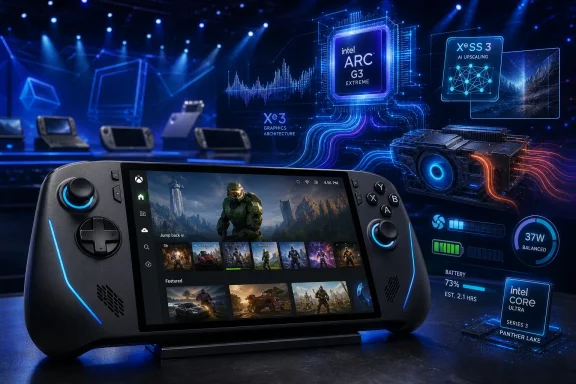 Intel Finally Names the Handheld Problem
For the past few years, the Windows handheld PC has been an impressive contradiction. Devices like the ROG Ally, Lenovo Legion Go, MSI Claw, and OneXPlayer models have shown that PC games can run acceptably on portable hardware, but they have also made painfully clear that Windows was never designed around thumbsticks, suspend-and-resume rituals, small batteries, and impatient players.Intel’s Arc G-Series is a direct answer to that contradiction. The company is positioning Arc G3 and Arc G3 Extreme as processors tuned for portable gaming systems rather than ordinary laptop chips repackaged for a smaller chassis. That distinction is marketing, certainly, but it is also the right marketing. Handheld PCs are not thin-and-light notebooks without keyboards; they are thermal envelopes with controls attached.
The chips are based on Intel’s Core Ultra Series 3 architecture, codenamed Panther Lake, and use Xe3 graphics. That gives Intel a modern graphics block to pitch against AMD’s long-running advantage in handheld APUs. AMD has benefited from the fact that its Ryzen Z-series silicon became the default choice for many Windows gaming handhelds, while Valve’s Steam Deck used a custom AMD APU and escaped the Windows problem altogether by running SteamOS.
Intel is now trying to compress several years of catch-up into a platform story. Arc G3 is not merely a CPU label. It is a way to tell Acer, MSI, OneXPlayer, and other device makers that Intel has a handheld roadmap, a graphics roadmap, and enough software glue to make both matter.
Panther Lake Gives Intel a Better Hand, But Not a Free Win
Panther Lake gives Intel a credible starting point because handhelds reward precisely the things Intel has been struggling to prove in client computing: efficient cores, scalable integrated graphics, and process leadership. Intel says these Arc G-Series chips are manufactured using its 18A process technology, aligning them with the company’s broader attempt to make Panther Lake a showcase for its foundry ambitions. That matters because handheld performance is not measured only in frame rates. It is measured in how long the machine can keep those frame rates before heat and battery limits become the real benchmark.The move to Xe3 graphics is equally important. Integrated graphics have become the center of gravity for handheld PCs because discrete GPUs are mostly impractical in this form factor. The GPU must share memory, power, cooling, and physical space with the rest of the system, and any inefficiency shows up immediately as fan noise, warmth, or a battery warning.
Intel’s story is that Arc G3 and Arc G3 Extreme will deliver the right mix of CPU and GPU capability for portable play. The company is talking about real-time ray tracing, XeSS 3, multi-frame generation, and low-latency features, which places the chips squarely in the same marketing vocabulary as desktop GPUs. But handheld gaming is a cruel place for desktop promises. A feature that looks terrific in a keynote can become irrelevant if it works only at settings and power levels that destroy battery life.
That does not make Intel’s claims empty. XeSS 3 is particularly relevant in this class of device because upscaling and frame generation can help small screens punch above their raw rendering weight. A handheld does not need to render every game at native resolution with brute force if the display, viewing distance, and latency management cooperate. The trick is making those technologies broadly useful rather than selectively impressive.
Intel’s challenge is consistency. Handheld buyers do not want to become unpaid driver testers every time a major PC release arrives. If Arc G3 systems ship into the same market where AMD devices have already built a software reputation, Intel will need day-one game support, predictable driver cadence, and OEM firmware that does not bury performance behind confusing profiles.
The New Windows Shell Is the Real Co-Star
Microsoft’s Xbox-style Windows 11 gaming interface has been described in different ways over the past year: Xbox Mode, Full Screen Experience, a console-inspired launcher, a controller-first shell. Whatever the label, the goal is obvious. Windows handhelds need to stop dropping users into a desktop that assumes a mouse, a keyboard, and a tolerance for tiny taskbar targets.The feature gives Windows 11 a full-screen, gamepad-friendly environment centered on the Xbox app and a consolidated gaming experience. It does not magically turn a Windows PC into an Xbox, nor does it remove the messiness of PC gaming storefronts, driver updates, launchers, anti-cheat systems, overlays, and background services. But it creates a more plausible first impression, and first impressions matter enormously in a market where the Steam Deck has trained users to expect a console-like flow.
Intel’s decision to call out support for this interface is therefore strategic. A handheld chip without a handheld shell is just another mobile processor. A handheld chip that launches alongside a Windows mode designed for controllers begins to look like part of a platform.
This is the point Microsoft and Intel both need to land. The Windows handheld problem was never only that the hardware was too slow. It was that the experience felt assembled from laptop parts, gaming utilities, OEM launchers, and hope. A better shell will not fix every PC gaming inconvenience, but it gives OEMs a common target instead of forcing each vendor to invent its own half-console layer on top of Windows.
Intel’s Shader Pitch Aims at PC Gaming’s Oldest Handheld Embarrassment
Intel Precompiled Shaders may sound like an obscure driver-side feature, but it is one of the more practical pieces of the announcement. Shader compilation stutter has become one of PC gaming’s least glamorous but most visible problems. On a desktop tower, it is annoying. On a handheld, where users expect the immediacy of a console and often play in short sessions, it can be fatal to the experience.The idea is simple enough: download optimized shader files from Intel’s cloud servers so games spend less time compiling them on the device. If it works well, it could reduce loading delays and stutter in supported titles. If it works inconsistently, it becomes another checkbox feature that reviewers mention once and users forget.
Still, the direction is correct. Handheld PCs need more than raw performance because they operate under tighter constraints than gaming laptops. Anything that moves work away from the device, reduces repeated compilation, or smooths frame pacing can be more valuable than a headline performance percentage.
The risk is fragmentation. Shader systems depend on games, drivers, graphics architectures, and distribution mechanisms all lining up. Intel can build the plumbing, but users will judge the result game by game. That means the company must do the unglamorous work of maintaining a service, coordinating with developers, and fixing the inevitable edge cases after launch.
This is where Intel’s Arc history cuts both ways. The company has made visible progress with Arc drivers since its first modern discrete GPUs stumbled into the market, and that progress gives it more credibility than it had a few years ago. But handheld buyers are less forgiving than desktop tinkerers. They are buying the fantasy of PC gaming without PC chores.
AMD Is the Incumbent Intel Has to Dislodge
Intel’s announcement is also a challenge to AMD’s quiet dominance in handheld gaming PCs. The category’s most recognizable devices have leaned heavily on AMD APUs, and that has given AMD a head start in OEM relationships, performance tuning, and user expectations. Intel is entering a fight where the scoreboard is not empty.That matters because handheld buyers increasingly compare devices across the whole experience rather than the processor logo alone. They look at battery life, fan noise, ergonomics, display quality, suspend behavior, driver reliability, storefront compatibility, and whether a game runs without a forum search. Intel can win synthetic benchmarks and still lose the product argument if Arc G3 handhelds feel less predictable.
On the other hand, the market is not settled. The Windows handheld category is still young, uneven, and open to disruption. Many devices have been either too expensive, too bulky, too compromised, or too Windows-like for mainstream users. If Intel can give OEMs a stronger integrated platform and a credible software story, it can become more than the alternative supplier.
Acer, MSI, and OneXPlayer are exactly the kind of partners Intel needs. Acer can bring mainstream PC retail reach, MSI has already experimented with Intel-powered handhelds, and OneXPlayer has long served the enthusiast edge of the market. None of those names guarantees success, but they suggest Intel is not treating Arc G-Series as a paper launch.
The real test will be pricing. Handheld PCs are squeezed between consoles, gaming laptops, tablets, and the Steam Deck’s value proposition. A Panther Lake-based handheld with premium memory, a high-refresh display, and a large battery can easily drift into gaming-laptop territory. At that point, the device has to justify why portability is worth the compromises.
Connectivity Is a Platform Argument, Not a Spec Sheet
Intel also emphasized support for Wi-Fi 7, Bluetooth 6, and Thunderbolt 4. These are easy details to skim past, but they reveal how Intel wants these devices to be used. A modern Windows handheld is not only a couch machine. It is also a dockable PC, a travel system, a streaming endpoint, and sometimes a miniature desktop.Thunderbolt 4 support is especially important because it lets OEMs pitch the handheld as part of a broader setup. Dock it to a monitor, attach storage, connect peripherals, or use it as a small Windows PC when you are not gaming. This is one of the places Windows handhelds can differentiate themselves from console-like devices: they are awkward consoles, but surprisingly flexible PCs.
That flexibility is both a strength and a liability. The more a device behaves like a PC, the more users expect PC-level compatibility. The more it behaves like a console, the less patience users have for updates, drivers, and settings. Intel and Microsoft are trying to occupy both identities at once.
Wireless support also matters for controllers, accessories, streaming, and cloud gaming. Handheld PCs are increasingly part of a mixed gaming life where local rendering, remote play, cloud libraries, and docked sessions blur together. Intel’s platform pitch acknowledges that the handheld is no longer just a small device running a local executable; it is a node in a personal gaming network.
But connectivity will not save a weak handheld. It can make a good device feel complete, but it cannot compensate for poor battery life or inconsistent frame pacing. Intel’s specs create the conditions for a premium ecosystem. OEM execution will decide whether users experience that ecosystem or just read about it on a box.
Microsoft Needs Intel as Much as Intel Needs Microsoft
The Arc G-Series announcement lands at a convenient time for Microsoft. Windows 11’s gaming full-screen experience is rolling out beyond its early handheld focus and into a broader PC gaming audience, but Microsoft still needs hardware that makes the idea feel native. A UI mode cannot carry a category by itself.Microsoft has spent years watching the Steam Deck demonstrate an uncomfortable truth: PC gaming does not require Windows to feel like PC gaming. Valve used Linux, Proton, and Steam’s console-like interface to make a handheld that hides much of the traditional desktop complexity. It did not defeat Windows on compatibility, but it made Windows look clumsy in the very form factor where elegance mattered most.
Xbox Mode is Microsoft’s answer, but it is an answer built on top of Windows rather than a clean break from it. That makes partner silicon and OEM design more important. If the device boots cleanly into a controller-first interface, manages power well, resumes reliably, and keeps background noise under control, users may forgive the fact that Windows is still underneath. If it does not, the shell becomes a cosmetic mask over the same old desktop.
Intel gives Microsoft another chance to make the Windows handheld story feel intentional. Instead of each OEM shipping a different launcher, controller mapper, performance overlay, and update tool, the combination of Arc G-Series hardware and Windows’ full-screen gaming mode can become a reference path. That is the closest Windows handhelds have come to a common platform identity.
The irony is that Microsoft’s most valuable contribution may be restraint. Windows does not need five competing gaming surfaces fighting for attention on a handheld. It needs one predictable controller-first path into the user’s library, with the desktop available when needed but not constantly reasserting itself. If Xbox Mode becomes merely another layer, Microsoft will have missed the point.
The Handheld PC Is Becoming a Three-Way Contest
The broader market is now splitting into three models. Valve offers a curated, console-like SteamOS experience with a PC gaming library behind it. Traditional Windows OEMs offer maximum compatibility with varying degrees of handheld polish. Microsoft and Intel are now trying to create a third path: Windows compatibility with a more unified console-style front end and silicon designed specifically for the job.That third path is promising because it does not ask users to give up Windows. For some players, that matters. Anti-cheat compatibility, niche launchers, modding tools, Game Pass, productivity apps, and legacy games all keep Windows relevant. The question is whether Microsoft can make those advantages available without forcing users to live inside desktop clutter.
For IT-minded readers, the category also raises familiar management questions. These devices are consumer gaming machines, but they are still Windows PCs. They receive updates, run drivers, connect to networks, store credentials, and may be used for more than gaming. A handheld that docks into a monitor and keyboard can quickly become a personal endpoint with all the usual security and support implications.
That is not a reason to fear the category. It is a reason to take it seriously. The more these machines resemble normal PCs under the hood, the more they inherit Windows’ strengths and weaknesses. Firmware updates, driver quality, Microsoft account integration, BitLocker behavior, storefront permissions, and local admin habits all matter more than they would on a closed console.
The gaming handheld is therefore not just a toy story. It is another example of Windows trying to stretch across form factors while preserving its compatibility promise. Intel’s Arc G-Series is the silicon side of that stretch.
The First Devices Will Decide Whether This Is a Platform or a Press Release
Intel says more details will come around Computex 2026, and partner devices are expected later this year. That timing is important. The company has announced the platform, but the market will judge the devices. A chip family succeeds in handhelds only when thermals, industrial design, battery capacity, screen choice, firmware, drivers, and software all arrive in balance.Acer, MSI, and OneXPlayer will likely make different bets. One may chase premium performance, another may chase mainstream price, and another may serve enthusiasts who want every watt exposed in a tuning utility. That diversity is good for PC choice, but it can also make the platform feel inconsistent.
Intel’s job is to reduce that inconsistency. If Arc G3 and Arc G3 Extreme produce wildly different experiences depending on OEM cooling and firmware, the brand will not mean much to buyers. If, instead, the label signals a predictable baseline for Windows handheld gaming, Intel will have created something more valuable than another processor tier.
Microsoft faces the same test with Xbox Mode. If users can count on the full-screen experience to appear, work, update cleanly, and play nicely with multiple storefronts, it becomes part of the category’s foundation. If it remains unevenly rolled out, region-gated, or confusingly dependent on hidden switches and app versions, the community will route around it with tools, launchers, and registry tweaks.
That would be very Windows, but not very console-like. And the whole point of this new handheld push is to borrow the console’s discipline without surrendering the PC’s breadth.
The Fine Print That Will Matter More Than the Branding
The concrete promise of Arc G-Series is easy to state: Intel wants to give Windows handheld makers a purpose-built platform with modern integrated graphics, gaming-focused software, and support for Microsoft’s controller-first Windows shell. The concrete risk is just as easy to state: handheld users will not care about the platform story if the first devices are expensive, hot, noisy, or inconsistent.The near-term details worth watching are not abstract. They are the unromantic numbers and behaviors that separate a good portable from a spec-sheet trophy.
- The first Arc G3 handhelds need to show sustained performance at realistic handheld power levels, not only short benchmark bursts.
- Xbox Mode needs to behave like a dependable front door to Windows gaming rather than a decorative launcher on top of desktop friction.
- Intel Precompiled Shaders need broad game support and visible reductions in stutter to become more than another driver feature.
- OEMs need to price Arc G-Series devices against the Steam Deck, AMD-based Windows handhelds, and entry gaming laptops, not against Intel’s ambitions.
- Driver updates need to arrive quickly enough that new PC releases do not expose Arc G3 as a second-tier gaming platform.
- Battery life, sleep reliability, fan noise, and heat will shape user opinion more than ray tracing checkboxes.
References
- Primary source: Neowin
Published: Thu, 28 May 2026 19:02:00 GMT
The new Windows 11 gaming desktop UI will be supported by Intel's new Arc G3 chips - Neowin
Intel's new Arc G3 series processors will support the updated Windows 11 gaming desktop interface, and more. www.neowin.net
- Related coverage: tomshardware.com
Acer is reportedly working on a 'Predator Atlas 8' handheld featuring Intel's Arc G3 chips — Panther Lake-based handhelds expected to be revealed at Computex 2026 | Tom's Hardware
The Arc G3 series would compete directly against AMD's Ryzen Z2 platform.www.tomshardware.com - Related coverage: gamesradar.com
The first Intel Arc G3 handhelds could emerge tomorrow, including an Acer portable I'd deemed vaporware | GamesRadar+
Leaks suggest Intel will unveil its Arc G3 handheld lineup on May 28, and the expected MSI Claw sequel could be joined by a revitalised Acer Predator portable.www.gamesradar.com - Related coverage: newsroom.intel.com
Intel Arc G-Series Processors Set a New Standard for Handheld PC Gaming - Intel Newsroom
Intel® Arc™ G-Series processors combine leadership performance and power efficiency to deliver smooth, immersive gameplay with exceptional battery lifenewsroom.intel.com - Related coverage: phoronix.com
Intel Arc G-Series Processors Announced For Handheld Gaming Devices - Phoronix
Ahead of Computex, Intel today announced the introduction of the Arc G-Serieswww.phoronix.com
- Related coverage: tech.sportskeeda.com
Intel Core/Arc G3 Panther Lake CPUs for gaming handhelds reportedly coming in Q2 2026
Reports of Panther Lake CPUs for gaming handhelds aren't new. At CES 2026, Intel officially announced that it plans to launch the Panther Lake chip for handheld devices soon.tech.sportskeeda.com
- Related coverage: techspot.com
Intel launches Core Ultra Series 3 "Panther Lake" chips on its 2nm 18A process | TechSpot
Intel's long-anticipated 2-nanometer 18A manufacturing process is finally in production, powering the company's new Core Ultra Series 3 chips, code-named Panther Lake. The processors, unveiled at CES...www.techspot.com - Related coverage: igorslab.de
Intel Arc G-Series: Panther Lake gets its own handheld mission and Ar…
Intel is using Computex 2026 to launch a much more targeted attack on the Windows handheld market with the new Intel Arc G-Series processors.www.igorslab.de - Related coverage: mobilesyrup.com
Intel announces ARC G Series processors for handheld gaming
Intel has announced new ARC G Series processors designed for handheld gaming softwares, which comes as Valve increased Steam deck prices due to cost.mobilesyrup.com - Related coverage: notebookcheck.net
Core G3: Intel Panther Lake chip for handheld consoles reportedly pushed back - Notebookcheck News
A new leak from Weibo says the Intel Core G3 and Core G3 Extreme Panther Lake chips have been pushed back to Q2, 2026. Both chips are optimised for handheld consoles and come with a 14-core CPU and Intel Arc B300 series iGPU. www.notebookcheck.net
- Related coverage: arstechnica.com
Intel makes a bid for handheld gaming PCs with new Arc G3 processors - Ars Technica
Intel's Arc B390 integrated GPU has offered impressive performance in laptops.arstechnica.com - Related coverage: techtimes.com
Intel Arc G3 Arrives Before Computex: First Dedicated Handheld Chip Challenges AMD Ryzen Z2
Intel Arc G3 and Arc G3 Extreme are the first chips designed exclusively for gaming handhelds, announced May 28 ahead of Computex 2026. Built on the Intel 18A process, the Arc G3 Extreme powers thewww.techtimes.com - Related coverage: thurrott.com
Intel Announces Arc G-Series Processors for Gaming Handhelds - Thurrott.com
Intel today announced a new family of Arc G-series processors aimed at Windows 11 gaming handhelds.www.thurrott.com - Related coverage: pcgamer.com
Intel's new handheld gaming chip rumoured to be called 'Core G3 Extreme' and rocks a full-spec Xe3 iGPU with 12 graphics cores | PC Gamer
It's the Panther Lake laptop chip, just slightly tweaked.www.pcgamer.com - Related coverage: windowscentral.com
Intel Arc GPUs get a major boost with new XeSS driver | Windows Central
XeSS 3 MFG delivers up to three additional frames for every "real" frame rendered by the GPU, significantly improving framerates.www.windowscentral.com - Related coverage: laptopmag.com
Big cat sighting: Intel shows off Panther Lake at Computex | Laptop Mag
Intel chose not to host a press conference or keynote at Computex 2025, but the company’s 18A flagship CPU still appeared in small press demo sessions.www.laptopmag.com - Related coverage: download.intel.com
- Related coverage: news.xbox.com
Xbox Mode Begins Rolling Out to Players on Windows 11 PCs Today - XBOX Wire
Beginning today, we’re excited to share that Xbox mode will begin rolling out to Windows 11 PCs, bringing a console-inspired Xbox experience to more players than ever.news.xbox.com - Related coverage: windowslatest.com
Tested: First look at the new Xbox Mode for Windows 11 PCs with console-style gaming UI
Microsoft confirms Xbox Mode for Windows 11 PCs coming in 2026, and I tested the new console-style gaming interface on a Windows PC www.windowslatest.com
- Related coverage: pureinfotech.com
Enable Xbox Full Screen Experience for handhelds on Windows 11 - Pureinfotech
To enable the Xbox full-screen experience, you have to update to Windows 11 25H2 using the ViveTool and the Registry. pureinfotech.com
- Related coverage: allthings.how
Xbox FSE (Full Screen Experience) on Windows 11: Setup, controls, and performance
Learn how the Xbox full screen experience works on handhelds and PCs, how to turn it on, and what to expect day to day.allthings.how - Official source: support.microsoft.com
Windows Gaming: Full screen experience - Microsoft Support
 support.microsoft.com
- Related coverage: tomsguide.com
The Xbox Full Screen Experience just arrived on all Windows handhelds — here's how to enable it | Tom's Guide
Microsoft quietly announced that all Windows-based handheld consoles will get the Xbox Full Screen Experience starting November 21.www.tomsguide.com - Related coverage: guidingtech.com
Using Windows 11 Xbox Fullscreen Experience - Guiding Tech
The Windows 11 Xbox fullscreen experience brings console gaming to your PC in a big way. We show you how to get it installed and use it.www.guidingtech.com
