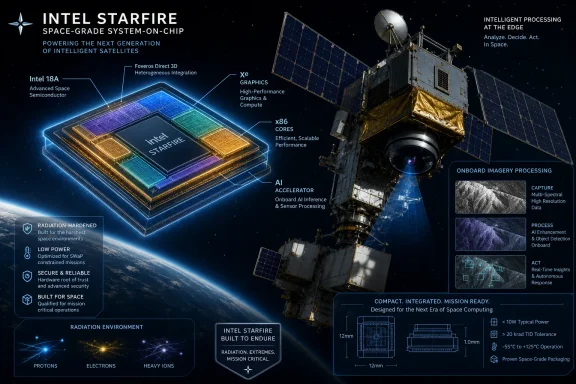
Intel has unveiled Starfire, a space-grade processor that repackages its Panther Lake-era technology for U.S. government spacecraft and other systems operating beyond conventional computing environments. Detailed in an Intel product brief and reported July 13 by Tom’s Hardware and Notebookcheck, the chip combines eight x86 CPU cores, integrated Xe graphics, and dedicated AI acceleration in power envelopes ranging from 10 watts to 35 watts, with samples scheduled for the third quarter of 2026.
The striking part is not simply that Intel has built another rugged processor. Starfire places CPU and neural-processing silicon manufactured on the company’s leading-edge Intel 18A process into a package intended for eventual operation in space, where radiation, extreme temperatures, limited electrical power, and long service lives complicate almost every assumption made for a normal PC.
Intel is not yet calling the processor radiation-qualified. Testing for total ionizing dose, single-event latch-up, and other radiation effects remains in progress, and the published specifications are subject to change. Starfire is therefore best understood as an ambitious product entering the sampling and qualification phase, not as flight-proven hardware ready to be fitted to a spacecraft today.
Starfire is based on a configuration closely related to Intel’s Panther Lake platform, known commercially in PCs as the Core Ultra Series 3 family. Its compute arrangement consists of four performance cores and four low-power efficiency cores, accompanied by a three-tile neural processing unit.
Both the CPU and NPU are manufactured on Intel 18A. The integrated GPU uses Intel 3 and contains four Xe cores with 64 execution units, giving Intel a mixed-node design assembled into one Foveros package rather than a monolithic processor manufactured entirely on a single process.
That structure reflects Intel’s broader system of chips strategy. Different pieces of a processor can be built on the process most appropriate for their performance, maturity, cost, and physical requirements, then connected through advanced packaging. Intel has used a similar division of manufacturing technologies elsewhere, including products that combine 18A compute silicon with components produced on Intel 3.
For Windows enthusiasts, Starfire’s architecture is recognizable even if its destination is not. It brings together the same broad categories of heterogeneous compute now appearing in AI PCs: conventional x86 cores for general-purpose code, a GPU for highly parallel workloads, and an NPU for efficient inference. The difference is that Starfire must deliver those capabilities within the constraints of a satellite or government platform rather than a notebook.
Intel has disclosed two configurations:
Starfire is aimed at a different class of workload. Its maximum 75 TOPS rating and dedicated NPU suggest systems capable of running meaningful AI inference locally, without transmitting every piece of raw sensor data to Earth for processing.
A satellite equipped with this kind of compute capacity could potentially classify imagery, identify anomalies, prioritize communications, or filter sensor information before using a limited downlink. Autonomous systems could also make more decisions locally when latency or an interrupted connection makes constant ground control impractical.
Those are potential applications rather than announced deployments, and TOPS figures alone do not establish real-world performance. Model support, memory bandwidth, numerical precision, software optimization, thermal limits, and radiation-induced interruptions will all affect useful throughput. Intel’s headline number nevertheless places Starfire in a substantially different category from processors designed primarily for telemetry, command handling, and basic flight control.
As Tom’s Hardware noted, the long-standing reference point is BAE Systems’ RAD750, a radiation-hardened PowerPC processor used across more than 150 spacecraft, including Mars missions and scientific observatories. Its comparatively low clock speeds and older manufacturing processes are not evidence of poor engineering; they reflect a design philosophy in which survivability and known behavior outweigh desktop-style performance.
More recent space processors, including BAE’s multicore RAD5545 and Microchip’s PIC64-HPSC program, are already pushing the sector toward substantially greater performance. Starfire sharpens that transition by adding a modern heterogeneous AI architecture rather than treating onboard processing as a conventional CPU-only problem.
Leading-edge transistors, however, do not automatically make better space components. As devices shrink, the amount of charge involved in storing and switching information also decreases, potentially making circuits more vulnerable to disruption from high-energy particles. Space-grade computing therefore depends on much more than choosing a modern process node.
Radiation tolerance can involve circuit-level hardening, error detection and correction, redundant execution, protected memories, watchdog systems, specialized packaging, and software designed to recover from faults. Intel’s product material does not yet provide enough public detail to determine how Starfire distributes those protections or how its final tolerance will compare with established radiation-hardened processors.
The listed operating junction temperature range of -55°C to 125°C demonstrates the environmental target, but temperature tolerance is only one part of space qualification. Intel says characterization remains underway for total ionizing dose, single-event latch-up, and single-event effects—the measurements that will reveal whether Starfire can reliably survive sustained radiation exposure and individual particle strikes.
Until those results are available, the 18A connection is a promise under test. A successful qualification would show that Intel can adapt one of its newest manufacturing technologies to applications traditionally served by much older, carefully hardened processes. A disappointing result could require revisions to the silicon, package, operating limits, or targeted missions.
Intel already participates in U.S. defense semiconductor initiatives and holds Trusted Foundry status. Starfire gives the company a product through which it can combine domestic leading-edge fabrication, Foveros packaging, x86 compatibility, and AI acceleration in a form intended for government programs.
The x86 foundation could also reduce some software friction compared with less familiar space architectures. Developers may be able to draw from mature compilers, profiling tools, operating-system experience, and existing libraries, although Intel has not yet disclosed the complete software platform, supported operating systems, or the degree to which ordinary Panther Lake code can transfer to Starfire unchanged.
That is particularly relevant to IT professionals evaluating the announcement through a Windows lens. Starfire is not a new Windows PC processor, and Intel has not announced a Windows-based spacecraft platform. Its importance to the broader PC ecosystem is that it demonstrates how Intel intends to reuse its client-era CPU, GPU, NPU, and packaging investments in specialized markets where long availability and environmental hardening matter more than consumer launch cycles.
Intel plans to provide samples in the third quarter of 2026, meaning the next meaningful milestone will not be another TOPS figure but qualification data and customer evaluation. If Starfire’s radiation testing validates the architecture, Intel will have moved Panther Lake’s heterogeneous computing model from AI laptops into one of silicon’s least forgiving environments. Until then, the chip remains a compelling specification sheet awaiting the evidence required for orbit.
The striking part is not simply that Intel has built another rugged processor. Starfire places CPU and neural-processing silicon manufactured on the company’s leading-edge Intel 18A process into a package intended for eventual operation in space, where radiation, extreme temperatures, limited electrical power, and long service lives complicate almost every assumption made for a normal PC.
Intel is not yet calling the processor radiation-qualified. Testing for total ionizing dose, single-event latch-up, and other radiation effects remains in progress, and the published specifications are subject to change. Starfire is therefore best understood as an ambitious product entering the sampling and qualification phase, not as flight-proven hardware ready to be fitted to a spacecraft today.
 Panther Lake Leaves the Laptop Behind
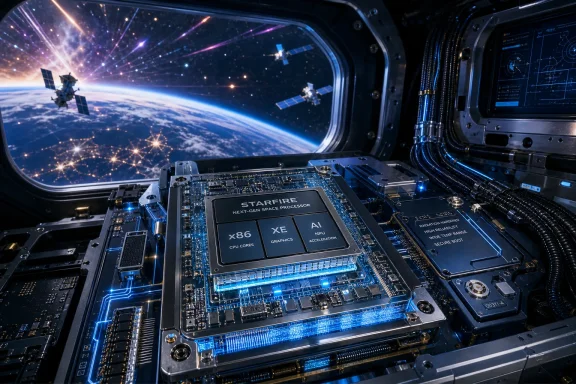
Starfire is based on a configuration closely related to Intel’s Panther Lake platform, known commercially in PCs as the Core Ultra Series 3 family. Its compute arrangement consists of four performance cores and four low-power efficiency cores, accompanied by a three-tile neural processing unit.Both the CPU and NPU are manufactured on Intel 18A. The integrated GPU uses Intel 3 and contains four Xe cores with 64 execution units, giving Intel a mixed-node design assembled into one Foveros package rather than a monolithic processor manufactured entirely on a single process.
That structure reflects Intel’s broader system of chips strategy. Different pieces of a processor can be built on the process most appropriate for their performance, maturity, cost, and physical requirements, then connected through advanced packaging. Intel has used a similar division of manufacturing technologies elsewhere, including products that combine 18A compute silicon with components produced on Intel 3.
For Windows enthusiasts, Starfire’s architecture is recognizable even if its destination is not. It brings together the same broad categories of heterogeneous compute now appearing in AI PCs: conventional x86 cores for general-purpose code, a GPU for highly parallel workloads, and an NPU for efficient inference. The difference is that Starfire must deliver those capabilities within the constraints of a satellite or government platform rather than a notebook.
Intel has disclosed two configurations:
- The 10-watt Low Power model runs its performance cores at 1.0 GHz, its low-power efficiency cores at 850 MHz, and its GPU between 800 MHz and 1.0 GHz, delivering up to 45 TOPS of combined AI performance.
- The 35-watt Performance model raises the performance cores to 3.1 GHz, the efficiency cores to 2.1 GHz, and the GPU to 2.0 GHz, reaching up to 75 TOPS.
The NPU Changes What a Space Processor Can Do
Traditional spacecraft processors have generally prioritized predictability, reliability, and radiation resistance over raw throughput. Many remain in service for decades because a modest, thoroughly characterized processor is preferable to a faster chip whose behavior in orbit is not fully understood.Starfire is aimed at a different class of workload. Its maximum 75 TOPS rating and dedicated NPU suggest systems capable of running meaningful AI inference locally, without transmitting every piece of raw sensor data to Earth for processing.
A satellite equipped with this kind of compute capacity could potentially classify imagery, identify anomalies, prioritize communications, or filter sensor information before using a limited downlink. Autonomous systems could also make more decisions locally when latency or an interrupted connection makes constant ground control impractical.
Those are potential applications rather than announced deployments, and TOPS figures alone do not establish real-world performance. Model support, memory bandwidth, numerical precision, software optimization, thermal limits, and radiation-induced interruptions will all affect useful throughput. Intel’s headline number nevertheless places Starfire in a substantially different category from processors designed primarily for telemetry, command handling, and basic flight control.
As Tom’s Hardware noted, the long-standing reference point is BAE Systems’ RAD750, a radiation-hardened PowerPC processor used across more than 150 spacecraft, including Mars missions and scientific observatories. Its comparatively low clock speeds and older manufacturing processes are not evidence of poor engineering; they reflect a design philosophy in which survivability and known behavior outweigh desktop-style performance.
More recent space processors, including BAE’s multicore RAD5545 and Microchip’s PIC64-HPSC program, are already pushing the sector toward substantially greater performance. Starfire sharpens that transition by adding a modern heterogeneous AI architecture rather than treating onboard processing as a conventional CPU-only problem.
Intel 18A Faces Its Harshest Test
Putting 18A silicon into the Starfire design is both a technical statement and a qualification challenge. Intel 18A uses RibbonFET gate-all-around transistors and PowerVia backside power delivery, technologies Intel has positioned as central to the revival of its manufacturing operation.Leading-edge transistors, however, do not automatically make better space components. As devices shrink, the amount of charge involved in storing and switching information also decreases, potentially making circuits more vulnerable to disruption from high-energy particles. Space-grade computing therefore depends on much more than choosing a modern process node.
Radiation tolerance can involve circuit-level hardening, error detection and correction, redundant execution, protected memories, watchdog systems, specialized packaging, and software designed to recover from faults. Intel’s product material does not yet provide enough public detail to determine how Starfire distributes those protections or how its final tolerance will compare with established radiation-hardened processors.
The listed operating junction temperature range of -55°C to 125°C demonstrates the environmental target, but temperature tolerance is only one part of space qualification. Intel says characterization remains underway for total ionizing dose, single-event latch-up, and single-event effects—the measurements that will reveal whether Starfire can reliably survive sustained radiation exposure and individual particle strikes.
Until those results are available, the 18A connection is a promise under test. A successful qualification would show that Intel can adapt one of its newest manufacturing technologies to applications traditionally served by much older, carefully hardened processes. A disappointing result could require revisions to the silicon, package, operating limits, or targeted missions.
Domestic Manufacturing Is Part of the Product
Starfire is being handled by Intel Government Technologies and is explicitly presented as a U.S.-manufactured component. That positioning matters because government customers increasingly consider supply-chain origin, foundry access, packaging capability, and long-term availability alongside processor specifications.Intel already participates in U.S. defense semiconductor initiatives and holds Trusted Foundry status. Starfire gives the company a product through which it can combine domestic leading-edge fabrication, Foveros packaging, x86 compatibility, and AI acceleration in a form intended for government programs.
The x86 foundation could also reduce some software friction compared with less familiar space architectures. Developers may be able to draw from mature compilers, profiling tools, operating-system experience, and existing libraries, although Intel has not yet disclosed the complete software platform, supported operating systems, or the degree to which ordinary Panther Lake code can transfer to Starfire unchanged.
That is particularly relevant to IT professionals evaluating the announcement through a Windows lens. Starfire is not a new Windows PC processor, and Intel has not announced a Windows-based spacecraft platform. Its importance to the broader PC ecosystem is that it demonstrates how Intel intends to reuse its client-era CPU, GPU, NPU, and packaging investments in specialized markets where long availability and environmental hardening matter more than consumer launch cycles.
Intel plans to provide samples in the third quarter of 2026, meaning the next meaningful milestone will not be another TOPS figure but qualification data and customer evaluation. If Starfire’s radiation testing validates the architecture, Intel will have moved Panther Lake’s heterogeneous computing model from AI laptops into one of silicon’s least forgiving environments. Until then, the chip remains a compelling specification sheet awaiting the evidence required for orbit.
References
- Primary source: Tom's Hardware
Published: 2026-07-13T16:09:33+00:00
Intel's new space-grade Starfire chip is a Panther Lake SoC that puts an 18A CPU into orbit — chip designed for the US government leverages Intel 3 for the GPU | Tom's Hardware
The two-SKU part tops out at 75 TOPS.www.tomshardware.com - Independent coverage: Notebookcheck
Published: 2026-07-13T16:15:00+00:00
Panther Lake to space: Intel's new Starfire processor is built to survive in space - Notebookcheck News
Intel has announced Starfire, a space-grade processor built on its 18A node that combines eight CPU cores, a 64-execution-unit Xe GPU, and up to 75 TOPS of AI performance within a 35W power envelope. The chip comes in low-power and performance configurations and is rated for temperatures between... www.notebookcheck.net
- Related coverage: intel.com
Intel® Starfire™ Built for Extremes. Powered by Intel
Starfire™ is designed for space grade survivability, advanced AI performance while meeting the size, weight and power constraints. www.intel.com
- Related coverage: download.intel.com
- Related coverage: pcworld.com
Intel's 'Panther Lake' laptop CPU explained: all the details | PCWorld
Intel's Panther Lake chip for laptops includes more cores and powerful new AI technologies for graphics and wireless as it readies its flagship processor for early 2026. This is a deep dive on what the next Core Ultra chip contains.www.pcworld.com