IO Interactive has quietly rolled back one of the more eyebrow‑raising entries in its early PC hardware guidance for 007 First Light: the studio corrected the recommended system RAM from 32 GB down to 16 GB, trimmed VRAM targets, and fixed a minimum CPU line after community scrutiny — a change that removes an expensive upgrade hurdle for many Windows gamers preparing for the May 27, 2026 launch.
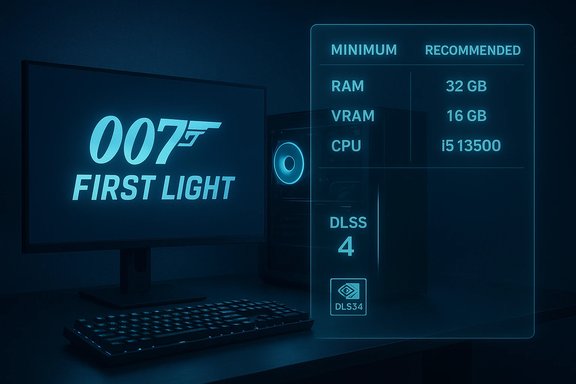
007 First Light is IO Interactive’s standalone James Bond origin story built on an updated Glacier engine and positioned as a technically ambitious, single‑player AAA release. The studio initially published a concise two‑tier PC requirements table that focused on 1080p performance targets: Minimum (1080p / 30 FPS) and Recommended (1080p / 60 FPS). That early reveal included an unusual jump in system memory: 16 GB minimum and 32 GB recommended, with VRAM called out as 8 GB minimum and 12 GB recommended — numbers that immediately attracted attention across the PC community.
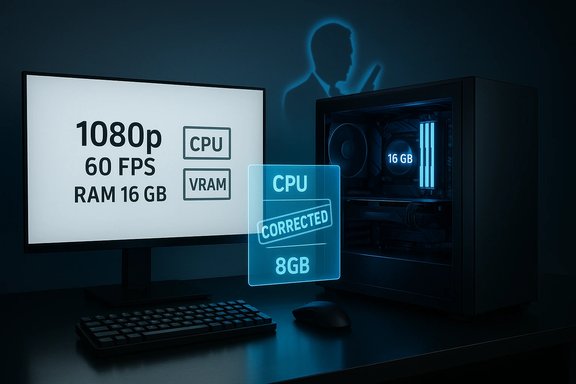
Shortly after that initial disclosure, IO Interactive acknowledged inconsistencies in the published listing and updated the PC system requirements to correct those entries. The studio said the earlier mistake stemmed from an internal miscommunication and that the corrected values were now reflected on the store pages. The corrected recommended RAM figure is now 16 GB, while minimum VRAM and CPU entries were also adjusted.
Multiple outlets and analysis threads flagged exactly this tension after the first reveal, a scrutiny that appears to have motivated IO Interactive’s recheck and subsequent correction.
Caveat: some vendor demo numbers (for example, very high 4K framerate claims in dev demos) were shown on high‑end hardware and cannot be treated as representative of midrange GPUs or the experience without MFG enabled. Those demo numbers should be considered illustrative and require hands‑on third‑party verification.
Strengths of the updated position:
IO Interactive’s correction is a useful reminder that early system requirement tables can contain errors and that community scrutiny can meaningfully improve the information gamers rely on to make buying and upgrade decisions. The updated guidance reduces upgrade friction ahead of the May 27, 2026 launch, but the broader technical story — how DLSS 4, frame generation, VRAM usage and engine streaming interact in real‑world play — will be settled only after hands‑on reviews and launch‑week driver patches. Watch official channels and reputable reviewer benchmarks in the days after release to make the most informed hardware choices.
Source: Wccftech https://wccftech.com/no-need-to-emp...cle/windows-10-spring-creators-update-delay/]
 Background
007 First Light is IO Interactive’s standalone James Bond origin story built on an updated Glacier engine and positioned as a technically ambitious, single‑player AAA release. The studio initially published a concise two‑tier PC requirements table that focused on 1080p performance targets: Minimum (1080p / 30 FPS) and Recommended (1080p / 60 FPS). That early reveal included an unusual jump in system memory: 16 GB minimum and 32 GB recommended, with VRAM called out as 8 GB minimum and 12 GB recommended — numbers that immediately attracted attention across the PC community.Shortly after that initial disclosure, IO Interactive acknowledged inconsistencies in the published listing and updated the PC system requirements to correct those entries. The studio said the earlier mistake stemmed from an internal miscommunication and that the corrected values were now reflected on the store pages. The corrected recommended RAM figure is now 16 GB, while minimum VRAM and CPU entries were also adjusted.
What changed — the numbers, in plain terms
The original (as first published)
- Performance targets: Minimum = 1080p @ 30 FPS; Recommended = 1080p @ 60 FPS.
- System RAM: 16 GB (Minimum) — 32 GB (Recommended).
- VRAM: ~8 GB (Minimum) — ~12 GB (Recommended).
- Typical recommended GPUs listed: NVIDIA RTX 3060 Ti / AMD RX 6700 XT for the recommended tier (noting that VRAM capacity varies by SKU).
The corrected (updated) listing
- System RAM: 16 GB (Minimum) — 16 GB (Recommended) (the 32 GB recommendation was removed).
- VRAM: lowered values in the minimum/recommended columns (for example, minimum VRAM called out as 6 GB in some updated summaries and recommended VRAM as 8 GB), and the minimum CPU line was fixed to reflect the proper model numbers.
Why the reversal matters — beyond the headline
The difference between recommending 16 GB and 32 GB of system RAM is more than an academic number: today’s RAM market and upgrade logistics make that recommendation consequential for large segments of PC owners, streamers, and content creators.- Cost and practicality: Upgrading from 16 GB to 32 GB can be an expensive, time‑consuming change for many PC users — especially for owners of older systems that may also require a CPU or motherboard refresh to support modern memory kits. By reverting the recommended figure to 16 GB, IO Interactive effectively removes a common blocker for midrange gamers who were planning to play at 1080p/60.
- Buyer confusion and SKU mismatches: The initial listing also highlighted a VRAM vs GPU model mismatch — for example, citing 12 GB of VRAM alongside GPUs (like many RTX 3060 Ti SKUs) that ship with 8 GB. That juxtaposition can confuse purchasers who match model names but overlook VRAM variation between SKUs. The updated listing clarifies VRAM expectations and reduces ambiguity for buyers who only scan headline model names.
- Community validation of QA: The correction is a small but important reminder that community review and early scrutiny can surface documentation errors that materially affect purchase and upgrade decisions. IO Interactive’s acknowledgement and the store updates show a pragmatic responsiveness that benefits players.
Technical analysis — what likely caused the original 32 GB recommendation (and why it was questionable)
There are legitimate technical scenarios where a developer might call for larger system memory in a recommended column. The main drivers are:- Aggressive asset streaming and large texture pools: Modern engines often push more texture and animation data into RAM as well as VRAM to smooth streaming in open areas. When the working set of assets grows, system RAM helps avoid hitching during heavy scenes.
- Creator/multitasking headroom: Developers sometimes pick recommended specs that assume the player may also run capture software, browser tabs, voice chat, overlays and other background tasks. That multiplies memory needs compared to a minimal single‑player run.
- Conservative padding: Some studios intentionally overshoot recommended figures to avoid underreporting needs and to reduce day‑one support volume for performance issues.
Multiple outlets and analysis threads flagged exactly this tension after the first reveal, a scrutiny that appears to have motivated IO Interactive’s recheck and subsequent correction.
DLSS 4 and multi‑frame generation — the performance wildcard
One of the most important performance levers in IO Interactive’s PC roadmap for 007 First Light is its announced partnership with NVIDIA. The PC build will ship with DLSS 4 and Multi Frame Generation (MFG) support, technologies that can meaningfully change the effective performance profile on GeForce RTX hardware.- DLSS 4 (transformer‑based super resolution): Provides upscaling with improved temporal stability and motion handling compared with earlier DLSS versions. It can raise visual detail while lowering native rendering load.
- Multi Frame Generation: Generates AI‑synthesized frames to multiply perceived framerate without rendering every frame at full cost. This can dramatically boost FPS on compatible RTX cards, but it is not without tradeoffs: artifacts, reconstruction anomalies, and varying latency profiles can surface depending on card generation, driver maturity, and engine integration.
Caveat: some vendor demo numbers (for example, very high 4K framerate claims in dev demos) were shown on high‑end hardware and cannot be treated as representative of midrange GPUs or the experience without MFG enabled. Those demo numbers should be considered illustrative and require hands‑on third‑party verification.
Practical guidance for Windows players — what to do now
If you’re planning to play 007 First Light on a Windows PC, here’s a prioritized, practical checklist based on the updated requirements and technical context:- Verify your system against the corrected store page before purchase or upgrade. The updated specs are now reflected on storefronts; use that official guidance as the final word.
- Prioritize storage and driver readiness. Move the install target to an SSD (NVMe preferred) and keep 120–160 GB free during preload to avoid patch/install failures. Update Windows and GPU drivers to vendor‑recommended builds at launch.
- If you have 16 GB of RAM and don’t stream or run capture software, you can expect to hit the recommended experience for 1080p/60 based on the corrected guidance. If you do stream or run heavy background apps, 32 GB remains a useful upgrade for headroom — but it’s no longer an IO Interactive requirement for recommended play.
- Confirm GPU VRAM on the exact SKU you own or plan to buy. Don’t assume model names map to a single memory configuration; check VRAM capacity (8 GB vs 12 GB vs 16 GB) and prefer higher VRAM when you expect to run max texture pools.
- Test vendor upscaler/frame‑generation options at launch. Run a short native‑resolution benchmark, then compare DLSS 4 or alternative upscalers (AMD FSR, Intel XeSS) for artifacts vs performance gains, and measure input latency if you’re competitive. Use the in‑game benchmark if provided.
- Windows 10/11 64‑bit updated.
- System RAM: 16 GB (recommended per updated spec).
- GPU: equivalent to GTX 1660 / RX 5700 (minimum) or RTX 3060 Ti / RX 6700 XT class (recommended) — confirm SKU VRAM.
- Storage: SSD with 80 GB minimum free; leave extra headroom for patches.
- Updated GPU drivers and tested upscaler settings.
Risks, unknowns and what to watch between now and launch
- Driver maturity and day‑one stability: DLSS 4 and MFG are driver‑sensitive features. Expect vendor driver updates close to launch and be prepared for patch‑based fixes. Mismatched drivers can cause crashes, artifacts or regressions.
- Storefront metadata can change: System requirement entries on Steam and other stores are editable; developers sometimes refine numbers right up to or after launch. Treat published numbers as guidance, not immutable truth. Check IO Interactive’s official posts and the storefront notes before buying hardware solely for this title.
- Perception of vendor preference: Heavy reliance on vendor‑specific performance features can create a perception of unequal treatment across GPU brands. IO Interactive’s use of DLSS 4 is a performance boon for GeForce owners, but robust alternatives or parity options for AMD/Intel GPU users will be important to avoid community friction.
- Demo vs consumer reality: Any promotional footage showing extreme framerates on flagship GPUs should be considered demonstration of potential rather than an expectation for the average player. Hands‑on, third‑party benchmarks will be the definitive measurement of real consumer experience.
- IO Interactive’s official channels and the game’s storefront for final system fields.
- GPU vendor driver release notes (NVIDIA, AMD, Intel) for DLSS/FSR/XeSS updates and recommended builds.
Final assessment — what this change means for Windows gamers
The corrected system requirements for 007 First Light are a pragmatic win for mainstream Windows gamers: IO Interactive’s decision to revert the recommended system RAM to 16 GB and clarify VRAM/CPU entries removes a costly, confusing upgrade obligation and aligns the public guidance more closely with the stated 1080p performance targets.Strengths of the updated position:
- Lower barrier to entry: More players on common midrange hardware can approach the recommended experience without new purchases.
- Clarity for buyers: Corrected VRAM lines and CPU model fixes reduce SKU‑selection errors that could lead to purchase regrets.
- DLSS 4 as a force multiplier: The NVIDIA feature set can meaningfully improve perceived framerates and visual fidelity for RTX owners when drivers and integration are mature.
- Performance will still vary by GPU generation and driver maturity; DLSS 4 / MFG is not a universal cure, and artifact/latency tradeoffs will need validation.
- High‑resolution targets unknown: IO Interactive has not yet published official 1440p or 4K target tables; players buying GPUs specifically for higher native resolutions should wait for launch benchmarks.
IO Interactive’s correction is a useful reminder that early system requirement tables can contain errors and that community scrutiny can meaningfully improve the information gamers rely on to make buying and upgrade decisions. The updated guidance reduces upgrade friction ahead of the May 27, 2026 launch, but the broader technical story — how DLSS 4, frame generation, VRAM usage and engine streaming interact in real‑world play — will be settled only after hands‑on reviews and launch‑week driver patches. Watch official channels and reputable reviewer benchmarks in the days after release to make the most informed hardware choices.
Source: Wccftech https://wccftech.com/no-need-to-emp...cle/windows-10-spring-creators-update-delay/]