

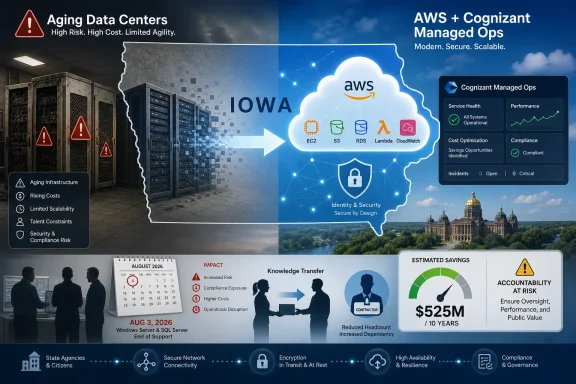
Iowa will lay off 192 Department of Management information-technology employees on August 3, 2026, as Governor Kim Reynolds moves executive-branch systems from state-run physical servers and data centers to Amazon Web Services and hands daily IT operations to Cognizant Government Solutions. The official pitch is security, agility, and a projected $525 million in savings over ten years. The practical reality is more complicated: Iowa is not merely changing hosting providers; it is changing who holds institutional knowledge, who answers when systems fail, and who profits from the public sector’s dependence on modern infrastructure. For Windows administrators and public-sector IT pros, this is the cloud migration debate stripped of marketing varnish.
The Reynolds administration has framed the move as a modernization project whose technical logic is difficult to dismiss at the surface level. State governments still run an uncomfortable amount of critical infrastructure on aging servers, fragmented data centers, bespoke applications, and staffing models designed for a different era of computing. Anyone who has patched an old Windows Server estate, nursed along a brittle SQL deployment, or discovered that a core agency workflow depends on a forgotten service account knows the cost of technological sediment.
But Iowa’s announcement is not just a cloud-first strategy. It is a managed-services handoff with a layoff date attached. The state says roughly 200 affected Department of Management Division of Information Technology employees will receive individualized, competitive job offers from Cognizant Government Solutions, while Iowa Workforce Development’s layoff listing puts the affected number at 192 and the effective date at August 3.
That distinction matters. A job offer from the replacement contractor is not the same thing as continuity of public employment, pension expectations, seniority, workplace protections, or a public-service mandate. Even if many employees land at Cognizant, the employer of record changes, the incentives change, and the long-term relationship between Iowa’s government and its technical workforce changes with it.
Cloud migration often begins as an infrastructure argument and ends as an organizational argument. Iowa’s decision makes that progression explicit. The state is saying that the future of its IT is not merely in AWS regions and managed services, but in a smaller direct public workforce overseeing a larger private operating layer.
The problem is that large cloud savings claims are only as credible as the assumptions beneath them. Cloud can reduce waste when it replaces idle hardware, duplicate systems, overprovisioned storage, and inefficient procurement cycles. It can also become more expensive than expected when workloads are lifted and shifted without redesign, data egress charges pile up, logging and security tools multiply, or agencies treat elastic capacity as a license to avoid architectural restraint.
That is why the $525 million figure needs more than repetition. Taxpayers should eventually see what baseline costs were counted, which facilities and contracts are being retired, how labor costs are being modeled, what transition expenses are excluded, and how the state will measure savings after the deal is operational. Without that map, the number is a promise rather than an accountability framework.
For IT professionals, the technical question is not whether AWS can host Iowa workloads securely and reliably. Of course it can, if the architecture, identity model, network design, backup strategy, and governance are competent. The harder question is whether the state has preserved enough internal expertise to know when the cloud bill, the service-level agreement, or the contractor’s implementation choices stop serving the public interest.
But cloud is not a synonym for secure. It is a shift in the threat model. Misconfigured identity, overprivileged accounts, exposed storage, weak key management, poor logging, and sloppy vendor access controls can turn a modern cloud estate into a very fast-moving liability.
The state’s most important cybersecurity asset may not be the AWS control plane. It may be the people who know which legacy application breaks if a certificate expires, which agency has a special data-sharing agreement, which database contains regulated information, and which “temporary” exception has been running in production for eight years. Those people are often the same employees now being pushed out of state service or asked to reappear under a contractor badge.
If Cognizant absorbs enough of that workforce and Iowa retains a strong internal architecture, security, procurement, and audit function, the transition could improve the state’s posture. If the layoffs turn into knowledge loss, the state could discover that a cleaner architecture diagram does not compensate for the disappearance of the humans who understood the exceptions.
A state can migrate to cloud while keeping a strong public IT workforce. It can use contractors for specialized migration work while retaining day-to-day operations. It can outsource commodity functions while keeping security architecture, data governance, vendor management, and incident command firmly in-house. Iowa’s announcement goes further because it pairs AWS migration with Cognizant management of daily IT operations and a mass layoff of the existing state IT staff.
That makes the deal less like a technology upgrade and more like a structural privatization of the operating layer. The servers may be virtualized, but the governance problem becomes concrete: who has the authority and expertise to challenge the vendor when service quality dips, costs rise, or a technical shortcut creates future risk?
The answer cannot be “the contract” alone. Contracts are necessary, but they are not self-enforcing. They require public employees who understand the technology well enough to spot drift, enforce performance obligations, and avoid dependency on the very vendor they are supposed to supervise.
That means the migration will almost certainly involve a messy blend of IaaS, managed databases, virtual desktops or app delivery, hybrid identity, VPN or Direct Connect-style networking, storage migration, backup redesign, and security monitoring. The glossy phrase “single, secure cloud system” obscures the reality that government IT is usually a federation of systems with different ages, owners, risk profiles, and modernization paths.
The danger in any big migration is that leaders talk as though cloud adoption is a destination, while administrators experience it as years of coexistence. Legacy Windows workloads often survive longer than expected because rewriting them is expensive, agency workflows are politically sensitive, and “temporary” compatibility architectures become permanent. If the state cuts too deeply into the people who know those systems, the transition could become more fragile precisely when it needs the most context.
AWS has mature support for Microsoft workloads, and Cognizant has experience running large managed-service environments. That does not eliminate the need for Iowa-side technical memory. A state cannot outsource accountability for domain design, privileged access, data classification, retention obligations, and incident response priorities simply because the infrastructure underneath is someone else’s hardware.
But a contractor offer is not a guarantee of equivalence. Compensation may be competitive in salary terms while differing on benefits, retirement, job security, remote-work rules, promotion paths, workload expectations, or future layoff exposure. Some employees may accept because they want continuity, while others may see the offer as an invitation to reapply for a version of the job they already had.
There is also a power imbalance baked into the timing. The state has announced the transition, the layoff date is set, and Cognizant will make offers later in June. Workers are being asked to evaluate private employment while the public employer that held their career path is withdrawing from the field.
That arrangement may be legal, orderly, and common in outsourcing deals. It is still a profound change in the employment relationship. The people who kept state systems running are being told that their expertise remains valuable, but not necessarily as public employees.
AWS lock-in by itself is manageable if a customer has strong architecture standards, cost controls, portability expectations where they matter, and a workforce capable of understanding tradeoffs. Managed-services lock-in is trickier. Once a contractor controls daily operations, writes the runbooks, handles incidents, and becomes the keeper of operational reality, the customer can become dependent on the vendor not just for infrastructure but for knowing how the infrastructure works.
That is why layoffs change the risk profile. A government that retains a deep bench of engineers can push back against a cloud provider or systems integrator. A government that reduces itself to contract management may struggle to distinguish genuine technical necessity from vendor convenience.
The state’s projected savings may still materialize. But the cost of lost optionality rarely appears in the first press release. It shows up years later, when renewal pricing hardens, migrations become too disruptive to contemplate, or a new administration discovers that reversing course would require rebuilding an internal capability that was deliberately dismantled.
The political appeal is obvious. A cloud deal lets leaders say they are replacing aging infrastructure, improving security, cutting costs, and shrinking government headcount in one motion. It compresses a decade of IT policy into a single announcement that sounds both modern and fiscally prudent.
Yet the national record on government modernization is mixed because technology is rarely the only obstacle. Procurement rules, agency silos, legacy statutes, underfunded maintenance, identity fragmentation, and data-quality problems follow workloads into the cloud. If those problems are not addressed, the same dysfunctions can reappear on newer infrastructure with a more expensive meter running underneath.
That is the caution for Iowa. AWS and Cognizant can provide platforms, tools, staffing models, and operational discipline. They cannot, by themselves, provide public accountability. That has to be designed into the deal, funded inside the state, and defended after the press conference fades.
A serious migration would need workload discovery, application dependency mapping, data classification, identity rationalization, network segmentation, recovery-time objectives, compliance mapping, and a decision tree for what gets rehosted, refactored, retired, replaced, or left alone for now. That is not a weekend cutover. It is a portfolio-management exercise with security consequences.
The August 3 date appears to mark the operational handoff, not the completion of every technical migration. That distinction matters because day-to-day operations can be transferred before the underlying estate is fully transformed. In fact, many outsourcing arrangements begin with the contractor taking over the current environment, then modernizing it over time.
That sequencing can work if incentives are aligned. But it can also create a situation where the contractor is paid to operate complexity and then paid again to reduce it, while the customer has fewer employees capable of independently validating the path. Iowa should be judged not only on whether it signs a modern cloud deal, but on whether it publishes enough milestones and performance data for citizens and lawmakers to see whether modernization is actually happening.
Experienced administrators and engineers carry informal knowledge that ticketing systems never fully capture. They remember the weird outage from four years ago, the agency director who needs advance warning before a maintenance window, the batch process that runs longer during benefit cycles, and the ancient application that fails silently unless someone checks a log no dashboard watches. This is not nostalgia; it is operational risk management.
Contractors can learn environments, and good transition planning can capture knowledge. But knowledge transfer is not magic. It requires time, trust, documentation, overlap, and incentives for departing staff to be candid about ugly realities that may embarrass management.
If Iowa treats employees as replaceable line items, the state may get a harsher education in what those employees actually did. If it treats them as essential transition partners, preserves enough of them in meaningful roles, and builds a retained public technical core, the migration has a better chance of delivering on its security and reliability claims.
In a data center, waste often looks like idle equipment, duplicated platforms, and delayed refreshes. In cloud, waste looks like oversized instances, forgotten volumes, excessive snapshots, unmanaged logs, inefficient data movement, premium services used casually, and development environments that never shut down. The bill becomes more granular, but not necessarily smaller.
The state’s projected ten-year savings will depend on whether Iowa and its vendors build a real FinOps culture. That means tagging, budget alerts, unit-cost metrics, rightsizing, reserved-capacity strategy, lifecycle policies, and agency-level accountability for consumption. It also means resisting the temptation to call every new cloud expense “modernization” and every old cost “technical debt.”
For Windows-heavy shops, licensing will be another crucial variable. Microsoft licensing in cloud environments can be complex, and choices around Windows Server, SQL Server, virtual desktop infrastructure, identity, endpoint management, and hybrid rights can materially affect costs. A migration that underestimates licensing complexity may discover that the old server room was not the only expensive thing in the building.
A serious accountability plan would define service availability targets, incident reporting expectations, security audit practices, data residency and access controls, cost baselines, savings methodology, workforce transition outcomes, and penalties for missed obligations. It would also explain what capabilities remain inside the state after the layoffs and which public officials are responsible for vendor oversight.
This is especially important because the affected systems support public services, not abstract enterprise workflows. When state IT fails, residents may have trouble accessing benefits, licenses, tax systems, agency portals, or public records. The cost of downtime is measured in public frustration and, sometimes, real hardship.
The state may argue that some details cannot be public for security or procurement reasons. That is fair up to a point. But “security” should not become a blanket that covers every inconvenient question about cost, staffing, accountability, and contractor performance.
The worst version is also plausible. The state loses too much institutional knowledge, the contractor inherits a messy estate, promised savings depend on optimistic assumptions, cloud costs grow in opaque ways, and Iowa becomes dependent on vendors for both operations and explanation. In that version, the public workforce shrinks, but the public’s dependence on complex technology does not.
The deciding factor will be governance. Cloud platforms reward organizations that know what they are doing and punish those that confuse procurement with transformation. Outsourcing can provide scale and expertise, but it can also hollow out the customer if leaders treat internal technical capability as overhead rather than leverage.
That is why this story belongs on a Windows and IT forum, not just in Iowa political coverage. The details are local, but the pattern is everywhere: public institutions want modern technology without carrying the full cost and complexity of being technology organizations. The uncomfortable truth is that modern government is a technology organization, whether elected officials like that framing or not.
 Iowa Turns a Cloud Migration Into a Workforce Reset
The Reynolds administration has framed the move as a modernization project whose technical logic is difficult to dismiss at the surface level. State governments still run an uncomfortable amount of critical infrastructure on aging servers, fragmented data centers, bespoke applications, and staffing models designed for a different era of computing. Anyone who has patched an old Windows Server estate, nursed along a brittle SQL deployment, or discovered that a core agency workflow depends on a forgotten service account knows the cost of technological sediment.But Iowa’s announcement is not just a cloud-first strategy. It is a managed-services handoff with a layoff date attached. The state says roughly 200 affected Department of Management Division of Information Technology employees will receive individualized, competitive job offers from Cognizant Government Solutions, while Iowa Workforce Development’s layoff listing puts the affected number at 192 and the effective date at August 3.
That distinction matters. A job offer from the replacement contractor is not the same thing as continuity of public employment, pension expectations, seniority, workplace protections, or a public-service mandate. Even if many employees land at Cognizant, the employer of record changes, the incentives change, and the long-term relationship between Iowa’s government and its technical workforce changes with it.
Cloud migration often begins as an infrastructure argument and ends as an organizational argument. Iowa’s decision makes that progression explicit. The state is saying that the future of its IT is not merely in AWS regions and managed services, but in a smaller direct public workforce overseeing a larger private operating layer.
The Savings Number Is Big Enough to Demand a Map
The headline number — more than $525 million over ten years — is doing a lot of political work. It suggests a clean business case: shut down aging infrastructure, stop buying and maintaining hardware, consolidate operations, and convert capital-heavy IT into scalable services. In procurement language, that is the classic move from capex to opex, and it has real advantages when done with discipline.The problem is that large cloud savings claims are only as credible as the assumptions beneath them. Cloud can reduce waste when it replaces idle hardware, duplicate systems, overprovisioned storage, and inefficient procurement cycles. It can also become more expensive than expected when workloads are lifted and shifted without redesign, data egress charges pile up, logging and security tools multiply, or agencies treat elastic capacity as a license to avoid architectural restraint.
That is why the $525 million figure needs more than repetition. Taxpayers should eventually see what baseline costs were counted, which facilities and contracts are being retired, how labor costs are being modeled, what transition expenses are excluded, and how the state will measure savings after the deal is operational. Without that map, the number is a promise rather than an accountability framework.
For IT professionals, the technical question is not whether AWS can host Iowa workloads securely and reliably. Of course it can, if the architecture, identity model, network design, backup strategy, and governance are competent. The harder question is whether the state has preserved enough internal expertise to know when the cloud bill, the service-level agreement, or the contractor’s implementation choices stop serving the public interest.
Security Improves Only If Governance Survives the Migration
Reynolds and state officials are leaning heavily on cybersecurity as a justification, and that argument will resonate with anyone who has watched public agencies struggle with ransomware, unsupported systems, exposed services, and uneven patch discipline. Centralizing infrastructure in a major cloud platform can bring stronger physical security, better resilience options, mature identity integrations, and access to tooling that would be difficult for a mid-sized government to build alone. Moving away from scattered physical servers and multiple data centers can reduce the number of places where old mistakes hide.But cloud is not a synonym for secure. It is a shift in the threat model. Misconfigured identity, overprivileged accounts, exposed storage, weak key management, poor logging, and sloppy vendor access controls can turn a modern cloud estate into a very fast-moving liability.
The state’s most important cybersecurity asset may not be the AWS control plane. It may be the people who know which legacy application breaks if a certificate expires, which agency has a special data-sharing agreement, which database contains regulated information, and which “temporary” exception has been running in production for eight years. Those people are often the same employees now being pushed out of state service or asked to reappear under a contractor badge.
If Cognizant absorbs enough of that workforce and Iowa retains a strong internal architecture, security, procurement, and audit function, the transition could improve the state’s posture. If the layoffs turn into knowledge loss, the state could discover that a cleaner architecture diagram does not compensate for the disappearance of the humans who understood the exceptions.
Public Cloud Is Not Privatization by Itself, But This Deal Is Closer Than Most
It is tempting to collapse the debate into a familiar culture-war shorthand: cloud good, outsourcing bad, or government inefficient, private sector efficient. None of those slogans is adequate. Public agencies have good reasons to use commercial cloud infrastructure, and many already do. The question is not whether Iowa should ever use AWS; it is how much operational control it should transfer, and under what conditions.A state can migrate to cloud while keeping a strong public IT workforce. It can use contractors for specialized migration work while retaining day-to-day operations. It can outsource commodity functions while keeping security architecture, data governance, vendor management, and incident command firmly in-house. Iowa’s announcement goes further because it pairs AWS migration with Cognizant management of daily IT operations and a mass layoff of the existing state IT staff.
That makes the deal less like a technology upgrade and more like a structural privatization of the operating layer. The servers may be virtualized, but the governance problem becomes concrete: who has the authority and expertise to challenge the vendor when service quality dips, costs rise, or a technical shortcut creates future risk?
The answer cannot be “the contract” alone. Contracts are necessary, but they are not self-enforcing. They require public employees who understand the technology well enough to spot drift, enforce performance obligations, and avoid dependency on the very vendor they are supposed to supervise.
The Windows Shop Does Not Disappear in an AWS World
For WindowsForum readers, one misconception is worth killing early: moving to AWS does not mean Iowa stops being a Windows environment. State governments run Windows Server, Active Directory or Entra ID integrations, SQL Server, .NET applications, endpoint management, print and document workflows, identity federation, remote access tooling, and countless line-of-business systems that were never designed for cloud-native purity. The cloud does not erase that estate; it relocates, refactors, wraps, or slowly replaces it.That means the migration will almost certainly involve a messy blend of IaaS, managed databases, virtual desktops or app delivery, hybrid identity, VPN or Direct Connect-style networking, storage migration, backup redesign, and security monitoring. The glossy phrase “single, secure cloud system” obscures the reality that government IT is usually a federation of systems with different ages, owners, risk profiles, and modernization paths.
The danger in any big migration is that leaders talk as though cloud adoption is a destination, while administrators experience it as years of coexistence. Legacy Windows workloads often survive longer than expected because rewriting them is expensive, agency workflows are politically sensitive, and “temporary” compatibility architectures become permanent. If the state cuts too deeply into the people who know those systems, the transition could become more fragile precisely when it needs the most context.
AWS has mature support for Microsoft workloads, and Cognizant has experience running large managed-service environments. That does not eliminate the need for Iowa-side technical memory. A state cannot outsource accountability for domain design, privileged access, data classification, retention obligations, and incident response priorities simply because the infrastructure underneath is someone else’s hardware.
The Contractor Job Offer Is a Political Pressure Valve
The promise that affected employees will receive individualized, competitive job offers from Cognizant is meant to soften the blow. It lets the administration argue that the work is not leaving Iowa wholesale and that many employees may continue doing similar jobs. Reynolds has also reportedly said the state is committed to maintaining an Iowa-based workforce after the privatization move.But a contractor offer is not a guarantee of equivalence. Compensation may be competitive in salary terms while differing on benefits, retirement, job security, remote-work rules, promotion paths, workload expectations, or future layoff exposure. Some employees may accept because they want continuity, while others may see the offer as an invitation to reapply for a version of the job they already had.
There is also a power imbalance baked into the timing. The state has announced the transition, the layoff date is set, and Cognizant will make offers later in June. Workers are being asked to evaluate private employment while the public employer that held their career path is withdrawing from the field.
That arrangement may be legal, orderly, and common in outsourcing deals. It is still a profound change in the employment relationship. The people who kept state systems running are being told that their expertise remains valuable, but not necessarily as public employees.
The Real Risk Is Vendor Lock-In With a Government Seal
Cloud lock-in is often discussed as a developer problem: proprietary APIs, managed databases, event buses, identity integrations, monitoring stacks, and automation pipelines that make it hard to move later. In government, lock-in has a broader meaning. It can include the vendor that runs the environment, the procurement vehicle that defines future change, and the loss of internal staff capacity to retake control.AWS lock-in by itself is manageable if a customer has strong architecture standards, cost controls, portability expectations where they matter, and a workforce capable of understanding tradeoffs. Managed-services lock-in is trickier. Once a contractor controls daily operations, writes the runbooks, handles incidents, and becomes the keeper of operational reality, the customer can become dependent on the vendor not just for infrastructure but for knowing how the infrastructure works.
That is why layoffs change the risk profile. A government that retains a deep bench of engineers can push back against a cloud provider or systems integrator. A government that reduces itself to contract management may struggle to distinguish genuine technical necessity from vendor convenience.
The state’s projected savings may still materialize. But the cost of lost optionality rarely appears in the first press release. It shows up years later, when renewal pricing hardens, migrations become too disruptive to contemplate, or a new administration discovers that reversing course would require rebuilding an internal capability that was deliberately dismantled.
Iowa Is Following a National Script, Not Inventing One
Iowa’s move fits a larger pattern in public-sector technology. Governors and agency heads want modernization, better cybersecurity, faster digital services, and lower headline costs. Cloud providers want large, stable government workloads. Systems integrators want managed-service contracts that stretch beyond one-time migration projects. Workers are often told the future requires flexibility, while institutions quietly decide that flexibility belongs mostly to employers and vendors.The political appeal is obvious. A cloud deal lets leaders say they are replacing aging infrastructure, improving security, cutting costs, and shrinking government headcount in one motion. It compresses a decade of IT policy into a single announcement that sounds both modern and fiscally prudent.
Yet the national record on government modernization is mixed because technology is rarely the only obstacle. Procurement rules, agency silos, legacy statutes, underfunded maintenance, identity fragmentation, and data-quality problems follow workloads into the cloud. If those problems are not addressed, the same dysfunctions can reappear on newer infrastructure with a more expensive meter running underneath.
That is the caution for Iowa. AWS and Cognizant can provide platforms, tools, staffing models, and operational discipline. They cannot, by themselves, provide public accountability. That has to be designed into the deal, funded inside the state, and defended after the press conference fades.
A Single Cloud System Is a Comforting Phrase, Not an Architecture
The phrase “single, secure cloud system” sounds clean, and political language often prefers clean. Real IT estates are not clean. They are full of exceptions, integrations, identity dependencies, shadow processes, and data flows that cross agency boundaries in ways that even insiders sometimes struggle to document.A serious migration would need workload discovery, application dependency mapping, data classification, identity rationalization, network segmentation, recovery-time objectives, compliance mapping, and a decision tree for what gets rehosted, refactored, retired, replaced, or left alone for now. That is not a weekend cutover. It is a portfolio-management exercise with security consequences.
The August 3 date appears to mark the operational handoff, not the completion of every technical migration. That distinction matters because day-to-day operations can be transferred before the underlying estate is fully transformed. In fact, many outsourcing arrangements begin with the contractor taking over the current environment, then modernizing it over time.
That sequencing can work if incentives are aligned. But it can also create a situation where the contractor is paid to operate complexity and then paid again to reduce it, while the customer has fewer employees capable of independently validating the path. Iowa should be judged not only on whether it signs a modern cloud deal, but on whether it publishes enough milestones and performance data for citizens and lawmakers to see whether modernization is actually happening.
The Labor Story Is Also a Reliability Story
Layoffs are usually covered as an employment issue, and rightly so. Nearly 200 families face a forced career decision because the state has chosen a different operating model. But for IT systems, labor is also reliability infrastructure.Experienced administrators and engineers carry informal knowledge that ticketing systems never fully capture. They remember the weird outage from four years ago, the agency director who needs advance warning before a maintenance window, the batch process that runs longer during benefit cycles, and the ancient application that fails silently unless someone checks a log no dashboard watches. This is not nostalgia; it is operational risk management.
Contractors can learn environments, and good transition planning can capture knowledge. But knowledge transfer is not magic. It requires time, trust, documentation, overlap, and incentives for departing staff to be candid about ugly realities that may embarrass management.
If Iowa treats employees as replaceable line items, the state may get a harsher education in what those employees actually did. If it treats them as essential transition partners, preserves enough of them in meaningful roles, and builds a retained public technical core, the migration has a better chance of delivering on its security and reliability claims.
Cost Control Moves From Hardware Budgets to Cloud Discipline
One reason governments like cloud is that it promises to end the boom-and-bust cycle of hardware procurement. Instead of buying servers for peak capacity and watching them age, agencies consume what they need. That model is rational, but it replaces one discipline with another.In a data center, waste often looks like idle equipment, duplicated platforms, and delayed refreshes. In cloud, waste looks like oversized instances, forgotten volumes, excessive snapshots, unmanaged logs, inefficient data movement, premium services used casually, and development environments that never shut down. The bill becomes more granular, but not necessarily smaller.
The state’s projected ten-year savings will depend on whether Iowa and its vendors build a real FinOps culture. That means tagging, budget alerts, unit-cost metrics, rightsizing, reserved-capacity strategy, lifecycle policies, and agency-level accountability for consumption. It also means resisting the temptation to call every new cloud expense “modernization” and every old cost “technical debt.”
For Windows-heavy shops, licensing will be another crucial variable. Microsoft licensing in cloud environments can be complex, and choices around Windows Server, SQL Server, virtual desktop infrastructure, identity, endpoint management, and hybrid rights can materially affect costs. A migration that underestimates licensing complexity may discover that the old server room was not the only expensive thing in the building.
The Public Deserves More Than a Press-Release Dashboard
The Reynolds administration’s announcement contains the standard ingredients of a modern government technology pitch: improved cybersecurity, better reliability, faster response to public needs, scalable services, and long-term savings. None of those goals is objectionable. The missing piece is how citizens will verify them.A serious accountability plan would define service availability targets, incident reporting expectations, security audit practices, data residency and access controls, cost baselines, savings methodology, workforce transition outcomes, and penalties for missed obligations. It would also explain what capabilities remain inside the state after the layoffs and which public officials are responsible for vendor oversight.
This is especially important because the affected systems support public services, not abstract enterprise workflows. When state IT fails, residents may have trouble accessing benefits, licenses, tax systems, agency portals, or public records. The cost of downtime is measured in public frustration and, sometimes, real hardship.
The state may argue that some details cannot be public for security or procurement reasons. That is fair up to a point. But “security” should not become a blanket that covers every inconvenient question about cost, staffing, accountability, and contractor performance.
The Cloud Era Rewards States That Stay Technically Literate
The best version of Iowa’s plan is not hard to imagine. The state retires aging data centers, reduces duplicated infrastructure, improves disaster recovery, standardizes identity and security controls, modernizes neglected applications, gives residents more reliable digital services, and spends less over time. Some former state employees join Cognizant on good terms, while Iowa retains a smaller but highly capable internal team to govern architecture, security, vendor performance, and long-term strategy.The worst version is also plausible. The state loses too much institutional knowledge, the contractor inherits a messy estate, promised savings depend on optimistic assumptions, cloud costs grow in opaque ways, and Iowa becomes dependent on vendors for both operations and explanation. In that version, the public workforce shrinks, but the public’s dependence on complex technology does not.
The deciding factor will be governance. Cloud platforms reward organizations that know what they are doing and punish those that confuse procurement with transformation. Outsourcing can provide scale and expertise, but it can also hollow out the customer if leaders treat internal technical capability as overhead rather than leverage.
That is why this story belongs on a Windows and IT forum, not just in Iowa political coverage. The details are local, but the pattern is everywhere: public institutions want modern technology without carrying the full cost and complexity of being technology organizations. The uncomfortable truth is that modern government is a technology organization, whether elected officials like that framing or not.
The August Deadline Leaves Iowa With Five Tests It Cannot Outsource
The immediate story is the layoff notice, but the longer story will be whether Iowa can turn a disruptive handoff into a disciplined modernization program. The state has less than two months between the June announcement and the August 3 layoff date, which makes the transition plan more important than the rhetoric around it.- Iowa should be able to explain how the $525 million savings estimate was calculated and how actual savings will be measured over the life of the deal.
- Iowa should preserve enough internal technical expertise to challenge AWS and Cognizant on architecture, security, cost, and service quality.
- Cognizant’s job offers should be judged not only by salary, but by benefits, job security, location commitments, and whether experienced state workers are retained long enough to transfer knowledge safely.
- The migration should include public-facing performance metrics for uptime, incident response, cybersecurity progress, and service reliability.
- Lawmakers and citizens should watch for cloud cost growth, contract amendments, and renewal terms that could erode the promised savings.
- The state should treat legacy Windows, identity, database, and agency-specific systems as migration risks requiring expert handling, not as clutter that disappears when a contract is signed.
References
- Primary source: aol.com
Published: 2026-06-10T21:30:09.656978
Nearly 200 state IT employees to be laid off - AOL
DES MOINES, Iowa — Nearly 200 state IT workers will be laid off in August. Governor Kim Reynolds announced Tuesday that the executive branch will transition from an IT system using physical servers and data centers to a cloud-based system with Amazon Web Services. Once the transition is...www.aol.com - Related coverage: governor.iowa.gov
Gov. Reynolds announces partnership with Amazon Web Services and Cognizant Government Solutions to transform state’s IT systems and operations
The state of Iowa will move core IT capabilities to a managed service provider (MSP) model with partners Amazon Web Services and Cognizant Government Solutions.governor.iowa.gov - Related coverage: iowacapitaldispatch.com
Reynolds: State IT jobs will be filled by Iowans after privatization move • Iowa Capital Dispatch
Concerns followed the announcement that 200 state workers will be laid off as the state contracts with private companies for IT services.iowacapitaldispatch.com - Related coverage: govtech.com
Iowa Tech Overhaul Shifts State IT to Managed Service Model
The state projects a savings of more than half a billion dollars over the next decade as it moves away from aging physical infrastructure and hands daily IT operations to two providers.www.govtech.com - Related coverage: crn.com
AWS Layoffs Hit US And Canada Employees As Amazon Sheds 16,000 Jobs
AWS is laying off employees as part of Amazon’s 16,000 layoff round of corporate employees including software developers, engineers, scientists and cloud managers.www.crn.com - Related coverage: warnact.io
Iowa Layoffs 2026 - WARN Act Filings | WARNact
11,868 workers affected by 301 WARN Act filings in Iowa. Largest recent filing: Wells Fargo. Updated from Iowa workforce agency records.warnact.io
- Related coverage: layoffalert.org

WARN Notice IA - Iowa Layoffs 2026 | LayoffAlert.org
Track WARN Act notices in Iowa. 677 notices affecting 33,090 employees. Updated daily.
layoffalert.org
