

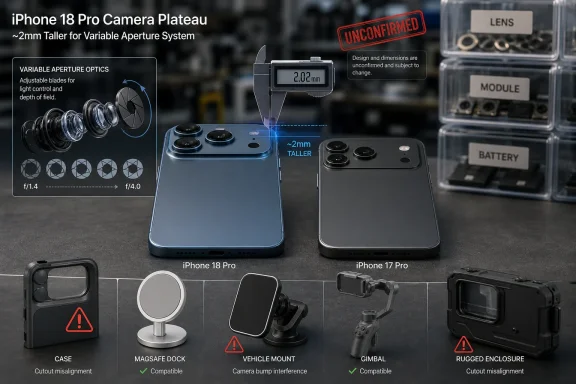
Apple’s iPhone 18 Pro is now the subject of a supply-chain rumor claiming the rear camera module, not necessarily the entire phone, could grow by about 2 millimeters. If that interpretation is right, the change would likely mean a taller camera plateau built to house a more complex rear-camera system, with the rumored variable-aperture lens as the most obvious reason. For buyers, admins, and accessory makers, the immediate takeaway is simple: do not assume iPhone 17 Pro cases, mounts, gimbals, desk chargers, scanning rigs, or rugged enclosures will carry forward cleanly if the camera bump expands.
The claim remains unconfirmed by Apple, and secondary reports do not describe it in exactly the same way. VOI.id presents the more cautious reading: the main body may remain close to the iPhone 17 Pro’s general size while the rear camera module becomes thicker. Technobezz frames the rumor more broadly and leaves room for a thicker overall device. Those are materially different outcomes. This article treats the 2 mm figure as a reported camera-module increase unless otherwise stated, because that is the clearest way to resolve the current ambiguity without overstating what Apple has confirmed.
For years, the iPhone’s premium story was easy to understand from across a room. It was thinner, cleaner, flatter, and more tightly machined than the last one, even when the practical gains were incremental. The iPhone 18 Pro rumor cuts against that instinct because a roughly 2 mm increase, if applied to a camera module, is still meaningful in smartphone design.
The first mistake is to read the rumor as proof that the entire phone is becoming dramatically thicker. VOI.id, working from Fixed Focus Digital’s Weibo claim, frames the more careful version: the iPhone 18 Pro’s main body is reportedly expected to stay broadly similar while the rear camera module grows. Technobezz’s account is more aggressive, suggesting the iPhone 18 Pro could be thicker overall. Because these claims are not identical, the safer reading is that the reported change concerns the rear camera structure unless later reporting or Apple’s own specifications say otherwise.
If only the camera plateau grows, this is Apple doing what the industry has been doing for years: placing more of the camera system in a raised island while preserving the basic feel of the main slab. If the whole chassis grows by around 2 mm, that would be a much louder design reversal and would require a stronger explanation involving camera hardware, battery layout, thermals, or all three.
The distinction matters for users and IT teams. A thicker camera module can affect cases, chargers, mounts, and flat-back accessories even if the phone body feels familiar in the hand. A thicker overall phone would also affect pockets, clamps, trays, enterprise charging stations, and rugged enclosures. Until the final dimensions are confirmed, accessory planning should focus on rear-clearance risk rather than assuming a full-body thickness jump.
That distinction is useful because camera modules are no longer minor features attached to a finished phone. They are major structural elements around which flagship phones are designed. A larger plateau can indicate larger optics, more stabilization hardware, additional mechanical parts, or a redesigned lens stack. It can also force changes in case depth, lens-protector shape, MagSafe ring alignment, and how the phone sits in docks.
The reported reason is Apple’s first variable-aperture lens for an iPhone. This remains a rumor, but it is a plausible explanation for a larger camera assembly. A variable aperture is not simply another computational photography label. It is a mechanical lens feature that changes the size of the opening through which light reaches the sensor. In a dedicated camera, aperture control can affect exposure and depth of field. In a phone, its usefulness depends on the size of the sensor, the lens design, Apple’s processing pipeline, and how much control Apple exposes or automates.
The mechanical part is the key. A fixed-aperture phone camera can be optimized around a simpler optical stack because the opening does not move. A variable-aperture system would need additional components, space, tolerances, calibration, and durability controls. That does not prove the iPhone 18 Pro will ship with the feature, and it does not prove the camera will be better in every situation. It does explain why a thicker camera plateau would be a believable engineering tradeoff.
The rumor stack therefore has a coherent shape without needing to overclaim. A leaker says the rear design is changing. VOI.id frames the 2 mm increase as more likely tied to the camera module than the whole device. Technobezz connects the change to camera hardware and supplier-linked materials. Apple has not confirmed any of it, but the internal logic is straightforward: if Apple adds a mechanically more complex camera feature, the rear module may need more room.
Those are possible benefits, not guaranteed outcomes. Smartphone sensors are still small compared with dedicated cameras, and the value of aperture control depends on the full optical system. A variable aperture on its own does not automatically mean dramatically better photos. Apple would need to integrate the hardware with autofocus, stabilization, image processing, video exposure behavior, and the camera app’s automatic decision-making.
That is why the camera-module rumor matters. If Apple is willing to enlarge the rear camera structure, it suggests the company may see enough value in a more complex lens assembly to accept a visible industrial-design compromise. It also suggests Apple may believe that some next-step camera improvements require physical space, not just image-processing changes.
Other phone makers have experimented with variable-aperture camera systems before, and the feature has not become universal. The reasons are practical: added cost, more space, mechanical complexity, and the challenge of explaining the benefit to people who just want better photos. Apple’s possible bet would be that it can make the hardware disappear into the normal camera experience so users see better results without needing to manage aperture settings manually.
For most buyers, the sales pitch would not be “variable aperture.” It would be more consistent photos and video in scenes where today’s phones still struggle. If that improvement is visible, a thicker camera island becomes easier to accept. If the difference is subtle, the bump will be remembered as bulk.
The table shows why the Pro Max may be the more affected buying decision if these filings are accurate. The reported gains are much larger on the Pro Max variants than on the smaller Pro variants. For users who treat the phone as a camera, hotspot, navigation device, authentication tool, and work terminal throughout the day, the difference between modest and meaningful battery growth can affect procurement choices.
The smaller iPhone 18 Pro looks less dramatic in the reported figures. A SIM-card model rising from 3,988 mAh to 4,056 mAh is a gain, but not one that would, by itself, explain a major redesign. The eSIM-only U.S. Pro moving from 4,252 mAh to 4,288 mAh is even less persuasive as the primary driver. That supports a cautious interpretation: the rumored camera system may be the main packaging pressure, while battery changes vary by model and region.
There is also speculation that Apple could pair the phone with a more efficient next-generation Pro chip. VOI.id frames chip efficiency as part of the battery-life discussion, but the exact performance and endurance results cannot be known until Apple announces the hardware and independent testing follows. The safe conclusion is narrower: if both camera hardware and battery capacity change, Apple could market the phone around endurance and imaging rather than around thinness.
That is how Apple usually turns engineering compromise into product narrative. The customer does not buy a thicker camera bump. The customer buys longer life, better camera behavior, and fewer moments when the phone feels constrained by its hardware.
The material question matters because Apple has used premium materials as part of the Pro identity. Stainless steel had weight and polish. Titanium carried a high-end, aerospace-coded feel. Aluminum can sound less exotic, but in a compact device that must manage heat from a high-end chip, camera processing, wireless radios, charging, and bright displays, thermal behavior can be a practical advantage.
Technobezz attributes favorable comments about aluminum’s heat dissipation to the leaker. That should be treated as a leaker claim rather than proof of Apple’s engineering rationale. Still, the idea is plausible enough to include cautiously: a Pro iPhone with a more complex camera system and potentially larger battery may benefit from a frame material that helps with weight, manufacturability, and heat movement.
The risk is finish durability and perceived premium quality. If Apple keeps aluminum for the iPhone 18 Pro, it will need finishes that hold up well under case grit, pocket wear, heat cycles, and small impacts. Reports of finish concerns on prior models should be treated cautiously unless tied to documented repair programs or broad evidence, but the general concern is real for any anodized or coated device used heavily in cases and mounts.
For enterprise and managed-device buyers, the material choice is less emotional but still relevant. A field phone may spend hours in navigation, video capture, mobile hotspot mode, barcode scanning, inspection apps, or authentication workflows. Thermal comfort, sustained performance, and finish wear inside rugged cases can affect support tickets and replacement timing. Aluminum is not automatically a downgrade if it supports those practical goals.
This story currently has several channels. Fixed Focus Digital is the Weibo leaker associated with the original thickness claim. VOI.id separates the camera-module interpretation from the whole-device interpretation and cautions that the account’s track record is mixed. Technobezz discusses Tata-linked materials, battery-capacity figures, and a broader thickness interpretation. These pieces overlap, but they should not be blended into one confirmed specification.
The more responsible reading is to separate rumor from synthesis:
Where the coverage diverges is on how much of the phone gets thicker. VOI.id leans toward the camera module as the likely location of the increase, while Technobezz leaves open a broader device-thickness change. The safe conclusion is not that the iPhone 18 Pro will definitely be a dramatically thicker slab. It is that Apple’s next Pro camera system is rumored to require visible physical accommodation.
VOI.id coverage — Camera-module interpretation: VOI.id reports that the increase is more likely tied to the rear camera module than to the whole body, while cautioning that the leaker’s record is mixed.
Technobezz coverage — Broader design and battery framing: Technobezz discusses Tata-linked materials, possible overall thickness implications, and reported battery-capacity figures from certification-related sources.
Pre-launch period — Accessory uncertainty: Case makers, mount vendors, and procurement teams should treat rear-camera clearance as unsettled until Apple publishes final dimensions.
Expected Apple launch window — Unconfirmed until Apple announces it: Apple has not confirmed the iPhone 18 Pro launch date in this rumor set, so any specific event-date claims should be treated as speculation unless Apple sends invitations or publishes official details.
A thicker iPhone 18 Pro camera module has practical consequences. Cases, gimbals, vehicle mounts, barcode scanning rigs, MagSafe accessories, desk chargers, lens protectors, and rugged enclosures may need revised tolerances. A 2 mm camera-module increase is not just something reviewers notice when they place the phone on a table. It can break assumptions in accessories designed around precise rear clearance.
The first IT implication is accessory timing. Organizations should avoid buying large volumes of iPhone 18 Pro accessories based on iPhone 17 Pro dimensions. Even when the main body dimensions remain similar, a taller rear camera plateau can interfere with flat charging pads, clamp-style mounts, lens covers, vehicle cradles, camera rigs, and protective cases with tight rear cutouts.
The second implication is model selection. If the reported battery figures hold, the Pro Max variants appear more likely to deliver noticeable endurance gains than the smaller Pro variants. Field teams using navigation, camera capture, mobile hotspot, Teams or Zoom calls, VPN, and authenticator apps may benefit more from the larger model, while office users may not need the extra size or cost.
The third implication is regional provisioning. The reported battery numbers distinguish between SIM-card and eSIM-only variants. For U.S. deployments, eSIM-only workflows already affect carrier activation, spare-device handling, travel support, and break-fix logistics. If battery capacity also differs by region or variant, procurement teams should avoid assuming one global iPhone 18 Pro specification.
The fourth implication is mount and case lifecycle. Rugged cases and scanning sleds are often purchased on longer cycles than phones. If the camera bump changes, organizations using point-of-sale scanning, field inspection, warehouse apps, law-enforcement capture, fleet navigation, or healthcare workflows may need new shells or adapters even if the phone’s width and height remain close to the prior generation.
If Apple does introduce the iPhone 18 Pro alongside a more attention-grabbing new form factor, the conventional Pro line will still need a clear identity. A larger camera module, a rumored variable-aperture lens, and possible battery gains would give the familiar Pro model a practical upgrade story even if another device gets more keynote drama.
The Pro iPhone has a different job from a radically new form factor. It has to reassure high-end buyers that the safest, most familiar Apple phone remains the one with the strongest camera system, predictable performance, and durable everyday design. A thicker camera module is a smaller controversy than a new device category, but it still signals a real design choice.
That division could help Apple manage risk. Experimental form factors tend to raise questions around durability, repairability, app behavior, display behavior, and pricing. A thicker iPhone 18 Pro camera module is easier to explain: Apple can argue, directly or indirectly, that the added physical space supports a better camera system and possibly better endurance.
For enterprise buyers, the difference is practical. A conventional Pro model with a larger camera bump is a deployment problem that can be solved with updated cases and mounts. A new form factor can be a much larger compatibility and support question. That makes the iPhone 18 Pro rumor worth watching even if the most novel Apple hardware gets more consumer attention.
The old design ideal treated flatness as elegance. The newer flagship tradeoff treats optical volume as capability. Larger sensors, stabilized optics, folded lens paths, complex lens assemblies, and a possible variable aperture all demand space. Software can enhance images, but it cannot eliminate the physical requirements of lenses, sensors, actuators, stabilization, and structural protection.
That is why the iPhone 18 Pro rumor feels larger than the measurement. Two millimeters is tiny on a ruler and meaningful in a flagship phone’s rear camera structure. It can be the difference between an accessory fitting and failing, between a camera assembly being possible and compromised, and between a marketing story centered on thinness and one centered on photographic control.
Apple is not alone here. The broader phone industry has already accepted large camera islands as the price of better mobile photography. What would make Apple’s move notable is the company’s tendency to wait until a hardware idea can be integrated into a mainstream user experience. If Apple is ready to thicken the Pro camera platform, it likely believes the camera payoff can be made visible enough to survive design criticism.
The risk is that users notice the bump more than the benefit. If the iPhone 18 Pro produces clearly better everyday photos and video, the extra rear height becomes part of the product’s capability story. If the improvement is visible only in narrow shooting conditions, buyers may see the change as another awkward camera island chasing diminishing returns.
The biggest unresolved issue is what the 2 mm number describes. It may refer to the full device, the rear camera module, part of the rear housing, or a translated shorthand that became broader as it moved through secondary coverage. VOI.id’s camera-module interpretation is the cleaner reading because it explains how the phone could keep a familiar body while still making room for a more complex camera system. Technobezz’s broader framing keeps the whole-device possibility alive, but that should be treated as less certain until firmer dimensional data appears.
The second unresolved issue is how much variable aperture would matter in normal use. Enthusiasts understand why physical aperture control can be valuable, but most iPhone owners do not shoot like camera hobbyists. Apple would need to translate the hardware into obvious outcomes, such as more consistent exposure, more natural depth behavior, improved video handling, or better results in difficult lighting.
The third issue is durability. A mechanical aperture system would add moving parts to a device that is dropped, heated, cooled, pocketed, mounted, shaken, charged, and repaired at enormous scale. Apple’s engineering challenge would not simply be making the aperture work. It would be making it work invisibly for years.
The fourth issue is accessory churn. A camera-module increase can cause real inconvenience even when the phone itself is not dramatically larger. Users may need new cases. Admins may need new mounts. Accessory makers may need deeper camera rings and revised rear cutouts. That is a mundane issue, but it is often the first way a design change becomes expensive.
The claim remains unconfirmed by Apple, and secondary reports do not describe it in exactly the same way. VOI.id presents the more cautious reading: the main body may remain close to the iPhone 17 Pro’s general size while the rear camera module becomes thicker. Technobezz frames the rumor more broadly and leaves room for a thicker overall device. Those are materially different outcomes. This article treats the 2 mm figure as a reported camera-module increase unless otherwise stated, because that is the clearest way to resolve the current ambiguity without overstating what Apple has confirmed.
 Apple’s Thinness Story Is Running Into Physics
For years, the iPhone’s premium story was easy to understand from across a room. It was thinner, cleaner, flatter, and more tightly machined than the last one, even when the practical gains were incremental. The iPhone 18 Pro rumor cuts against that instinct because a roughly 2 mm increase, if applied to a camera module, is still meaningful in smartphone design.The first mistake is to read the rumor as proof that the entire phone is becoming dramatically thicker. VOI.id, working from Fixed Focus Digital’s Weibo claim, frames the more careful version: the iPhone 18 Pro’s main body is reportedly expected to stay broadly similar while the rear camera module grows. Technobezz’s account is more aggressive, suggesting the iPhone 18 Pro could be thicker overall. Because these claims are not identical, the safer reading is that the reported change concerns the rear camera structure unless later reporting or Apple’s own specifications say otherwise.
If only the camera plateau grows, this is Apple doing what the industry has been doing for years: placing more of the camera system in a raised island while preserving the basic feel of the main slab. If the whole chassis grows by around 2 mm, that would be a much louder design reversal and would require a stronger explanation involving camera hardware, battery layout, thermals, or all three.
The distinction matters for users and IT teams. A thicker camera module can affect cases, chargers, mounts, and flat-back accessories even if the phone body feels familiar in the hand. A thicker overall phone would also affect pockets, clamps, trays, enterprise charging stations, and rugged enclosures. Until the final dimensions are confirmed, accessory planning should focus on rear-clearance risk rather than assuming a full-body thickness jump.
The 2 mm Leak Is Primarily a Camera-Module Claim
Fixed Focus Digital’s reported claim, posted on Weibo and discussed by VOI.id and Technobezz, centers on changes to the iPhone 18 Pro’s rear design and camera area. VOI.id says the rumor was initially interpreted by some as a whole-device thickness increase but that newer information points more likely to the rear camera module. Technobezz ties the added bulk to the camera plateau and broader body-design materials, but that account should still be treated as rumor, not specification.That distinction is useful because camera modules are no longer minor features attached to a finished phone. They are major structural elements around which flagship phones are designed. A larger plateau can indicate larger optics, more stabilization hardware, additional mechanical parts, or a redesigned lens stack. It can also force changes in case depth, lens-protector shape, MagSafe ring alignment, and how the phone sits in docks.
The reported reason is Apple’s first variable-aperture lens for an iPhone. This remains a rumor, but it is a plausible explanation for a larger camera assembly. A variable aperture is not simply another computational photography label. It is a mechanical lens feature that changes the size of the opening through which light reaches the sensor. In a dedicated camera, aperture control can affect exposure and depth of field. In a phone, its usefulness depends on the size of the sensor, the lens design, Apple’s processing pipeline, and how much control Apple exposes or automates.
The mechanical part is the key. A fixed-aperture phone camera can be optimized around a simpler optical stack because the opening does not move. A variable-aperture system would need additional components, space, tolerances, calibration, and durability controls. That does not prove the iPhone 18 Pro will ship with the feature, and it does not prove the camera will be better in every situation. It does explain why a thicker camera plateau would be a believable engineering tradeoff.
The rumor stack therefore has a coherent shape without needing to overclaim. A leaker says the rear design is changing. VOI.id frames the 2 mm increase as more likely tied to the camera module than the whole device. Technobezz connects the change to camera hardware and supplier-linked materials. Apple has not confirmed any of it, but the internal logic is straightforward: if Apple adds a mechanically more complex camera feature, the rear module may need more room.
Variable Aperture Is Not a Spec Sheet Gimmick, but It Is Not Magic Either
A variable aperture could give Apple a more flexible main camera, especially in situations where current phone cameras rely heavily on software to work around optical constraints. In bright light, aperture control could help manage incoming light before software processing begins. In closer shots, it could help shape depth-of-field behavior more directly than a fixed opening. For video, more physical control over light could give Apple another tool for balancing exposure and motion.Those are possible benefits, not guaranteed outcomes. Smartphone sensors are still small compared with dedicated cameras, and the value of aperture control depends on the full optical system. A variable aperture on its own does not automatically mean dramatically better photos. Apple would need to integrate the hardware with autofocus, stabilization, image processing, video exposure behavior, and the camera app’s automatic decision-making.
That is why the camera-module rumor matters. If Apple is willing to enlarge the rear camera structure, it suggests the company may see enough value in a more complex lens assembly to accept a visible industrial-design compromise. It also suggests Apple may believe that some next-step camera improvements require physical space, not just image-processing changes.
Other phone makers have experimented with variable-aperture camera systems before, and the feature has not become universal. The reasons are practical: added cost, more space, mechanical complexity, and the challenge of explaining the benefit to people who just want better photos. Apple’s possible bet would be that it can make the hardware disappear into the normal camera experience so users see better results without needing to manage aperture settings manually.
For most buyers, the sales pitch would not be “variable aperture.” It would be more consistent photos and video in scenes where today’s phones still struggle. If that improvement is visible, a thicker camera island becomes easier to accept. If the difference is subtle, the bump will be remembered as bulk.
The Battery Numbers Make the Design Trade Easier to Sell
The camera is the headline, but reported battery-capacity changes make the design trade easier to understand. Technobezz describes battery data from separate Chinese certification filings, with different figures for SIM-card and eSIM-only variants. These numbers remain unconfirmed, but they suggest the Pro Max variants may benefit more than the smaller Pro models, which matters for buyers choosing between portability and endurance.| Model and variant | iPhone 17 battery | iPhone 18 battery | Reported gain | Practical read |
|---|---|---|---|---|
| SIM-card iPhone Pro | 3,988 mAh | 4,056 mAh | +68 mAh | Small gain, unlikely to be the main reason for a larger design |
| SIM-card iPhone Pro Max | 4,823 mAh | 5,391 mAh | +568 mAh | Meaningful increase if the reported values hold |
| eSIM-only U.S. iPhone Pro | 4,252 mAh | 4,288 mAh | +36 mAh | Minimal reported change for the smaller U.S. Pro variant |
| eSIM-only U.S. iPhone Pro Max | 5,088 mAh | 5,567 mAh | +479 mAh | Large enough to matter for heavy users if confirmed |
The smaller iPhone 18 Pro looks less dramatic in the reported figures. A SIM-card model rising from 3,988 mAh to 4,056 mAh is a gain, but not one that would, by itself, explain a major redesign. The eSIM-only U.S. Pro moving from 4,252 mAh to 4,288 mAh is even less persuasive as the primary driver. That supports a cautious interpretation: the rumored camera system may be the main packaging pressure, while battery changes vary by model and region.
There is also speculation that Apple could pair the phone with a more efficient next-generation Pro chip. VOI.id frames chip efficiency as part of the battery-life discussion, but the exact performance and endurance results cannot be known until Apple announces the hardware and independent testing follows. The safe conclusion is narrower: if both camera hardware and battery capacity change, Apple could market the phone around endurance and imaging rather than around thinness.
That is how Apple usually turns engineering compromise into product narrative. The customer does not buy a thicker camera bump. The customer buys longer life, better camera behavior, and fewer moments when the phone feels constrained by its hardware.
Aluminum Is No Longer the Cheap Option in This Story
The material rumor is also revealing. Fixed Focus Digital reportedly says Apple is sticking with aluminum alloy mid-frames for the Pro lineup rather than returning to titanium. VOI.id also says aluminum remains the main choice, presenting heat dissipation, lower weight, and production efficiency as possible reasons. Those are interpretations, not Apple’s official explanation.The material question matters because Apple has used premium materials as part of the Pro identity. Stainless steel had weight and polish. Titanium carried a high-end, aerospace-coded feel. Aluminum can sound less exotic, but in a compact device that must manage heat from a high-end chip, camera processing, wireless radios, charging, and bright displays, thermal behavior can be a practical advantage.
Technobezz attributes favorable comments about aluminum’s heat dissipation to the leaker. That should be treated as a leaker claim rather than proof of Apple’s engineering rationale. Still, the idea is plausible enough to include cautiously: a Pro iPhone with a more complex camera system and potentially larger battery may benefit from a frame material that helps with weight, manufacturability, and heat movement.
The risk is finish durability and perceived premium quality. If Apple keeps aluminum for the iPhone 18 Pro, it will need finishes that hold up well under case grit, pocket wear, heat cycles, and small impacts. Reports of finish concerns on prior models should be treated cautiously unless tied to documented repair programs or broad evidence, but the general concern is real for any anodized or coated device used heavily in cases and mounts.
For enterprise and managed-device buyers, the material choice is less emotional but still relevant. A field phone may spend hours in navigation, video capture, mobile hotspot mode, barcode scanning, inspection apps, or authentication workflows. Thermal comfort, sustained performance, and finish wear inside rugged cases can affect support tickets and replacement timing. Aluminum is not automatically a downgrade if it supports those practical goals.
The Supply Chain Is Telling the Story Before Apple Can
Apple has not confirmed the iPhone 18 Pro’s design, materials, camera system, battery capacities, or launch details. That sentence should sit under every rumor about this device. Supply-chain leaks can be directionally useful, but they can also be wrong on final dimensions, regional variants, component choices, or interpretation.This story currently has several channels. Fixed Focus Digital is the Weibo leaker associated with the original thickness claim. VOI.id separates the camera-module interpretation from the whole-device interpretation and cautions that the account’s track record is mixed. Technobezz discusses Tata-linked materials, battery-capacity figures, and a broader thickness interpretation. These pieces overlap, but they should not be blended into one confirmed specification.
The more responsible reading is to separate rumor from synthesis:
- VOI.id’s key contribution: the roughly 2 mm increase may refer to the rear camera module rather than the entire iPhone 18 Pro body.
- Technobezz’s key contribution: the report connects the added bulk to supplier-linked material claims, battery-capacity figures, and the possibility of a thicker overall device.
- Synthesis: a larger camera plateau is technically consistent with a rumored variable-aperture camera, but Apple has not confirmed that feature or the final dimensions.
- Unresolved point: the phrase “2 mm thicker” may describe the camera island, an internal or external rear assembly, or the overall phone depending on the source and interpretation.
Where the coverage diverges is on how much of the phone gets thicker. VOI.id leans toward the camera module as the likely location of the increase, while Technobezz leaves open a broader device-thickness change. The safe conclusion is not that the iPhone 18 Pro will definitely be a dramatically thicker slab. It is that Apple’s next Pro camera system is rumored to require visible physical accommodation.
Timeline
Current rumor stage — Fixed Focus Digital on Weibo: A supply-chain-linked claim says the iPhone 18 Pro’s rear design could grow by about 2 mm, with later interpretation focusing on the camera module.VOI.id coverage — Camera-module interpretation: VOI.id reports that the increase is more likely tied to the rear camera module than to the whole body, while cautioning that the leaker’s record is mixed.
Technobezz coverage — Broader design and battery framing: Technobezz discusses Tata-linked materials, possible overall thickness implications, and reported battery-capacity figures from certification-related sources.
Pre-launch period — Accessory uncertainty: Case makers, mount vendors, and procurement teams should treat rear-camera clearance as unsettled until Apple publishes final dimensions.
Expected Apple launch window — Unconfirmed until Apple announces it: Apple has not confirmed the iPhone 18 Pro launch date in this rumor set, so any specific event-date claims should be treated as speculation unless Apple sends invitations or publishes official details.
Why This Matters to Windows Users and IT Shops
WindowsForum readers may reasonably ask why an iPhone camera bump belongs in the same conversation as PCs, endpoint management, and enterprise infrastructure. The answer is that the iPhone is rarely just a personal gadget anymore. It is a camera, identity token, hotspot, authenticator, field workstation, scanner, and managed endpoint that often sits beside Windows laptops in the same fleet.A thicker iPhone 18 Pro camera module has practical consequences. Cases, gimbals, vehicle mounts, barcode scanning rigs, MagSafe accessories, desk chargers, lens protectors, and rugged enclosures may need revised tolerances. A 2 mm camera-module increase is not just something reviewers notice when they place the phone on a table. It can break assumptions in accessories designed around precise rear clearance.
The first IT implication is accessory timing. Organizations should avoid buying large volumes of iPhone 18 Pro accessories based on iPhone 17 Pro dimensions. Even when the main body dimensions remain similar, a taller rear camera plateau can interfere with flat charging pads, clamp-style mounts, lens covers, vehicle cradles, camera rigs, and protective cases with tight rear cutouts.
The second implication is model selection. If the reported battery figures hold, the Pro Max variants appear more likely to deliver noticeable endurance gains than the smaller Pro variants. Field teams using navigation, camera capture, mobile hotspot, Teams or Zoom calls, VPN, and authenticator apps may benefit more from the larger model, while office users may not need the extra size or cost.
The third implication is regional provisioning. The reported battery numbers distinguish between SIM-card and eSIM-only variants. For U.S. deployments, eSIM-only workflows already affect carrier activation, spare-device handling, travel support, and break-fix logistics. If battery capacity also differs by region or variant, procurement teams should avoid assuming one global iPhone 18 Pro specification.
The fourth implication is mount and case lifecycle. Rugged cases and scanning sleds are often purchased on longer cycles than phones. If the camera bump changes, organizations using point-of-sale scanning, field inspection, warehouse apps, law-enforcement capture, fleet navigation, or healthcare workflows may need new shells or adapters even if the phone’s width and height remain close to the prior generation.
Action checklist for admins
- Delay bulk accessory purchases until Apple confirms final iPhone 18 Pro and iPhone 18 Pro Max dimensions.
- Ask vendors specifically for rear camera-bump clearance, not just height, width, and body thickness.
- Audit mounts, docks, rugged cases, scanning sleds, gimbals, charging pads, and vehicle cradles that depend on flat-back alignment.
- Separate procurement assumptions for iPhone 18 Pro and iPhone 18 Pro Max, especially where battery life drives the purchase.
- Treat reported SIM-card and eSIM-only battery differences as unconfirmed until official specifications and teardown data are available.
- Review eSIM provisioning workflows before ordering U.S. variants at scale.
- Warn support teams that “2 mm thicker” reports may refer to the camera module rather than the full body.
- For camera-heavy field teams, wait for real-world testing before treating variable aperture as a workflow upgrade.
- Build a short accessory-validation window into rollout plans before approving fleet-wide deployment.
- Keep at least one prior-generation accessory option available until new mounts and cases are verified.
Apple Is Preparing a More Complicated September
The expected iPhone 18 Pro launch window sits in Apple’s usual fall hardware cycle, but Apple has not confirmed the event date or product lineup discussed in these reports. Any specific date claims should be treated as speculation unless Apple announces the event. Reports also suggest Apple may be preparing a broader iPhone lineup that could include more than the conventional Pro models, but those claims remain outside the confirmed fact set.If Apple does introduce the iPhone 18 Pro alongside a more attention-grabbing new form factor, the conventional Pro line will still need a clear identity. A larger camera module, a rumored variable-aperture lens, and possible battery gains would give the familiar Pro model a practical upgrade story even if another device gets more keynote drama.
The Pro iPhone has a different job from a radically new form factor. It has to reassure high-end buyers that the safest, most familiar Apple phone remains the one with the strongest camera system, predictable performance, and durable everyday design. A thicker camera module is a smaller controversy than a new device category, but it still signals a real design choice.
That division could help Apple manage risk. Experimental form factors tend to raise questions around durability, repairability, app behavior, display behavior, and pricing. A thicker iPhone 18 Pro camera module is easier to explain: Apple can argue, directly or indirectly, that the added physical space supports a better camera system and possibly better endurance.
For enterprise buyers, the difference is practical. A conventional Pro model with a larger camera bump is a deployment problem that can be solved with updated cases and mounts. A new form factor can be a much larger compatibility and support question. That makes the iPhone 18 Pro rumor worth watching even if the most novel Apple hardware gets more consumer attention.
The Camera Now Owns More of the Phone
Smartphone design has quietly inverted. The camera used to fit into the phone; now the phone is increasingly designed around the camera. Apple’s Pro line has been moving in that direction for years, and a visibly thicker camera module would make the hierarchy harder to ignore.The old design ideal treated flatness as elegance. The newer flagship tradeoff treats optical volume as capability. Larger sensors, stabilized optics, folded lens paths, complex lens assemblies, and a possible variable aperture all demand space. Software can enhance images, but it cannot eliminate the physical requirements of lenses, sensors, actuators, stabilization, and structural protection.
That is why the iPhone 18 Pro rumor feels larger than the measurement. Two millimeters is tiny on a ruler and meaningful in a flagship phone’s rear camera structure. It can be the difference between an accessory fitting and failing, between a camera assembly being possible and compromised, and between a marketing story centered on thinness and one centered on photographic control.
Apple is not alone here. The broader phone industry has already accepted large camera islands as the price of better mobile photography. What would make Apple’s move notable is the company’s tendency to wait until a hardware idea can be integrated into a mainstream user experience. If Apple is ready to thicken the Pro camera platform, it likely believes the camera payoff can be made visible enough to survive design criticism.
The risk is that users notice the bump more than the benefit. If the iPhone 18 Pro produces clearly better everyday photos and video, the extra rear height becomes part of the product’s capability story. If the improvement is visible only in narrow shooting conditions, buyers may see the change as another awkward camera island chasing diminishing returns.
The Rumor Still Has Several Failure Points
The safest way to read this leak is as a plausible design direction, not a finished spec sheet. Fixed Focus Digital has reportedly leaked Apple-related information before, but VOI.id cautions that the account’s track record is mixed. Supply-chain leaks can be accurate on components and wrong on final assembly. Accessory guidance can reflect conservative tolerances rather than finished retail hardware. Certification-related battery figures can describe regional variants that confuse broader comparisons.The biggest unresolved issue is what the 2 mm number describes. It may refer to the full device, the rear camera module, part of the rear housing, or a translated shorthand that became broader as it moved through secondary coverage. VOI.id’s camera-module interpretation is the cleaner reading because it explains how the phone could keep a familiar body while still making room for a more complex camera system. Technobezz’s broader framing keeps the whole-device possibility alive, but that should be treated as less certain until firmer dimensional data appears.
The second unresolved issue is how much variable aperture would matter in normal use. Enthusiasts understand why physical aperture control can be valuable, but most iPhone owners do not shoot like camera hobbyists. Apple would need to translate the hardware into obvious outcomes, such as more consistent exposure, more natural depth behavior, improved video handling, or better results in difficult lighting.
The third issue is durability. A mechanical aperture system would add moving parts to a device that is dropped, heated, cooled, pocketed, mounted, shaken, charged, and repaired at enormous scale. Apple’s engineering challenge would not simply be making the aperture work. It would be making it work invisibly for years.
The fourth issue is accessory churn. A camera-module increase can cause real inconvenience even when the phone itself is not dramatically larger. Users may need new cases. Admins may need new mounts. Accessory makers may need deeper camera rings and revised rear cutouts. That is a mundane issue, but it is often the first way a design change becomes expensive.
The Practical Read Before the Keynote
The iPhone 18 Pro rumor is best understood as a packaging story with camera, battery, thermal, material, and accessory consequences. The claim may narrow or change before launch, but the direction is specific enough that buyers and IT teams should plan around uncertainty rather than assume the iPhone 18 Pro will fit every iPhone 17 Pro accessory.- The most cautious interpretation is a thicker rear camera module, not a confirmed 2 mm increase across the whole phone.
- The rumored variable-aperture lens is a plausible explanation for added camera-module volume.
- Battery gains, if the reported figures are accurate, appear more meaningful on the Pro Max than on the smaller Pro.
- Aluminum alloy remaining in the Pro line is rumored, with heat, weight, and production efficiency offered as possible reasons rather than confirmed Apple rationale.
- Accessory compatibility may be the first real-world pain point if the camera plateau grows.
- Windows and IT teams should validate cases, mounts, docks, scanning sleds, and eSIM workflows before bulk deployment.
- Apple has not confirmed the design, camera hardware, battery capacities, materials, event date, or launch timing.
References
- Primary source: voi.id
Published: Thu, 09 Jul 2026 01:13:59 GMT
iPhone 18 Pro Leaks Make You Shocked! Camera Module is Said to be Thicker
The iPhone 18 Pro is rumored to come with a camera module that is about 2 mm thicker. This change is allegedly related to the increase in cameras and a larger battery.voi.id - Independent coverage: Technobezz
Published: 2026-07-08T18:10:10.691813
iPhone 18 Pro Will Be Roughly 2mm Thicker Than iPhone 17 Pro According to Leaker | Technobezz
Leaked details reveal the iPhone 18 Pro will be 2mm thicker than its predecessor, driven by a new variable aperture camera system.www.technobezz.com - Related coverage: 9to5mac.com
Weibo leaker says iPhone 18 Pro thickness will be ‘surprising’ - 9to5Mac
Days after materials from Apple supplier Tata surfaced online, prominent Weibo leaker “Fixed Focus Digital” doubled down on his earlier claim that the iPhone 18 Pro will be thicker than the iPhone 17 Pro.9to5mac.com - Related coverage: owler.com
- Related coverage: phonearena.com
iPhone 18 Pro camera module will reportedly be a little thicker, but that is actually good news - PhoneArena
The thicker rear camera module turns out to be a positive sign for the iPhone 18 Pro's Main camera.www.phonearena.com - Related coverage: whatmobile.com.pk
Apple iPhone 18 Pro to Get Major Camera Upgrade at the Expense of a Thicker Body - WhatMobile news
A leak has been circulating about some big upgrade coming to iPhone 18 Pro’s main camera. Fixed Focus Digital is at it again, and they seem to have found some new info about the next Pro iPhone thawww.whatmobile.com.pk
- Related coverage: tomsguide.com
iPhone 18 Pro could be the first iPhone to get a variable aperture camera — here's why that matters | Tom's Guide
A well-known source has indicated that Apple plans to add variable camera apertures to the next generation of iPhones.www.tomsguide.com - Related coverage: techspot.com
iPhone 18 Pro to lead Apple's four-phase camera upgrade strategy | TechSpot
Digital Chat Station, a popular account on the Chinese social media app Weibo, claims the iPhone 18 Pro and Pro Max will ship with the new feature...www.techspot.com - Related coverage: forbes.com
Supply Chain Leaks Confirm iPhone 18 Pro To Receive Radical Camera Upgrade
Supply chain leaks confirm the iPhone 18 Pro camera is getting a variable aperture lens. This is why it's so important.www.forbes.com - Related coverage: macrumors.com
iPhone 18 Pro Variable Aperture Camera Enters Production
Apple has started ramping up its supply chain for a new variable aperture camera system expected to debut in the iPhone 18 Pro and Pro Max this September, reports Korea's ETNews. Apple has never implemented a variable aperture on an iPhone. From the iPhone 14 Pro through the iPhone 17 Pro...www.macrumors.com - Related coverage: digitalcameraworld.com
Ever wondered what the definition of a "real" camera was? Rumors say Apple has decided to tell you – with the iPhone 18 Pro... | Digital Camera World
Testing leaks suggest Apple is about to bring a feature to the iPhone 18 Pro no previous Apple camera has had \u2013 and with that, it'll be a "real camera"www.digitalcameraworld.com - Related coverage: t3.com
Apple could be planning a major overhaul of the iPhone 18 Pro – but surely this is too far? | T3
Next year's flagship iPhone could see some major changeswww.t3.com - Official source: apple.com
iPhone 17 Pro and 17 Pro Max - Technical Specifications - Apple (BH)
View all technical specifications for iPhone 17 Pro and iPhone 17 Pro Max.www.apple.com - Related coverage: media.bechtle.com
- Related coverage: cuit.columbia.edu
- Related coverage: techradar.com
Apple iPhone 17 Pro Max review: a new design and powerful cameras make this the best iPhone ever | TechRadar
Orange you glad they made it?www.techradar.com - Related coverage: androidcentral.com
Apple iPhone 17 Pro review: A bigger upgrade than I realized | Android Central
With a bigger battery, new cameras, and bold design, this is the biggest iPhone Pro upgrade in four years.www.androidcentral.com - Related coverage: elpais.com
iPhone 17 Pro Max: lo mejor y lo peor del móvil más potente de Apple | Tecnología | EL PAÍS
EL PAÍS pone a prueba el teléfono, que destaca por una batería que dura más o por una cámara muy renovada y ahora especializada en selfis; frente sus competidores, desentona por la falta de funciones de IA realmente innovadoraselpais.com - Related coverage: cincodias.elpais.com
Aparecen unas fotos del iPhone 17 Pro, y hay sorpresa en su increíble batería | Smartphones | Smartlife | Cinco Días
Este componente será sorprendentemente delgado y más grande de lo que se esperaba inicialmente, lo que son muy buenas noticias.cincodias.elpais.com - Related coverage: theapplepost.com
Apple’s iPhone 18 event could take place on September 9, with pre-orders rumored for September 10 | The Apple Post
Apple is likely to unveil its next-generation iPhone lineup on Wednesday, September 9, according to… www.theapplepost.com
- Related coverage: 91mobiles.com
iPhone 18 Pro and Ultra tipped to launch either on September 8th or 9th | 91mobiles.com
Unlike previous years, the September Apple keynote is expected to focus solely on the iPhone 18 Pro models and the iPhone Ultra.www.91mobiles.com - Related coverage: ibtimes.com.au
Apple's iPhone 18 Pro and iPhone Ultra Could Likely Launch on This Exact September Date, Analyst Says
Apple is expected to unveil the iPhone 18 Pro and its first foldable iPhone in early September, amidst pricing challenges due to a global memory chip shortage.www.ibtimes.com.au - Related coverage: gizbot.com
iPhone 18 Pro and iPhone Ultra Launch Timeline Tipped - Gizbot News
Apple hasnt announced anything yet, but Bloombergs Mark Gurman has laid out what the iPhone 18 launch could look like, and there are a couple of details worth paying attention to beyond just the date.www.gizbot.com - Related coverage: ilounge.com
Upgrade for iPhone 18 Pro Camera to Cost More than Half for Apple | iLounge
The new variable aperture lens for the iPhone 18 Pro Max and Pro models will cost the company 50% more than the unit camera that is used for the current ...www.ilounge.com
