

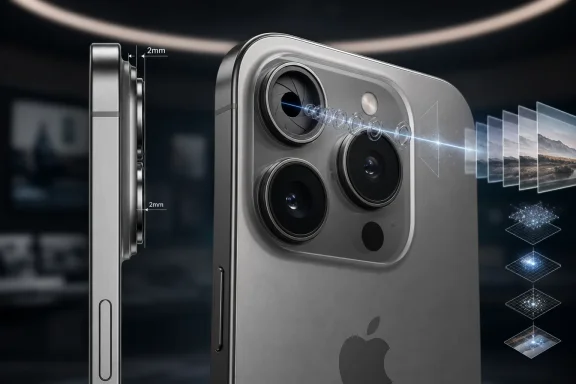
Apple’s iPhone 18 Pro is now rumored, as of June 24, 2026, to pair a larger main camera system with a body or camera plateau roughly 2mm thicker, according to reports tracing the claim to Weibo leaker Fixed Focus Digital. That single number is doing a lot of work. If accurate, it suggests Apple may be preparing to trade one of the iPhone’s longest-running industrial-design obsessions — thinness — for a more serious optical stack. The interesting story is not that next year’s Pro iPhone may have a better camera; it is that Apple may finally be admitting that computational photography cannot repeal physics forever.
For years, the iPhone camera bump has been treated like a design compromise Apple would rather you stop noticing. It began as a small protrusion, became a square island, and in recent Pro models has grown into a dominant feature of the device’s rear identity. The rumored iPhone 18 Pro leak pushes that evolution into more explicit territory: the camera module is no longer an accessory to the phone’s design, but one of the main things shaping it.
The latest claim is frustratingly imprecise in the way supply-chain leaks often are. The reported “2mm” increase may refer to the camera bump, the rear camera plateau, or the general thickness of the device. When pressed for clarification, the leaker reportedly answered in a way that still leaves room for interpretation rather than providing a clean engineering measurement.
That ambiguity matters. A 2mm increase to the camera bump is noticeable but unsurprising in a world where flagship phones already resemble compact cameras with screens attached. A 2mm increase to the body itself would be much more dramatic, moving the iPhone Pro line into a design posture Apple has historically avoided unless it could sell the change as battery, durability, or camera progress.
Either way, the rumor fits a broader pattern. Multiple reports over the past year have pointed toward a variable-aperture main camera for the iPhone 18 Pro and iPhone 18 Pro Max, alongside a physically larger primary camera system. Those two changes would not be cosmetic. They require space, precision parts, and a willingness to accept mechanical complexity inside a device category Apple has spent nearly two decades sealing, flattening, and simplifying.
In practical terms, this could let an iPhone use a wider aperture in low light and a narrower aperture in bright scenes or close-up shots where more depth of field is useful. It could also give Apple’s camera software another hardware control to work with, especially in Pro modes where photographers want less automation and more predictable output. This is not the same as turning an iPhone into a mirrorless camera, but it does move the phone slightly closer to the vocabulary of conventional photography.
The catch is that variable aperture is not magic. Smartphones have tiny optical systems compared with full-size cameras, and the creative difference between aperture settings can be modest unless the sensor and lens are also meaningfully larger. Samsung experimented with variable aperture years ago, and while it was technically impressive, it did not permanently reshape the smartphone market.
That history is why the reported thickness increase is the more revealing part of the iPhone 18 Pro rumor. If Apple were merely adding a minor iris mechanism to an otherwise familiar camera, the design trade-off might look excessive. If Apple is combining variable aperture with a larger sensor and more ambitious optics, however, the thicker camera structure starts to make more sense.
Apple’s modern iPhone camera strategy has been built around a careful mix of hardware upgrades and computational photography. The company moved the Pro line to 48-megapixel main sensors, leaned into pixel binning, improved image pipelines, and turned features like Night mode, Portrait mode, and Photonic Engine into everyday selling points. The result is a phone camera that is extremely reliable, especially for users who do not want to think about photography.
But that reliability has also created a ceiling. Computational photography can brighten dark scenes, simulate blur, stack exposures, and infer details, but it cannot collect photons that never reached the sensor. As Android rivals have pushed larger sensors, periscope zoom systems, and more aggressive camera hardware, Apple’s preference for controlled, balanced imaging has begun to look conservative to some enthusiasts.
A physically larger iPhone 18 Pro main camera would be Apple’s answer to that pressure. It would not mean abandoning computational photography. It would mean feeding the computational pipeline better raw material, which is exactly the sort of move Apple prefers: a hardware change that makes its software advantage more convincing.
Apple has spent years training customers to accept protruding camera systems while preserving the idea that the phone itself remains sleek. The trick has been to let the camera bump grow while keeping the main chassis within familiar bounds. That way, the device still feels thin in marketing photos, even if it wobbles on a table without a case.
If the iPhone 18 Pro’s camera plateau grows by about 2mm, Apple can probably absorb the change visually. Cases will smooth it over, reviewers will complain for a week, and users will adapt. If the body itself grows by that amount, Apple will need a stronger argument.
That argument could be battery life. It could be thermals. It could be structural strength. But the camera would almost certainly be the visible excuse, because Apple’s Pro iPhones are now sold as much to creators as to traditional smartphone buyers. The iPhone Pro is a communications device, a gaming device, a secure wallet, and a pocket computer, but its annual stage time is increasingly organized around what its cameras can do.
If Apple is increasing camera hardware complexity, the rest of the enclosure becomes a balancing act. A larger camera assembly adds mass and takes internal volume. A variable aperture introduces moving parts. A bigger sensor and lens stack may affect durability, repairability, and drop behavior. Materials become part of the engineering response, not just a finish choice.
The iPhone 17 Pro generation already pushed Apple toward a more camera-centered rear design. If the iPhone 18 Pro continues that path, the company may be less interested in preserving the old jewelry-like minimalism and more interested in building a mobile imaging device that happens to run iOS. That would be a subtle but important shift.
For WindowsForum readers, the relevant comparison is not just other phones. It is the way laptops changed when webcams, microphones, NPUs, and thermal systems became central to the product rather than peripheral checkboxes. Once a capability becomes strategic, the hardware bends around it. The iPhone camera is now that kind of strategic component.
If that timeline holds, the iPhone 18 Pro will have to carry the fall launch more or less on its own. That changes the marketing calculus. A routine processor bump, slightly brighter display, and modest camera tuning would feel thin if the non-Pro models are absent or delayed. A visibly more serious camera system gives Apple a cleaner story.
This is where the camera bump becomes more than a component leak. It becomes part of launch strategy. Apple can tolerate a thicker or more prominent device if the product narrative says this is the iPhone for people who create, shoot, edit, travel, and replace dedicated gear with a phone.
The rumored iPhone Ultra complicates that picture. If Apple introduces a higher-end model above Pro, it may reserve some design or camera features for that tier. But the current reports still point to the iPhone 18 Pro and Pro Max as the first beneficiaries of the variable-aperture main camera. That suggests Apple sees the feature not as a boutique experiment, but as central to the next Pro identity.
Smartphone upgrades have become uneven. Processors are faster than most users need, screens are already excellent, and battery life improves in increments. Cameras remain one of the few areas where ordinary users can instantly see a difference, especially in difficult lighting or motion-heavy scenes.
A larger sensor and variable aperture could produce improvements that show up without needing a benchmark chart. Better low-light portraits, cleaner indoor video, more natural background separation, and less reliance on heavy-handed processing would all be the kind of gains users notice in family photos, travel shots, and social video. The question is whether Apple tunes the system for naturalism or simply uses the new hardware to push its existing computational look further.
Annual upgraders should be more skeptical. If you already own a recent Pro iPhone, the iPhone 18 Pro’s rumored camera hardware may be less about solving a problem you have and more about future-proofing Apple’s imaging platform. The most meaningful benefits may emerge over several years as iOS camera features, third-party apps, and video workflows learn to exploit the hardware.
A variable-aperture camera adds another mechanism to a device that users drop, heat, cool, pocket, mount on motorcycles, take to beaches, and use in rain. Even if the mechanism is tiny and robust, Apple will need to validate it across millions of units. A camera feature that fails after two years would be far more damaging to the Pro brand than a software feature that ships late.
That may explain why the rumor has taken so long to mature. Variable-aperture iPhone speculation has floated for multiple cycles, sometimes attached to earlier models before being pushed further out. Apple often waits until it can integrate a technology at scale rather than being first with a fragile implementation.
The trade-off is that competitors get to set expectations. Android manufacturers have tested bigger sensors, longer zoom systems, variable apertures, and unusual camera hardware more openly. Apple’s slower approach can look boring until the company ships a version that is polished enough for the mainstream. The iPhone 18 Pro rumor, if accurate, is Apple choosing the moment when the risk is finally worth the payoff.
Higher-quality capture usually means larger files. ProRes, high-resolution photos, spatial media, log video, and advanced HDR already create friction for users moving between iPhone and Windows PCs. A more capable iPhone 18 Pro camera could intensify that divide if Apple leans further into formats and workflows that feel native on macOS but merely tolerated on Windows.
For IT departments, the issue is not whether employees can take prettier photos. It is whether mobile capture becomes a larger part of business documentation, training, marketing, field reporting, inspections, and support. A better iPhone camera can quietly raise expectations for what a “quick phone video” should look like, and those files still need to be stored, secured, transferred, indexed, and sometimes preserved for compliance.
For creators who edit on Windows, the rumored upgrade is a reminder that the phone is now part of the workstation. The camera captures; the PC ingests, edits, backs up, and publishes. Apple may prefer to tell that story with a MacBook in the frame, but plenty of serious iPhone footage ends up on Windows desktops with NVIDIA GPUs and calibrated monitors.
This particular leak deserves attention because it aligns with earlier reporting about variable aperture, production preparation, and a broader camera push. It does not deserve certainty. The exact thickness increase is unclear, the final product name is unconfirmed, and Apple can still alter hardware plans before launch.
There is also a difference between engineering samples and shipping devices. Prototypes can be thicker, heavier, or more experimental than retail hardware. A supply-chain observer may see a component change without seeing the final enclosure. A leaker may correctly identify a direction but miss the implementation.
The responsible reading is therefore conditional: Apple appears to be testing or preparing a more ambitious iPhone 18 Pro camera system, and that system may require a visibly thicker camera structure. The exact measurement and user-facing impact remain unresolved. That uncertainty does not make the rumor meaningless; it makes it a signpost rather than a verdict.
 Apple’s Camera Bump Has Become the Product Roadmap
For years, the iPhone camera bump has been treated like a design compromise Apple would rather you stop noticing. It began as a small protrusion, became a square island, and in recent Pro models has grown into a dominant feature of the device’s rear identity. The rumored iPhone 18 Pro leak pushes that evolution into more explicit territory: the camera module is no longer an accessory to the phone’s design, but one of the main things shaping it.The latest claim is frustratingly imprecise in the way supply-chain leaks often are. The reported “2mm” increase may refer to the camera bump, the rear camera plateau, or the general thickness of the device. When pressed for clarification, the leaker reportedly answered in a way that still leaves room for interpretation rather than providing a clean engineering measurement.
That ambiguity matters. A 2mm increase to the camera bump is noticeable but unsurprising in a world where flagship phones already resemble compact cameras with screens attached. A 2mm increase to the body itself would be much more dramatic, moving the iPhone Pro line into a design posture Apple has historically avoided unless it could sell the change as battery, durability, or camera progress.
Either way, the rumor fits a broader pattern. Multiple reports over the past year have pointed toward a variable-aperture main camera for the iPhone 18 Pro and iPhone 18 Pro Max, alongside a physically larger primary camera system. Those two changes would not be cosmetic. They require space, precision parts, and a willingness to accept mechanical complexity inside a device category Apple has spent nearly two decades sealing, flattening, and simplifying.
Variable Aperture Is a Small Door Into a Bigger Argument
The phrase variable aperture sounds like camera-nerd garnish, but it describes a meaningful difference between most phone cameras and dedicated cameras. A fixed-aperture smartphone lens is always open at one set aperture, leaving exposure, depth of field, and motion handling to sensor behavior, shutter speed, ISO, image processing, and software tricks. A variable aperture adds a physical iris or equivalent mechanism that can change how much light reaches the sensor.In practical terms, this could let an iPhone use a wider aperture in low light and a narrower aperture in bright scenes or close-up shots where more depth of field is useful. It could also give Apple’s camera software another hardware control to work with, especially in Pro modes where photographers want less automation and more predictable output. This is not the same as turning an iPhone into a mirrorless camera, but it does move the phone slightly closer to the vocabulary of conventional photography.
The catch is that variable aperture is not magic. Smartphones have tiny optical systems compared with full-size cameras, and the creative difference between aperture settings can be modest unless the sensor and lens are also meaningfully larger. Samsung experimented with variable aperture years ago, and while it was technically impressive, it did not permanently reshape the smartphone market.
That history is why the reported thickness increase is the more revealing part of the iPhone 18 Pro rumor. If Apple were merely adding a minor iris mechanism to an otherwise familiar camera, the design trade-off might look excessive. If Apple is combining variable aperture with a larger sensor and more ambitious optics, however, the thicker camera structure starts to make more sense.
The Bigger Sensor Is the Real Upgrade Hiding Behind the Aperture Talk
Aperture gets the headlines because it is easy to name. Sensor size is harder to market cleanly, but it is often the more important factor in image quality. A larger sensor can gather more light, improve dynamic range, reduce noise, and give software more real information to work with before machine learning starts polishing the result.Apple’s modern iPhone camera strategy has been built around a careful mix of hardware upgrades and computational photography. The company moved the Pro line to 48-megapixel main sensors, leaned into pixel binning, improved image pipelines, and turned features like Night mode, Portrait mode, and Photonic Engine into everyday selling points. The result is a phone camera that is extremely reliable, especially for users who do not want to think about photography.
But that reliability has also created a ceiling. Computational photography can brighten dark scenes, simulate blur, stack exposures, and infer details, but it cannot collect photons that never reached the sensor. As Android rivals have pushed larger sensors, periscope zoom systems, and more aggressive camera hardware, Apple’s preference for controlled, balanced imaging has begun to look conservative to some enthusiasts.
A physically larger iPhone 18 Pro main camera would be Apple’s answer to that pressure. It would not mean abandoning computational photography. It would mean feeding the computational pipeline better raw material, which is exactly the sort of move Apple prefers: a hardware change that makes its software advantage more convincing.
A 2mm Increase Is Tiny in a Pocket and Huge in Apple’s Design Language
Two millimeters is not much in ordinary life. It is the thickness of a couple of credit cards, a measurement most users would ignore if it appeared on a spec sheet for a power bank or a laptop charger. On an iPhone Pro, though, it is a philosophical statement.Apple has spent years training customers to accept protruding camera systems while preserving the idea that the phone itself remains sleek. The trick has been to let the camera bump grow while keeping the main chassis within familiar bounds. That way, the device still feels thin in marketing photos, even if it wobbles on a table without a case.
If the iPhone 18 Pro’s camera plateau grows by about 2mm, Apple can probably absorb the change visually. Cases will smooth it over, reviewers will complain for a week, and users will adapt. If the body itself grows by that amount, Apple will need a stronger argument.
That argument could be battery life. It could be thermals. It could be structural strength. But the camera would almost certainly be the visible excuse, because Apple’s Pro iPhones are now sold as much to creators as to traditional smartphone buyers. The iPhone Pro is a communications device, a gaming device, a secure wallet, and a pocket computer, but its annual stage time is increasingly organized around what its cameras can do.
The Aluminum Back Rumor Points to a Different Kind of Pro Phone
The WhatMobile report also repeats a claim that Apple will continue with an aluminum backplate rather than returning to titanium. That detail may sound secondary, but it matters because materials are part of how Apple tells users what “Pro” means. Titanium signaled premium strength and lightness; aluminum can signal thermal management, manufacturing efficiency, weight control, or simply a new design direction.If Apple is increasing camera hardware complexity, the rest of the enclosure becomes a balancing act. A larger camera assembly adds mass and takes internal volume. A variable aperture introduces moving parts. A bigger sensor and lens stack may affect durability, repairability, and drop behavior. Materials become part of the engineering response, not just a finish choice.
The iPhone 17 Pro generation already pushed Apple toward a more camera-centered rear design. If the iPhone 18 Pro continues that path, the company may be less interested in preserving the old jewelry-like minimalism and more interested in building a mobile imaging device that happens to run iOS. That would be a subtle but important shift.
For WindowsForum readers, the relevant comparison is not just other phones. It is the way laptops changed when webcams, microphones, NPUs, and thermal systems became central to the product rather than peripheral checkboxes. Once a capability becomes strategic, the hardware bends around it. The iPhone camera is now that kind of strategic component.
Apple’s Staggered iPhone Calendar Makes the Pro Model Carry More Weight
The latest rumor also lands amid reports that Apple is changing the iPhone release cadence. The claim circulating in recent coverage is that Apple may launch the iPhone 18 Pro and Pro Max first, while pushing some mainstream models, including a standard iPhone 18, iPhone 18e, and a second-generation Air-style device, into early 2027. Apple’s long-rumored foldable iPhone is also said to be part of the scheduling puzzle.If that timeline holds, the iPhone 18 Pro will have to carry the fall launch more or less on its own. That changes the marketing calculus. A routine processor bump, slightly brighter display, and modest camera tuning would feel thin if the non-Pro models are absent or delayed. A visibly more serious camera system gives Apple a cleaner story.
This is where the camera bump becomes more than a component leak. It becomes part of launch strategy. Apple can tolerate a thicker or more prominent device if the product narrative says this is the iPhone for people who create, shoot, edit, travel, and replace dedicated gear with a phone.
The rumored iPhone Ultra complicates that picture. If Apple introduces a higher-end model above Pro, it may reserve some design or camera features for that tier. But the current reports still point to the iPhone 18 Pro and Pro Max as the first beneficiaries of the variable-aperture main camera. That suggests Apple sees the feature not as a boutique experiment, but as central to the next Pro identity.
The Upgrade Case Is Strongest for Older iPhone Owners, Not Annual Buyers
Trusted Reviews framed the possible iPhone 18 Pro camera upgrade as something that could make the device worth waiting for. That is plausible, but only for the right buyer. The person holding an iPhone 17 Pro will probably not experience a revolution unless they are deeply invested in photography or video. The person on an iPhone 14 Pro, iPhone 15 Pro, or older model may see a much larger jump.Smartphone upgrades have become uneven. Processors are faster than most users need, screens are already excellent, and battery life improves in increments. Cameras remain one of the few areas where ordinary users can instantly see a difference, especially in difficult lighting or motion-heavy scenes.
A larger sensor and variable aperture could produce improvements that show up without needing a benchmark chart. Better low-light portraits, cleaner indoor video, more natural background separation, and less reliance on heavy-handed processing would all be the kind of gains users notice in family photos, travel shots, and social video. The question is whether Apple tunes the system for naturalism or simply uses the new hardware to push its existing computational look further.
Annual upgraders should be more skeptical. If you already own a recent Pro iPhone, the iPhone 18 Pro’s rumored camera hardware may be less about solving a problem you have and more about future-proofing Apple’s imaging platform. The most meaningful benefits may emerge over several years as iOS camera features, third-party apps, and video workflows learn to exploit the hardware.
Moving Parts Are a Risk Apple Usually Avoids Until It Can Control the Whole Story
Apple does not hate mechanical complexity, but it is careful with it. The company has shipped hinges, buttons, haptics, camera stabilization systems, speaker assemblies, and sophisticated thermal designs. It also has a long institutional memory for parts that wear, collect dust, fail calibration, or complicate water resistance.A variable-aperture camera adds another mechanism to a device that users drop, heat, cool, pocket, mount on motorcycles, take to beaches, and use in rain. Even if the mechanism is tiny and robust, Apple will need to validate it across millions of units. A camera feature that fails after two years would be far more damaging to the Pro brand than a software feature that ships late.
That may explain why the rumor has taken so long to mature. Variable-aperture iPhone speculation has floated for multiple cycles, sometimes attached to earlier models before being pushed further out. Apple often waits until it can integrate a technology at scale rather than being first with a fragile implementation.
The trade-off is that competitors get to set expectations. Android manufacturers have tested bigger sensors, longer zoom systems, variable apertures, and unusual camera hardware more openly. Apple’s slower approach can look boring until the company ships a version that is polished enough for the mainstream. The iPhone 18 Pro rumor, if accurate, is Apple choosing the moment when the risk is finally worth the payoff.
The Windows Angle Is the Workflow, Not the Logo on the Phone
A Windows enthusiast site does not need to pretend the iPhone is a Windows device to care about this rumor. The iPhone is one of the most common cameras feeding Windows PCs, OneDrive libraries, Adobe workflows, Teams calls, social media desks, and corporate content pipelines. When Apple changes iPhone camera hardware, it changes the files, formats, storage demands, and editing expectations that land on Windows machines.Higher-quality capture usually means larger files. ProRes, high-resolution photos, spatial media, log video, and advanced HDR already create friction for users moving between iPhone and Windows PCs. A more capable iPhone 18 Pro camera could intensify that divide if Apple leans further into formats and workflows that feel native on macOS but merely tolerated on Windows.
For IT departments, the issue is not whether employees can take prettier photos. It is whether mobile capture becomes a larger part of business documentation, training, marketing, field reporting, inspections, and support. A better iPhone camera can quietly raise expectations for what a “quick phone video” should look like, and those files still need to be stored, secured, transferred, indexed, and sometimes preserved for compliance.
For creators who edit on Windows, the rumored upgrade is a reminder that the phone is now part of the workstation. The camera captures; the PC ingests, edits, backs up, and publishes. Apple may prefer to tell that story with a MacBook in the frame, but plenty of serious iPhone footage ends up on Windows desktops with NVIDIA GPUs and calibrated monitors.
The Rumor Mill Is Useful Only If We Keep Its Uncertainty Intact
The danger with iPhone leaks is that repetition hardens into assumed fact. A Weibo post becomes a blog item, the blog item becomes a roundup, and the roundup becomes “everyone knows” months before Apple has announced anything. By September, the rumor is either confirmed, forgotten, or retroactively explained away.This particular leak deserves attention because it aligns with earlier reporting about variable aperture, production preparation, and a broader camera push. It does not deserve certainty. The exact thickness increase is unclear, the final product name is unconfirmed, and Apple can still alter hardware plans before launch.
There is also a difference between engineering samples and shipping devices. Prototypes can be thicker, heavier, or more experimental than retail hardware. A supply-chain observer may see a component change without seeing the final enclosure. A leaker may correctly identify a direction but miss the implementation.
The responsible reading is therefore conditional: Apple appears to be testing or preparing a more ambitious iPhone 18 Pro camera system, and that system may require a visibly thicker camera structure. The exact measurement and user-facing impact remain unresolved. That uncertainty does not make the rumor meaningless; it makes it a signpost rather than a verdict.
The Next Pro iPhone May Be Designed Around the Shot
The most concrete reading of the current rumors is that Apple is preparing the iPhone 18 Pro to be judged less as a thin slab and more as an imaging instrument. That does not mean the company will stop caring about industrial design. It means design elegance may be redefined around what the camera enables rather than how little space the camera occupies.- The iPhone 18 Pro is rumored to gain a larger main camera system that may add roughly 2mm to the camera bump, rear structure, or overall thickness.
- The leading technical explanation is a variable-aperture main camera, possibly paired with a larger sensor that would demand more internal space.
- The upgrade would matter most if Apple uses the new hardware to improve real-world dynamic range, low-light capture, close-up depth of field, and video quality rather than merely adding a spec-sheet feature.
- The rumor remains unconfirmed, and the wording around the 2mm increase is too ambiguous to treat as a final chassis measurement.
- A staggered iPhone 18 launch would make the Pro models more important to Apple’s fall story, increasing the incentive to ship a visibly meaningful camera upgrade.
- Windows users and IT teams should watch the workflow consequences, because better iPhone cameras usually mean larger media files, more advanced formats, and higher expectations for editing and storage.
References
- Primary source: WhatMobile
Published: 2026-06-24T18:20:23.309468
Apple iPhone 18 Pro to Get Major Camera Upgrade at the Expense of a Thicker Body - WhatMobile news
A leak has been circulating about some big upgrade coming to iPhone 18 Pro’s main camera. Fixed Focus Digital is at it again, and they seem to have found some new info about the next Pro iPhone thawww.whatmobile.com.pk - Independent coverage: Trusted Reviews
Published: Wed, 24 Jun 2026 11:35:36 GMT
Apple iPhone 18 Pro’s camera upgrade could make it worth the upgrade
The iPhone 18 Pro is still around a year away. However, a new leak suggests one of its biggest upgrades may already be taking shape.www.trustedreviews.com - Related coverage: digitalcameraworld.com
iPhone 18 rumor roundup: what we might expect from the next iPhone | Digital Camera World
From a revamped Dynamic Island, to a better display and improved primary camera lenswww.digitalcameraworld.com - Related coverage: phonearena.com
Why the iPhone 18 Pro’s biggest camera upgrade is not worth the effort - PhoneArena
Adding variable aperture won’t help the iPhone 18 Pro photos look better, but it hides some risks.www.phonearena.com - Related coverage: macrumors.com
iPhone 18 Pro Variable Aperture Camera Enters Production
Apple has started ramping up its supply chain for a new variable aperture camera system expected to debut in the iPhone 18 Pro and Pro Max this September, reports Korea's ETNews. Apple has never implemented a variable aperture on an iPhone. From the iPhone 14 Pro through the iPhone 17 Pro...www.macrumors.com - Related coverage: mobilemall.co
iPhone 18 Pro's main camera is getting physically bigger, the latest Weibo leak says - MobileMall Blog
iPhone 18 Pro leak points to a larger camera bump as Apple readies a variable-aperture main lens, promising better photos and depth control.mobilemall.co
- Related coverage: logicity.in
iPhone 18 Pro camera upgrade reportedly adds 2mm to bump | Logicity
A Weibo tipster claims the iPhone 18 Pro will get a larger camera module with variable aperture, adding roughly 2mm to the camera bump thickness.logicity.in - Related coverage: tomsguide.com
iPhone 18 Pro Max camera may get this major upgrade — but why isn't iPhone 18 Pro getting it too? | Tom's Guide
iPhone 18 Pro Max might be the only iPhone to get a variable aperture camera lens. But what's stopping it from coming to iPhone 18 Pro as well?www.tomsguide.com - Related coverage: 9to5mac.com
iPhone 18 Pro: Three new camera upgrades are coming - 9to5Mac
Rumors indicate iPhone 18 Pro could bring an especially noteworthy batch of camera upgrades. Here are the three main features rumored.9to5mac.com - Related coverage: apfelpatient.de
iPhone 18 Pro: Why the camera bump is growing Apfelpatient
Leaked dimensions reveal: The camera platform of the iPhone 18 Pro grows noticeably – the reason being a large 48 MP sensor with variable aperture.www.apfelpatient.de - Related coverage: patriotictech.com
iPhone 18 Pro Camera Leak Puts Variable Aperture Back In The Spotlight | Patriotic Tech
A Chinese report says the iPhone 18 Pro and Pro Max may gain a variable-aperture main camera and stronger imaging controls. www.patriotictech.com
- Related coverage: theapplepost.com
iPhone 18 Pro could feature larger camera bump and thicker lenses, leak suggests | The Apple Post
The iPhone 18 Pro lineup could see a noticeable increase in camera size this year, according to new details based on early dummy units. YouTuber Vadim Yuryev of the Max Tech channel claims that both the camera plateau and individual lenses on the iPhone 18 Pro Max will be thicker than those on...www.theapplepost.com
