

The Indian Railway Catering and Tourism Corporation said it deactivated 3.03 crore suspicious user IDs in 2025, revalidated 6.05 crore more, and still set new online ticketing records during the 2025–26 financial year across India’s national railway reservation system. The headline is not merely that IRCTC blocked a vast number of accounts. It is that one of the world’s most heavily used public booking platforms is now treating identity, bot mitigation, and peak-load engineering as the same problem. For passengers, especially those fighting the daily Tatkal scramble, that may be overdue; for administrators, it is a reminder that scale does not forgive weak trust models.
IRCTC’s 2025–26 numbers tell two stories that are easy to separate and dangerous to separate. On one side, the platform averaged 14.53 lakh ticket bookings per day, up from 13.88 lakh in 2024–25, with digital channels accounting for nearly 89 percent of reserved railway tickets. On the other, the corporation says it deactivated 3.03 crore suspicious accounts, placed 6.05 crore user IDs under revalidation, and blocked 13,343 fraudulent email domains.
Those figures belong together because the modern ticketing rush is no longer just a capacity challenge. When millions of users converge on a system at predictable windows, capacity becomes adversarial. Every optimization meant to help a genuine passenger complete a booking faster also helps a bot, a reseller, or a bulk-booking operator unless the platform can distinguish intent under load.
That is the real significance of IRCTC’s record minute on August 16, 2025, when 37,410 tickets were reportedly booked at 10:02 AM. A railway reservation system handling that kind of burst traffic is not simply serving customers. It is running a contested marketplace in which milliseconds, credentials, payment flows, captchas, disposable emails, and queue behavior decide who gets a berth.
For years, passengers have treated Tatkal as a ritual of frustration: log in early, save passenger details, hover over the clock, and hope the site or app does not stall just as the window opens. IRCTC’s new data reframes that familiar irritation as something more structural. The enemy is not only bad UX or insufficient servers; it is automation competing directly with human time.
IRCTC’s filing of 501 complaints on the National Cyber Crime Portal involving 4.18 lakh suspicious PNRs is important because it moves the problem from platform hygiene into law-enforcement territory. A suspicious account can be deleted quietly. A suspicious PNR is closer to the transaction itself: a booking record, a passenger journey, and a monetizable outcome.
That distinction matters. Fraudulent accounts are the raw material; PNRs are the finished product. If enforcement only removes fake IDs after the fact, the platform is forever sweeping the floor while the machinery keeps running. If enforcement can connect account clusters, payment behavior, device fingerprints, domains, and PNR patterns, IRCTC has a better chance of attacking the booking networks rather than merely pruning their disposable endpoints.
The blocked email-domain count is also revealing. Disposable and fraudulent domains are a classic low-cost way to scale account creation, especially when a service’s verification model depends too heavily on email uniqueness. Blocking 13,343 domains will not stop determined operators forever, but it raises the cost of maintaining account farms. In anti-abuse work, that is often the point: not perfect prevention, but enough friction that the attacker’s business model degrades.
Still, the scale of the purge raises a question IRCTC cannot avoid: how many legitimate users were caught in the net? Any automated enforcement system operating at crore-scale will produce false positives. The platform’s credibility will depend not only on how aggressively it blocks abuse, but how quickly and transparently it helps wrongly flagged passengers recover access.
IRCTC’s use of artificial intelligence and machine learning to identify suspicious behavior is unsurprising, but the phrase can obscure the practical work involved. The system must look for patterns: accounts created in clusters, abnormal login timing, repeated failed captchas, impossible speed across forms, suspicious payment reuse, proxy behavior, device overlap, domain abuse, and unusual booking concentration. None of those signals is decisive by itself. Together, they form the behavioral fingerprint of a booking operation rather than a passenger.
This is where the user experience becomes tricky. The more IRCTC tightens controls, the more genuine users may encounter added authentication, account revalidation, temporary lockouts, or slower flows. The more IRCTC relaxes controls, the more automated actors can crowd out humans during the only minutes that matter. There is no frictionless version of fairness at this scale.
The choice, then, is not between convenience and security. It is between visible friction imposed by the platform and invisible friction imposed by fraudsters. Passengers may dislike extra verification, but they dislike watching tickets vanish to scripts even more. IRCTC’s challenge is to make the former feel like protection rather than punishment.
But volume is not fairness. A booking system can process more transactions than ever and still leave ordinary passengers convinced the game is rigged. That is the paradox of IRCTC’s year: the platform is demonstrably larger and more capable, yet the very need to deactivate crores of accounts confirms how contested the system had become.
For public services, throughput metrics can flatter the operator. “More bookings per day” sounds like success, and in one sense it is. But passengers experience the system at the point of scarcity, not in annual averages. A user trying to book a high-demand route during a peak window does not care that the platform handled lakhs of successful bookings across the day if their own session froze, failed, or lost inventory to faster actors.
This is why IRCTC’s anti-fraud numbers may matter more than its booking records. They suggest the corporation understands that the credibility of the reservation system depends on perceived procedural fairness. The public does not expect every passenger to get a confirmed seat. It does expect that failure to get one is not caused by bots, agents, or account farms gaming the queue.
The deeper significance is that IRCTC is expanding the number of front doors into the same reservation core. Users increasingly expect public services to work through apps, chatbots, voice interfaces, lightweight mobile flows, and multilingual assistants. Each new interface can improve accessibility, but each also becomes part of the trust boundary.
A chatbot that books tickets is not merely a customer-service bot. It is a transaction channel connected to identity, payments, inventory, and cancellation workflows. That means it must inherit the same anti-abuse protections as the website and mobile app without becoming so cumbersome that users abandon it. If AskDisha becomes easier for humans but also easier for automated exploitation, the platform has only moved the pressure point.
The Microsoft Azure detail will interest IT pros because it underscores a broader shift in public-sector digital systems: cloud-backed conversational interfaces are now being placed in front of critical national services. That can improve scalability and language support, but it also makes architecture, data governance, logging, and incident response more important. The chatbot is not a gimmick if it becomes a meaningful booking channel; it is part of the production surface.
But stronger identity is not a free lunch. When a public service links scarce access to identity infrastructure, the system must be unusually careful about errors, privacy, and exclusion. A wrongly deactivated throwaway account is one problem. A wrongly blocked verified passenger, or a user unable to complete identity checks because of mismatched records or authentication failures, is another.
The security argument for KYC is strongest in exactly the scenario IRCTC faces: high-volume, high-demand, repeatable abuse where account farms can overwhelm softer controls. But the civil-service argument requires more than “trust us.” Users need reliable recovery routes, clear notices, minimal data retention, and confidence that identity linkage is being used to stop fraud rather than to create unnecessary surveillance.
For administrators, the lesson is familiar. Identity hardening can reduce abuse, but it also centralizes risk. Once identity becomes the gatekeeper for essential digital services, outages, false positives, and data leaks become more consequential. IRCTC’s next phase will be judged not only by how many suspicious IDs it blocks, but by how well it handles the edge cases its own controls create.
This is the same lesson large consumer platforms, banks, game launches, and tax portals have learned repeatedly. Peak demand attracts automation. Automation worsens congestion. Congestion makes genuine users retry, refresh, and submit duplicate requests. Those retries then look, at scale, like hostile traffic. Without careful design, the platform can end up fighting its own users.
IRCTC’s reported interception of large volumes of malicious online traffic suggests it is treating this as a live operational problem rather than an occasional audit task. That matters because bot defense cannot be something switched on after abuse is discovered. In a booking window measured in minutes, detection and mitigation must happen during the event.
The hard part is distinguishing desperation from automation. A passenger repeatedly refreshing at 10:00 AM may look noisy. A bot may be engineered to appear patient. A family sharing one connection may resemble a suspicious cluster. A fraud network may distribute itself across infrastructure to avoid easy grouping. Good anti-abuse systems are probabilistic, and that means governance matters as much as models.
That changes the standard by which the platform should be judged. If IRCTC is now the dominant channel for reserved ticketing, with digital bookings nearing nine-tenths of the total, then online access is effectively public access. A bad interface, an opaque suspension, or a failed authentication flow is not merely an inconvenience; it can alter someone’s ability to travel.
This is why the corporation’s infrastructure-upgrade narrative must be matched by a user-rights narrative. Faster booking and stronger fraud prevention are necessary, but they are incomplete without transparent appeals, consistent account recovery, accessible support, and published principles for how suspicious activity is handled. Security without accountability can become arbitrary from the user’s point of view.
There is also a regional and linguistic dimension. AskDisha’s support for Hindi, English, and Hinglish is a useful step, but India’s railway user base is far broader than those three modes of interaction. If digital becomes the default, accessibility cannot be treated as a chatbot feature alone. It must include language, disability access, low-bandwidth performance, payment diversity, and support for users who are not technically fluent.
That admission is healthy. Mature platforms do not pretend that abuse is an anomaly. They assume it is permanent, adaptive, and economically motivated. The question is whether the operator can keep increasing the attacker’s cost without making the legitimate user’s experience intolerable.
The record booking figures suggest IRCTC has improved raw capacity. The anti-fraud measures suggest it is improving platform integrity. The chatbot numbers suggest it is experimenting with new access paths. Together, they point toward a reservation system becoming more sophisticated under pressure.
But sophistication brings new dependencies. AI models must be monitored. Cloud services must be resilient. Identity systems must be secure. Domain-blocking rules must be updated. Law-enforcement referrals must be meaningful. Customer support must be prepared for the inevitable human fallout of automated enforcement. At this scale, every fix becomes part of a larger system that can fail in new ways.
The most concrete lessons are not exotic. They are the basics, executed at intimidating scale.
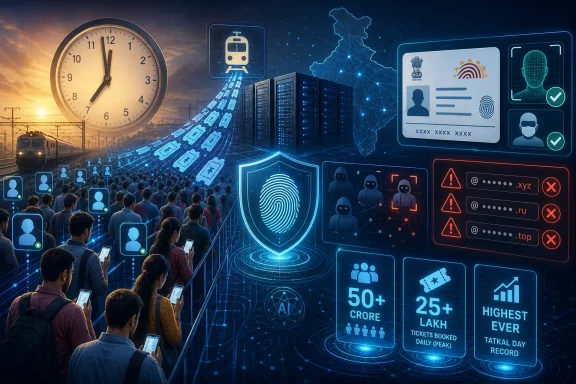 IRCTC’s Ticketing Boom Has Become a Security Story
IRCTC’s 2025–26 numbers tell two stories that are easy to separate and dangerous to separate. On one side, the platform averaged 14.53 lakh ticket bookings per day, up from 13.88 lakh in 2024–25, with digital channels accounting for nearly 89 percent of reserved railway tickets. On the other, the corporation says it deactivated 3.03 crore suspicious accounts, placed 6.05 crore user IDs under revalidation, and blocked 13,343 fraudulent email domains.Those figures belong together because the modern ticketing rush is no longer just a capacity challenge. When millions of users converge on a system at predictable windows, capacity becomes adversarial. Every optimization meant to help a genuine passenger complete a booking faster also helps a bot, a reseller, or a bulk-booking operator unless the platform can distinguish intent under load.
That is the real significance of IRCTC’s record minute on August 16, 2025, when 37,410 tickets were reportedly booked at 10:02 AM. A railway reservation system handling that kind of burst traffic is not simply serving customers. It is running a contested marketplace in which milliseconds, credentials, payment flows, captchas, disposable emails, and queue behavior decide who gets a berth.
For years, passengers have treated Tatkal as a ritual of frustration: log in early, save passenger details, hover over the clock, and hope the site or app does not stall just as the window opens. IRCTC’s new data reframes that familiar irritation as something more structural. The enemy is not only bad UX or insufficient servers; it is automation competing directly with human time.
The Suspicious-ID Crackdown Is Bigger Than a Cleanup Exercise
A platform does not deactivate 3.03 crore suspicious IDs because a few bad actors discovered a loophole. That number points to an industrialized ecosystem of account creation, credential farming, disposable-domain abuse, scripted booking attempts, and likely resale activity. The fraud surface is not a side alley attached to railway booking; it is embedded in the economics of scarce tickets.IRCTC’s filing of 501 complaints on the National Cyber Crime Portal involving 4.18 lakh suspicious PNRs is important because it moves the problem from platform hygiene into law-enforcement territory. A suspicious account can be deleted quietly. A suspicious PNR is closer to the transaction itself: a booking record, a passenger journey, and a monetizable outcome.
That distinction matters. Fraudulent accounts are the raw material; PNRs are the finished product. If enforcement only removes fake IDs after the fact, the platform is forever sweeping the floor while the machinery keeps running. If enforcement can connect account clusters, payment behavior, device fingerprints, domains, and PNR patterns, IRCTC has a better chance of attacking the booking networks rather than merely pruning their disposable endpoints.
The blocked email-domain count is also revealing. Disposable and fraudulent domains are a classic low-cost way to scale account creation, especially when a service’s verification model depends too heavily on email uniqueness. Blocking 13,343 domains will not stop determined operators forever, but it raises the cost of maintaining account farms. In anti-abuse work, that is often the point: not perfect prevention, but enough friction that the attacker’s business model degrades.
Still, the scale of the purge raises a question IRCTC cannot avoid: how many legitimate users were caught in the net? Any automated enforcement system operating at crore-scale will produce false positives. The platform’s credibility will depend not only on how aggressively it blocks abuse, but how quickly and transparently it helps wrongly flagged passengers recover access.
Tatkal Is Where Public Infrastructure Meets the Bot Economy
Tatkal booking is the perfect stress test for public digital infrastructure because demand is intense, predictable, and emotionally charged. Seats open at a known time. The inventory is limited. The difference between success and failure can be a few seconds. That is exactly the kind of environment where automation thrives.IRCTC’s use of artificial intelligence and machine learning to identify suspicious behavior is unsurprising, but the phrase can obscure the practical work involved. The system must look for patterns: accounts created in clusters, abnormal login timing, repeated failed captchas, impossible speed across forms, suspicious payment reuse, proxy behavior, device overlap, domain abuse, and unusual booking concentration. None of those signals is decisive by itself. Together, they form the behavioral fingerprint of a booking operation rather than a passenger.
This is where the user experience becomes tricky. The more IRCTC tightens controls, the more genuine users may encounter added authentication, account revalidation, temporary lockouts, or slower flows. The more IRCTC relaxes controls, the more automated actors can crowd out humans during the only minutes that matter. There is no frictionless version of fairness at this scale.
The choice, then, is not between convenience and security. It is between visible friction imposed by the platform and invisible friction imposed by fraudsters. Passengers may dislike extra verification, but they dislike watching tickets vanish to scripts even more. IRCTC’s challenge is to make the former feel like protection rather than punishment.
Record Bookings Show the Platform Is Scaling, but Not That the Market Is Fair
The single-day record of 18.40 lakh tickets on August 19, 2025, is a real operational achievement. So is the rise in average daily bookings. A fragile platform does not absorb that much demand while also running account revalidation, domain blocking, malicious-traffic interception, and chatbot-assisted transactions.But volume is not fairness. A booking system can process more transactions than ever and still leave ordinary passengers convinced the game is rigged. That is the paradox of IRCTC’s year: the platform is demonstrably larger and more capable, yet the very need to deactivate crores of accounts confirms how contested the system had become.
For public services, throughput metrics can flatter the operator. “More bookings per day” sounds like success, and in one sense it is. But passengers experience the system at the point of scarcity, not in annual averages. A user trying to book a high-demand route during a peak window does not care that the platform handled lakhs of successful bookings across the day if their own session froze, failed, or lost inventory to faster actors.
This is why IRCTC’s anti-fraud numbers may matter more than its booking records. They suggest the corporation understands that the credibility of the reservation system depends on perceived procedural fairness. The public does not expect every passenger to get a confirmed seat. It does expect that failure to get one is not caused by bots, agents, or account farms gaming the queue.
AskDisha Is the Friendly Face of a Much Harder Platform Shift
IRCTC’s AskDisha chatbot, powered by Microsoft Azure, has become part of the corporation’s digital access story. It supports English, Hindi, and Hinglish, and handled about 8.12 lakh reserved rail e-ticket bookings in 2025–26. On the surface, that looks like a convenience feature: a conversational interface for booking, PNR status, cancellations, and refunds.The deeper significance is that IRCTC is expanding the number of front doors into the same reservation core. Users increasingly expect public services to work through apps, chatbots, voice interfaces, lightweight mobile flows, and multilingual assistants. Each new interface can improve accessibility, but each also becomes part of the trust boundary.
A chatbot that books tickets is not merely a customer-service bot. It is a transaction channel connected to identity, payments, inventory, and cancellation workflows. That means it must inherit the same anti-abuse protections as the website and mobile app without becoming so cumbersome that users abandon it. If AskDisha becomes easier for humans but also easier for automated exploitation, the platform has only moved the pressure point.
The Microsoft Azure detail will interest IT pros because it underscores a broader shift in public-sector digital systems: cloud-backed conversational interfaces are now being placed in front of critical national services. That can improve scalability and language support, but it also makes architecture, data governance, logging, and incident response more important. The chatbot is not a gimmick if it becomes a meaningful booking channel; it is part of the production surface.
The Aadhaar-KYC Direction Tightens Trust and Raises the Stakes
Reports around IRCTC’s anti-fraud push have also pointed to tighter verification norms, including Aadhaar-linked checks for high-demand booking contexts such as Tatkal and opening-day reservation windows. The logic is straightforward. If fake or disposable accounts are a major input to booking abuse, stronger identity verification makes those accounts harder to manufacture at scale.But stronger identity is not a free lunch. When a public service links scarce access to identity infrastructure, the system must be unusually careful about errors, privacy, and exclusion. A wrongly deactivated throwaway account is one problem. A wrongly blocked verified passenger, or a user unable to complete identity checks because of mismatched records or authentication failures, is another.
The security argument for KYC is strongest in exactly the scenario IRCTC faces: high-volume, high-demand, repeatable abuse where account farms can overwhelm softer controls. But the civil-service argument requires more than “trust us.” Users need reliable recovery routes, clear notices, minimal data retention, and confidence that identity linkage is being used to stop fraud rather than to create unnecessary surveillance.
For administrators, the lesson is familiar. Identity hardening can reduce abuse, but it also centralizes risk. Once identity becomes the gatekeeper for essential digital services, outages, false positives, and data leaks become more consequential. IRCTC’s next phase will be judged not only by how many suspicious IDs it blocks, but by how well it handles the edge cases its own controls create.
The Bot Fight Is Really a Capacity Fight in Disguise
Anti-bot systems are often discussed as security products, but in IRCTC’s case they are also capacity-management tools. Every automated request that hits the platform during Tatkal booking consumes resources that could have served a genuine user. Blocking malicious traffic is not just about preventing fraud; it is about preserving the scarce computational attention of the service at peak demand.This is the same lesson large consumer platforms, banks, game launches, and tax portals have learned repeatedly. Peak demand attracts automation. Automation worsens congestion. Congestion makes genuine users retry, refresh, and submit duplicate requests. Those retries then look, at scale, like hostile traffic. Without careful design, the platform can end up fighting its own users.
IRCTC’s reported interception of large volumes of malicious online traffic suggests it is treating this as a live operational problem rather than an occasional audit task. That matters because bot defense cannot be something switched on after abuse is discovered. In a booking window measured in minutes, detection and mitigation must happen during the event.
The hard part is distinguishing desperation from automation. A passenger repeatedly refreshing at 10:00 AM may look noisy. A bot may be engineered to appear patient. A family sharing one connection may resemble a suspicious cluster. A fraud network may distribute itself across infrastructure to avoid easy grouping. Good anti-abuse systems are probabilistic, and that means governance matters as much as models.
Public Digital Infrastructure Cannot Hide Behind Consumer-App Excuses
Private platforms can sometimes tolerate a rough edge: a failed sneaker drop, a crashed concert-ticket sale, a botched game preorder. Users complain, brands apologize, and the next launch comes around. IRCTC does not have that luxury. For many passengers, rail travel is not discretionary entertainment. It is work, family obligation, medical travel, migration, education, and emergency movement.That changes the standard by which the platform should be judged. If IRCTC is now the dominant channel for reserved ticketing, with digital bookings nearing nine-tenths of the total, then online access is effectively public access. A bad interface, an opaque suspension, or a failed authentication flow is not merely an inconvenience; it can alter someone’s ability to travel.
This is why the corporation’s infrastructure-upgrade narrative must be matched by a user-rights narrative. Faster booking and stronger fraud prevention are necessary, but they are incomplete without transparent appeals, consistent account recovery, accessible support, and published principles for how suspicious activity is handled. Security without accountability can become arbitrary from the user’s point of view.
There is also a regional and linguistic dimension. AskDisha’s support for Hindi, English, and Hinglish is a useful step, but India’s railway user base is far broader than those three modes of interaction. If digital becomes the default, accessibility cannot be treated as a chatbot feature alone. It must include language, disability access, low-bandwidth performance, payment diversity, and support for users who are not technically fluent.
The Numbers Hint at a More Mature IRCTC, Not a Finished One
IRCTC deserves credit for publishing figures that reveal the scale of the problem. Many platforms prefer to talk about successful transactions and avoid discussing how much abuse they block. By disclosing crores of suspicious IDs, lakhs of suspicious PNRs, and thousands of blocked domains, IRCTC is effectively admitting that the reservation system has been under sustained adversarial pressure.That admission is healthy. Mature platforms do not pretend that abuse is an anomaly. They assume it is permanent, adaptive, and economically motivated. The question is whether the operator can keep increasing the attacker’s cost without making the legitimate user’s experience intolerable.
The record booking figures suggest IRCTC has improved raw capacity. The anti-fraud measures suggest it is improving platform integrity. The chatbot numbers suggest it is experimenting with new access paths. Together, they point toward a reservation system becoming more sophisticated under pressure.
But sophistication brings new dependencies. AI models must be monitored. Cloud services must be resilient. Identity systems must be secure. Domain-blocking rules must be updated. Law-enforcement referrals must be meaningful. Customer support must be prepared for the inevitable human fallout of automated enforcement. At this scale, every fix becomes part of a larger system that can fail in new ways.
What WindowsForum Readers Should See in India’s Ticketing Stress Test
For WindowsForum’s audience, IRCTC’s story is not just a railways story from India. It is a case study in what happens when a public-facing platform combines extreme demand, limited inventory, identity abuse, automation, and political visibility. The technical contours will look familiar to anyone who has managed login storms, bot floods, account fraud, or high-stakes consumer portals.The most concrete lessons are not exotic. They are the basics, executed at intimidating scale.
- A high-demand booking platform must treat bot mitigation as core infrastructure, not as an add-on purchased after users start complaining.
- Account identity is only useful when paired with behavioral detection, payment analysis, device intelligence, and fast recovery for legitimate users.
- Peak-load records are impressive, but they do not prove fairness unless the platform can show that automated actors are not capturing disproportionate inventory.
- Chatbots and conversational booking tools expand access, but they also expand the attack surface and must be governed like transaction systems.
- Stronger KYC can reduce fake-account abuse, but it increases the need for privacy discipline, transparent appeals, and resilient authentication.
- Public digital services should measure success not only by transactions completed, but by whether ordinary users believe the process is honest.
References
- Primary source: The News Mill
Published: 2026-06-20T08:30:16.249854
IRCTC blocks 3 crore suspicious IDs and sets ticket booking records in 2025-26
The Indian Railway Catering and Tourism Corporation (IRCTC) intensified its anti-fraud and cybersecurity measures in 2025 to ensure genuine passengers havethenewsmill.com - Related coverage: hindustantimes.com
IRCTC sets new records in online ticket booking, blocks 3 crore suspicious IDs in 2025-26 | India News
As part of these efforts, IRCTC informed that the corporation deactivated 3.03 crore suspicious user IDs in 2025. | India Newswww.hindustantimes.com - Related coverage: currentaffairsai.com
Railways cracks down on Fake IDs:… — Current Affairs for Exams
[CORE] Polity: Target this Data: 3.03 crore IRCTC IDs deactivated in 2025. (CERT-In, NCIIPC) For UPSC, MPSC, SSC, Banking & Teaching exams.currentaffairsai.com - Related coverage: mid-day.com
IRCTC blocks 3.03 crore fake IDs in major crackdown on ticketing fraud
In major clean-up of its online ticketing system, the Indian Railway Catering and Tourism Corporation IRCTC has deactivated 303 crore suspicious user accountwww.mid-day.com - Related coverage: keralakaumudi.com
End of Tatkal ticket scam: Railways blocks bots and three crore fraudulent IDs
KOCHI: The Ministry of Railways reported these figures in Parliament as evidence of the system's effectiveness in preventing illicit automated access.keralakaumudi.com - Related coverage: nationpress.com
IRCTC serves 58 crore meals yearly, books 18.4 lakh tickets in a day | Nation Press
IRCTC isn't just a ticketing platform anymore — it's quietly become one of India's largest AI-run service operations. With 58 crore meals a year, 800+ kitchens under AI cameras, 18.40 lakh tickets in a single day, and 3 crore fake IDs purged, the Navratna PSU is scaling automation faster than...www.nationpress.com
- Related coverage: angelone.in
IRCTC Blocks 3.03 Crore Fake IDs in a Crackdown on Fraudulent Ticket Booking
IRCTC’s crackdown is designed to eliminate misuse that disrupts the booking system and undermines fairness for genuine passengers.www.angelone.in - Related coverage: indianexpress.com
Indian Railways Cracks Down on Fake IRCTC IDs: 3 Crore Accounts Deactivated, 60 Billion Bot Attacks Blocked
Indian Railways Cracks Down on Fake IRCTC IDs: The Railway Minister further said that several anti-fraud measures have been implemented to prevent unauthorised access and ensure seamless ticket booking for genuine users.indianexpress.com - Related coverage: moneycontrol.com
- Related coverage: goodreturns.in
IRCTC Aadhaar KYC: 3.03 Crore Suspicious User IDs Deactivated | IRCTC Aadhaar KYC - Goodreturns
IRCTC deactivates 3.03 crore suspicious IDs and mandates Aadhaar KYC for Tatkal bookings to stop bots and touts, ensuring fair ticket access for passengers.www.goodreturns.in - Related coverage: dailypioneer.com
IRCTC blocks 3.03 crore fake IDs to curb fraud, launches new UI | Daily Pioneer
IRCTC blocks 3.03 crore fake IDs to curb fraud, launches new UIdailypioneer.com
