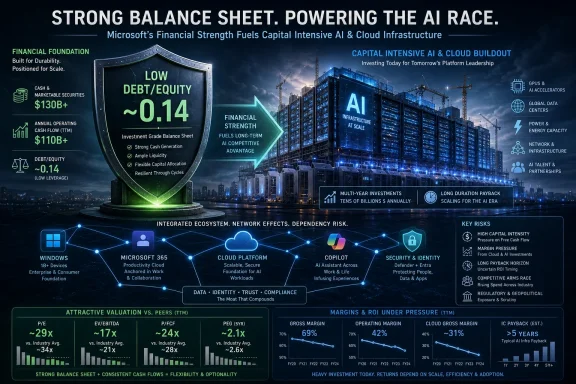
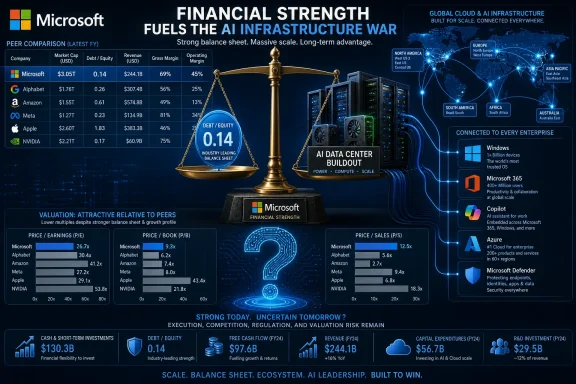
Microsoft’s latest peer-comparison snapshot, published June 29, 2026 by Benzinga, argues that Microsoft sits in a stronger balance-sheet position than four major software peers, with a debt-to-equity ratio of 0.14 and valuation multiples that screen low against the group. The headline is seductive: the world’s most systemically important software company appears both financially conservative and, by some peer metrics, relatively cheap. But that reading only holds if investors treat Microsoft like a generic software stock. The more useful conclusion is narrower and more interesting: Microsoft’s balance sheet gives it room to wage the AI infrastructure war, but the returns from that war are now the real valuation question.
Peer-comparison articles are designed to compress complexity into a table. Price-to-earnings, price-to-book, price-to-sales, return on equity, EBITDA, gross profit, revenue growth, and debt-to-equity all sit beside one another as if they measure the same kind of corporate reality. They do not.
Microsoft is not merely another software vendor with a subscription base and a sales team. It is an operating-system company, a cloud hyperscaler, an enterprise productivity toll road, a gaming platform owner, a cybersecurity vendor, an advertising business, and now one of the central distributors of generative AI into corporate computing. That makes peer analysis useful as a starting point and dangerous as an ending point.
The Benzinga frame says Microsoft’s PE, PB, and PS ratios are low compared with software peers, while its debt-to-equity ratio is also lower than the group. On paper, that combination suggests a conservative balance sheet attached to a stock that might be undervalued. In an ordinary software cycle, that would be a clean bullish signal.
This is not an ordinary software cycle. Microsoft is spending into a computing transition that requires data centers, GPUs, networking, power contracts, model partnerships, and years of customer workflow change. The company’s low leverage matters precisely because it allows Microsoft to carry a capital burden that smaller software peers cannot plausibly match.
That is the central paradox. Microsoft may screen as “cheap” against a handful of high-multiple software names, but the market is not only pricing today’s earnings. It is also asking whether today’s cloud and AI spending becomes tomorrow’s durable margin expansion or merely the new cost of staying in the game.
For IT pros and WindowsForum readers, the importance is less about bondholder comfort and more about product continuity. A highly leveraged software company under pressure tends to cut, bundle aggressively, raise prices abruptly, or slow investment. Microsoft has plenty of pricing power, but it is not obviously being forced into short-term defensive moves by its balance sheet.
That matters because Microsoft’s strategic commitments are unusually broad. Azure capacity, Microsoft 365 Copilot, GitHub Copilot, Windows AI features, Defender, Purview, Dynamics, LinkedIn, Xbox cloud services, and enterprise identity all draw from the same capital and engineering reservoir. A weaker balance sheet would make those bets more fragile.
The low debt-to-equity ratio also gives Microsoft optionality. It can borrow if it needs to, fund capex from cash flow, continue shareholder returns, and absorb volatility from AI-related investments. In a market where infrastructure scarcity can decide product availability, optionality is not a footnote.
But investors should resist treating low leverage as a free pass. A company can be underleveraged and still overinvest. The relevant question is not whether Microsoft can afford the AI buildout. It is whether the buildout produces returns that justify the opportunity cost.
A low PE ratio compared with a high-growth peer can mean undervaluation. It can also mean the market expects slower growth. A low price-to-sales ratio can suggest opportunity. It can also reflect the fact that Microsoft already generates enormous revenue, making percentage growth mathematically harder.
Microsoft’s scale is both its advantage and its burden. A smaller cloud software company can grow revenue 30 percent from a smaller base and earn a premium multiple for it. Microsoft can add tens of billions in annual revenue and still be accused of deceleration because the denominator is so large.
That is why the “low multiples” claim should be read as an invitation, not a verdict. It tells us Microsoft may not be priced as aggressively as some software peers. It does not tell us whether Microsoft is cheap relative to its own future capital intensity, regulatory exposure, margin profile, or AI monetization path.
The most useful valuation lens is not “Microsoft versus software.” It is “Microsoft versus the infrastructure economics it has chosen.” The company is no longer just selling software that runs on someone else’s compute. Increasingly, it is selling intelligence, automation, and cloud services whose cost structure depends on owning or renting a colossal amount of compute capacity.
Yet gross profit is no longer the clean comfort metric it once was. In classic software, gross margins were a monument to the beauty of code: build once, sell many times, enjoy low marginal costs. In AI-enabled cloud software, the marginal cost can be more stubborn. Every prompt, inference request, model run, indexing job, and agentic workflow consumes compute.
Microsoft has acknowledged that cloud gross margin is being pressured by continued investment in AI infrastructure and growing AI usage. That does not mean the strategy is failing. It means the business is moving from a pure software metaphor toward a hybrid model where software margins meet industrial-scale infrastructure economics.
This is why Microsoft’s operational strength should be viewed dynamically. High gross profit today gives the company fuel. It does not guarantee that every AI feature layered into Microsoft 365, Windows, GitHub, or Azure will carry traditional software economics at maturity.
The market is trying to price that transition in real time. If AI features drive higher average revenue per user, reduce churn, deepen enterprise lock-in, and generate new workloads on Azure, the spending will look prescient. If customers adopt AI unevenly, resist price increases, or discover that productivity gains are harder to measure than demos suggest, the margins may tell a less heroic story.
A highly leveraged company can produce impressive ROE because debt magnifies returns on a smaller equity base. A company with aggressive buybacks can also flatter the metric. Conversely, a financially conservative company with large retained earnings may look less efficient on ROE even while producing enormous absolute profits.
For Microsoft, a comparatively lower ROE should not be read as a simple profitability problem. The company is massively profitable. The better interpretation is that Microsoft’s size, capital base, and investment cycle make some peer-relative efficiency metrics less revealing than they appear.
Still, the warning is not meaningless. If Microsoft is pouring capital into AI infrastructure, investors should expect that capital to generate attractive incremental returns over time. A low or falling ROE in that environment would sharpen the question of whether Microsoft is deploying capital as efficiently as its narrative suggests.
This is where software investors and IT buyers see the same issue from different angles. Investors ask whether the AI capex earns a return. CIOs ask whether Copilot, Azure AI, and related services deliver measurable productivity, security, or automation gains. Both questions point to the same test: Microsoft must turn infrastructure spending into outcomes customers will pay for repeatedly.
The issue is not whether Microsoft can grow. It clearly can. The issue is where growth comes from and how expensive it is to produce.
Microsoft 365 seat growth, Azure consumption, security consolidation, Dynamics expansion, GitHub adoption, and AI-assisted productivity all offer paths for growth. But many of these paths involve either selling more into existing customers or convincing them to pay higher per-user prices for AI-enhanced capabilities. That is a different challenge from simply landing greenfield SaaS accounts.
Windows itself remains strategically important even when it is not the main growth engine. It is the distribution layer, the enterprise endpoint, the management target, and the familiar workspace through which Microsoft can surface cloud and AI services. For administrators, this means the Windows estate is increasingly tied to cloud identity, compliance, telemetry, update policy, and AI feature governance.
That integration can be valuable, but it also creates fatigue. Enterprises already wrestling with licensing complexity, endpoint management, security baselines, and cloud migration do not automatically welcome another layer of AI SKUs and administrative controls. Revenue growth depends not only on product capability but on customers believing the bundle is worth the operational complexity.
In developer tools, Microsoft’s GitHub and Visual Studio ecosystem gives it a powerful position, but AI coding assistants have turned developer productivity into a contested frontier. In security, Microsoft benefits from bundling and identity reach, but it also faces specialist vendors that argue consolidation creates blind spots. In operating systems, Windows still dominates enterprise desktops, yet the strategic value of the endpoint is changing as more workloads move to browsers, mobile devices, and cloud desktops.
This is why “software peers” can understate Microsoft’s ambition. The company is not just trying to outperform software companies. It is trying to become the control plane for work, identity, development, security, and AI-mediated business processes.
That ambition makes the balance sheet more important. It also makes the risks more systemic. A misstep in Windows Recall-style privacy messaging, Copilot data governance, Azure reliability, licensing, or security defaults can echo across multiple product lines. Microsoft’s advantage is integration; its liability is also integration.
For customers, the peer comparison matters less than the dependency map. If your organization runs Windows, Entra ID, Microsoft 365, Defender, Intune, Azure, Teams, SharePoint, and GitHub, Microsoft is not a vendor in a procurement spreadsheet. It is part of the operating environment.
This changes how we should interpret Microsoft’s financial strength. Low debt and high cash generation are not merely signs of prudence. They are strategic weapons in a world where product leadership may depend on whether a vendor can bring enough capacity online to satisfy demand.
Azure’s growth suggests demand is real. Microsoft Cloud revenue and Azure momentum show customers are still moving workloads and experimenting with AI-enabled services. Commercial backlog also signals that many customers have already committed future spending.
But there is a difference between demand and profitable demand. AI workloads can be expensive to serve, and enterprise customers are still figuring out which use cases justify sustained spending. The early wave of Copilot adoption and Azure AI experimentation does not automatically prove that every seat, agent, or workload will become a high-margin annuity.
Microsoft’s challenge is to make AI feel less like an add-on and more like an embedded productivity layer. If Copilot becomes part of how documents are drafted, meetings are summarized, tickets are triaged, code is reviewed, and data is queried, then the economic case strengthens. If it remains a premium feature that users admire in demos but underuse in daily work, the capex story becomes more uncomfortable.
That does not mean every AI feature will be mandatory or successful. Microsoft has already learned that privacy, local indexing, screenshots, telemetry, and user trust can turn an AI feature into a reputational problem if the rollout feels careless. Enterprise administrators will expect policy controls, auditability, data boundary clarity, and a sane default posture.
The tension is that Microsoft wants AI to feel ambient, while enterprise IT wants it to be governable. Those goals are not mutually exclusive, but they often collide during product launches. A feature designed to reduce friction for consumers can become a deployment headache in regulated environments.
This is where Microsoft’s balance-sheet strength does not solve everything. Money can buy GPUs, engineers, and marketing campaigns. It cannot buy trust instantly after administrators decide a feature is poorly explained, inadequately controlled, or bundled too aggressively.
If Microsoft wants Windows to remain the front door for AI in the workplace, it must treat administrative control as a product feature, not an afterthought. The same applies to Microsoft 365 Copilot and Azure AI services. Governance is not a compliance tax; it is the condition under which enterprises will scale adoption.
The administrator’s reading is more ambivalent. Microsoft’s consolidation can reduce vendor sprawl, simplify identity, and integrate security signals. It can also concentrate operational risk, licensing dependence, and outage exposure.
When Microsoft changes a default, retires a product, alters licensing, introduces a cloud dependency, or pushes a new security model, IT departments feel it quickly. The more Microsoft becomes the control plane for enterprise computing, the more its financial strategy becomes an operational reality for customers.
This is the part peer tables cannot capture. A smaller software company can disappoint investors without reshaping the daily work of millions of administrators. Microsoft’s decisions ripple through patch management, endpoint policy, authentication flows, document workflows, developer pipelines, and procurement calendars.
That is why the debt-to-equity ratio is comforting but incomplete. Microsoft is financially resilient. The more important question is whether its customers remain operationally resilient as they adopt more of Microsoft’s stack.
The bundle is Microsoft’s superpower. Microsoft 365, Teams, OneDrive, SharePoint, Entra, Defender, Intune, Power Platform, Dynamics, Azure, Windows, and Copilot reinforce one another. Each product makes the others easier to justify, harder to remove, or more attractive in procurement negotiations.
The bundle is also where regulators, competitors, and customers will keep applying pressure. Competitors argue that Microsoft uses distribution power to advantage its own services. Regulators have shown persistent interest in large platform companies. Customers worry about lock-in even when they appreciate integration.
If the bundle holds, Microsoft’s valuation may indeed look modest in hindsight. AI features become upsell paths, Azure captures workload growth, security consolidates budgets, and Windows remains the endpoint anchor. Low debt gives Microsoft room to keep investing until the model matures.
If the bundle frays, the story changes. Customers may slow Copilot expansion, diversify cloud workloads, resist E5 upsells, scrutinize security consolidation, or demand clearer ROI before expanding AI commitments. Microsoft would still be a formidable company, but the “cheap” argument would look less obvious.
Microsoft is one of them. That makes conventional software metrics feel slightly out of date. EBITDA and gross profit still matter. PE, PB, and PS still matter. ROE still matters. But they must now be interpreted against a backdrop of heavy capital investment and uncertain AI monetization curves.
This does not make Microsoft a bad investment case. It makes it a more complicated one. The company’s low leverage and high operating profit give it a margin of safety that many peers lack. Its cloud and productivity franchises give it distribution that AI-native challengers would kill for.
The danger is that investors treat infrastructure spending as a temporary bridge to software-like margins. It may be. But it may also represent a more permanent reset in the cost of delivering premium software. If every enterprise productivity suite must include AI, and every AI interaction consumes meaningful compute, then the industry’s margin structure may evolve.
Microsoft is better positioned than almost anyone to absorb that shift. But being best positioned is not the same as being unaffected.
 Microsoft Looks Cheap Only If You Ignore Why It Is Expensive
Peer-comparison articles are designed to compress complexity into a table. Price-to-earnings, price-to-book, price-to-sales, return on equity, EBITDA, gross profit, revenue growth, and debt-to-equity all sit beside one another as if they measure the same kind of corporate reality. They do not.Microsoft is not merely another software vendor with a subscription base and a sales team. It is an operating-system company, a cloud hyperscaler, an enterprise productivity toll road, a gaming platform owner, a cybersecurity vendor, an advertising business, and now one of the central distributors of generative AI into corporate computing. That makes peer analysis useful as a starting point and dangerous as an ending point.
The Benzinga frame says Microsoft’s PE, PB, and PS ratios are low compared with software peers, while its debt-to-equity ratio is also lower than the group. On paper, that combination suggests a conservative balance sheet attached to a stock that might be undervalued. In an ordinary software cycle, that would be a clean bullish signal.
This is not an ordinary software cycle. Microsoft is spending into a computing transition that requires data centers, GPUs, networking, power contracts, model partnerships, and years of customer workflow change. The company’s low leverage matters precisely because it allows Microsoft to carry a capital burden that smaller software peers cannot plausibly match.
That is the central paradox. Microsoft may screen as “cheap” against a handful of high-multiple software names, but the market is not only pricing today’s earnings. It is also asking whether today’s cloud and AI spending becomes tomorrow’s durable margin expansion or merely the new cost of staying in the game.
The Debt Number Is the Least Ambiguous Part of the Story
A debt-to-equity ratio of 0.14 is not a mystical signal, but it is a meaningful one. It says Microsoft is not relying heavily on borrowed money to support its current capital structure. For investors, that reduces one category of risk: the company is not being squeezed by leverage at the same time it is trying to fund a once-in-a-generation infrastructure buildout.For IT pros and WindowsForum readers, the importance is less about bondholder comfort and more about product continuity. A highly leveraged software company under pressure tends to cut, bundle aggressively, raise prices abruptly, or slow investment. Microsoft has plenty of pricing power, but it is not obviously being forced into short-term defensive moves by its balance sheet.
That matters because Microsoft’s strategic commitments are unusually broad. Azure capacity, Microsoft 365 Copilot, GitHub Copilot, Windows AI features, Defender, Purview, Dynamics, LinkedIn, Xbox cloud services, and enterprise identity all draw from the same capital and engineering reservoir. A weaker balance sheet would make those bets more fragile.
The low debt-to-equity ratio also gives Microsoft optionality. It can borrow if it needs to, fund capex from cash flow, continue shareholder returns, and absorb volatility from AI-related investments. In a market where infrastructure scarcity can decide product availability, optionality is not a footnote.
But investors should resist treating low leverage as a free pass. A company can be underleveraged and still overinvest. The relevant question is not whether Microsoft can afford the AI buildout. It is whether the buildout produces returns that justify the opportunity cost.
Valuation Multiples Flatten a Company That Is Anything but Flat
The idea that Microsoft’s PE, PB, and PS ratios are low compared with peers sounds straightforward until one asks which peers and why. Software is an enormous category. A cybersecurity company with explosive growth, a SaaS firm coming off depressed earnings, a data platform vendor, and Microsoft may all live in the same sector screen while carrying radically different business models.A low PE ratio compared with a high-growth peer can mean undervaluation. It can also mean the market expects slower growth. A low price-to-sales ratio can suggest opportunity. It can also reflect the fact that Microsoft already generates enormous revenue, making percentage growth mathematically harder.
Microsoft’s scale is both its advantage and its burden. A smaller cloud software company can grow revenue 30 percent from a smaller base and earn a premium multiple for it. Microsoft can add tens of billions in annual revenue and still be accused of deceleration because the denominator is so large.
That is why the “low multiples” claim should be read as an invitation, not a verdict. It tells us Microsoft may not be priced as aggressively as some software peers. It does not tell us whether Microsoft is cheap relative to its own future capital intensity, regulatory exposure, margin profile, or AI monetization path.
The most useful valuation lens is not “Microsoft versus software.” It is “Microsoft versus the infrastructure economics it has chosen.” The company is no longer just selling software that runs on someone else’s compute. Increasingly, it is selling intelligence, automation, and cloud services whose cost structure depends on owning or renting a colossal amount of compute capacity.
AI Has Turned Gross Profit Into a More Complicated Signal
Benzinga’s summary points to Microsoft’s high EBITDA and gross profit as evidence of strong operational performance. That is fair. Microsoft remains one of the great profit engines in global technology, and its enterprise software franchises continue to throw off cash at a scale most companies can only envy.Yet gross profit is no longer the clean comfort metric it once was. In classic software, gross margins were a monument to the beauty of code: build once, sell many times, enjoy low marginal costs. In AI-enabled cloud software, the marginal cost can be more stubborn. Every prompt, inference request, model run, indexing job, and agentic workflow consumes compute.
Microsoft has acknowledged that cloud gross margin is being pressured by continued investment in AI infrastructure and growing AI usage. That does not mean the strategy is failing. It means the business is moving from a pure software metaphor toward a hybrid model where software margins meet industrial-scale infrastructure economics.
This is why Microsoft’s operational strength should be viewed dynamically. High gross profit today gives the company fuel. It does not guarantee that every AI feature layered into Microsoft 365, Windows, GitHub, or Azure will carry traditional software economics at maturity.
The market is trying to price that transition in real time. If AI features drive higher average revenue per user, reduce churn, deepen enterprise lock-in, and generate new workloads on Azure, the spending will look prescient. If customers adopt AI unevenly, resist price increases, or discover that productivity gains are harder to measure than demos suggest, the margins may tell a less heroic story.
Return on Equity Is a Warning Light, Not a Fatal Flaw
The Benzinga takeaway notes that Microsoft’s low ROE suggests lower profitability relative to industry peers. That statement deserves more care than a peer table can provide. Return on equity can be distorted by capital structure, buybacks, accumulated equity, and the maturity of the business.A highly leveraged company can produce impressive ROE because debt magnifies returns on a smaller equity base. A company with aggressive buybacks can also flatter the metric. Conversely, a financially conservative company with large retained earnings may look less efficient on ROE even while producing enormous absolute profits.
For Microsoft, a comparatively lower ROE should not be read as a simple profitability problem. The company is massively profitable. The better interpretation is that Microsoft’s size, capital base, and investment cycle make some peer-relative efficiency metrics less revealing than they appear.
Still, the warning is not meaningless. If Microsoft is pouring capital into AI infrastructure, investors should expect that capital to generate attractive incremental returns over time. A low or falling ROE in that environment would sharpen the question of whether Microsoft is deploying capital as efficiently as its narrative suggests.
This is where software investors and IT buyers see the same issue from different angles. Investors ask whether the AI capex earns a return. CIOs ask whether Copilot, Azure AI, and related services deliver measurable productivity, security, or automation gains. Both questions point to the same test: Microsoft must turn infrastructure spending into outcomes customers will pay for repeatedly.
Revenue Growth Is Slower Because Microsoft Is Already Everywhere
The Benzinga summary flags low revenue growth as a concern compared with peers. Again, the comparison is understandable but incomplete. Microsoft’s most recent quarterly results showed strong overall growth by mega-cap standards, including robust cloud and Azure performance, but it is unrealistic to expect a company of Microsoft’s scale to compound like a smaller software vendor indefinitely.The issue is not whether Microsoft can grow. It clearly can. The issue is where growth comes from and how expensive it is to produce.
Microsoft 365 seat growth, Azure consumption, security consolidation, Dynamics expansion, GitHub adoption, and AI-assisted productivity all offer paths for growth. But many of these paths involve either selling more into existing customers or convincing them to pay higher per-user prices for AI-enhanced capabilities. That is a different challenge from simply landing greenfield SaaS accounts.
Windows itself remains strategically important even when it is not the main growth engine. It is the distribution layer, the enterprise endpoint, the management target, and the familiar workspace through which Microsoft can surface cloud and AI services. For administrators, this means the Windows estate is increasingly tied to cloud identity, compliance, telemetry, update policy, and AI feature governance.
That integration can be valuable, but it also creates fatigue. Enterprises already wrestling with licensing complexity, endpoint management, security baselines, and cloud migration do not automatically welcome another layer of AI SKUs and administrative controls. Revenue growth depends not only on product capability but on customers believing the bundle is worth the operational complexity.
The Peer Set Hides Microsoft’s Real Competitors
A peer table in the software industry usually compares public companies by sector classification. But Microsoft’s real competitive field is broader and harsher than that. In cloud, it fights Amazon and Google. In AI infrastructure, it competes for GPUs, power, data center sites, and model talent. In productivity software, it competes not only with Google Workspace but with customer inertia and budget scrutiny.In developer tools, Microsoft’s GitHub and Visual Studio ecosystem gives it a powerful position, but AI coding assistants have turned developer productivity into a contested frontier. In security, Microsoft benefits from bundling and identity reach, but it also faces specialist vendors that argue consolidation creates blind spots. In operating systems, Windows still dominates enterprise desktops, yet the strategic value of the endpoint is changing as more workloads move to browsers, mobile devices, and cloud desktops.
This is why “software peers” can understate Microsoft’s ambition. The company is not just trying to outperform software companies. It is trying to become the control plane for work, identity, development, security, and AI-mediated business processes.
That ambition makes the balance sheet more important. It also makes the risks more systemic. A misstep in Windows Recall-style privacy messaging, Copilot data governance, Azure reliability, licensing, or security defaults can echo across multiple product lines. Microsoft’s advantage is integration; its liability is also integration.
For customers, the peer comparison matters less than the dependency map. If your organization runs Windows, Entra ID, Microsoft 365, Defender, Intune, Azure, Teams, SharePoint, and GitHub, Microsoft is not a vendor in a procurement spreadsheet. It is part of the operating environment.
The AI Capex Cycle Is the New Enterprise Software Cycle
Traditional enterprise software cycles were measured in licenses, renewals, migrations, and feature upgrades. The AI cycle adds a new constraint: physical capacity. Models need compute. Compute needs chips. Chips need supply chains. Data centers need power, cooling, networking, and permitting.This changes how we should interpret Microsoft’s financial strength. Low debt and high cash generation are not merely signs of prudence. They are strategic weapons in a world where product leadership may depend on whether a vendor can bring enough capacity online to satisfy demand.
Azure’s growth suggests demand is real. Microsoft Cloud revenue and Azure momentum show customers are still moving workloads and experimenting with AI-enabled services. Commercial backlog also signals that many customers have already committed future spending.
But there is a difference between demand and profitable demand. AI workloads can be expensive to serve, and enterprise customers are still figuring out which use cases justify sustained spending. The early wave of Copilot adoption and Azure AI experimentation does not automatically prove that every seat, agent, or workload will become a high-margin annuity.
Microsoft’s challenge is to make AI feel less like an add-on and more like an embedded productivity layer. If Copilot becomes part of how documents are drafted, meetings are summarized, tickets are triaged, code is reviewed, and data is queried, then the economic case strengthens. If it remains a premium feature that users admire in demos but underuse in daily work, the capex story becomes more uncomfortable.
Windows Is the Distribution Layer Microsoft Cannot Afford to Squander
For Windows enthusiasts and administrators, the financial analysis has a product-level implication: Microsoft’s AI strategy will keep pressing into Windows, whether or not every user wants it there. The company’s incentive is obvious. Windows remains one of the most powerful distribution surfaces in computing.That does not mean every AI feature will be mandatory or successful. Microsoft has already learned that privacy, local indexing, screenshots, telemetry, and user trust can turn an AI feature into a reputational problem if the rollout feels careless. Enterprise administrators will expect policy controls, auditability, data boundary clarity, and a sane default posture.
The tension is that Microsoft wants AI to feel ambient, while enterprise IT wants it to be governable. Those goals are not mutually exclusive, but they often collide during product launches. A feature designed to reduce friction for consumers can become a deployment headache in regulated environments.
This is where Microsoft’s balance-sheet strength does not solve everything. Money can buy GPUs, engineers, and marketing campaigns. It cannot buy trust instantly after administrators decide a feature is poorly explained, inadequately controlled, or bundled too aggressively.
If Microsoft wants Windows to remain the front door for AI in the workplace, it must treat administrative control as a product feature, not an afterthought. The same applies to Microsoft 365 Copilot and Azure AI services. Governance is not a compliance tax; it is the condition under which enterprises will scale adoption.
Investors See a Moat, Administrators See a Blast Radius
The bullish reading of Microsoft is easy to understand. The company has durable enterprise relationships, massive recurring revenue, a cloud platform growing at scale, a developer ecosystem, a security business, and a privileged position in AI distribution. Add low leverage, and it looks like the rare giant that can still attack new markets.The administrator’s reading is more ambivalent. Microsoft’s consolidation can reduce vendor sprawl, simplify identity, and integrate security signals. It can also concentrate operational risk, licensing dependence, and outage exposure.
When Microsoft changes a default, retires a product, alters licensing, introduces a cloud dependency, or pushes a new security model, IT departments feel it quickly. The more Microsoft becomes the control plane for enterprise computing, the more its financial strategy becomes an operational reality for customers.
This is the part peer tables cannot capture. A smaller software company can disappoint investors without reshaping the daily work of millions of administrators. Microsoft’s decisions ripple through patch management, endpoint policy, authentication flows, document workflows, developer pipelines, and procurement calendars.
That is why the debt-to-equity ratio is comforting but incomplete. Microsoft is financially resilient. The more important question is whether its customers remain operationally resilient as they adopt more of Microsoft’s stack.
The Undervaluation Argument Depends on Trusting the Bundle
Calling Microsoft undervalued because several multiples sit below peer averages assumes the market is mispricing the durability of its earnings. That may be true. But with Microsoft, the durability argument increasingly rests on the bundle.The bundle is Microsoft’s superpower. Microsoft 365, Teams, OneDrive, SharePoint, Entra, Defender, Intune, Power Platform, Dynamics, Azure, Windows, and Copilot reinforce one another. Each product makes the others easier to justify, harder to remove, or more attractive in procurement negotiations.
The bundle is also where regulators, competitors, and customers will keep applying pressure. Competitors argue that Microsoft uses distribution power to advantage its own services. Regulators have shown persistent interest in large platform companies. Customers worry about lock-in even when they appreciate integration.
If the bundle holds, Microsoft’s valuation may indeed look modest in hindsight. AI features become upsell paths, Azure captures workload growth, security consolidates budgets, and Windows remains the endpoint anchor. Low debt gives Microsoft room to keep investing until the model matures.
If the bundle frays, the story changes. Customers may slow Copilot expansion, diversify cloud workloads, resist E5 upsells, scrutinize security consolidation, or demand clearer ROI before expanding AI commitments. Microsoft would still be a formidable company, but the “cheap” argument would look less obvious.
Software Metrics Are Catching Up to Infrastructure Reality
The old software industry rewarded asset-light scaling. The new AI software industry is less pure. The companies best positioned to deliver AI at enterprise scale may also be the companies willing to spend the most on infrastructure.Microsoft is one of them. That makes conventional software metrics feel slightly out of date. EBITDA and gross profit still matter. PE, PB, and PS still matter. ROE still matters. But they must now be interpreted against a backdrop of heavy capital investment and uncertain AI monetization curves.
This does not make Microsoft a bad investment case. It makes it a more complicated one. The company’s low leverage and high operating profit give it a margin of safety that many peers lack. Its cloud and productivity franchises give it distribution that AI-native challengers would kill for.
The danger is that investors treat infrastructure spending as a temporary bridge to software-like margins. It may be. But it may also represent a more permanent reset in the cost of delivering premium software. If every enterprise productivity suite must include AI, and every AI interaction consumes meaningful compute, then the industry’s margin structure may evolve.
Microsoft is better positioned than almost anyone to absorb that shift. But being best positioned is not the same as being unaffected.
The Numbers Say Strength, but the Strategy Demands Proof
The most concrete reading of the Benzinga snapshot is that Microsoft enters the next phase of the software market from a position of strength. The company is not overleveraged, not struggling for scale, and not short of operating profit. The harder part is proving that its AI-era spending turns those advantages into higher-value customer relationships rather than merely higher infrastructure bills.- Microsoft’s debt-to-equity ratio of 0.14 supports the view that the company has a conservative capital structure compared with the cited software peers.
- Low PE, PB, and PS ratios against selected peers may suggest relative undervaluation, but they do not automatically account for Microsoft’s scale, maturity, or AI capital intensity.
- High EBITDA and gross profit confirm Microsoft’s operating power, while AI infrastructure spending makes future margin trends more important than past software economics.
- A lower peer-relative ROE should be treated as a prompt for deeper analysis, not as proof that Microsoft is weakly profitable.
- Revenue growth comparisons need context because Microsoft is already operating from a massive base and is increasingly selling AI and cloud expansion into existing enterprise estates.
- For Windows and enterprise IT customers, Microsoft’s financial strength matters most when it translates into reliable platforms, governable AI features, and predictable licensing.
References
- Primary source: Benzinga
Published: 2026-06-29T09:59:17.048636
Evaluating Microsoft Against Peers In Software Industry - Microsoft (NASDAQ:MSFT) - Benzinga
In the ever-evolving and intensely competitive business landscape, conducting a thorough company analysis is of utmost importance for investors and industry followers. In this article, we will carry out an in-depthwww.benzinga.com - Related coverage: cdn6.benzinga.com
Competitor Analysis: Evaluating Microsoft And Competitors In Software Industry
In today's rapidly changing and highly competitive business world, it is imperative for investors and industry observers to carefully assess companies ...cdn6.benzinga.com
- Official source: microsoft.com
FY26 Q1 - Press Releases - Investor Relations - Microsoft
FY26 Q1 - Press Releases - Investor Relations - Microsoftwww.microsoft.com
- Related coverage: nasdaq.com
Evaluating Microsoft Against Peers In Software Industry | Nasdaq
Amidst the fast-paced and highly competitive business environment of today, conducting comprehensive company analysis is essential for investors and industry enthusiasts. In this article, we will delve into an extensive industry comparison, evaluating ...www.nasdaq.com - Related coverage: windowsforum.com
Microsoft Looks Cheap: Debt-Low Metrics vs AI/Cloud Infrastructure Stakes (2026) | Windows Forum
Microsoft’s latest peer-comparison snapshot, published June 2026 by Benzinga, argues that the company carries less balance-sheet risk than major software...windowsforum.com - Related coverage: techradar.com
Microsoft forced to up AI spending by $25 billion to cover hardware price rises — says it 'remains confident in the return on these investments' | TechRadar
Microsoft capex is being hit by rising priceswww.techradar.com
- Related coverage: windowscentral.com
Everyone has an opinion on Microsoft’s spending, but the real story is what the numbers say about its position | Windows Central
Microsoft beat expectations again, but investors want proof that rising AI spending will deliver real profit down the road.www.windowscentral.com - Official source: adoption.microsoft.com
- Official source: news.microsoft.com