

Satya Nadella’s year‑in‑review blog landed with an unexpected echo: readers and even Microsoft’s own Copilot detected a voice that felt mechanized — polished, abstract, and heavy on jargon — prompting a fresh conversation about when a CEO’s thought leadership becomes indistinguishable from the output of the very AI he champions.
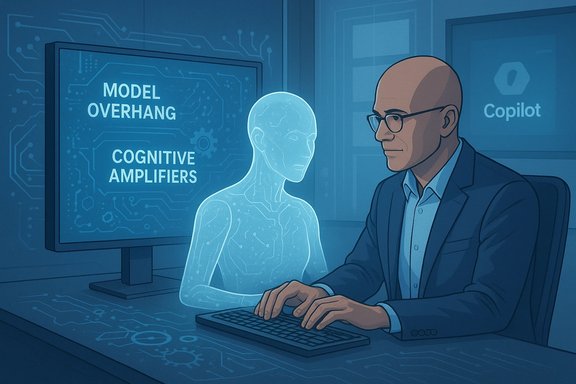
Satya Nadella’s end‑of‑year reflections framed 2025 as an inflection point for generative AI: a period moving from discovery to widescale diffusion, confronting what he calls “model overhang”, and urging a collective shift from spectacle to substance. Those phrases — crisp, conceptual, and elevated — are exactly the kind of language that rings familiar to anyone who has used large language models or Copilot to draft vision statements or summarize meetings. Windows Central published a close reading that pointed out several turns of phrase from Nadella’s post that look very much like model‑style prose, and used Copilot itself to evaluate whether the post was human‑written, AI‑authored, or some hybrid of the two.
Two separate but related realities make this question consequential. First, Nadella isn’t writing a personal blog for a niche audience — he’s setting expectations for customers, partners, regulators, and tens of thousands of Microsoft employees. Second, Microsoft has publicly acknowledged that AI is material to its engineering process: Nadella himself said that roughly “maybe 20%, 30%” of code in some Microsoft repositories is now produced with AI assistance. That claim has been widely reported across major outlets and is real enough to change how people read executive messaging about AI. This article unpacks what happened, verifies the key technical claims, weighs the strengths and weaknesses of Nadella’s approach, and explains the risks — both product and reputational — Microsoft must manage as it blends AI into communications and core products.
Nadella’s post contains legitimate strategic thinking about the role of AI. At the same time, the sterile cadence of parts of the piece and the community backlash over product misfires expose a gap between vision and lived experience. Microsoft’s task now is not to litigate authorship but to demonstrate, with code, telemetry, and public commitments, that its AI integrations deliver measurable, trustworthy improvements — and to make the path from spectacle to substance unmistakably visible to customers and developers alike.
Source: Windows Central https://www.windowscentral.com/soft...-written-by-ai-at-least-according-to-copilot/
 Background / Overview
Satya Nadella’s end‑of‑year reflections framed 2025 as an inflection point for generative AI: a period moving from discovery to widescale diffusion, confronting what he calls “model overhang”, and urging a collective shift from spectacle to substance. Those phrases — crisp, conceptual, and elevated — are exactly the kind of language that rings familiar to anyone who has used large language models or Copilot to draft vision statements or summarize meetings. Windows Central published a close reading that pointed out several turns of phrase from Nadella’s post that look very much like model‑style prose, and used Copilot itself to evaluate whether the post was human‑written, AI‑authored, or some hybrid of the two.Two separate but related realities make this question consequential. First, Nadella isn’t writing a personal blog for a niche audience — he’s setting expectations for customers, partners, regulators, and tens of thousands of Microsoft employees. Second, Microsoft has publicly acknowledged that AI is material to its engineering process: Nadella himself said that roughly “maybe 20%, 30%” of code in some Microsoft repositories is now produced with AI assistance. That claim has been widely reported across major outlets and is real enough to change how people read executive messaging about AI. This article unpacks what happened, verifies the key technical claims, weighs the strengths and weaknesses of Nadella’s approach, and explains the risks — both product and reputational — Microsoft must manage as it blends AI into communications and core products.
What Copilot and readers noticed about the post
The signals that read as “model‑ish”
Readers and Copilot flagged a handful of writing characteristics that often point to model involvement:- High abstraction, low specificity. The piece leans on conceptual categories — “diffusion,” “scaffolding,” “systems,” “real‑world impact” — rather than anchoring arguments in concrete examples, dates, or first‑hand anecdotes.
- Polished cadence. Sentences are even, balanced, and rhythmically consistent, a quality often produced by models tuned to produce fluent, “executive” tone.
- Repetition of motifs. Key terms recur across sections in slightly varied forms — a technique models use to reinforce themes when asked to produce a persuasive narrative.
- Lack of personal fingerprints. There are few sensory or situational markers (e.g., “In a meeting last March…”) that would clearly anchor the piece to Nadella’s lived experience.
What felt human
Where the piece read as authentically human, Copilot and critics noted:- A coherent worldview. The post consistently frames AI as augmentation — “cognitive amplifiers,” not replacements — creating a recognizable company philosophy rather than an abstract marketing slogan.
- A structured narrative arc. The writing follows a classic thought‑leadership format: past → present → imperative → call to action. Humans do this intentionally; models emulate it.
- Occasional original phrasing. Phrases such as “bicycles for the mind” echo established metaphors but are deployed in ways that suggest a human mind testing an analogy.
Why authorship matters: beyond vanity
Claims about whether a CEO’s blog post was written by AI are not only about purity of authorship. They touch on three practical issues:- Trust and transparency. Leaders are held to different expectations. If executives use model‑assisted language, the company should be clear about it when that assistance affects policy, commitments, or technical claims.
- Accountability for technical assertions. When a leader makes a numerical or operational claim, readers expect traceable facts. If the prose is AI‑assisted, editorial rigor around numbers and citations becomes even more important.
- Tone and customer perception. Visionary language that feels generic or “corporate‑AI” risks alienating engineers, partners, and power users who prize concrete problem‑solving over high‑level rhetoric.
Verifying the technical claims
Did Nadella really say “20–30%” of code is written by AI?
Yes. Multiple reputable outlets recorded Nadella saying “maybe 20%, 30% of the code that is inside of our repos today…in some of our projects are probably all written by software” during a public conversation at a developer event. CNBC and GeekWire both reported the quote, and the phrasing has been widely syndicated. This is not a rumor — it is a public admission that AI is materially present in substantial portions of Microsoft’s engineering workflows. That remark requires nuance: Microsoft’s use of AI ranges from inline completions and scaffolding to larger agent‑driven edits that are later human‑reviewed. The percentage is a directional indicator of adoption, not an audited breakdown of autonomous AI commits across every product. Still, the figure is large enough that executive communications around AI — including blog posts — should be read with an awareness that AI is both an operational tool and a narrative subject at Microsoft.Was 2025 a “disastrous” year for Windows 11?
The claim that 2025 was broadly disastrous for Windows 11 is an overstatement, but it captures a real and measurable trust problem. Major elements underpinning that conclusion include:- High‑profile marketing and demo misfires (for example, Copilot demonstrations that suggested incorrect settings or misinterpreted UI context), which were widely picked up in tech press and social media.
- Vocal community backlash to the “agentic OS” framing, with Windows leadership publicly acknowledging that reliability and developer experience needed work.
- Reports of specific reliability and usability regressions (File Explorer sluggishness, inconsistent dialogs), which have generated significant user frustration.
The strengths in Nadella’s approach
Despite the critique of tone, the post does have substantive strengths that are worth acknowledging.- Vision framing. Nadella positions AI as an augmentative layer for cognitive tasks, which is a defensible and widely shared enterprise view. That framing can help align large organizations around measured product investments.
- Systemic thinking. The post attempts to connect model capability (what models can do) to system design (how to integrate AI responsibly), which is essential as companies consider governance, observability, and auditability.
- Product ambition. Microsoft’s focus on agents, multimodality, and developer tooling reflects a coherent product roadmap that could deliver productivity gains at scale if executed with engineering discipline.
The risks and weaknesses: what needs correction
At least four concrete risks emerge from the style and substance of the blog post and Microsoft’s broader rollout:- Perception of inauthenticity. Overly sanitized, model‑like prose risks distancing stakeholders who want evidence of lived experience and decision‑level accountability.
- Overpromising without operational detail. Visionary claims require operational anchoring — timelines, pilots, user metrics, and post‑mortems — otherwise they appear speculative.
- Product trust erosion. Aggressive Copilot integrations, presented as default conveniences, collided with real usability failures and developer concerns about code quality and autonomy. That erosion is measurable and requires remediation.
- Governance gaps. As AI writes more code and participates in decisions, provenance, model versioning, audit trails, and human‑in‑the‑loop checks become non‑negotiable safety and compliance requirements.
Practical recommendations for Microsoft (and other AI‑heavy companies)
To rebuild trust and demonstrate responsible, human‑centered leadership, the following steps should be prioritized:- Be transparent about assistance. When AI substantially contributes to product claims or leader communications, disclose the extent of assistance and provide technical appendices where appropriate.
- Publish measurable commitments. Follow visionary statements with concrete milestones: reliability SLAs, staged feature rollouts, and timelines for developer experience improvements.
- Surface provenance. For code and content generated or suggested by AI, attach metadata: model ID, prompt/hyperparameters snapshot, generation timestamp, and reviewer identity.
- Strengthen live demos and QA. Every external demo should pass real‑world adversarial testing that mirrors the conditions critics will attempt to reproduce.
- Offer opt‑out and control. For system‑level assistants (Copilot in the OS), make opt‑outs simple and respect existing user workflows for power users and IT admins.
- Invest in post‑incident transparency. When regressions or outages happen, publish timely, technical post‑mortems that explain root causes and remediation steps.
How to tell when an executive post was AI‑assisted (practical cues)
Readers who want to critically read CEO essays can look for a few telltale signs of AI assistance versus purely human composition:- Excessive abstraction without context. AI‑assisted drafts lean heavily on framing language and fewer concrete anecdotes.
- Uniform sentence length and rhythm. Models tend to produce sentences with consistent cadence unless explicitly instructed to vary.
- Motif repetition. Repeated keyphrases and synonyms clustered in the same piece can indicate a model reinforcing central themes.
- Absence of verifiable minutiae. Human executives often reference specific meetings, dates, pilot projects, or metrics; their absence suggests lighter editorial rigor.
- Polished transitions. Model‑edited text often reads like a refined speech: smooth linkages but shallow evidentiary depth.
Wider implications for enterprise customers and developers
Microsoft’s trajectory matters because enterprises make procurement, security, and architecture decisions based on vendor visions. If an OS vendor pushes system‑level agents that can act autonomously, companies must ask:- How will audit trails be preserved for agent actions that alter data or configuration?
- What testing and rollout safeguards exist to prevent regressions during agentic updates?
- How are privacy and consent managed when an agent assesses screen content or interfaces with multiple accounts?
What Microsoft should say next — and how
A credible follow‑up from Microsoft’s leadership should combine three things:- A candid acknowledgment of the gaps between marketing demos and field experience — not defensive cheerleading.
- A short list of concrete actions (two to four items) with measurable timelines for improving reliability, developer experience, and opt‑in controls.
- A commitment to transparency about AI’s role inside the company — including how much assistance is used in engineering and communications, and how decisions are audited.
Conclusion
The kerfuffle over whether Satya Nadella’s year‑end blog was written by a human, AI, or a blend of the two is more than a semantic quibble. It is an indicator of a broader cultural and technical inflection: companies that build and promote AI systems must be held to new standards of clarity, provenance, and operational rigor.Nadella’s post contains legitimate strategic thinking about the role of AI. At the same time, the sterile cadence of parts of the piece and the community backlash over product misfires expose a gap between vision and lived experience. Microsoft’s task now is not to litigate authorship but to demonstrate, with code, telemetry, and public commitments, that its AI integrations deliver measurable, trustworthy improvements — and to make the path from spectacle to substance unmistakably visible to customers and developers alike.
Source: Windows Central https://www.windowscentral.com/soft...-written-by-ai-at-least-according-to-copilot/
