

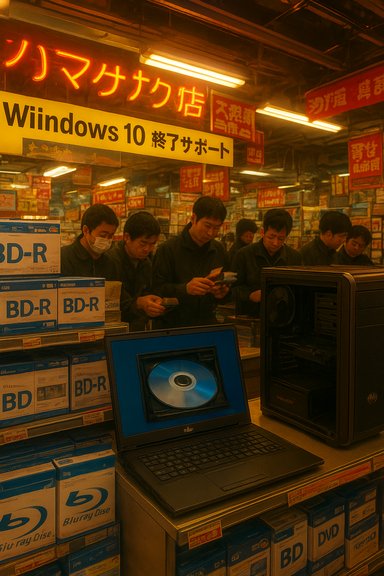
Optical drives are quietly back on the shopping lists of Japanese PC buyers, and the cause is as practical as it is cultural: the end of Windows 10 support forced a refresh cycle that exposed a simple compatibility gap—new Windows 11 machines often omit internal optical bays—prompting a wave of purchases for internal Blu‑ray and DVD drives and even hardware designed to accommodate them.
Microsoft ended mainstream support for Windows 10 on October 14, 2025, a milestone that removed routine feature updates, cumulative security patches, and standard technical assistance for consumer editions and pushed many users toward Windows 11 or paid Extended Security Updates. That deadline created a concrete migration moment: users who had kept older, drive-equipped machines for years suddenly faced buying new PCs that frequently lacked built-in optical drives. For a meaningful segment of Japanese buyers—collectors, professionals using archival media, and households with extensive personal libraries of discs—losing that local, built‑in access is a real problem rather than a mere inconvenience. Local reporting from Akihabara and specialist retailers documented brisk demand for internal BD‑R burners and DVD drives as Windows‑10-to‑11 upgrades accelerated. This article synthesizes the on‑the‑ground reporting, OEM product responses, and the market dynamics behind the revival. It cross‑references the original report circulated on HWCooling and corroborating Japanese and international coverage, evaluates technical and business implications, and highlights the likely arc of this micro‑revival: practical, locally significant, but not a global reversal of the long decline in optical media.
Key technical points of the CM695:
Yet the larger structural trends—the shift to streaming, distribution consolidation, decreasing global production of blank media, and the long‑term decline in optical hardware volumes—remain dominant. Unless demand becomes sustained and broad, the revival is likely to remain a notable regional niche rather than a global renaissance.
Caution remains essential. The scarcity reports reflect a localized imbalance between demand and supply in an ecosystem that has shrunk. Buyers should evaluate optical media as part of a layered approach to storage and preservation and factor in availability and long‑term support when making purchasing decisions.
The optical drive didn’t come back because nostalgia won; it re‑emerged because a concrete need intersected with local behavior and a lean supply base—creating a short, sharp market signal and prompting hardware choices that respect real user needs.
Source: HWCooling.net Optical drives make a comeback in Japan due to Windows 11 - HWCooling.net
 Background
Microsoft ended mainstream support for Windows 10 on October 14, 2025, a milestone that removed routine feature updates, cumulative security patches, and standard technical assistance for consumer editions and pushed many users toward Windows 11 or paid Extended Security Updates. That deadline created a concrete migration moment: users who had kept older, drive-equipped machines for years suddenly faced buying new PCs that frequently lacked built-in optical drives. For a meaningful segment of Japanese buyers—collectors, professionals using archival media, and households with extensive personal libraries of discs—losing that local, built‑in access is a real problem rather than a mere inconvenience. Local reporting from Akihabara and specialist retailers documented brisk demand for internal BD‑R burners and DVD drives as Windows‑10-to‑11 upgrades accelerated. This article synthesizes the on‑the‑ground reporting, OEM product responses, and the market dynamics behind the revival. It cross‑references the original report circulated on HWCooling and corroborating Japanese and international coverage, evaluates technical and business implications, and highlights the likely arc of this micro‑revival: practical, locally significant, but not a global reversal of the long decline in optical media.Overview of what happened
- Microsoft’s support cutoff for Windows 10 acted as the proximate trigger for PC purchases.
- Japanese specialty retailers in Akihabara and elsewhere reported sudden increases in demand for internal Blu‑ray burners (BD‑R) and DVD drives; several shops described internal BD‑R units as sold out or severely depleted.
- Hardware vendors responded regionally: Cooler Master launched the MasterBox CM695 mid‑tower with a classic 5.25‑inch front bay in Japan, and Fujitsu and other domestic laptop makers continued to offer models with integrated optical drives.
- Retailers and buyers prefer internal drives for sustained write performance and thermal handling—important for BD‑R burning and archival workflows—explaining why internal drives were favored over external USB models in this wave.
Why this matters: technical and cultural drivers
1. A software lifecycle that turned into a hardware question
The Windows 10 end‑of‑support event is a classic example of software policy cascading into hardware demand. When a user upgrades to a supported OS, the expectation is functional continuity—files, media, and the ability to run what worked before. That expectation clashes with modern PC design choices that deprioritized legacy mechanical bays in favor of thinner profiles, improved airflow, and SSD storage. The result: a simple friction point that motivated immediate purchases of optical drives and accessories.2. Japan’s stronger attachment to physical media
Japan retains a comparatively large market of collectors and consumers for physical media—anime Blu‑ray box sets, special music releases, concert Blu‑rays, and software distributed on disc. For these buyers, a disc is not just a delivery mechanism but an object with collectible value and long‑term ownership semantics. This cultural context amplifies the hardware impact of software transitions: losing a drive feels like compromising ownership, not just convenience. ITmedia’s reporter observed the trend directly in Akihabara shops, where staff described customers explicitly seeking internal drives to maintain continuity.3. Professional and archival use cases
Beyond fandom, some photographers, videographers, studios, and small businesses use optical media as part of multi‑layer archival strategies—especially with archival media like M‑Disc and BDXL that are marketed for long retention. Internal BD‑R burners are perceived as more reliable for sustained writes than many bus‑powered externals, further steering professionals toward integrated drives. However, claims about absolute archival lifespans are variable and depend on media quality and storage conditions; the preference is driven by workflow expectations as much as immutable technical superiority.The hardware reaction: cases, drives, and laptops
Cooler Master’s MasterBox CM695: a design tuned for a market need
Cooler Master publicly listed the MasterBox CM695 as a consumer product that intentionally retains a 5.25‑inch optical bay, explicitly targeting users who still value optical drives. The product web page and Japanese press coverage describe two model variants (solid and tempered glass), support for large GPUs, multiple storage bays, and modern I/O such as a USB‑C 20 Gbps port—evidence the chassis is modern in core design while reintroducing a legacy feature. Why this matters: the CM695 shows manufacturers can still design regionally targeted hardware that blends modern component compatibility with legacy options. It’s not nostalgia for nostalgia’s sake—the bay solves a practical problem for buyers who need internal BD‑R capability without a second external device.Key technical points of the CM695:
- One full‑height 5.25‑inch front bay for optical drives or front‑panel devices.
- Support for up to four 3.5‑inch HDDs and five 2.5‑inch SSD mounts, and large GPU clearance (roughly up to 398 mm).
- Modern I/O including USB 3.2 Gen 2x2 Type‑C and multiple fan/radiator layout options, keeping thermals contemporary.
- The case ships without a drive; buyers must procure an internal BD‑R or DVD drive separately—and internal BD‑R stock was reported tight in the aftermarket.
Fujitsu and the unusual laptop choices
Fujitsu’s 2025 FMV Note A family was offered in Japan with configurations that included built‑in optical drives—DVD or even BDXL‑compatible Blu‑ray drives in higher tiers—confirming OEMs still see enough regional demand to justify the mechanical complexity and cost. The FMV Note A models shipped as 16‑inch machines with 1,920 × 1,200 panels, multiple CPU options (Intel 13th‑Gen U‑series or AMD Ryzen 7 7735U), and a thicker chassis where a tray mechanism fits conveniently. Fujitsu’s official pages and Japanese tech outlets carry these specs and configuration options. Other Japan‑market models from NEC (Lavie N16) and Dynabook (T‑series) also offered optical drive options in 2025 notebooks, illustrating that OEMs are not alone in responding to market specifics. Tom’s Hardware and Japanese outlets noted these models and their presence in domestic retail. Why this is notable: laptop OEMs avoiding optical drives for years now re‑exposed the tradeoffs. For some buyers, the modest weight and thickness penalty is acceptable to retain native playback and archive capabilities in a single device.Market mechanics and supply constraints
Why stockouts happened (and what they mean)
Several factors combined to make BD‑R and internal optical drives scarce in Japan’s specialty channels:- The global optical‑media supply base has shrunk over years as demand declined; production lines consolidated and many consumer lines were scaled back. When baseline supply is low, a small demand uptick is visible as a shortage.
- The Windows 10 support cutoff created a concentrated, time‑bound spike in demand as many users decided to replace machines rather than remain unsupported.
- Internal BD‑R drives are niche and not made in the same volumes as in the past; logistics and channel allocation meant that Akihabara and specialist retailers could run out faster than broad mass‑market shelves.
Internal vs external drives: the performance argument
Retailers quoted in ITmedia and other reporting emphasized write speed and thermal stability when recommending internal SATA BD‑R burners to customers who author discs frequently. External USB drives—while convenient—are often bus‑powered and can throttle sustained write speeds when thermals or bus limitations intervene, which matters for large BDXL burns. That practical performance gap explains the preference for internal devices despite the added installation complexity.Strengths, opportunities, and risks
Notable strengths of the current revival
- Real, user‑level demand: the surge is behaviorally grounded, not purely sentimental. For many buyers the disc is active and necessary.
- OEM and channel agility: Cooler Master and Fujitsu demonstrate vendors can pivot regionally, offering purpose‑built cases and laptops that meet localized needs without abandoning modern design principles.
- Preservation workflows: renewed attention to physical archival strategies may benefit professions and households that value an offline, human‑readable backup layer.
Potential risks and limitations
- Fragile supply: the optical‑media ecosystem is lean; if demand remains modest or episodic, prices and availability could remain volatile and OEM support could retract again.
- False sense of permanence: promotional claims about multi‑decade durability for specific media (e.g., M‑Disc) vary by manufacturer; archival longevity depends on media quality, storage conditions, and redundancy. Purchasers should not assume a disc alone is a single‑source archive for critical data. Treat optical media as one layer in a layered backup strategy.
- Narrow market footprint: the uptick is concentrated and culturally specific; it doesn’t imply a global return to discs in mainstream markets dominated by streaming and cloud storage. The phenomenon is meaningful inside particular workflows and regions—Japan included—but is not a mass‑market trend outside those contexts.
Practical guidance for buyers and builders
- If you value native playback or archive burning, prioritize an internal BD‑R burner (SATA) where possible. These typically provide higher sustained write performance and better thermal handling than bus‑powered externals.
- If your case lacks a 5.25‑inch bay, options include:
- Choose a modern case with a bay (e.g., Cooler Master MasterBox CM695 in Japan) or seek compatible variants in your region.
- Use a quality external USB 3.x Blu‑ray drive (convenient but potentially limited on sustained writes).
- Consider a small internal PCIe‑based solution if you can find specialty vendors that support internal optical mechanisms in non‑standard enclosures.
- For laptop buyers who rely on discs regularly, consider regionally available models with integrated drives (in Japan: Fujitsu FMV Note A, NEC Lavie N16, and Dynabook T‑series were offered with optical options). These will be heavier and thicker than ultralight notebooks but deliver integrated convenience.
- Archive smartly: always use multiple copies, multiple formats, and a verified refresh schedule. Optical media can be part of a longer retention strategy but should not be your sole archive.
Market outlook: transient surge or persistent niche?
The evidence points to a credible, localized surge driven by a specific trigger (Windows 10 end of support), cultural consumption patterns in Japan, and a supply base that magnified the effect. Manufacturers and vendors moved quickly to provide products that address the gap—Cooler Master with a bayed case, Fujitsu and others by maintaining optical options on laptops—illustrating how hardware makers can answer narrowly‑defined user needs.Yet the larger structural trends—the shift to streaming, distribution consolidation, decreasing global production of blank media, and the long‑term decline in optical hardware volumes—remain dominant. Unless demand becomes sustained and broad, the revival is likely to remain a notable regional niche rather than a global renaissance.
Final analysis and takeaway
The optical‑drive comeback in Japan is an instructive microcase of how software lifecycle decisions intersect with hardware design and culture. A date on Microsoft’s calendar—October 14, 2025—created a predictable upgrade impulse. Where that impulse encountered a gap (new machines lacking optical bays), buyers and vendors responded in ways that respected local behavior and workflows: retailers sold out of internal BD‑R drives, Cooler Master introduced a contemporary case with a 5.25‑inch bay, and Fujitsu and other domestic OEMs offered laptops with built‑in optical mechanisms. That response is pragmatic, not paradoxical: it’s about maintaining continuity of ownership and utility for people who still actively use disc‑based content. The revival highlights the value of choice in PC design—structures that let users keep legacy workflows where needed while still embracing modern performance and connectivity.Caution remains essential. The scarcity reports reflect a localized imbalance between demand and supply in an ecosystem that has shrunk. Buyers should evaluate optical media as part of a layered approach to storage and preservation and factor in availability and long‑term support when making purchasing decisions.
The optical drive didn’t come back because nostalgia won; it re‑emerged because a concrete need intersected with local behavior and a lean supply base—creating a short, sharp market signal and prompting hardware choices that respect real user needs.
Source: HWCooling.net Optical drives make a comeback in Japan due to Windows 11 - HWCooling.net
