

June 2026’s most important gadgets were a wave of laptops, handhelds, AI glasses, creator cameras, robot mowers, phones, and consoles announced or reviewed around Computex, WWDC, and AWE, with Windows PC makers using the month to answer Apple’s low-cost MacBook Neo and the broader industry leaning hard into AI hardware. The bigger story was not any single device. It was the uncomfortable collision between premium design, AI acceleration, and rising component costs. Summer gadget season did not slow down; it clarified where consumer technology is heading next.
For Windows users, the most strategically important product in June may not be the flashiest one. Dell’s new XPS 13 matters because it is a direct response to Apple’s MacBook Neo: a relatively affordable, thin, aluminum laptop positioned as the default computer for students, commuters, and anyone who wants a real machine without paying workstation money.
That is a familiar role for the XPS line, but the economics have changed. A $700 XPS 13 with 8GB of RAM, 512GB of storage, a 2.5K touchscreen, and a 2.2-pound aluminum body is not just another midrange notebook. It is Dell trying to make the case that Windows laptops can still compete on build quality and price at the same time.
The interesting chip here is Intel’s “Wildcat Lake,” reportedly a more mainstream offshoot of the Panther Lake generation. That distinction matters because Intel and its PC partners are trying to slice the market more carefully than before. Some buyers will want battery life and AI features; others just need a well-built machine that does not feel like punishment for staying under $1,000.
There are still compromises. The trackpad appears to be one of the places where Dell may have shaved cost, and 8GB of RAM remains a hard sell in 2026 if you expect to keep a machine for years. But the XPS 13’s existence is the signal: Apple’s MacBook Neo forced the PC industry to stop treating the low end as a dumping ground for plastic shells and dim panels.
June’s laptop announcements suggest a different instinct. Dell, HP, Microsoft, and others are increasingly selling the whole object: screen, chassis, battery life, input feel, thermal behavior, AI features, and price. That is the right fight, because most mainstream buyers do not purchase a laptop as a motherboard with a display attached. They buy a daily object.
HP’s OmniBook Ultra 14 fits into that same shift. A 14-inch clamshell with a 3K OLED touch display, strong speakers, and solid performance is not a revolutionary machine, but it shows how quickly high-end display technology has moved from luxury differentiator to mainstream expectation. OLED used to be the “nice if you can afford it” upgrade. Now, inky blacks and high contrast are part of the pitch for a portable productivity laptop.
That is good news for Windows users. The bad news is that the same display, memory, and storage improvements that make machines feel modern are arriving just as the bill of materials is getting uglier.
That helps explain why the month felt so contradictory. On one hand, there were more genuinely interesting devices than could comfortably fit into a gadget roundup. On the other, many of them seemed to arrive with a quiet warning label: enjoy this, because the next version may cost more.
Xbox is the most obvious example. Repeated console price increases within a year are not normal in the old consumer-electronics rhythm, where hardware typically gets cheaper as a generation matures. A Series X climbing toward luxury pricing changes the psychological contract between console makers and players. Consoles were supposed to be the stable, predictable alternative to PC gaming’s component churn.
The transparent green 25th anniversary Xbox hardware may be catnip for nostalgia, especially for anyone who remembers the original Xbox’s black-and-green industrial swagger. But nostalgia lands differently when the base hardware is already expensive. A special edition that might once have felt celebratory now risks looking like a premium wrapper around a pricing problem.
That makes the “is it worth it?” question unusually personal. If the device delivers high frame rates, strong graphics settings, and credible battery behavior, it may be worth the money to a dedicated PC gamer who wants portability without the compromises of earlier handhelds. But the price also shows that the category is splitting in two.
Nintendo still owns the console-handheld lane because it owns the games. If you want Nintendo’s first-party library, the Switch 2 is the machine. Windows handhelds, by contrast, are trying to become portable access points to Steam, Game Pass, Epic, emulators, cloud saves, and a messy but powerful PC ecosystem.
Asus’ Xbox Ally X20 pushes the premium side even harder. A larger 7.4-inch OLED display, much higher brightness, and a bundled pair of ROG Xreal R1 AR glasses make it sound less like a handheld revision and more like an entire portable gaming environment. The problem is obvious: bundling premium glasses with an already expensive handheld risks creating a product for enthusiasts who already own too many handhelds.
That is not a normal Surface pitch. Surface historically traded on refinement, portability, pen support, and Microsoft’s ability to show OEMs what a polished Windows machine could look like. A 4.5-pound Surface Laptop Ultra sounds more like Microsoft making a statement about local AI, creator workloads, and developer machines.
The Nvidia angle matters. If Windows on ARM is going to move beyond thin-and-light battery-life demos, it needs performance silicon that can make developers, video editors, 3D artists, and AI hobbyists take it seriously. Qualcomm opened one door; Nvidia could open a very different one.
But there is a risk. Windows on ARM still has to earn trust in compatibility, drivers, virtualization, enterprise management, and weird edge-case software that nobody remembers until it breaks. If Microsoft is going to sell a powerful ARM workstation-class laptop, it has to convince buyers that they are not volunteering to become compatibility testers.
The improved AI layer is just as important as the hardware. Earlier smart glasses were often better at creating social discomfort than solving daily problems. A camera on your face is a high-friction object unless the assistant behind it is fast, useful, and accurate enough to justify the awkwardness.
Muse Spark-powered Meta AI is reportedly more capable for visual understanding and quick contextual assistance. That is the feature that could make glasses useful: not recording for its own sake, but helping identify, translate, summarize, navigate, or recall what the wearer is looking at. The phrase computer vision becomes less abstract when it is sitting on your nose.
Privacy remains the category’s unresolved debt. Smaller camera holes may make the glasses more elegant, but they also make them less obvious to bystanders. Meta’s challenge is not merely to build a better wearable; it is to convince people who are not wearing one that they are not unwilling participants in someone else’s always-on assistant.
Wearables succeed or fail socially before they succeed technically. Watches had an existing fashion category to inhabit. Earbuds could disappear into commuting and workouts. Glasses sit on the center of the face, mediate eye contact, and change how other people behave around you.
This is why Meta’s emphasis on smaller holes, adjustable fit, and conventional frames is not just cosmetic. The smart-glasses winner will not be the device with the most dramatic demo. It will be the one people can wear without constantly explaining themselves.
For Windows users and IT departments, that social layer will eventually become a policy layer. Cameras on faces raise workplace questions around confidential screens, meeting rooms, clean desks, healthcare environments, classrooms, and manufacturing floors. The consumer gadget of June could become the admin headache of 2027.
The detachable screen is the clever part. Used as a remote and microphone, it solves several real creator problems at once: framing, narration, control, and distance from the camera. Add accessory support such as an LED light, and the Luna Ultra starts to look like an answer to the question many creators actually ask: how much gear can I leave at home?
DJI’s Osmo Pocket 3 became popular because it reduced friction. It made stabilized, good-looking footage easy. Insta360 appears to be answering with flexibility, resolution, and modularity.
That is the broader creator-tech trend. The best new cameras are not only about image quality. They are about workflow. A device that records great footage but complicates audio, monitoring, lighting, or transfer is less useful than a slightly less perfect camera that gets the whole process moving faster.
At roughly $2,500, the Navimow X430 is not an impulse buy. But lawn care is expensive in time, labor, and recurring service costs. For homeowners who dislike mowing, have compatible yards, and can tolerate the setup process, a serious robotic mower can be more than a novelty.
The “same Segway” joke is unavoidable, because the company’s self-balancing scooters became a cultural shorthand for awkward futurism. But the robot mower category is a better fit for that engineering heritage than mall-cop transport ever was. Sensors, balance, autonomy, route planning, and ruggedized movement matter more when the machine is cutting grass than when it is trying to make a security guard look less bored.
The smart home has often overpromised with light bulbs, dashboards, and half-baked automation routines. A mower that simply handles the lawn is refreshingly direct. The best smart-home devices are not the ones that make you feel futuristic; they are the ones that make a chore disappear.
That is not failure. Mature smartphones improve by accumulation: better screens, better cameras, better thermals, smarter software, longer support windows, and smoother integration. But it does mean that phone makers are leaning on AI branding to make incremental changes feel more dramatic than they are.
The camera comparison is also telling. Samsung remains the safe premium Android choice in many markets, especially in the United States, but Chinese flagships from Xiaomi, Oppo, and Huawei continue to push camera hardware and computational photography in ways many American buyers cannot easily access. That creates an odd split: the “best phone for most people” may not be the most technically advanced phone.
For Windows users, Samsung’s phones still matter because of ecosystem integration. Phone Link, DeX-like workflows, cross-device clipboard features, and cloud syncing have made Android-Windows pairing far less clumsy than it used to be. But the S26 Ultra’s larger lesson is that AI features need to become daily habits, not demo moments.
That is especially important in the AI era. A laptop, phone, or pair of glasses can be transformed by a model update, a privacy policy change, an app integration, or a cloud feature that did not exist at launch. The most important spec may become not TOPS, RAM, or display brightness, but whether the vendor keeps improving the product after the review embargo lifts.
This is where Microsoft, Apple, Google, Meta, Samsung, and the PC OEMs are all converging. Each wants hardware to become the physical endpoint for an AI service layer. The device is still important, but the business logic increasingly lives in the assistant, the cloud subscription, the app ecosystem, and the user data loop.
That makes buyers more dependent on vendor judgment. A great product can be weakened by bad updates, intrusive AI prompts, or subscription creep. A merely good product can become excellent if its software matures. In 2026, buying hardware is also buying into a roadmap you cannot fully see.
That does not mean every device will become unaffordable. The Dell XPS 13 shows that competition can still drive impressive machines into lower price bands. Meta’s cheaper self-branded glasses show that removing a fashion logo can bring down the entry point. Apple’s MacBook Neo forced an entire class of PC makers to sharpen their pencils.
But the direction of travel is uneven. Consoles are getting pricier. Premium handhelds are approaching laptop money. High-end creator cameras are becoming modular rigs. AI laptops are climbing into workstation territory. Phones are adding features that sound futuristic but do not necessarily change the daily value equation.
The consumer electronics industry used to rely on a comforting pattern: today’s flagship becomes tomorrow’s mainstream device. June 2026 suggests that pattern is still alive, but under pressure. If AI demand keeps absorbing component supply, the trickle-down curve may slow.
Dell’s XPS 13 changes expectations for affordable Windows laptops. Meta’s Fury changes expectations for how cheap and normal AI glasses can become. The Surface Laptop Ultra changes expectations for what a Windows ARM performance machine might look like. The MSI Claw 8 EX AI+ changes expectations for how far PC handheld pricing can stretch.
Some devices are important because many people will buy them. Others are important because competitors will copy them. A few are important because they reveal where the market is getting weird.
June had all three. That is why it felt less like a summer lull and more like a product-map leak for the next year of consumer tech.
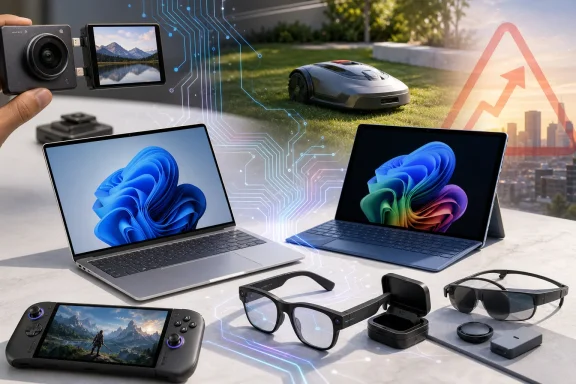 The Cheap Laptop War Has Become the Main Event
For Windows users, the most strategically important product in June may not be the flashiest one. Dell’s new XPS 13 matters because it is a direct response to Apple’s MacBook Neo: a relatively affordable, thin, aluminum laptop positioned as the default computer for students, commuters, and anyone who wants a real machine without paying workstation money.That is a familiar role for the XPS line, but the economics have changed. A $700 XPS 13 with 8GB of RAM, 512GB of storage, a 2.5K touchscreen, and a 2.2-pound aluminum body is not just another midrange notebook. It is Dell trying to make the case that Windows laptops can still compete on build quality and price at the same time.
The interesting chip here is Intel’s “Wildcat Lake,” reportedly a more mainstream offshoot of the Panther Lake generation. That distinction matters because Intel and its PC partners are trying to slice the market more carefully than before. Some buyers will want battery life and AI features; others just need a well-built machine that does not feel like punishment for staying under $1,000.
There are still compromises. The trackpad appears to be one of the places where Dell may have shaved cost, and 8GB of RAM remains a hard sell in 2026 if you expect to keep a machine for years. But the XPS 13’s existence is the signal: Apple’s MacBook Neo forced the PC industry to stop treating the low end as a dumping ground for plastic shells and dim panels.
Windows PCs Are Finally Fighting Apple on Apple’s Terrain
The most revealing thing about the XPS 13 is not that it exists, but that it looks like a MacBook Neo rival rather than a spec-sheet rebuttal. Windows OEMs spent years trying to out-configure Apple. More RAM, more ports, more SKUs, more model numbers, more confusing distinctions between nearly identical products.June’s laptop announcements suggest a different instinct. Dell, HP, Microsoft, and others are increasingly selling the whole object: screen, chassis, battery life, input feel, thermal behavior, AI features, and price. That is the right fight, because most mainstream buyers do not purchase a laptop as a motherboard with a display attached. They buy a daily object.
HP’s OmniBook Ultra 14 fits into that same shift. A 14-inch clamshell with a 3K OLED touch display, strong speakers, and solid performance is not a revolutionary machine, but it shows how quickly high-end display technology has moved from luxury differentiator to mainstream expectation. OLED used to be the “nice if you can afford it” upgrade. Now, inky blacks and high contrast are part of the pitch for a portable productivity laptop.
That is good news for Windows users. The bad news is that the same display, memory, and storage improvements that make machines feel modern are arriving just as the bill of materials is getting uglier.
AI Has Started Taxing the Consumer Electronics Aisle
The dark cloud over June’s gadget list was pricing. Flash storage and memory are under pressure, and AI data centers are a major reason why. When hyperscalers buy aggressively, consumer hardware companies compete for the leftovers or sign more expensive supply contracts. Either way, the cost does not disappear; it moves downstream.That helps explain why the month felt so contradictory. On one hand, there were more genuinely interesting devices than could comfortably fit into a gadget roundup. On the other, many of them seemed to arrive with a quiet warning label: enjoy this, because the next version may cost more.
Xbox is the most obvious example. Repeated console price increases within a year are not normal in the old consumer-electronics rhythm, where hardware typically gets cheaper as a generation matures. A Series X climbing toward luxury pricing changes the psychological contract between console makers and players. Consoles were supposed to be the stable, predictable alternative to PC gaming’s component churn.
The transparent green 25th anniversary Xbox hardware may be catnip for nostalgia, especially for anyone who remembers the original Xbox’s black-and-green industrial swagger. But nostalgia lands differently when the base hardware is already expensive. A special edition that might once have felt celebratory now risks looking like a premium wrapper around a pricing problem.
Handheld Gaming Has Become a Luxury PC Category
The MSI Claw 8 EX AI+ is the clearest example of where portable gaming is going at the high end. At around $1,800, it is not really competing with a Nintendo Switch 2. It is competing with gaming laptops, compact desktops, and the idea that a handheld can be a primary gaming PC.That makes the “is it worth it?” question unusually personal. If the device delivers high frame rates, strong graphics settings, and credible battery behavior, it may be worth the money to a dedicated PC gamer who wants portability without the compromises of earlier handhelds. But the price also shows that the category is splitting in two.
Nintendo still owns the console-handheld lane because it owns the games. If you want Nintendo’s first-party library, the Switch 2 is the machine. Windows handhelds, by contrast, are trying to become portable access points to Steam, Game Pass, Epic, emulators, cloud saves, and a messy but powerful PC ecosystem.
Asus’ Xbox Ally X20 pushes the premium side even harder. A larger 7.4-inch OLED display, much higher brightness, and a bundled pair of ROG Xreal R1 AR glasses make it sound less like a handheld revision and more like an entire portable gaming environment. The problem is obvious: bundling premium glasses with an already expensive handheld risks creating a product for enthusiasts who already own too many handhelds.
Microsoft’s Surface Laptop Ultra Is a Bet on Workstations Becoming Personal
Microsoft’s Surface Laptop Ultra may be the most WindowsForum-relevant machine of the month because it represents a different branch of the PC’s future. Rather than chasing the MacBook Neo on price, it reportedly aims at the top of the market with Nvidia’s ARM-based RTX Spark chip, 20 CPU cores, a Blackwell-class GPU, a 15-inch mini LED touchscreen, and a chassis heavy enough to announce that portability is no longer the main priority.That is not a normal Surface pitch. Surface historically traded on refinement, portability, pen support, and Microsoft’s ability to show OEMs what a polished Windows machine could look like. A 4.5-pound Surface Laptop Ultra sounds more like Microsoft making a statement about local AI, creator workloads, and developer machines.
The Nvidia angle matters. If Windows on ARM is going to move beyond thin-and-light battery-life demos, it needs performance silicon that can make developers, video editors, 3D artists, and AI hobbyists take it seriously. Qualcomm opened one door; Nvidia could open a very different one.
But there is a risk. Windows on ARM still has to earn trust in compatibility, drivers, virtualization, enterprise management, and weird edge-case software that nobody remembers until it breaks. If Microsoft is going to sell a powerful ARM workstation-class laptop, it has to convince buyers that they are not volunteering to become compatibility testers.
Smart Glasses Are Escaping the Novelty Bin
Meta’s Fury AI glasses were one of June’s more consequential launches because they suggest smart glasses are moving from “interesting demo” to mass-market accessory. The lack of Ray-Ban branding may actually be the point. If Meta can sell a cheaper pair with better adjustability, smaller camera and LED cutouts, and a folding charging case, it is testing whether the category can stand without fashion-house camouflage.The improved AI layer is just as important as the hardware. Earlier smart glasses were often better at creating social discomfort than solving daily problems. A camera on your face is a high-friction object unless the assistant behind it is fast, useful, and accurate enough to justify the awkwardness.
Muse Spark-powered Meta AI is reportedly more capable for visual understanding and quick contextual assistance. That is the feature that could make glasses useful: not recording for its own sake, but helping identify, translate, summarize, navigate, or recall what the wearer is looking at. The phrase computer vision becomes less abstract when it is sitting on your nose.
Privacy remains the category’s unresolved debt. Smaller camera holes may make the glasses more elegant, but they also make them less obvious to bystanders. Meta’s challenge is not merely to build a better wearable; it is to convince people who are not wearing one that they are not unwilling participants in someone else’s always-on assistant.
The Dweeb Factor Still Matters More Than Silicon
AWE’s smart-glasses announcements showed the category’s split personality. One product can look plausible enough for normal life, while another can still make the wearer look like a cyberpunk extra who got lost on the way to a trade-show booth. That sounds superficial, but it is not.Wearables succeed or fail socially before they succeed technically. Watches had an existing fashion category to inhabit. Earbuds could disappear into commuting and workouts. Glasses sit on the center of the face, mediate eye contact, and change how other people behave around you.
This is why Meta’s emphasis on smaller holes, adjustable fit, and conventional frames is not just cosmetic. The smart-glasses winner will not be the device with the most dramatic demo. It will be the one people can wear without constantly explaining themselves.
For Windows users and IT departments, that social layer will eventually become a policy layer. Cameras on faces raise workplace questions around confidential screens, meeting rooms, clean desks, healthcare environments, classrooms, and manufacturing floors. The consumer gadget of June could become the admin headache of 2027.
Creator Cameras Are Becoming Modular Production Kits
Insta360’s Luna Ultra is a direct shot at DJI’s Osmo Pocket 3, and that rivalry is good for anyone who makes video. A dual-lens pocket camera with a 1-inch sensor, Leica Summicron lens, 8K recording, telephoto reach, and a detachable OLED touchscreen is not merely a vlogging toy. It is a pocket production system.The detachable screen is the clever part. Used as a remote and microphone, it solves several real creator problems at once: framing, narration, control, and distance from the camera. Add accessory support such as an LED light, and the Luna Ultra starts to look like an answer to the question many creators actually ask: how much gear can I leave at home?
DJI’s Osmo Pocket 3 became popular because it reduced friction. It made stabilized, good-looking footage easy. Insta360 appears to be answering with flexibility, resolution, and modularity.
That is the broader creator-tech trend. The best new cameras are not only about image quality. They are about workflow. A device that records great footage but complicates audio, monitoring, lighting, or transfer is less useful than a slightly less perfect camera that gets the whole process moving faster.
Robot Mowers Are the Smart Home’s Least Glamorous Revolution
The Segway Navimow X430 is not glamorous, but it may be one of the most practically meaningful gadgets in the June lineup. Robot vacuums became normal because they attacked a recurring household chore. Robot lawn mowers are aiming at the same logic outside.At roughly $2,500, the Navimow X430 is not an impulse buy. But lawn care is expensive in time, labor, and recurring service costs. For homeowners who dislike mowing, have compatible yards, and can tolerate the setup process, a serious robotic mower can be more than a novelty.
The “same Segway” joke is unavoidable, because the company’s self-balancing scooters became a cultural shorthand for awkward futurism. But the robot mower category is a better fit for that engineering heritage than mall-cop transport ever was. Sensors, balance, autonomy, route planning, and ruggedized movement matter more when the machine is cutting grass than when it is trying to make a security guard look less bored.
The smart home has often overpromised with light bulbs, dashboards, and half-baked automation routines. A mower that simply handles the lawn is refreshingly direct. The best smart-home devices are not the ones that make you feel futuristic; they are the ones that make a chore disappear.
Samsung’s Galaxy S26 Ultra Shows the Limits of AI Polish
The Galaxy S26 Ultra remains the default premium Android answer for many buyers, but the review cycle around it is instructive. Features such as automated app actions, a privacy display, and the Galaxy AI suite sound like the sort of enhancements that should reshape daily phone use. In practice, they appear to be convenient rather than transformative.That is not failure. Mature smartphones improve by accumulation: better screens, better cameras, better thermals, smarter software, longer support windows, and smoother integration. But it does mean that phone makers are leaning on AI branding to make incremental changes feel more dramatic than they are.
The camera comparison is also telling. Samsung remains the safe premium Android choice in many markets, especially in the United States, but Chinese flagships from Xiaomi, Oppo, and Huawei continue to push camera hardware and computational photography in ways many American buyers cannot easily access. That creates an odd split: the “best phone for most people” may not be the most technically advanced phone.
For Windows users, Samsung’s phones still matter because of ecosystem integration. Phone Link, DeX-like workflows, cross-device clipboard features, and cloud syncing have made Android-Windows pairing far less clumsy than it used to be. But the S26 Ultra’s larger lesson is that AI features need to become daily habits, not demo moments.
WWDC’s “27” Software Wave Reminded Everyone That Gadgets Are Now Services
Apple’s WWDC presence hung over June even for people who do not use Apple hardware. The company’s “27” software updates and new Siri AI push were reminders that modern gadgets are increasingly defined after purchase. Hardware launches create the object; software updates decide whether it ages well.That is especially important in the AI era. A laptop, phone, or pair of glasses can be transformed by a model update, a privacy policy change, an app integration, or a cloud feature that did not exist at launch. The most important spec may become not TOPS, RAM, or display brightness, but whether the vendor keeps improving the product after the review embargo lifts.
This is where Microsoft, Apple, Google, Meta, Samsung, and the PC OEMs are all converging. Each wants hardware to become the physical endpoint for an AI service layer. The device is still important, but the business logic increasingly lives in the assistant, the cloud subscription, the app ecosystem, and the user data loop.
That makes buyers more dependent on vendor judgment. A great product can be weakened by bad updates, intrusive AI prompts, or subscription creep. A merely good product can become excellent if its software matures. In 2026, buying hardware is also buying into a roadmap you cannot fully see.
The June Gadget Boom Was Really a Pricing Warning
The uncomfortable through-line in June was that many of the most exciting gadgets were expensive, likely to become expensive, or positioned as premium responses to a market losing its old affordability assumptions. This is not just inflation hand-waving. AI infrastructure is now competing with consumer electronics for memory, storage, GPUs, power, and manufacturing priority.That does not mean every device will become unaffordable. The Dell XPS 13 shows that competition can still drive impressive machines into lower price bands. Meta’s cheaper self-branded glasses show that removing a fashion logo can bring down the entry point. Apple’s MacBook Neo forced an entire class of PC makers to sharpen their pencils.
But the direction of travel is uneven. Consoles are getting pricier. Premium handhelds are approaching laptop money. High-end creator cameras are becoming modular rigs. AI laptops are climbing into workstation territory. Phones are adding features that sound futuristic but do not necessarily change the daily value equation.
The consumer electronics industry used to rely on a comforting pattern: today’s flagship becomes tomorrow’s mainstream device. June 2026 suggests that pattern is still alive, but under pressure. If AI demand keeps absorbing component supply, the trickle-down curve may slow.
The Devices That Matter Are the Ones That Change the Default
The best gadget lists are always a little arbitrary. A month can produce too many devices, too many announcements, and too many review samples for any ranking to feel definitive. But the useful exercise is not picking a winner; it is identifying which products might change expectations.Dell’s XPS 13 changes expectations for affordable Windows laptops. Meta’s Fury changes expectations for how cheap and normal AI glasses can become. The Surface Laptop Ultra changes expectations for what a Windows ARM performance machine might look like. The MSI Claw 8 EX AI+ changes expectations for how far PC handheld pricing can stretch.
Some devices are important because many people will buy them. Others are important because competitors will copy them. A few are important because they reveal where the market is getting weird.
June had all three. That is why it felt less like a summer lull and more like a product-map leak for the next year of consumer tech.
June’s Gadget Shelf Has a Message for WindowsForum Readers
For Windows enthusiasts and IT pros, the month’s hardware news was not just lifestyle fodder. It mapped directly onto the machines, policies, and purchase decisions that will land on desks and networks soon.- Dell’s new XPS 13 shows that the Windows laptop market is taking Apple’s MacBook Neo seriously and is willing to fight on price, build quality, and screen technology at the same time.
- Microsoft’s Surface Laptop Ultra suggests Windows on ARM is moving beyond thin laptops and into performance territory, but compatibility and enterprise trust will decide whether that ambition sticks.
- Premium Windows handhelds are becoming powerful enough to be real gaming PCs, but their prices are drifting toward boutique hardware rather than mass-market consoles.
- Meta’s AI glasses are getting cheaper and more practical, which makes workplace privacy, recording policies, and bystander consent harder to ignore.
- AI demand is no longer an abstract data-center story; it is beginning to shape the price of laptops, consoles, phones, storage, and memory for ordinary buyers.
- The best gadgets of the month were not always the most polished ones, but the devices that showed where the next round of platform competition is headed.
References
- Primary source: Gizmodo
Published: 2026-06-30T11:31:09.765372
The Best Gadgets of June 2026
From the most powerful Microsoft Surface Laptop ever made to a robotic lawn mower to an adorable gimbal-based vlogging camera that looks like a tiny Wall-E, June was packed with new gadget unveils. gizmodo.com
- Related coverage: techradar.com
The best student laptops in 2026: our top tested picks for college and school | TechRadar
We're bringing you all our top picks for the best student laptops, from Windows machines to Apple MacBooks and more.www.techradar.com
