

HR Magazine’s June 2026 toolbox points HR leaders to five new workplace resources: Kyndryl’s AI digital twin for IT support, Mozilla’s self-hostable Thunderbolt AI workspace, a menopause-at-work comic, a free employment dispute resolution e-book, and the UK Cyber Security Council’s new associate professional accreditation. The list looks eclectic, but the through-line is unmistakable. HR is being pulled deeper into questions that used to belong to IT, legal, occupational health, and professional standards bodies. The modern people function is no longer just buying tools for employees; it is being asked to govern the systems employees live inside.
The most revealing thing about this batch of resources is not that it includes AI, menopause, dispute resolution, and cybersecurity. It is that none of those topics can now be treated as an “adjacent” HR concern. Each is a workplace operating issue, and each asks HR leaders to decide how much control, transparency, and institutional responsibility they want to keep in-house.
That is a meaningful shift from the older HR technology pitch. For years, the sector sold convenience: cloud platforms to digitise forms, pulse surveys to measure sentiment, learning systems to track compliance, and employee portals to reduce administrative friction. The new pitch is more ambitious and more uncomfortable. It says the workplace itself is becoming programmable, monitored, mediated by AI, and legally contested.
Kyndryl’s Digital Twin for the Workplace sits squarely in that new category. The product, launched in April 2026, is positioned as an AI-powered capability that can anticipate and resolve employee technology problems before they disrupt work. Built using Microsoft Foundry and running in the Microsoft cloud ecosystem, it treats the employee’s digital environment as something that can be modelled, monitored, and optimised.
Mozilla’s Thunderbolt comes from the opposite philosophical direction but lands in the same HR inbox. It promises an open-source, self-hostable AI client for organisations that want generative AI without surrendering all data flows to a third-party workspace assistant. In plain English, it is a bet that enterprises will want AI tools they can run under their own governance rather than simply subscribing to someone else’s black box.
The other entries make the same point in human terms. A menopause-focused comic turns workplace inclusion research into something employees and managers might actually read. A free e-book on employment dispute resolution reflects an environment where formal processes are creaking under the weight of mistrust. The UK Cyber Security Council’s Associate Cyber Security Professional title gives early-career cyber workers a more formal route into a profession that employers urgently need but often struggle to define.
Together, these resources capture a hard truth for 2026: HR is becoming the department where enterprise technology, employee wellbeing, legal risk, and organisational trust collide.
A digital twin approach reframes that mess as a system that can be simulated and corrected. Instead of waiting for employees to report problems, the organisation gathers signals from devices, applications, and workplace locations, then uses AI and automation to spot patterns. A recurring failure in one software build, one office, one department, or one workflow can theoretically be resolved before it becomes Monday morning misery.
For IT leaders, that is a practical proposition. For HR leaders, it is an employee experience proposition. The old HR question was whether workers had the right tools. The new question is whether the organisation can detect when those tools are undermining productivity, morale, or access to work before the damage shows up in engagement scores or attrition data.
But prevention has a governance cost. A workplace digital twin is not magic; it depends on telemetry. It needs to know enough about devices, applications, locations, workflows, and failure patterns to make useful predictions. That does not automatically make it sinister, but it does mean HR cannot treat the product as a neutral service-desk upgrade.
If a system can infer that a team is repeatedly blocked, that a location has persistent connectivity issues, or that a certain class of employees is suffering more disruption than others, then it is no longer just an IT tool. It becomes part of the organisation’s evidence base about work. HR should want that evidence, but it should also want rules around who sees it, how it is used, how long it is retained, and whether it ever bleeds into performance management.
This is where the Microsoft Foundry angle matters. Kyndryl is not pitching a hobbyist dashboard; it is placing the product inside the enterprise AI mainstream, with Microsoft’s cloud and orchestration layer as the substrate. That will reassure many CIOs because procurement, security, and integration pathways are familiar. It should also sharpen HR’s questions, because anything that scales through enterprise AI can scale both good practice and bad assumptions.
The useful version of this future is humane: fewer broken workdays, faster support, less time spent proving that a problem is real. The dangerous version is managerial: a quantified workplace where friction becomes another metric to assign, benchmark, and weaponise. HR’s role is to keep the first version from quietly turning into the second.
That argument will resonate with IT pros who have watched “AI adoption” become shorthand for pasting sensitive business context into whichever chatbot has the best interface this quarter. It will also resonate with compliance teams that understand the difference between a vendor saying data is protected and an organisation being able to prove how data moves. The self-hostable claim is not merely a technical feature; it is a governance position.
For HR, Thunderbolt’s relevance is less obvious at first glance, but potentially larger. HR departments handle some of the most sensitive material in the company: grievances, medical disclosures, performance concerns, compensation decisions, investigations, redundancy planning, and internal communications. If generative AI is going to enter those workflows, “where does the data go?” is not a procurement footnote. It is the central question.
The comparison with ChatGPT or Microsoft Copilot is not simply about brand rivalry. Hosted AI assistants are attractive because they are easy to adopt, deeply integrated, and rapidly improving. They also concentrate dependency. Once employees build habits around a proprietary assistant, the organisation’s knowledge practices can become shaped by the vendor’s roadmap, interface decisions, retention policies, and commercial terms.
An open-source, self-hostable client does not magically solve that. Self-hosting shifts responsibilities back to the organisation: deployment, patching, identity integration, model selection, data protection, audit logging, and support. Anyone who has run open-source infrastructure in production knows the difference between freedom and free labour. The pitch is control, not simplicity.
That is why Thunderbolt is best understood as part of a broader enterprise debate about AI sovereignty. The phrase can sound inflated, but the underlying issue is concrete. Organisations are trying to decide whether AI becomes a utility purchased from a handful of platform companies, or a capability they can assemble, inspect, and govern more directly.
Mozilla’s brand gives this argument symbolic weight. The organisation’s history is tied to open web ideals, even if its modern business realities are more complicated. Thunderbolt borrows from that lineage: the suggestion that the AI client should not be another sealed corporate portal but an extensible workspace that organisations can adapt to their own risk tolerance.
The Windows angle is also practical. If native clients are available across Windows, macOS, Linux, mobile, and the web, Thunderbolt is trying to meet employees where they already work rather than forcing AI into a browser-only experiment. That matters because enterprise AI will not be adopted by policy memo. It will be adopted when it is close enough to daily work that employees stop treating it as a separate destination.
Chithramali Rodrigo’s collaboration with academics and artists, funded by Henpicked, is built around a premise HR should take seriously: research and lived experience need translation. The workplace has no shortage of evidence about menopause symptoms, stigma, manager discomfort, and the effect of poor support on retention. What it often lacks is a format that makes the issue discussable before it becomes a crisis.
This matters because menopause at work is not just an inclusion topic. It is a management capability topic. Employees need reasonable conversations about adjustments, flexibility, temperature, uniforms, workload, absence, and dignity. Managers need enough confidence not to turn every discussion into either awkward silence or procedural overreach.
The comic format is not a gimmick if it makes those conversations easier. Visual storytelling can show ambiguity in ways a policy cannot. It can depict a manager hesitating, a colleague misunderstanding, an employee masking symptoms, or a team learning how to respond. That kind of scenario-based communication is often more useful than a compliance slide that says “be supportive” and moves on.
There is a lesson here for the AI and cyber entries too. Organisations keep buying sophisticated systems and then underinvesting in the human narrative around them. Employees are told that a new assistant will improve productivity, that a new monitoring system will reduce disruption, or that a new security standard will protect the business. What they often hear is: something is being done to us.
Good workplace resources change that framing. They explain why a change matters, what it feels like, what rights and responsibilities are involved, and how people can speak about it without fear. In that sense, the menopause comic is not the outlier in this toolbox. It is the reminder that adoption is a cultural act before it is a technical one.
That does not mean process is unnecessary. Quite the opposite. Employment disputes need fairness, evidence, consistency, and legal defensibility. But when the process becomes the experience, organisations can end up measuring whether they followed the steps rather than whether they repaired harm, clarified expectations, or restored trust.
The timing matters. Hybrid work has changed how conflict surfaces. Digital communication leaves trails but strips tone. Distributed teams can normalise avoidance. Managers may intervene late because they do not see everyday friction. Employees may escalate faster because informal resolution feels inaccessible or unsafe.
AI complicates this further. As organisations adopt AI tools for productivity, scheduling, monitoring, case triage, sentiment analysis, or HR service delivery, new disputes will follow. Employees will challenge algorithmic summaries, automated decisions, opaque risk scores, and the use of workplace data. The future of employment dispute resolution will not be separate from the future of workplace technology.
That is why a rigorous, free resource on dispute resolution belongs beside AI workspaces and cyber credentials. It reminds HR that governance cannot end at deployment. Every new tool creates new forms of contestability. Someone will ask how a decision was made, why certain evidence was used, whether data was accurate, and whether the process treated them as a person or a data point.
The best HR teams will not wait for tribunals, regulators, or unions to force those answers. They will design dispute pathways that can handle technical evidence, human context, and procedural fairness together. That means training investigators to understand digital systems, ensuring employees can challenge AI-mediated outputs, and refusing to let “the system says” become a substitute for managerial judgement.
For HR and recruitment teams, that matters. Cyber roles are notoriously hard to benchmark. Titles vary wildly between organisations. A “security analyst” in one company may be a ticket-handler, threat hunter, compliance generalist, or cloud engineer in another. Without common standards, hiring becomes a proxy contest of brand names, certificates, and guesswork.
An associate title cannot fix the cyber labour market by itself. It will not create seasoned incident responders overnight, nor will it resolve salary inflation or burnout. But it can help early-career candidates demonstrate readiness in a way employers recognise. That is particularly important if the sector wants to widen access beyond people who can afford expensive private training or already know how to navigate the certification maze.
There is also a governance link to the other toolbox entries. If organisations deploy AI systems, digital workplace monitoring, self-hosted assistants, and data-rich HR platforms, their security needs become more complex. HR cannot recruit for that environment using yesterday’s assumptions about “IT support with a security hat.” The boundary between workplace technology and security risk is dissolving.
The ACSP title also reflects a professionalisation trend already visible in areas such as engineering, accountancy, and occupational health. Cybersecurity is moving from a loose collection of technical specialisms toward a more formal occupational identity. That can be good for standards, ethics, and career pathways, but it may also introduce gatekeeping if handled poorly.
HR’s job is to use credentials intelligently rather than lazily. A recognised title should support better hiring, not become another automated filter that excludes unconventional candidates. The most resilient cyber teams often include people with backgrounds in systems administration, law, psychology, fraud, intelligence, education, and operations. Professional standards should clarify competence without narrowing imagination.
That is a lot to place on HR. It is tempting to say these matters should sit elsewhere: AI with the CIO, menopause with wellbeing leads, dispute resolution with legal, cyber credentials with security leadership. In practice, employees experience all of it as one workplace. HR becomes the function responsible for whether the pieces cohere.
This does not mean HR should pretend to be IT, legal, clinical support, or security engineering. It means HR must become a better institutional integrator. The department needs enough technical literacy to ask hard questions, enough legal awareness to spot procedural risk, enough empathy to understand lived experience, and enough operational authority to stop tools being imposed without workforce legitimacy.
The AI entries make that especially urgent. Enterprise AI is often discussed as though adoption is inevitable and resistance is irrational. But adoption without trust produces shadow usage, workarounds, quiet non-compliance, and resentment. Employees will use tools they find useful, avoid tools they find creepy, and sabotage tools they believe are unfair.
Trust is not built by slogans about innovation. It is built through boundaries. Employees need to know when AI is being used, what data it can access, what decisions it can influence, and how errors can be challenged. Managers need guidance on what AI-generated material can and cannot be used for. Administrators need clear ownership for configuration, audit, and incident response.
The same applies to digital workplace telemetry. If Kyndryl-style systems reduce disruption, employees may welcome them. But if the organisation cannot explain the difference between monitoring device health and monitoring worker performance, suspicion will fill the gap. HR has to insist on that distinction before rollout, not after a backlash.
Kyndryl’s digital twin gives the organisation more power to see operational friction. Mozilla’s Thunderbolt gives the organisation more power over AI infrastructure. The menopause comic gives employees and managers more power to name an experience that is often hidden. The dispute resolution e-book gives practitioners more power to critique failed systems. The cyber accreditation gives early-career professionals more power to prove readiness.
Those are not equivalent forms of power, and they do not automatically align. A tool that gives the employer more visibility can make employees’ lives better or worse depending on governance. A credential that gives candidates legitimacy can also become a gate. A self-hosted AI client can protect sensitive data or become an under-maintained risk. A comic can open conversation or be used as a token gesture if policy and manager behaviour do not change.
This is where HR needs a sharper procurement posture. The question is not merely “does this resource solve a problem?” The question is “what new obligations does this resource create?” A digital twin creates obligations around transparency and data minimisation. A self-hosted AI client creates obligations around technical stewardship. A menopause resource creates obligations around actual support. A dispute resolution blueprint creates obligations around reform. A cyber title creates obligations around fair recognition.
The strongest organisations will not treat these obligations as drag. They will treat them as the price of mature adoption. The weak ones will chase the surface benefit and then blame employees, regulators, or vendors when the social contract fails.
A sensible HR team would start by mapping ownership. Who signs off on AI tools used in HR workflows? Who approves telemetry from employee devices? Who decides whether self-hosting is realistic? Who trains managers on menopause support? Who reviews dispute processes when technology is part of the evidence? Who defines entry-level cyber competence in recruitment?
Those questions sound bureaucratic, but they are really about accountability. The worst version of modern workplace technology is nobody’s fault by design. The vendor provides the platform, IT enables it, HR communicates it, managers misuse it, employees distrust it, and legal inherits the dispute. Mature organisations break that chain before it forms.
There is also a sequencing issue. It makes little sense to deploy advanced AI into HR processes if the organisation cannot explain its dispute resolution model. It makes little sense to expand workplace telemetry if employees have no confidence that wellbeing concerns are handled respectfully. It makes little sense to demand cyber maturity while treating cyber career pathways as opaque and exclusionary.
The June toolbox is therefore less a list of resources than a stress test. It asks whether HR can operate at the level the modern workplace now requires. Not as a support function waiting for other departments to make decisions, but as a co-governor of the systems through which work happens.
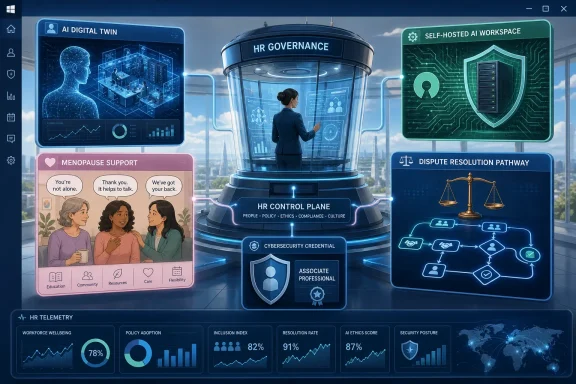 HR’s Toolbox Has Become a Control Plane
The most revealing thing about this batch of resources is not that it includes AI, menopause, dispute resolution, and cybersecurity. It is that none of those topics can now be treated as an “adjacent” HR concern. Each is a workplace operating issue, and each asks HR leaders to decide how much control, transparency, and institutional responsibility they want to keep in-house.That is a meaningful shift from the older HR technology pitch. For years, the sector sold convenience: cloud platforms to digitise forms, pulse surveys to measure sentiment, learning systems to track compliance, and employee portals to reduce administrative friction. The new pitch is more ambitious and more uncomfortable. It says the workplace itself is becoming programmable, monitored, mediated by AI, and legally contested.
Kyndryl’s Digital Twin for the Workplace sits squarely in that new category. The product, launched in April 2026, is positioned as an AI-powered capability that can anticipate and resolve employee technology problems before they disrupt work. Built using Microsoft Foundry and running in the Microsoft cloud ecosystem, it treats the employee’s digital environment as something that can be modelled, monitored, and optimised.
Mozilla’s Thunderbolt comes from the opposite philosophical direction but lands in the same HR inbox. It promises an open-source, self-hostable AI client for organisations that want generative AI without surrendering all data flows to a third-party workspace assistant. In plain English, it is a bet that enterprises will want AI tools they can run under their own governance rather than simply subscribing to someone else’s black box.
The other entries make the same point in human terms. A menopause-focused comic turns workplace inclusion research into something employees and managers might actually read. A free e-book on employment dispute resolution reflects an environment where formal processes are creaking under the weight of mistrust. The UK Cyber Security Council’s Associate Cyber Security Professional title gives early-career cyber workers a more formal route into a profession that employers urgently need but often struggle to define.
Together, these resources capture a hard truth for 2026: HR is becoming the department where enterprise technology, employee wellbeing, legal risk, and organisational trust collide.
Kyndryl Sells Prevention, But Prevention Requires Watching
The promise behind Kyndryl’s Digital Twin for the Workplace is easy to understand if you have ever lost half a morning to a broken VPN, a failing endpoint update, a Teams authentication loop, or a laptop that suddenly behaves as though it has joined a protest movement. Work is now inseparable from the device, the app stack, the identity provider, the network, and the service desk queue. When any of those components falters, the employee experience collapses into a ticket number.A digital twin approach reframes that mess as a system that can be simulated and corrected. Instead of waiting for employees to report problems, the organisation gathers signals from devices, applications, and workplace locations, then uses AI and automation to spot patterns. A recurring failure in one software build, one office, one department, or one workflow can theoretically be resolved before it becomes Monday morning misery.
For IT leaders, that is a practical proposition. For HR leaders, it is an employee experience proposition. The old HR question was whether workers had the right tools. The new question is whether the organisation can detect when those tools are undermining productivity, morale, or access to work before the damage shows up in engagement scores or attrition data.
But prevention has a governance cost. A workplace digital twin is not magic; it depends on telemetry. It needs to know enough about devices, applications, locations, workflows, and failure patterns to make useful predictions. That does not automatically make it sinister, but it does mean HR cannot treat the product as a neutral service-desk upgrade.
If a system can infer that a team is repeatedly blocked, that a location has persistent connectivity issues, or that a certain class of employees is suffering more disruption than others, then it is no longer just an IT tool. It becomes part of the organisation’s evidence base about work. HR should want that evidence, but it should also want rules around who sees it, how it is used, how long it is retained, and whether it ever bleeds into performance management.
This is where the Microsoft Foundry angle matters. Kyndryl is not pitching a hobbyist dashboard; it is placing the product inside the enterprise AI mainstream, with Microsoft’s cloud and orchestration layer as the substrate. That will reassure many CIOs because procurement, security, and integration pathways are familiar. It should also sharpen HR’s questions, because anything that scales through enterprise AI can scale both good practice and bad assumptions.
The useful version of this future is humane: fewer broken workdays, faster support, less time spent proving that a problem is real. The dangerous version is managerial: a quantified workplace where friction becomes another metric to assign, benchmark, and weaponise. HR’s role is to keep the first version from quietly turning into the second.
Mozilla’s Thunderbolt Is a Rebellion Against Rented AI
Thunderbolt is interesting because it attacks the enterprise AI problem from a different angle. Most workplace AI products ask organisations to trust a vendor’s hosted environment, policy controls, and contractual promises. Mozilla’s pitch is that some organisations will want to own more of the stack: the client experience, the data path, the deployment model, and the integration choices.That argument will resonate with IT pros who have watched “AI adoption” become shorthand for pasting sensitive business context into whichever chatbot has the best interface this quarter. It will also resonate with compliance teams that understand the difference between a vendor saying data is protected and an organisation being able to prove how data moves. The self-hostable claim is not merely a technical feature; it is a governance position.
For HR, Thunderbolt’s relevance is less obvious at first glance, but potentially larger. HR departments handle some of the most sensitive material in the company: grievances, medical disclosures, performance concerns, compensation decisions, investigations, redundancy planning, and internal communications. If generative AI is going to enter those workflows, “where does the data go?” is not a procurement footnote. It is the central question.
The comparison with ChatGPT or Microsoft Copilot is not simply about brand rivalry. Hosted AI assistants are attractive because they are easy to adopt, deeply integrated, and rapidly improving. They also concentrate dependency. Once employees build habits around a proprietary assistant, the organisation’s knowledge practices can become shaped by the vendor’s roadmap, interface decisions, retention policies, and commercial terms.
An open-source, self-hostable client does not magically solve that. Self-hosting shifts responsibilities back to the organisation: deployment, patching, identity integration, model selection, data protection, audit logging, and support. Anyone who has run open-source infrastructure in production knows the difference between freedom and free labour. The pitch is control, not simplicity.
That is why Thunderbolt is best understood as part of a broader enterprise debate about AI sovereignty. The phrase can sound inflated, but the underlying issue is concrete. Organisations are trying to decide whether AI becomes a utility purchased from a handful of platform companies, or a capability they can assemble, inspect, and govern more directly.
Mozilla’s brand gives this argument symbolic weight. The organisation’s history is tied to open web ideals, even if its modern business realities are more complicated. Thunderbolt borrows from that lineage: the suggestion that the AI client should not be another sealed corporate portal but an extensible workspace that organisations can adapt to their own risk tolerance.
The Windows angle is also practical. If native clients are available across Windows, macOS, Linux, mobile, and the web, Thunderbolt is trying to meet employees where they already work rather than forcing AI into a browser-only experiment. That matters because enterprise AI will not be adopted by policy memo. It will be adopted when it is close enough to daily work that employees stop treating it as a separate destination.
The Menopause Comic Understands Something Software Often Forgets
The menopause-focused comic may seem like the softest entry in the toolbox, but it is arguably the most sophisticated communications product in the list. Workplace policies often fail not because the PDF is badly written, but because nobody wants to read it, talk about it, or be seen needing it. A comic can lower that social barrier without trivialising the subject.Chithramali Rodrigo’s collaboration with academics and artists, funded by Henpicked, is built around a premise HR should take seriously: research and lived experience need translation. The workplace has no shortage of evidence about menopause symptoms, stigma, manager discomfort, and the effect of poor support on retention. What it often lacks is a format that makes the issue discussable before it becomes a crisis.
This matters because menopause at work is not just an inclusion topic. It is a management capability topic. Employees need reasonable conversations about adjustments, flexibility, temperature, uniforms, workload, absence, and dignity. Managers need enough confidence not to turn every discussion into either awkward silence or procedural overreach.
The comic format is not a gimmick if it makes those conversations easier. Visual storytelling can show ambiguity in ways a policy cannot. It can depict a manager hesitating, a colleague misunderstanding, an employee masking symptoms, or a team learning how to respond. That kind of scenario-based communication is often more useful than a compliance slide that says “be supportive” and moves on.
There is a lesson here for the AI and cyber entries too. Organisations keep buying sophisticated systems and then underinvesting in the human narrative around them. Employees are told that a new assistant will improve productivity, that a new monitoring system will reduce disruption, or that a new security standard will protect the business. What they often hear is: something is being done to us.
Good workplace resources change that framing. They explain why a change matters, what it feels like, what rights and responsibilities are involved, and how people can speak about it without fear. In that sense, the menopause comic is not the outlier in this toolbox. It is the reminder that adoption is a cultural act before it is a technical one.
The Dispute Resolution E-Book Arrives in a Low-Trust Workplace
The free e-book on employment dispute resolution speaks to a darker undercurrent. If HR leaders are being handed blueprints for the future of workplace conflict resolution, it is because the present model is visibly strained. Formal grievance systems are slow, adversarial, exhausting, and often distrusted by the very people they are supposed to protect.That does not mean process is unnecessary. Quite the opposite. Employment disputes need fairness, evidence, consistency, and legal defensibility. But when the process becomes the experience, organisations can end up measuring whether they followed the steps rather than whether they repaired harm, clarified expectations, or restored trust.
The timing matters. Hybrid work has changed how conflict surfaces. Digital communication leaves trails but strips tone. Distributed teams can normalise avoidance. Managers may intervene late because they do not see everyday friction. Employees may escalate faster because informal resolution feels inaccessible or unsafe.
AI complicates this further. As organisations adopt AI tools for productivity, scheduling, monitoring, case triage, sentiment analysis, or HR service delivery, new disputes will follow. Employees will challenge algorithmic summaries, automated decisions, opaque risk scores, and the use of workplace data. The future of employment dispute resolution will not be separate from the future of workplace technology.
That is why a rigorous, free resource on dispute resolution belongs beside AI workspaces and cyber credentials. It reminds HR that governance cannot end at deployment. Every new tool creates new forms of contestability. Someone will ask how a decision was made, why certain evidence was used, whether data was accurate, and whether the process treated them as a person or a data point.
The best HR teams will not wait for tribunals, regulators, or unions to force those answers. They will design dispute pathways that can handle technical evidence, human context, and procedural fairness together. That means training investigators to understand digital systems, ensuring employees can challenge AI-mediated outputs, and refusing to let “the system says” become a substitute for managerial judgement.
Cybersecurity Professionalisation Is Now an HR Problem
The UK Cyber Security Council’s Associate Cyber Security Professional title is presented as an entry-level credential, but its significance is broader. Cybersecurity has long suffered from a paradox: employers complain about skills shortages while writing job descriptions that demand impossible experience, overlapping certifications, and vague “hands-on” expertise. A government-backed associate title is an attempt to put a more legible floor under the profession.For HR and recruitment teams, that matters. Cyber roles are notoriously hard to benchmark. Titles vary wildly between organisations. A “security analyst” in one company may be a ticket-handler, threat hunter, compliance generalist, or cloud engineer in another. Without common standards, hiring becomes a proxy contest of brand names, certificates, and guesswork.
An associate title cannot fix the cyber labour market by itself. It will not create seasoned incident responders overnight, nor will it resolve salary inflation or burnout. But it can help early-career candidates demonstrate readiness in a way employers recognise. That is particularly important if the sector wants to widen access beyond people who can afford expensive private training or already know how to navigate the certification maze.
There is also a governance link to the other toolbox entries. If organisations deploy AI systems, digital workplace monitoring, self-hosted assistants, and data-rich HR platforms, their security needs become more complex. HR cannot recruit for that environment using yesterday’s assumptions about “IT support with a security hat.” The boundary between workplace technology and security risk is dissolving.
The ACSP title also reflects a professionalisation trend already visible in areas such as engineering, accountancy, and occupational health. Cybersecurity is moving from a loose collection of technical specialisms toward a more formal occupational identity. That can be good for standards, ethics, and career pathways, but it may also introduce gatekeeping if handled poorly.
HR’s job is to use credentials intelligently rather than lazily. A recognised title should support better hiring, not become another automated filter that excludes unconventional candidates. The most resilient cyber teams often include people with backgrounds in systems administration, law, psychology, fraud, intelligence, education, and operations. Professional standards should clarify competence without narrowing imagination.
The Common Thread Is Institutional Responsibility
What ties these five resources together is the collapse of the old boundary between employee experience and enterprise architecture. Kyndryl’s product says the workplace can be modelled and optimised through AI. Thunderbolt says AI itself should be governable by the organisation rather than rented entirely from external platforms. The menopause comic says policies must become human enough to be used. The dispute resolution e-book says conflict systems need rebuilding. The cyber accreditation says digital trust depends on professional capacity.That is a lot to place on HR. It is tempting to say these matters should sit elsewhere: AI with the CIO, menopause with wellbeing leads, dispute resolution with legal, cyber credentials with security leadership. In practice, employees experience all of it as one workplace. HR becomes the function responsible for whether the pieces cohere.
This does not mean HR should pretend to be IT, legal, clinical support, or security engineering. It means HR must become a better institutional integrator. The department needs enough technical literacy to ask hard questions, enough legal awareness to spot procedural risk, enough empathy to understand lived experience, and enough operational authority to stop tools being imposed without workforce legitimacy.
The AI entries make that especially urgent. Enterprise AI is often discussed as though adoption is inevitable and resistance is irrational. But adoption without trust produces shadow usage, workarounds, quiet non-compliance, and resentment. Employees will use tools they find useful, avoid tools they find creepy, and sabotage tools they believe are unfair.
Trust is not built by slogans about innovation. It is built through boundaries. Employees need to know when AI is being used, what data it can access, what decisions it can influence, and how errors can be challenged. Managers need guidance on what AI-generated material can and cannot be used for. Administrators need clear ownership for configuration, audit, and incident response.
The same applies to digital workplace telemetry. If Kyndryl-style systems reduce disruption, employees may welcome them. But if the organisation cannot explain the difference between monitoring device health and monitoring worker performance, suspicion will fill the gap. HR has to insist on that distinction before rollout, not after a backlash.
The Vendor Pitch Is Efficiency; the Real Question Is Power
Every item in the toolbox is presented as a resource, and most of them are plainly useful. Yet the larger pattern is about power: who gets to see, decide, diagnose, automate, credential, and resolve. HR leaders should read these launches less as shopping recommendations and more as signals about where workplace power is moving.Kyndryl’s digital twin gives the organisation more power to see operational friction. Mozilla’s Thunderbolt gives the organisation more power over AI infrastructure. The menopause comic gives employees and managers more power to name an experience that is often hidden. The dispute resolution e-book gives practitioners more power to critique failed systems. The cyber accreditation gives early-career professionals more power to prove readiness.
Those are not equivalent forms of power, and they do not automatically align. A tool that gives the employer more visibility can make employees’ lives better or worse depending on governance. A credential that gives candidates legitimacy can also become a gate. A self-hosted AI client can protect sensitive data or become an under-maintained risk. A comic can open conversation or be used as a token gesture if policy and manager behaviour do not change.
This is where HR needs a sharper procurement posture. The question is not merely “does this resource solve a problem?” The question is “what new obligations does this resource create?” A digital twin creates obligations around transparency and data minimisation. A self-hosted AI client creates obligations around technical stewardship. A menopause resource creates obligations around actual support. A dispute resolution blueprint creates obligations around reform. A cyber title creates obligations around fair recognition.
The strongest organisations will not treat these obligations as drag. They will treat them as the price of mature adoption. The weak ones will chase the surface benefit and then blame employees, regulators, or vendors when the social contract fails.
The June Toolbox Draws a Map of the Next HR Stack
The practical message for HR leaders is that these resources should not be evaluated in isolation. They belong to the same emerging stack: AI-mediated work, employee-centred support, professionalised security, and more contestable workplace governance. That stack will define the next phase of people operations more than another incremental HRIS upgrade.A sensible HR team would start by mapping ownership. Who signs off on AI tools used in HR workflows? Who approves telemetry from employee devices? Who decides whether self-hosting is realistic? Who trains managers on menopause support? Who reviews dispute processes when technology is part of the evidence? Who defines entry-level cyber competence in recruitment?
Those questions sound bureaucratic, but they are really about accountability. The worst version of modern workplace technology is nobody’s fault by design. The vendor provides the platform, IT enables it, HR communicates it, managers misuse it, employees distrust it, and legal inherits the dispute. Mature organisations break that chain before it forms.
There is also a sequencing issue. It makes little sense to deploy advanced AI into HR processes if the organisation cannot explain its dispute resolution model. It makes little sense to expand workplace telemetry if employees have no confidence that wellbeing concerns are handled respectfully. It makes little sense to demand cyber maturity while treating cyber career pathways as opaque and exclusionary.
The June toolbox is therefore less a list of resources than a stress test. It asks whether HR can operate at the level the modern workplace now requires. Not as a support function waiting for other departments to make decisions, but as a co-governor of the systems through which work happens.
The June List Rewards HR Teams That Read Between the Product Lines
The most useful way to act on this toolbox is to separate the immediate resource from the institutional question behind it. HR leaders do not need to buy every product, adopt every framework, or circulate every publication. They do need to understand why these resources are arriving now.- Kyndryl’s Digital Twin for the Workplace shows that employee experience is becoming an AI operations problem, not just a service desk metric.
- Mozilla’s Thunderbolt shows that AI governance is moving from policy statements into infrastructure choices.
- The menopause comic shows that workplace inclusion depends on formats people can actually engage with, not just policies they can technically access.
- The dispute resolution e-book shows that conflict processes must be redesigned for a workplace shaped by hybrid work, data trails, and AI-mediated decisions.
- The UK Cyber Security Council’s associate title shows that cyber hiring is becoming a standards-and-pathways issue as much as a skills-shortage issue.
- The common test for HR is whether each resource increases trust, or merely increases organisational capability without earning employee confidence.
References
- Primary source: HR Magazine
Published: 2026-06-22T07:40:16.174732
HR Magazine - HR toolbox: June 2026 - HR Magazine
New resources for HR leaders. www.hrmagazine.co.uk
