

On February 5, 2026, senior Melbourne Football Club figures reportedly held a Microsoft Teams call with about 15 players’ partners in Melbourne, discussing Steven May and Sachi Dade’s private situation after a police welfare check; Dade later filed a Federal Court privacy application on May 22. The lawsuit turns a short workplace video meeting into a test case for how organisations handle sensitive personal information when Teams, Zoom, and Slack have become the default rooms where institutional judgment is exercised. The technology did not create the alleged privacy problem, but it made the problem frictionless, scalable, and deceptively informal.
The alleged meeting had the shape of modern corporate normality. A message goes out, an online link is clicked, senior leaders appear in little rectangles, and the tone is set somewhere between welfare briefing, internal comms, and damage control. That ordinariness is precisely why the episode matters beyond Australian football.
According to reporting, the call was framed as an introductory session for partners to meet chief executive Paul Guerra, coach Steven King, and football boss Alan Richardson, while also addressing “a matter that impacts the football program.” It reportedly shifted quickly toward May, who was on personal leave, and Dade, his partner. The Herald Sun has since reported that Dade is suing the club, King, and Richardson, with Federal Court documents describing the application as a privacy matter.
That chronology is important because it shows how the meeting moved from community management to potential legal exposure. The invite did not, at least according to accounts so far, present itself as a formal privacy disclosure process. It sounded like a stakeholder catch-up.
In an earlier era, a club might have gathered people in a boardroom, briefed a few leaders privately, or circulated a carefully lawyered statement. Teams collapses those options into one seductive middle ground: intimate enough to feel human, remote enough to feel low-risk, and easy enough to convene before anyone has fully asked whether the meeting should exist.
That distinction matters for IT pros because too many privacy discussions still begin and end with encryption, retention labels, multifactor authentication, and audit logs. Those controls are necessary, but they do not solve a leader deciding to disclose sensitive information to 15 people who may not need to know it. A perfectly secured meeting can still be a disastrous meeting.
Teams, like its rivals, is designed to reduce the cost of assembling people. It turns “we should get everyone together” from an operational task into a reflex. In most workplaces, that is a productivity gain; in sensitive matters involving health, family, police attendance, employment status, or reputational harm, it can become an accelerant.
The lesson is not that organisations should stop using Teams for difficult conversations. It is that video meetings are not casual just because they are easy to schedule. A Teams call can be a staff meeting, a disciplinary process, a welfare intervention, a board-level disclosure, or evidence in litigation. The interface looks the same in every case.
But the timing is striking. For years, Australian privacy law was often discussed as a patchwork: sector rules, confidentiality duties, data protection obligations, equity, defamation, and uncertain common law development. The new tort changed the weather. It gave privacy disputes a more direct vocabulary.
That does not mean every awkward disclosure becomes a successful claim. A court would still need to examine the facts, the seriousness of the alleged invasion, the expectation of privacy, intention or recklessness, possible defences, and any competing public interest. None of that can be assumed from a media report.
Still, the new legal setting changes how organisations should evaluate meetings like this before they happen. The old instinct — “we need to keep people informed” — now has to compete with a sharper question: “Do these people have a lawful and necessary reason to receive this information?”
But need to know is not a feeling. It is a governance test. Who needs to know what, for what purpose, by what authority, and with what safeguards?
In the reported Melbourne call, those questions are the heart of the controversy. If the club’s aim was to reassure families, there were ways to do that without naming private details. If the aim was welfare, there were ways to involve trained professionals. If the aim was reputation management, that is a different kind of meeting altogether.
The problem with hybrid workplace tools is that they blur those categories. A Teams meeting can be scheduled faster than the organisation can define its purpose. Once the call begins, leaders may speak in the language of care while performing the function of risk management.
Sports clubs are unusual workplaces. They have young employees, intense public scrutiny, partner and family networks, medical and performance staff, and a constant flow of rumours. The human stakes are real. So is the temptation to manage those stakes through informal authority.
A senior figure saying, in effect, “we are dealing with this” may believe they are calming the room. But if the room contains people outside the direct employment, legal, or welfare chain, and if the subject concerns someone’s private life, the reassurance can become exposure.
That is where IT governance and human governance meet. The platform provides the room; leadership defines the boundaries. If the boundaries are missing, the meeting becomes a broadcast.
Participants remember. Participants take notes. Participants text each other. Participants complain to regulators, unions, associations, lawyers, or journalists. In this case, earlier reporting said concerns reached the AFL Players’ Association and the AFL after a complaint. That is how modern accountability often works: not through an official recording, but through the networked memory of attendees.
The Teams interface can encourage a false sense of containment. A meeting appears bounded by its participant list, yet its contents can travel instantly through screenshots, messages, summaries, and human retelling. A private briefing is only as private as the least comfortable person on the call.
For IT administrators, that means sensitivity labels and meeting policies are only one layer. The larger control is procedural: requiring meeting owners to classify the purpose and audience before sensitive topics are discussed.
That closeness can be humane. It can also become a privacy trap. The more an organisation describes itself as a family, the more likely it is to treat personal information as communal knowledge.
Modern collaboration platforms intensify that habit. They extend the “family” into channels, group chats, shared calendars, and video calls. The boundaries between employee, partner, contractor, volunteer, and supporter become socially porous even when they remain legally distinct.
The reported Melbourne meeting sits exactly on that fault line. Partners are deeply affected by club culture, but they are not automatically entitled to private information about another player or partner. Inclusion does not erase confidentiality.
Even where a meeting is not recorded, its metadata may remain. Invites, attendance, chat messages, file shares, reactions, transcripts if enabled, and follow-up emails can all become part of an organisation’s evidence trail. That is a feature for compliance teams and a hazard for leaders who mistake convenience for informality.
The rise of AI assistants adds another layer. If a meeting is transcribed or summarised, sensitive disclosures can be converted into searchable text. If summaries are shared too broadly, the original audience problem repeats itself in document form.
That is why administrators should not treat this story as sports gossip. It is a case study in how workplace collaboration systems can convert managerial ambiguity into durable records.
That gap is where this kind of problem grows. The decision to convene a meeting is often treated as logistical rather than legal. Who sends the invite? Who approves the agenda? Who checks whether personal information will be discussed? Who decides whether attendees are employees, contractors, family members, or third parties?
If the answer is “the executive who wants the meeting,” the organisation has already lost a layer of protection. Sensitive meetings need friction. Not bureaucracy for its own sake, but a deliberate pause that forces purpose, audience, and wording into the open.
IT can help here, but it cannot carry the burden alone. Meeting templates, sensitivity labels, disabled recording defaults, restricted chat, lobby controls, and retention policies are useful. They do not replace judgment.
The club’s challenge now is that the meeting has become a symbol. It is not merely about what was said in 14 or 20 minutes, depending on the account. It is about whether a powerful institution treated private information as an internal culture-management asset.
That is why the case may resonate beyond the AFL. Employers increasingly deal with crises involving mental health, domestic stress, police contact, misconduct allegations, and public reputation. The instinct to “get ahead of it” is strong. Privacy law exists partly to slow that instinct down.
If the facts alleged by Dade are tested in court, the proceeding may help define how Australian privacy law treats semi-private organisational briefings. That could matter for every employer that thinks a closed video meeting is meaningfully different from a public disclosure.
Oversharing is cultural before it is technical. It comes from leaders believing that authority entitles them to narrate someone else’s private circumstances. It comes from organisations treating reputational containment as a form of care. It comes from meetings where nobody in the room has been empowered to say, “We should not be discussing this here.”
The best controls are often procedural and social. Sensitive agendas should be written. Attendee lists should be challenged. Legal, HR, welfare, or privacy staff should have veto power. Leaders should be trained to separate general reassurance from personal disclosure.
For Microsoft 365 administrators, the practical question is how to support that culture with tooling. A “Confidential — personal information” meeting label should not be decorative. It should trigger stricter defaults, clearer warnings, and narrower access.
A brief online meeting can now carry the weight of a formal disclosure. A loosely defined audience can become a privacy problem. A welfare rationale can be undermined by the absence of welfare safeguards. A collaboration platform can preserve, amplify, or expose decisions that once might have evaporated after a hallway conversation.
For Windows shops, the message is not to fear Teams. It is to stop treating Teams as neutral space.
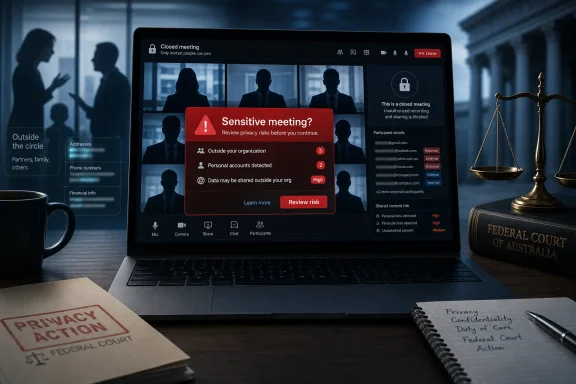 A Football Club Learned That “Just a Teams Call” Is Still a Room Full of Witnesses
The alleged meeting had the shape of modern corporate normality. A message goes out, an online link is clicked, senior leaders appear in little rectangles, and the tone is set somewhere between welfare briefing, internal comms, and damage control. That ordinariness is precisely why the episode matters beyond Australian football.According to reporting, the call was framed as an introductory session for partners to meet chief executive Paul Guerra, coach Steven King, and football boss Alan Richardson, while also addressing “a matter that impacts the football program.” It reportedly shifted quickly toward May, who was on personal leave, and Dade, his partner. The Herald Sun has since reported that Dade is suing the club, King, and Richardson, with Federal Court documents describing the application as a privacy matter.
That chronology is important because it shows how the meeting moved from community management to potential legal exposure. The invite did not, at least according to accounts so far, present itself as a formal privacy disclosure process. It sounded like a stakeholder catch-up.
In an earlier era, a club might have gathered people in a boardroom, briefed a few leaders privately, or circulated a carefully lawyered statement. Teams collapses those options into one seductive middle ground: intimate enough to feel human, remote enough to feel low-risk, and easy enough to convene before anyone has fully asked whether the meeting should exist.
The Platform Is Not the Defendant, but It Is Part of the Story
Microsoft Teams is not accused of wrongdoing here. The alleged issue is not a software exploit, a recording leak, or a cloud security breach. The problem is more mundane and more dangerous: people may have used a collaboration tool to say things in front of the wrong audience.That distinction matters for IT pros because too many privacy discussions still begin and end with encryption, retention labels, multifactor authentication, and audit logs. Those controls are necessary, but they do not solve a leader deciding to disclose sensitive information to 15 people who may not need to know it. A perfectly secured meeting can still be a disastrous meeting.
Teams, like its rivals, is designed to reduce the cost of assembling people. It turns “we should get everyone together” from an operational task into a reflex. In most workplaces, that is a productivity gain; in sensitive matters involving health, family, police attendance, employment status, or reputational harm, it can become an accelerant.
The lesson is not that organisations should stop using Teams for difficult conversations. It is that video meetings are not casual just because they are easy to schedule. A Teams call can be a staff meeting, a disciplinary process, a welfare intervention, a board-level disclosure, or evidence in litigation. The interface looks the same in every case.
Australia’s New Privacy Landscape Raises the Stakes
The lawsuit arrives after Australia’s new statutory tort for serious invasions of privacy commenced in June 2025. That reform gave individuals a clearer route to sue over serious invasions of privacy, including misuse of private information, where the conduct meets the legal thresholds. It is too early to know exactly how Dade’s application will be argued, and the public record is still limited.But the timing is striking. For years, Australian privacy law was often discussed as a patchwork: sector rules, confidentiality duties, data protection obligations, equity, defamation, and uncertain common law development. The new tort changed the weather. It gave privacy disputes a more direct vocabulary.
That does not mean every awkward disclosure becomes a successful claim. A court would still need to examine the facts, the seriousness of the alleged invasion, the expectation of privacy, intention or recklessness, possible defences, and any competing public interest. None of that can be assumed from a media report.
Still, the new legal setting changes how organisations should evaluate meetings like this before they happen. The old instinct — “we need to keep people informed” — now has to compete with a sharper question: “Do these people have a lawful and necessary reason to receive this information?”
The Most Dangerous Phrase in Corporate Communications Is “People Need to Know”
Every organisation has a version of the “need to know” problem. Leaders believe silence will create rumours, rumours will damage culture, and culture requires transparency. In sports clubs, where partners and families are often treated as part of the broader team ecosystem, that instinct can be especially strong.But need to know is not a feeling. It is a governance test. Who needs to know what, for what purpose, by what authority, and with what safeguards?
In the reported Melbourne call, those questions are the heart of the controversy. If the club’s aim was to reassure families, there were ways to do that without naming private details. If the aim was welfare, there were ways to involve trained professionals. If the aim was reputation management, that is a different kind of meeting altogether.
The problem with hybrid workplace tools is that they blur those categories. A Teams meeting can be scheduled faster than the organisation can define its purpose. Once the call begins, leaders may speak in the language of care while performing the function of risk management.
Welfare Conversations Require More Than Good Intentions
The reporting around the call includes claims that no psychologists or welfare officers were present. That detail matters, not because every sensitive meeting must become clinical, but because welfare discussions can quickly become harmful when handled as comms exercises.Sports clubs are unusual workplaces. They have young employees, intense public scrutiny, partner and family networks, medical and performance staff, and a constant flow of rumours. The human stakes are real. So is the temptation to manage those stakes through informal authority.
A senior figure saying, in effect, “we are dealing with this” may believe they are calming the room. But if the room contains people outside the direct employment, legal, or welfare chain, and if the subject concerns someone’s private life, the reassurance can become exposure.
That is where IT governance and human governance meet. The platform provides the room; leadership defines the boundaries. If the boundaries are missing, the meeting becomes a broadcast.
The Recording Button Is Not the Only Risk
When organisations think about sensitive video meetings, they often fixate on whether the call is recorded. That is understandable. Recordings are discoverable, portable, and damaging when mishandled. But a non-recorded meeting can still create legal and reputational risk.Participants remember. Participants take notes. Participants text each other. Participants complain to regulators, unions, associations, lawyers, or journalists. In this case, earlier reporting said concerns reached the AFL Players’ Association and the AFL after a complaint. That is how modern accountability often works: not through an official recording, but through the networked memory of attendees.
The Teams interface can encourage a false sense of containment. A meeting appears bounded by its participant list, yet its contents can travel instantly through screenshots, messages, summaries, and human retelling. A private briefing is only as private as the least comfortable person on the call.
For IT administrators, that means sensitivity labels and meeting policies are only one layer. The larger control is procedural: requiring meeting owners to classify the purpose and audience before sensitive topics are discussed.
The Case Is a Warning for Every Employer With a “Family Culture”
The most exposed organisations are often the ones that pride themselves on being close-knit. Football clubs, schools, startups, hospitals, churches, nonprofits, and family-owned businesses all use intimacy as a management asset. People know each other’s partners, children, health struggles, and crises.That closeness can be humane. It can also become a privacy trap. The more an organisation describes itself as a family, the more likely it is to treat personal information as communal knowledge.
Modern collaboration platforms intensify that habit. They extend the “family” into channels, group chats, shared calendars, and video calls. The boundaries between employee, partner, contractor, volunteer, and supporter become socially porous even when they remain legally distinct.
The reported Melbourne meeting sits exactly on that fault line. Partners are deeply affected by club culture, but they are not automatically entitled to private information about another player or partner. Inclusion does not erase confidentiality.
Microsoft Teams Has Become the New Institutional Memory
For WindowsForum readers, the software angle is not incidental. Teams is now part of the Microsoft 365 nervous system: identity, calendar, chat, video, SharePoint files, compliance records, eDiscovery, retention, transcription, Copilot summaries, and audit trails all orbit the same workspace. The “meeting” is no longer just a meeting.Even where a meeting is not recorded, its metadata may remain. Invites, attendance, chat messages, file shares, reactions, transcripts if enabled, and follow-up emails can all become part of an organisation’s evidence trail. That is a feature for compliance teams and a hazard for leaders who mistake convenience for informality.
The rise of AI assistants adds another layer. If a meeting is transcribed or summarised, sensitive disclosures can be converted into searchable text. If summaries are shared too broadly, the original audience problem repeats itself in document form.
That is why administrators should not treat this story as sports gossip. It is a case study in how workplace collaboration systems can convert managerial ambiguity into durable records.
The Real Policy Gap Is Before the Meeting Starts
Most organisations have policies for data breaches. Many have policies for media statements. Some have policies for workplace investigations. Fewer have practical rules for the five minutes before a senior leader says, “Let’s get everyone on a call.”That gap is where this kind of problem grows. The decision to convene a meeting is often treated as logistical rather than legal. Who sends the invite? Who approves the agenda? Who checks whether personal information will be discussed? Who decides whether attendees are employees, contractors, family members, or third parties?
If the answer is “the executive who wants the meeting,” the organisation has already lost a layer of protection. Sensitive meetings need friction. Not bureaucracy for its own sake, but a deliberate pause that forces purpose, audience, and wording into the open.
IT can help here, but it cannot carry the burden alone. Meeting templates, sensitivity labels, disabled recording defaults, restricted chat, lobby controls, and retention policies are useful. They do not replace judgment.
The Demons’ Problem Is Bigger Than One Call
Melbourne’s earlier apology reportedly said the meeting was intended to reassure families and acknowledged distress. That kind of statement is familiar: intent was good, execution caused harm, lessons will be learned. The lawsuit suggests that apology did not close the matter.The club’s challenge now is that the meeting has become a symbol. It is not merely about what was said in 14 or 20 minutes, depending on the account. It is about whether a powerful institution treated private information as an internal culture-management asset.
That is why the case may resonate beyond the AFL. Employers increasingly deal with crises involving mental health, domestic stress, police contact, misconduct allegations, and public reputation. The instinct to “get ahead of it” is strong. Privacy law exists partly to slow that instinct down.
If the facts alleged by Dade are tested in court, the proceeding may help define how Australian privacy law treats semi-private organisational briefings. That could matter for every employer that thinks a closed video meeting is meaningfully different from a public disclosure.
The Admin Console Cannot Fix a Culture That Overshares
There is a familiar ritual after incidents like this: tighten permissions, review retention, remind staff not to record calls, and update the acceptable-use policy. Those steps may be sensible. They are also insufficient.Oversharing is cultural before it is technical. It comes from leaders believing that authority entitles them to narrate someone else’s private circumstances. It comes from organisations treating reputational containment as a form of care. It comes from meetings where nobody in the room has been empowered to say, “We should not be discussing this here.”
The best controls are often procedural and social. Sensitive agendas should be written. Attendee lists should be challenged. Legal, HR, welfare, or privacy staff should have veto power. Leaders should be trained to separate general reassurance from personal disclosure.
For Microsoft 365 administrators, the practical question is how to support that culture with tooling. A “Confidential — personal information” meeting label should not be decorative. It should trigger stricter defaults, clearer warnings, and narrower access.
This Is the Compliance Lesson Hiding in a Sports Scandal
The Melbourne case will be argued on its facts, and the public should be careful not to prejudge liability from fragments. But the operational lessons are already visible. They are less about football than about the everyday machinery of digital work.A brief online meeting can now carry the weight of a formal disclosure. A loosely defined audience can become a privacy problem. A welfare rationale can be undermined by the absence of welfare safeguards. A collaboration platform can preserve, amplify, or expose decisions that once might have evaporated after a hallway conversation.
For Windows shops, the message is not to fear Teams. It is to stop treating Teams as neutral space.
The Fourteen Minutes IT Should Be Replaying
The practical reading of this episode is blunt: if a meeting concerns someone’s private life, the organisation should assume the meeting may later be examined by a court, regulator, union, journalist, or plaintiff’s lawyer. That assumption does not paralyse communication. It disciplines it.- Organisations should define the purpose of a sensitive meeting before inviting attendees, not during the opening remarks.
- Personal information should be shared only with people who have a genuine role-based need to receive it.
- Welfare-related discussions should involve appropriately qualified staff or be kept separate from reputation-management briefings.
- Microsoft Teams policies should treat confidential meetings differently through recording, transcription, chat, lobby, and access controls.
- Leaders should be trained that a closed video call is still a disclosure, not an informal conversation.
- Privacy review should become part of crisis communications, especially when family members, partners, or other non-employees are included.
References
- Primary source: Herald Sun
Published: 2026-06-19T02:42:13.069358
- Related coverage: sen.com.au
Exclusive: Melbourne under fire for “concerning” conduct — SEN
The conduct of senior Demons leaders is under the microscope.www.sen.com.au - Related coverage: melbournefc.com.au
Club Statement: Steven May and Jake Melksham
The club has released a statement in regards to Steven May and Jake Melkshamwww.melbournefc.com.au
- Related coverage: rsn.net.au
May misses training, Melbourne aware of police meeting
The Demons defender is navigating his personal situation away from the club.rsn.net.au - Related coverage: newsminimalist.com
- Related coverage: foxsports.com.au
Dees apologise for ‘distress’ caused by meeting that shared personal info
Dees apologise for ‘distress’ caused by meeting that shared personal infowww.foxsports.com.au
- Related coverage: ground.news
%22 d=%22M44,140.1h42.8V272H54.9c0-0.1,0-103.8,0-103.8H44V140.1z M44,1c28.4,0,42.6,16.2,42.6,42.2v66.1H54.9V43.8 c0-7.2-3.1-11.7-10.6-11.7c-7,0-10.6,4.2-10.6,11.7c0,0,0,228.1,0,228.2H0.2c0-0.5,0-228.8,0-228.8C0.1,16.8,14.8,1,44,1L44,1z%22/><style>path { fill: %23262626 } @media (prefers-color-scheme: dark) { path { fill: %23EEEFE9 } }</style></svg>)
Demons sorry for ‘distress’ caused by meeting with players’ partners
Melbourne have responded to reports they discussed Steven May’s alleged personal issues during a phone hook-up between club bosses and the partners of players.
ground.news
- Related coverage: fcfcoa.gov.au
- Related coverage: abc.net.au
Charges dropped against AFL players Dion Prestia and Steven May over alleged brawl - ABC News
Prosecutors have dropped all charges against current and former footballers Dion Prestia and Steven May over an alleged brawl in Sorrento on Victoria's Mornington Peninsula on Boxing Day in 2024. www.abc.net.au
