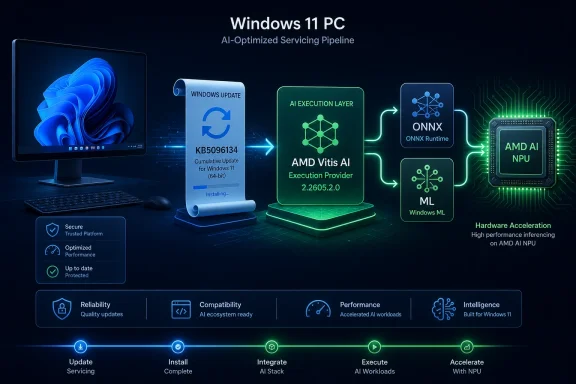
Microsoft has published KB5096134 as an automatic Windows Update package for Windows 11 versions 24H2 and 25H2, updating the AMD Vitis AI Execution Provider to version 2.2605.2.0 for ONNX Runtime and Windows machine-learning workloads on supported AMD AI hardware this week. The update is small in the visible sense but large in architectural meaning: Microsoft is treating AI acceleration as a serviced Windows component, not a driver-side afterthought. For users, it will mostly appear as another line in Update history. For developers and administrators, it is another sign that the Windows AI stack is becoming part of the operating system’s normal maintenance rhythm.
KB5096134 is not the kind of update that changes the Start menu, adds a Copilot button, or triggers a reboot drama visible across an office floor. It updates an execution provider, a layer most users will never knowingly touch, that helps ONNX Runtime and Windows ML route compatible AI inference workloads to AMD hardware.
That invisibility is the point. Microsoft’s current Windows AI strategy depends on making local inference feel ordinary. If an application can ask Windows for acceleration and Windows can quietly keep the vendor-specific component current, developers have one less reason to ship fragile hardware-detection logic or bundle multiple inference back ends.
The AMD Vitis AI Execution Provider sits in that middle ground between a model and the silicon. It is not the model itself, and it is not the full AMD driver stack. It is the translation and execution layer that lets supported workloads make use of AMD’s AI-capable platforms, including Ryzen AI hardware and other AMD acceleration targets.
That makes KB5096134 more interesting than its sparse support-page language suggests. Microsoft is not merely pushing an AMD component through Windows Update; it is reinforcing Windows Update as the distribution channel for the AI substrate beneath modern applications.
ONNX Runtime already gives developers a cross-platform way to run machine-learning models. Windows ML builds on that idea for Windows developers by offering a more integrated system path. Execution providers are the adapters that make this practical across different silicon vendors.
AMD’s Vitis AI Execution Provider is one of those adapters. Qualcomm has its own route through QNN, Intel through OpenVINO, NVIDIA through TensorRT RTX-oriented components, and AMD also has GPU-focused paths such as MIGraphX. Microsoft’s challenge is not simply supporting AI; it is supporting a market where every silicon vendor wants its own acceleration stack while developers want one predictable API surface.
That tension explains why these updates matter. If execution providers are updated independently of applications, Microsoft can improve operator support, compatibility, and performance without forcing every app developer to republish software. The risk is that Windows becomes the place where more vendor complexity is hidden, and hidden complexity is still complexity.
The update installs automatically from Windows Update. Users who want to confirm it is present must go to Settings, then Windows Update, then Update history. After installation, the relevant entry should appear as a Windows Runtime ML AMD NPU Execution Provider update.
That wording matters because it tells us where Microsoft wants the mental model to land. This is not presented as an AMD chipset update. It is not framed as a Radeon package. It is a Windows Runtime ML component update, even though the useful work depends on AMD’s stack.
For IT departments, the requirement for the latest cumulative update is equally important. AI component servicing is not floating separately from Windows servicing hygiene. Microsoft is making current cumulative updates the foundation for these smaller AI-layer updates, which gives administrators one more reason to keep 24H2 and 25H2 devices aligned with monthly maintenance.
That model only works if Microsoft can keep the base platform constrained. By limiting KB5096134 to Windows 11 24H2 and 25H2, the company avoids promising uniform AI behavior across older Windows builds. It also nudges the ecosystem toward the newest servicing tracks.
For enthusiasts, this may feel arbitrary. A machine with a capable AMD processor or NPU may seem like it should receive the same execution provider regardless of Windows release. But from a platform engineering standpoint, AI acceleration touches runtime libraries, app deployment frameworks, driver interfaces, model execution behavior, and security boundaries. Microsoft is choosing fewer combinations over broader theoretical reach.
The consequence is familiar. New Windows AI features will not merely depend on having the right silicon; they will depend on having the right Windows version, the right cumulative update, and the right vendor component. Hardware capability is becoming necessary but not sufficient.
The Vitis AI brand has long belonged to AMD’s broader AI development stack, spanning more than consumer laptops. Bringing that execution path into Windows Update gives AMD a more integrated client-PC story. It allows the company to say, in effect, that supported Windows machines can receive AI runtime improvements through the same channel users already trust for operating-system maintenance.
But AMD’s Windows AI story is still multi-lane. Vitis AI, Ryzen AI software, ONNX Runtime support, NPU drivers, Adrenalin packages, and GPU-oriented execution providers can all be relevant depending on the workload. That is not necessarily a flaw; heterogeneous computing is inherently messy. But it means the industry’s marketing phrase “AI PC” continues to conceal a great deal of plumbing.
KB5096134 does not erase that complexity. It simply moves one important piece of it into a managed Windows servicing path. That is progress, but it is not magic.
Windows ML’s execution-provider catalog is designed to make that less painful. An app can target Windows ML and compatible providers rather than becoming a hardware-detection utility with an interface attached. Once a provider is installed, Microsoft’s documentation says compatible updates can arrive through Windows Update and become available without the app manually updating.
That is the dream version. In practice, developers still need to check what is present, handle fallback behavior, test across hardware, and understand what operators are supported by each provider. AI models are not interchangeable widgets; a model that runs efficiently on one provider may require conversion, quantization, or operator changes elsewhere.
Still, KB5096134 is part of the scaffolding developers need. The less time a software vendor spends teaching users how to install an AMD-specific runtime, the more likely it is to ship local AI features at all.
The practical management question is not whether KB5096134 is “good” or “bad.” It is whether organizations know which devices have the hardware, Windows build, cumulative update level, and provider version needed for a given workload. AI acceleration turns into another inventory dimension.
This will matter more as line-of-business applications adopt local inference. A help-desk tool that performs document classification locally, a creative app that uses on-device image features, or a security product that performs local model inference may all behave differently depending on whether the provider exists and which version is installed.
The old enterprise reflex was to test Windows updates against applications. The new version includes testing the local AI path as well. It is not enough to ask whether the app launches; administrators will increasingly need to ask whether it uses the intended accelerator.
That makes the update easy to underestimate. Some of the most consequential Windows platform changes now arrive as components that users cannot interpret by name. “AMD Vitis AI Execution Provider” sounds like a developer package, yet it may influence how future consumer apps perform AI tasks locally.
Microsoft appears comfortable with that disconnect. The company wants Windows to abstract the acceleration layer just as it abstracts many other hardware capabilities. Users should not need to know which provider is active any more than they need to know which DirectX shader compiler path a game used.
The danger is support opacity. When acceleration fails silently, users may blame the app, the PC maker, AMD, or Windows. The more invisible the stack becomes, the more important diagnostics become for developers, IT staff, and power users.
The industry tends to overstate visible features and understate servicing models. Yet the success of local AI on Windows will depend heavily on whether updates like this work reliably. If execution providers improve frequently without breaking apps, developers gain confidence. If they introduce regressions or behave inconsistently across devices, the local AI promise becomes another compatibility maze.
Microsoft’s approach is pragmatic. It cannot make AMD, Intel, Qualcomm, and NVIDIA converge on one hardware stack. It can, however, make Windows the broker that installs and updates the right pieces when the device and app need them.
That gives Microsoft leverage. Whoever controls the update path and runtime abstraction controls much of the developer experience. KB5096134 is an AMD update, but it is also a Microsoft platform move.
When that happens, version numbers like 2.2605.2.0 will matter more. A new provider build may add support for operators needed by a model, improve performance for a class of workloads, or fix compatibility issues on specific hardware. It may also expose the uncomfortable reality that “AI PC” capability is not a single checkbox.
There is a subtle shift here in how Windows applications are serviced. An app update may not be the thing that improves the app. A Windows runtime update, a vendor execution-provider update, or a driver update may be the real cause. That makes performance attribution harder but also gives the platform more room to improve after a device ships.
For AMD systems, that post-sale improvement path is especially important. AI hardware is being bought today for workloads that are still emerging. If the runtime cannot evolve cleanly, early AI PCs age badly. If it can, the hardware may become more useful over time.
The concrete picture is simple:
 Microsoft Moves AI Acceleration Into the Windows Servicing Machine
KB5096134 is not the kind of update that changes the Start menu, adds a Copilot button, or triggers a reboot drama visible across an office floor. It updates an execution provider, a layer most users will never knowingly touch, that helps ONNX Runtime and Windows ML route compatible AI inference workloads to AMD hardware.That invisibility is the point. Microsoft’s current Windows AI strategy depends on making local inference feel ordinary. If an application can ask Windows for acceleration and Windows can quietly keep the vendor-specific component current, developers have one less reason to ship fragile hardware-detection logic or bundle multiple inference back ends.
The AMD Vitis AI Execution Provider sits in that middle ground between a model and the silicon. It is not the model itself, and it is not the full AMD driver stack. It is the translation and execution layer that lets supported workloads make use of AMD’s AI-capable platforms, including Ryzen AI hardware and other AMD acceleration targets.
That makes KB5096134 more interesting than its sparse support-page language suggests. Microsoft is not merely pushing an AMD component through Windows Update; it is reinforcing Windows Update as the distribution channel for the AI substrate beneath modern applications.
The Execution Provider Is the New Driver, Even If Microsoft Won’t Call It That
Windows users understand display drivers, printer drivers, chipset drivers, and firmware updates because those categories have decades of baggage behind them. Execution providers are newer and less intuitive, but they are beginning to play a similar role for AI applications. They determine whether a workload runs generically, slowly, or with hardware-specific acceleration.ONNX Runtime already gives developers a cross-platform way to run machine-learning models. Windows ML builds on that idea for Windows developers by offering a more integrated system path. Execution providers are the adapters that make this practical across different silicon vendors.
AMD’s Vitis AI Execution Provider is one of those adapters. Qualcomm has its own route through QNN, Intel through OpenVINO, NVIDIA through TensorRT RTX-oriented components, and AMD also has GPU-focused paths such as MIGraphX. Microsoft’s challenge is not simply supporting AI; it is supporting a market where every silicon vendor wants its own acceleration stack while developers want one predictable API surface.
That tension explains why these updates matter. If execution providers are updated independently of applications, Microsoft can improve operator support, compatibility, and performance without forcing every app developer to republish software. The risk is that Windows becomes the place where more vendor complexity is hidden, and hidden complexity is still complexity.
KB5096134 Is a Quiet Update With a Narrow Doorway
The stated eligibility for KB5096134 is specific: Windows 11, version 24H2 or Windows 11, version 25H2, with the latest cumulative update installed. That means this is not a general Windows 10-era compatibility package, nor is it aimed at older Windows 11 releases. Microsoft is putting this servicing model behind its newest Windows platform releases.The update installs automatically from Windows Update. Users who want to confirm it is present must go to Settings, then Windows Update, then Update history. After installation, the relevant entry should appear as a Windows Runtime ML AMD NPU Execution Provider update.
That wording matters because it tells us where Microsoft wants the mental model to land. This is not presented as an AMD chipset update. It is not framed as a Radeon package. It is a Windows Runtime ML component update, even though the useful work depends on AMD’s stack.
For IT departments, the requirement for the latest cumulative update is equally important. AI component servicing is not floating separately from Windows servicing hygiene. Microsoft is making current cumulative updates the foundation for these smaller AI-layer updates, which gives administrators one more reason to keep 24H2 and 25H2 devices aligned with monthly maintenance.
Windows 11 24H2 and 25H2 Become the AI Servicing Baseline
Microsoft has spent years trying to make Windows updates feel modular without letting the platform fragment beyond repair. The AI component update model is another iteration of that same strategy. The operating system carries the framework, Windows Update supplies compatible acceleration components, and apps consume the result through supported APIs.That model only works if Microsoft can keep the base platform constrained. By limiting KB5096134 to Windows 11 24H2 and 25H2, the company avoids promising uniform AI behavior across older Windows builds. It also nudges the ecosystem toward the newest servicing tracks.
For enthusiasts, this may feel arbitrary. A machine with a capable AMD processor or NPU may seem like it should receive the same execution provider regardless of Windows release. But from a platform engineering standpoint, AI acceleration touches runtime libraries, app deployment frameworks, driver interfaces, model execution behavior, and security boundaries. Microsoft is choosing fewer combinations over broader theoretical reach.
The consequence is familiar. New Windows AI features will not merely depend on having the right silicon; they will depend on having the right Windows version, the right cumulative update, and the right vendor component. Hardware capability is becoming necessary but not sufficient.
AMD Gets a Better Windows Story, But Not a Simpler One
For AMD, this update supports a broader strategic need. Ryzen AI laptops and AI-capable AMD platforms must compete not just on TOPS figures, but on whether real applications can reliably find and use the acceleration hardware. A benchmark win is not the same as a developer ecosystem.The Vitis AI brand has long belonged to AMD’s broader AI development stack, spanning more than consumer laptops. Bringing that execution path into Windows Update gives AMD a more integrated client-PC story. It allows the company to say, in effect, that supported Windows machines can receive AI runtime improvements through the same channel users already trust for operating-system maintenance.
But AMD’s Windows AI story is still multi-lane. Vitis AI, Ryzen AI software, ONNX Runtime support, NPU drivers, Adrenalin packages, and GPU-oriented execution providers can all be relevant depending on the workload. That is not necessarily a flaw; heterogeneous computing is inherently messy. But it means the industry’s marketing phrase “AI PC” continues to conceal a great deal of plumbing.
KB5096134 does not erase that complexity. It simply moves one important piece of it into a managed Windows servicing path. That is progress, but it is not magic.
Developers Win When the Runtime Stops Being Their Problem
The strongest argument for Microsoft’s execution-provider model is developer sanity. Without a shared system mechanism, every Windows AI app faces awkward choices. It can bundle large runtimes, ship multiple vendor-specific paths, rely on users to install the right driver package, or fall back to CPU execution when the environment is not exactly right.Windows ML’s execution-provider catalog is designed to make that less painful. An app can target Windows ML and compatible providers rather than becoming a hardware-detection utility with an interface attached. Once a provider is installed, Microsoft’s documentation says compatible updates can arrive through Windows Update and become available without the app manually updating.
That is the dream version. In practice, developers still need to check what is present, handle fallback behavior, test across hardware, and understand what operators are supported by each provider. AI models are not interchangeable widgets; a model that runs efficiently on one provider may require conversion, quantization, or operator changes elsewhere.
Still, KB5096134 is part of the scaffolding developers need. The less time a software vendor spends teaching users how to install an AMD-specific runtime, the more likely it is to ship local AI features at all.
Administrators Get Predictability, and a New Asset to Inventory
For sysadmins, automatic installation is both reassuring and irritating. It reduces the need for manual runtime distribution, but it also adds another component that can affect application behavior. If a local AI workload changes performance after Patch Tuesday or a preview update cycle, the execution provider may now be part of the investigation.The practical management question is not whether KB5096134 is “good” or “bad.” It is whether organizations know which devices have the hardware, Windows build, cumulative update level, and provider version needed for a given workload. AI acceleration turns into another inventory dimension.
This will matter more as line-of-business applications adopt local inference. A help-desk tool that performs document classification locally, a creative app that uses on-device image features, or a security product that performs local model inference may all behave differently depending on whether the provider exists and which version is installed.
The old enterprise reflex was to test Windows updates against applications. The new version includes testing the local AI path as well. It is not enough to ask whether the app launches; administrators will increasingly need to ask whether it uses the intended accelerator.
The User Experience Is Deliberately Boring
Most users should not expect KB5096134 to produce an obvious before-and-after moment. There is no new app to open, no settings panel that suddenly becomes meaningful, and no guarantee that every AI-branded feature will accelerate faster. The update matters only when software uses the relevant Windows ML or ONNX Runtime path and the device has compatible AMD hardware and drivers.That makes the update easy to underestimate. Some of the most consequential Windows platform changes now arrive as components that users cannot interpret by name. “AMD Vitis AI Execution Provider” sounds like a developer package, yet it may influence how future consumer apps perform AI tasks locally.
Microsoft appears comfortable with that disconnect. The company wants Windows to abstract the acceleration layer just as it abstracts many other hardware capabilities. Users should not need to know which provider is active any more than they need to know which DirectX shader compiler path a game used.
The danger is support opacity. When acceleration fails silently, users may blame the app, the PC maker, AMD, or Windows. The more invisible the stack becomes, the more important diagnostics become for developers, IT staff, and power users.
The AI PC Era Is Being Built From Unromantic Updates
The AI PC narrative has been sold through launch events, Copilot demos, neural processing unit metrics, and sleek laptop branding. KB5096134 is the other side of that narrative: a support article, a version number, and a line in Update history. This is what platform transitions look like after the keynote.The industry tends to overstate visible features and understate servicing models. Yet the success of local AI on Windows will depend heavily on whether updates like this work reliably. If execution providers improve frequently without breaking apps, developers gain confidence. If they introduce regressions or behave inconsistently across devices, the local AI promise becomes another compatibility maze.
Microsoft’s approach is pragmatic. It cannot make AMD, Intel, Qualcomm, and NVIDIA converge on one hardware stack. It can, however, make Windows the broker that installs and updates the right pieces when the device and app need them.
That gives Microsoft leverage. Whoever controls the update path and runtime abstraction controls much of the developer experience. KB5096134 is an AMD update, but it is also a Microsoft platform move.
The Real Test Comes When Apps Depend on This
Right now, many Windows users can ignore execution-provider updates because relatively few mainstream applications depend on them in a visible way. That will not last. As more software adds local summarization, image processing, transcription, search, and automation features, the quality of the local inference stack will become user-facing whether Microsoft wants it to or not.When that happens, version numbers like 2.2605.2.0 will matter more. A new provider build may add support for operators needed by a model, improve performance for a class of workloads, or fix compatibility issues on specific hardware. It may also expose the uncomfortable reality that “AI PC” capability is not a single checkbox.
There is a subtle shift here in how Windows applications are serviced. An app update may not be the thing that improves the app. A Windows runtime update, a vendor execution-provider update, or a driver update may be the real cause. That makes performance attribution harder but also gives the platform more room to improve after a device ships.
For AMD systems, that post-sale improvement path is especially important. AI hardware is being bought today for workloads that are still emerging. If the runtime cannot evolve cleanly, early AI PCs age badly. If it can, the hardware may become more useful over time.
The Update History Line Tells a Bigger Story
KB5096134 is worth checking for, but it is not worth treating like a traditional feature drop. Its significance is infrastructural. It shows that Microsoft’s AI runtime strategy is now mature enough to have ordinary servicing artifacts, and ordinary servicing artifacts are how Windows features become durable.The concrete picture is simple:
- KB5096134 updates the AMD Vitis AI Execution Provider to version 2.2605.2.0 on eligible Windows 11 24H2 and 25H2 devices.
- The update is delivered automatically through Windows Update, provided the device already has the latest cumulative update for its supported Windows release.
- Users can verify installation through Windows Update history, where it should appear as a Windows Runtime ML AMD NPU Execution Provider update.
- The update matters only for workloads that use the relevant Windows ML or ONNX Runtime acceleration path on supported AMD AI hardware.
- Developers and administrators should treat execution-provider versions as part of the Windows AI compatibility surface, not as obscure background noise.
References
- Primary source: Microsoft Support
Published: Tue, 26 May 2026 21:02:29 Z
- Official source: learn.microsoft.com
Update execution providers in Windows ML
Learn how execution providers are updated in Windows ML.learn.microsoft.com - Related coverage: windowsforum.com

KB5096134 Update for Windows 11: AMD Vitis AI Execution Provider 2.2605.2.0
Microsoft has published KB5096134, an automatic Windows Update package for Windows 11 version 24H2 and 25H2 that updates the AMD Vitis AI Execution Provider to version 2.2605.2.0 for ONNX Runtime and Windows machine learning workloads on supported AMD AI hardware. The small support article says... windowsforum.com
- Related coverage: amd.com
- Related coverage: xilinx.com