

The Kendall Village Board agreed Monday to avoid a quoted $36,000 software replacement at its wastewater treatment plant by installing Windows 10 on a new computer and continuing to run the control software it already owns. That sounds like a small-town procurement footnote, but it is really a Windows lifecycle story with public infrastructure attached. The board’s decision captures the uncomfortable gap between “if it still works, keep using it” and the security reality of running municipal systems on an operating system Microsoft has already moved beyond.
For a small village, $36,000 is not an abstraction. It is the sort of line item that competes with roads, pumps, staffing, meters, and all the dull-but-essential work that keeps local government functioning. When the choice is framed as “buy new plant software” or “make the old software run on a new PC,” it is not hard to see why the Kendall Village Board picked the latter.
The wrinkle is the operating system. Windows 10 is not merely “older Windows” anymore. Microsoft ended standard support for Windows 10 on October 14, 2025, which means the platform no longer receives ordinary free security fixes, feature updates, or mainstream technical support unless a device is covered by an Extended Security Updates arrangement.
That does not mean Windows 10 suddenly stopped booting. It means the risk meter changed while the user interface stayed familiar. In ordinary office computing, that is already a problem; in a wastewater plant, it becomes part of the operational-risk ledger.
Kendall’s move is therefore both rational and fragile. Rational, because replacing industrial or municipal control software is often wildly more expensive than outsiders expect. Fragile, because “we saved $36,000” is only the first sentence of the story, not the last.
Small municipalities sit in the awkward middle. They run critical services but often lack enterprise IT budgets. Their computers may be attached to pumps, sensors, programmable logic controllers, reporting systems, lab equipment, billing software, and vendor-specific packages that were installed years ago and then quietly became indispensable.
The public tends to imagine Windows upgrades as a consumer problem: a laptop that cannot run Windows 11, a Start menu someone dislikes, a TPM requirement that feels arbitrary. In municipal operations, the same upgrade can become a compatibility project. The question is not simply whether Windows 11 installs; it is whether the plant software, drivers, serial adapters, vendor dongles, remote-access tools, and reporting workflows survive the move.
That is why a $36,000 software quote can appear beside what looks like a routine PC replacement. The expensive part is rarely the copy of Windows. It is the ecosystem around the machine: licensing, vendor validation, configuration, migration, operator training, support contracts, and the hidden tax of touching anything connected to infrastructure.
Kendall’s choice suggests the existing wastewater software remains valuable enough to keep but old enough to make replacement painful. That is the profile of thousands of local-government systems across the country: not broken, not modern, and not cheap to move.
That trust is not irrational. Operators do not want a surprise interface redesign when they are managing treatment processes. They do not want a driver update to interrupt communications with equipment. They do not want a vendor patch to change behavior in a system where consistency is part of safety.
But this culture of stability creates a trap. Software that is stable can become stranded. The vendor may support only a narrow set of operating systems, or the old version may require a paid upgrade before it can run on newer hardware. A small public agency then faces a bad menu: pay for a modernization bundle, preserve the old stack, or attempt a workaround that keeps operations moving but leaves unanswered security and support questions.
Kendall appears to have chosen preservation. Install Windows 10 on the new computer, keep using the software already in hand, avoid the $36,000 bill. In procurement terms, that is a clean win. In lifecycle terms, it is a deferral.
Deferrals are not automatically bad. Public-sector technology management is full of them because budgets are finite and emergencies are real. The problem comes when a deferral is mistaken for a solution.
A Windows 10 computer running isolated plant software on a locked-down network is a different risk from a Windows 10 computer browsing the web, receiving email, and running with shared admin credentials. The operating system matters, but architecture matters more. Security posture is not defined by the version number alone.
Still, unsupported Windows in operational technology deserves scrutiny. Wastewater facilities are not glamorous targets, but water and wastewater systems have been the subject of repeated cybersecurity warnings in recent years because they combine public impact with uneven security maturity. Small utilities are especially exposed: they are essential, budget-constrained, and often dependent on outside vendors for specialized systems.
The dangerous phrase in these environments is just one computer. One computer can be the operator workstation. One computer can hold the reporting path. One computer can bridge a control network and an office network. One computer can contain credentials that unlock remote support tools.
If Kendall’s Windows 10 installation is treated as a temporary compatibility bridge, tightly segmented and covered by a planned replacement path, the decision is understandable. If it becomes the new normal with no compensating controls, the village has bought time by spending risk.
That argument makes sense at platform scale. It lands differently in a village board meeting.
The operating system vendor does not pay the municipal software bill. The board does. The plant operator does not experience “Windows lifecycle modernization” as a strategic roadmap; they experience it as a quote, a compatibility problem, and a risk to systems that already work. The vendor ecosystem around public infrastructure often turns an OS transition into a forced upgrade event, and forced upgrade events are where resentment grows.
This is one reason Windows 10’s afterlife will be long. Not because users are unaware of Windows 11, and not only because hardware requirements blocked some PCs. It will persist because old software, specialized workflows, and limited budgets create strong incentives to keep working systems alive.
For Windows enthusiasts, that is familiar territory. For sysadmins, it is the daily grind. For local governments, it becomes policy by necessity.
Small agencies often buy systems as projects rather than as lifecycles. A plant is upgraded, a control package is installed, the vendor trains staff, the invoices are paid, and the system settles into the background. Years later, a component ages out: a PC fails, Windows changes, a license server breaks, or a vendor ends support for a version.
At that moment, the agency discovers whether it bought software or inherited a dependency. If the system can be moved cleanly, the cost is manageable. If the vendor controls the migration path, the cost can look less like maintenance and more like a second procurement.
This is especially painful in infrastructure because the replacement decision is rarely optional in the long term. Wastewater treatment is regulated, monitored, and operationally continuous. The plant cannot simply “go without” its control or reporting software while officials shop for alternatives.
That pressure gives vendors leverage, even when they are not acting maliciously. Specialized municipal software markets are small. Support expertise is scarce. Compliance requirements are real. The result is pricing that can shock local boards but still reflect the economics of niche systems.
Kendall’s workaround avoids the immediate bill. It does not erase the market structure that produced the bill.
A controlled plan starts with asset clarity. The village needs to know the exact Windows 10 edition and build being installed, the software version, license terms, hardware dependencies, network connections, backup status, and vendor support posture. If the machine is eligible for Extended Security Updates, that should be decided deliberately, not discovered after an incident.
Then comes isolation. A wastewater control workstation should not be treated like a general-purpose office PC. If it does not need internet access, it should not have it. If remote support is required, it should be brokered through hardened, logged, time-limited access rather than an always-on remote desktop arrangement that nobody reviews.
Finally, there has to be a budget path. The $36,000 bill may be unacceptable this year, but the replacement need will not disappear. A staged capital plan, grant search, regional IT-sharing arrangement, or competitive review of alternative vendors could turn a crisis quote into a planned project.
The least defensible outcome would be silence. Unsupported systems become dangerous when everyone knows they are old but nobody owns the next step.
Windows 10 is now entering that phase. It is familiar, broadly compatible, and for many specialized applications it may be the last version that feels frictionless. Windows 11’s hardware requirements, security model, and driver expectations have improved the baseline for modern PCs, but they have also made marginal systems harder to carry forward.
That is not an argument against Windows 11. It is an argument for recognizing that the upgrade problem is not just technical. It is financial, contractual, and operational. A village board can approve a PC purchase in minutes; replacing the software ecosystem attached to that PC can require months of planning and a five-figure appropriation.
The danger for Microsoft is reputational as much as technical. When Windows transitions collide with small public budgets, the operating system becomes the visible villain even if the true problem is a brittle vendor dependency. That perception matters because Windows remains embedded in public infrastructure far beyond the desktop.
For local IT pros, the lesson is to start these conversations before a machine fails. A failed PC turns modernization into emergency procurement. Emergency procurement is where bad compromises are born.
The concrete lessons are not exotic. They are the same lessons Windows admins have been repeating since the first unsupported XP boxes were found humming along under desks and behind locked doors.
Source: thecountyline.net Kendall in search of cheaper software - The County Line
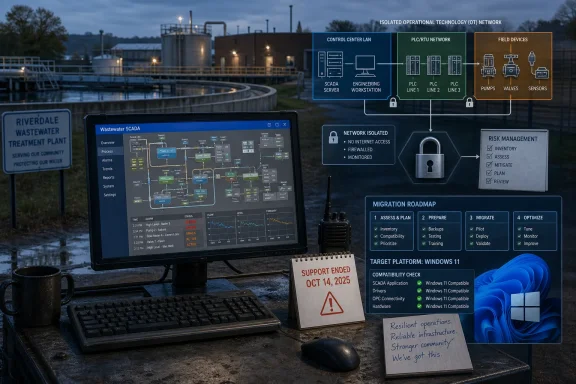 Kendall Chooses the Cheapest Door in a Very Expensive Hallway
For a small village, $36,000 is not an abstraction. It is the sort of line item that competes with roads, pumps, staffing, meters, and all the dull-but-essential work that keeps local government functioning. When the choice is framed as “buy new plant software” or “make the old software run on a new PC,” it is not hard to see why the Kendall Village Board picked the latter.The wrinkle is the operating system. Windows 10 is not merely “older Windows” anymore. Microsoft ended standard support for Windows 10 on October 14, 2025, which means the platform no longer receives ordinary free security fixes, feature updates, or mainstream technical support unless a device is covered by an Extended Security Updates arrangement.
That does not mean Windows 10 suddenly stopped booting. It means the risk meter changed while the user interface stayed familiar. In ordinary office computing, that is already a problem; in a wastewater plant, it becomes part of the operational-risk ledger.
Kendall’s move is therefore both rational and fragile. Rational, because replacing industrial or municipal control software is often wildly more expensive than outsiders expect. Fragile, because “we saved $36,000” is only the first sentence of the story, not the last.
The Windows 10 Deadline Has Become a Local Government Problem
Microsoft’s Windows 10 cutoff was always going to hit unevenly. Big enterprises had asset inventories, migration programs, procurement teams, and at least some ability to pay for extended support. Households had upgrade prompts and a choice between sticking with an old PC, buying a new one, or enrolling in consumer Extended Security Updates where eligible.Small municipalities sit in the awkward middle. They run critical services but often lack enterprise IT budgets. Their computers may be attached to pumps, sensors, programmable logic controllers, reporting systems, lab equipment, billing software, and vendor-specific packages that were installed years ago and then quietly became indispensable.
The public tends to imagine Windows upgrades as a consumer problem: a laptop that cannot run Windows 11, a Start menu someone dislikes, a TPM requirement that feels arbitrary. In municipal operations, the same upgrade can become a compatibility project. The question is not simply whether Windows 11 installs; it is whether the plant software, drivers, serial adapters, vendor dongles, remote-access tools, and reporting workflows survive the move.
That is why a $36,000 software quote can appear beside what looks like a routine PC replacement. The expensive part is rarely the copy of Windows. It is the ecosystem around the machine: licensing, vendor validation, configuration, migration, operator training, support contracts, and the hidden tax of touching anything connected to infrastructure.
Kendall’s choice suggests the existing wastewater software remains valuable enough to keep but old enough to make replacement painful. That is the profile of thousands of local-government systems across the country: not broken, not modern, and not cheap to move.
Industrial Software Ages Differently Than Office Software
Office applications live in a world of monthly updates, cloud accounts, and subscription plans. Wastewater plant software lives closer to the industrial-control world, where stability is often valued above novelty and a system that has worked for a decade earns institutional trust.That trust is not irrational. Operators do not want a surprise interface redesign when they are managing treatment processes. They do not want a driver update to interrupt communications with equipment. They do not want a vendor patch to change behavior in a system where consistency is part of safety.
But this culture of stability creates a trap. Software that is stable can become stranded. The vendor may support only a narrow set of operating systems, or the old version may require a paid upgrade before it can run on newer hardware. A small public agency then faces a bad menu: pay for a modernization bundle, preserve the old stack, or attempt a workaround that keeps operations moving but leaves unanswered security and support questions.
Kendall appears to have chosen preservation. Install Windows 10 on the new computer, keep using the software already in hand, avoid the $36,000 bill. In procurement terms, that is a clean win. In lifecycle terms, it is a deferral.
Deferrals are not automatically bad. Public-sector technology management is full of them because budgets are finite and emergencies are real. The problem comes when a deferral is mistaken for a solution.
The Security Risk Is Not Theoretical, but It Is Also Not the Whole Story
It would be easy to scold Kendall for using Windows 10 after end of support. That would also be too simple. The practical risk depends on how the machine is configured, whether it touches the internet, how remote access is handled, what user privileges exist, whether backups are tested, and whether the device is enrolled in available extended security coverage.A Windows 10 computer running isolated plant software on a locked-down network is a different risk from a Windows 10 computer browsing the web, receiving email, and running with shared admin credentials. The operating system matters, but architecture matters more. Security posture is not defined by the version number alone.
Still, unsupported Windows in operational technology deserves scrutiny. Wastewater facilities are not glamorous targets, but water and wastewater systems have been the subject of repeated cybersecurity warnings in recent years because they combine public impact with uneven security maturity. Small utilities are especially exposed: they are essential, budget-constrained, and often dependent on outside vendors for specialized systems.
The dangerous phrase in these environments is just one computer. One computer can be the operator workstation. One computer can hold the reporting path. One computer can bridge a control network and an office network. One computer can contain credentials that unlock remote support tools.
If Kendall’s Windows 10 installation is treated as a temporary compatibility bridge, tightly segmented and covered by a planned replacement path, the decision is understandable. If it becomes the new normal with no compensating controls, the village has bought time by spending risk.
Microsoft’s Lifecycle Policy Meets the Reality of Public Works
Microsoft’s position is straightforward: Windows 10 had a long support life, Windows 11 is the supported client platform, and Extended Security Updates exist for those who need more time. From Redmond’s perspective, there has to be an end date. Maintaining old operating systems forever is costly, complicates engineering, and leaves the ecosystem fragmented.That argument makes sense at platform scale. It lands differently in a village board meeting.
The operating system vendor does not pay the municipal software bill. The board does. The plant operator does not experience “Windows lifecycle modernization” as a strategic roadmap; they experience it as a quote, a compatibility problem, and a risk to systems that already work. The vendor ecosystem around public infrastructure often turns an OS transition into a forced upgrade event, and forced upgrade events are where resentment grows.
This is one reason Windows 10’s afterlife will be long. Not because users are unaware of Windows 11, and not only because hardware requirements blocked some PCs. It will persist because old software, specialized workflows, and limited budgets create strong incentives to keep working systems alive.
For Windows enthusiasts, that is familiar territory. For sysadmins, it is the daily grind. For local governments, it becomes policy by necessity.
The $36,000 Quote Is a Symptom, Not the Disease
The dollar figure in Kendall’s case is eye-catching because it makes the decision legible. A new software package costs $36,000; using the existing package costs much less. The board picked the cheaper route. But the quote is better understood as a symptom of a deeper procurement pattern.Small agencies often buy systems as projects rather than as lifecycles. A plant is upgraded, a control package is installed, the vendor trains staff, the invoices are paid, and the system settles into the background. Years later, a component ages out: a PC fails, Windows changes, a license server breaks, or a vendor ends support for a version.
At that moment, the agency discovers whether it bought software or inherited a dependency. If the system can be moved cleanly, the cost is manageable. If the vendor controls the migration path, the cost can look less like maintenance and more like a second procurement.
This is especially painful in infrastructure because the replacement decision is rarely optional in the long term. Wastewater treatment is regulated, monitored, and operationally continuous. The plant cannot simply “go without” its control or reporting software while officials shop for alternatives.
That pressure gives vendors leverage, even when they are not acting maliciously. Specialized municipal software markets are small. Support expertise is scarce. Compliance requirements are real. The result is pricing that can shock local boards but still reflect the economics of niche systems.
Kendall’s workaround avoids the immediate bill. It does not erase the market structure that produced the bill.
The Sensible Path Is Boring, Documented, and Funded
The best version of Kendall’s decision is not “run Windows 10 forever.” It is “preserve service while building a controlled migration plan.” That distinction matters.A controlled plan starts with asset clarity. The village needs to know the exact Windows 10 edition and build being installed, the software version, license terms, hardware dependencies, network connections, backup status, and vendor support posture. If the machine is eligible for Extended Security Updates, that should be decided deliberately, not discovered after an incident.
Then comes isolation. A wastewater control workstation should not be treated like a general-purpose office PC. If it does not need internet access, it should not have it. If remote support is required, it should be brokered through hardened, logged, time-limited access rather than an always-on remote desktop arrangement that nobody reviews.
Finally, there has to be a budget path. The $36,000 bill may be unacceptable this year, but the replacement need will not disappear. A staged capital plan, grant search, regional IT-sharing arrangement, or competitive review of alternative vendors could turn a crisis quote into a planned project.
The least defensible outcome would be silence. Unsupported systems become dangerous when everyone knows they are old but nobody owns the next step.
Windows 10 Is Becoming the New Windows 7 in Municipal Back Rooms
Anyone who worked through the Windows 7 retirement cycle has seen this movie. The official deadline passes, the world does not end, and therefore some organizations conclude the risk was overblown. Years later, the same machines are still running because every postponement made the eventual move harder.Windows 10 is now entering that phase. It is familiar, broadly compatible, and for many specialized applications it may be the last version that feels frictionless. Windows 11’s hardware requirements, security model, and driver expectations have improved the baseline for modern PCs, but they have also made marginal systems harder to carry forward.
That is not an argument against Windows 11. It is an argument for recognizing that the upgrade problem is not just technical. It is financial, contractual, and operational. A village board can approve a PC purchase in minutes; replacing the software ecosystem attached to that PC can require months of planning and a five-figure appropriation.
The danger for Microsoft is reputational as much as technical. When Windows transitions collide with small public budgets, the operating system becomes the visible villain even if the true problem is a brittle vendor dependency. That perception matters because Windows remains embedded in public infrastructure far beyond the desktop.
For local IT pros, the lesson is to start these conversations before a machine fails. A failed PC turns modernization into emergency procurement. Emergency procurement is where bad compromises are born.
Kendall’s Shortcut Should Come With a Written Expiration Date
Kendall’s board made the kind of decision small governments make all the time: protect the budget, preserve the working system, and defer the expensive replacement. The question now is whether the deferral is managed like risk or forgotten like clutter.The concrete lessons are not exotic. They are the same lessons Windows admins have been repeating since the first unsupported XP boxes were found humming along under desks and behind locked doors.
- The village saved money upfront by keeping its existing wastewater plant software instead of accepting a $36,000 replacement cost.
- Installing Windows 10 in 2026 carries lifecycle risk because Microsoft’s standard support for the operating system ended on October 14, 2025.
- The security impact depends heavily on whether the plant computer is isolated, patched through an eligible extended-support path, and protected from general-purpose internet use.
- The decision should be treated as a temporary bridge, not a permanent operating model for public infrastructure.
- The next budget cycle should include a migration plan that tests Windows 11 compatibility, vendor alternatives, remote-access controls, and long-term support costs.
- Small municipalities should inventory specialized Windows systems now, because the most expensive upgrade is the one discovered only after hardware fails.
Source: thecountyline.net Kendall in search of cheaper software - The County Line
