

Amazon’s legacy Kindle for PC client is already gone as of June 30, 2026, and the replacement is now the Microsoft Store-distributed Kindle app for Windows. That is the immediate Windows story buried in the latest Good e-Reader Radio Show: Amazon has moved a long-standing Win32 reader into a Store-era delivery model just as European repair rules are poised to reshape the hardware business around it.
The new app is listed for both Windows 10 and Windows 11 despite Amazon’s earlier messaging describing it as a Windows 11 release. Reporting from Good e-Reader, The eBook Reader, and Microsoft’s own community support channels indicates that the old application’s retirement was not merely an end to new downloads; the service-dependent client lost its practical ability to authenticate and access protected Kindle books.
For Windows users with large Kindle libraries, the change makes the Microsoft Store app—or Kindle Cloud Reader in a browser—the supported path forward. Local collections that were never synced to Amazon’s cloud are the awkward exception: they do not automatically transfer into the new client.
Amazon’s decision illustrates the central limitation of a DRM-backed ebook ecosystem. A Kindle title downloaded to a Windows PC is not a conventional document that can simply be opened in another reader if the original application disappears. It is content controlled through Amazon’s authorization system, and the client transition determines whether a user can continue to read it.
That distinction matters particularly for students, researchers, accessibility users, and anyone who relied on Kindle for PC’s older local-content workflow. The legacy desktop program had been in circulation for years, worked across a broad range of Windows installations, and fit naturally alongside library-management tools. The new Store app may be a cleaner distribution channel for Amazon, but it also narrows the user’s control over the software environment.
There are reports of compatibility problems on Windows on ARM systems, including newer Snapdragon-based Surface devices. Microsoft community responses have pointed affected readers toward Kindle Cloud Reader where supported, while enthusiasts have reported mixed results with manual package installation. That is not an enterprise-grade deployment answer, and it leaves Windows on ARM users in the uncomfortable position of having a modern Windows PC but an uncertain path to a mainstream reading service.
For administrators, the operational concern is simple: test the replacement before removing the old software from managed devices, especially where Kindle content is part of training, academic, or accessibility workflows. The Store migration also introduces familiar questions about Store policy, Microsoft account availability, package dependencies, and whether an organization permits consumer-store applications at all.
However, the practical language is more precise than “every device needs a removable back panel.” The regulation says replacement must be possible using commercially available tools and without specialized or proprietary tools, thermal energy, or solvents for disassembly. It also requires instructions and safety information to be made permanently available online, and obliges manufacturers to make compatible spare batteries available for at least five years after the last unit of a model is placed on the market.
That could mean screws, clips, gaskets, accessible pull tabs, or other serviceable designs. It does not, on its face, prescribe a universal Kindle chassis, require a particular screw type, or declare all adhesive use illegal. The European Commission has also been working through exemptions, including categories where safety and waterproofing concerns may make professional replacement appropriate.
For e-readers, the policy collision is obvious. Kindle, Kobo, PocketBook, and other vendors have long benefited from sealed construction that helps make devices thin, rigid, and resistant to water intrusion. A battery that can be swapped by an owner without heat, solvents, or vendor-only tools changes the engineering priorities. It may also make long-lived E Ink devices more viable after their lithium-ion cells begin to fade.
The key date is not this summer’s product cycle but February 2027. Vendors selling portable-battery products in Europe have roughly seven months to ensure new products comply, unless a narrowly applicable exemption applies. Existing stock and model timing will determine how quickly consumers see visibly different designs.
That means the report should be treated as a roadmap claim, not a product announcement. The proposition is plausible: newer on-device or cloud-connected reading features, such as Kindle Recaps and Story So Far, can benefit from more capable hardware and a more modern software stack. But there is no verified evidence yet that Amazon’s next Kindle generation will use a screw-secured rear panel or eliminate battery adhesive.
The timing also deserves scrutiny. If Amazon launches products before the February 2027 compliance deadline, it could conceivably sell a transitional design where permitted. Conversely, an EU-ready chassis could arrive earlier if Amazon wants a common global hardware platform rather than regional variants. Those are business choices, not requirements publicly set out by the regulation.
The more credible takeaway is that repairability has moved from an enthusiast concern to a concrete product-planning constraint. E-readers are especially exposed because their displays and processors can remain useful for many years, while battery degradation is often what turns an otherwise functional device into e-waste.
Kobo says the service updates Currently Reading status and reading progress, expressed as a percentage and converted by StoryGraph into pages or minutes. Kobo’s June product update says it works across Kobo eReaders, Kobo apps, and the Kobo Web Reader. The company’s support documentation notes that highlights, notes, and back-syncing are not currently supported, and disconnecting the services does not erase activity already shared.
According to Good e-Reader, the integration covers books and audiobooks acquired from the Kobo Store, Kobo Plus titles, and public-library loans accessed through OverDrive or Libby. Sideloaded titles transferred by USB or placed in Kobo cloud storage are excluded.
That limitation is significant. Kobo is often favored by advanced readers precisely because it is relatively accommodating of EPUB files and personal libraries. But the StoryGraph integration is tracking Kobo platform activity, not acting as a universal reading telemetry layer. Users who primarily sideload books will still need a manual workflow or a separate tracking method.
For everyone else, the integration gives Kobo a useful differentiator against Kindle’s Goodreads-centered history. StoryGraph has built its appeal around granular reading statistics, mood and content metadata, challenges, and recommendations less tied to bestseller dynamics. Native sync removes the tedious part: remembering to mark a title started, update a percentage, and log it as finished.
The near-term consequence is practical rather than glamorous. Windows readers must adapt to Amazon’s new Store app now; Kobo readers can connect StoryGraph now; and ebook hardware makers face a February 17, 2027 deadline that may finally make a worn battery a repair instead of a reason to replace an otherwise healthy reader.
The new app is listed for both Windows 10 and Windows 11 despite Amazon’s earlier messaging describing it as a Windows 11 release. Reporting from Good e-Reader, The eBook Reader, and Microsoft’s own community support channels indicates that the old application’s retirement was not merely an end to new downloads; the service-dependent client lost its practical ability to authenticate and access protected Kindle books.
For Windows users with large Kindle libraries, the change makes the Microsoft Store app—or Kindle Cloud Reader in a browser—the supported path forward. Local collections that were never synced to Amazon’s cloud are the awkward exception: they do not automatically transfer into the new client.
 The PC App Has Become an Access Gate, Not a File Reader
Amazon’s decision illustrates the central limitation of a DRM-backed ebook ecosystem. A Kindle title downloaded to a Windows PC is not a conventional document that can simply be opened in another reader if the original application disappears. It is content controlled through Amazon’s authorization system, and the client transition determines whether a user can continue to read it.That distinction matters particularly for students, researchers, accessibility users, and anyone who relied on Kindle for PC’s older local-content workflow. The legacy desktop program had been in circulation for years, worked across a broad range of Windows installations, and fit naturally alongside library-management tools. The new Store app may be a cleaner distribution channel for Amazon, but it also narrows the user’s control over the software environment.
There are reports of compatibility problems on Windows on ARM systems, including newer Snapdragon-based Surface devices. Microsoft community responses have pointed affected readers toward Kindle Cloud Reader where supported, while enthusiasts have reported mixed results with manual package installation. That is not an enterprise-grade deployment answer, and it leaves Windows on ARM users in the uncomfortable position of having a modern Windows PC but an uncertain path to a mainstream reading service.
For administrators, the operational concern is simple: test the replacement before removing the old software from managed devices, especially where Kindle content is part of training, academic, or accessibility workflows. The Store migration also introduces familiar questions about Store policy, Microsoft account availability, package dependencies, and whether an organization permits consumer-store applications at all.
Europe’s Battery Rule Is Real, but the Kindle Details Are Still Speculation
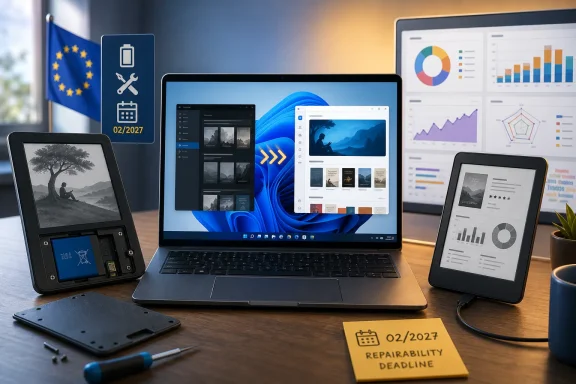
The podcast’s lead claim is that a coming European Union battery law will force ebook makers to redesign their devices around user-replaceable batteries. The underlying regulation is real. Article 11 of the EU Batteries Regulation generally requires portable batteries in products sold in the EU to be readily removable and replaceable by end users beginning February 17, 2027.However, the practical language is more precise than “every device needs a removable back panel.” The regulation says replacement must be possible using commercially available tools and without specialized or proprietary tools, thermal energy, or solvents for disassembly. It also requires instructions and safety information to be made permanently available online, and obliges manufacturers to make compatible spare batteries available for at least five years after the last unit of a model is placed on the market.
That could mean screws, clips, gaskets, accessible pull tabs, or other serviceable designs. It does not, on its face, prescribe a universal Kindle chassis, require a particular screw type, or declare all adhesive use illegal. The European Commission has also been working through exemptions, including categories where safety and waterproofing concerns may make professional replacement appropriate.
For e-readers, the policy collision is obvious. Kindle, Kobo, PocketBook, and other vendors have long benefited from sealed construction that helps make devices thin, rigid, and resistant to water intrusion. A battery that can be swapped by an owner without heat, solvents, or vendor-only tools changes the engineering priorities. It may also make long-lived E Ink devices more viable after their lithium-ion cells begin to fade.
The key date is not this summer’s product cycle but February 2027. Vendors selling portable-battery products in Europe have roughly seven months to ensure new products comply, unless a narrowly applicable exemption applies. Existing stock and model timing will determine how quickly consumers see visibly different designs.
Amazon Has Not Confirmed a New Kindle Lineup
Good e-Reader reports that Amazon plans multiple new Kindle models later in 2026, potentially with faster processors, more memory, enhanced AI features, and user-replaceable batteries. Amazon has not publicly announced such hardware, specifications, launch dates, or a repairability redesign.That means the report should be treated as a roadmap claim, not a product announcement. The proposition is plausible: newer on-device or cloud-connected reading features, such as Kindle Recaps and Story So Far, can benefit from more capable hardware and a more modern software stack. But there is no verified evidence yet that Amazon’s next Kindle generation will use a screw-secured rear panel or eliminate battery adhesive.
The timing also deserves scrutiny. If Amazon launches products before the February 2027 compliance deadline, it could conceivably sell a transitional design where permitted. Conversely, an EU-ready chassis could arrive earlier if Amazon wants a common global hardware platform rather than regional variants. Those are business choices, not requirements publicly set out by the regulation.
The more credible takeaway is that repairability has moved from an enthusiast concern to a concrete product-planning constraint. E-readers are especially exposed because their displays and processors can remain useful for many years, while battery degradation is often what turns an otherwise functional device into e-waste.
Kobo Gives StoryGraph a Native Route Into Reading Data
While Amazon’s Windows client transition focuses attention on platform control, Rakuten Kobo has launched a different kind of ecosystem integration. Kobo’s new StoryGraph connection automatically syncs reading activity after users link accounts through Kobo’s account integrations page.Kobo says the service updates Currently Reading status and reading progress, expressed as a percentage and converted by StoryGraph into pages or minutes. Kobo’s June product update says it works across Kobo eReaders, Kobo apps, and the Kobo Web Reader. The company’s support documentation notes that highlights, notes, and back-syncing are not currently supported, and disconnecting the services does not erase activity already shared.
According to Good e-Reader, the integration covers books and audiobooks acquired from the Kobo Store, Kobo Plus titles, and public-library loans accessed through OverDrive or Libby. Sideloaded titles transferred by USB or placed in Kobo cloud storage are excluded.
That limitation is significant. Kobo is often favored by advanced readers precisely because it is relatively accommodating of EPUB files and personal libraries. But the StoryGraph integration is tracking Kobo platform activity, not acting as a universal reading telemetry layer. Users who primarily sideload books will still need a manual workflow or a separate tracking method.
For everyone else, the integration gives Kobo a useful differentiator against Kindle’s Goodreads-centered history. StoryGraph has built its appeal around granular reading statistics, mood and content metadata, challenges, and recommendations less tied to bestseller dynamics. Native sync removes the tedious part: remembering to mark a title started, update a percentage, and log it as finished.
The near-term consequence is practical rather than glamorous. Windows readers must adapt to Amazon’s new Store app now; Kobo readers can connect StoryGraph now; and ebook hardware makers face a February 17, 2027 deadline that may finally make a worn battery a repair instead of a reason to replace an otherwise healthy reader.
References
- Primary source: Good e-Reader
Published: 2026-07-16T02:06:28+00:00
Podcast: New Kindles, Kobo Storygraph and upcoming Battery Law - Good e-Reader
This edition of the Good e-Reader Radio Show includes upcoming new Kindles, Storygraph on Kobo e-readers, and a new Kindle app for Windows 11.goodereader.com - Related coverage: help.kobo.com
Sync Your Kobo Reading Progress with StoryGraph – Rakuten Kobo
You'll be able to connect your Kobo account to StoryGraph and have your reading progress sync automatically, no more manual updates. Once...help.kobo.com
