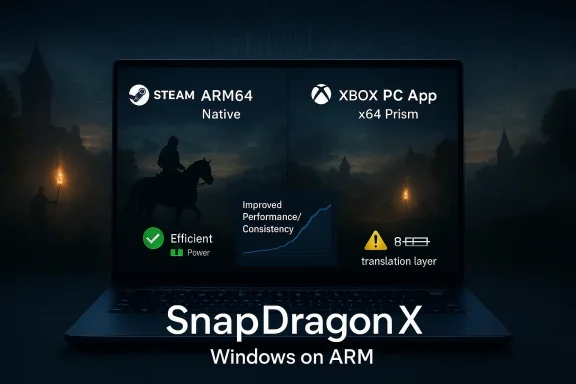
Steam’s newly native ARM64 build of Kingdom Come: Deliverance II is a small patch with outsized implications for Windows on Arm gaming, and it exposes a familiar weak spot in Microsoft’s PC gaming ecosystem. Steam users with Snapdragon X hardware can now run the RPG natively, while PC Game Pass players are still stuck with translated x64 execution through Prism, at least for now. That creates a stark split between a storefront that is moving quickly on Arm support and Microsoft’s own distribution path that is, on this evidence, still lagging behind. (windowscentral.com)
The immediate story is straightforward, but the underlying context is more interesting. Kingdom Come: Deliverance II already had a reputation as a highly polished PC release, with Windows Central previously praising its performance and calling it “the perfect RPG sequel” in an earlier review. What changed this week is not the game itself, but the way it is packaged for a growing class of Arm-based Windows laptops. Warhorse’s patch 1.5.3 is described as a purely technical architecture update, and that wording matters: this is less about new content than about whether the software runs natively on the hardware in front of the player. (windowscentral.com)
That distinction has become much more important over the last year. Microsoft and Qualcomm have spent months telling the market that Windows on Arm is no longer a novelty platform, especially after the launch of Snapdragon X machines and Microsoft’s improvements to Prism, the translation layer that lets many x86 and x64 apps run on Arm devices. Microsoft has also been pushing a stronger gaming story for Arm PCs, including the ability to download and run more Xbox PC titles locally on supported Arm hardware. The broad message is that Arm is supposed to be a first-class Windows platform now, not a fallback.
Yet gaming distribution is still fragmented. Steam and the Xbox PC app do not always move in lockstep, and that can leave users with the odd situation where the same title has one behavior on one storefront and a different one on another. In this case, the Steam patch notes acknowledge the native Arm64 path, while the Xbox PC app still presents the game as x64 on compatible devices. That means the same subscriber can buy or play the same game and still end up taking the less efficient route simply because of where they launched it. (windowscentral.com)
This is exactly the kind of gap that makes Windows on Arm enthusiasts impatient. Native support is not just a performance nicety; it is an ecosystem signal. It tells buyers, developers, and platform holders whether Arm support is becoming routine or remaining a special case. And when a high-profile RPG gets a native build on Steam before PC Game Pass sees the same treatment, the message to users is that the market is still uneven even when the hardware is ready.
The practical impact is easy to understand. Native code is generally better for battery life, responsiveness, and thermal behavior, especially on thin-and-light laptops where efficiency is part of the value proposition. Emulation has improved a lot, and Microsoft has made that point repeatedly, but translation still adds complexity that native software simply does not need. For a game already built to look and feel impressive on PC, the native path matters because it removes one more layer between the player and the game engine.
There is also a symbolic component. Steam has long been the store where PC gaming feels most open to experimentation and fast iteration. In the Arm era, that openness now extends to architecture-specific builds, which is exactly the sort of flexibility early adopters value. The store is not just selling the game; it is acting as a live deployment channel for the platform.
This is where the user frustration comes in. If Microsoft wants Windows on Arm to feel mature, then Game Pass parity should be the expectation, not the exception. A user paying for access through Microsoft’s own subscription service should not be forced into a less optimal code path than a Steam buyer with the same laptop. That is a distribution problem, not a hardware problem, and it makes the platform feel less coherent than it ought to.
That is especially true for a large, modern RPG. These games are often a mix of CPU-side simulation, asset streaming, script handling, and GPU-heavy rendering. Even when the GPU carries most of the visual load, the CPU still has to keep the pipeline fed. Native execution gives the system a cleaner path for doing that work. The result is often not just higher average performance but better consistency, which is what players actually notice. Consistency is usually more valuable than theoretical peak speed.
The same point applies to the broader platform. Microsoft has repeatedly said that Prism has improved and now supports more x86/x64 instruction sets, including AVX and AVX2. That makes emulation much more viable than it used to be, but it does not erase the value of native builds. In fact, the two trends reinforce each other: better emulation widens compatibility, while native support unlocks the best-case experience.
That question is becoming more important as Arm PCs become more common. Microsoft’s own messaging says the Xbox PC app now supports local downloads on Arm devices and that a large portion of the Game Pass catalog is compatible. The next logical step is obvious: the distribution system itself needs to feel as modern as the compatibility claims.
There are probably several ways to explain the delay, and none of them are ideal from the consumer’s perspective. It could be a submission process issue, a metadata problem, or a platform validation wrinkle. The most important point is that none of those explanations feel satisfying to a paying user. If the build exists, it should ship. That is the simplest version of the complaint, and it is hard to argue with.
This is also where third-party stores keep gaining credibility. If the official Microsoft storefront is slower to surface an ARM64 update, users begin to treat Steam as the more reliable gaming platform for Arm devices, even when both are technically running on Windows. That is not a small branding problem. It cuts directly against Microsoft’s effort to position Game Pass and the Xbox PC app as the center of the PC gaming story.
That progress is real, but it does not remove the remaining friction. Games with anti-cheat, niche drivers, or architecture-specific assumptions still create problems. More importantly, the platform still depends on vendors and storefronts behaving consistently. A game can be fully compatible in engineering terms and still feel incomplete if the delivery system is out of sync.
But compatibility is not the same as native execution. Prism is a safety net, not an ideal state. If a publisher can ship a true Arm64 build, that is still the better outcome. In other words, Prism makes the platform workable, while native support makes it credible.
This is why the Kingdom Come II situation matters beyond this one game. It is a signal test. If publishers and storefronts can get native builds delivered cleanly, Arm gaming becomes much more believable. If not, users will keep treating Windows on Arm as a platform with promise but frustrating seams.
For enterprises, the story is more subtle but still relevant. Arm-native application availability is one of the reasons organizations are finally able to consider Arm laptops for more than basic web and office work. Gaming is not the business use case, of course, but it acts as a proxy for software maturity. If a modern game can ship natively on Arm, that tells IT decision-makers something about how far the broader platform has come.
That does not mean Microsoft is failing overall. It means the company’s success has raised expectations enough that inconsistencies now stand out sharply. A few years ago, this kind of discrepancy might have been dismissed as inevitable. In 2026, with Arm PCs getting stronger and Microsoft publicly touting compatibility gains, it looks more like a process issue that needs fixing.
The irony is that Microsoft has already done the hard work of improving the technical substrate. Prism is better, local installs on Arm are more viable, and the compatibility story is stronger than it used to be. The missing piece is operational polish. Native game delivery should feel automatic by now.
That contrast is why this article is more than a patch note roundup. It is a reminder that platform leadership is often decided in the mundane details. Who gets the update first? Who surfaces the right architecture label? Who avoids forcing users through emulation when a native build exists? Those are the questions that matter.
The second question is whether more publishers follow Warhorse’s lead. One native RPG build would be nice; a pattern would be much more important. If major game libraries begin to ship Arm64 versions routinely, then Windows on Arm becomes much easier to recommend without caveats. That is the real prize Microsoft is chasing.
The broader lesson is that Arm compatibility is no longer the only benchmark that matters. Delivery, consistency, and storefront parity now matter too, and they matter enough that a single RPG patch can expose the strengths and weaknesses of an entire platform. In that sense, Kingdom Come: Deliverance II has become a surprisingly effective stress test for Windows on Arm — and the results are encouraging, but not yet complete.
Source: Windows Central Steam gets an ARM native build for Kingdom Come II, while PC Game Pass players are left waiting
 Background
The immediate story is straightforward, but the underlying context is more interesting. Kingdom Come: Deliverance II already had a reputation as a highly polished PC release, with Windows Central previously praising its performance and calling it “the perfect RPG sequel” in an earlier review. What changed this week is not the game itself, but the way it is packaged for a growing class of Arm-based Windows laptops. Warhorse’s patch 1.5.3 is described as a purely technical architecture update, and that wording matters: this is less about new content than about whether the software runs natively on the hardware in front of the player. (windowscentral.com)That distinction has become much more important over the last year. Microsoft and Qualcomm have spent months telling the market that Windows on Arm is no longer a novelty platform, especially after the launch of Snapdragon X machines and Microsoft’s improvements to Prism, the translation layer that lets many x86 and x64 apps run on Arm devices. Microsoft has also been pushing a stronger gaming story for Arm PCs, including the ability to download and run more Xbox PC titles locally on supported Arm hardware. The broad message is that Arm is supposed to be a first-class Windows platform now, not a fallback.
Yet gaming distribution is still fragmented. Steam and the Xbox PC app do not always move in lockstep, and that can leave users with the odd situation where the same title has one behavior on one storefront and a different one on another. In this case, the Steam patch notes acknowledge the native Arm64 path, while the Xbox PC app still presents the game as x64 on compatible devices. That means the same subscriber can buy or play the same game and still end up taking the less efficient route simply because of where they launched it. (windowscentral.com)
This is exactly the kind of gap that makes Windows on Arm enthusiasts impatient. Native support is not just a performance nicety; it is an ecosystem signal. It tells buyers, developers, and platform holders whether Arm support is becoming routine or remaining a special case. And when a high-profile RPG gets a native build on Steam before PC Game Pass sees the same treatment, the message to users is that the market is still uneven even when the hardware is ready.
What Actually Changed
Patch 1.5.3 is the key technical event here. Warhorse’s Steam notes describe it as a native Windows on ARM update optimized for devices using Qualcomm’s Snapdragon X Elite platform, and Windows Central reports that the change is visible in practice: Steam users can access an ARM64 build, while Xbox PC users still see x64 architecture. That means the Steam version can avoid emulation overhead on supported hardware, while the Game Pass version cannot yet take the same route. (windowscentral.com)The practical impact is easy to understand. Native code is generally better for battery life, responsiveness, and thermal behavior, especially on thin-and-light laptops where efficiency is part of the value proposition. Emulation has improved a lot, and Microsoft has made that point repeatedly, but translation still adds complexity that native software simply does not need. For a game already built to look and feel impressive on PC, the native path matters because it removes one more layer between the player and the game engine.
Steam Gets the Cleaner Path
Steam’s advantage here is partly technical and partly procedural. If the developer can publish an updated Arm64 package and the storefront can deliver it quickly, the user experience becomes direct and relatively frictionless. That is what makes the Steam path feel so clean in this case: the patch exists, the storefront delivers it, and compatible hardware benefits immediately. (windowscentral.com)There is also a symbolic component. Steam has long been the store where PC gaming feels most open to experimentation and fast iteration. In the Arm era, that openness now extends to architecture-specific builds, which is exactly the sort of flexibility early adopters value. The store is not just selling the game; it is acting as a live deployment channel for the platform.
- Native ARM64 build available on Steam
- Optimized for Snapdragon X hardware
- Reduced reliance on Prism translation
- Immediate benefit to efficiency and latency
- Stronger fit for Windows on Arm laptops
Xbox PC Game Pass Still Lags
The Xbox PC app is the more disappointing half of the story. Windows Central says the game still shows as x64 on the Xbox storefront, which strongly suggests that the native Arm build has not yet propagated through Microsoft’s distribution and validation pipeline. That is awkward for Microsoft because Arm support is one of the platform stories it has been promoting most aggressively in 2025 and 2026. (windowscentral.com)This is where the user frustration comes in. If Microsoft wants Windows on Arm to feel mature, then Game Pass parity should be the expectation, not the exception. A user paying for access through Microsoft’s own subscription service should not be forced into a less optimal code path than a Steam buyer with the same laptop. That is a distribution problem, not a hardware problem, and it makes the platform feel less coherent than it ought to.
Why Arm Native Matters for Gaming
Native Arm builds are not just a bragging right. They directly influence how games behave on thin-and-light laptops, especially devices built around Qualcomm’s recent chips. When a game runs natively, the CPU no longer has to spend extra work translating instructions, which can improve scheduling efficiency and reduce overhead. On a platform where power envelope matters as much as raw speed, that difference can be more important than benchmark charts suggest.That is especially true for a large, modern RPG. These games are often a mix of CPU-side simulation, asset streaming, script handling, and GPU-heavy rendering. Even when the GPU carries most of the visual load, the CPU still has to keep the pipeline fed. Native execution gives the system a cleaner path for doing that work. The result is often not just higher average performance but better consistency, which is what players actually notice. Consistency is usually more valuable than theoretical peak speed.
Efficiency Is the Real Story
Qualcomm’s Snapdragon X family was always sold as a performance-per-watt play as much as a raw performance play. That matters because Windows on Arm laptops are often judged by desktop standards, even though their strength is meant to be mobility, battery life, and sustained responsiveness. Native games support that pitch far better than translated ones do.The same point applies to the broader platform. Microsoft has repeatedly said that Prism has improved and now supports more x86/x64 instruction sets, including AVX and AVX2. That makes emulation much more viable than it used to be, but it does not erase the value of native builds. In fact, the two trends reinforce each other: better emulation widens compatibility, while native support unlocks the best-case experience.
- Lower translation overhead
- Better thermals under sustained load
- Improved battery life potential
- Smoother frame pacing in demanding games
- More credible gaming on ultra-mobile hardware
Why It Still Feels Uneven
The problem is that users do not experience the platform as a neat technical diagram. They see the store, click install, and expect the game to use the best available version. When Steam and Xbox PC behave differently, that expectation gets broken. The result is not just a minor performance complaint; it is a trust problem. If a native build exists, why is it not being delivered everywhere it should be?That question is becoming more important as Arm PCs become more common. Microsoft’s own messaging says the Xbox PC app now supports local downloads on Arm devices and that a large portion of the Game Pass catalog is compatible. The next logical step is obvious: the distribution system itself needs to feel as modern as the compatibility claims.
Steam Versus Xbox PC
The storefront split is the biggest practical takeaway from this episode. Steam appears to be delivering the native build, while the Xbox PC app is still serving the older architecture. That is not a theoretical distinction; it changes how the game runs on real Snapdragon X hardware. Windows Central’s report makes clear that the Xbox app still shows x64 architecture, not ARM64, and that is exactly the kind of inconsistency users remember. (windowscentral.com)There are probably several ways to explain the delay, and none of them are ideal from the consumer’s perspective. It could be a submission process issue, a metadata problem, or a platform validation wrinkle. The most important point is that none of those explanations feel satisfying to a paying user. If the build exists, it should ship. That is the simplest version of the complaint, and it is hard to argue with.
Distribution Is the Bottleneck
Microsoft has invested heavily in making Windows on Arm look ready for mainstream gaming, but storefront delivery still matters more than marketing. A native build hidden behind a slower distribution path is not much help to users who bought the ecosystem promise. Steam’s faster path shows what the ideal experience should look like: clear labeling, prompt rollout, and architecture-specific delivery when available. (windowscentral.com)This is also where third-party stores keep gaining credibility. If the official Microsoft storefront is slower to surface an ARM64 update, users begin to treat Steam as the more reliable gaming platform for Arm devices, even when both are technically running on Windows. That is not a small branding problem. It cuts directly against Microsoft’s effort to position Game Pass and the Xbox PC app as the center of the PC gaming story.
The User Perception Problem
Perception matters because Windows on Arm still carries legacy skepticism from the Surface Pro X era and earlier. Even though compatibility has improved a great deal, many buyers are still waiting for proof that the ecosystem has truly matured. Every time a native build lands unevenly, that skepticism gets reinforced. The result is that good news for Arm can still arrive wrapped in frustration.- Steam looks faster to capitalize on native Arm builds
- Xbox PC looks slower to surface the same update
- Users notice architecture labels immediately
- Game Pass parity becomes a trust issue
- Microsoft’s own platform story takes a credibility hit
The Bigger Windows on Arm Context
This story is not really about one RPG. It is about whether Windows on Arm is entering the phase where users can expect native software by default. Microsoft has spent the last year improving Prism, broadening app compatibility, and making the Xbox PC app work more naturally on Arm-based Windows 11 devices. The company has also claimed that more than 85% of the Game Pass catalog is compatible with these PCs, which is a meaningful milestone even if it does not solve every edge case.That progress is real, but it does not remove the remaining friction. Games with anti-cheat, niche drivers, or architecture-specific assumptions still create problems. More importantly, the platform still depends on vendors and storefronts behaving consistently. A game can be fully compatible in engineering terms and still feel incomplete if the delivery system is out of sync.
Prism Has Raised the Floor
Microsoft’s recent Prism updates matter because they changed the conversation from “does it run?” to “how well does it run?” That is a major shift. AVX and AVX2 support in Prism makes a larger class of x86/x64 games usable than before, which means compatibility is no longer the same weak point it once was.But compatibility is not the same as native execution. Prism is a safety net, not an ideal state. If a publisher can ship a true Arm64 build, that is still the better outcome. In other words, Prism makes the platform workable, while native support makes it credible.
Snapdragon X Needs Native Momentum
Qualcomm’s Snapdragon X family has given Windows on Arm its strongest consumer hardware push yet. That creates a neat but demanding equation: if the hardware is now good enough to compete, the software ecosystem has to keep pace. High-profile games moving to ARM64 is one way to prove that the ecosystem is catching up. Delays through Microsoft’s own storefront do the opposite.This is why the Kingdom Come II situation matters beyond this one game. It is a signal test. If publishers and storefronts can get native builds delivered cleanly, Arm gaming becomes much more believable. If not, users will keep treating Windows on Arm as a platform with promise but frustrating seams.
Enterprise Versus Consumer Impact
For consumers, the practical issue is mostly one of convenience and performance. A player with a Snapdragon X laptop wants the best version of the game that their machine can run, and that means the native build should be the default whenever possible. If they are paying for Game Pass, they also expect parity with what Steam users get. That expectation is not unreasonable; it is exactly what a mature ecosystem should deliver. (windowscentral.com)For enterprises, the story is more subtle but still relevant. Arm-native application availability is one of the reasons organizations are finally able to consider Arm laptops for more than basic web and office work. Gaming is not the business use case, of course, but it acts as a proxy for software maturity. If a modern game can ship natively on Arm, that tells IT decision-makers something about how far the broader platform has come.
Why This Matters to IT Buyers
IT teams care about repeatability and supportability, not just raw compatibility. When a consumer game gets different behavior depending on storefront, that is a reminder that software delivery on Arm still has edge cases. Enterprises will be watching the same ecosystem and drawing their own conclusions about how reliable it is. That may not affect the gaming market directly, but it shapes the reputation of Arm PCs overall.- Consumers want the best-performing build automatically
- Enterprises want predictable deployment behavior
- Storefront differences raise support questions
- Native builds strengthen confidence in Arm
- Inconsistent rollout weakens the platform message
Consumer Expectations Are Rising Faster
The consumer side is moving even faster than enterprise acceptance. Arm laptops are no longer exotic, and users increasingly expect the same polished store experience they get on x86 systems. That makes lagging storefront parity more visible, not less. The more Microsoft markets Arm PCs as mainstream, the less patience users will have for architecture mismatches in the Xbox app. Promise and delivery have to line up.Microsoft’s Position Gets Harder
Microsoft is in a tricky spot because the company has every reason to celebrate progress on Windows on Arm, yet this story exposes a visible gap inside its own ecosystem. The Xbox PC app is supposed to be part of the answer, not part of the problem. If Steam can deliver the native build first, the comparison is immediate and unfavorable. (windowscentral.com)That does not mean Microsoft is failing overall. It means the company’s success has raised expectations enough that inconsistencies now stand out sharply. A few years ago, this kind of discrepancy might have been dismissed as inevitable. In 2026, with Arm PCs getting stronger and Microsoft publicly touting compatibility gains, it looks more like a process issue that needs fixing.
The Storefront Needs to Feel First-Party
The Xbox PC app is not just another store. It is Microsoft’s consumer-facing gaming platform, and that gives it extra responsibility. If the app cannot reliably surface a native build that Steam already exposes, users start to wonder whether the first-party route is actually the best route. That is a dangerous perception for a company trying to keep PC gamers inside its ecosystem.The irony is that Microsoft has already done the hard work of improving the technical substrate. Prism is better, local installs on Arm are more viable, and the compatibility story is stronger than it used to be. The missing piece is operational polish. Native game delivery should feel automatic by now.
Steam’s Simpler Story Wins the Day
Steam benefits because its value proposition is simple: it gets users the build the developer shipped, and it does so with relatively little friction. That makes it look competent in a way that resonates with enthusiasts. When the game in question is architecture-sensitive, Steam’s approach looks even better. It is not just a store; it is a dependable delivery mechanism. (windowscentral.com)That contrast is why this article is more than a patch note roundup. It is a reminder that platform leadership is often decided in the mundane details. Who gets the update first? Who surfaces the right architecture label? Who avoids forcing users through emulation when a native build exists? Those are the questions that matter.
Strengths and Opportunities
The good news is that this release demonstrates real momentum for native Windows on Arm gaming, and it shows that publishers are willing to ship architecture-specific builds when the platform economics make sense. It also proves that Snapdragon X hardware is now credible enough for developers to optimize against directly rather than merely tolerate through emulation. That is a meaningful step forward for the whole ecosystem. (windowscentral.com)- Better performance potential on Snapdragon X laptops
- Improved battery and thermal efficiency
- Stronger evidence that Arm gaming is maturing
- A showcase for native build workflows
- More pressure on other publishers to follow
- Clearer proof that Prism is not the end state
- A practical win for Steam users on Arm
Risks and Concerns
The risk is that this kind of split rollout becomes normal, and users start expecting inconsistency across storefronts. That would be bad for Microsoft, bad for Game Pass, and bad for the broader reputation of Windows on Arm. It also creates confusion for buyers who do not track architecture details closely and just want the game to work the best way possible. (windowscentral.com)- Game Pass users may feel second-class
- Storefront fragmentation can confuse buyers
- Emulation may remain the default too often
- Native builds could arrive unevenly across platforms
- Microsoft’s credibility takes a small but visible hit
- Support teams may have to explain avoidable gaps
- Enthusiasts could drift toward Steam for reliability
Looking Ahead
The next question is simple: how quickly does Microsoft close the gap in its own storefront? If the Xbox PC app eventually surfaces the ARM64 build, this episode becomes a footnote about rollout timing. If it does not, then it becomes another example of Microsoft’s gaming story being undermined by its own delivery machinery. That is a much bigger problem than one game patch. (windowscentral.com)The second question is whether more publishers follow Warhorse’s lead. One native RPG build would be nice; a pattern would be much more important. If major game libraries begin to ship Arm64 versions routinely, then Windows on Arm becomes much easier to recommend without caveats. That is the real prize Microsoft is chasing.
- Xbox PC app parity with Steam on Arm builds
- More native ARM64 releases from major publishers
- Clearer storefront architecture labeling
- Continued Prism improvements for fallback compatibility
- Stronger user confidence in Snapdragon X gaming
The broader lesson is that Arm compatibility is no longer the only benchmark that matters. Delivery, consistency, and storefront parity now matter too, and they matter enough that a single RPG patch can expose the strengths and weaknesses of an entire platform. In that sense, Kingdom Come: Deliverance II has become a surprisingly effective stress test for Windows on Arm — and the results are encouraging, but not yet complete.
Source: Windows Central Steam gets an ARM native build for Kingdom Come II, while PC Game Pass players are left waiting