

Kore.ai launched the Artemis edition of its Agent Platform on May 21, 2026, making Microsoft Azure the first cloud home for a new enterprise system designed to build, govern, and operate multiagent AI workflows. The announcement is less about another chatbot builder than about the next control layer in enterprise software. Kore.ai is arguing that the agent era will not be won by the smartest model alone, but by the platform that can make fleets of agents auditable, repeatable, and safe enough for regulated work.
The most important word in the Artemis announcement is not “agentic.” It is “compiled.”
That may sound like a developer’s detail, but it points to the deeper wager behind Kore.ai’s new platform. The company is trying to turn agent construction from a messy mix of prompts, glue code, API calls, and hope into something closer to software engineering. Artemis introduces Agent Blueprint Language, or ABL, as a declarative way to define agents, workflows, orchestration patterns, and governance rules before anything reaches production.
That framing matters because enterprise AI has been stuck between two uncomfortable poles. On one side are demos that look astonishing in conference keynotes. On the other are security reviews, audit trails, exception handling, data residency requirements, identity boundaries, and angry business owners when an automation makes the wrong decision at scale.
Artemis is Kore.ai’s answer to that gap. It promises to let enterprises describe what they want in business language, have an AI architect generate the underlying agent design, and then govern the result through a deterministic platform layer. The sales pitch is speed, but the strategic pitch is control.
For the last two years, the agent conversation has been dominated by capability: whether models can plan, call tools, execute multistep tasks, and coordinate with other agents. That was a necessary phase, but it was never sufficient for enterprises. A bank, insurer, hospital, retailer, or government contractor does not merely ask whether an AI agent can complete a task. It asks who authorized it, what data it touched, what policy constrained it, what happened when the first tool call failed, and whether the whole episode can be reconstructed six months later.
Kore.ai is positioning Artemis as the layer where those questions are answered before deployment rather than after an incident. The platform’s six orchestration patterns — supervisor, delegation, handoff, fan-out, escalation, and agent-to-agent federation — read like a catalog of the failure modes enterprises already fear. Someone must be in charge. Work must be delegated cleanly. Control must pass between systems without vanishing. Parallel actions must be reconciled. Risky events must escalate. Agents must talk to one another without becoming an ungoverned swarm.
That is the real market Kore.ai is chasing. Not “AI that can do things,” but AI that can be allowed to do things.
Microsoft has spent the past year turning that adjacency into a platform argument. Foundry Agent Service gives developers a managed environment for building and deploying agents. Microsoft 365 Copilot and Teams provide the daily user interface for knowledge workers. Entra ID supplies identity and access control. Microsoft Graph provides the connective tissue into mail, calendars, files, chats, users, and organizational context. Agent 365 is Microsoft’s attempt to make agents discoverable, manageable, and governed across that estate.
Kore.ai is plugging Artemis into precisely that stack. The company says the platform integrates with Microsoft Foundry, Microsoft Agent 365, Entra ID, Microsoft Graph API, and Teams through Azure Bot Framework. That makes the Azure-first launch less a cloud hosting choice than a distribution and governance strategy.
For WindowsForum readers, the Microsoft angle is the practical one. The future of enterprise AI may be model-agnostic in theory, but the first serious deployments will often be Microsoft-adjacent in practice. Agents will surface in Teams, act on Microsoft 365 data, authenticate through Entra, and be reviewed by administrators already living in Microsoft’s security and compliance portals.
This is also why the partnership is a double-edged sword. Kore.ai wants to present Artemis as model-independent and ultimately cloud-flexible. But the first launch partner shapes the early center of gravity. The tighter Artemis becomes with Microsoft’s agent ecosystem, the more attractive it becomes to Microsoft-standardized enterprises — and the more carefully customers will need to evaluate how portable their agent designs really are.
That is a meaningful distinction. Prompt-driven development has been useful because it is fast, flexible, and accessible to people who do not think of themselves as programmers. It has also been fragile. Prompts drift, tool behavior changes, model upgrades alter response patterns, and one team’s clever workaround becomes another team’s compliance problem.
A compiled blueprint suggests a different discipline. The organization can inspect what an agent is supposed to do. The platform can validate whether the design conforms to policy. Governance can be applied to the structure of the workflow, not merely to the model’s answer. Operations teams can observe production traces against a known design rather than reverse-engineering behavior from logs.
This does not eliminate uncertainty. Large language models remain probabilistic systems, and no declarative layer magically turns open-ended reasoning into traditional deterministic software. But it does move the boundary. Instead of asking a model to improvise every part of a process, Artemis appears designed to constrain where improvisation happens and where fixed flow control takes over.
That is why Kore.ai’s “dual-brain” architecture is more than marketing garnish. The company says Artemis combines agentic reasoning with deterministic flows, operating in parallel through shared memory and governed by one runtime. If that works as advertised, it gives enterprises a way to use generative AI where judgment and language matter, while preserving conventional workflow controls where predictability matters more.
In other words, Kore.ai is not merely offering a platform for building agents. It is offering AI that helps build the agents, govern them, and optimize them over time. The company’s own formulation is blunt: AI building AI, AI governing AI, AI optimizing AI.
There is a powerful business case here. Enterprise software backlogs are full of workflow automations that never get built because bespoke engineering is too expensive. If Arch can take a plain-language objective, generate a reviewable blueprint, validate it against policy, and produce something close to production-ready, the economics of automation change. The marginal cost of the next agent falls because the shared runtime, patterns, governance controls, and integration fabric are already in place.
But this is also where customers should slow down. “AI-generated” does not mean “risk-free,” and “reviewable” does not mean “reviewed.” The strongest version of the Artemis story depends on human oversight remaining meaningful rather than ceremonial. If Arch proposes changes from production traces, someone still needs to understand whether those optimizations improve the business process, degrade compliance posture, or simply overfit to yesterday’s workload.
The long-term question is whether enterprises can build a reliable approval pipeline around AI-generated agent designs. That pipeline will need product owners, security teams, compliance officers, platform engineers, and business process experts. If Artemis reduces hand-coding but increases governance complexity, the productivity gain will depend on whether organizations redesign their operating model, not just whether they buy the platform.
CIOs want consolidation because many organizations already have agent sprawl: experiments in business units, vendor-provided assistants in SaaS tools, custom bots built by innovation teams, and shadow automations wired into internal data. CISOs want enforceable controls because an agent that can read documents, call APIs, and send messages is not just a productivity tool. It is a new actor inside the enterprise. CFOs want reuse because the economics of AI become ugly if every use case requires separate infrastructure, security review, model tuning, and support.
Artemis speaks to all three constituencies. It promises one foundation for multiple agents, governance outside the model’s control, traceability for decisions and policy enforcement, and shared infrastructure that makes later agents cheaper to create than the first. The argument is elegant: if enterprises are going to deploy hundreds or thousands of agents, they need an agent platform, not a collection of disconnected assistants.
The danger is that governance language can become a comfort blanket. Certifications, audit trails, and policy engines are necessary, but they do not automatically prove that a given agent is safe for a given business process. Real governance is contextual. A workflow that is acceptable for triaging HR requests may be unacceptable for approving credit exceptions, changing patient records, or modifying production infrastructure.
That is where Artemis will need to prove itself in customer deployments. The platform can provide the scaffolding, but enterprises still have to define the rules, assign accountability, test edge cases, and decide which decisions remain human-owned.
That creates an interesting tension. Kore.ai benefits from Azure’s infrastructure, Microsoft 365’s surface area, and the familiarity of Entra-backed administration. At the same time, Microsoft’s own agent stack will keep expanding. Customers will ask when to use Kore.ai, when to use Microsoft-native tools, when to use Salesforce or ServiceNow agents, and when to build directly on model-provider APIs.
Kore.ai’s answer appears to be specialization and neutrality. Artemis is pitched as model-independent, architected for multiagent orchestration, and designed from a decade of enterprise conversational AI deployments. That history matters. Kore.ai was not born in the current agent gold rush; it has long sold automation and AI systems into customer service, employee support, banking, healthcare, retail, and other regulated environments.
Still, neutrality is difficult to maintain when go-to-market motion flows through a dominant ecosystem. If Artemis is best on Azure, most visible through Microsoft 365, and deeply integrated with Microsoft’s agent management layer, customers will reasonably treat it as part of a Microsoft-centric architecture. That is not necessarily bad. For many Global 2000 organizations, that is exactly the point.
That list is not decorative. It tells us who Kore.ai thinks will buy first: organizations that already know why ungoverned AI is a problem. In banking, healthcare, insurance, telecom, retail, and public-sector-adjacent industries, the path from AI demo to production often dies in risk review. A platform that arrives with compliance primitives baked in has a better chance of surviving procurement.
The FedRAMP claim is particularly relevant for U.S. public sector and government-adjacent buyers, while PCI DSS and HIPAA alignment speak to industries where AI agents will inevitably touch sensitive financial or health-related workflows. The promise of immutable audit trails is similarly important because it acknowledges a simple reality: if an agent takes action, the organization must be able to reconstruct that action later.
But compliance claims also require careful reading. A platform’s certification does not automatically certify every agent a customer builds on top of it. Data flows, integrations, retention policies, access controls, prompt content, and downstream systems can all change the compliance picture. Artemis may lower the barrier, but it does not remove the responsibility.
Traditional software teams have learned to manage this with testing, monitoring, versioning, rollback, change control, and incident response. Agentic AI needs the same discipline, with the added complication that the system may reason differently across contexts. Observability is therefore not a luxury feature. It is the difference between a controllable automation and an expensive black box.
Artemis claims to log, trace, and analyze every decision, path, and outcome in real time. If that is implemented well, it gives enterprises a fighting chance at operational AI management. Security teams can investigate anomalous behavior. Developers can see where workflows break. Business owners can compare outcomes against intent. Compliance teams can map actions to policy controls.
The harder question is how much of that observability will be intelligible to non-specialists. Logs are only useful when someone can interpret them. Traces are only valuable when they connect technical behavior to business consequence. If Artemis can make agent behavior legible to CIOs, CISOs, auditors, and process owners, it will have something more durable than another builder interface.
Those questions still matter, but the enterprise platform battle is moving upward. Customers want model flexibility because today’s best model may not be tomorrow’s best model. They want policy enforcement that survives model swaps. They want integrations that do not need to be rebuilt every quarter. They want agent definitions that can be reviewed, versioned, and governed independently of the latest benchmark race.
Kore.ai’s model-independent claim should be read in that light. If Artemis can let enterprises define agent behavior once and run it across multiple model providers, that becomes a hedge against vendor lock-in at the model layer. It also gives Kore.ai a way to compete with hyperscalers without pretending to outspend them on frontier model training.
The irony is that model independence may become most valuable inside a cloud-dependent deployment. A company standardized on Azure may still want freedom to use OpenAI, Azure OpenAI, Anthropic, Gemini, or future models depending on cost, latency, region, capability, and regulatory constraints. The agent platform becomes the abstraction layer where those decisions can change without rewriting the business process.
That means administrators will need to ask familiar questions in unfamiliar form. Which agents can act on behalf of which users? What scopes do they have in Microsoft Graph? Can they send messages, create tickets, update records, retrieve sensitive files, or trigger external workflows? How are agent permissions reviewed when employees change roles or leave the company?
The Teams channel is especially important because user experience often determines adoption. Employees do not want to learn a separate portal for every AI tool. If Artemis-backed agents appear inside Teams and Microsoft 365 workflows, they inherit the convenience — and the risk — of being close to where work already happens.
This is where agent governance will intersect with everyday Windows and Microsoft 365 administration. The next wave of IT tickets may not be about installing software or resetting passwords. They may be about why an agent cannot access a SharePoint library, why it escalated a request to the wrong team, why it used stale CRM data, or why its policy prevented an action the business expected it to take.
There are good reasons to believe time-to-value can improve. Reusable orchestration patterns, prebuilt integrations, declarative blueprints, AI-assisted architecture, and shared governance controls should reduce repetitive engineering. If an organization has common workflows across departments — intake, triage, routing, escalation, summarization, data lookup, case creation — a platform approach can compound quickly.
But “days instead of months” is not the same as “no work required.” The difficult parts of enterprise automation often live outside the tool. Data quality must be assessed. Integration permissions must be granted. Business exceptions must be documented. Compliance teams must agree on acceptable automation boundaries. Users must be trained. Support teams must know what to do when the agent is wrong.
The more consequential the workflow, the more these non-coding tasks matter. An agent that summarizes public product documentation can move fast. An agent that touches claims adjudication, employee records, clinical workflows, payment processes, or production infrastructure should not.
The better reading of Kore.ai’s promise is that Artemis may reduce the engineering bottleneck. It does not eliminate organizational bottlenecks, and responsible customers should not want it to.
Enterprise agents are moving through that arc at uncomfortable speed. Salesforce wants agents tied to CRM and customer workflows. ServiceNow wants agents around IT and business service management. Microsoft wants agents embedded in work and governed through its cloud. Google, AWS, OpenAI, Anthropic, and others are all building their own layers of agent infrastructure. Kore.ai is trying to occupy the cross-enterprise orchestration and governance lane.
That lane is plausible because many organizations do not live inside one application vendor’s universe. A customer support process may touch Microsoft 365, Salesforce, ServiceNow, custom internal systems, payments, identity, document repositories, and industry-specific platforms. An agent platform that can orchestrate across those systems has a credible role, particularly if it can satisfy security and compliance requirements.
The challenge is differentiation. Every vendor now claims governance, observability, integrations, and enterprise readiness. Kore.ai will need to show not just that Artemis has the right vocabulary, but that its blueprint language, AI architect, dual-brain runtime, and production trace loop produce better outcomes than stitching together native tools from Microsoft and other platform vendors.
The concrete signals to watch are not hard to identify.
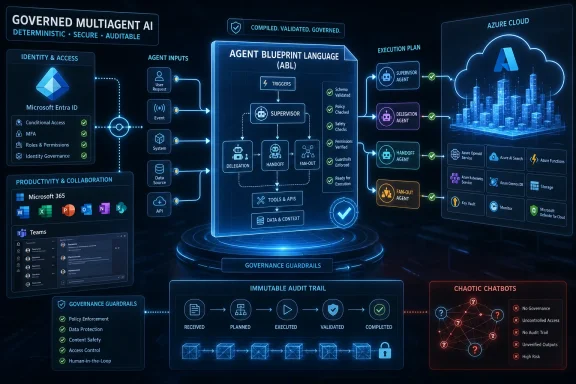 Kore.ai Is Selling Discipline, Not Magic
The most important word in the Artemis announcement is not “agentic.” It is “compiled.”That may sound like a developer’s detail, but it points to the deeper wager behind Kore.ai’s new platform. The company is trying to turn agent construction from a messy mix of prompts, glue code, API calls, and hope into something closer to software engineering. Artemis introduces Agent Blueprint Language, or ABL, as a declarative way to define agents, workflows, orchestration patterns, and governance rules before anything reaches production.
That framing matters because enterprise AI has been stuck between two uncomfortable poles. On one side are demos that look astonishing in conference keynotes. On the other are security reviews, audit trails, exception handling, data residency requirements, identity boundaries, and angry business owners when an automation makes the wrong decision at scale.
Artemis is Kore.ai’s answer to that gap. It promises to let enterprises describe what they want in business language, have an AI architect generate the underlying agent design, and then govern the result through a deterministic platform layer. The sales pitch is speed, but the strategic pitch is control.
The Agent Boom Has Reached Its Middleware Moment
Every software cycle eventually discovers middleware. The PC had drivers and management tools. The web had application servers and identity layers. Cloud computing had orchestration, observability, and policy engines. AI agents are now arriving at the same inflection point.For the last two years, the agent conversation has been dominated by capability: whether models can plan, call tools, execute multistep tasks, and coordinate with other agents. That was a necessary phase, but it was never sufficient for enterprises. A bank, insurer, hospital, retailer, or government contractor does not merely ask whether an AI agent can complete a task. It asks who authorized it, what data it touched, what policy constrained it, what happened when the first tool call failed, and whether the whole episode can be reconstructed six months later.
Kore.ai is positioning Artemis as the layer where those questions are answered before deployment rather than after an incident. The platform’s six orchestration patterns — supervisor, delegation, handoff, fan-out, escalation, and agent-to-agent federation — read like a catalog of the failure modes enterprises already fear. Someone must be in charge. Work must be delegated cleanly. Control must pass between systems without vanishing. Parallel actions must be reconciled. Risky events must escalate. Agents must talk to one another without becoming an ungoverned swarm.
That is the real market Kore.ai is chasing. Not “AI that can do things,” but AI that can be allowed to do things.
Azure Gets the First Cut Because the Enterprise Runs on Identity
Kore.ai’s decision to launch Artemis first on Microsoft Azure is not incidental. It is a recognition of where enterprise AI will be operationalized. If agents are going to act inside organizations, they need to live near identity, messaging, documents, workflow systems, security logs, and administrative controls.Microsoft has spent the past year turning that adjacency into a platform argument. Foundry Agent Service gives developers a managed environment for building and deploying agents. Microsoft 365 Copilot and Teams provide the daily user interface for knowledge workers. Entra ID supplies identity and access control. Microsoft Graph provides the connective tissue into mail, calendars, files, chats, users, and organizational context. Agent 365 is Microsoft’s attempt to make agents discoverable, manageable, and governed across that estate.
Kore.ai is plugging Artemis into precisely that stack. The company says the platform integrates with Microsoft Foundry, Microsoft Agent 365, Entra ID, Microsoft Graph API, and Teams through Azure Bot Framework. That makes the Azure-first launch less a cloud hosting choice than a distribution and governance strategy.
For WindowsForum readers, the Microsoft angle is the practical one. The future of enterprise AI may be model-agnostic in theory, but the first serious deployments will often be Microsoft-adjacent in practice. Agents will surface in Teams, act on Microsoft 365 data, authenticate through Entra, and be reviewed by administrators already living in Microsoft’s security and compliance portals.
This is also why the partnership is a double-edged sword. Kore.ai wants to present Artemis as model-independent and ultimately cloud-flexible. But the first launch partner shapes the early center of gravity. The tighter Artemis becomes with Microsoft’s agent ecosystem, the more attractive it becomes to Microsoft-standardized enterprises — and the more carefully customers will need to evaluate how portable their agent designs really are.
ABL Is a Bet That Prompts Are Not Enough
The most technically interesting part of Artemis is Agent Blueprint Language. Kore.ai describes ABL as a compiled, declarative language for defining, validating, and governing agents, systems, and workflows. In plain English, Kore.ai wants the agent’s intended behavior to be expressed as a reviewable artifact, not scattered across prompts, plugins, custom scripts, and undocumented runtime decisions.That is a meaningful distinction. Prompt-driven development has been useful because it is fast, flexible, and accessible to people who do not think of themselves as programmers. It has also been fragile. Prompts drift, tool behavior changes, model upgrades alter response patterns, and one team’s clever workaround becomes another team’s compliance problem.
A compiled blueprint suggests a different discipline. The organization can inspect what an agent is supposed to do. The platform can validate whether the design conforms to policy. Governance can be applied to the structure of the workflow, not merely to the model’s answer. Operations teams can observe production traces against a known design rather than reverse-engineering behavior from logs.
This does not eliminate uncertainty. Large language models remain probabilistic systems, and no declarative layer magically turns open-ended reasoning into traditional deterministic software. But it does move the boundary. Instead of asking a model to improvise every part of a process, Artemis appears designed to constrain where improvisation happens and where fixed flow control takes over.
That is why Kore.ai’s “dual-brain” architecture is more than marketing garnish. The company says Artemis combines agentic reasoning with deterministic flows, operating in parallel through shared memory and governed by one runtime. If that works as advertised, it gives enterprises a way to use generative AI where judgment and language matter, while preserving conventional workflow controls where predictability matters more.
The AI Architect Is the Most Ambitious — and Riskiest — Claim
Arch, Kore.ai’s AI agent architect, is the feature that will attract the most attention and probably the most skepticism. The company says Arch can translate business objectives into production-ready ABL, design agent topologies, support the full lifecycle, and continuously refine agents using real-world production traces.In other words, Kore.ai is not merely offering a platform for building agents. It is offering AI that helps build the agents, govern them, and optimize them over time. The company’s own formulation is blunt: AI building AI, AI governing AI, AI optimizing AI.
There is a powerful business case here. Enterprise software backlogs are full of workflow automations that never get built because bespoke engineering is too expensive. If Arch can take a plain-language objective, generate a reviewable blueprint, validate it against policy, and produce something close to production-ready, the economics of automation change. The marginal cost of the next agent falls because the shared runtime, patterns, governance controls, and integration fabric are already in place.
But this is also where customers should slow down. “AI-generated” does not mean “risk-free,” and “reviewable” does not mean “reviewed.” The strongest version of the Artemis story depends on human oversight remaining meaningful rather than ceremonial. If Arch proposes changes from production traces, someone still needs to understand whether those optimizations improve the business process, degrade compliance posture, or simply overfit to yesterday’s workload.
The long-term question is whether enterprises can build a reliable approval pipeline around AI-generated agent designs. That pipeline will need product owners, security teams, compliance officers, platform engineers, and business process experts. If Artemis reduces hand-coding but increases governance complexity, the productivity gain will depend on whether organizations redesign their operating model, not just whether they buy the platform.
Governance Becomes the Product Feature Buyers Actually Understand
Kore.ai’s announcement is packed with capability claims, but the clearest buyer-facing message is governance. That is not an accident. The enterprise AI market has learned that the easiest pilot to fund is not always the easiest system to approve.CIOs want consolidation because many organizations already have agent sprawl: experiments in business units, vendor-provided assistants in SaaS tools, custom bots built by innovation teams, and shadow automations wired into internal data. CISOs want enforceable controls because an agent that can read documents, call APIs, and send messages is not just a productivity tool. It is a new actor inside the enterprise. CFOs want reuse because the economics of AI become ugly if every use case requires separate infrastructure, security review, model tuning, and support.
Artemis speaks to all three constituencies. It promises one foundation for multiple agents, governance outside the model’s control, traceability for decisions and policy enforcement, and shared infrastructure that makes later agents cheaper to create than the first. The argument is elegant: if enterprises are going to deploy hundreds or thousands of agents, they need an agent platform, not a collection of disconnected assistants.
The danger is that governance language can become a comfort blanket. Certifications, audit trails, and policy engines are necessary, but they do not automatically prove that a given agent is safe for a given business process. Real governance is contextual. A workflow that is acceptable for triaging HR requests may be unacceptable for approving credit exceptions, changing patient records, or modifying production infrastructure.
That is where Artemis will need to prove itself in customer deployments. The platform can provide the scaffolding, but enterprises still have to define the rules, assign accountability, test edge cases, and decide which decisions remain human-owned.
Microsoft’s Agent Strategy Gives Kore.ai Reach — and Competition
The Microsoft partnership gives Kore.ai immediate credibility and reach, but it also places Artemis inside one of the most competitive zones in enterprise technology. Microsoft is not merely a channel partner in the agent market. It is a platform vendor with its own agent-building tools, its own developer frameworks, its own Copilot strategy, and its own ambitions to manage agent identity and lifecycle.That creates an interesting tension. Kore.ai benefits from Azure’s infrastructure, Microsoft 365’s surface area, and the familiarity of Entra-backed administration. At the same time, Microsoft’s own agent stack will keep expanding. Customers will ask when to use Kore.ai, when to use Microsoft-native tools, when to use Salesforce or ServiceNow agents, and when to build directly on model-provider APIs.
Kore.ai’s answer appears to be specialization and neutrality. Artemis is pitched as model-independent, architected for multiagent orchestration, and designed from a decade of enterprise conversational AI deployments. That history matters. Kore.ai was not born in the current agent gold rush; it has long sold automation and AI systems into customer service, employee support, banking, healthcare, retail, and other regulated environments.
Still, neutrality is difficult to maintain when go-to-market motion flows through a dominant ecosystem. If Artemis is best on Azure, most visible through Microsoft 365, and deeply integrated with Microsoft’s agent management layer, customers will reasonably treat it as part of a Microsoft-centric architecture. That is not necessarily bad. For many Global 2000 organizations, that is exactly the point.
The Compliance Pitch Is Aimed Squarely at Regulated Buyers
Kore.ai’s compliance checklist is deliberately extensive. The company says Artemis meets requirements including SOC 2 Type II, ISO 27001, PCI DSS certification, FedRAMP Moderate authorization, HIPAA alignment, HITRUST and GDPR compliance, plus real-time PII tokenization, tenant isolation, immutable audit trails, data residency options, and deployment across public cloud, sovereign regions, private cloud, and on-premises environments.That list is not decorative. It tells us who Kore.ai thinks will buy first: organizations that already know why ungoverned AI is a problem. In banking, healthcare, insurance, telecom, retail, and public-sector-adjacent industries, the path from AI demo to production often dies in risk review. A platform that arrives with compliance primitives baked in has a better chance of surviving procurement.
The FedRAMP claim is particularly relevant for U.S. public sector and government-adjacent buyers, while PCI DSS and HIPAA alignment speak to industries where AI agents will inevitably touch sensitive financial or health-related workflows. The promise of immutable audit trails is similarly important because it acknowledges a simple reality: if an agent takes action, the organization must be able to reconstruct that action later.
But compliance claims also require careful reading. A platform’s certification does not automatically certify every agent a customer builds on top of it. Data flows, integrations, retention policies, access controls, prompt content, and downstream systems can all change the compliance picture. Artemis may lower the barrier, but it does not remove the responsibility.
The Real Test Is Production Drift
Kore.ai’s emphasis on production traces is one of the more grounded parts of the Artemis story. Enterprise AI systems do not fail only at launch. They drift. Business policies change, APIs evolve, user behavior shifts, models are upgraded, and edge cases accumulate.Traditional software teams have learned to manage this with testing, monitoring, versioning, rollback, change control, and incident response. Agentic AI needs the same discipline, with the added complication that the system may reason differently across contexts. Observability is therefore not a luxury feature. It is the difference between a controllable automation and an expensive black box.
Artemis claims to log, trace, and analyze every decision, path, and outcome in real time. If that is implemented well, it gives enterprises a fighting chance at operational AI management. Security teams can investigate anomalous behavior. Developers can see where workflows break. Business owners can compare outcomes against intent. Compliance teams can map actions to policy controls.
The harder question is how much of that observability will be intelligible to non-specialists. Logs are only useful when someone can interpret them. Traces are only valuable when they connect technical behavior to business consequence. If Artemis can make agent behavior legible to CIOs, CISOs, auditors, and process owners, it will have something more durable than another builder interface.
The Platform War Is Moving Above the Model Layer
The Artemis launch reinforces a larger shift in AI strategy. The model is no longer the whole story. In 2023 and 2024, many organizations treated model choice as the main event. Which model was smartest? Which one had the best context window? Which one reasoned better, wrote better, coded better, or cost less?Those questions still matter, but the enterprise platform battle is moving upward. Customers want model flexibility because today’s best model may not be tomorrow’s best model. They want policy enforcement that survives model swaps. They want integrations that do not need to be rebuilt every quarter. They want agent definitions that can be reviewed, versioned, and governed independently of the latest benchmark race.
Kore.ai’s model-independent claim should be read in that light. If Artemis can let enterprises define agent behavior once and run it across multiple model providers, that becomes a hedge against vendor lock-in at the model layer. It also gives Kore.ai a way to compete with hyperscalers without pretending to outspend them on frontier model training.
The irony is that model independence may become most valuable inside a cloud-dependent deployment. A company standardized on Azure may still want freedom to use OpenAI, Azure OpenAI, Anthropic, Gemini, or future models depending on cost, latency, region, capability, and regulatory constraints. The agent platform becomes the abstraction layer where those decisions can change without rewriting the business process.
Windows Shops Should Watch the Teams and Graph Surface
For IT pros in Microsoft-heavy environments, Artemis is worth watching less as a standalone AI product and more as a possible new workload class inside the Microsoft estate. If agents become accessible through Teams, grounded in Microsoft 365 data, governed through Entra-linked identity, and published through Microsoft’s agent ecosystem, they will quickly become part of the same operational world as endpoints, apps, identities, and collaboration policies.That means administrators will need to ask familiar questions in unfamiliar form. Which agents can act on behalf of which users? What scopes do they have in Microsoft Graph? Can they send messages, create tickets, update records, retrieve sensitive files, or trigger external workflows? How are agent permissions reviewed when employees change roles or leave the company?
The Teams channel is especially important because user experience often determines adoption. Employees do not want to learn a separate portal for every AI tool. If Artemis-backed agents appear inside Teams and Microsoft 365 workflows, they inherit the convenience — and the risk — of being close to where work already happens.
This is where agent governance will intersect with everyday Windows and Microsoft 365 administration. The next wave of IT tickets may not be about installing software or resetting passwords. They may be about why an agent cannot access a SharePoint library, why it escalated a request to the wrong team, why it used stale CRM data, or why its policy prevented an action the business expected it to take.
The Fine Print Behind the “Days Instead of Months” Promise
Kore.ai says Artemis can compress delivery of production-ready multiagent AI systems from months to days. That is the kind of claim that gets executives interested and practitioners cautious.There are good reasons to believe time-to-value can improve. Reusable orchestration patterns, prebuilt integrations, declarative blueprints, AI-assisted architecture, and shared governance controls should reduce repetitive engineering. If an organization has common workflows across departments — intake, triage, routing, escalation, summarization, data lookup, case creation — a platform approach can compound quickly.
But “days instead of months” is not the same as “no work required.” The difficult parts of enterprise automation often live outside the tool. Data quality must be assessed. Integration permissions must be granted. Business exceptions must be documented. Compliance teams must agree on acceptable automation boundaries. Users must be trained. Support teams must know what to do when the agent is wrong.
The more consequential the workflow, the more these non-coding tasks matter. An agent that summarizes public product documentation can move fast. An agent that touches claims adjudication, employee records, clinical workflows, payment processes, or production infrastructure should not.
The better reading of Kore.ai’s promise is that Artemis may reduce the engineering bottleneck. It does not eliminate organizational bottlenecks, and responsible customers should not want it to.
The Enterprise Agent Market Is Starting to Look Like ERP in Fast Motion
There is a familiar pattern emerging. First, individual teams adopt tools. Then organizations realize those tools touch shared data and business-critical processes. Then governance, integration, reporting, and lifecycle management become more important than the original feature set. Eventually, the market consolidates around platforms.Enterprise agents are moving through that arc at uncomfortable speed. Salesforce wants agents tied to CRM and customer workflows. ServiceNow wants agents around IT and business service management. Microsoft wants agents embedded in work and governed through its cloud. Google, AWS, OpenAI, Anthropic, and others are all building their own layers of agent infrastructure. Kore.ai is trying to occupy the cross-enterprise orchestration and governance lane.
That lane is plausible because many organizations do not live inside one application vendor’s universe. A customer support process may touch Microsoft 365, Salesforce, ServiceNow, custom internal systems, payments, identity, document repositories, and industry-specific platforms. An agent platform that can orchestrate across those systems has a credible role, particularly if it can satisfy security and compliance requirements.
The challenge is differentiation. Every vendor now claims governance, observability, integrations, and enterprise readiness. Kore.ai will need to show not just that Artemis has the right vocabulary, but that its blueprint language, AI architect, dual-brain runtime, and production trace loop produce better outcomes than stitching together native tools from Microsoft and other platform vendors.
The Buyer’s Checklist Is Already Taking Shape
Artemis is not a consumer AI story, and it should not be judged like one. The relevant question is not whether it can impress a user in a five-minute demo. The relevant question is whether it can survive the ugly middle of enterprise adoption: procurement, security review, integration, pilot expansion, audit, user training, incident response, and cost management.The concrete signals to watch are not hard to identify.
- Enterprises should test whether ABL blueprints are genuinely understandable and reviewable by both technical teams and process owners.
- Security teams should verify that governance is enforced outside the model and cannot be bypassed by prompt behavior or tool-calling shortcuts.
- Microsoft 365 administrators should examine how Artemis-backed agents interact with Entra ID, Graph permissions, Teams, Copilot, and Agent 365 discovery.
- Compliance teams should distinguish between Kore.ai’s platform certifications and the compliance status of each customer-built agent workflow.
- Finance leaders should measure whether reuse actually lowers the cost of later agents, rather than merely shifting cost into platform licensing and governance labor.
- Operations teams should demand clear evidence that production traces, rollback, versioning, and optimization recommendations are usable during real incidents.
References
- Primary source: SMEStreet
Published: Sat, 23 May 2026 12:17:37 GMT

Kore.ai Launches AI-Native Agent Platform Artemis
Kore.ai launched the Artemis edition of its AI-native Agent Platform on Microsoft Azure, enabling enterprises to build and govern multiagent AI systems. Technology For SMEs | IoT & AI smestreet.in
- Related coverage: businesswire.com
- Related coverage: kore.ai
- Related coverage: venturebeat.com
- Official source: learn.microsoft.com

Agent applications in Microsoft Foundry - Microsoft Foundry
Learn about agent applications in Microsoft Foundry, configure authentication and permissions, and use a stable endpoint to invoke your agent.learn.microsoft.com - Related coverage: docs.kore.ai

Get Started - Kore.ai Docs
 docs.kore.ai


- Related coverage: itbrief.news
- Related coverage: vktr.com
Kore.ai Launches Artemis, the New Generation of the Kore.ai Agent Platform
Agent Blueprint Language (ABL) compounds returns and compresses agent delivery from months to days.www.vktr.com
- Official source: azure.microsoft.com
Foundry Agent Service | Microsoft Azure
Use Foundry Agent Service to design, deploy, and scale AI agents securely. Create enterprise-grade AI agents to automate complex business processes.azure.microsoft.com
- Related coverage: newsroom.workday.com
- Official source: cdn-dynmedia-1.microsoft.com
- Related coverage: ir.korewireless.com
