

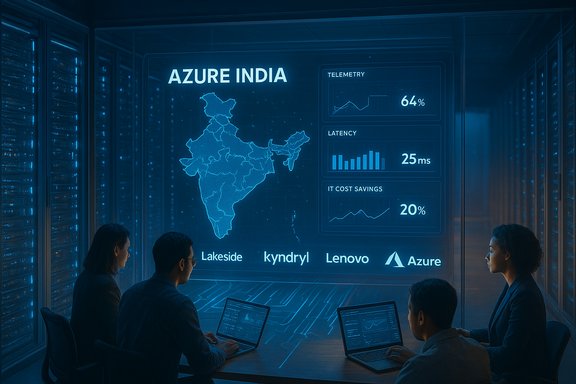
Lakeside Software’s announcement that SysTrack Cloud now has a dedicated Azure region in India signals a clear push to meet latency, compliance, and scalability demands for Digital Employee Experience (DEX) tooling in one of the world’s fastest-growing cloud markets. The company framed the launch as a response to customer demand for in‑country telemetry processing, lower latency, and easier scaling for enterprise DEX workloads, and the region is presented as immediately available for SysTrack Cloud customers.
Lakeside Software builds SysTrack, an AI‑driven Digital Employee Experience platform that collects endpoint telemetry, analyzes performance, and triggers remediation to reduce friction and IT costs. The company’s press materials position SysTrack as Azure‑native and highlight partner endorsements from Kyndryl, Lenovo, and SPNX that emphasize locality, reduced time‑to‑isolate issues, and compliance benefits for Indian customers. Those partner perspectives and the core announcement are captured in the company release. Microsoft’s ongoing investment in India — reported externally as a roughly US$3 billion commitment to expand Azure cloud and AI infrastructure in the country — provides the hyperscale capacity that vendors such as Lakeside can leverage to host regulated or latency‑sensitive workloads onshore. Independent reporting confirms the scale and strategic intent of Microsoft’s investment in India. At the same time, third‑party research cited by Lakeside — a Zoho Workplace survey showing 71% of Indian employees are at advanced digital maturity levels versus a global average of roughly 61% — helps explain market readiness for richer DEX tooling that surfaces user‑impacting issues and enables proactive remediation. Multiple outlets reporting on Zoho’s survey reproduce that 71% figure.
However, the headline benefits must be validated empirically. Critical next steps for buyers are straightforward: insist on technical confirmation of region details and service parity, demand a signed data flow diagram and contractual controls for access and key management, and run a controlled pilot to measure the promised operational improvements. Vendor ROI claims (for example, the 20% IT cost reduction figure) should be treated as directional until reproduced in your environment. When executed with the right due diligence, a local SysTrack region in Azure India can be a meaningful lever to improve employee experience, reduce friction, and lower certain operational costs — but success depends on careful technical validation, contractual rigor, and measured pilots that translate vendor promises into tangible outcomes.
Source: GlobeNewswire Lakeside Software Expands Global Footprint with New SysTrack Cloud Region in Azure India
 Background / Overview
Lakeside Software builds SysTrack, an AI‑driven Digital Employee Experience platform that collects endpoint telemetry, analyzes performance, and triggers remediation to reduce friction and IT costs. The company’s press materials position SysTrack as Azure‑native and highlight partner endorsements from Kyndryl, Lenovo, and SPNX that emphasize locality, reduced time‑to‑isolate issues, and compliance benefits for Indian customers. Those partner perspectives and the core announcement are captured in the company release. Microsoft’s ongoing investment in India — reported externally as a roughly US$3 billion commitment to expand Azure cloud and AI infrastructure in the country — provides the hyperscale capacity that vendors such as Lakeside can leverage to host regulated or latency‑sensitive workloads onshore. Independent reporting confirms the scale and strategic intent of Microsoft’s investment in India. At the same time, third‑party research cited by Lakeside — a Zoho Workplace survey showing 71% of Indian employees are at advanced digital maturity levels versus a global average of roughly 61% — helps explain market readiness for richer DEX tooling that surfaces user‑impacting issues and enables proactive remediation. Multiple outlets reporting on Zoho’s survey reproduce that 71% figure. What Lakeside announced — the essentials
- Lakeside now offers a SysTrack Cloud region in Microsoft Azure’s India footprint, available to all SysTrack Cloud customers immediately.
- The vendor markets the move as enabling lower latency, stronger data residency controls, and simplified scaling for enterprises in India and neighboring markets.
- Lakeside’s collateral reiterates a marketing figure that SysTrack can contribute to around 20% savings on annual IT costs per employee, a vendor claim that appears across Lakeside press and marketing pages. This figure is not independently audited in public documents and should be validated during procurement and pilot evaluation.
Why this matters now
Three intersecting market forces make an India‑region for a DEX platform strategically relevant:- Latency-sensitive operational workflows. DEX telemetry ingestion and interactive remediation workflows benefit materially when ingestion, analytics, and remediation endpoints are physically closer to end users. This reduces round‑trip times for agent‑server interactions and improves time‑to‑diagnose for live incidents.
- Data residency and compliance pressure. Many Indian enterprises and public sector bodies increasingly prefer or require telemetry and analytics to remain in country. While regional hosting alone is not a legal panacea, it is often a procurement gating factor and eases negotiations on data handling. Lakeside’s region gives customers the architectural option to keep telemetry in India.
- Hyperscaler capacity growth in India. Microsoft’s investment and Azure’s expanding India footprint mean vendors can rely on local availability zones and on‑ramps (ExpressRoute/Direct Peering) that improve predictability and throughput for enterprise telemetry flows. Independent reporting of Microsoft’s multi‑billion commitment supports the reality of increasing local cloud capacity.
Technical verification: what’s confirmed and what to validate
What can be verified quickly
- The Lakeside announcement and partner quotes are publicly available through the company’s press release distribution and corporate site. The release explicitly names Kyndryl, Lenovo and SPNX as endorsers of the India expansion.
- Zoho’s workplace survey and the 71% advanced maturity figure are reported across mainstream Indian and trade outlets. That statistic is attributable to Zoho’s Workplace research and appears consistently in coverage.
- Microsoft’s increased capital and capacity investment in India (the widely reported ~US$3 billion commitment to grow Azure cloud and AI infrastructure in India) is documented by major news organizations and Microsoft statements. This underscores why vendors are enabling India‑region deployments now.
Items that require direct confirmation before migration
When planning any production or regulated deployment, IT teams should validate the following with Lakeside and Microsoft account teams:- Exact region name and physical locality: Confirm the specific Azure region (for example, Central India, South India, West India or another named region) used by Lakeside for SysTrack Cloud in India and whether it will be supported in multiple Indian regions. Azure maintains detailed region lists and service parity varies by region; confirm the programmatic region name to map to your cloud governance. Microsoft’s documentation provides an authoritative region list and availability‑zone support.
- Availability Zone topology and supported SKUs: Ask Lakeside and Microsoft which Availability Zones are available in the region and whether the specific Azure VM SKUs, managed services (Azure SQL/Blob, Cosmos, Managed Disks), and GPU SKUs used by SysTrack are available. New regions often add services in phases; do not assume instant parity with older regions.
- Data flow diagrams and operational controls: Request a precise, signed data‑flow diagram showing where telemetry is collected, where it is processed (in‑region versus global), and where backups or disaster recovery replicas are stored. Insist on documented controls for encryption keys, separation of duties, and any cross‑border failover events. Lakeside’s marketing statements do not substitute for contractual commitments.
- Support access and personnel locality: Clarify whether operational support personnel, engineers who may access logs or live sessions, are permitted to access telemetry only from in‑country locations or whether support can cross borders under documented procedures. In‑region hosting reduces procurement friction but does not automatically control personnel access unless contractually bound.
- SLA and exception policy: Obtain the service‑level agreement for the India region (uptime, incident response timelines) and a clear exception policy that describes cross‑region routing in capacity or disaster events.
How an India region affects DEX architecture — practical implications
Performance and operational benefits
- Faster telemetry ingestion and dashboard refresh for local users, which improves real‑time troubleshooting and reduces Mean Time To Detection (MTTD) and Mean Time To Resolution (MTTR).
- Lower cross‑region egress costs for telemetry flows when data remains in a local region.
- Better interactive latency for live remote sessions and agent‑driven remediation actions due to shorter network hops.
Compliance and procurement benefits
- Easier procurement for regulated customers that specify in‑country hosting.
- Improved posture for audits that examine where telemetry is stored and where analysis occurs.
- Simpler contractual language for data residency when telemetry at rest can be demonstrably kept within India.
Operational trade‑offs
- Fragmentation: Multi‑region vendor footprints can increase operational complexity (additional subscriptions, cross‑region monitoring, more complex disaster recovery tests).
- Feature parity risk: Newer regions may arrive with a subset of Azure services or delayed GPU/VM SKU availability — confirm before shifting production workloads.
Critical analysis — strengths, opportunities, and risks
Strengths
- Locality is tangible: For many interactive DEX scenarios (real‑time diagnostics, agent actions), measured latency improvements are real and meaningful. Deploying SysTrack nearer endpoints is likely to produce faster remediation cycles and improve helpdesk efficiency.
- Procurement and ecosystem leverage: Lakeside’s channel-focused quotes from Kyndryl, Lenovo, and SPNX indicate a partner strategy that can accelerate deployments and managed‑service offerings. Partners with deep local operations help translate capability into measurable outcomes and reduce deployment friction.
- Market timing: India’s growing digital maturity and Microsoft’s expanded Azure footprint together reduce barriers to adoption for cloud‑hosted DEX solutions. External reporting on Microsoft’s investment and regional expansion aligns with Lakeside’s timing.
Opportunities
- Localized AI-driven insights: With telemetry collected in‑country, AI models for operational insights can run closer to the data, improving inference time and making near‑real‑time automation and proactive remediation more feasible.
- MSP and channel monetization: Managed Service Providers can use the in‑region offering to offer DEX‑as‑a‑service with Indian residency guarantees—this opens a route to recurring revenue that is attractive to domestic procurement teams.
Risks and caveats
- Vendor ROI claims need proof: Lakeside’s frequently repeated figure of “save 20% on annual IT costs per employee” is a vendor‑provided metric shown in corporate collateral. It’s plausible in many environments, but buyers should insist on concrete case studies, the underlying methodology, and pilot results before baking this into procurement decisions. This claim is best treated as directional until validated with customer‑specific baselines.
- Data residency is complex: Hosting data in an Indian Azure region reduces cross‑border transfer, but it does not eliminate legal nuances such as lawful access requests, encryption key locality, or contractual audit rights. Regional hosting is necessary but not always sufficient to meet sovereign or sectoral requirements; contractual and operational controls determine the true legal posture.
- Service parity and capacity caveats: New or expanded Azure regions often roll out services in stages; some VM families, managed services, or GPU SKUs required for advanced analytics or AI may arrive later. Confirm service availability and capacity guarantees for the exact region Lakeside uses. Microsoft’s region list and service parity guidance should be consulted for precise inventories.
Practical due diligence checklist for IT teams (quick hit)
- Request a signed data flow diagram from Lakeside showing collection, processing, storage, backup, and cross‑region replication points.
- Confirm the exact Azure programmatic region name and its Availability Zone count and supported SKUs.
- Validate where encryption keys are held (Azure Key Vault, customer‑managed keys, HSM locality) and whether keys remain in India per contractual terms.
- Insist on documented support access controls and pen‑test/SOC reports for the India region.
- Run a latency pilot from representative user sites (offices, remote locations, mobile) to the new region to measure MTTD/MTTR delta.
- Model costs (storage, compute, egress, support) with the India region in place and include potential cross‑region failover costs.
A 90‑day tactical rollout plan for pilots and validation
- Day 0–15: Procurement & compliance mapping
- Map regulatory obligations (data residency, sectoral rules).
- Open Microsoft and Lakeside technical workshops; request region‑specific documentation and SLAs.
- Day 15–45: Pilot planning & network prep
- Configure low‑latency paths (ExpressRoute or direct peering) where needed.
- Select pilot cohorts representing typical device types, app mixes, and remote connectivity scenarios.
- Day 45–75: Pilot execution & measurement
- Route SysTrack agents to the India region and run ingestion/latency/baselining tests.
- Measure MTTD, MTTR, dashboard refresh times, ticket volumes and agent‑action latencies.
- Day 75–90: Review, contract negotiation & phasing
- Validate pilot KPIs against promised savings and operational improvements.
- Negotiate contractual clauses for key handling, support access, and exception handling.
- Plan phased roll‑out and runbook hand‑offs to partners or MSPs.
Vendor claims and how to probe them
- When a vendor claims a percent reduction in IT costs per employee, ask for:
- The methodology used to compute savings (assumptions on ticket volumes, labor rates, remediation automation).
- Customer references where the vendor reproduced those numbers in a comparable environment.
- Access to anonymized pilot data or a joint proof‑of‑value phase with defined KPIs.
- For claims about “in‑country processing”: obtain explicit, auditable evidence that backups, analytics, and support access align with your legal/regulatory posture, not just a region label. Contractual language and technical controls (key locality, access logging, role-based access) are the decisive controls.
Broader market context: why hyperscalers and DEX vendors are converging on India
Microsoft’s expanded cloud investment and regional build‑out across Asia are reducing friction for ISVs to offer localized instances of their platforms. Hyperscaler region launches — and the multi‑billion‑dollar investments backing them — create both the technical capacity and the procurement narrative that make regional hosting commercially and operationally feasible. For DEX solutions specifically, this adds an important lever: the ability to place telemetry and analytics closer to users without building bespoke local data centers. Zoho’s survey results indicating elevated digital maturity in India further strengthen the business case: Indian organizations increasingly operate at a level of process and tooling maturity where advanced DEX tooling delivers measurable value, because user expectations and digital workflows are already at a high baseline. This combination of hyperscaler capacity and market readiness helps explain why Lakeside and its partners are investing in India now.Final verdict for decision makers
Lakeside’s launch of a SysTrack Cloud region in Azure India is a pragmatic and timely move. For Indian enterprise customers and regional teams of global organizations, the offering can reduce latency, help meet procurement expectations for in‑country hosting, and accelerate DEX initiatives when paired with local partners. Partner endorsements in the release reinforce a channel path for managed or co‑managed rollouts.However, the headline benefits must be validated empirically. Critical next steps for buyers are straightforward: insist on technical confirmation of region details and service parity, demand a signed data flow diagram and contractual controls for access and key management, and run a controlled pilot to measure the promised operational improvements. Vendor ROI claims (for example, the 20% IT cost reduction figure) should be treated as directional until reproduced in your environment. When executed with the right due diligence, a local SysTrack region in Azure India can be a meaningful lever to improve employee experience, reduce friction, and lower certain operational costs — but success depends on careful technical validation, contractual rigor, and measured pilots that translate vendor promises into tangible outcomes.
Quick reference: authoritative items checked during reporting
- Lakeside’s official press release announcing SysTrack Cloud in Azure India.
- Microsoft’s announced multi‑billion investment and capacity expansion in India.
- Zoho Workplace survey reporting 71% of Indian employees at advanced digital maturity levels (Zoho survey coverage).
- Azure region lists and availability‑zone guidance from Microsoft documentation and independent region trackers to confirm service parity caveats.
Source: GlobeNewswire Lakeside Software Expands Global Footprint with New SysTrack Cloud Region in Azure India
