Lancashire County Council is using Microsoft 365 Copilot and related AI tools in 2026 to help social workers turn spoken visit notes and case material into structured documentation, with the council estimating that targeted use cases could release at least 225,000 staff hours a year. The claim matters because it places generative AI not in the usual productivity theater of inbox summaries and meeting recaps, but in one of government’s most sensitive human workflows. If the council’s approach holds up, the lesson is not that AI can “do social work.” It is that social work has been made less human by administrative drag, and AI may be useful precisely where it gets out of the way.
The most revealing line in Lancashire County Council’s account is not about a model, a license, or a Microsoft product name. It is the statement from frontline staff that paperwork has long stood between practitioners and the people they support. That is a mundane complaint, but in social care it is not a minor operational inconvenience; it changes the texture of the service.
Social workers are asked to operate in the most complex territory local government touches: crisis, mental health, family conflict, disability, safeguarding, special educational needs, poverty, and the brittle edges of statutory intervention. The work depends on trust, memory, judgment, and the ability to hear what is not being said. Yet the institutional machinery around that work often demands that every conversation be translated into a formal record, every visit become a case note, and every case note fit a template designed for compliance, audit, and handover.
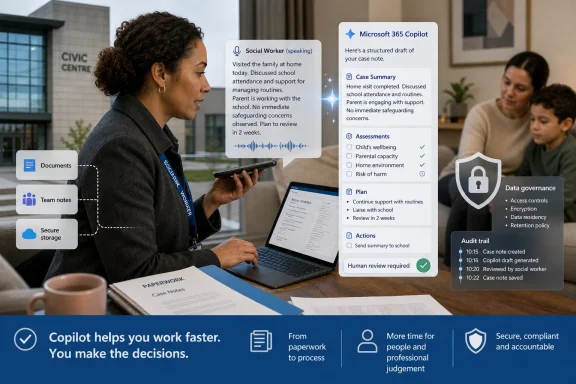
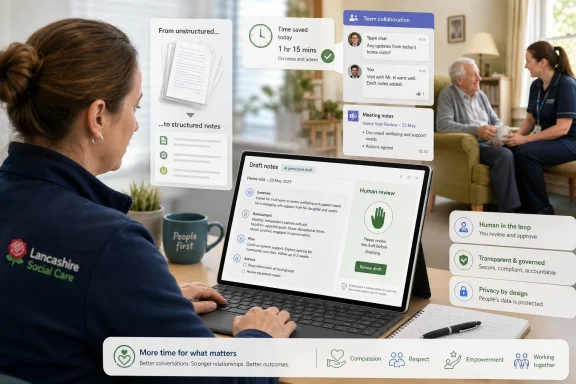
Lancashire’s argument is that generative AI can compress that translation step. A practitioner can capture a spoken account using Microsoft Teams or Facilitator on a phone, then use Microsoft 365 Copilot to turn that material into structured notes or draft documentation. The worker still owns the record, reviews the output, and makes the professional decisions. But the first pass no longer begins with a blank screen after a difficult visit.
That distinction is the whole story. The council is not presenting AI as a substitute social worker, decision-maker, or safeguarding authority. It is presenting AI as an administrative prosthetic for a profession drowning in documentation. In public services, that is a less glamorous pitch than “AI transformation,” but it is also a more credible one.
The modern social worker is part practitioner, part coordinator, part compliance writer, part system navigator. A visit may begin with a human conversation, but it rarely ends there. Notes must be captured, formalized, checked, categorized, sometimes duplicated, and often rewritten for different audiences and systems.
Chris Hayes, a Performance Quality Review Officer at Lancashire, describes the familiar pattern: staff take notes during a visit, then return to the office to write the same information again in the required format. Even when that repetition is necessary for auditability or safeguarding, it eats into the time available for contact with families and individuals. If an hour is allocated to a family, the meaningful face-to-face portion can be squeezed by the invisible work around it.
This is where AI’s value proposition becomes less speculative. Generative tools are not always good at truth. They are, however, often good at reorganizing language, summarizing material, matching a format, and turning rough input into something a professional can inspect. In a workflow built around converting lived complexity into structured records, that capability is not trivial.
The risk, of course, is that the system starts treating the polished draft as the truth. Lancashire’s public framing insists that practitioners remain responsible for review and judgment, and that is not just a governance nicety. It is the line between a useful tool and a dangerous one.
The council says it has rolled out Copilot to thousands of staff, with roughly two-thirds of the workforce actively using AI tools through a mix of free and paid licenses. Lancashire’s own news operation has put the supported user figure at more than 6,500 staff, around 68 percent of the workforce. The headline number is the estimate of more than 200,000 hours a year released from routine tasks, with Microsoft’s feature putting the potential annual saving at at least 225,000 hours.
Those numbers should be read carefully. Time saved in a case study is not the same as budget saved, nor is it automatically the same as better care. In public services, “released capacity” can disappear into demand that was already waiting at the door. A social worker who saves two hours on a report may not experience a lighter week; they may see another family sooner, handle a more complex case, or simply reduce unpaid overflow into evenings.
That does not make the saving meaningless. It makes it more politically interesting. The best public-sector AI deployments may not reduce headcount or create clean cashable savings. They may instead expose how much essential work has been hidden inside administrative overload.
For Microsoft, that is a strong sales story. For councils, it is a harder management story. The question is not only whether Copilot can produce a draft faster. It is whether managers protect the saved time for better practice, or quietly convert it into higher throughput.
Peter Lloyd, Lancashire’s Director of Digital, argues that success depended on building solutions with the people using them every day. That is the right instinct, and it is also a quiet rebuke to the old public-sector IT model in which systems were procured, configured, and imposed from above. AI used badly will reproduce that failure at higher speed.
The council says frontline staff in some cases became better prompt writers than digital teams, and even better than Microsoft. That line will sound cute in a vendor story, but it points to a real principle: the people closest to the work often understand the structure of the work better than the people deploying the software. A social worker knows what a good case note must preserve, what language is acceptable, what nuance matters, and what must never be inferred.
That is why the human-in-the-loop language cannot be treated as boilerplate. If the practitioner merely rubber-stamps an AI draft, the tool has become a shadow decision-maker. If the practitioner uses the draft as a scaffold, corrects it, adds context, removes unwarranted assumptions, and applies professional judgment, the tool remains subordinate to the work.
This is also where training becomes less about “how to prompt” and more about professional literacy in AI failure modes. Staff need to know that a fluent paragraph can still be wrong, that missing detail may be as dangerous as invented detail, and that consistency of format is not the same as accuracy of record. In social care, the cost of a bad summary is not embarrassment; it can be a distorted case history.
More consistent documentation can reduce that burden. If a case record is clearer, better structured, and completed closer to the time of the conversation, subsequent practitioners may be less likely to miss context. In theory, that means fewer gaps between teams, fewer repeated assessments, and less emotional labor imposed on families and vulnerable adults.
But this is also where the AI story becomes delicate. Social care records are not neutral transcripts of reality. They are professional artifacts, shaped by what a worker notices, what a person chooses to disclose, what the law requires, and what institutional categories can accommodate. AI may help structure those artifacts, but it can also smooth away uncertainty in ways that make messy situations look falsely settled.
The phrase “strengths-based, person-led support plan” is important here. In social care, language is not decorative. A record that frames someone only through risk, deficit, or non-compliance can shape how future professionals respond to them. A tool that drafts documentation must therefore be tuned not only for grammar and speed, but for the values and statutory duties of the service.
Lancashire’s approach appears to recognize that by keeping review with practitioners and designing around local standards. The real test will come over time, when novelty fades and pressure mounts. Public-sector systems have a way of turning support tools into mandatory productivity levers. If AI-generated drafts become expected at volume, the temptation will be to measure the number of documents produced rather than the quality of the care relationship restored.
Lancashire says AI is being used strictly to support professional judgment in children’s services, with practitioners retaining full responsibility for safeguarding decisions. That is the only defensible position. A model cannot understand family dynamics, cannot weigh credibility like an experienced practitioner, cannot hold statutory accountability, and cannot be cross-examined in any meaningful sense.
Yet the boundary between drafting and deciding is not always clean. A summary chooses what to foreground. A template creates categories. A generated chronology may imply causality where the evidence is thinner. If a practitioner is tired, overloaded, or under managerial pressure, the draft can become more influential than anyone admits.
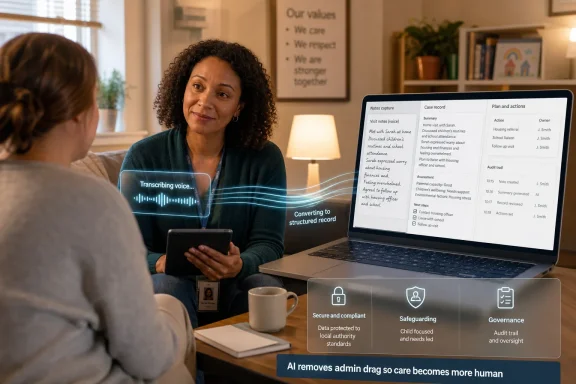
That means councils deploying AI in social care need more than a procurement checklist. They need audit trails, retention policies, data protection reviews, clear labeling of AI-assisted work where appropriate, and professional standards for review. They also need a culture in which staff can reject a bad output without being treated as inefficient.
The technology may reduce administrative burden, but governance adds some burden back. That is not a flaw. In sensitive public services, friction is sometimes a safety feature.
This pattern matters because the public sector gives Microsoft something enterprise marketing often lacks: morally legible use cases. “Copilot helped a consultant summarize a meeting” is useful but forgettable. “Copilot helped a social worker spend more time with a person in crisis” is a much stronger argument.
It is also a politically convenient one. Governments are under pressure to improve services without proportionate increases in staffing or funding. Councils face rising demand in adult social care, children’s services, special educational needs, housing, and customer contact. AI arrives as a promise that capacity can be found inside the existing workforce by stripping out waste.
There is truth in that promise, but it can become dangerous if it substitutes for resourcing. Administrative inefficiency is real. So are workforce shortages, caseload pressure, burnout, and rising complexity of need. AI can help with the paperwork around social care, but it cannot create placements, build relationships with partner agencies, conjure specialist provision, or reduce poverty.
Microsoft’s public-sector AI pitch works best when it is modest. The Lancashire case is compelling because it describes a tool that helps practitioners write up work, not a machine that claims to understand human distress. The more vendors inflate that into a revolution, the more councils should become suspicious.
That makes adoption easier, but it also raises the stakes. When AI is built into the productivity environment, the boundary between ordinary digital work and AI-assisted work becomes harder to see. A Teams meeting, a Word document, an Outlook thread, and a Copilot-generated summary may all become part of the same workflow.
For IT administrators, this is where the Lancashire story turns from inspirational case study into operational homework. Licensing is only the first problem. Admins need to understand data boundaries, tenant configuration, identity, conditional access, retention, sensitivity labels, mobile capture, endpoint management, and user training. In social care, a phone used to capture a spoken account is not just a convenience; it is an endpoint in a sensitive information chain.
The most successful deployments will likely be boring in the best possible way. They will use familiar Microsoft controls, clear policies, approved prompts, careful permissions, and measured rollout. They will avoid a free-for-all in which staff paste sensitive case material into whatever consumer AI tool gives the fastest answer.
That may be Microsoft’s biggest advantage in councils. Not necessarily that Copilot is always the most capable model, but that it sits inside a governance environment IT departments already understand. In public services, the winning AI tool may be the one that can be managed, audited, and constrained.
In social care, the more important question is whether the person receiving support experiences a better service. Do they feel heard? Do they avoid repeating painful histories? Does the plan reflect their strengths and choices? Are risks identified more clearly? Are practitioners less burned out and more present?
Lancashire’s frontline voices suggest that the answer can be yes. Aspden’s account of having more time for in-depth discussion is powerful precisely because it connects operational efficiency to relationship-based practice. The saved time is not just a spreadsheet metric; it changes the conversation in the room.
Still, councils should resist the urge to declare victory too early. AI pilots often benefit from motivated users, close support, and carefully chosen workflows. Scaling across thousands of staff introduces uneven skills, inconsistent review habits, edge cases, and the dull entropy of real organizations. The difference between a promising deployment and an institutional dependency may only become visible after the first year.
The public should also be told enough to understand how AI is being used in services that affect them. Not every internal drafting tool requires a public notice at the point of service, but democratic legitimacy depends on transparency. If AI is part of the machinery of social care records, residents deserve plain-language assurance about what it does, what it does not do, and who remains accountable.
That is not science fiction. It is clerical compression. But clerical compression at scale can matter enormously in a council that serves more than 1.3 million residents and operates across adult services, children’s services, and special educational needs. Small improvements in documentation workflows can accumulate into a different working day.
The council’s experience also suggests that AI adoption is less about a single killer app than about hundreds of small irritants being reduced. Duplicate recording. Blank-page report writing. Reformatting material for different templates. Recapping meetings. Turning rough notes into usable first drafts. None of these tasks is glamorous, but together they shape whether public servants feel able to do the job they joined to do.
The most human version of AI in social care is therefore not an artificial companion, an automated triage oracle, or a predictive risk engine. It is a quieter tool that lets the human professional look up from the screen. If Lancashire can sustain that principle, it may offer a model worth copying.
 Lancashire’s AI Bet Starts With a Very Old Public-Sector Problem
The most revealing line in Lancashire County Council’s account is not about a model, a license, or a Microsoft product name. It is the statement from frontline staff that paperwork has long stood between practitioners and the people they support. That is a mundane complaint, but in social care it is not a minor operational inconvenience; it changes the texture of the service.Social workers are asked to operate in the most complex territory local government touches: crisis, mental health, family conflict, disability, safeguarding, special educational needs, poverty, and the brittle edges of statutory intervention. The work depends on trust, memory, judgment, and the ability to hear what is not being said. Yet the institutional machinery around that work often demands that every conversation be translated into a formal record, every visit become a case note, and every case note fit a template designed for compliance, audit, and handover.
Lancashire’s argument is that generative AI can compress that translation step. A practitioner can capture a spoken account using Microsoft Teams or Facilitator on a phone, then use Microsoft 365 Copilot to turn that material into structured notes or draft documentation. The worker still owns the record, reviews the output, and makes the professional decisions. But the first pass no longer begins with a blank screen after a difficult visit.
That distinction is the whole story. The council is not presenting AI as a substitute social worker, decision-maker, or safeguarding authority. It is presenting AI as an administrative prosthetic for a profession drowning in documentation. In public services, that is a less glamorous pitch than “AI transformation,” but it is also a more credible one.
The Keyboard Became the Barrier
Brett Aspden, a Mental Health Social Care Lead at Lancashire County Council, frames the issue in terms any clinician, teacher, or caseworker will recognize: he does not want a keyboard between himself and the person he is helping. That image is useful because it punctures the abstraction around digital transformation. The problem is not that councils have failed to digitize; in many cases, they have digitized so thoroughly that the system now demands constant feeding.The modern social worker is part practitioner, part coordinator, part compliance writer, part system navigator. A visit may begin with a human conversation, but it rarely ends there. Notes must be captured, formalized, checked, categorized, sometimes duplicated, and often rewritten for different audiences and systems.
Chris Hayes, a Performance Quality Review Officer at Lancashire, describes the familiar pattern: staff take notes during a visit, then return to the office to write the same information again in the required format. Even when that repetition is necessary for auditability or safeguarding, it eats into the time available for contact with families and individuals. If an hour is allocated to a family, the meaningful face-to-face portion can be squeezed by the invisible work around it.
This is where AI’s value proposition becomes less speculative. Generative tools are not always good at truth. They are, however, often good at reorganizing language, summarizing material, matching a format, and turning rough input into something a professional can inspect. In a workflow built around converting lived complexity into structured records, that capability is not trivial.
The risk, of course, is that the system starts treating the polished draft as the truth. Lancashire’s public framing insists that practitioners remain responsible for review and judgment, and that is not just a governance nicety. It is the line between a useful tool and a dangerous one.
Microsoft’s Public-Sector Copilot Moment Gets More Concrete
Microsoft has spent the last several years trying to make Copilot feel inevitable across work. That strategy has sometimes looked like a branding exercise sprayed across Windows, Office, Teams, Edge, and every crevice of the Microsoft 365 estate. Lancashire is a more persuasive case study because it narrows the scope: less “AI everywhere,” more “AI where the paperwork is hurting the service.”The council says it has rolled out Copilot to thousands of staff, with roughly two-thirds of the workforce actively using AI tools through a mix of free and paid licenses. Lancashire’s own news operation has put the supported user figure at more than 6,500 staff, around 68 percent of the workforce. The headline number is the estimate of more than 200,000 hours a year released from routine tasks, with Microsoft’s feature putting the potential annual saving at at least 225,000 hours.
Those numbers should be read carefully. Time saved in a case study is not the same as budget saved, nor is it automatically the same as better care. In public services, “released capacity” can disappear into demand that was already waiting at the door. A social worker who saves two hours on a report may not experience a lighter week; they may see another family sooner, handle a more complex case, or simply reduce unpaid overflow into evenings.
That does not make the saving meaningless. It makes it more politically interesting. The best public-sector AI deployments may not reduce headcount or create clean cashable savings. They may instead expose how much essential work has been hidden inside administrative overload.
For Microsoft, that is a strong sales story. For councils, it is a harder management story. The question is not only whether Copilot can produce a draft faster. It is whether managers protect the saved time for better practice, or quietly convert it into higher throughput.
The Most Important Feature Is Not the Model, but the Workflow Around It
Lancashire’s account is careful to emphasize co-design with frontline teams. That matters more than the product name. A generic Copilot license does not know the difference between a routine visit note, a safeguarding concern, an Education, Health and Care Plan workflow, a mental health support plan, or a statutory report. The quality comes from shaping prompts, templates, and review steps around actual local practice.Peter Lloyd, Lancashire’s Director of Digital, argues that success depended on building solutions with the people using them every day. That is the right instinct, and it is also a quiet rebuke to the old public-sector IT model in which systems were procured, configured, and imposed from above. AI used badly will reproduce that failure at higher speed.
The council says frontline staff in some cases became better prompt writers than digital teams, and even better than Microsoft. That line will sound cute in a vendor story, but it points to a real principle: the people closest to the work often understand the structure of the work better than the people deploying the software. A social worker knows what a good case note must preserve, what language is acceptable, what nuance matters, and what must never be inferred.
That is why the human-in-the-loop language cannot be treated as boilerplate. If the practitioner merely rubber-stamps an AI draft, the tool has become a shadow decision-maker. If the practitioner uses the draft as a scaffold, corrects it, adds context, removes unwarranted assumptions, and applies professional judgment, the tool remains subordinate to the work.
This is also where training becomes less about “how to prompt” and more about professional literacy in AI failure modes. Staff need to know that a fluent paragraph can still be wrong, that missing detail may be as dangerous as invented detail, and that consistency of format is not the same as accuracy of record. In social care, the cost of a bad summary is not embarrassment; it can be a distorted case history.
Better Notes Can Mean Better Care, but Only If They Stay Honest
Lancashire’s strongest care-quality claim is not simply that staff save time. It is that people receiving support do not have to retell the same story each time. Anyone who has dealt with a fragmented public service knows the exhausting ritual of repetition: explaining the crisis again, naming the professionals again, reassembling the chronology again, hoping the next person has read the file.More consistent documentation can reduce that burden. If a case record is clearer, better structured, and completed closer to the time of the conversation, subsequent practitioners may be less likely to miss context. In theory, that means fewer gaps between teams, fewer repeated assessments, and less emotional labor imposed on families and vulnerable adults.
But this is also where the AI story becomes delicate. Social care records are not neutral transcripts of reality. They are professional artifacts, shaped by what a worker notices, what a person chooses to disclose, what the law requires, and what institutional categories can accommodate. AI may help structure those artifacts, but it can also smooth away uncertainty in ways that make messy situations look falsely settled.
The phrase “strengths-based, person-led support plan” is important here. In social care, language is not decorative. A record that frames someone only through risk, deficit, or non-compliance can shape how future professionals respond to them. A tool that drafts documentation must therefore be tuned not only for grammar and speed, but for the values and statutory duties of the service.
Lancashire’s approach appears to recognize that by keeping review with practitioners and designing around local standards. The real test will come over time, when novelty fades and pressure mounts. Public-sector systems have a way of turning support tools into mandatory productivity levers. If AI-generated drafts become expected at volume, the temptation will be to measure the number of documents produced rather than the quality of the care relationship restored.
The Safeguarding Line Cannot Be Blurred
Children’s services are the hardest test for this kind of technology. The stakes are high, the records are sensitive, and hindsight can be brutal. Every note may one day be read in a legal process, a serious case review, or a family dispute. In that environment, “AI helped draft this” is not a casual operational detail.Lancashire says AI is being used strictly to support professional judgment in children’s services, with practitioners retaining full responsibility for safeguarding decisions. That is the only defensible position. A model cannot understand family dynamics, cannot weigh credibility like an experienced practitioner, cannot hold statutory accountability, and cannot be cross-examined in any meaningful sense.
Yet the boundary between drafting and deciding is not always clean. A summary chooses what to foreground. A template creates categories. A generated chronology may imply causality where the evidence is thinner. If a practitioner is tired, overloaded, or under managerial pressure, the draft can become more influential than anyone admits.
That means councils deploying AI in social care need more than a procurement checklist. They need audit trails, retention policies, data protection reviews, clear labeling of AI-assisted work where appropriate, and professional standards for review. They also need a culture in which staff can reject a bad output without being treated as inefficient.
The technology may reduce administrative burden, but governance adds some burden back. That is not a flaw. In sensitive public services, friction is sometimes a safety feature.
The UK Public Sector Is Becoming Microsoft’s Most Persuasive AI Showroom
Lancashire is not an isolated example. Microsoft has been collecting public-sector proof points across UK local government and health, including councils using Copilot for report drafting, meeting notes, invoice handling, customer contact, and internal productivity. NHS England has also moved toward broad Copilot adoption after a large pilot reported substantial daily time savings for staff.This pattern matters because the public sector gives Microsoft something enterprise marketing often lacks: morally legible use cases. “Copilot helped a consultant summarize a meeting” is useful but forgettable. “Copilot helped a social worker spend more time with a person in crisis” is a much stronger argument.
It is also a politically convenient one. Governments are under pressure to improve services without proportionate increases in staffing or funding. Councils face rising demand in adult social care, children’s services, special educational needs, housing, and customer contact. AI arrives as a promise that capacity can be found inside the existing workforce by stripping out waste.
There is truth in that promise, but it can become dangerous if it substitutes for resourcing. Administrative inefficiency is real. So are workforce shortages, caseload pressure, burnout, and rising complexity of need. AI can help with the paperwork around social care, but it cannot create placements, build relationships with partner agencies, conjure specialist provision, or reduce poverty.
Microsoft’s public-sector AI pitch works best when it is modest. The Lancashire case is compelling because it describes a tool that helps practitioners write up work, not a machine that claims to understand human distress. The more vendors inflate that into a revolution, the more councils should become suspicious.
The Windows Angle Is the Workplace Angle
For WindowsForum readers, the significance is not that Lancashire happens to use Microsoft tools. It is that Windows, Teams, Microsoft 365, and Copilot are becoming the default substrate for AI in the public-sector workplace. The AI layer is not arriving as a separate application that users consciously open; it is being embedded into the software stack where records, meetings, emails, files, and collaboration already live.That makes adoption easier, but it also raises the stakes. When AI is built into the productivity environment, the boundary between ordinary digital work and AI-assisted work becomes harder to see. A Teams meeting, a Word document, an Outlook thread, and a Copilot-generated summary may all become part of the same workflow.
For IT administrators, this is where the Lancashire story turns from inspirational case study into operational homework. Licensing is only the first problem. Admins need to understand data boundaries, tenant configuration, identity, conditional access, retention, sensitivity labels, mobile capture, endpoint management, and user training. In social care, a phone used to capture a spoken account is not just a convenience; it is an endpoint in a sensitive information chain.
The most successful deployments will likely be boring in the best possible way. They will use familiar Microsoft controls, clear policies, approved prompts, careful permissions, and measured rollout. They will avoid a free-for-all in which staff paste sensitive case material into whatever consumer AI tool gives the fastest answer.
That may be Microsoft’s biggest advantage in councils. Not necessarily that Copilot is always the most capable model, but that it sits inside a governance environment IT departments already understand. In public services, the winning AI tool may be the one that can be managed, audited, and constrained.
Time Saved Is Not the Same as Trust Earned
There is a trap in every AI productivity story: the stopwatch becomes the proof. A report that took two days now takes four hours. A meeting note that took an afternoon now takes minutes. A year’s worth of routine tasks becomes hundreds of thousands of “saved” hours. These numbers are useful, but they are not the final measure.In social care, the more important question is whether the person receiving support experiences a better service. Do they feel heard? Do they avoid repeating painful histories? Does the plan reflect their strengths and choices? Are risks identified more clearly? Are practitioners less burned out and more present?
Lancashire’s frontline voices suggest that the answer can be yes. Aspden’s account of having more time for in-depth discussion is powerful precisely because it connects operational efficiency to relationship-based practice. The saved time is not just a spreadsheet metric; it changes the conversation in the room.
Still, councils should resist the urge to declare victory too early. AI pilots often benefit from motivated users, close support, and carefully chosen workflows. Scaling across thousands of staff introduces uneven skills, inconsistent review habits, edge cases, and the dull entropy of real organizations. The difference between a promising deployment and an institutional dependency may only become visible after the first year.
The public should also be told enough to understand how AI is being used in services that affect them. Not every internal drafting tool requires a public notice at the point of service, but democratic legitimacy depends on transparency. If AI is part of the machinery of social care records, residents deserve plain-language assurance about what it does, what it does not do, and who remains accountable.
Lancashire’s Lesson Is That AI Should Give the Room Back to the Worker
Lancashire’s case is strongest when stripped of hype. A worker speaks after or around a visit. A Microsoft tool helps turn that spoken material into a draft. The worker reviews, corrects, and finalizes it. The saved time goes back into care, contact, planning, and judgment.That is not science fiction. It is clerical compression. But clerical compression at scale can matter enormously in a council that serves more than 1.3 million residents and operates across adult services, children’s services, and special educational needs. Small improvements in documentation workflows can accumulate into a different working day.
The council’s experience also suggests that AI adoption is less about a single killer app than about hundreds of small irritants being reduced. Duplicate recording. Blank-page report writing. Reformatting material for different templates. Recapping meetings. Turning rough notes into usable first drafts. None of these tasks is glamorous, but together they shape whether public servants feel able to do the job they joined to do.
The most human version of AI in social care is therefore not an artificial companion, an automated triage oracle, or a predictive risk engine. It is a quieter tool that lets the human professional look up from the screen. If Lancashire can sustain that principle, it may offer a model worth copying.
The Lancashire Test for Every Council Buying AI
Lancashire’s deployment offers a practical standard against which other public bodies should measure their own AI ambitions. The point is not to imitate every product choice, but to ask whether the deployment moves power and time toward the frontline rather than upward into dashboards.- AI is being used most credibly where it drafts, structures, summarizes, and reformats material that a professional still owns.
- The claimed time savings are meaningful only if managers protect that capacity for better service, not simply higher throughput.
- Social care deployments need stronger governance than ordinary office productivity pilots because the records are sensitive and the consequences are human.
- Frontline co-design is not a courtesy; it is the difference between a useful workflow and a system that misunderstands the work.
- Microsoft’s advantage in this market is as much about manageability, identity, and compliance as it is about model performance.
- The real measure of success is whether people receiving support experience more attentive, consistent, and relationship-based care.
References
- Primary source: Microsoft UK Stories
Published: 2026-06-30T06:20:07.937585
- Related coverage: news.lancashire.gov.uk
Showcasing the impact of AI with local government staff nationwide | Lancashire County Council News
Around 100 people attended an event hosted by Lancashire County Council on how Artificial Intelligence (AI) is benefitting services including adult and children's social care.news.lancashire.gov.uk
- Official source: microsoft.com
Oxfordshire County Council breaks down silos with Microsoft Copilot | Microsoft Customer Stories
Oxfordshire County Council is keeping AI adoption excitement high, whilst driving greater ROI.www.microsoft.com
- Related coverage: windowscentral.com
Shadow AI tools threaten UK privacy, Microsoft warns | Windows Central
A new Microsoft study says AI could save the UK economy 12.1 billion per year, but warns Shadow AI tools pose serious privacy and security risks.www.windowscentral.com - Official source: news.microsoft.com
- Related coverage: techradar.com
Microsoft rolls out Copilot AI tools to over half a million NHS England staff, promises 'to improve service delivery, reduce costs and create more time for care' | TechRadar
NHS England to deploy Copilot to half a million staffwww.techradar.com


- Official source: info.microsoft.com
Microsoft-logo_rgb_c-gray
Cheerful elementary school girl showing her book to her teacher who is leaning over the desk and concentratinginfo.microsoft.com