

Lancom Technology has earned Microsoft’s Azure Infrastructure and Database Migration Specialization in June 2026, giving the Auckland-based managed services provider a third-party-audited credential for moving enterprise production workloads, including Windows Server, SQL Server, Linux virtual machines, and open-source databases, into Microsoft Azure. The badge is not merely another partner-program ribbon; it is Microsoft’s way of telling customers which providers have evidence of repeatable migration delivery rather than only sales alignment or staff certifications. For Lancom, the win sharpens its cloud-first positioning in New Zealand and signals a broader truth about the Azure market: migration has become less about lifting servers and more about proving operational discipline.
Microsoft’s partner ecosystem has always had a language problem. To customers, the difference between a partner, a solutions partner, a specialist, a managed services provider, and a cloud consultancy can blur into the same familiar promise: we can get you to the cloud. The Azure Infrastructure and Database Migration Specialization exists because that promise is no longer enough.
The specialization sits inside the Microsoft AI Cloud Partner Program and is available only to partners that already meet broader prerequisites, such as an active Solutions Partner designation in Infrastructure or Data & AI. Microsoft then layers on performance evidence, technical skilling, and an audit requirement. In plain terms, it asks whether the partner has people who know the tooling, customers who have actually migrated, and delivery methods that survive external scrutiny.
That distinction matters because infrastructure and database migration is one of the least glamorous but most consequential forms of cloud work. The easy story is about modernization, AI readiness, and escaping aging hardware. The harder story is about DNS dependencies, database cutover windows, identity assumptions, backup chains, compliance controls, monitoring baselines, application owners who have left the company, and production workloads that cannot simply be “cloudified” because a diagram says so.
Lancom’s new designation therefore lands in a market where customers are not short of cloud migration pitches. They are short of confidence. Microsoft’s specialization program is an attempt to convert that confidence into a visible marketplace signal.
That lane is important. Microsoft’s specialization covers migration of production infrastructure and database workloads to Azure, including Windows Server and SQL Server environments as well as Linux virtual machines and databases such as MySQL, PostgreSQL, MariaDB, NoSQL platforms, and Azure-native database services. This is the messy middle of enterprise cloud adoption, where businesses are not necessarily rewriting every application but also cannot treat Azure as a remote VMware cluster with better branding.
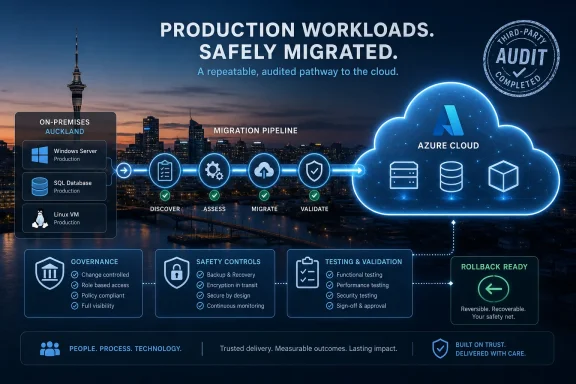
Lancom says its submission included multiple customer projects spanning infrastructure migration, database migration, deployment automation, testing, and operational handover. The audit reportedly examined standardized templates, Infrastructure-as-Code deployments, governance practices, Azure Migrate, Azure Database Migration Service, monitoring, backup, and operational controls. That is exactly the sort of evidence customers should want reviewed, because failed migrations usually fail in the connective tissue between tools and process.
Technical Director Gregor Blaj led the certification effort and framed the designation as support for Lancom’s cloud-first managed services position. Chief Executive Officer Priscila Bernardes put the emphasis on customer assurance, arguing that Microsoft’s validation demonstrates repeatable success in real scenarios rather than theoretical capability. Both messages are predictable corporate messaging, but the underlying point is sound: in cloud migration, repeatability is not a bureaucratic virtue. It is the difference between a controlled cutover and a weekend of improvised recovery.
That system matters most during migration because enterprise environments are full of traps that do not appear in a sales workshop. A Windows Server estate may include legacy authentication dependencies, hard-coded IP addresses, unsupported operating systems, old SQL Server versions, brittle line-of-business applications, and storage performance assumptions that only become visible under load. A database migration may pass a schema assessment and still fail because batch jobs, reporting windows, or latency-sensitive integrations were not mapped correctly.
The Azure tooling has improved significantly over the years. Azure Migrate can assess and help move servers, databases, and application dependencies. Azure Database Migration Service can support database transitions into Azure SQL, managed instances, or other targets. Azure Policy, backup services, monitoring, and landing-zone patterns give administrators more ways to govern the destination environment than they had in the first wave of cloud adoption.
But tools are not a delivery method. A migration partner still has to decide what to assess, how to sequence workloads, which dependencies to model, how to test rollback, how to communicate downtime, how to validate performance, and when to stop pretending a lift-and-shift is modernization. The audit focus described by Lancom suggests Microsoft is pushing partners toward documented, repeatable delivery practices because Azure projects are too consequential to run as artisanal one-offs.
This is where the story becomes more than a corporate award notice. Microsoft is tightening the relationship between partner credibility and measurable Azure consumption. The Azure migration specialization includes performance requirements tied to Azure Consumed Revenue across eligible workloads and customers, as well as skilling requirements across certifications such as Azure Administrator Associate, Azure Security Engineer Associate, DevOps Engineer Expert, and Azure Database Administrator Associate. The badge is not awarded simply because a partner says it likes migrations.
That model nudges the partner ecosystem toward repeatable, revenue-generating cloud operations. Microsoft benefits when partners move more workloads to Azure and keep them there. Partners benefit when Microsoft directs customers toward providers with validated capabilities. Customers benefit if the validation actually correlates with better delivery.
The caveat is obvious: a badge is a signal, not a guarantee. A specialization does not mean every future project will go smoothly, that every engineer on the account has deep migration experience, or that the partner’s approach will fit every environment. It does mean customers have a stronger starting point for due diligence than a generic partner listing or a glossy migration deck.
In the early cloud adoption wave, many migration projects were justified as data center exit exercises. The goal was to shut down hardware, escape lease renewals, or reduce the operational drag of aging infrastructure. The dominant pattern was often lift and shift: replicate virtual machines, adjust networking, validate applications, and declare victory.
That approach still has a place, especially when time pressure is real. But it rarely delivers the full value customers expect from cloud. A virtual machine moved from on-premises infrastructure to Azure is still a virtual machine that must be patched, monitored, backed up, secured, optimized, and paid for every month. If the migration does not improve operational control, it may simply relocate technical debt.
The newer migration argument is about building a managed operating model around the move. Infrastructure-as-Code helps make deployments repeatable and auditable. Governance controls help prevent subscription sprawl, insecure configurations, and budget surprises. Monitoring and backup patterns help ensure the landing zone is not merely a destination but a platform. Database migration planning helps distinguish between workloads that should remain on IaaS, move to managed database services, or become candidates for deeper modernization.
This is why Lancom’s specialization is relevant to WindowsForum readers beyond New Zealand. Windows Server and SQL Server estates remain central to enterprise IT, and many organizations are still deciding whether Azure is a retirement home for legacy workloads or a stepping stone to modernization. The answer depends less on the cloud provider’s slogan than on the discipline of the migration program.
Microsoft has a natural advantage here. Azure offers licensing benefits, hybrid rights, extended security update paths, and migration tooling designed around Microsoft workloads. For customers already committed to Windows Server, Active Directory, SQL Server, Microsoft 365, and Defender, Azure can feel less like a platform change than an extension of the Microsoft estate.
That familiarity is useful, but it can also encourage complacency. Administrators may assume a Windows workload will behave predictably because the target cloud is Microsoft’s. Database teams may underestimate the differences between SQL Server on a VM, Azure SQL Managed Instance, and Azure SQL Database. Security teams may discover too late that identity, network segmentation, and monitoring models need to be rethought for cloud operations.
A specialization focused on infrastructure and database migration implicitly recognizes those risks. It says the partner is not just expected to move workloads but to understand the production consequences of moving them. For Windows-heavy customers, that is the more valuable signal.
That reflects the reality of modern enterprise environments. Even companies standardized on Microsoft often run mixed database estates. Acquisitions bring in Linux workloads. Development teams choose PostgreSQL for new services. SaaS integrations depend on non-Microsoft stacks. Analytics platforms and application back ends sprawl across multiple engines.
For a partner like Lancom, being evaluated on a range of infrastructure and database technologies is commercially useful. Customers increasingly want one migration program that can handle the Microsoft core without ignoring the open-source edge. They also want to know whether the partner understands when an Azure-native managed service is appropriate and when a workload should remain closer to its current architecture.
This is one of the quieter shifts in Microsoft’s cloud strategy. The company still has deep incentives to promote its own platforms, but Azure has to absorb the heterogeneous reality of enterprise IT. Migration specialists are being judged on whether they can carry that heterogeneity into Azure without turning it into operational chaos.
Still, the AI claim deserves careful handling. Migrating a database to Azure does not automatically make an organization AI-ready. A company can move every workload into the cloud and still lack clean data, access controls, lineage, cost governance, model evaluation processes, or a credible use case. Cloud proximity helps, but architecture and governance decide whether AI becomes useful or merely expensive.
Where the AI angle is credible is in the foundation. A well-governed Azure environment can make it easier to connect operational data to analytics platforms, automation, and AI services. Managed databases can reduce infrastructure overhead. Standardized deployment patterns can make experimentation safer. Monitoring and policy controls can help IT teams understand what is being used, by whom, and at what cost.
That is why migration specializations matter in the AI era even when the badge itself is not an AI credential. Before organizations can build responsibly with AI, many need to know where their workloads are, how their data flows, how identity is enforced, and whether infrastructure can be reproduced without heroics. A disciplined migration program can expose and improve those foundations.
Customers do not hire migration partners because Azure Migrate is impossible to use. They hire them because the consequences of getting migration wrong are painful. Downtime can interrupt revenue. Performance regressions can damage trust. Security misconfigurations can create exposure. Poor handover can leave internal teams managing an environment they do not understand. Cost drift can turn a supposedly efficient cloud project into an executive headache.
Microsoft’s specialization program tries to package a degree of assurance into a partner signal. It does not replace procurement diligence, architecture review, security assessment, or customer references. But it does give buyers a reason to ask better questions.
Instead of asking whether a partner “does Azure migrations,” customers can ask how its audited method handles dependency mapping, database compatibility assessment, landing-zone design, test plans, cutover rehearsals, rollback, governance, backup, monitoring, and operational handover. The specialization does not answer all of those questions by itself. It makes those questions unavoidable.
But the trend also reflects a real shift. Cloud work has become too broad for a single partner designation to communicate capability. A company can be excellent at Microsoft 365 deployment and weak at Azure landing zones. It can be strong in security operations and inexperienced in database modernization. It can build modern applications but struggle with legacy infrastructure migration. Granularity is necessary because “cloud partner” now covers too much territory.
The challenge for Microsoft is to make the specializations meaningful rather than decorative. That means maintaining real audit standards, updating requirements as products change, and avoiding a system where badges primarily reward partners already generating consumption at scale. The challenge for customers is to read the badges as signals of fit rather than proof of perfection.
For Lancom, the new specialization gives it a sharper story in a crowded services market. For Microsoft, it reinforces a partner model in which Azure growth depends on audited delivery capacity outside Microsoft itself. For customers, it offers a useful but incomplete filter.
In smaller markets, partner credibility can carry extra weight because the ecosystem is tighter and referenceability matters. Customers often know the local providers, the talent pool, and the reputational consequences of failed delivery. A Microsoft specialization gives a local provider a globally recognizable signal while still allowing it to compete on regional knowledge and customer relationships.
That combination is useful in markets where the cloud decision is not simply a technical migration but a business transformation with local constraints. Data residency, support expectations, network design, industry compliance, and vendor relationships all shape the practical path to Azure. A partner that can translate Microsoft’s global platform into locally executable projects has a real advantage.
The specialization does not tell us whether Lancom is the right partner for every New Zealand organization. No credential can. It does tell us that Microsoft has seen enough evidence, through its program and audit mechanisms, to let Lancom carry a specific migration label. In a market crowded with cloud claims, that is not nothing.
Operational handover is particularly important for managed services providers. If the partner will continue running the environment, the migration method must feed directly into steady-state operations. If the customer’s internal team will own the platform, documentation, monitoring, access models, runbooks, and cost controls become part of the project’s success criteria.
Lancom’s announcement specifically mentions operational handover, monitoring, backup, and governance tools. Those details are more interesting than the badge itself because they describe the work that determines whether a migration remains successful six months later. A clean cutover can still become a failure if no one understands alerts, backup recovery, identity boundaries, patching responsibilities, or monthly Azure spend.
This is where Microsoft’s specialization framework aligns with the practical needs of sysadmins and IT pros. The migration is not done when the VM boots. It is done when the workload is supportable, observable, secure, recoverable, and financially understood in its new environment.
The best use of Lancom’s new designation is as a prompt for deeper examination. Customers should ask for migration examples similar to their own environment. They should examine how the partner handles discovery, dependency analysis, database compatibility, security baselines, identity, rollback, and cost governance. They should ask who will actually do the work, not merely who holds the certifications.
They should also distinguish between migration and modernization. Moving SQL Server to an Azure VM, moving to SQL Managed Instance, and refactoring an application to use Azure SQL Database are different projects with different trade-offs. Moving a Windows Server workload unchanged may be sensible in one case and a missed opportunity in another. The partner’s value lies partly in knowing which answer fits which workload.
Lancom’s specialization makes the company easier to shortlist for Azure migration conversations. It should not make the conversation shorter. If anything, it should make the conversation more specific.
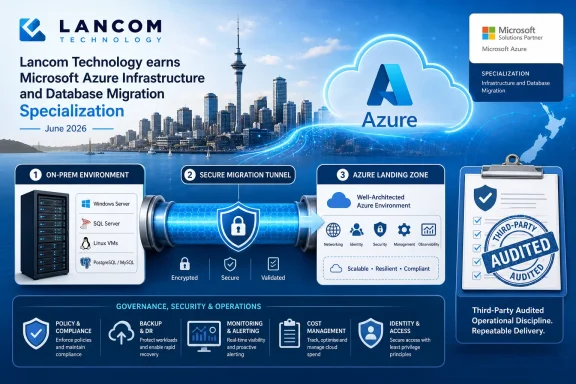 Microsoft’s Partner Badges Are Becoming a Risk Filter
Microsoft’s partner ecosystem has always had a language problem. To customers, the difference between a partner, a solutions partner, a specialist, a managed services provider, and a cloud consultancy can blur into the same familiar promise: we can get you to the cloud. The Azure Infrastructure and Database Migration Specialization exists because that promise is no longer enough.The specialization sits inside the Microsoft AI Cloud Partner Program and is available only to partners that already meet broader prerequisites, such as an active Solutions Partner designation in Infrastructure or Data & AI. Microsoft then layers on performance evidence, technical skilling, and an audit requirement. In plain terms, it asks whether the partner has people who know the tooling, customers who have actually migrated, and delivery methods that survive external scrutiny.
That distinction matters because infrastructure and database migration is one of the least glamorous but most consequential forms of cloud work. The easy story is about modernization, AI readiness, and escaping aging hardware. The harder story is about DNS dependencies, database cutover windows, identity assumptions, backup chains, compliance controls, monitoring baselines, application owners who have left the company, and production workloads that cannot simply be “cloudified” because a diagram says so.
Lancom’s new designation therefore lands in a market where customers are not short of cloud migration pitches. They are short of confidence. Microsoft’s specialization program is an attempt to convert that confidence into a visible marketplace signal.
Lancom’s Win Is Local, but the Pattern Is Global
Lancom Technology is based in Auckland and already markets itself as a Microsoft-focused cloud and managed services provider. The company holds several Microsoft Solutions Partner designations, including Azure Infrastructure, Digital & App Innovation, Security, and Modern Work Enterprise. The new Azure Infrastructure and Database Migration Specialization adds a narrower credential: not just “we work with Azure,” but “we have been audited for this particular migration lane.”That lane is important. Microsoft’s specialization covers migration of production infrastructure and database workloads to Azure, including Windows Server and SQL Server environments as well as Linux virtual machines and databases such as MySQL, PostgreSQL, MariaDB, NoSQL platforms, and Azure-native database services. This is the messy middle of enterprise cloud adoption, where businesses are not necessarily rewriting every application but also cannot treat Azure as a remote VMware cluster with better branding.
Lancom says its submission included multiple customer projects spanning infrastructure migration, database migration, deployment automation, testing, and operational handover. The audit reportedly examined standardized templates, Infrastructure-as-Code deployments, governance practices, Azure Migrate, Azure Database Migration Service, monitoring, backup, and operational controls. That is exactly the sort of evidence customers should want reviewed, because failed migrations usually fail in the connective tissue between tools and process.
Technical Director Gregor Blaj led the certification effort and framed the designation as support for Lancom’s cloud-first managed services position. Chief Executive Officer Priscila Bernardes put the emphasis on customer assurance, arguing that Microsoft’s validation demonstrates repeatable success in real scenarios rather than theoretical capability. Both messages are predictable corporate messaging, but the underlying point is sound: in cloud migration, repeatability is not a bureaucratic virtue. It is the difference between a controlled cutover and a weekend of improvised recovery.
The Audit Matters Because Migration Is Where Cloud Strategy Meets Production Reality
There is a reason Microsoft requires a third-party audit for many Azure specializations. Certifications prove individuals have passed exams. Revenue metrics prove customers are consuming Azure services. Customer references prove someone can tell a success story. An audit, at least in theory, asks whether the partner has a system.That system matters most during migration because enterprise environments are full of traps that do not appear in a sales workshop. A Windows Server estate may include legacy authentication dependencies, hard-coded IP addresses, unsupported operating systems, old SQL Server versions, brittle line-of-business applications, and storage performance assumptions that only become visible under load. A database migration may pass a schema assessment and still fail because batch jobs, reporting windows, or latency-sensitive integrations were not mapped correctly.
The Azure tooling has improved significantly over the years. Azure Migrate can assess and help move servers, databases, and application dependencies. Azure Database Migration Service can support database transitions into Azure SQL, managed instances, or other targets. Azure Policy, backup services, monitoring, and landing-zone patterns give administrators more ways to govern the destination environment than they had in the first wave of cloud adoption.
But tools are not a delivery method. A migration partner still has to decide what to assess, how to sequence workloads, which dependencies to model, how to test rollback, how to communicate downtime, how to validate performance, and when to stop pretending a lift-and-shift is modernization. The audit focus described by Lancom suggests Microsoft is pushing partners toward documented, repeatable delivery practices because Azure projects are too consequential to run as artisanal one-offs.
The Specialization Is Also a Marketplace Weapon
Microsoft’s specialization badges are partly about customer assurance, but they are also about channel economics. Partners that earn specializations can display customer-facing labels on Microsoft business profiles, may gain access to go-to-market programs, and can be prioritized in customer searches in Microsoft Marketplace. For a mid-market or regional provider, that visibility can be material.This is where the story becomes more than a corporate award notice. Microsoft is tightening the relationship between partner credibility and measurable Azure consumption. The Azure migration specialization includes performance requirements tied to Azure Consumed Revenue across eligible workloads and customers, as well as skilling requirements across certifications such as Azure Administrator Associate, Azure Security Engineer Associate, DevOps Engineer Expert, and Azure Database Administrator Associate. The badge is not awarded simply because a partner says it likes migrations.
That model nudges the partner ecosystem toward repeatable, revenue-generating cloud operations. Microsoft benefits when partners move more workloads to Azure and keep them there. Partners benefit when Microsoft directs customers toward providers with validated capabilities. Customers benefit if the validation actually correlates with better delivery.
The caveat is obvious: a badge is a signal, not a guarantee. A specialization does not mean every future project will go smoothly, that every engineer on the account has deep migration experience, or that the partner’s approach will fit every environment. It does mean customers have a stronger starting point for due diligence than a generic partner listing or a glossy migration deck.
Azure Migration Has Moved Past the Lift-and-Shift Era
The most interesting part of Lancom’s announcement is not that it mentions Azure Migrate or database migration tooling. It is that it also mentions deployment automation, standardized templates, governance, monitoring, backup, and handover. That collection of nouns tells us where the Azure migration market has moved.In the early cloud adoption wave, many migration projects were justified as data center exit exercises. The goal was to shut down hardware, escape lease renewals, or reduce the operational drag of aging infrastructure. The dominant pattern was often lift and shift: replicate virtual machines, adjust networking, validate applications, and declare victory.
That approach still has a place, especially when time pressure is real. But it rarely delivers the full value customers expect from cloud. A virtual machine moved from on-premises infrastructure to Azure is still a virtual machine that must be patched, monitored, backed up, secured, optimized, and paid for every month. If the migration does not improve operational control, it may simply relocate technical debt.
The newer migration argument is about building a managed operating model around the move. Infrastructure-as-Code helps make deployments repeatable and auditable. Governance controls help prevent subscription sprawl, insecure configurations, and budget surprises. Monitoring and backup patterns help ensure the landing zone is not merely a destination but a platform. Database migration planning helps distinguish between workloads that should remain on IaaS, move to managed database services, or become candidates for deeper modernization.
This is why Lancom’s specialization is relevant to WindowsForum readers beyond New Zealand. Windows Server and SQL Server estates remain central to enterprise IT, and many organizations are still deciding whether Azure is a retirement home for legacy workloads or a stepping stone to modernization. The answer depends less on the cloud provider’s slogan than on the discipline of the migration program.
Windows Server and SQL Server Still Anchor the Enterprise Cloud Conversation
For all the industry’s enthusiasm around containers, serverless platforms, and AI services, Windows Server and SQL Server remain stubbornly important. They run finance systems, manufacturing applications, document workflows, ERP integrations, identity-adjacent services, and decades of internal tooling. Moving those workloads to Azure is not just a technical operation; it is a negotiation with institutional memory.Microsoft has a natural advantage here. Azure offers licensing benefits, hybrid rights, extended security update paths, and migration tooling designed around Microsoft workloads. For customers already committed to Windows Server, Active Directory, SQL Server, Microsoft 365, and Defender, Azure can feel less like a platform change than an extension of the Microsoft estate.
That familiarity is useful, but it can also encourage complacency. Administrators may assume a Windows workload will behave predictably because the target cloud is Microsoft’s. Database teams may underestimate the differences between SQL Server on a VM, Azure SQL Managed Instance, and Azure SQL Database. Security teams may discover too late that identity, network segmentation, and monitoring models need to be rethought for cloud operations.
A specialization focused on infrastructure and database migration implicitly recognizes those risks. It says the partner is not just expected to move workloads but to understand the production consequences of moving them. For Windows-heavy customers, that is the more valuable signal.
Open-Source Databases Are Now Part of the Microsoft Migration Story
The inclusion of open-source databases in the specialization is equally telling. Azure migration is no longer framed only as a Windows Server and SQL Server pathway. Microsoft’s own requirements and positioning acknowledge Linux virtual machines and databases such as PostgreSQL, MySQL, MariaDB, and NoSQL platforms.That reflects the reality of modern enterprise environments. Even companies standardized on Microsoft often run mixed database estates. Acquisitions bring in Linux workloads. Development teams choose PostgreSQL for new services. SaaS integrations depend on non-Microsoft stacks. Analytics platforms and application back ends sprawl across multiple engines.
For a partner like Lancom, being evaluated on a range of infrastructure and database technologies is commercially useful. Customers increasingly want one migration program that can handle the Microsoft core without ignoring the open-source edge. They also want to know whether the partner understands when an Azure-native managed service is appropriate and when a workload should remain closer to its current architecture.
This is one of the quieter shifts in Microsoft’s cloud strategy. The company still has deep incentives to promote its own platforms, but Azure has to absorb the heterogeneous reality of enterprise IT. Migration specialists are being judged on whether they can carry that heterogeneity into Azure without turning it into operational chaos.
The AI Angle Is Real, but It Should Not Be Oversold
Lancom’s CEO connected migration benefits to efficiency, new functionality, and the ability for customers to take advantage of modern technology, including AI. That is now a standard line in almost every cloud announcement, and for good reason. AI services need data, compute, governance, identity, and integration. Workloads stranded in poorly documented on-premises environments are harder to connect to that future.Still, the AI claim deserves careful handling. Migrating a database to Azure does not automatically make an organization AI-ready. A company can move every workload into the cloud and still lack clean data, access controls, lineage, cost governance, model evaluation processes, or a credible use case. Cloud proximity helps, but architecture and governance decide whether AI becomes useful or merely expensive.
Where the AI angle is credible is in the foundation. A well-governed Azure environment can make it easier to connect operational data to analytics platforms, automation, and AI services. Managed databases can reduce infrastructure overhead. Standardized deployment patterns can make experimentation safer. Monitoring and policy controls can help IT teams understand what is being used, by whom, and at what cost.
That is why migration specializations matter in the AI era even when the badge itself is not an AI credential. Before organizations can build responsibly with AI, many need to know where their workloads are, how their data flows, how identity is enforced, and whether infrastructure can be reproduced without heroics. A disciplined migration program can expose and improve those foundations.
The Customer Assurance Message Is the Real Product
Lancom’s public comments emphasize assurance, repeatable delivery, and reduced perceived risk. That is not incidental. In the cloud services market, assurance is often the product being sold before any server moves.Customers do not hire migration partners because Azure Migrate is impossible to use. They hire them because the consequences of getting migration wrong are painful. Downtime can interrupt revenue. Performance regressions can damage trust. Security misconfigurations can create exposure. Poor handover can leave internal teams managing an environment they do not understand. Cost drift can turn a supposedly efficient cloud project into an executive headache.
Microsoft’s specialization program tries to package a degree of assurance into a partner signal. It does not replace procurement diligence, architecture review, security assessment, or customer references. But it does give buyers a reason to ask better questions.
Instead of asking whether a partner “does Azure migrations,” customers can ask how its audited method handles dependency mapping, database compatibility assessment, landing-zone design, test plans, cutover rehearsals, rollback, governance, backup, monitoring, and operational handover. The specialization does not answer all of those questions by itself. It makes those questions unavoidable.
The Partner Program Is Becoming More Granular Because Cloud Work Is More Specialized
Microsoft lists more than 30 specializations across Azure, Data & AI, Digital & App Innovation, Infrastructure, Business Applications, Modern Workplace, and Security. That proliferation can look like badge inflation, and in some ways it is. The more labels a vendor creates, the harder it becomes for customers to understand which ones matter.But the trend also reflects a real shift. Cloud work has become too broad for a single partner designation to communicate capability. A company can be excellent at Microsoft 365 deployment and weak at Azure landing zones. It can be strong in security operations and inexperienced in database modernization. It can build modern applications but struggle with legacy infrastructure migration. Granularity is necessary because “cloud partner” now covers too much territory.
The challenge for Microsoft is to make the specializations meaningful rather than decorative. That means maintaining real audit standards, updating requirements as products change, and avoiding a system where badges primarily reward partners already generating consumption at scale. The challenge for customers is to read the badges as signals of fit rather than proof of perfection.
For Lancom, the new specialization gives it a sharper story in a crowded services market. For Microsoft, it reinforces a partner model in which Azure growth depends on audited delivery capacity outside Microsoft itself. For customers, it offers a useful but incomplete filter.
New Zealand’s Cloud Market Has the Same Old Enterprise Problem
Lancom’s Auckland base gives the announcement a regional flavor, but the enterprise problem is familiar everywhere. Organizations want cloud benefits while carrying years of accumulated infrastructure decisions. They want faster delivery but cannot abandon compliance. They want modernization but need production continuity. They want AI readiness but have databases whose ownership is unclear.In smaller markets, partner credibility can carry extra weight because the ecosystem is tighter and referenceability matters. Customers often know the local providers, the talent pool, and the reputational consequences of failed delivery. A Microsoft specialization gives a local provider a globally recognizable signal while still allowing it to compete on regional knowledge and customer relationships.
That combination is useful in markets where the cloud decision is not simply a technical migration but a business transformation with local constraints. Data residency, support expectations, network design, industry compliance, and vendor relationships all shape the practical path to Azure. A partner that can translate Microsoft’s global platform into locally executable projects has a real advantage.
The specialization does not tell us whether Lancom is the right partner for every New Zealand organization. No credential can. It does tell us that Microsoft has seen enough evidence, through its program and audit mechanisms, to let Lancom carry a specific migration label. In a market crowded with cloud claims, that is not nothing.
The Hidden Test Comes After the Cutover
The most underestimated phase of migration is what happens after the celebratory email. Once workloads are live in Azure, the organization has to operate them. That is where many cloud projects reveal whether they were designed as transformations or treated as relocations.Operational handover is particularly important for managed services providers. If the partner will continue running the environment, the migration method must feed directly into steady-state operations. If the customer’s internal team will own the platform, documentation, monitoring, access models, runbooks, and cost controls become part of the project’s success criteria.
Lancom’s announcement specifically mentions operational handover, monitoring, backup, and governance tools. Those details are more interesting than the badge itself because they describe the work that determines whether a migration remains successful six months later. A clean cutover can still become a failure if no one understands alerts, backup recovery, identity boundaries, patching responsibilities, or monthly Azure spend.
This is where Microsoft’s specialization framework aligns with the practical needs of sysadmins and IT pros. The migration is not done when the VM boots. It is done when the workload is supportable, observable, secure, recoverable, and financially understood in its new environment.
The Badge Should Start the Due Diligence, Not End It
A Microsoft specialization is useful evidence, but customers should resist the temptation to outsource judgment to a logo. The right migration partner for a given organization depends on workload profile, regulatory requirements, internal skills, architecture goals, budget tolerance, and appetite for modernization. A partner can be audited and still be a poor fit for a particular project.The best use of Lancom’s new designation is as a prompt for deeper examination. Customers should ask for migration examples similar to their own environment. They should examine how the partner handles discovery, dependency analysis, database compatibility, security baselines, identity, rollback, and cost governance. They should ask who will actually do the work, not merely who holds the certifications.
They should also distinguish between migration and modernization. Moving SQL Server to an Azure VM, moving to SQL Managed Instance, and refactoring an application to use Azure SQL Database are different projects with different trade-offs. Moving a Windows Server workload unchanged may be sensible in one case and a missed opportunity in another. The partner’s value lies partly in knowing which answer fits which workload.
Lancom’s specialization makes the company easier to shortlist for Azure migration conversations. It should not make the conversation shorter. If anything, it should make the conversation more specific.
The Lancom Badge Says More Than a Press Release Usually Does
The concrete takeaways from Lancom’s Microsoft specialization are less about corporate congratulations and more about how Azure migration buying is changing. The market is moving from broad partner claims toward audited specialization, and customers should treat that as a chance to demand more precise evidence.- Lancom Technology has earned Microsoft’s Azure Infrastructure and Database Migration Specialization, adding a migration-specific credential to its existing Microsoft Solutions Partner designations.
- The specialization covers production workload migration to Azure, including Windows Server, SQL Server, Linux virtual machines, and open-source databases.
- Microsoft’s process emphasizes real delivery evidence, including performance requirements, technical skilling, and a third-party audit for this specialization.
- Lancom says its audit evidence included customer projects, standardized templates, Infrastructure-as-Code deployments, governance practices, migration tooling, monitoring, backup, and operational handover.
- The badge is a useful customer assurance signal, but it should be treated as the beginning of due diligence rather than a replacement for architecture, security, and commercial review.
- The bigger story is that Azure migration has become an operational discipline, not just a server relocation exercise.
References
- Primary source: IT Brief New Zealand
Published: 2026-06-30T04:30:10.026459
Lancom wins Microsoft Azure migration specialisation
Customers seeking cloud moves may see lower risk after the Auckland-based firm proved repeatable delivery on Azure database and infrastructure migrations. itbrief.co.nz
- Official source: partner.microsoft.com
Infra and Database Migration to Microsoft Azure specialization
For partners who demonstrate deep knowledge, extensive experience, and proven success in migrating to Windows Server and SQL Server-based production workloads.partner.microsoft.com
- Official source: learn.microsoft.com
Apply for specializations - Partner Center | Microsoft Learn
Strengthen your business profile in the Microsoft partner directory. Learn how to use Partner Center to apply for and earn advanced specializations.learn.microsoft.com - Related coverage: lancom.tech

Lancom Technology | Microsoft Solutions Partner
We are expert at designing, building, migrating and operating complex Microsoft Azure environments and delivering successful cloud projects for companies of all sizes, across all industries.
www.lancom.tech
- Official source: techcommunity.microsoft.com
Performance and certification updates coming to Microsoft Infra and Database Migration specialization
Learn more about updates coming to the Infra and Database Migration to Microsoft Azure specialization as well as a new requirement for the Azure Security... techcommunity.microsoft.com
- Official source: azure.microsoft.com
- Related coverage: hbs.net
HBS earns Infra & Database Migration to Azure Specialization
HBS earns Microsoft’s specialized recognition for migrating infrastructure and databases to Azure. Discover how they lead in tech solutions.www.hbs.net - Related coverage: softserveinc.com
SoftServe Achieves Third Microsoft Azure Specialization
SoftServe achieves Infrastructure and Database Migration to Microsoft Azure specialization.www.softserveinc.com - Official source: devicepartner.microsoft.com
Specialization
The Microsoft Copilot specialization helps partners showcase their experience and capabilities with Microsoft 365 Copilot.devicepartner.microsoft.com
- Related coverage: evoila.com
Awarded by Microsoft: evoila receives specialization for Azure migrations - evoila US
Microsoft awards evoila the Azure migration specialization and confirms expertise in infrastructure and database migrations. evoila.com
- Official source: info.microsoft.com
- Official source: download.microsoft.com
Migrating your Windows Azure Applications between Data Centers
Considerations, approaches and risk managementdownload.microsoft.com



%22 d=%22M44,140.1h42.8V272H54.9c0-0.1,0-103.8,0-103.8H44V140.1z M44,1c28.4,0,42.6,16.2,42.6,42.2v66.1H54.9V43.8 c0-7.2-3.1-11.7-10.6-11.7c-7,0-10.6,4.2-10.6,11.7c0,0,0,228.1,0,228.2H0.2c0-0.5,0-228.8,0-228.8C0.1,16.8,14.8,1,44,1L44,1z%22/><style>path { fill: %23262626 } @media (prefers-color-scheme: dark) { path { fill: %23EEEFE9 } }</style></svg>)
