

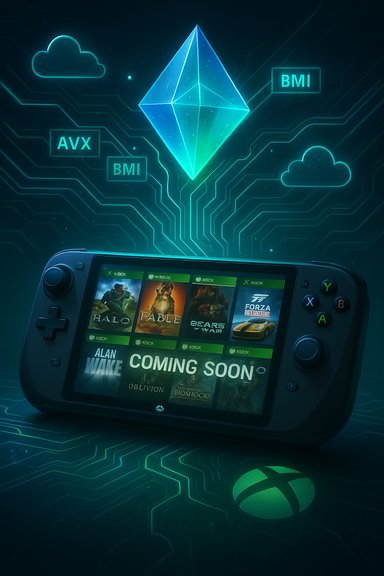
Microsoft appears to be quietly testing the edges of a big, nostalgia‑driven idea: making legacy Xbox catalog titles — notably original Xbox and Xbox 360 games — playable on Windows PCs and Windows handhelds. The claim rests on a mix of insider chatter, back‑end storefront oddities that showed “coming soon” relists, and real technical improvements in Windows’ Arm emulation stack that make such a move technically plausible — but far from certain.
In recent days several outlets and community threads picked up a ResetEra insider post that suggested Xbox engineering teams are “making an effort” to expand backward compatibility (BC) beyond consoles and into Windows devices, including the ROG Xbox Ally family of handhelds. That post — and subsequent sightings of previously delisted Xbox titles appearing as placeholders in certain Microsoft Store regions — reignited hopes that Microsoft may relist and package older Xbox titles as purchasable, playable Windows products.
Why this would matter: Microsoft already treats Xbox content as a cross‑device asset (Game Pass, Xbox Play Anywhere, cloud streaming), and putting validated, entitlements‑backed legacy titles on Windows would be a major convenience and preservation win. It would also further Microsoft’s strategic play of making Xbox content available across consoles, PCs, and handheld Windows devices. Yet the rumor chain is explicit about gaps: licensing windows, anti‑cheat drivers, and server/online dependencies remain major blockers that make a comprehensive, immediate roll‑out unlikely.
Source: TechPowerUp Legacy Xbox Games May be Coming to Windows | TechPowerUp}
 Background / Overview
In recent days several outlets and community threads picked up a ResetEra insider post that suggested Xbox engineering teams are “making an effort” to expand backward compatibility (BC) beyond consoles and into Windows devices, including the ROG Xbox Ally family of handhelds. That post — and subsequent sightings of previously delisted Xbox titles appearing as placeholders in certain Microsoft Store regions — reignited hopes that Microsoft may relist and package older Xbox titles as purchasable, playable Windows products.Why this would matter: Microsoft already treats Xbox content as a cross‑device asset (Game Pass, Xbox Play Anywhere, cloud streaming), and putting validated, entitlements‑backed legacy titles on Windows would be a major convenience and preservation win. It would also further Microsoft’s strategic play of making Xbox content available across consoles, PCs, and handheld Windows devices. Yet the rumor chain is explicit about gaps: licensing windows, anti‑cheat drivers, and server/online dependencies remain major blockers that make a comprehensive, immediate roll‑out unlikely.
Why the rumor is believable: the technical and platform context
Prism emulation: a real, measurable capability increase
One of the most consequential technical threads supporting the plausibility of this effort is Prism — Microsoft’s x86/x64→ARM64 translation/emulation layer used for Windows on Arm. In late 2024–2025 Microsoft broadened Prism’s emulated CPU features to include extensions like AVX and AVX2 (plus BMI, FMA, F16C and others). That expansion removes one of the principal reasons many x64 games refused to run on Arm devices: missing CPU instruction support. Microsoft’s announcement and follow‑ups confirm the rollout and show this capability is now available in retail Windows 11 builds for Arm devices. Prism’s expanded instruction support does not equal native parity — emulating 256‑bit AVX instructions on 128‑bit ARM NEON/SVE units involves extra translation work — but it does materially widen the set of binaries that can launch and run on Arm‑based Windows handhelds and laptops. For Microsoft, that lowers the engineering bar to releasing validated legacy console binaries on Windows handhelds that run Arm silicon.The Xbox PC app and the “aggregated library” play
Concurrently, Microsoft has been evolving the Xbox PC app into a centralized landing and discovery hub: an aggregated library that discovers installed games across Steam, Epic, GOG, and the Microsoft Store, and orchestrates launches, handoffs, and integrated experiences. That UX layer gives Microsoft the distribution plumbing to surface older Xbox SKUs (if relisted) to Windows users without requiring those titles to be re‑engineered into native Win32 ports. The combined effect of Prism improvements plus the Xbox app’s aggregation makes the engineering path plausible in principle.Three pragmatic delivery models
There are three realistic ways Microsoft (or publishers) could make legacy Xbox games play on Windows:- Native re‑ports: publishers rebuild code to run natively on Windows (costly, time‑consuming, often impossible where source code or rights are missing).
- Official emulation packaging: Microsoft extends the same emulation approach used for Xbox Series BC, integrates the emulator into the OS/store, and ships validated, supported SKUs.
- Cloud streaming: keep binaries on consoles/servers and stream playable video/audio to Windows devices (already a fallback for titles blocked by client‑side middleware).
Storefront signals and the evidence trail
What observers actually saw
Multiple outlets and forum sleuths reported that a set of previously delisted or console‑only Xbox titles started appearing in certain Microsoft Store regional views with “Coming Soon” tags and incomplete metadata. Titles mentioned across those observations included well‑known legacy names — in some regions — but product pages often lacked pricing, full descriptions, or purchase controls, suggesting a backend catalog state change rather than a finished product launch. That pattern is exactly what one would expect during a staged relisting or internal store update.Four plausible interpretations
- Deliberate relisting due to renewed licensing — publishers or Microsoft renegotiated rights and the store is being prepared for a public offering.
- A technical BC rollout — store placeholders created ahead of an emulation/packaging program that will enable digital purchases and validated play.
- Internal testing or a staged rollout — selective region flags and previews, intentionally limited while internal systems are exercised.
- A catalog/caching error — a backend migration or cache inconsistency that briefly exposed dormant SKUs.
The hard constraints Microsoft must solve
Licensing and music/third‑party content
Many legacy titles contain licensed music, branded assets, or voice work licensed only for the original distribution window. Re‑licensing is often expensive, sometimes impossible, and is typically negotiated title‑by‑title and region‑by‑region. That alone guarantees any relist will be patchy: expect omissions, regional exclusions, and fragmented catalogs.Anti‑cheat and kernel drivers
A single‑largest practical blocker is anti‑cheat middleware. Modern competitive games — and even some older multiplayer titles — rely on kernel‑mode drivers or specialized middleware that cannot be trivially emulated across architectures or safely translated in userland. Without updated anti‑cheat drivers and vendor cooperation, multiplayer and online features will be blocked even if the single‑player experience runs. History shows this is a real, recurring chokepoint for cross‑architecture compatibility.Services, achievements, and online server dependencies
Digital entitlements, achievements, cloud saves, and online services depend on server‑side components and contractual rights. Relisting a SKU in the store is only the first step — restoring full platform features requires server support, account entitlements, and often publisher participation. In many cases Microsoft will need to either recreate or proxy old services, or accept reduced feature sets (single‑player only, for example) for some titles.The emulator ecosystem and why it matters
Community emulators remain vital — but limited
Community projects such as Xenia (Xbox 360) and xemu/xqemu/Cxbx‑Reloaded (original Xbox) already run large parts of legacy catalogs on PC. These projects are crucial for preservation, research, and enthusiast play, but they cannot legally or practically provide official storefront entitlements, achievements, or supported multiplayer — nor should the community expect them to act as surrogates for an official Microsoft program. Xemu’s project pages and releases make this independence clear, and the Xenia team has explicitly denied being part of any Microsoft collaboration on a formal BC rollout.Why Microsoft is unlikely to outsource BC engineering
Microsoft has historically engineered official backward compatibility stacks in‑house for Xbox Series consoles and has the contractual reach to package validated SKUs. Community emulators, while excellent technically in many cases, cannot deliver the certification, QA, and commercial rights framework that commercial storefront distribution demands. Expect community emulators to continue filling gaps where official programs are infeasible or slow.Windows handhelds, ROG Xbox Ally, and the hardware angle
Why handhelds matter
ASUS’ ROG Xbox Ally family (and similar Windows handhelds) are Windows 11 devices that ship with an Xbox‑first experience and tightly validated drivers. These hardware partners effectively act as testbeds for Microsoft’s controller‑first, console‑like Windows sessions. If Microsoft wants legacy Xbox content to be playable on handhelds, the Ally family gives them a real, validated reference platform where Prism improvements and OEM‑provided GPU drivers lower the variability that plagues open Windows hardware.Windows on Arm and the performance tradeoffs
Arm handhelds benefit from Prism’s expanded instruction support, but emulation is still a performance tradeoff. Emulated AVX/AVX2 instructions must be translated to ARM vector operations, sometimes splitting work across smaller vector lanes — this yields compatibility but can reduce sustained performance compared to native x86 silicon. For single‑player classics and many older titles, this may be acceptable; for CPU‑heavy physics or multiplayer real‑time games, it may not. Microsoft’s pragmatic path could be: selective title support (lower variance), cloud fallback for online features, and optional native‑platform reissues where performance matters.What to watch next — concrete signals that would confirm a program
- An official Microsoft / Xbox Wire announcement describing a dedicated “Classics” program for Windows and handhelds.
- Publisher blog posts or store SKUs that show full purchase pages, region availability, prices, and feature notes (achievements/cloud saves).
- Microsoft technical documentation explaining how anti‑cheat drivers and server dependencies are being handled for legacy titles.
- Xbox PC app updates that add explicit “Legacy Xbox” catalog sections or validated emulation metadata in product entries.
- Public statements from emulator teams clarifying whether they are under NDA or collaborating — a denial would strongly indicate Microsoft is keeping BC efforts internal, while an affirmation would reshape expectations.
Benefits if Microsoft does this — realistic upside
- Preservation and convenience: Bringing delisted classics back to a modern, supported environment helps preserve gaming history and gives consumers legal, supported ways to replay favorites.
- Cross‑device continuity: Game Pass, Xbox Play Anywhere, and cloud streaming all become more compelling if older titles also live under the same entitlements system.
- Hardware halo: Windows handhelds like the ROG Xbox Ally receive a stronger content proposition if they can run validated legacy titles locally (or via low‑latency cloud fallbacks).
Risks, tradeoffs and the likely shape of any rollout
- Patchwork catalog: Licensing will guarantee an uneven offering — expect flagship classics to return while many niche or music‑heavy games remain absent.
- Limited multiplayer: Titles that depend on unsupported anti‑cheat stacks may be playable only in offline modes until vendor cooperation arrives.
- Performance variability: Arm handhelds running emulated x64 code will see mixed results; Microsoft’s Prism fixes help, but emulation costs remain. Desktop x86 Windows will offer the best native‑like experience when titles can be packaged to run locally.
- Community relationship tension: Official emulation packaged by Microsoft will likely further separate the corporate preservation path from independent emulator projects — useful for mainstream users but potentially contentious among preservationists.
Practical guidance for players and collectors
- Monitor official Microsoft/Xbox channels and publisher blogs for formal announcements rather than acting on single storefront anomalies. Product placeholders can be backend artifacts and are not reliable confirmation.
- If your priority is immediate playability, community emulators like Xenia (Xbox 360) and xemu (original Xbox) already run many titles — but they lack official entitlements, achievements, and guaranteed multiplayer. Use them for preservation and hobby play, but expect technical tinkering.
- Windows on Arm users should keep firmware, drivers, and the Xbox PC app up to date; Prism and driver updates have demonstrably improved the odds that previously incompatible binaries will at least launch. Still, test expectations: not every legacy title will be a good fit.
Verdict: cautious optimism, staged reality
The technical building blocks for bringing legacy Xbox titles to Windows increasingly exist: Prism’s expanded emulation, a more featureful Xbox PC app, and validated Windows handheld hardware all make the idea feasible in principle. The available evidence — insider posts and storefront placeholders — aligns with a program that Microsoft could build. But the heavy lifting remains legal (licenses), middleware (anti‑cheat), and QA (performance/UX) — and those are non‑trivial. Until Microsoft issues a formal program announcement, the balanced view is: plausible and desirable, but likely selective and gradual.Final takeaways for Windows and Xbox enthusiasts
- The rumor that legacy Xbox games may come to Windows is more than idle wishful thinking: it is grounded in real engineering progress and observable storefront behavior.
- Expect a phased, selective approach rather than an immediate, all‑titles release. Licensing and anti‑cheat are the practical choke points that will shape what arrives first.
- Community emulation will continue to play a preservation role, but only an official Microsoft program can deliver integrated purchases, achievements, cloud saves, and supported multiplayer.
- The clearest confirmation would be a Microsoft/Xbox Wire announcement plus visible, complete product pages in the Microsoft Store — those are the signals to watch for next.
Source: TechPowerUp Legacy Xbox Games May be Coming to Windows | TechPowerUp}
