

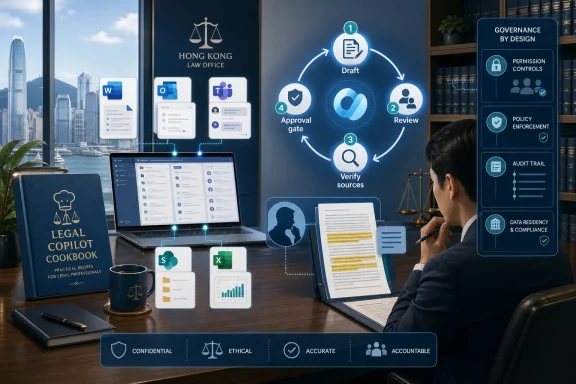
Microsoft, LITE Lab@HKU, ALITA, and The Law Society of Hong Kong have published a “Legal Copilot Cookbook” for legal professionals in Hong Kong and beyond, presenting practical Microsoft Copilot workflows for drafting, due diligence, regulatory monitoring, enquiry triage, and other routine legal work. The interesting part is not that lawyers have found another AI guide. It is that the guide starts from the software stack many lawyers already inhabit every day: Word, Outlook, Teams, SharePoint, Excel, and the Microsoft 365 security perimeter. That makes this less a manifesto for legal AI than a field manual for a profession trying to convert cautious curiosity into governed repetition.
The Cookbook’s thesis is simple enough to sound almost boring: don’t begin with a moonshot, begin with the work. For a sector trained to distrust ambiguity, that may be the right framing. Legal AI has spent the last two years oscillating between utopian claims about autonomous legal work and cautionary tales about hallucinated cases, sanctions, privilege risks, and uncontrolled data exposure. A recipe book is a quieter intervention, but perhaps a more useful one.
The legal industry does not lack AI demos. It lacks durable patterns that lawyers, knowledge teams, risk officers, and IT administrators can repeat without pretending that a general-purpose chatbot is a junior associate, a research librarian, and a compliance officer all at once. The Legal Copilot Cookbook tries to solve that by turning use cases into “recipes,” an intentionally domestic metaphor for a profession that often treats new technology as either magic or malpractice.
That choice matters. A recipe assumes ingredients, constraints, sequence, and review. It does not say, “Ask AI to solve the problem.” It says, “Use this tool, in this context, against this category of material, with this human checkpoint.” That is exactly the level at which AI adoption tends to succeed or fail inside legal organizations.
The Cookbook’s stated personas stretch across private practice, legal departments, and compliance functions. That is a better framing than the usual single-image caricature of “the lawyer” using AI to draft a contract. The daily life of a disputes partner, a compliance analyst, an in-house lawyer triaging business requests, and a professional support lawyer monitoring regulatory updates are materially different. Their risk profiles are different, too.
By translating real-world use cases from firms and corporate legal departments into structured workflows, the project implicitly acknowledges something enterprise IT already knows: adoption is not a licensing event. Turning on Copilot is not the same as changing work. The new capability has to be mapped onto recurring tasks, and users have to know where the machine stops.
That is the core commercial logic behind Copilot in legal practice. Lawyers live in Word redlines, Outlook threads, Teams calls, Excel trackers, PowerPoint decks, and SharePoint folders. A tool embedded in that environment does not have to win the first battle for attention. It is already there when the lawyer opens the document.
The Cookbook leans into that reality. It does not ask firms to replatform their practice management systems or hand their matter files to a legal-tech startup. It asks them to start with “tools at hand,” a phrase that sounds modest but cuts to the heart of Microsoft’s enterprise AI pitch. The fastest path to adoption is not always the most advanced product; it is often the product that meets users where their data and habits already are.
That does not make Copilot risk-free. In some ways, embedding AI inside Microsoft 365 makes governance more urgent because the tool sits close to sensitive material. A legal-specific platform may be fenced off by matter type, user group, or procurement gate. Copilot, by contrast, inherits the complexity of the tenant: permissions, SharePoint sprawl, Teams channels, personal OneDrive files, legacy documents, external sharing, and inconsistent labeling.
This is where Microsoft’s platform story cuts both ways. Copilot respects existing permissions, but existing permissions are often the problem. If a firm has overshared matter files, poorly governed SharePoint sites, or ambiguous access groups, Copilot can make those weaknesses more visible. It does not create the underlying information-governance mess, but it may surface it with uncomfortable efficiency.
In legal work, the distinction between draft and decision is everything. A generated summary of a regulation may be useful. A generated conclusion about a client’s regulatory exposure is something else entirely. A first-pass due diligence issue list can accelerate review. An unverified representation in a transaction report can create professional and commercial risk.
The Cookbook appears to focus on the first category: high-frequency, lower-risk, reviewable work where Copilot can reduce friction without displacing accountability. That includes legal advice drafting, due diligence research, regulatory monitoring, legal enquiry triaging, and timesheet auditing. None of these tasks is trivial, but each can be decomposed into stages where AI assists and a human validates.
That is the realistic frontier for Copilot in law. Not autonomous advocacy. Not unsupervised legal research. Not a machine quietly deciding what a client should do. The near-term value is in compressing the time between information and first draft, between inbox and triage, between meeting and action list, between policy change and internal alert.
The Cookbook’s contribution is to normalize that middle layer of AI use. It shifts the debate away from whether AI can “replace lawyers,” a question that generates more heat than insight, toward whether legal teams can redesign mundane knowledge work around assistants that are fast, fallible, and always in need of supervision.
Regulatory monitoring is a good example. Many legal and compliance teams already track agency updates, consultation papers, enforcement notices, sanctions lists, and internal policy implications. Copilot can help summarize changes, compare versions, draft alerts, and produce first-pass briefings. The lawyer still has to verify the source, interpret the impact, and decide what to say to the business.
Timesheet auditing is another revealing use case because it is not glamorous. It is administrative, repetitive, and valuable. If AI can help identify incomplete narratives, inconsistent billing descriptions, or missing matter context, it may save time without touching privileged legal reasoning in the same way a case analysis would.
Legal enquiry triaging may be even more important for in-house teams. Corporate legal departments are drowning in requests that range from urgent regulatory issues to routine contract questions to matters that should never have reached legal at all. Copilot-assisted triage can help categorize requests, draft intake responses, and route work to the right owner, provided the business is not allowed to mistake the triage layer for final advice.
Due diligence research and legal advice drafting sit higher on the risk ladder. They are also where lawyers will be most tempted to overtrust the machine because the outputs look polished. The lesson from early generative AI failures in law is not that lawyers should avoid AI-generated text; it is that polished text is a poor proxy for truth. Verification has to be explicit, not assumed.
Microsoft’s enterprise pitch is built around the idea that Copilot operates within the Microsoft 365 trust boundary, honors user permissions, and does not use customer prompts and files to train foundation models. For many legal organizations, that is an important baseline. It makes Copilot easier to evaluate than consumer AI tools pasted into a browser with unclear data controls.
But baseline is not governance. Administrators still have to understand which Copilot experience is being used, whether organizational data is being grounded, whether web grounding is enabled, how prompts and responses are retained, how audit and eDiscovery apply, and what happens when agents or connectors are added. The moment a legal team moves from chat to workflow automation, the risk model changes.
This is why the Cookbook’s emphasis on responsible AI should not be treated as decorative ethics language. In practice, responsible deployment means deciding who may use Copilot for which categories of work, what data may be included, how outputs must be checked, and which uses are prohibited. It also means training users to understand that “Copilot in Microsoft 365” is not one monolithic thing; the behavior and data access differ depending on context, license, app, configuration, and connected services.
For IT pros, the uncomfortable truth is that legal AI readiness may require long-deferred housekeeping. SharePoint permissions, sensitivity labels, retention policies, external sharing controls, stale Teams, unmanaged OneDrive folders, and overbroad security groups become AI issues once Copilot can reason across available content. The chatbot gets the headlines, but the access-control list writes the plot.
It also reflects a wider divide in legal AI adoption. Large law firms and major in-house teams have the budgets, security teams, and change-management capacity to pilot tools in controlled environments. Smaller practices may have the same need for productivity but fewer resources to evaluate risk, configure tenants, train staff, and document policies.
A cookbook can narrow that gap if it gives smaller teams patterns they can adapt. But it cannot eliminate the need for leadership. The announcement explicitly poses strategic questions to law firm and legal department leaders, which is the right audience. AI adoption in legal practice cannot be delegated entirely to enthusiastic associates or a single innovation manager.
The firms that benefit most will likely be those that treat Copilot as part of practice management, not personal productivity. If every lawyer invents their own prompts, stores their own outputs, and applies their own risk tolerance, the organization gets a thousand tiny experiments and very little institutional learning. If use cases are standardized, reviewed, and improved, the firm gets a knowledge asset.
That distinction is especially important in law because quality control is collective. A lawyer’s work product carries the reputation of the firm or department. The Cookbook model suggests that legal AI should be taught the way organizations teach drafting conventions, matter opening, conflicts checks, document management, and client communication. Not as a toy, but as a professional habit.
But legal productivity is not the same as generic office productivity. A faster email summary is useful; a faster but wrong legal conclusion is dangerous. The legal profession measures output not only by speed but by defensibility, accountability, and client trust. That makes the productivity conversation narrower, and more interesting, than the usual “AI saves hours” narrative.
The Cookbook’s recipe format helps by forcing the question: where, exactly, is the time saved? Is Copilot gathering background material, producing a first draft, identifying inconsistencies, formatting a table, comparing two documents, preparing a meeting summary, or suggesting next steps? Those are different interventions with different review burdens.
The best AI deployments will measure at that level of granularity. “Copilot saved lawyers time” is a slogan. “Copilot reduced the first-pass preparation time for weekly regulatory update notes, while requiring lawyer verification before circulation” is a process improvement. Legal organizations need the second sentence.
They also need to measure what AI adds to the reviewer’s workload. If a lawyer spends less time drafting but more time checking citations, correcting nuance, and worrying about hidden errors, the net gain may disappear. The right use cases are those where the review burden is proportionate, visible, and easier than doing the work manually.
Copilot’s integration with Microsoft 365 does not magically solve that. It may ground responses in organizational content or web data depending on the experience, but grounding is not the same as legal authority. A system can summarize the wrong document accurately, rely on an obsolete internal note, or reflect a user’s access to a poorly curated folder.
That is why the human-in-the-loop principle has to be more than a disclaimer at the bottom of a policy. Human review must be attached to specific failure modes. For legal research, that means source verification. For drafting, it means legal and factual review. For compliance monitoring, it means checking the primary materials. For triage, it means escalation routes. For due diligence, it means sampling, issue validation, and audit trails.
The Cookbook’s focus on practical recipes is valuable because it can teach users where to expect errors. A generic AI policy that says “verify outputs” is easy to ignore. A workflow that says “compare the generated summary against the uploaded source documents before circulation” is harder to misunderstand.
There is also a cultural point here. Lawyers are trained to sound certain when advising clients, while generative AI is trained to produce plausible continuations. Put those tendencies together and the danger is not merely wrong answers; it is wrong answers dressed in professional prose. Good deployment must slow the reader down at exactly the moment the output looks most fluent.
The involvement of LITE Lab@HKU gives the project an educational dimension. Legal AI adoption is not just a procurement issue; it is becoming a training issue for the profession. If law students and early-career lawyers learn AI as a supervised workflow rather than a shortcut, the long-term effect may be more important than any single recipe in the guide.
The support of ALITA and The Law Society of Hong Kong also matters because legal AI needs legitimacy. Lawyers are more likely to experiment when guidance comes not only from a vendor but from academic, professional, and industry bodies. That does not remove the need for independent judgment, but it helps move the conversation from fear to structured experimentation.
For WindowsForum readers, the regional origin should not make the lessons feel remote. The Microsoft 365 stack is global, and the legal-sector constraints are familiar across jurisdictions. Whether the office is in Hong Kong, London, Sydney, Chicago, or Singapore, the same practical questions recur: who can access the data, what can the AI do with it, how is output reviewed, and who is accountable when something goes wrong?
The answer will vary by legal system and organization, but the deployment pattern travels well. Start with repeatable work. Keep humans responsible. Govern the data. Measure the result. Expand only when the workflow, not the demo, has earned trust.
A legal team’s ability to use Copilot safely depends on tenant configuration, identity management, data classification, retention, audit logging, endpoint security, and app governance. Those are IT domains. But the consequences of poor configuration may show up as a confidentiality issue, a privilege dispute, a client complaint, or a regulatory breach.
This creates a new kind of interdisciplinary deployment table. Legal, IT, information security, knowledge management, records, compliance, and practice leaders all need to agree on acceptable use. The Cookbook model can help by giving those groups concrete workflows to discuss instead of abstract AI anxieties.
Administrators should pay particular attention to agents and connectors. Once Copilot is extended beyond ordinary chat and document assistance, organizations must decide which systems it can reach, which actions it can trigger, and whether a human must approve sensitive operations. The convenience of an AI assistant that can traverse systems is also the danger of an AI assistant that can traverse systems.
The profession’s old habit of treating Microsoft Office as neutral plumbing is ending. Word, Outlook, Teams, and SharePoint are becoming AI surfaces. That means the governance of everyday productivity software is now part of legal AI strategy.
That is why the Cookbook should be read as a starting point rather than a standard of care. Its value is in showing how legal professionals have begun to operationalize Copilot, not in proving that every Copilot use case is safe. The hard work remains local.
Each firm or department needs to decide its own risk appetite. Some may permit Copilot for internal drafts but not external advice. Some may allow regulatory monitoring but prohibit case-law research unless supported by specialist databases. Some may restrict use to anonymized or non-client-confidential materials until governance maturity improves. Some may embrace broader use because their Microsoft 365 environment is already tightly controlled.
The key is to make those decisions deliberately. Shadow AI use thrives where official policy is vague, training is absent, and lawyers feel pressure to be more efficient without approved tools. A structured Copilot program, even a conservative one, may be safer than pretending users are not already experimenting.
The Cookbook’s most persuasive message is therefore institutional rather than technical. Legal AI maturity is not achieved when a lawyer learns a clever prompt. It arrives when the organization knows which prompts are appropriate, which data is allowed, which outputs require verification, and which workflows are worth scaling.
That distinction is especially important as Copilot evolves from chat assistance toward agents and workflow automation. The more capable the system becomes, the less adequate it is to focus only on text entered into a box. Legal teams will need process maps, approval gates, logging expectations, data boundaries, and escalation rules.
A good recipe for legal AI should specify the task, the input material, the tool context, the expected output, the review step, the prohibited uses, and the owner of the final decision. It should also be revised when the technology changes. Copilot is not static, and neither are the risks.
This is where academic and professional bodies can play a useful role. They can gather patterns across organizations, normalize responsible practices, and help smaller teams avoid repeating avoidable mistakes. Vendors can provide tooling and documentation, but the profession has to define how the tooling fits its duties.
The Cookbook’s “AI literacy to AI fluency” framing captures the journey well. Literacy is knowing what Copilot can do. Fluency is knowing when to use it, when not to use it, how to challenge it, and how to embed it into work without lowering professional standards.
The Cookbook’s thesis is simple enough to sound almost boring: don’t begin with a moonshot, begin with the work. For a sector trained to distrust ambiguity, that may be the right framing. Legal AI has spent the last two years oscillating between utopian claims about autonomous legal work and cautionary tales about hallucinated cases, sanctions, privilege risks, and uncontrolled data exposure. A recipe book is a quieter intervention, but perhaps a more useful one.
 The Real Innovation Is Not the Model, but the Menu
The legal industry does not lack AI demos. It lacks durable patterns that lawyers, knowledge teams, risk officers, and IT administrators can repeat without pretending that a general-purpose chatbot is a junior associate, a research librarian, and a compliance officer all at once. The Legal Copilot Cookbook tries to solve that by turning use cases into “recipes,” an intentionally domestic metaphor for a profession that often treats new technology as either magic or malpractice.That choice matters. A recipe assumes ingredients, constraints, sequence, and review. It does not say, “Ask AI to solve the problem.” It says, “Use this tool, in this context, against this category of material, with this human checkpoint.” That is exactly the level at which AI adoption tends to succeed or fail inside legal organizations.
The Cookbook’s stated personas stretch across private practice, legal departments, and compliance functions. That is a better framing than the usual single-image caricature of “the lawyer” using AI to draft a contract. The daily life of a disputes partner, a compliance analyst, an in-house lawyer triaging business requests, and a professional support lawyer monitoring regulatory updates are materially different. Their risk profiles are different, too.
By translating real-world use cases from firms and corporate legal departments into structured workflows, the project implicitly acknowledges something enterprise IT already knows: adoption is not a licensing event. Turning on Copilot is not the same as changing work. The new capability has to be mapped onto recurring tasks, and users have to know where the machine stops.
Microsoft Wins When AI Looks Like Office Work
Microsoft’s strategic advantage in legal AI is not that Copilot is always the most specialized legal tool. It is that Microsoft already owns the desktop, the inbox, the meeting room, and the document repository in a vast number of law firms and legal departments. If AI arrives inside those applications, it bypasses one of the most stubborn barriers in legal technology: getting lawyers to leave the workflow they already trust.That is the core commercial logic behind Copilot in legal practice. Lawyers live in Word redlines, Outlook threads, Teams calls, Excel trackers, PowerPoint decks, and SharePoint folders. A tool embedded in that environment does not have to win the first battle for attention. It is already there when the lawyer opens the document.
The Cookbook leans into that reality. It does not ask firms to replatform their practice management systems or hand their matter files to a legal-tech startup. It asks them to start with “tools at hand,” a phrase that sounds modest but cuts to the heart of Microsoft’s enterprise AI pitch. The fastest path to adoption is not always the most advanced product; it is often the product that meets users where their data and habits already are.
That does not make Copilot risk-free. In some ways, embedding AI inside Microsoft 365 makes governance more urgent because the tool sits close to sensitive material. A legal-specific platform may be fenced off by matter type, user group, or procurement gate. Copilot, by contrast, inherits the complexity of the tenant: permissions, SharePoint sprawl, Teams channels, personal OneDrive files, legacy documents, external sharing, and inconsistent labeling.
This is where Microsoft’s platform story cuts both ways. Copilot respects existing permissions, but existing permissions are often the problem. If a firm has overshared matter files, poorly governed SharePoint sites, or ambiguous access groups, Copilot can make those weaknesses more visible. It does not create the underlying information-governance mess, but it may surface it with uncomfortable efficiency.
The Cookbook Treats Lawyers as Operators, Not Spectators
The most useful phrase in the Cookbook announcement is “humans-working-in-the-loop.” That is not merely compliance language. It is an operating model. The legal profession cannot responsibly adopt generative AI by telling lawyers to “use judgment” after the fact; it has to design workflows where judgment is built into the process.In legal work, the distinction between draft and decision is everything. A generated summary of a regulation may be useful. A generated conclusion about a client’s regulatory exposure is something else entirely. A first-pass due diligence issue list can accelerate review. An unverified representation in a transaction report can create professional and commercial risk.
The Cookbook appears to focus on the first category: high-frequency, lower-risk, reviewable work where Copilot can reduce friction without displacing accountability. That includes legal advice drafting, due diligence research, regulatory monitoring, legal enquiry triaging, and timesheet auditing. None of these tasks is trivial, but each can be decomposed into stages where AI assists and a human validates.
That is the realistic frontier for Copilot in law. Not autonomous advocacy. Not unsupervised legal research. Not a machine quietly deciding what a client should do. The near-term value is in compressing the time between information and first draft, between inbox and triage, between meeting and action list, between policy change and internal alert.
The Cookbook’s contribution is to normalize that middle layer of AI use. It shifts the debate away from whether AI can “replace lawyers,” a question that generates more heat than insight, toward whether legal teams can redesign mundane knowledge work around assistants that are fast, fallible, and always in need of supervision.
The First Safe Wins Are Boring by Design
The announcement’s advice to start with low-risk, high-frequency tasks is not a platitude. It is a deployment strategy. Legal organizations are unusually good at identifying worst-case scenarios and unusually bad at scaling modest process improvements, which makes a carefully chosen first use case more important than a flashy pilot.Regulatory monitoring is a good example. Many legal and compliance teams already track agency updates, consultation papers, enforcement notices, sanctions lists, and internal policy implications. Copilot can help summarize changes, compare versions, draft alerts, and produce first-pass briefings. The lawyer still has to verify the source, interpret the impact, and decide what to say to the business.
Timesheet auditing is another revealing use case because it is not glamorous. It is administrative, repetitive, and valuable. If AI can help identify incomplete narratives, inconsistent billing descriptions, or missing matter context, it may save time without touching privileged legal reasoning in the same way a case analysis would.
Legal enquiry triaging may be even more important for in-house teams. Corporate legal departments are drowning in requests that range from urgent regulatory issues to routine contract questions to matters that should never have reached legal at all. Copilot-assisted triage can help categorize requests, draft intake responses, and route work to the right owner, provided the business is not allowed to mistake the triage layer for final advice.
Due diligence research and legal advice drafting sit higher on the risk ladder. They are also where lawyers will be most tempted to overtrust the machine because the outputs look polished. The lesson from early generative AI failures in law is not that lawyers should avoid AI-generated text; it is that polished text is a poor proxy for truth. Verification has to be explicit, not assumed.
The Legal Sector’s AI Problem Is Really a Governance Problem
Every major legal AI conversation eventually returns to governance because law is a profession built on controlled information. Client confidentiality, privilege, conflicts, auditability, jurisdictional rules, data residency, ethical duties, and professional liability all shape what “productivity” can mean. A tool that saves ten minutes but creates uncertainty about data handling may be a net loss.Microsoft’s enterprise pitch is built around the idea that Copilot operates within the Microsoft 365 trust boundary, honors user permissions, and does not use customer prompts and files to train foundation models. For many legal organizations, that is an important baseline. It makes Copilot easier to evaluate than consumer AI tools pasted into a browser with unclear data controls.
But baseline is not governance. Administrators still have to understand which Copilot experience is being used, whether organizational data is being grounded, whether web grounding is enabled, how prompts and responses are retained, how audit and eDiscovery apply, and what happens when agents or connectors are added. The moment a legal team moves from chat to workflow automation, the risk model changes.
This is why the Cookbook’s emphasis on responsible AI should not be treated as decorative ethics language. In practice, responsible deployment means deciding who may use Copilot for which categories of work, what data may be included, how outputs must be checked, and which uses are prohibited. It also means training users to understand that “Copilot in Microsoft 365” is not one monolithic thing; the behavior and data access differ depending on context, license, app, configuration, and connected services.
For IT pros, the uncomfortable truth is that legal AI readiness may require long-deferred housekeeping. SharePoint permissions, sensitivity labels, retention policies, external sharing controls, stale Teams, unmanaged OneDrive folders, and overbroad security groups become AI issues once Copilot can reason across available content. The chatbot gets the headlines, but the access-control list writes the plot.
The Participating Firms Send a Message to the Market
The Cookbook’s contributor list is part of the story. Clifford Chance, Eversheds Sutherland, Johnson Stokes & Master, Stephenson Harwood, Bayer South East Asia, CLP Power Hong Kong, Microsoft, and MTR Corporation represent a mix of global firms, local legal heavyweights, regulated enterprises, and corporate legal departments. That blend signals that Copilot experimentation is not confined to innovation labs or vendor showcases.It also reflects a wider divide in legal AI adoption. Large law firms and major in-house teams have the budgets, security teams, and change-management capacity to pilot tools in controlled environments. Smaller practices may have the same need for productivity but fewer resources to evaluate risk, configure tenants, train staff, and document policies.
A cookbook can narrow that gap if it gives smaller teams patterns they can adapt. But it cannot eliminate the need for leadership. The announcement explicitly poses strategic questions to law firm and legal department leaders, which is the right audience. AI adoption in legal practice cannot be delegated entirely to enthusiastic associates or a single innovation manager.
The firms that benefit most will likely be those that treat Copilot as part of practice management, not personal productivity. If every lawyer invents their own prompts, stores their own outputs, and applies their own risk tolerance, the organization gets a thousand tiny experiments and very little institutional learning. If use cases are standardized, reviewed, and improved, the firm gets a knowledge asset.
That distinction is especially important in law because quality control is collective. A lawyer’s work product carries the reputation of the firm or department. The Cookbook model suggests that legal AI should be taught the way organizations teach drafting conventions, matter opening, conflicts checks, document management, and client communication. Not as a toy, but as a professional habit.
The Productivity Claim Needs a Narrower Definition
Microsoft and its customers have publicized legal-sector examples where Copilot reduces time spent on routine tasks, improves drafting workflows, and supports faster internal processes. Those claims are plausible because much legal work involves reading, summarizing, comparing, and converting information into structured language. Generative AI is well suited to those motions.But legal productivity is not the same as generic office productivity. A faster email summary is useful; a faster but wrong legal conclusion is dangerous. The legal profession measures output not only by speed but by defensibility, accountability, and client trust. That makes the productivity conversation narrower, and more interesting, than the usual “AI saves hours” narrative.
The Cookbook’s recipe format helps by forcing the question: where, exactly, is the time saved? Is Copilot gathering background material, producing a first draft, identifying inconsistencies, formatting a table, comparing two documents, preparing a meeting summary, or suggesting next steps? Those are different interventions with different review burdens.
The best AI deployments will measure at that level of granularity. “Copilot saved lawyers time” is a slogan. “Copilot reduced the first-pass preparation time for weekly regulatory update notes, while requiring lawyer verification before circulation” is a process improvement. Legal organizations need the second sentence.
They also need to measure what AI adds to the reviewer’s workload. If a lawyer spends less time drafting but more time checking citations, correcting nuance, and worrying about hidden errors, the net gain may disappear. The right use cases are those where the review burden is proportionate, visible, and easier than doing the work manually.
The Hallucination Era Is Not Over, It Has Just Become More Managed
Legal AI’s most infamous failures have involved lawyers relying on fabricated case citations or unverified authorities. Those stories have made “hallucination” the default risk shorthand, but the risk is broader. AI can omit a critical exception, flatten jurisdictional nuance, overstate certainty, misread a clause, invent a procedural step, or produce a confident answer based on outdated material.Copilot’s integration with Microsoft 365 does not magically solve that. It may ground responses in organizational content or web data depending on the experience, but grounding is not the same as legal authority. A system can summarize the wrong document accurately, rely on an obsolete internal note, or reflect a user’s access to a poorly curated folder.
That is why the human-in-the-loop principle has to be more than a disclaimer at the bottom of a policy. Human review must be attached to specific failure modes. For legal research, that means source verification. For drafting, it means legal and factual review. For compliance monitoring, it means checking the primary materials. For triage, it means escalation routes. For due diligence, it means sampling, issue validation, and audit trails.
The Cookbook’s focus on practical recipes is valuable because it can teach users where to expect errors. A generic AI policy that says “verify outputs” is easy to ignore. A workflow that says “compare the generated summary against the uploaded source documents before circulation” is harder to misunderstand.
There is also a cultural point here. Lawyers are trained to sound certain when advising clients, while generative AI is trained to produce plausible continuations. Put those tendencies together and the danger is not merely wrong answers; it is wrong answers dressed in professional prose. Good deployment must slow the reader down at exactly the moment the output looks most fluent.
Hong Kong Is a Sensible Test Bed for Legal AI Pragmatism
The Cookbook’s Hong Kong context is not incidental. Hong Kong’s legal market combines international firms, local practices, in-house teams serving complex regional businesses, common-law traditions, cross-border work, multilingual demands, and heavy regulatory exposure. That makes it a useful proving ground for AI workflows that must operate across documents, jurisdictions, and institutional cultures.The involvement of LITE Lab@HKU gives the project an educational dimension. Legal AI adoption is not just a procurement issue; it is becoming a training issue for the profession. If law students and early-career lawyers learn AI as a supervised workflow rather than a shortcut, the long-term effect may be more important than any single recipe in the guide.
The support of ALITA and The Law Society of Hong Kong also matters because legal AI needs legitimacy. Lawyers are more likely to experiment when guidance comes not only from a vendor but from academic, professional, and industry bodies. That does not remove the need for independent judgment, but it helps move the conversation from fear to structured experimentation.
For WindowsForum readers, the regional origin should not make the lessons feel remote. The Microsoft 365 stack is global, and the legal-sector constraints are familiar across jurisdictions. Whether the office is in Hong Kong, London, Sydney, Chicago, or Singapore, the same practical questions recur: who can access the data, what can the AI do with it, how is output reviewed, and who is accountable when something goes wrong?
The answer will vary by legal system and organization, but the deployment pattern travels well. Start with repeatable work. Keep humans responsible. Govern the data. Measure the result. Expand only when the workflow, not the demo, has earned trust.
IT Departments Will Be Pulled Into Legal Practice Management
Copilot adoption in legal organizations will drag IT deeper into questions that used to belong mainly to knowledge management, risk, and practice leadership. That is not because IT should decide how lawyers practice law. It is because AI turns infrastructure choices into professional-risk choices.A legal team’s ability to use Copilot safely depends on tenant configuration, identity management, data classification, retention, audit logging, endpoint security, and app governance. Those are IT domains. But the consequences of poor configuration may show up as a confidentiality issue, a privilege dispute, a client complaint, or a regulatory breach.
This creates a new kind of interdisciplinary deployment table. Legal, IT, information security, knowledge management, records, compliance, and practice leaders all need to agree on acceptable use. The Cookbook model can help by giving those groups concrete workflows to discuss instead of abstract AI anxieties.
Administrators should pay particular attention to agents and connectors. Once Copilot is extended beyond ordinary chat and document assistance, organizations must decide which systems it can reach, which actions it can trigger, and whether a human must approve sensitive operations. The convenience of an AI assistant that can traverse systems is also the danger of an AI assistant that can traverse systems.
The profession’s old habit of treating Microsoft Office as neutral plumbing is ending. Word, Outlook, Teams, and SharePoint are becoming AI surfaces. That means the governance of everyday productivity software is now part of legal AI strategy.
A Cookbook Cannot Substitute for a Firmwide Risk Appetite
The danger of any recipe book is that users may mistake repeatability for universality. A workflow that is appropriate for an internal regulatory alert may be inappropriate for client-facing advice. A due diligence summarization pattern that works on a controlled document set may fail when applied to messy data rooms. A triage assistant that helps a legal operations team may be dangerous if the business treats its output as binding guidance.That is why the Cookbook should be read as a starting point rather than a standard of care. Its value is in showing how legal professionals have begun to operationalize Copilot, not in proving that every Copilot use case is safe. The hard work remains local.
Each firm or department needs to decide its own risk appetite. Some may permit Copilot for internal drafts but not external advice. Some may allow regulatory monitoring but prohibit case-law research unless supported by specialist databases. Some may restrict use to anonymized or non-client-confidential materials until governance maturity improves. Some may embrace broader use because their Microsoft 365 environment is already tightly controlled.
The key is to make those decisions deliberately. Shadow AI use thrives where official policy is vague, training is absent, and lawyers feel pressure to be more efficient without approved tools. A structured Copilot program, even a conservative one, may be safer than pretending users are not already experimenting.
The Cookbook’s most persuasive message is therefore institutional rather than technical. Legal AI maturity is not achieved when a lawyer learns a clever prompt. It arrives when the organization knows which prompts are appropriate, which data is allowed, which outputs require verification, and which workflows are worth scaling.
The Recipe Card Is Becoming the New Prompt Guide
The next phase of legal AI adoption will not be won by prompt libraries alone. Prompts are useful, but they are too thin to carry governance. A prompt tells a user what to ask; a recipe tells the organization how work should move.That distinction is especially important as Copilot evolves from chat assistance toward agents and workflow automation. The more capable the system becomes, the less adequate it is to focus only on text entered into a box. Legal teams will need process maps, approval gates, logging expectations, data boundaries, and escalation rules.
A good recipe for legal AI should specify the task, the input material, the tool context, the expected output, the review step, the prohibited uses, and the owner of the final decision. It should also be revised when the technology changes. Copilot is not static, and neither are the risks.
This is where academic and professional bodies can play a useful role. They can gather patterns across organizations, normalize responsible practices, and help smaller teams avoid repeating avoidable mistakes. Vendors can provide tooling and documentation, but the profession has to define how the tooling fits its duties.
The Cookbook’s “AI literacy to AI fluency” framing captures the journey well. Literacy is knowing what Copilot can do. Fluency is knowing when to use it, when not to use it, how to challenge it, and how to embed it into work without lowering professional standards.
The Legal Copilot Lesson for Windows Shops
The practical lesson from the Legal Copilot Cookbook is not that every legal team should rush into Microsoft’s AI stack. It is that AI adoption becomes far more credible when it is attached to real work, existing systems, and enforceable review habits.- Legal teams should start with recurring, reviewable tasks such as internal summaries, regulatory monitoring, enquiry triage, and administrative checking before moving into higher-risk advisory workflows.
- Microsoft 365 Copilot’s advantage is its proximity to Word, Outlook, Teams, SharePoint, and Excel, but that same proximity makes permissions and information governance central to safe deployment.
- Human oversight must be designed into each workflow rather than added as a generic warning after AI output has already shaped the work.
- Law firm and legal department leaders need to define approved use cases, prohibited uses, review standards, and escalation paths before broad rollout.
- IT administrators should treat Copilot readiness as a data-governance project as much as an AI enablement project.
- The most durable legal AI gains will come from standardized recipes that can be measured, audited, taught, and improved over time.
References
- Primary source: | Asian Legal Business
Published: Tue, 30 Jun 2026 08:47:31 GMT
The Legal Copilot Cookbook: Practical Lessons for Harnessing Microsoft Copilot in Legal Practice | Asian Legal Business
“From Chatbots to Workflows and Agents: Developing a Beginner’s Mind to Adopt Responsible GenAI into Legal Practice” (June 2026)www.legalbusinessonline.com
- Official source: microsoft.com
- Related coverage: businesswire.com
- Related coverage: ailegalplaybook.com
AI Legal Playbook — Practical guides to AI tools for lawyers
Independent comparisons, buyer guides, and best practices for AI tools in legal practice. No sponsored coverage.www.ailegalplaybook.com - Official source: adoption.microsoft.com
Using Copilot in Legal (Copilot Scenario Library) – Microsoft Adoption
Legal departments are navigating an increasingly dynamic and complex legal, regulatory, and compliance landscape.adoption.microsoft.com - Official source: info.microsoft.com
Becoming Frontier with Microsoft 365 Copilot and Agents | The Legal Guide
info.microsoft.com
- Official source: cdn-dynmedia-1.microsoft.com
Microsoft-logo_rgb_c-wht
Smart city development concept.Modern big data connection technology is the future.Telecommunication and communication network on city.cdn-dynmedia-1.microsoft.com
- Related coverage: 5wpr.com
