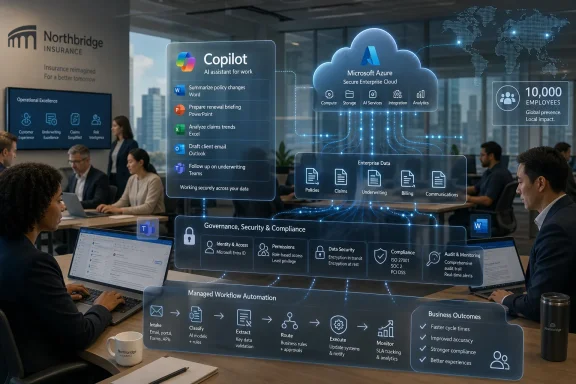
Legal & General has signed a new three-year agreement with Microsoft to expand Microsoft 365 Copilot across its 10,000 global employees and deepen its use of Azure as the UK financial services group modernises customer service, data platforms, and internal operations. The announcement is not just another enterprise AI press release; it is a marker for how Microsoft wants regulated industries to buy AI: not as a chatbot experiment, but as a cloud-and-productivity stack decision. For L&G, the bet is that generative AI becomes useful only when it is welded to the systems where employees already work and customers already wait. For Microsoft, the prize is proving that Copilot can graduate from conference-demo optimism to measurable operational change.
The first wave of enterprise generative AI was sold with the language of possibility. Every employee would have an assistant, every meeting would summarise itself, every spreadsheet would reveal insight on demand. The second wave, which L&G’s expanded Microsoft agreement exemplifies, is more prosaic and more important: procurement, migration, identity, governance, process redesign, and the willingness to put the tool in front of thousands of staff.
That shift matters because the software industry has spent two years treating AI adoption as if it were mostly a matter of access. Give users a Copilot button, the thinking went, and value would follow. In reality, large organisations are discovering that AI enablement looks suspiciously like every other difficult IT transformation: messy data, uneven workflows, nervous compliance teams, employee training gaps, and a CFO asking when the productivity promise appears in the numbers.
L&G’s announcement tries to answer that challenge by tying three things together. Microsoft 365 Copilot goes to the whole workforce. Azure continues as the destination for modernised platforms and data workloads. Customer service transformation moves from a targeted retail-business project into the wider story of how the group wants to operate.
That is the interesting part. The deal is not framed as “we bought an AI tool.” It is framed as “we are rebuilding the organisation around a Microsoft substrate.” Whether that proves wise will depend less on the glamour of generative AI than on the duller disciplines of architecture, data governance, and change management.
But the strategic centre of gravity is broader than Copilot. L&G is also expanding Azure usage to modernise its technology estate and support secure management and analysis of large volumes of data. That cloud foundation is what turns AI from a clever drafting tool into something that can plausibly reshape service operations, risk management, and business insight.
This is where Microsoft’s enterprise advantage is clearest. The company does not need to persuade L&G to adopt a separate AI universe. It can present Copilot, Azure, Dynamics 365, Power Platform, identity, security tooling, and governance as parts of a single operating model. The promise is less “AI magic” than “AI inside your existing control plane.”
That also creates lock-in of a more subtle kind. Once a firm modernises customer platforms on Dynamics, data workloads on Azure, employee workflows on Microsoft 365, and automation through Copilot-adjacent services, the switching cost becomes organisational rather than merely contractual. It is not just a software subscription; it is the shape of work.
For WindowsForum readers, this is the enterprise version of a pattern visible across Microsoft’s product strategy. Windows, Microsoft 365, Azure, Entra, Defender, Teams, and Copilot are increasingly pitched as an integrated fabric. The upside is consistency and centralised governance. The downside is that the fabric can become the architecture.
That claim deserves attention because it is more specific than the usual productivity haze. Net Promoter Score is imperfect, but it is at least tied to customer experience rather than internal enthusiasm. In regulated financial services, where customers are often calling about retirement, protection, claims, or bereavement, shaving minutes from admin and reducing repeated explanations can feel more meaningful than generating a prettier email.
The earlier phase of L&G’s Microsoft work centred on a customer-service platform built with Dynamics 365 Contact Center. The pitch was straightforward: consolidate fragmented systems into a single view of the customer, use Copilot to handle tasks such as call transcription and case summaries, and give colleagues more time for human interaction. This is exactly the use case where AI can be less gimmick than grease.
The phrase “single pane of glass” is overused in enterprise software, but in contact centres it has teeth. If an adviser must jump between multiple legacy systems while a customer explains a sensitive financial problem, the experience deteriorates for both sides. If AI can summarise prior interactions, surface relevant context, and reduce post-call wrap-up, the customer may never know a model was involved — which is probably the best outcome.
Still, the NPS claim should not be treated as a universal verdict on Copilot. Customer satisfaction can move for many reasons: staffing, process redesign, product changes, call volumes, or the consolidation of business units. The fair reading is narrower and more useful. L&G appears to be finding value where AI is embedded into a redesigned workflow, not simply handed to employees as a productivity accessory.
L&G has already been modernising parts of its estate on Azure. One Microsoft customer story from 2024 described the group moving a core retirement and retail pensions application away from a monolithic legacy architecture toward Azure SQL Database, microservices, and Azure Kubernetes Service. That project involved a highly transactional system serving hundreds of thousands of customers, with goals including safety, security, resilience, recovery, and agility.
That history matters because Copilot does not make legacy complexity disappear. If anything, AI exposes it. A model that can summarise a call is useful; a model that cannot retrieve the right customer context, respect permissions, understand product history, or avoid surfacing stale data is a liability. The value of the assistant depends on the quality of the underlying estate.
This is why Microsoft keeps pairing Copilot with Azure in enterprise announcements. Copilot is the user-facing manifestation. Azure is the plumbing, the data platform, the integration layer, and the commercial anchor. The pitch is that Microsoft can modernise the systems of record while adding AI to the systems of engagement.
There is a tension here. A regulated financial services firm wants innovation, but it also wants predictability. It wants AI-enabled insight, but not hallucinated customer advice. It wants automation, but not a black box making decisions that should remain governed by policy, law, and human judgement. The more L&G uses Microsoft’s stack to knit those demands together, the more Microsoft must prove that its governance story is as mature as its sales story.
But enterprise-wide deployment also tests a question Microsoft cannot answer with demos: how much of modern office work is actually improved by generative AI once novelty fades? A small pilot tends to attract motivated users and hand-picked scenarios. A full rollout includes the sceptics, the over-trusters, the under-trained, the casual users, and the people whose jobs do not map neatly to Copilot’s strengths.
That distinction is critical. AI tools often produce value unevenly. A project manager who spends the day in Teams, Outlook, and PowerPoint may gain hours. A specialist working in line-of-business systems may see less benefit unless Copilot connects to the right data and processes. A contact-centre colleague may benefit more from AI embedded in Dynamics than from a general-purpose assistant in Office.
L&G’s leadership is framing the rollout as a way to reduce administrative tasks, accelerate insight generation, and let colleagues focus on supporting customers. That is the correct ambition. The danger is that organisations measure Copilot success by seat deployment rather than work redesigned. A licence assigned is not a workflow improved.
Microsoft has been under pressure to show that Copilot is not merely an expensive add-on to Microsoft 365. Large deals help the narrative, especially when they involve household-name companies in regulated industries. Yet the durable proof will come from whether organisations renew, expand, and build repeatable operating metrics around AI-assisted work.
The most credible version of AI in this setting is therefore assistive rather than autonomous. It transcribes, summarises, retrieves, drafts, flags, and suggests. It gives service colleagues better context and handles the administrative residue of an interaction. It does not become the final authority on a customer’s financial life.
That line will be tested as capabilities improve. Once AI can identify sentiment, summarise thousands of conversations, detect friction points, and recommend next steps, the temptation to automate more of the interaction grows. The efficiency case will be obvious. The governance case will be harder.
Financial services firms are also dealing with stricter expectations around operational resilience, data protection, explainability, and third-party risk. A cloud-and-AI dependency is not just an IT decision; it is a board-level risk decision. The vendor’s assurances matter, but so do audit trails, access controls, data residency, incident response, model behaviour monitoring, and the ability to prove that policy was followed.
This is where Microsoft’s enterprise credibility helps. The company has spent decades selling into conservative IT environments and has built a formidable compliance and security apparatus around Microsoft 365 and Azure. But AI introduces a more dynamic risk surface. The system is not only storing and processing data; it is generating language, inferences, and recommendations that employees may act upon.
L&G’s reported use case follows that logic. Give advisers a fuller view of the customer. Reduce cutting and pasting across systems. Summarise interactions. Analyse tone and sentiment. Surface themes across thousands of conversations. Use the findings to simplify processes and improve products.
That is more convincing than the generic claim that everyone will become more productive. In customer service, the pre-AI baseline is often painfully visible: long hold times, repeated identity checks, fragmented records, inconsistent handoffs, and exhausted staff. If AI can reduce those frictions without degrading trust, the business case is stronger than in a back-office setting where productivity is harder to attribute.
There is also a Windows and endpoint angle here. AI-enabled service work still depends on reliable desktops, identity, device management, Teams, browser performance, peripheral support, and secure access to cloud services. The grand AI strategy lands on very ordinary endpoints. If the agent’s PC is slow, the headset fails, the browser session times out, or conditional access blocks the wrong workflow, the “AI transformation” becomes another helpdesk ticket.
This is why sysadmins should read announcements like L&G’s less as distant boardroom news and more as a preview of the next operational burden. AI adoption will increase dependency on identity hygiene, information architecture, endpoint telemetry, data-loss prevention, retention policies, and user training. The Copilot button is the visible part; the admin work sits underneath.
That pattern is commercially elegant. Copilot creates demand at the user level. Azure absorbs the data and application modernisation work needed to make AI useful. Dynamics and Power Platform extend the AI story into business processes. Security and compliance products reduce the perceived risk of doing all this inside one vendor ecosystem.
For customers, the attraction is speed and coherence. A company can avoid stitching together a dozen vendors for identity, productivity, cloud, AI, CRM, analytics, and governance. For Microsoft, the result is account expansion at multiple layers of the stack. For competitors, it raises the bar: it is not enough to have a better model if the enterprise buyer wants integrated controls and procurement simplicity.
The risk, again, is concentration. If a firm’s productivity layer, customer-service platform, cloud data estate, AI tooling, and security controls all lean on the same vendor, resilience planning becomes more complex. An outage, pricing shift, licensing change, or strategic product pivot has broader consequences. Microsoft’s biggest enterprise strength — integration — is also the reason IT leaders must keep a sceptical eye on dependency.
L&G’s deal therefore belongs to a larger moment in enterprise IT. The market is moving from “Which model is smartest?” to “Which platform can we govern, integrate, and afford?” Microsoft is betting that its answer is the default for organisations already living in its ecosystem.
That does not mean the investment is irrational. In a 10,000-person organisation, small time savings can become material if they are real, repeatable, and attached to high-value work. If AI reduces call wrap-up time, speeds case handling, improves first-contact resolution, or helps employees find accurate internal information faster, the returns may exceed the cost.
But productivity claims are notoriously easy to inflate. Minutes saved in a meeting summary do not automatically become revenue, margin, or better customer outcomes. Employees may use freed time for higher-value work, or the organisation may simply absorb the benefit as reduced friction. Both outcomes matter, but they are not the same.
The strongest part of L&G’s story is that it connects AI to customer experience and operational simplification, not just employee convenience. The eight-point NPS improvement in a specific business area gives the announcement more substance than a vague statement about “unlocking productivity.” Still, the long-term test will be whether such gains persist and spread across more products, teams, and geographies.
Enterprise AI needs a more honest scorecard. Adoption metrics should be paired with service metrics, quality metrics, compliance metrics, employee sentiment, incident data, and cost-to-serve. Otherwise organisations risk declaring victory because the software is deployed rather than because the work is better.
That is not a reason to avoid deployment. It is a reason to treat deployment as a governance forcing function. Before AI can safely summarise, retrieve, and reason across enterprise data, the enterprise must know what data exists, who can access it, how long it should live, and which systems are authoritative.
The same applies to endpoint management. AI workloads may live in the cloud, but user trust is built on the local experience: Windows devices that perform reliably, browsers that authenticate cleanly, Teams that does not grind through memory, and security controls that do not turn every interaction into a workaround. Copilot adoption will be judged not by architecture diagrams but by whether employees can use it without fighting the environment.
Admins should also expect a new class of support ticket. Users will ask why Copilot cannot find a document, why it cited an old version, why a summary omitted something, why access differs between colleagues, or why a generated answer looks plausible but wrong. Many of those tickets will not be AI failures in the narrow sense. They will be information-management failures wearing an AI mask.
That is the operational lesson from deals like L&G’s. AI does not eliminate the need for disciplined Microsoft 365 administration. It raises the cost of not having it.
The concrete implications are already visible.
The L&G agreement is best understood as a wager on integration: that AI becomes valuable when it is embedded in the tools employees already use, connected to the cloud platforms that hold the organisation’s data, and aimed at workflows where customers feel the difference. If that wager pays off, Microsoft will have a powerful template for regulated industries that want AI without abandoning enterprise control. If it does not, the market will learn an older lesson in a new accent: technology platforms can accelerate change, but they cannot substitute for the hard organisational work that makes change real.
 Microsoft’s AI Pitch Moves From Inspiration to Installation
The first wave of enterprise generative AI was sold with the language of possibility. Every employee would have an assistant, every meeting would summarise itself, every spreadsheet would reveal insight on demand. The second wave, which L&G’s expanded Microsoft agreement exemplifies, is more prosaic and more important: procurement, migration, identity, governance, process redesign, and the willingness to put the tool in front of thousands of staff.That shift matters because the software industry has spent two years treating AI adoption as if it were mostly a matter of access. Give users a Copilot button, the thinking went, and value would follow. In reality, large organisations are discovering that AI enablement looks suspiciously like every other difficult IT transformation: messy data, uneven workflows, nervous compliance teams, employee training gaps, and a CFO asking when the productivity promise appears in the numbers.
L&G’s announcement tries to answer that challenge by tying three things together. Microsoft 365 Copilot goes to the whole workforce. Azure continues as the destination for modernised platforms and data workloads. Customer service transformation moves from a targeted retail-business project into the wider story of how the group wants to operate.
That is the interesting part. The deal is not framed as “we bought an AI tool.” It is framed as “we are rebuilding the organisation around a Microsoft substrate.” Whether that proves wise will depend less on the glamour of generative AI than on the duller disciplines of architecture, data governance, and change management.
L&G Is Buying the Stack, Not Just the Assistant
Microsoft 365 Copilot is the headline because it is the product most employees will touch. It sits inside the everyday Microsoft 365 estate: Word, Excel, PowerPoint, Outlook, Teams, and the broader Microsoft Graph that connects documents, meetings, messages, and permissions. For a 10,000-person organisation, that ubiquity is the selling point. The assistant does not need a new destination; it arrives where the work already happens.But the strategic centre of gravity is broader than Copilot. L&G is also expanding Azure usage to modernise its technology estate and support secure management and analysis of large volumes of data. That cloud foundation is what turns AI from a clever drafting tool into something that can plausibly reshape service operations, risk management, and business insight.
This is where Microsoft’s enterprise advantage is clearest. The company does not need to persuade L&G to adopt a separate AI universe. It can present Copilot, Azure, Dynamics 365, Power Platform, identity, security tooling, and governance as parts of a single operating model. The promise is less “AI magic” than “AI inside your existing control plane.”
That also creates lock-in of a more subtle kind. Once a firm modernises customer platforms on Dynamics, data workloads on Azure, employee workflows on Microsoft 365, and automation through Copilot-adjacent services, the switching cost becomes organisational rather than merely contractual. It is not just a software subscription; it is the shape of work.
For WindowsForum readers, this is the enterprise version of a pattern visible across Microsoft’s product strategy. Windows, Microsoft 365, Azure, Entra, Defender, Teams, and Copilot are increasingly pitched as an integrated fabric. The upside is consistency and centralised governance. The downside is that the fabric can become the architecture.
The Customer-Service Story Is the Proof Microsoft Needs
The most concrete evidence in the L&G announcement comes from customer service. Microsoft says L&G’s existing collaboration has already helped deliver faster, more seamless support for more than 12 million customers. In the company’s Defined Contribution and Workplace Savings business, L&G reports an eight-point year-on-year increase in Net Promoter Score during the first quarter after giving service teams a real-time view of customer interactions and using AI to streamline processes.That claim deserves attention because it is more specific than the usual productivity haze. Net Promoter Score is imperfect, but it is at least tied to customer experience rather than internal enthusiasm. In regulated financial services, where customers are often calling about retirement, protection, claims, or bereavement, shaving minutes from admin and reducing repeated explanations can feel more meaningful than generating a prettier email.
The earlier phase of L&G’s Microsoft work centred on a customer-service platform built with Dynamics 365 Contact Center. The pitch was straightforward: consolidate fragmented systems into a single view of the customer, use Copilot to handle tasks such as call transcription and case summaries, and give colleagues more time for human interaction. This is exactly the use case where AI can be less gimmick than grease.
The phrase “single pane of glass” is overused in enterprise software, but in contact centres it has teeth. If an adviser must jump between multiple legacy systems while a customer explains a sensitive financial problem, the experience deteriorates for both sides. If AI can summarise prior interactions, surface relevant context, and reduce post-call wrap-up, the customer may never know a model was involved — which is probably the best outcome.
Still, the NPS claim should not be treated as a universal verdict on Copilot. Customer satisfaction can move for many reasons: staffing, process redesign, product changes, call volumes, or the consolidation of business units. The fair reading is narrower and more useful. L&G appears to be finding value where AI is embedded into a redesigned workflow, not simply handed to employees as a productivity accessory.
The Real AI Deployment Is a Data-Cleaning Exercise With Better Marketing
Enterprises like to talk about AI transformation because it sounds forward-looking. What they often need first is data transformation, which sounds expensive and thankless. L&G’s expanded Azure commitment is therefore more revealing than the Copilot rollout, because large-scale AI depends on the boring availability of secure, well-structured, permission-aware data.L&G has already been modernising parts of its estate on Azure. One Microsoft customer story from 2024 described the group moving a core retirement and retail pensions application away from a monolithic legacy architecture toward Azure SQL Database, microservices, and Azure Kubernetes Service. That project involved a highly transactional system serving hundreds of thousands of customers, with goals including safety, security, resilience, recovery, and agility.
That history matters because Copilot does not make legacy complexity disappear. If anything, AI exposes it. A model that can summarise a call is useful; a model that cannot retrieve the right customer context, respect permissions, understand product history, or avoid surfacing stale data is a liability. The value of the assistant depends on the quality of the underlying estate.
This is why Microsoft keeps pairing Copilot with Azure in enterprise announcements. Copilot is the user-facing manifestation. Azure is the plumbing, the data platform, the integration layer, and the commercial anchor. The pitch is that Microsoft can modernise the systems of record while adding AI to the systems of engagement.
There is a tension here. A regulated financial services firm wants innovation, but it also wants predictability. It wants AI-enabled insight, but not hallucinated customer advice. It wants automation, but not a black box making decisions that should remain governed by policy, law, and human judgement. The more L&G uses Microsoft’s stack to knit those demands together, the more Microsoft must prove that its governance story is as mature as its sales story.
Copilot at 10,000 Seats Turns Productivity Into an Organisational Experiment
Rolling out Microsoft 365 Copilot to all 10,000 L&G employees is a major internal experiment in how knowledge work changes when AI is ambient. Some gains are easy to imagine: meeting summaries, email drafting, document comparison, first-pass analysis, internal search, and quicker synthesis of scattered information. For employees buried under administrative work, those gains could be real.But enterprise-wide deployment also tests a question Microsoft cannot answer with demos: how much of modern office work is actually improved by generative AI once novelty fades? A small pilot tends to attract motivated users and hand-picked scenarios. A full rollout includes the sceptics, the over-trusters, the under-trained, the casual users, and the people whose jobs do not map neatly to Copilot’s strengths.
That distinction is critical. AI tools often produce value unevenly. A project manager who spends the day in Teams, Outlook, and PowerPoint may gain hours. A specialist working in line-of-business systems may see less benefit unless Copilot connects to the right data and processes. A contact-centre colleague may benefit more from AI embedded in Dynamics than from a general-purpose assistant in Office.
L&G’s leadership is framing the rollout as a way to reduce administrative tasks, accelerate insight generation, and let colleagues focus on supporting customers. That is the correct ambition. The danger is that organisations measure Copilot success by seat deployment rather than work redesigned. A licence assigned is not a workflow improved.
Microsoft has been under pressure to show that Copilot is not merely an expensive add-on to Microsoft 365. Large deals help the narrative, especially when they involve household-name companies in regulated industries. Yet the durable proof will come from whether organisations renew, expand, and build repeatable operating metrics around AI-assisted work.
Regulated Industries Want Human-Centred AI Because They Have No Other Choice
L&G and Microsoft are careful to describe the AI programme in human-centred terms. That is partly moral language and partly regulatory realism. In insurance, pensions, and savings, the customer interaction is often emotionally charged and financially consequential. No serious firm wants to be seen as outsourcing judgement, empathy, or accountability to a model.The most credible version of AI in this setting is therefore assistive rather than autonomous. It transcribes, summarises, retrieves, drafts, flags, and suggests. It gives service colleagues better context and handles the administrative residue of an interaction. It does not become the final authority on a customer’s financial life.
That line will be tested as capabilities improve. Once AI can identify sentiment, summarise thousands of conversations, detect friction points, and recommend next steps, the temptation to automate more of the interaction grows. The efficiency case will be obvious. The governance case will be harder.
Financial services firms are also dealing with stricter expectations around operational resilience, data protection, explainability, and third-party risk. A cloud-and-AI dependency is not just an IT decision; it is a board-level risk decision. The vendor’s assurances matter, but so do audit trails, access controls, data residency, incident response, model behaviour monitoring, and the ability to prove that policy was followed.
This is where Microsoft’s enterprise credibility helps. The company has spent decades selling into conservative IT environments and has built a formidable compliance and security apparatus around Microsoft 365 and Azure. But AI introduces a more dynamic risk surface. The system is not only storing and processing data; it is generating language, inferences, and recommendations that employees may act upon.
The Contact Centre Is Becoming the First Serious AI Workplace
The contact centre may turn out to be the proving ground for enterprise AI because it combines volume, repetition, emotion, and measurable outcomes. Calls generate transcripts. Transcripts generate summaries. Summaries generate searchable patterns. Patterns generate operational improvements. The entire workflow is a data flywheel waiting for automation.L&G’s reported use case follows that logic. Give advisers a fuller view of the customer. Reduce cutting and pasting across systems. Summarise interactions. Analyse tone and sentiment. Surface themes across thousands of conversations. Use the findings to simplify processes and improve products.
That is more convincing than the generic claim that everyone will become more productive. In customer service, the pre-AI baseline is often painfully visible: long hold times, repeated identity checks, fragmented records, inconsistent handoffs, and exhausted staff. If AI can reduce those frictions without degrading trust, the business case is stronger than in a back-office setting where productivity is harder to attribute.
There is also a Windows and endpoint angle here. AI-enabled service work still depends on reliable desktops, identity, device management, Teams, browser performance, peripheral support, and secure access to cloud services. The grand AI strategy lands on very ordinary endpoints. If the agent’s PC is slow, the headset fails, the browser session times out, or conditional access blocks the wrong workflow, the “AI transformation” becomes another helpdesk ticket.
This is why sysadmins should read announcements like L&G’s less as distant boardroom news and more as a preview of the next operational burden. AI adoption will increase dependency on identity hygiene, information architecture, endpoint telemetry, data-loss prevention, retention policies, and user training. The Copilot button is the visible part; the admin work sits underneath.
Microsoft’s UK Enterprise Campaign Is Becoming a Pattern
L&G is not an isolated Microsoft customer story. Microsoft has been steadily announcing AI collaborations with major organisations across the UK and Europe, from retailers to consultancies to financial services firms. The language varies by sector, but the pattern is consistent: Copilot for employee productivity, Azure for data and platform modernisation, industry-specific workflows for customer engagement, and governance as the reassurance layer.That pattern is commercially elegant. Copilot creates demand at the user level. Azure absorbs the data and application modernisation work needed to make AI useful. Dynamics and Power Platform extend the AI story into business processes. Security and compliance products reduce the perceived risk of doing all this inside one vendor ecosystem.
For customers, the attraction is speed and coherence. A company can avoid stitching together a dozen vendors for identity, productivity, cloud, AI, CRM, analytics, and governance. For Microsoft, the result is account expansion at multiple layers of the stack. For competitors, it raises the bar: it is not enough to have a better model if the enterprise buyer wants integrated controls and procurement simplicity.
The risk, again, is concentration. If a firm’s productivity layer, customer-service platform, cloud data estate, AI tooling, and security controls all lean on the same vendor, resilience planning becomes more complex. An outage, pricing shift, licensing change, or strategic product pivot has broader consequences. Microsoft’s biggest enterprise strength — integration — is also the reason IT leaders must keep a sceptical eye on dependency.
L&G’s deal therefore belongs to a larger moment in enterprise IT. The market is moving from “Which model is smartest?” to “Which platform can we govern, integrate, and afford?” Microsoft is betting that its answer is the default for organisations already living in its ecosystem.
The Productivity Math Remains Unfinished
The economics of Microsoft 365 Copilot remain one of the unresolved questions in enterprise software. At scale, per-user AI licensing becomes a serious recurring cost. Add Azure consumption, data services, integration work, Copilot Studio or agent development, security tooling, training, and consultancy, and the bill becomes more complicated than a neat monthly licence.That does not mean the investment is irrational. In a 10,000-person organisation, small time savings can become material if they are real, repeatable, and attached to high-value work. If AI reduces call wrap-up time, speeds case handling, improves first-contact resolution, or helps employees find accurate internal information faster, the returns may exceed the cost.
But productivity claims are notoriously easy to inflate. Minutes saved in a meeting summary do not automatically become revenue, margin, or better customer outcomes. Employees may use freed time for higher-value work, or the organisation may simply absorb the benefit as reduced friction. Both outcomes matter, but they are not the same.
The strongest part of L&G’s story is that it connects AI to customer experience and operational simplification, not just employee convenience. The eight-point NPS improvement in a specific business area gives the announcement more substance than a vague statement about “unlocking productivity.” Still, the long-term test will be whether such gains persist and spread across more products, teams, and geographies.
Enterprise AI needs a more honest scorecard. Adoption metrics should be paired with service metrics, quality metrics, compliance metrics, employee sentiment, incident data, and cost-to-serve. Otherwise organisations risk declaring victory because the software is deployed rather than because the work is better.
Windows Admins Will Inherit the Governance Problem
For IT professionals, the L&G announcement is a reminder that AI strategy quickly becomes tenant strategy. Copilot depends on permissions, identity, data boundaries, retention policies, and the quality of what Microsoft Graph can see. If an organisation has overshared SharePoint sites, stale Teams, inconsistent labelling, or weak lifecycle management, Copilot can make those problems more visible.That is not a reason to avoid deployment. It is a reason to treat deployment as a governance forcing function. Before AI can safely summarise, retrieve, and reason across enterprise data, the enterprise must know what data exists, who can access it, how long it should live, and which systems are authoritative.
The same applies to endpoint management. AI workloads may live in the cloud, but user trust is built on the local experience: Windows devices that perform reliably, browsers that authenticate cleanly, Teams that does not grind through memory, and security controls that do not turn every interaction into a workaround. Copilot adoption will be judged not by architecture diagrams but by whether employees can use it without fighting the environment.
Admins should also expect a new class of support ticket. Users will ask why Copilot cannot find a document, why it cited an old version, why a summary omitted something, why access differs between colleagues, or why a generated answer looks plausible but wrong. Many of those tickets will not be AI failures in the narrow sense. They will be information-management failures wearing an AI mask.
That is the operational lesson from deals like L&G’s. AI does not eliminate the need for disciplined Microsoft 365 administration. It raises the cost of not having it.
The L&G Deal Shows Where Enterprise AI Is Actually Headed
The most important signal in L&G’s expanded Microsoft collaboration is not that a large company is deploying Copilot. It is that the deployment is tied to cloud modernisation, customer-service redesign, and measurable experience outcomes. That is the model enterprise AI is converging on: not a standalone assistant, but a layer across productivity, data, applications, and operations.The concrete implications are already visible.
- L&G plans to continue deploying Microsoft 365 Copilot to all 10,000 employees globally under a new three-year agreement.
- The company is expanding Azure usage to modernise platforms and strengthen the data foundation behind its digital strategy.
- Its earlier Microsoft collaboration in retail customer service has supported more than 12 million customers and is associated with an eight-point year-on-year NPS rise in one workplace savings business area.
- Dynamics 365 Contact Center and Copilot-style automation show where generative AI is most credible today: reducing administrative drag around high-volume human workflows.
- The biggest risks are not only model accuracy but data governance, permissions hygiene, vendor concentration, cost control, and employee adoption.
- For Windows and Microsoft 365 administrators, enterprise AI will make identity, endpoint management, information architecture, and security policy more central rather than less.
The L&G agreement is best understood as a wager on integration: that AI becomes valuable when it is embedded in the tools employees already use, connected to the cloud platforms that hold the organisation’s data, and aimed at workflows where customers feel the difference. If that wager pays off, Microsoft will have a powerful template for regulated industries that want AI without abandoning enterprise control. If it does not, the market will learn an older lesson in a new accent: technology platforms can accelerate change, but they cannot substitute for the hard organisational work that makes change real.
References
- Primary source: Microsoft UK Stories
Published: Tue, 16 Jun 2026 06:43:25 GMT
L&G expands Microsoft AI collaboration
Legal & General (L&G) has announced a significant expansion of its relationship with Microsoft, entering a new three-year agreement to support delivery of its digital strategy.ukstories.microsoft.com - Official source: news.microsoft.com
- Official source: microsoft.com
- Official source: blogs.microsoft.com
How Microsoft’s customers and partners accelerated AI Transformation in FY25 to innovate with purpose and shape their future success - The Official Microsoft Blog
Over the past fiscal year, our customers and partners have driven pragmatic outcomes by implementing AI-first strategies across their organizations. With AI Transformation as their framework, we helped them enrich employee experiences, reinvent customer engagement, reshape business processes and...blogs.microsoft.com - Related coverage: prnewswire.co.uk
- Related coverage: uk.marketscreener.com
Legal & General : L&G announces collaboration with Microsoft to drive customer-focused AI transformation
L&G is collaborating with Microsoft to deliver an AI-powered customer service platform designed to enhance interactions for both customers and employees. The multi-year agreement...uk.marketscreener.com

- Related coverage: news.cognizant.com
Cognizant and Microsoft Expand Partnership to Advance AI Transformation and Frontier Firm Experiences - Dec 18, 2025
PDF documentnews.cognizant.com
- Related coverage: newsroom.ibm.com
IBM Consulting Collaborates with Microsoft to Help Companies Accelerate Adoption of Generative AI
PDF documentnewsroom.ibm.com
- Official source: info.microsoft.com