

The Houses of the Oireachtas has moved its telephone system onto Microsoft Teams as part of a wider Microsoft-based communications stack in Leinster House, even as Ireland and other EU states publicly commit to reducing strategic dependence on non-European digital infrastructure. The timing is the story. Dublin is not merely swapping desk phones for headsets; it is choosing a cloud-era dependency at the precise moment Europe has begun treating such dependencies as political risk.
That does not make the Oireachtas reckless by default. Microsoft Teams telephony is now ordinary enterprise plumbing, and public bodies have good reasons to consolidate email, messaging, meetings, files, identity, and calling into one managed environment. But the controversy around the move shows how quickly “IT modernisation” has become a proxy fight over sovereignty, sanctions, procurement inertia, cybersecurity, and the uncomfortable fact that parliaments now run on someone else’s platform.
The old office landline was a simple symbol of institutional continuity. It rang, it sat on a desk, and it implied that parliament had its own machinery humming somewhere in the background. The shift to Teams breaks that mental model. A “phone system” is no longer a phone system in the older sense; it is a layer inside a productivity suite, mediated by accounts, licences, identity policies, endpoints, internet connectivity, and a vendor’s global service architecture.
That is why the comments from Sinn Féin TD Máire Devine land with more force than a normal complaint about workplace software. “Is it a telephone?” is not a naïve question. It is the kind of question that exposes how institutions often migrate to cloud platforms faster than their users, elected representatives, and sometimes even their oversight structures can develop a vocabulary for what has changed.
The Oireachtas had already been living in Microsoft’s world. Email, document storage, internal messaging, Windows devices, Outlook, Office, and Teams are not exotic tools in public administration; they are the default office environment across much of Europe. What changed with telephony is that another formerly distinct channel of institutional communication appears to have been folded into the same stack.
For IT departments, that consolidation can look like discipline. Fewer systems, fewer contracts, one user directory, one support model, one security and compliance framework. For legislators and sovereignty advocates, the same consolidation can look like a narrowing of institutional escape routes.
This is the productivity-suite bargain in its purest form. Microsoft sells integration, and integration is genuinely useful. A call becomes a Teams presence state, a meeting invite becomes a calendar item, a recording becomes a file, a file becomes a searchable asset, and the identity system decides who may touch what.
The same integration also creates a dependency map that is difficult to reverse. Once staff workflows, records, contacts, meetings, phone numbers, security policies, and user habits are wrapped around one vendor’s ecosystem, “switching away” stops being a procurement exercise and becomes an institutional transplant.
That is why Labour Senator Alice-Mary Higgins’ concern about “so many systems dependent on a single provider” deserves to be read as more than anti-Microsoft sentiment. The specific vendor matters, but the architectural pattern matters more. A parliament that relies on any single cloud provider for too many critical functions is making an implicit continuity bet: that the provider, the provider’s home jurisdiction, the provider’s legal obligations, the provider’s security posture, and the provider’s commercial incentives will remain aligned with the institution’s needs.
That is a lot to ask of an office suite.
Ireland’s signing of the Declaration for European Digital Sovereignty placed it inside that policy current. The declaration’s language is not isolationist. It does not say European governments must abandon every American platform, nor could it plausibly do so without causing chaos. Its more careful argument is that Europe should have the ability to choose, act, and govern autonomously in digital infrastructure.
That distinction matters because critics of sovereignty talk often caricature it as autarky in a hoodie. The real debate is less theatrical. It asks whether critical public institutions can tolerate deep reliance on providers that are subject to foreign law, foreign sanctions regimes, foreign intelligence demands, and foreign political volatility.
The Oireachtas migration to Teams telephony sits awkwardly inside that debate. Ireland says, at the European level, that strategic autonomy matters. Its parliament, at the operational level, appears to be deepening reliance on a US hyperscaler for the everyday communications of elected officials and staff.
That contradiction may be explainable. It is not yet reassuring.
European officials, public-sector buyers, and security professionals saw the scenario they had long treated as theoretical: a legal order in one jurisdiction affecting the digital working life of an international institution in another. Whether one frames the ICC episode as sanctions compliance, account disruption, legal misreporting, or a communications crisis, it made the risk legible to non-specialists.
That is why the episode keeps surfacing in debates far beyond The Hague. It gave digital sovereignty advocates a narrative with a beginning, middle, and moral. A US platform serves a European or international body; US political action targets a person or institution; access to a critical communications service becomes uncertain; European officials ask whether “cloud” has quietly become a remote-control dependency.
Microsoft’s denial is important, and responsible analysis should not flatten the case into a slogan. But denial does not dissolve the broader concern. Even if Microsoft did everything legally and contractually required, the incident still exposed the uncomfortable overlap between vendor control, legal jurisdiction, and institutional continuity.
For parliaments, courts, regulators, and defence bodies, that overlap is not academic. It is the threat model.
Those assurances are part of why Microsoft remains dominant in government. It has a mature enterprise compliance story, a deep public-sector sales apparatus, strong identity tooling, extensive documentation, and the practical advantage of being already installed almost everywhere. For a public-sector CIO, choosing Microsoft is rarely the risky career move. Choosing something else often is.
But Microsoft’s very strength is the issue. The company is so embedded, so capable, and so operationally convenient that institutions can drift from vendor adoption into vendor dependence without ever making a single dramatic decision. Every individual migration has a business case. The cumulative result can be a public administration whose ability to communicate, authenticate, collaborate, archive, and recover is bound to one commercial ecosystem.
This is the paradox of modern enterprise IT. The safest short-term choice can become the largest long-term concentration risk.
The argument is not that Microsoft is uniquely malign. In many categories, it may be better governed and more transparent than smaller alternatives. The argument is that a parliament should not confuse supplier competence with institutional sovereignty.
The cybersecurity critique is the easiest to understand because it maps to incidents. Microsoft’s cloud services, identity systems, and collaboration tools are constant targets because they are everywhere. A vulnerability, misconfiguration, credential compromise, or abuse of a feature in such an environment can have systemic consequences across organisations.
The sovereignty critique is subtler. It asks not just whether attackers can break in, but who ultimately controls the service, which laws can compel action, how resilient the institution is to vendor decisions, and whether it has a credible exit path. This is where the telephony shift matters. Phones may seem mundane, but voice communications are part of institutional continuity during crises.
The privacy critique is different again. Public representatives handle sensitive constituent data, political correspondence, legal documents, whistleblower material, and internal parliamentary communications. Even when data is processed lawfully, centralising so much of it within one vendor ecosystem increases the importance of permissions hygiene, auditability, retention policy, and human training.
The Oireachtas does not need to prove that Microsoft Teams is dangerous before asking whether this concentration is wise. In critical institutions, the burden should not be “show us the breach.” It should be “show us the resilience plan.”
That is precisely why AI assistants are both tempting and worrying. In a well-governed environment, they can surface documents, summarise meetings, draft correspondence, and reduce administrative burden. In a poorly governed environment, they can expose permissions mistakes, amplify data sprawl, and make it easier for users to retrieve information they technically had access to but would never realistically have found.
The reported use of Copilot licences in Dublin City Council and trials of Copilot Chat in a government department show that Ireland’s public sector is already experimenting with this layer. The question is no longer whether generative AI will enter public administration. It is whether it will enter as a carefully governed capability or as the next default feature switched on inside an already dominant vendor environment.
This matters for the Oireachtas even if individual TD offices are not using Copilot today. Once a Microsoft-based communications and documents estate is normalised, the path to AI adoption becomes shorter. The vendor can offer productivity gains on top of the existing stack, and procurement officials can present AI as an incremental upgrade rather than a separate strategic decision.
That is how platform dependence compounds. First comes email. Then files. Then chat. Then meetings. Then phones. Then AI.
Sceptics are right to point out that open source is not pixie dust. A parliament cannot simply replace Microsoft 365 with a Git repository and a patriotic speech. It needs support contracts, security patching, accessibility compliance, mobile support, records management, e-discovery, identity integration, training, procurement frameworks, and reliability at political speed.
But open source changes the bargaining position. It can reduce vendor lock-in, allow independent security review, support local service providers, and give public bodies more control over the direction of the software they rely on. It also makes exit strategies more plausible because the code, standards, and data formats are less tightly bound to one supplier’s commercial roadmap.
The hardest part is not technical. It is institutional. Microsoft wins not only because its products work, but because they match the habits, risk tolerance, and procurement culture of large organisations. Alternatives must compete not just with software features but with decades of administrative muscle memory.
If Europe wants sovereignty, it must fund boring excellence: migration tools, training, help desks, compliance templates, interoperability testing, and long-term maintenance. Otherwise “use European alternatives” will remain a slogan deployed against every Microsoft renewal and defeated by every deadline.
This is why the absence of a clear public explanation from the Oireachtas matters. A migration of parliamentary telephony into Teams may be entirely defensible, but a public institution should be able to say why it was done, what alternatives were assessed, what risks were considered, and what exit plan exists if the strategic environment changes.
That explanation is especially important because the Oireachtas is not an ordinary office park. It is the national legislature. Its communications systems support democratic work, political opposition, constituency service, committee scrutiny, and government accountability. The threshold for transparency should be higher than “this is what enterprise IT does now.”
Procurement documents often reduce these questions to cost, functionality, support, and implementation timeline. Those criteria remain necessary, but they are no longer sufficient. The modern public-sector technology decision must include jurisdictional exposure, supplier concentration, resilience under sanctions, interoperability, auditability, and reversibility.
If those categories sound political, that is because infrastructure is political now.
The strongest case against it is optionality. Once voice becomes another Microsoft workload, the Oireachtas has fewer independent levers. A Microsoft outage, licensing dispute, security incident, account problem, policy change, or legal compulsion could affect multiple communications channels at once. That is concentration risk in its plainest form.
Good architecture does not require rejecting cloud services. It requires designing so that no single failure mode takes down too much of the institution. In a parliamentary context, that could mean independent emergency communications, documented fallback channels, exportable records, multi-vendor continuity planning, and periodic testing of how quickly essential work could continue if a core provider were impaired.
This is where sovereignty becomes practical rather than ideological. The question is not “Microsoft or Europe?” It is “Can the Oireachtas operate if Microsoft is unavailable, constrained, compromised, or politically complicated?” If the answer is vague, the migration is incomplete.
A phone system is a good place to start asking because everyone understands what it means when the phones do not work.
The most concrete lessons are not abstract. They are operational, testable, and overdue.
The Oireachtas’ move to Teams telephony may turn out to be a competent modernisation project wrapped in bad timing. But bad timing can be clarifying. Europe is learning that digital sovereignty is not declared in Berlin and then delegated to default settings in Dublin; it is built, contract by contract and fallback plan by fallback plan, before the day an institution discovers that the phone it no longer owns is also the phone it cannot afford to lose.
That does not make the Oireachtas reckless by default. Microsoft Teams telephony is now ordinary enterprise plumbing, and public bodies have good reasons to consolidate email, messaging, meetings, files, identity, and calling into one managed environment. But the controversy around the move shows how quickly “IT modernisation” has become a proxy fight over sovereignty, sanctions, procurement inertia, cybersecurity, and the uncomfortable fact that parliaments now run on someone else’s platform.
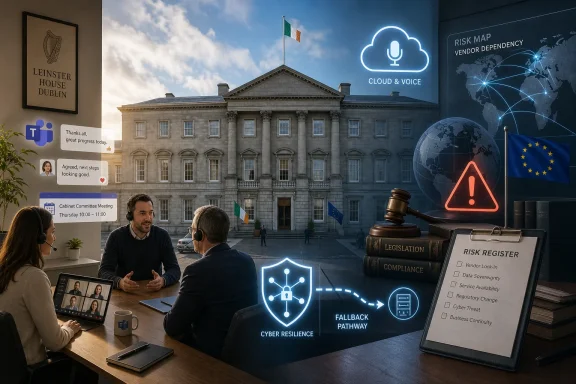 Leinster House Discovers the Phone Is Now a Cloud Service
The old office landline was a simple symbol of institutional continuity. It rang, it sat on a desk, and it implied that parliament had its own machinery humming somewhere in the background. The shift to Teams breaks that mental model. A “phone system” is no longer a phone system in the older sense; it is a layer inside a productivity suite, mediated by accounts, licences, identity policies, endpoints, internet connectivity, and a vendor’s global service architecture.That is why the comments from Sinn Féin TD Máire Devine land with more force than a normal complaint about workplace software. “Is it a telephone?” is not a naïve question. It is the kind of question that exposes how institutions often migrate to cloud platforms faster than their users, elected representatives, and sometimes even their oversight structures can develop a vocabulary for what has changed.
The Oireachtas had already been living in Microsoft’s world. Email, document storage, internal messaging, Windows devices, Outlook, Office, and Teams are not exotic tools in public administration; they are the default office environment across much of Europe. What changed with telephony is that another formerly distinct channel of institutional communication appears to have been folded into the same stack.
For IT departments, that consolidation can look like discipline. Fewer systems, fewer contracts, one user directory, one support model, one security and compliance framework. For legislators and sovereignty advocates, the same consolidation can look like a narrowing of institutional escape routes.
The Desk Phone Was Never the Point
The physical disappearance of landlines is the least important part of the story. The more consequential change is that communications once split across different technical and contractual systems are increasingly becoming features of a single cloud platform. That platform is not merely a tool used by the Oireachtas; it becomes the environment inside which parliamentary work happens.This is the productivity-suite bargain in its purest form. Microsoft sells integration, and integration is genuinely useful. A call becomes a Teams presence state, a meeting invite becomes a calendar item, a recording becomes a file, a file becomes a searchable asset, and the identity system decides who may touch what.
The same integration also creates a dependency map that is difficult to reverse. Once staff workflows, records, contacts, meetings, phone numbers, security policies, and user habits are wrapped around one vendor’s ecosystem, “switching away” stops being a procurement exercise and becomes an institutional transplant.
That is why Labour Senator Alice-Mary Higgins’ concern about “so many systems dependent on a single provider” deserves to be read as more than anti-Microsoft sentiment. The specific vendor matters, but the architectural pattern matters more. A parliament that relies on any single cloud provider for too many critical functions is making an implicit continuity bet: that the provider, the provider’s home jurisdiction, the provider’s legal obligations, the provider’s security posture, and the provider’s commercial incentives will remain aligned with the institution’s needs.
That is a lot to ask of an office suite.
Europe’s Sovereignty Debate Has Moved from Slogan to Procurement
For years, “digital sovereignty” sounded like Brussels vocabulary: broad enough to mean infrastructure resilience, industrial policy, data protection, competition policy, cyber defence, and a general desire not to be technologically subordinate to the United States or China. In 2025 and 2026, the term became sharper. It now increasingly means the ability of governments to keep functioning when technology supply chains become instruments of geopolitics.Ireland’s signing of the Declaration for European Digital Sovereignty placed it inside that policy current. The declaration’s language is not isolationist. It does not say European governments must abandon every American platform, nor could it plausibly do so without causing chaos. Its more careful argument is that Europe should have the ability to choose, act, and govern autonomously in digital infrastructure.
That distinction matters because critics of sovereignty talk often caricature it as autarky in a hoodie. The real debate is less theatrical. It asks whether critical public institutions can tolerate deep reliance on providers that are subject to foreign law, foreign sanctions regimes, foreign intelligence demands, and foreign political volatility.
The Oireachtas migration to Teams telephony sits awkwardly inside that debate. Ireland says, at the European level, that strategic autonomy matters. Its parliament, at the operational level, appears to be deepening reliance on a US hyperscaler for the everyday communications of elected officials and staff.
That contradiction may be explainable. It is not yet reassuring.
The ICC Case Turned a Legal Abstraction into a Boardroom Scenario
The International Criminal Court became the defining cautionary tale because it made the sovereignty problem feel concrete. After US sanctions targeted the court’s chief prosecutor, Karim Khan, reporting indicated that his Microsoft email access was disrupted, while Microsoft later said it had not ceased or suspended services to the ICC. The exact operational details remain contested, but the political effect was unmistakable.European officials, public-sector buyers, and security professionals saw the scenario they had long treated as theoretical: a legal order in one jurisdiction affecting the digital working life of an international institution in another. Whether one frames the ICC episode as sanctions compliance, account disruption, legal misreporting, or a communications crisis, it made the risk legible to non-specialists.
That is why the episode keeps surfacing in debates far beyond The Hague. It gave digital sovereignty advocates a narrative with a beginning, middle, and moral. A US platform serves a European or international body; US political action targets a person or institution; access to a critical communications service becomes uncertain; European officials ask whether “cloud” has quietly become a remote-control dependency.
Microsoft’s denial is important, and responsible analysis should not flatten the case into a slogan. But denial does not dissolve the broader concern. Even if Microsoft did everything legally and contractually required, the incident still exposed the uncomfortable overlap between vendor control, legal jurisdiction, and institutional continuity.
For parliaments, courts, regulators, and defence bodies, that overlap is not academic. It is the threat model.
Microsoft’s Best Argument Is Also Its Weakness
Microsoft’s defence is familiar and not frivolous. The company says its products are tested, GDPR-compliant, governed by contractual safeguards, and designed to give customers control over data management. It says it does not give governments direct, unfettered access to customer data and that requests are reviewed for legal validity, necessity, and scope.Those assurances are part of why Microsoft remains dominant in government. It has a mature enterprise compliance story, a deep public-sector sales apparatus, strong identity tooling, extensive documentation, and the practical advantage of being already installed almost everywhere. For a public-sector CIO, choosing Microsoft is rarely the risky career move. Choosing something else often is.
But Microsoft’s very strength is the issue. The company is so embedded, so capable, and so operationally convenient that institutions can drift from vendor adoption into vendor dependence without ever making a single dramatic decision. Every individual migration has a business case. The cumulative result can be a public administration whose ability to communicate, authenticate, collaborate, archive, and recover is bound to one commercial ecosystem.
This is the paradox of modern enterprise IT. The safest short-term choice can become the largest long-term concentration risk.
The argument is not that Microsoft is uniquely malign. In many categories, it may be better governed and more transparent than smaller alternatives. The argument is that a parliament should not confuse supplier competence with institutional sovereignty.
Security Is Not the Same Thing as Sovereignty
Some criticism of Microsoft collapses three separate issues into one: cybersecurity, privacy, and sovereignty. They overlap, but they are not identical. A service can be secure in the engineering sense and still raise sovereignty concerns. A service can store data in Europe and still be subject to legal processes elsewhere. A service can satisfy GDPR paperwork and still be strategically uncomfortable for a legislature.The cybersecurity critique is the easiest to understand because it maps to incidents. Microsoft’s cloud services, identity systems, and collaboration tools are constant targets because they are everywhere. A vulnerability, misconfiguration, credential compromise, or abuse of a feature in such an environment can have systemic consequences across organisations.
The sovereignty critique is subtler. It asks not just whether attackers can break in, but who ultimately controls the service, which laws can compel action, how resilient the institution is to vendor decisions, and whether it has a credible exit path. This is where the telephony shift matters. Phones may seem mundane, but voice communications are part of institutional continuity during crises.
The privacy critique is different again. Public representatives handle sensitive constituent data, political correspondence, legal documents, whistleblower material, and internal parliamentary communications. Even when data is processed lawfully, centralising so much of it within one vendor ecosystem increases the importance of permissions hygiene, auditability, retention policy, and human training.
The Oireachtas does not need to prove that Microsoft Teams is dangerous before asking whether this concentration is wise. In critical institutions, the burden should not be “show us the breach.” It should be “show us the resilience plan.”
The AI Layer Raises the Stakes Because It Feeds on the Stack
The Copilot angle is not a side plot. Microsoft’s AI strategy depends on the same consolidation that makes Teams telephony attractive. The more work an organisation does inside Microsoft 365, the more valuable Copilot becomes, because it can sit across email, files, chats, meetings, calendars, and organisational knowledge.That is precisely why AI assistants are both tempting and worrying. In a well-governed environment, they can surface documents, summarise meetings, draft correspondence, and reduce administrative burden. In a poorly governed environment, they can expose permissions mistakes, amplify data sprawl, and make it easier for users to retrieve information they technically had access to but would never realistically have found.
The reported use of Copilot licences in Dublin City Council and trials of Copilot Chat in a government department show that Ireland’s public sector is already experimenting with this layer. The question is no longer whether generative AI will enter public administration. It is whether it will enter as a carefully governed capability or as the next default feature switched on inside an already dominant vendor environment.
This matters for the Oireachtas even if individual TD offices are not using Copilot today. Once a Microsoft-based communications and documents estate is normalised, the path to AI adoption becomes shorter. The vendor can offer productivity gains on top of the existing stack, and procurement officials can present AI as an incremental upgrade rather than a separate strategic decision.
That is how platform dependence compounds. First comes email. Then files. Then chat. Then meetings. Then phones. Then AI.
Open Source Is Not a Magic Exit, but It Changes the Bargaining Position
The French and German examples have become rallying points because they suggest that European public administration can at least try to build alternatives. Linux desktops, open-source office suites, sovereign collaboration platforms, and national cloud initiatives are not new ideas. What is new is the geopolitical urgency attached to them.Sceptics are right to point out that open source is not pixie dust. A parliament cannot simply replace Microsoft 365 with a Git repository and a patriotic speech. It needs support contracts, security patching, accessibility compliance, mobile support, records management, e-discovery, identity integration, training, procurement frameworks, and reliability at political speed.
But open source changes the bargaining position. It can reduce vendor lock-in, allow independent security review, support local service providers, and give public bodies more control over the direction of the software they rely on. It also makes exit strategies more plausible because the code, standards, and data formats are less tightly bound to one supplier’s commercial roadmap.
The hardest part is not technical. It is institutional. Microsoft wins not only because its products work, but because they match the habits, risk tolerance, and procurement culture of large organisations. Alternatives must compete not just with software features but with decades of administrative muscle memory.
If Europe wants sovereignty, it must fund boring excellence: migration tools, training, help desks, compliance templates, interoperability testing, and long-term maintenance. Otherwise “use European alternatives” will remain a slogan deployed against every Microsoft renewal and defeated by every deadline.
Procurement Inertia Is the Quiet Power in the Room
Public bodies rarely choose dependence in a single meeting. They inherit it. A department standardises on Windows, then Exchange, then Office, then Teams, then Microsoft 365 security tooling, then Azure integrations, then voice, then AI. Each step is rational. The aggregate is destiny.This is why the absence of a clear public explanation from the Oireachtas matters. A migration of parliamentary telephony into Teams may be entirely defensible, but a public institution should be able to say why it was done, what alternatives were assessed, what risks were considered, and what exit plan exists if the strategic environment changes.
That explanation is especially important because the Oireachtas is not an ordinary office park. It is the national legislature. Its communications systems support democratic work, political opposition, constituency service, committee scrutiny, and government accountability. The threshold for transparency should be higher than “this is what enterprise IT does now.”
Procurement documents often reduce these questions to cost, functionality, support, and implementation timeline. Those criteria remain necessary, but they are no longer sufficient. The modern public-sector technology decision must include jurisdictional exposure, supplier concentration, resilience under sanctions, interoperability, auditability, and reversibility.
If those categories sound political, that is because infrastructure is political now.
The Real Choice Is Between Convenience and Optionality
The strongest case for Teams telephony is convenience. Users already have Teams. IT already manages Microsoft identities. Support teams already understand the environment. Calls, meetings, chat, and presence can be unified. Legacy phone systems are expensive, ageing, and increasingly awkward to maintain.The strongest case against it is optionality. Once voice becomes another Microsoft workload, the Oireachtas has fewer independent levers. A Microsoft outage, licensing dispute, security incident, account problem, policy change, or legal compulsion could affect multiple communications channels at once. That is concentration risk in its plainest form.
Good architecture does not require rejecting cloud services. It requires designing so that no single failure mode takes down too much of the institution. In a parliamentary context, that could mean independent emergency communications, documented fallback channels, exportable records, multi-vendor continuity planning, and periodic testing of how quickly essential work could continue if a core provider were impaired.
This is where sovereignty becomes practical rather than ideological. The question is not “Microsoft or Europe?” It is “Can the Oireachtas operate if Microsoft is unavailable, constrained, compromised, or politically complicated?” If the answer is vague, the migration is incomplete.
A phone system is a good place to start asking because everyone understands what it means when the phones do not work.
Dublin’s Microsoft Bet Now Needs a Public Risk Register
The Oireachtas does not need to perform a dramatic U-turn to take the criticism seriously. It needs to treat the Teams telephony move as a trigger for a broader dependency audit. That audit should not be a vendor-bashing exercise. It should be a sober map of which parliamentary functions depend on which providers, which jurisdictions apply, which contractual protections exist, and how quickly the institution could move if it had to.The most concrete lessons are not abstract. They are operational, testable, and overdue.
- The Oireachtas should publish a plain-English rationale for moving telephony into Teams, including what alternatives were considered and how security, resilience, and sovereignty risks were assessed.
- Parliamentary communications should have documented fallback channels that do not depend on the same Microsoft tenant, identity layer, or internet path as day-to-day Teams use.
- Any expansion of Copilot or similar AI tools should be treated as a separate governance decision, not as a routine feature upgrade inside Microsoft 365.
- Ireland’s commitment to European digital sovereignty should be reflected in procurement scoring, including interoperability, reversibility, and supplier concentration.
- The Oireachtas should maintain an exit strategy that is tested often enough to be credible, because an untested exit strategy is only a slide in a risk presentation.
The Oireachtas’ move to Teams telephony may turn out to be a competent modernisation project wrapped in bad timing. But bad timing can be clarifying. Europe is learning that digital sovereignty is not declared in Berlin and then delegated to default settings in Dublin; it is built, contract by contract and fallback plan by fallback plan, before the day an institution discovers that the phone it no longer owns is also the phone it cannot afford to lose.
References
- Primary source: Dublin InQuirer
Published: Tue, 30 Jun 2026 23:20:20 GMT
The Oireachtas leans into Microsoft for its comms, even as other European governments retreat
Switching to the US big tech provider, for phone systems and more, comes at a time of fierce debate about tech sovereignty. www.dublininquirer.com
- Related coverage: gov.ie
Ireland signs Declaration for European Digital Sovereignty
The Declaration establishes a common framework for enhancing Europe's digital capabilities while preserving access to open markets, interoperability, and international collaboration with partners who share European valueswww.gov.ie - Related coverage: techzine.eu
Microsoft denies having suspended any services to ICC - Techzine Global
Microsoft denies stopping services to ICC after sanctions. European concerns about dependence on US tech are growing. www.techzine.eu
- Related coverage: heise.de
Microsoft denies mail blockade at the International Criminal Court | heise online
Microsoft has neither discontinued nor suspended its services to the International Criminal Court, claims Microsoft's president, Brad Smith. www.heise.de
- Official source: blogs.microsoft.com
One year on: Progress on our European digital commitments - Microsoft On the Issues
Microsoft reflects on a year of progress across Europe, scaling AI infrastructure and reinforcing data protection and cyber resilience.blogs.microsoft.com - Related coverage: techradar.com
The International Criminal Court is ditching Microsoft software for an open source alternative | TechRadar
The ICC says it has become too dependent on US techwww.techradar.com
- Related coverage: techzine.nl
Microsoft ontkent diensten ICC te hebben gestopt - Techzine.nl
Microsoft ontkent services ICC te stoppen na sancties. Europese zorgen over afhankelijkheid Amerikaanse tech groeien. www.techzine.nl
- Related coverage: techspot.com
The International Criminal Court is replacing Microsoft Office with "sovereign" EU suite OpenDesk | TechSpot
The International Criminal Court (ICC), based in The Hague, is shifting from Microsoft Office to a European alternative. The organization confirmed it will adopt the OpenDesk platform...www.techspot.com - Related coverage: dutchitleaders.nl
Dutch IT Leaders - ICC-hoofdaanklager Karim Khan kan na sancties niet meer bij Microsoft mailaccount
ICC-hoofdaanklager Karim Khan kan na sancties niet meer bij Microsoft mailaccount www.dutchitleaders.nl
- Related coverage: data.oireachtas.ie
