

Lexar’s CES 2026 showcase makes one thing clear: the brand that helped define flash memory performance three decades ago is positioning itself for the AI era by pairing familiar consumer products — microSD cards, portable SSDs, and DRAM/TLC NVMe drives — with a new strategic layer Lexar calls AI Storage Core. The company walked the show floor with headline-grabbing hardware like a 2 TB UHS‑I microSD card it calls Professional SILVER PLUS, ultra‑light portable SSDs, a family of PCIe Gen4 NVMe drives aimed at gamers and creators, and a marketing roadmap for “AI‑grade” storage modules intended for edge and client AI workloads. Lexar’s messaging and product highlights indicate a shift from incremental speed wars toward storage products explicitly tailored for on‑device inference, imaging pipelines, and fast, reliable local storage for AI‑enriched PCs and devices.
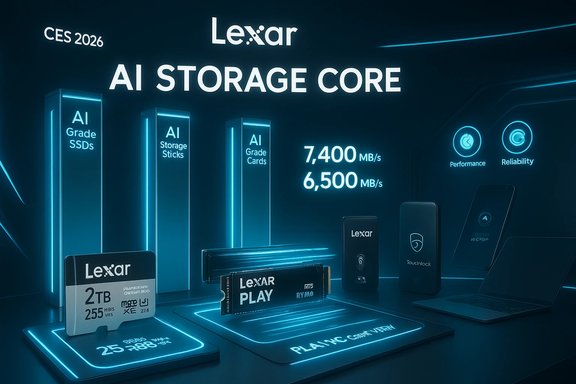
Lexar’s CES presence in 2026 built on a familiar formula: announce incremental product refinements while launching a higher‑level platform narrative. The company used CES to introduce the AI Storage Core—a mission statement and product taxonomy that groups future offerings into AI‑Grade SSDs, AI‑Grade Storage Sticks, and AI‑Grade Cards aimed at devices that must feed local compute and sensors with low‑latency persistent storage. That roadmap is deliberately broad: it reaches from gaming and creator rigs to autonomous sensors and intelligent robotics. Lexar’s official materials describe the AI Storage Core as focused on three pillars: performance, reliability, and flexibility. This move is not taking place in a vacuum. CES 2026 also illustrated a wider industry trend: storage vendors and OEMs are designing components with on‑device AI workloads in mind, balancing throughput, power, and thermal envelopes for thin laptops, handheld consoles, and edge sensors rather than only desktop gaming rigs or data‑center arrays. That macro trend—Gen5/Gen4 throughput improvements, DRAMless controller advances, and NPU-led device architectures—shaped the conversations Lexar tied its announcements to at the show.
Two important technical notes for buyers and IT pros:
Acknowledging the pace of CES announcements, readers should expect detailed reviews and firmware disclosures to follow product availability; those will be the true tests of whether Lexar’s AI‑grade ambitions translate into usable, durable storage for the next generation of AI‑enabled Windows PCs, handhelds, and edge devices.
Source: TechPowerUp Lexar Shows SSDs, Memory, MicroSD Cards, and AI Vision at CES 2026 | TechPowerUp}
 Background / Overview
Lexar’s CES presence in 2026 built on a familiar formula: announce incremental product refinements while launching a higher‑level platform narrative. The company used CES to introduce the AI Storage Core—a mission statement and product taxonomy that groups future offerings into AI‑Grade SSDs, AI‑Grade Storage Sticks, and AI‑Grade Cards aimed at devices that must feed local compute and sensors with low‑latency persistent storage. That roadmap is deliberately broad: it reaches from gaming and creator rigs to autonomous sensors and intelligent robotics. Lexar’s official materials describe the AI Storage Core as focused on three pillars: performance, reliability, and flexibility. This move is not taking place in a vacuum. CES 2026 also illustrated a wider industry trend: storage vendors and OEMs are designing components with on‑device AI workloads in mind, balancing throughput, power, and thermal envelopes for thin laptops, handheld consoles, and edge sensors rather than only desktop gaming rigs or data‑center arrays. That macro trend—Gen5/Gen4 throughput improvements, DRAMless controller advances, and NPU-led device architectures—shaped the conversations Lexar tied its announcements to at the show.What Lexar showed at CES 2026 — the product highlights
Lexar’s booth showcased a mix of tangible products and aspirational platform messaging. The most newsworthy product claims were specific and repeatable; others remain conceptual or high level.Flagship device highlights
- Lexar Professional SILVER PLUS microSDXC (2 TB, UHS‑I) — Marketed as “the world’s fastest 2 TB UHS‑I microSD card,” Lexar lists peak read speeds up to 255 MB/s and write speeds up to 180 MB/s, positioning the card for drone and action‑camera workflows and 4K60P capture. The company emphasized improved durability for outdoor use.
- Lexar PLAY X PCIe 4.0 NVMe SSD — Aimed at gamers and creators, the PLAY X claims up to 7,400 MB/s sequential read and 6,500 MB/s sequential write for PCIe Gen4 systems, delivering a high throughput option without requiring Gen5 hardware.
- Lexar TouchLock Portable SSD — Not a raw performance play but a security/convenience product: TouchLock was showcased with an NFC‑based unlock scheme paired with hardware encryption. Lexar describes it as featuring NFC authentication and 128‑bit AES hardware encryption, along with smartphone‑triggered automatic photo backups. The product has a magnetic design that attaches to host devices and supports quick access workflows.
- Lexar Air Portable SSD — A striking aesthetic and portability statement: Lexar advertises this drive at just 0.6 oz (~17 grams), pairing an ultra‑light physical profile with app‑driven automatic backup features for mobile creators.
- AI Storage Core (strategic platform) — Beyond stand‑alone products, Lexar publicly outlined three “AI‑grade” hardware families: AI‑Grade SSDs (internal NVMe for AI PCs), AI‑Grade Storage Sticks (instant expansion modules), and AI‑Grade Cards (for 8K AI imaging and sensor fusion). Details such as controller architecture, NAND types, endurance (TBW), or host integration requirements were not specified in product detail pages at CES; Lexar framed these as upcoming product directions.
Additional booth notes and partnerships
Lexar also announced a high‑visibility global partnership with the Argentina national football team and teased co‑branded special editions of portable SSDs slated for H1 2026—an early indicator Lexar is blending consumer lifestyle marketing with its product strategy.Technical verification — what Lexar actually published vs. what remains promotional
When evaluating CES announcements it’s important to separate firm product specifications from marketing language. Lexar published concrete peak numbers for several products; those figures were repeated across multiple trade outlets and in Lexar’s press materials. Key, verifiable technical claims include the microSD peak I/O numbers (255 MB/s read, 180 MB/s write) and the PLAY X PCIe Gen4 sequential numbers. These are present in Lexar’s official product announcement and were echoed by independent coverage. However, the AI Storage Core initiative is mostly a platform narrative at this stage. Lexar’s announcement names product categories and target workloads (AI PCs, 8K imaging, sensor fusion), but it does not publish the detailed specifications that would let engineers and integrators evaluate suitability for model inference, dataset staging, or high‑velocity telemetry capture. There are no published TBW/endurance tables, no explicit NAND technology calls (e.g., TLC vs QLC vs G9/G10), and no controller part numbers tied to the AI‑grade roadmap in the CES materials. Those gaps mean performance and longevity claims for the AI‑grade category are, at present, aspirational until Lexar publishes concrete specs or third‑party benchmarks.Why the microSD and portable SSD announcements matter — practical implications
The microSD and portable SSD segments remain high‑volume, consumer‑visible markets. A credible, high‑speed 2 TB UHS‑I microSD card does two things: it raises the ceiling for device designers who want large local media capacity (drones, cinema‑grade action cameras, handheld gaming consoles that accept microSD), and it blurs the historic line between compact removable media and low‑latency local storage.- For photographers and videographers, a 2 TB microSD at UHS‑I speeds simplifies day‑long capture without swapping cards. That matters for field workflows and rapid offload scenarios. The card’s claimed 255 MB/s read speed and 180 MB/s write speed are high for UHS‑I and should enable sustained 4K60 capture on compatible devices, though real‑world sustained write performance depends on host device implementation and buffer handling.
- For mobile creators and journalists, an ultra‑light portable SSD with smartphone backup support presents an attractive backup/transfer path that integrates with a modern smartphone workflow—particularly when paired with automatic backup via a vendor app. Lexar’s Air Portable SSD is effectively an exercise in lowering physical friction for content capture.
- For gamers, the PLAY X’s PCIe Gen4 throughput is a straight performance play. While Gen5 is getting traction elsewhere, high bandwidth Gen4 drives remain well‑matched to a vast installed base of motherboards and consoles that don’t yet support Gen5 modules. The PLAY X’s claimed sequential numbers would position it near the high end of Gen4 consumer performance.
Security and convenience: readability on the TouchLock claims
TouchLock’s combination of NFC‑based unlocking and hardware AES encryption addresses a practical market: users who want portable, secure storage they can unlock with their phone. Lexar’s CES descriptions specified 128‑bit AES encryption and NFC authentication. That combination is functionally convenient: it removes password entry friction and attempts to make key management intuitive by tying the key to a mobile device.Two important technical notes for buyers and IT pros:
- AES‑128 is widely considered secure for consumer use, but enterprise deployments and high‑security contexts often prefer AES‑256 for a larger cryptographic margin.
- NFC‑based unlock schemes are convenient but carry attack surface considerations (cloning, lost phone scenarios). Buyers should verify whether the TouchLock implements secure element storage on the phone side, whether it supports multi‑factor fallback, and whether local wipe and remote revoke are available. Those product‑support details were not fully specified in the CES materials and are important for organizations contemplating field deployment of such drives.
Lexar’s AI Storage Core: promise, use cases, and the missing technical glue
Lexar’s AI Storage Core frames future products around explicit AI use cases — low‑latency local inference, sensor fusion, and 8K imaging. The declared product classes—AI‑Grade SSDs, AI‑Grade Storage Sticks, AI‑Grade Cards—map sensibly onto market needs:- AI‑Grade SSDs: internal NVMe devices intended to host models, datasets, and swap/scratch storage for on‑device inference. These must balance peak throughput with sustained performance and thermal/power limits inside laptops and edge boxes.
- AI‑Grade Storage Sticks: plug‑and‑play expansion modules for systems that support them natively (an intriguing idea for future laptops with internal expansion slots or USB‑C/PCIe pass‑through designs).
- AI‑Grade Cards: removable media designed to support real‑time imaging pipelines and sensor fusion, potentially for camera bodies, drones, and automotive vision stacks.
- Controller-level transparency — The AI use cases demand predictable latency and background behavior. Lexar must publish controller partners, firmware strategies (GC, power states, QoS), and endurance figures to let OEMs validate long‑term reliability under inference workloads.
- Ecosystem integration — On‑device AI performance depends on the entire stack: CPU/NPU architecture, OS storage drivers, and application-level caching. Lexar’s AI Storage Core can be compelling only if OEMs, OS vendors, and model runtimes accept and optimize for these storage characteristics.
Cross‑checking key claims with independent outlets
Lexar’s product numbers were repeated across multiple independent outlets that covered CES. For example:- The 2 TB Professional SILVER PLUS microSD speed claims (255 MB/s read, 180 MB/s write) appear on Lexar’s site and were reported in Forbes and Digital Camera World. Those outlets reproduce Lexar’s peak numbers in press coverage.
- The PLAY X PCIe Gen4 figures (up to 7,400 MB/s / 6,500 MB/s) show up in Lexar’s press materials and in trade coverage summarizing the CES lineup.
- The TouchLock features — NFC unlocking plus AES hardware encryption — are described in Lexar’s release and reiterated by independent tech press. Independent writeups emphasize the convenience model (tap to unlock) but also flag the need to verify key‑management and remote kill features for security.
Risks, caveats, and what to watch for
Lexar’s announcements are strategically coherent, but technical buyers and end users should remain cautious in several areas:- Peak vs. sustained performance: As with any storage announcement, headline sequential read/write figures are useful but incomplete. Sustained write throughput, background garbage collection, p99 latency, and thermal throttling curves are the critical metrics for creators and AI workloads. Vendors often present peak numbers measured in optimized test rigs; real machines can behave differently. Independent long‑duration tests will be necessary.
- Endurance and NAND choice: AI workloads can stress flash endurance in new ways—frequent model caching, dataset staging, and checkpointing create mixed I/O patterns that are tougher than typical gaming or media workloads. Lexar has not (at CES) published TBW or endurance ratings for its AI‑grade roadmap; those numbers matter for enterprise and prosumer buyers.
- Firmware and ecosystem maturity: The AI Storage Core concept depends heavily on firmware behavior and host integration. New controllers and firmware often need iterative updates after field testing to stabilize corner‑case behavior such as write amplification during mixed I/O or power‑loss protection edge cases. Buyers should insist on firmware release notes and an update channel.
- Security model details for TouchLock: NFC unlock workflows are convenient but introduce attack surfaces. Verify whether the smartphone key is stored in a secure enclave, whether multi‑factor fallback exists, and how the device handles lost/stolen phones. The presence of AES‑128 encryption is a baseline, but enterprises may prefer AES‑256 or hardware key management integrations.
- Marketing scope vs. category definitions: Phrases like “world’s fastest” or “AI‑grade” can be narrowly scoped. “World’s fastest 2 TB UHS‑I microSD” is a meaningful but narrow claim—other microSD categories (UHS‑II, SD Express) sit in different comparatives. Similarly, “AI‑grade” lacks an industry standard; vendors may use it to mean different things (higher endurance, lower latency, or simply a marketing label). Read the fine print.
Practical guidance for Windows users, creators, and system builders
For WindowsForum readers—gamers, content creators, system builders, and IT professionals—the Lexar CES slate suggests concrete next steps and prudent posture:- Prioritize independent benchmarks. Insist on sustained‑write graphs, thermal throttling tests, and mixed I/O latency profiles for drives you plan to use as scratch disks or model caches.
- Ask vendors for TBW/endurance tables. For drives tied to AI inference or frequent dataset staging, capacity alone is not enough; endurance (TBW) and warranty coverage matter.
- Evaluate TouchLock security posture before enterprise use. For business deployment, require AES‑256 or hardware key management and documented remote wipe/kill procedures.
- For handheld or ultra‑thin systems, check physical compatibility (M.2 2230/2242), single‑sided PCB fitment, and host thermal allowances—especially if the drive advertises very high peak throughput.
- Treat AI Storage Core messaging as a roadmap. If you’re an integrator designing AI PCs or edge devices, request early evaluation samples and clear firmware SLAs before committing to a large procurement.
Where Lexar’s CES play fits in the market
Lexar’s strategy aligns with two observable market forces:- The democratization of high throughput storage through cost‑optimized Gen4/Gen5 controllers and denser NAND has made high sequential bandwidth available to more device classes.
- On‑device AI workloads are exposing new storage requirements—lower latency, predictable QoS, and better endurance patterns—forcing vendors to reframe storage around workload profiles rather than raw throughput alone.
Final assessment — strengths, questions, and likely outcomes
Lexar’s CES 2026 showcase has several definite strengths. The product lineup is practical and coherent: a high‑capacity/high‑speed microSD card, high‑throughput Gen4 NVMe for gamers/creators, and convenient portable SSDs that embrace mobile workflows. The AI Storage Core narrative is a timely strategic framing that can help Lexar sell into new markets (edge compute, robotics, AI PCs) if it follows through with technical details and partner integrations. Independent coverage across trade outlets and Lexar’s own press release corroborate headline numbers, which increases confidence that the claims are genuine product announcements rather than vaporware. At the same time, several open questions temper enthusiasm:- Will Lexar publish endurance and controller specifications for its AI‑grade devices, and will those hold up in independent testing?
- How will the AI Storage Core integrate with OS and OEM stacks to ensure predictability for latency‑sensitive AI inference?
- Will security convenience features like NFC unlock include robust enterprise controls (remote kill, hardware key management)?
Takeaway
Lexar’s CES 2026 presentation is a credible blend of product refreshes and strategic repositioning. The company introduced products with verifiable peak specifications—most notably the 2 TB UHS‑I microSD and the PLAY X Gen4 NVMe drive—while framing a longer‑term vision with the AI Storage Core. That vision addresses a real and growing market: the need for storage designed not just for capacity or raw speed but for predictable behavior in AI‑driven workloads. The immediate buyer’s advice is straightforward: treat Lexar’s new devices like any CES announcements—verify endurance and sustained performance through independent testing, demand firmware and security detail for deployment, and view the AI Storage Core as a platform roadmap that will only be meaningful once Lexar publishes technical specifications and field test results.Acknowledging the pace of CES announcements, readers should expect detailed reviews and firmware disclosures to follow product availability; those will be the true tests of whether Lexar’s AI‑grade ambitions translate into usable, durable storage for the next generation of AI‑enabled Windows PCs, handhelds, and edge devices.
Source: TechPowerUp Lexar Shows SSDs, Memory, MicroSD Cards, and AI Vision at CES 2026 | TechPowerUp}
