

LG smart TVs around the world have begun receiving a webOS update that quietly pins Microsoft’s Copilot to the home screen as a system-level, non-removable app, sparking an intense backlash from owners, privacy advocates, and consumer-rights groups. The move — visible to many users in mid-December 2025 — is the latest flashpoint in a broader debate over preinstalled system software, platform control, and where responsibility sits when the line between hardware vendor, platform provider, and third-party service blurs.
When LG and Microsoft announced a partnership to bring Copilot to smart TVs at CES 2025, the promise was straightforward: integrate a conversational AI assistant into the living-room experience to help viewers search, summarize, and interact with content without switching devices. The feature was pitched as part of LG’s broader “AI TV” initiative and expected to ship as an optional service or an on-demand app.
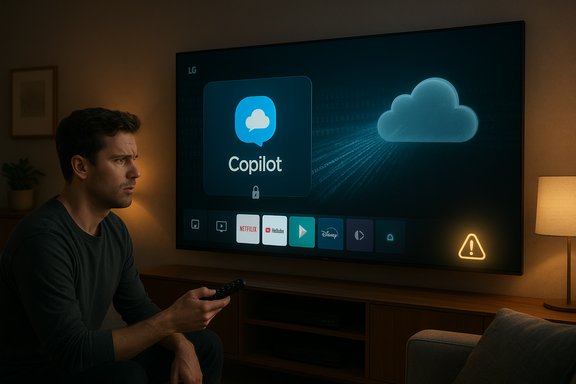
What users received in December 2025, however, was not a gentle, opt-in rollout. Instead, a routine webOS firmware push automatically added a Copilot tile to the home screen on a broad swath of LG models. Unlike the typical third‑party apps on webOS, which can be uninstalled by users, this Copilot entry is being treated as a system component — it can be hidden from view but not deleted. The update also surfaced related AI settings in menus, and some users reported a Live Plus-style content-recognition toggle appearing in privacy settings, intensifying worry about automatic data collection.
This article summarizes what happened, explains the technical and legal stakes, assesses the privacy and usability implications, and offers practical guidance for owners and recommendations for manufacturers and regulators.
What’s controversial is how the feature was delivered. Turning a third‑party assistant into a system-level app without a consumer-facing uninstall option echoes past controversies in computing and mobile — from carrier-installed bloatware to preloaded streaming apps — that reduce end-user control and heighten surveillance anxieties.
Common themes in community responses:
Manufacturers and platform partners must balance product innovation with consumer autonomy. Failure to do so invites regulatory scrutiny, consumer backlash, and reputational harm that could outweigh any short-term engagement or monetization gains. The optimal path forward is transparent, choice-driven integration: make AI features visible, optional, and accountable.
Consumers who value control and privacy should treat recent firmware updates as a potential vector for change and exercise their rights: check settings, withhold sign-ins, and push vendors for clarity. The Copilot-on-TV episode will not be the last time device makers test the limits of post‑sale updates; how quickly vendors respond to this controversy will determine whether it becomes a teachable moment or a recurring complaint.
Source: Пепелац Ньюс https://pepelac.news/en/posts/id16344-lg-smart-tvs-add-unremovable-copilot-in-webos-update/
 Background
When LG and Microsoft announced a partnership to bring Copilot to smart TVs at CES 2025, the promise was straightforward: integrate a conversational AI assistant into the living-room experience to help viewers search, summarize, and interact with content without switching devices. The feature was pitched as part of LG’s broader “AI TV” initiative and expected to ship as an optional service or an on-demand app.What users received in December 2025, however, was not a gentle, opt-in rollout. Instead, a routine webOS firmware push automatically added a Copilot tile to the home screen on a broad swath of LG models. Unlike the typical third‑party apps on webOS, which can be uninstalled by users, this Copilot entry is being treated as a system component — it can be hidden from view but not deleted. The update also surfaced related AI settings in menus, and some users reported a Live Plus-style content-recognition toggle appearing in privacy settings, intensifying worry about automatic data collection.
This article summarizes what happened, explains the technical and legal stakes, assesses the privacy and usability implications, and offers practical guidance for owners and recommendations for manufacturers and regulators.
What changed — a straightforward list
- LG pushed a webOS update in mid-December 2025 that installed a Microsoft Copilot tile onto many LG smart TVs.
- The Copilot tile is pinned to the home screen and — according to user reports and vendor documentation — cannot be uninstalled, only hidden.
- The Copilot entry appears to act largely as a shortcut to a web-based Copilot experience, rather than a fully native, locally executed AI agent on the TV.
- Several reports indicate the update also surfaced or enabled a Live Plus-style content recognition setting in system menus, raising data collection and personalization concerns.
- The rollout prompted immediate community outrage, particularly on social media and forums where affected owners said the app arrived without explicit consent.
Overview: how this fits into the industry trend
Copilot on TVs is not surprising — the method is
Smart TV manufacturers have been racing to add AI hooks and assistant integrations to their platforms. LG and Samsung publicly discussed Copilot integration at CES 2025 as part of a push to make TVs more interactive and helpful. From a product standpoint, the feature fits: conversational AI can improve search, provide contextual help while watching, and offer new monetization and engagement surfaces.What’s controversial is how the feature was delivered. Turning a third‑party assistant into a system-level app without a consumer-facing uninstall option echoes past controversies in computing and mobile — from carrier-installed bloatware to preloaded streaming apps — that reduce end-user control and heighten surveillance anxieties.
Technical anatomy: web shortcut or native integration?
What the current Copilot on LG TVs appears to be
- The initial deployments look like a web-based Copilot endpoint surfaced as a system tile in webOS rather than a deeply integrated, native application executing models locally on the TV.
- Functionality seen by early adopters is consistent with a browser-hosted assistant: it launches a Copilot UI that connects to Microsoft cloud services for query processing and responses.
- Because the UI is web-based, processing of conversational inputs and any heavy model inference is likely happening on remote servers, with the TV acting as a thin client.
Why that matters
- A web-based deployment reduces the performance constraints and hardware differences across models: Microsoft’s cloud handles computation, and LG can ship a consistent interface.
- It also means the privacy boundary depends heavily on the web service’s data practices and what the TV sends to Microsoft (or to LG’s servers on behalf of Microsoft).
- A native, on-device agent would raise different questions about firmware integrity and local data retention. The current pattern shifts the privacy and data-collection risk upstream to cloud-based processing.
Privacy and telemetry: Live Plus and content recognition
The update appears to have surfaced or toggled a setting tied to what some vendors call “content recognition” or “Live Plus” — systems that analyze what’s on the screen to personalize recommendations or advertising. The key issues:- What is being analyzed? Content-recognition features can use audio fingerprinting, image recognition, or metadata sampling. It’s not always clear whether raw frames, audio snippets, or hashed fingerprints are sent off-device.
- Where is it processed? On-device processing minimizes transmitted raw data, while cloud processing increases the risk that viewing information is logged, correlated, or used for ad targeting.
- Who has access? If Copilot queries or Live Plus telemetry are shared with Microsoft, LG, or ad partners, that expands the number of parties that could link content consumption with profiles.
- User control: Even when such features can be hidden, they are functionally active unless explicitly disabled. Many users report the Copilot tile appears by default and cannot be removed, and Live Plus-type toggles can be buried or pre-enabled.
Consumer reaction and the community response
The rollout triggered swift backlash on social forums and technology news sites. A widely viewed social post documenting an unremovable Copilot tile gathered tens of thousands of upvotes and thousands of comments, with owners describing frustration that a device they purchased is being altered without a clear opt-out or uninstall path.Common themes in community responses:
- Feelings of loss of control over hardware that buyers expect to own outright.
- Privacy fears: if the TV is collecting or transmitting viewing and interaction data, owners worry about profiling and targeted advertising.
- Bloatware fatigue: an increasing expectation that smart devices are becoming platforms for vendor or partner services that cannot be removed.
- Calls for clearer vendor transparency and an explicit opt-out for AI features.
Legal and regulatory considerations
Ownership vs. platform control
Smart TVs live in a legal gray area: consumers own the hardware but not the platform. Manufacturers reserve the right to deliver firmware updates. That latitude creates tension when updates change the user experience materially or add software that cannot be removed.Potential regulatory triggers
- Consumer protection frameworks: Some jurisdictions require clear disclosures about bundled software and provide remedies for unwanted, persistent preinstalled software.
- Data protection laws: Where telemetry or content-recognition data is transmitted, privacy laws (like the GDPR in Europe) require lawful bases for processing, clear transparency, and rights for data subjects. In some regions, adding an assistant that processes personal data without adequate consent could raise regulatory scrutiny.
- Competition law and rules for gatekeepers: Platforms that lock in certain services, or force prominent placement of partner apps, can attract attention from competition regulators — particularly where consumers have limited alternatives for key functionalities.
Practical options for owners
If your LG TV received the update and you want to minimize Copilot’s footprint or the data it may collect, consider the following steps:- Hide the tile from the home screen to reduce accidental activation.
- Review privacy settings and disable any content-recognition or personalization features labeled Live Plus, content recognition, or similar.
- Avoid signing into Copilot or a Microsoft account on the TV — without a login the service will be less personalized and possibly less persistent.
- Keep the TV offline if you want to guarantee the assistant cannot be used — note that this significantly reduces smart functionality and streaming.
- Use router-level controls to block access to known Copilot endpoints if you can identify them (advanced users only).
- Roll back to a previous firmware if LG publishes a downgrade path — many vendors do not provide downgrades, so this is often not available.
- Register your concerns with vendor support and on public consumer complaint channels; collective complaints have in the past prompted vendor action.
- If you are in a jurisdiction with strong privacy protections, exercise your data subject rights to request information about what data is collected and how it’s shared.
Business rationale and risks for LG and Microsoft
From a business perspective, embedding Copilot into the TV ecosystem offers benefits:- Deepened engagement with the TV as a portal to the cloud.
- New ad or commerce surfaces tied to conversational interactions.
- A potential competitive differentiator as AI features become selling points.
- Reputational damage: Forcing non-removable software undermines trust, particularly among tech-savvy buyers sensitive to privacy and control.
- Regulatory exposure: If the deployment is interpreted as pushing partner services without consent, regulators could levy fines or require transparency fixes.
- Customer churn: Upset buyers may shift future purchases to competitors or delay upgrades until vendor practices change.
What should vendors have done differently?
- Prioritize opt-in deployment with clear prompts and transparent explanations of functionality and data usage.
- Provide a genuine uninstall or disable option for third-party assistants that customers did not explicitly request.
- Publish a concise, machine-readable telemetry and data-flow document clarifying what signals are collected, how long they are retained, and who has access.
- Surface AI feature toggles during initial setup with a plain-language privacy summary and an immediate option to decline.
- Offer a rollback or opt-out mechanism for users who prefer to remain on prior firmware for reasons of privacy or preference.
Broader implications: trust in post-purchase updates
The incident is a reminder that modern devices are living platforms: manufacturers can change the behavior of sold hardware through updates long after purchase. That model enables useful security and feature improvements but also raises ethical and contractual questions.- Do consumers really own smart devices if vendors can add persistent, non-removable services?
- How much transparency should manufacturers owe regarding partner integrations pushed through firmware?
- Is there a need for a clearer "right to uninstall" for consumer devices to restore user autonomy?
Recommended actions (for consumers, vendors, and regulators)
- For consumers: Audit privacy settings after any firmware update, avoid signing into services you do not use, and use network-level controls to limit telemetry if needed. Record and report persistent or unremovable apps as consumer complaints if you believe your device has been materially altered without reasonable notice.
- For LG and other manufacturers: Revisit the deployment model. Provide uninstallability or explicit opt-in flows for third-party services and publish clear, accessible documentation describing what data is collected and why.
- For Microsoft and cloud partners: Ensure transparent data processing agreements and make service endpoints, data retention, and third-party access explicit and discoverable by end users.
- For regulators: Monitor forced deployments that alter device behavior post-purchase and consider rulemaking or enforcement actions where consumer choice or privacy protections are inadequate.
Final assessment
The installation of Microsoft Copilot as a non-removable tile on LG TVs is emblematic of a broader crossroads in consumer electronics: the tension between platform-driven feature rollouts and the traditional expectations of ownership and control. Bringing conversational AI to the TV is a natural next step for manufacturers and cloud providers, and it can deliver genuine utility. But the delivery method — forcing a system-level addition without an easy uninstall path or a clear, prominent privacy explanation — is a misstep that undermines user trust.Manufacturers and platform partners must balance product innovation with consumer autonomy. Failure to do so invites regulatory scrutiny, consumer backlash, and reputational harm that could outweigh any short-term engagement or monetization gains. The optimal path forward is transparent, choice-driven integration: make AI features visible, optional, and accountable.
Consumers who value control and privacy should treat recent firmware updates as a potential vector for change and exercise their rights: check settings, withhold sign-ins, and push vendors for clarity. The Copilot-on-TV episode will not be the last time device makers test the limits of post‑sale updates; how quickly vendors respond to this controversy will determine whether it becomes a teachable moment or a recurring complaint.
Source: Пепелац Ньюс https://pepelac.news/en/posts/id16344-lg-smart-tvs-add-unremovable-copilot-in-webos-update/
