

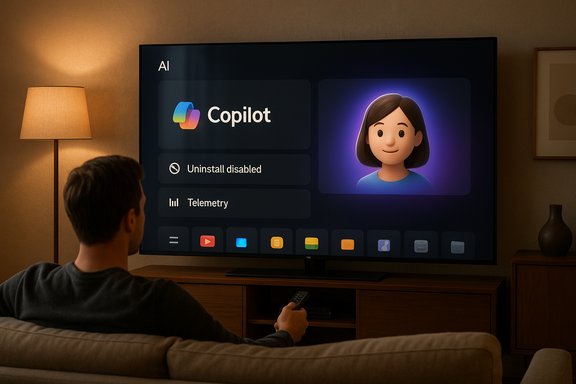
LG smart‑TV owners woke up this week to a new Copilot tile on their home screens — installed by a routine webOS firmware push and, in many reported cases, not removable through the normal app manager — sparking a debate about forced preinstallation, privacy, and what ownership of a “smart” device actually means.
In January at CES 2025, Microsoft and major TV OEMs publicly signaled a clear strategy: bring Microsoft Copilot — the company’s conversational AI — from PCs and phones into living‑room screens to power voice search, contextual discovery, and on‑screen assistance. OEM demonstrations framed Copilot as a convenience layer for content discovery and troubleshooting; LG positioned the integration inside an expanded webOS AI section and an “AI Remote.”
What changed was not the idea of Copilot on TVs but the distribution mechanics. Multiple LG owners report receiving a standard webOS over‑the‑air (FOTA) update that added a visible Copilot tile to their home ribbons. The consistent detail across independent community posts and tech coverage is that the Copilot tile in many cases lacks the usual uninstall option and can only be hidden — and that a factory reset sometimes restores the tile, suggesting the component was delivered as a privileged system package or baked into the firmware image.
This article examines what happened, why it matters to Windows and smart‑TV users, the likely technical packaging choices behind the behavior, the privacy and regulatory implications, mitigations for owners, and what vendors should do to repair trust.
Short‑term remedies exist for owners (hide the tile, disable Live Plus, use an external streamer), but they are workarounds, not answers. The durable fix is better product design: make partner AI optional, default to privacy‑minimal settings, publish clear update notes, and provide simple removal or rollback paths.
The lesson for manufacturers and partners is straightforward: integrating AI onto shared household devices is inevitable and can be beneficial — but how you ship and configure those experiences matters as much as the technology itself. If vendors prioritize engagement metrics over consent and transparency, the long‑term cost in trust will outweigh any short‑term gains.
The immediate story is one of expectation mismatch and rollout friction: Copilot on LG TVs is real, useful in principle, but — in practice for many owners — it arrived like a surprise guest and stayed past its welcome.
Source: Thurrott.com Microsoft Copilot App is Now Automatically Installed on Some LG TVs
 Background / Overview
In January at CES 2025, Microsoft and major TV OEMs publicly signaled a clear strategy: bring Microsoft Copilot — the company’s conversational AI — from PCs and phones into living‑room screens to power voice search, contextual discovery, and on‑screen assistance. OEM demonstrations framed Copilot as a convenience layer for content discovery and troubleshooting; LG positioned the integration inside an expanded webOS AI section and an “AI Remote.”What changed was not the idea of Copilot on TVs but the distribution mechanics. Multiple LG owners report receiving a standard webOS over‑the‑air (FOTA) update that added a visible Copilot tile to their home ribbons. The consistent detail across independent community posts and tech coverage is that the Copilot tile in many cases lacks the usual uninstall option and can only be hidden — and that a factory reset sometimes restores the tile, suggesting the component was delivered as a privileged system package or baked into the firmware image.
This article examines what happened, why it matters to Windows and smart‑TV users, the likely technical packaging choices behind the behavior, the privacy and regulatory implications, mitigations for owners, and what vendors should do to repair trust.
What owners are actually seeing
The observable pattern
Across multiple forum threads and social posts the reported sequence is repeatable:- An LG webOS device applies a routine firmware update (FOTA).
- A new Copilot tile appears on the home screen or inside the AI section.
- The TV’s Edit/App Manager flows often show only hide or disable rather than uninstall.
- A factory reset in some cases reintroduces the Copilot tile, indicating it may be embedded in the system image.
A confusing user experience
Owners report that what appears to be a Copilot shortcut today may behave like nothing more than a web app launcher, or in some cases a nonfunctional chat shortcut with an animated avatar (Microsoft’s “Mico”) that never completes voice‑activation. That mismatch between marketing (a conversational, contextual assistant) and on‑set behavior (a stuck spinner or a simple link) fuels frustration and strengthens the sense the rollout is unfinished.Why this matters: three overlapping sensitivities
- Device autonomy and ownership
- Consumers reasonably expect removable apps and opt‑in services on devices they own. When an OEM pushes a persistent system component with no clear uninstall path, many users interpret it as a loss of control over their property.
- Privacy and telemetry expansion
- Modern smart TVs already gather viewing and usage signals. LG’s Live Plus (its Automatic Content Recognition/ACR feature) illustrates how onscreen context can be used for personalization and advertising. Adding an assistant that benefits from voice and contextual signals increases the sensitivity and potential reach of telemetry — a plausible concern until vendors provide clear technical disclosures.
- Opaque update practices
- Firmware updates are expected to deliver security fixes and stability improvements. Surprise additions to device functionality — especially third‑party integrations — without explicit patch notes or consent steps damage trust and may trigger stronger regulatory scrutiny in privacy‑sensitive markets.
How manufacturers make an app effectively non‑removable (technical mechanics)
Two standard packaging approaches explain the reported behavior:- Privileged system package: The OEM installs the app outside the regular user app sandbox and flags it as a system service. In that mode the user UI typically exposes only limited actions (hide/disable) — uninstall is suppressed because removal could break platform integrity or other dependencies.
- Firmware‑baked image: The app is included as part of the firmware image itself. A factory reset restores that image, which explains why the tile can reappear after a reset; removing the component would require reflashing with a different firmware image or vendor support tools.
What the vendors have said — and where the record is incomplete
- Microsoft publicly described Copilot’s TV experiences around partner rollouts, with Samsung’s staged deployments being the most documented. Samsung’s materials emphasize sign‑in options and optional personalization flows for supported models. LG’s public messaging focused on webOS AI enhancements and the AI Remote, but it did not provide detailed, public technical bulletins explaining why a Copilot tile would be shipped as a privileged or firmware‑baked package across certain firmware builds.
- At the time of widespread forum reporting, neither LG nor Microsoft had published a detailed, model‑by‑model statement clarifying whether a Copilot install on a given firmware build is intended to be removable by consumers, or whether particular privacy telemetry flows were introduced by the Copilot integration. That gap leaves important technical and legal questions unanswered.
Privacy: what to watch for and what remains unverifiable
There are two legitimate privacy concerns tied to an assistant integrated into a living‑room device:- Audio capture and voice activation: Does Copilot add always‑on or broader microphone access beyond existing voice‑search behavior? Independent verification is required. Treat claims of expanded audio capture beyond webOS defaults as unverified until LG or Microsoft publish explicit technical details or a forensic capture proves otherwise.
- Use of on‑screen context and ACR signals: If Copilot uses ACR or Live Plus signals to enhance personalization, what data is transmitted, with whom is it shared, and are users given a clear, persistent opt‑out? These are reasonable questions; again, specifics were not widely disclosed at the time of reporting.
Mitigations and immediate steps for owners
If Copilot has appeared on an LG TV and you prefer not to use it, there are practical levers you can try now:- Hide the app tile. Use webOS’s Edit App List or App Manager to remove the visual nuisance from the home screen. This doesn’t uninstall the package, but it stops reminders.
- Disable Live Plus / ACR. Turn off LG’s Live Plus or content‑recognition personalization in settings to reduce contextual on‑screen telemetry used for ad personalization. This lowers some data flows even if it doesn’t remove the Copilot package.
- Avoid account sign‑in. Don’t sign into a Microsoft account on the TV if you want to limit personalization and account‑tied features.
- Network‑level blocking. Use DNS filtering or a Pi‑hole to block known telemetry domains. This is a blunt instrument and can break legitimate apps and updates. Use with caution.
- Use an external streaming device. Shift primary navigation to an Apple TV, Roku, Amazon Fire TV, or similar. That effectively puts a firewall between you and the OEM UI.
- Factory reset with verification. Some owners reported that resets reintroduced the tile; if you attempt a reset, check immediately whether Copilot returns before assuming the reset solved the issue.
- Contact LG support and document your case. If removal is important, escalate a ticket and ask for a model‑specific explanation or firmware rollback path.
Business logic: why OEMs ship partner services this way
There are strong commercial incentives for manufacturers to pin partner services to the homescreen:- Feature differentiation. As panel hardware converges, software and AI experiences are the clearest space left for OEMs to compete. An integrated assistant is an easy marketing bullet point.
- Engagement and ad revenue. More screen time and better data signals increase monetization opportunities for platform advertising and subscription cross‑sells. LG already operates ad formats and a CTV ad business; an assistant that can surface recommendations is a natural complement.
- Ecosystem reach for partners. For Microsoft, placing Copilot on living‑room screens raises brand presence and creates another user touchpoint for services such as Microsoft 365 integrations.
Regulatory and reputational risks
- Data protection laws. Regions with strict privacy rules (for example, parts of the EEA) could scrutinize forced preinstallation and opt‑out defaults, particularly if the assistant expands telemetry without explicit, informed consent.
- Consumer protection enforcement. Regulators and consumer protection agencies are increasingly sensitive to “bloatware” and opaque update practices. A pattern of persistent, non‑removable partner services could provoke formal inquiries or stronger disclosure requirements.
- Brand trust erosion. Short‑term engagement gains can translate into long‑term reputational damage. Community backlash around forced preinstalls leads to negative press, returns, and an increased appetite for alternatives. That reputational cost is hard to quantify but very real.
What vendors should do (and what we expect next)
- Publish an explicit technical bulletin. LG (and Microsoft) should publicly confirm which models and firmware builds received Copilot, explain why it was packaged as a system component (if that is the case), and detail exactly what audio and contextual signals the Copilot integration collects and transmits.
- Provide a clear uninstall or rollback path. Even if Copilot is a system service, vendors should offer a documented, user‑accessible removal or rollback option, or at minimum a one‑tap opt‑out that fully disables Copilot and its network traffic.
- Default to privacy‑minimal settings. New AI features should ship disabled or with explicit, granular opt‑ins for long‑term memory, linking to cloud accounts, or advanced personalization.
- Improve firmware changelogs. Publish discoverable, machine‑readable FOTA notes that describe new features and provide explicit opt‑out instructions.
- Engage with the community. OEMs should listen to forums and social feedback and respond quickly to practical mitigation requests (e.g., firmware that makes Copilot removable).
Final analysis: promising technology, poor rollout
The technical promise of a voice‑driven, context‑aware assistant on a TV is genuine. Properly implemented, Copilot could:- Improve content discovery across siloed streaming services.
- Provide accessibility benefits such as voice navigation and summarization.
- Surface on‑screen troubleshooting to reduce support friction.
- Offer seamless, casual productivity scenarios for households that want them.
Short‑term remedies exist for owners (hide the tile, disable Live Plus, use an external streamer), but they are workarounds, not answers. The durable fix is better product design: make partner AI optional, default to privacy‑minimal settings, publish clear update notes, and provide simple removal or rollback paths.
The lesson for manufacturers and partners is straightforward: integrating AI onto shared household devices is inevitable and can be beneficial — but how you ship and configure those experiences matters as much as the technology itself. If vendors prioritize engagement metrics over consent and transparency, the long‑term cost in trust will outweigh any short‑term gains.
The immediate story is one of expectation mismatch and rollout friction: Copilot on LG TVs is real, useful in principle, but — in practice for many owners — it arrived like a surprise guest and stayed past its welcome.
Source: Thurrott.com Microsoft Copilot App is Now Automatically Installed on Some LG TVs
