

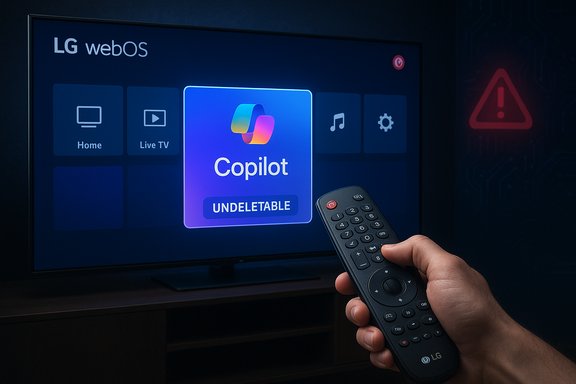
LG owners reported that a routine webOS firmware update added Microsoft Copilot to their smart‑TV home screens and, in many cases, that the Copilot tile behaves like a system component that can be hidden but not uninstalled — a change that has quickly become a flashpoint for debates about bloatware, privacy, and device ownership.
Smart TVs have evolved from passive displays into full‑blown connected platforms that run apps, collect usage signals, and provide advertising inventory. At CES 2025 Microsoft announced plans to bring its conversational AI, Copilot, to living‑room screens; Samsung and LG were both named as partners in that initiative. Microsoft and Samsung have publicly described Copilot’s role on TVs as a voice‑driven assistant for content discovery, on‑screen cards, and contextual help. Shortly after these vendor announcements, LG owners began sharing reports and screenshots showing a Copilot tile appearing on webOS home screens after an over‑the‑air (FOTA) update. The recurring detail across multiple community posts is that the new Copilot entry offers hide or disable options but lacks the standard uninstall affordance users expect for removable apps, and that a factory reset sometimes returns the Copilot presence — consistent with a privileged or firmware‑baked installation. Those user reports and community threads are the primary evidence for the non‑removability claim.
This article summarizes the verifiable facts, verifies vendor claims where possible, evaluates the technical and privacy implications, and offers pragmatic guidance for owners and recommendations for manufacturers.
Why that combination raises alarm:
Where caution is required: assertions about always‑on ambient audio capture, hidden telemetry beyond existing webOS flows, or deliberate data‑monetization strategies tied specifically to the Copilot push require targeted technical validation. Independent network forensics, vendor technical disclosures, or regulator‑mandated audits would be the right instruments to confirm or refute those claims. Until such analysis is published, treat those claims as plausible concerns rather than established facts.
In short: the technology’s potential is real; the method of delivery and the default privacy posture are the failures to fix. Vendors must prioritize clear consent, easy removal, and privacy‑first defaults — otherwise the reputational and regulatory costs will outweigh short‑term engagement gains. Owners should take pragmatic steps now to limit exposure while insisting on better transparency from vendors.
Conclusion
The Copilot‑on‑TV story is a classic case where product promise collides with distribution choices. Embedded AI can legitimately improve the TV experience, but the way it is delivered — particularly when it arrives as a privileged, seemingly non‑removable component — matters more than marketing claims. Evidence from community reports shows that some LG webOS owners received Copilot via an over‑the‑air update with no straightforward uninstall path, and that combination with default ACR settings is the heart of privacy and control concerns. Manufacturers and partners can repair trust quickly by making AI features optional, defaulting to privacy‑minimal settings, publishing clear update notes, and providing easy removal and data‑deletion paths. Until vendors do so, owners who value control should disable ACR, hide the Copilot tile, avoid account sign‑in, consider router‑level blocking, or run external streaming devices as practical mitigations.
The promise of Copilot on the big screen is real; the test now is whether platform stewards treat user agency and privacy as non‑negotiable design constraints rather than afterthoughts.
Source: 80 Level LG TVs Get Microsoft Copilot By Default With No Removal Option
 Background / Overview
Smart TVs have evolved from passive displays into full‑blown connected platforms that run apps, collect usage signals, and provide advertising inventory. At CES 2025 Microsoft announced plans to bring its conversational AI, Copilot, to living‑room screens; Samsung and LG were both named as partners in that initiative. Microsoft and Samsung have publicly described Copilot’s role on TVs as a voice‑driven assistant for content discovery, on‑screen cards, and contextual help. Shortly after these vendor announcements, LG owners began sharing reports and screenshots showing a Copilot tile appearing on webOS home screens after an over‑the‑air (FOTA) update. The recurring detail across multiple community posts is that the new Copilot entry offers hide or disable options but lacks the standard uninstall affordance users expect for removable apps, and that a factory reset sometimes returns the Copilot presence — consistent with a privileged or firmware‑baked installation. Those user reports and community threads are the primary evidence for the non‑removability claim.This article summarizes the verifiable facts, verifies vendor claims where possible, evaluates the technical and privacy implications, and offers pragmatic guidance for owners and recommendations for manufacturers.
What happened — the factual snapshot
- Multiple LG webOS owners reported receiving a routine firmware update that placed a Copilot tile or app into the TV home screen. Users posted screenshots and step‑by‑step accounts on Reddit and community forums.
- In reported cases the TV settings’ app manager did not show an uninstall/trash option for Copilot; the UI typically presented only hide or disable. Several owners reported that a factory reset returned the Copilot tile — a strong indicator the component was integrated at the system or firmware level.
- Microsoft and Samsung have publicly rolled out Copilot on select 2025 Samsung TVs and smart monitors and described the feature as appearing on the home screen and accessible via the remote’s mic button. Microsoft’s Copilot team and Samsung’s press channels provide the official rollout details; availability varies by model and market.
- LG publicly signaled an AI‑forward webOS roadmap and an “AI Remote” concept at CES, and marketing materials show Copilot as a partner feature for some 2025 models; however, at the time many community posts flagged that LG had not published a technical bulletin explicitly explaining whether Copilot had been shipped as a removable app or a system component for particular firmware builds.
Why an assistant like Copilot is being pushed to TVs
Manufacturers and platform partners have clear, commercial, and product motives for embedding AI assistants on TV platforms:- Feature differentiation: With panel performance converging, software and AI experiences are key marketing differentiators. An assistant that can summarize shows, search across streaming services, or answer questions adds a conspicuous capability to a TV’s feature list.
- Improved content discovery and accessibility: Copilot can offer conversational search, spoiler‑safe recaps, and vocal navigation — features that genuinely help discovery on large libraries of streaming content.
- Ecosystem reach: For Microsoft, putting Copilot on living‑room screens reinforces brand presence and deepens integration with Xbox, Windows, and Microsoft 365 ecosystems. For OEMs, it signals parity with other premium brands.
- Monetization and ad targeting: TVs are prime real‑estate for CTV ad inventory. Richer personalization from AI plus Automatic Content Recognition (ACR) data can make advertising more valuable, attracting partner revenue. Community commentary flags this commercial incentive as a driver for persistent placement.
How a TV app becomes “undeletable” — technical mechanics
There are two standard, verifiable mechanisms used by OEMs that make an app effectively non‑removable:- Privileged system package: The vendor installs the component as a system app outside the user app sandbox. The UI then exposes limited lifecycle controls (hide/disable) while disallowing uninstall. This is common for DRM, platform agents, and system services. Community tests showing “hide but no uninstall” are consistent with this model.
- Firmware‑baked component: The package is included in the flashed firmware image. A factory reset typically restores the current firmware image, reintroducing any baked‑in components. If Copilot is part of the firmware image applied by FOTA, a reset will not remove it. Multiple users reporting Copilot’s return after resets align with this packaging pattern.
Privacy, telemetry, and the Live Plus (ACR) factor
LG’s webOS includes an Automatic Content Recognition framework marketed as Live Plus (or similarly labeled menu options). Live Plus can analyze on‑screen content to generate contextual promotions, recommendations, and interactive overlays. That same ACR signal is precisely the contextual input that makes a conversational assistant notably more useful on a TV.Why that combination raises alarm:
- An assistant is more useful when it knows context (what’s playing, timestamps, scene info). ACR provides those signals.
- Combined with voice queries or ambient audio triggers, the potential telemetry surface grows from simple app usage to viewing habits, timestamps, and possibly voice interactions.
- Users have reported that Live Plus and certain personalization settings are enabled by default on some models; turning these features off is possible but requires finding buried menus. Community posts point owners to toggle Live Plus and ad personalization off as an immediate mitigation.
- Verifiable: Copilot’s inclusion on TVs was announced by Microsoft and OEMs for certain 2025 models; webOS includes an ACR setting that can be toggled.
- Unverified (and requiring forensic confirmation): Claims that the Copilot push introduced previously unannounced telemetry classes (for instance, continuous ambient audio capture routed to cloud services by Copilot or new cross‑device profiling beyond existing webOS flows). Those claims are plausible concerns raised by users but currently lack vendor confirmation or independent network analysis. Treat them as unverified until technical analysis — packet captures, telemetry disclosures, or vendor technical notes — supports the claim.
Community reaction: scale and remedies being tried
User backlash has been rapid and loud. Reddit threads, product forums, and enthusiast communities document multiple owners reporting the same pattern: Copilot appears after an automatic update and lacks an uninstall option; hiding and opt‑outs are the only readily available remedies in many cases. Advice in community threads ranges from pragmatic to extreme:- Pragmatic: turn off Live Plus/ACR, hide the Copilot tile, avoid signing in to a Microsoft account, and use a dedicated external streaming device for everyday apps.
- Network‑level: block known telemetry domains with Pi‑hole or router firewall rules — effective but technically demanding and potentially service‑breaking.
- Disconnection: keep the TV offline and use external streamers — preserves content experience but sacrifices integrated features and auto updates.
- Extreme: reflashing firmware or installing custom firmware — risky, warranty‑voiding, and unsupported for most users.
Vendor communications and verification
- Microsoft: publicly documented Copilot’s launch on select Samsung TVs and smart monitors and detailed activation and personalization flows. Microsoft’s Copilot blog and related press materials confirm the Samsung rollout and the general design for TV experiences.
- Samsung: published its own announcement and product messaging confirming Copilot availability on select 2025 models. Samsung’s press release and coverage from mainstream outlets corroborate the partnership and deployment timeline.
- LG: marketed AI features and the “AI Remote” and included Copilot references in CES materials, but at the time of community reports LG had not uniformly published a technical bulletin specifying whether Copilot was intended to be provisioned as a removable app versus a system component in particular firmware builds. That gap in public technical documentation is central to user frustration.
Risks, regulatory angle, and consumer rights
- Loss of device autonomy: Many buyers reasonably expect optional services to be removable. A persistent partner app contradicts that expectation and can be perceived as forced software on purchased hardware.
- Privacy creep: If Copilot increases the types of data collected by the platform (viewing metadata, voice queries, ambient signals), that increases the sensitivity of user profiles used for personalization or advertising.
- Monetization pressure and attention economics: Embedding an assistant that amplifies personalization can strengthen the ad business model, creating incentives to surface promotions or prioritized partner content.
- Regulatory scrutiny: In jurisdictions with strong privacy and consumer‑protection rules — for example, the EU’s GDPR and state laws such as California’s privacy statutes — obscured opt‑outs or hard‑to‑exercise removal pathways could attract formal complaints or investigations. Consumer advocates have previously flagged opaque consent flows on smart TVs; adding an assistant with deeper contextual signals increases the regulatory risk.
Practical, prioritized recommendations for owners
If you find Copilot installed on an LG TV and want to reduce exposure while retaining reasonable functionality, consider this ranked list from least to most disruptive:- Turn off Live Plus / ACR and ad personalization. Settings → All Settings → General → System → Additional Settings → Live Plus (menu wording varies). This reduces contextual signals available to personalization.
- Hide the Copilot tile and avoid signing in. Use the home UI to hide Copilot and do not link a Microsoft account; this reduces personalized sync and memory features.
- Disable automatic updates or postpone updates briefly. If you prefer to wait for community diagnostics, temporarily delay FOTA installations where the TV settings allow it.
- Use router‑level controls or a DNS blocker. Block known telemetry domains to prevent cloud calls. This is effective but can break legitimate services and is technically involved.
- Use an external streamer (Apple TV, Roku, Fire TV, Shield). Route streaming through a separate device and treat the TV as a display. This sidesteps webOS for everyday apps but sacrifices integrated features.
- Factory reset (cautious). Try a reset only to evaluate whether Copilot persists; if the firmware image contains Copilot, the reset will likely return the tile. Proceed only after backing up settings or account data.
- Seek consumer remedies. If the device changed materially from advertised features at the time of sale, pursue support, retailer return, or refund options. Document the behavior and correspondence.
What vendors should do to restore trust
The issue is fixable without sacrificing the product value of on‑screen AI — but it requires straightforward product and policy changes:- Make Copilot optional or easily uninstallable. Ship it as a user‑level app unless deep system integration is strictly required; if privileged installation is unavoidable, provide a single‑click uninstall that also purges associated telemetry artifacts.
- Default privacy‑minimal settings. ACR and ad personalization should be off until the user explicitly opts in during a clear, stand‑alone consent flow.
- Publish clear firmware change logs and discoverable opt‑out instructions. If a FOTA push adds new apps or services, the update notes must visibly describe what changed and how to disable or remove new functionality.
- Offer a privacy dashboard and deletion tools. Let owners view collected viewing data and request deletion in a straightforward way. This reduces friction and regulatory exposure.
- Use staged or preview channels for contentious features. Roll AI additions into preview/insider channels first, gather telemetry and feedback, then proceed to broad rollouts with validated opt‑out flows.
Final assessment — promise, execution, and the accountability gap
A conversational assistant on the TV is a defensible product idea: it can improve accessibility, simplify content discovery, and add value to the living‑room experience. Microsoft and Samsung have publicly rolled Copilot into select 2025 devices, and vendor materials describe plausible, user‑facing benefits. The core problem in this episode is execution and communication. Community evidence strongly supports the claim that some LG owners received a Copilot tile via FOTA that lacks a conventional uninstall path and sometimes reappears after a reset — behavior consistent with a privileged or firmware‑baked install. Users are right to be upset when platform stewards deliver persistent partner apps with opaque privacy defaults and no obvious removal mechanism.Where caution is required: assertions about always‑on ambient audio capture, hidden telemetry beyond existing webOS flows, or deliberate data‑monetization strategies tied specifically to the Copilot push require targeted technical validation. Independent network forensics, vendor technical disclosures, or regulator‑mandated audits would be the right instruments to confirm or refute those claims. Until such analysis is published, treat those claims as plausible concerns rather than established facts.
In short: the technology’s potential is real; the method of delivery and the default privacy posture are the failures to fix. Vendors must prioritize clear consent, easy removal, and privacy‑first defaults — otherwise the reputational and regulatory costs will outweigh short‑term engagement gains. Owners should take pragmatic steps now to limit exposure while insisting on better transparency from vendors.
Conclusion
The Copilot‑on‑TV story is a classic case where product promise collides with distribution choices. Embedded AI can legitimately improve the TV experience, but the way it is delivered — particularly when it arrives as a privileged, seemingly non‑removable component — matters more than marketing claims. Evidence from community reports shows that some LG webOS owners received Copilot via an over‑the‑air update with no straightforward uninstall path, and that combination with default ACR settings is the heart of privacy and control concerns. Manufacturers and partners can repair trust quickly by making AI features optional, defaulting to privacy‑minimal settings, publishing clear update notes, and providing easy removal and data‑deletion paths. Until vendors do so, owners who value control should disable ACR, hide the Copilot tile, avoid account sign‑in, consider router‑level blocking, or run external streaming devices as practical mitigations.
The promise of Copilot on the big screen is real; the test now is whether platform stewards treat user agency and privacy as non‑negotiable design constraints rather than afterthoughts.
Source: 80 Level LG TVs Get Microsoft Copilot By Default With No Removal Option
