

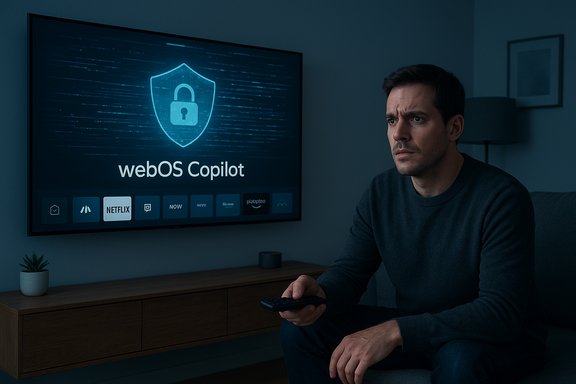
LG TV owners woke up to a software update that silently placed Microsoft’s Copilot on their home screens — and, in many reported cases, the Copilot tile cannot be fully removed, only hidden, fueling a fast-moving consumer backlash over ownership, privacy, and how AI features are shipped to devices already in people’s homes.
Background / Overview
LG and Microsoft publicly signaled a plan to bring Microsoft Copilot — the conversational AI that Microsoft has been rolling out across PCs and apps — to living‑room screens during the 2025 product cycle. Both companies showcased integrations at trade shows and in product briefings that framed Copilot as a helpful assistant for content discovery, show recaps, and voice-first navigation on large screens. What changed in mid‑December 2025 was not the idea itself but the delivery mechanism. Multiple owners across North America and Europe report receiving a routine webOS over‑the‑air (FOTA) update that added a Copilot tile to the webOS home ribbon. In a pattern repeated across forums and mainstream outlets, that tile behaves like a preinstalled, privileged element: users can hide it but not delete it via the normal Edit / App Manager flows, and a factory reset in numerous reported cases simply restores the tile. The tile often launches a web‑based Copilot interface inside the TV’s preinstalled browser rather than a deeply integrated native app — a nuance that matters for how updates, telemetry, and user control work. Several outlets and community posts describe the visible behavior and reproduce the steps that lead from a standard firmware install to the unexpected Copilot shortcut.What users actually saw
The mechanics of the surprise install
- After a normal webOS update, a Copilot tile or icon appears on the home screen, usually in the apps row or the new AI/Assistant area.
- Launching the tile typically opens a Copilot web experience in the TV’s browser shell. The UI accepts voice input from the remote microphone button in many reports.
- When users go to edit apps, the usual uninstall/trash icon that appears for removable third‑party apps is missing for Copilot. The only offered action is to hide the tile.
- Several owners who performed a factory reset found the Copilot tile reappeared after the reset — a clear signal the component is being provisioned as a system or firmware‑baked element rather than a store app the user installed.
Technical anatomy: why the Copilot tile feels “undeletable”
Understanding why the Copilot entry resists removal requires a short primer on how embedded platforms like webOS handle apps and firmware:- System/privileged packages vs store apps — OEMs can include packages in the firmware image and mark them as system components. Standard app managers typically allow only limited operations (hide, disable) on these packages to avoid breaking platform dependencies. Removing such packages often requires vendor tools or a firmware rollback.
- Firmware‑baked components — If a package is included in the firmware image, a factory reset restores the device to that image — which is why users reported Copilot reappearing after resets. That behavior strongly suggests provisioning via LG’s FOTA channel rather than a user‑level Content Store install.
- Web‑shortcut vs native app — Reports indicate that Copilot on many LG TVs is surfaced as a browser‑launched web experience rather than a deeply integrated native webOS app. That changes how it’s updated and how much local processing occurs; it can still be a persistent UI element even if execution happens in a browser tab.
Why this matters: ownership, privacy, and trust
Loss of device autonomy
Consumers expect optional third‑party services on hardware they bought to be removable. When an OEM treats a partner app as a system component, the device begins to feel like a manufacturer‑controlled service platform rather than privately owned hardware. That psychological breach is central to the current backlash: owners view the unsolicited Copilot tile as bloatware imposed post‑purchase.Expanded telemetry surface
Modern smart TVs already gather usage signals: automatic content recognition (ACR) and ad personalization features are standard. LG’s own ACR program — often referred to as Live Plus in reporting — ties on‑screen content to personalization and ad services. Adding a persistent assistant that can accept voice input and respond contextually creates a plausible expansion of the telemetry surface and increases the types of data that could be collected, even if current implementations are browser‑based. This risk is not proven to be already happening at scale but is a reasonable and immediate concern raised by users and privacy advocates.Opaque update practices
Firmware updates are expected to deliver security patches and stability fixes. When updates deliver partner services without clear patch notes, opt‑in mechanisms, or uninstall options, they break user expectations and trust. Surprise changes delivered through the normal update channel undermine the reliability users place in the update process.The business logic (and the unknowns)
There are several plausible business reasons this happened, but vendors have not publicly clarified motivations:- Paid placement or marketing deal: OEMs sometimes accept payment or reciprocal considerations to surfacing partner services on prominent UI real estate.
- Reciprocal strategic partnership: Microsoft and LG have been positioning Copilot as a cross‑device assistant — a deeper commercial partnership could explain preinstallation at scale.
- Mistake or rollout miscommunication: It’s possible device management rules or a staged rollout was misconfigured, delivering the tile more broadly than intended.
How this compares to other OEM Copilot rollouts
Samsung and other OEMs also announced Copilot integrations for 2025 TV lineups. The key distinction is rollout design: Samsung’s staged deployments were documented and communicated as staged feature updates for selected models, while LG’s recent webOS update — by community and press accounts — reached many existing owners without clear opt‑in or public communication. Where other OEM rollouts emphasized optionality and staged testing, the current LG event looks more like a broad provisioning that lacked visible consent controls.User reaction, scale, and social amplification
The initial wave of complaints was amplified by a viral Reddit thread that drew tens of thousands of upvotes and thousands of comments, plus posts on X and multiple enthusiast forums. Mainstream technology outlets picked up the story within days, turning a community irritation into national attention. That speed of amplification has put pressure on LG’s customer‑facing teams and raised the topic in consumer protection and privacy conversations.Practical mitigation steps for owners
If Copilot has appeared on your LG TV and you want to limit exposure or UI clutter, these steps — ranked by ease — are what owners and community guides have recommended:- Hide the Copilot tile using the Edit / App List UI to remove the visible tile from your home ribbon. This keeps the shortcut out of daily view but does not uninstall it.
- Disable or opt out of Live Plus / ACR and ad personalization in webOS settings to reduce context‑driven data collection. This doesn’t remove Copilot but reduces the assistant’s access to on‑screen context used for personalization.
- Avoid signing in to Copilot or using voice features tied to the assistant; without sign‑in the assistant has less personalization payload.
- Use network‑level controls (Pi‑hole, router DNS blocking, or firewall rules) to block domains associated with Copilot or Microsoft telemetry if you’re comfortable managing network rules. This is a technical mitigation and may break other services.
- Use an external streaming device (Apple TV, Fire TV, Chromecast, NVIDIA Shield) as your primary interface; that replaces webOS as the daily UI and sidesteps the built‑in tile.
- Disable automatic updates to avoid future surprise changes — but be cautious: this also delays security fixes and stability patches.
- If you want a clean factory state, note that a factory reset may restore Copilot if it is indeed baked into the firmware image; the reset is therefore not a guaranteed removal path.
Legal, regulatory, and consumer‑protection considerations
This issue sits at the intersection of consumer expectations, privacy law, and platform control:- Consumer rights: Jurisdictions with strong consumer protection regimes may view forced, non‑removable software pushed post‑sale as a legitimate complaint — especially if it materially alters device functionality and cannot be undone by a buyer.
- Privacy regulations: If Copilot expands data collection (voice inputs, query logs, contextual signals tied to ACR) without clear opt‑in or transparent retention policies, regulators in Europe and other privacy‑sensitive markets could demand disclosures or fines under data‑protection law. Evidence of expanded telemetry would be the trigger for formal scrutiny; community reports alone are not proof.
- Right to repair / software ownership debates: The broader debate about whether consumers own the software on devices they buy (and therefore can demand its removal) is only intensifying as more intelligence is grafted into commodity hardware. Manufacturers who push persistent services risk reputational and legal pushback.
Strengths and weaknesses of the current Copilot deployment
Notable strengths
- Potential user value: A well‑designed Copilot on the big screen can improve discovery, accessibility, and convenience — summary recaps, unified search, and voice navigation are valid user benefits when implemented with clear controls.
- Rapid feature distribution: Delivering functionality via FOTA lets OEMs push new capabilities quickly to large installed bases, enabling faster innovation than replacing hardware.
Significant risks and weaknesses
- Poor rollout transparency: Pushing a persistent assistant without clear announcement or opt‑in breaks trust and causes predictable backlash.
- Non‑removability undermines ownership: Treating an optional partner service as a firmware‑level component strips consumers of basic control over their purchased devices.
- Privacy anxieties: Even if the current Copilot implementation is browser‑based, the presence of a privileged assistant that accepts voice input increases perceived — and potentially real — telemetry risks.
- Reputational cost: Short‑term engagement or advertising metrics from pinning a partner service to the home screen are likely to be offset by brand damage among privacy‑sensitive buyers and early adopters.
Recommended actions for LG and Microsoft
- Publish a clear statement explaining the scope of the rollout, which models and regions are affected, and whether the Copilot tile is a privileged system component or a removable app.
- Provide a supported uninstall or firmware rollback that removes Copilot from consumer units that request it, and publish a user‑friendly opt‑out flow in webOS settings.
- Disclose the exact telemetry collected by Copilot on TV, where data is processed and stored, retention periods, and how voice data is handled — and offer a persistent off switch for voice capture and contextual ACR linkage.
- If the deployment was a commercial placement, disclose the nature of the partnership and any paid placement arrangements so consumers understand the motive behind UI changes.
- Improve patch notes and update transparency so future FOTA changes are visible and actionable by users (for example, an in‑OS “what’s new” popup that requires consent for non‑security features).
Bottom line
The addition of Microsoft Copilot to LG TVs — delivered via a routine webOS update and experienced by many owners as a non‑removable tile — crystallizes a broader industry tension: the speed of AI feature rollouts versus the responsibilities of device ownership and privacy. The Copilot feature itself has clear potential to be useful on a big screen, but the rollout mechanics have turned a potential convenience into a trust problem.Concrete vendor action — transparency about packaging, a supported uninstall or rollback path, and explicit telemetry disclosures — is the only credible remedy. Until then, the practical choices for owners are limited workarounds: hide the tile, disable ACR/ad personalization, manage network access, or outsource the smart interface to an external streamer.
If smart TVs are to be ubiquitous platforms for ambient AI, vendors must learn that convenience without consent is a brittle strategy: features that arrive without choice will be resisted, and trust — once eroded — is slow to return.
Source: heise online Smart TVs: LG forces Microsoft's Copilot on users
