

LG’s latest webOS update quietly pinned a Microsoft Copilot shortcut to the home screens of many owners’ televisions — and the backlash has exposed a deeper, systemic problem with how smart-TV makers deploy generative AI into living rooms without offering clear choice, control, or transparency.
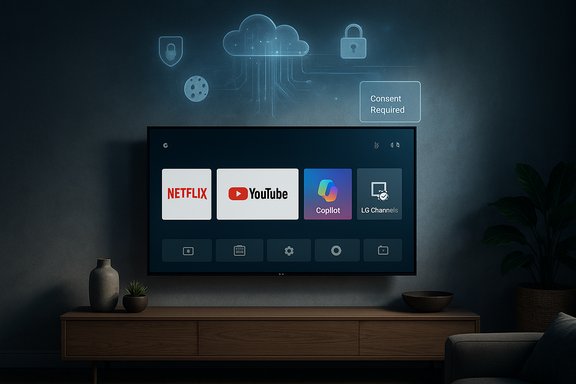
In 2025 the term “AI TV” stopped being marketing puffery and became an explicit industry roadmap: manufacturers promised conversational assistants, on‑screen summaries, and voice‑driven discovery as differentiators for new models. LG publicly framed Copilot — Microsoft’s cross‑device generative assistant — as a component of that strategy at CES, and this week a routine webOS over‑the‑air update placed a Copilot tile on many televisions’ home launchers. That tile looks like any other app icon, sits alongside Netflix and YouTube, and in many reported cases could not be fully uninstalled through the TV’s normal app management flows. The visible flashpoint came when a Reddit post showing the Copilot tile racked up tens of thousands of upvotes and hundreds of corroborating reports. Coverage by mainstream tech outlets quickly followed, prompting LG to clarify that the tile is a browser shortcut that opens the Copilot web interface in the TV browser and is not a native, locally installed AI app — and to promise a future update that will let owners remove the tile if they wish. LG’s spokesperson also emphasized that features like microphone input are only activated with explicit user consent. This sequence — push update, tile appears, social outcry, corporate clarification — is routine in tech journalism. What matters is the structural pattern it illustrates: manufacturers are baking cloud AI into commodity devices and using firmware updates to provision visibility and distribution without giving users a clear opt‑out or an obvious uninstall path. That pattern raises questions of consent, data flow, monetization, and product ownership that go well beyond a single removable tile.
LG’s immediate defensive claims have some merit: the Copilot tile appears to be a browser shortcut rather than an always‑listening native service, and the company says microphone access requires explicit consent. Those facts reduce the technical severity of some privacy concerns — if accurate and implemented correctly. But the weak points are also obvious: delivering the shortcut as a privileged or firmware‑baked asset removes a core consumer control (uninstallability), and placing such a tile without a clear, upfront opt‑in creates a perception of coercion. Even when microphone use is gated by permission, telemetry and usage metadata can be collected before a user touches the feature, depending on implementation. Moreover, promises to add a delete option after the fact are reactive; they do not restore the trust lost when the update landed without clear disclosure.
The lesson for manufacturers is straightforward: if you want consumers to trust AI in their homes, make consent obvious, make removal simple, and make update changes auditable. For owners, the practical takeaway is also clear: keep an eye on firmware notes, audit privacy settings, and prefer platforms that make control and transparency first‑class features. The TV in your living room should show what you want to watch — and not what a firmware push decided you should talk to.
Source: Ars Technica LG TVs’ unremovable Copilot shortcut is the least of smart TVs’ AI problems
 Background and overview
In 2025 the term “AI TV” stopped being marketing puffery and became an explicit industry roadmap: manufacturers promised conversational assistants, on‑screen summaries, and voice‑driven discovery as differentiators for new models. LG publicly framed Copilot — Microsoft’s cross‑device generative assistant — as a component of that strategy at CES, and this week a routine webOS over‑the‑air update placed a Copilot tile on many televisions’ home launchers. That tile looks like any other app icon, sits alongside Netflix and YouTube, and in many reported cases could not be fully uninstalled through the TV’s normal app management flows. The visible flashpoint came when a Reddit post showing the Copilot tile racked up tens of thousands of upvotes and hundreds of corroborating reports. Coverage by mainstream tech outlets quickly followed, prompting LG to clarify that the tile is a browser shortcut that opens the Copilot web interface in the TV browser and is not a native, locally installed AI app — and to promise a future update that will let owners remove the tile if they wish. LG’s spokesperson also emphasized that features like microphone input are only activated with explicit user consent. This sequence — push update, tile appears, social outcry, corporate clarification — is routine in tech journalism. What matters is the structural pattern it illustrates: manufacturers are baking cloud AI into commodity devices and using firmware updates to provision visibility and distribution without giving users a clear opt‑out or an obvious uninstall path. That pattern raises questions of consent, data flow, monetization, and product ownership that go well beyond a single removable tile.What actually happened (step‑by‑step)
- LG pushed a webOS firmware update to selected TV models via FOTA (firmware over the air).
- After installation and reboot, many owners found a new Copilot tile pinned to the home ribbon. Screenshots circulated and a Reddit post garnered widespread attention.
- Users attempting to manage the tile found the usual uninstall affordances absent; the UI commonly offered only hide or move. Several owners reported that a factory reset restored the tile. These behaviors strongly suggest the tile was provisioned as a privileged or firmware‑baked component rather than a user‑installed store app. That conclusion is an evidence‑based inference from repeated user reports, not a vendor‑provided engineering disclosure.
- Public pressure prompted LG to say the tile is a browser shortcut and to commit to providing a delete option in a future update. LG emphasized that microphone access will require explicit opt‑in.
Why this matters: control, privacy, and product boundaries
Smart TVs are no longer mere displays; they are networked devices that mediate content, recommendations, and — increasingly — AI interactions. This change matters for three interlocking reasons.- User control and ownership. Consumers reasonably expect to be able to control software installed on devices they own. When a device’s vendor uses firmware updates to install persistent features with limited removal options, that expectation is undermined. Hiding a tile is not the same as removing software that may be restoring itself after reset.
- Privacy and data flow. A Copilot shortcut that opens a web UI defers heavy processing to Microsoft’s cloud, but the user’s queries, usage signals, and possibly audio (if voice is used) flow into external infrastructure. Even when microphone access requires explicit consent, telemetry and metadata about interactions — and the presence of an always‑available AI entry point on a device in a private space — change risk calculus for privacy‑sensitive users. Smart‑TV platforms already host data‑collection features such as ACR (automatic content recognition) and “interest‑based advertising”; adding conversational AI increases the number of data flows to manage.
- Monetization and UI primacy. Pinning a partner’s AI assistant to the home ribbon guarantees visibility and engagement metrics for the platform partner. That advantage can be used to capture attention, steer users toward paid features, or create new ad placements. Even if the initial implementation is a simple shortcut, the placement signals a business strategy: AI is a new platform for monetization and measurement.
The technical anatomy: web shortcut vs native app (and why packaging matters)
There are important technical distinctions to understand, because they determine the options available to users and the surface area for privacy or security risk.- Browser shortcut / web app tile. This is the simplest approach: the launcher stores a bookmark that opens a web page in the TV’s browser. Local resource usage is minimal, and sensitive features such as microphone access should only be activated when the page requests them and the user consents. LG publicly described the Copilot tile this way.
- Store app (user‑installable). An application delivered through the vendor’s content store is typically sandboxed and removable by the user. This is the model consumers expect for third‑party streaming apps.
- System / firmware‑baked package. An app or UI asset included in the firmware image or installed as a privileged package can be restored by a factory reset and may lack uninstall affordances in the consumer UI. Vendors sometimes choose this model for core services, operator bundles, or partner features they want to guarantee are present. The behavior users observed — absence of delete, restoration after reset — is consistent with this model, though only a firmware inspection can prove it definitively. This is a reasoned technical inference supported by repeated reports.
Privacy, consent, and regulatory context
Generative AI on TVs intersects with two long‑running smart‑TV privacy concerns: automatic content recognition and voice capture. Vendors offer settings to disable some telemetry features, but defaults and discoverability matter.- LG and other manufacturers have long included features like Live Plus (ACR) and interest‑based advertising that collect viewing data unless disabled. Users can often turn these off, but they are frequently enabled by default and buried in settings. The addition of an always‑visible AI access point raises the volume and sensitivity of data moving off‑device.
- In regulated markets, GDPR and related rules require appropriate legal bases and meaningful consent for certain types of processing. Academic and regulatory commentary suggests that devices with complex or opaque consent flows pose a compliance risk, especially when the processing involves sensitive or profiling activities. TV vendors that surface cloud AI should ensure consent is clear, revocable, and granular.
- In the United States the regulatory landscape is less prescriptive but active: privacy and consumer‑protection authorities have scrutinized data‑collection practices in connected devices, and forced installs or hard‑to‑remove preinstalled services can draw complaints or enforcement attention where consumers feel misled. Whether the LG rollout reaches that threshold will depend on further disclosures about telemetry, consent flows, and remediation.
Practical mitigations for owners (what you can do right now)
For owners who woke up to a new Copilot tile and want to limit exposure or regain control, there are realistic, uneven workarounds. They vary in convenience and risk.- Hide the tile using webOS home customization. This removes the icon from immediate view but does not guarantee permanent removal.
- Check privacy settings and disable any interest‑based advertising, Live Plus / ACR, or voice‑data policies in the TV’s privacy menus. Doing this reduces some telemetry vectors.
- If you do not use the TV’s smart features, consider using an external streaming device (Roku, Apple TV, Nvidia Shield, Amazon Fire TV) and treat the LG interface as a pure display. This gives you a platform you control for apps.
- Disconnect the TV from the Internet. This is the bluntest option: it prevents the web app from loading and stops firmware updates, but it also disables all streaming and smart features.
- Contact LG support and register a complaint. Aggregate consumer contacts create regulatory and PR pressure; they have historically moved vendors to change policies or software behavior.
Broader implications and risks for the smart‑device ecosystem
The Copilot‑on‑TV episode is symptomatic of several industry trends that merit broader attention.- Firmware as a stealth distribution channel. FOTA updates are essential for security and functionality. They are also an effective way for vendors to provision new features centrally. That same mechanism can be used to deliver preinstalled partner offerings that users did not explicitly request. Over time this can erode trust and incentivize consumers to avoid updates — which paradoxically reduces security.
- AI as a monetizable UI real estate. Platform owners will prioritize features that drive engagement and provide analytics. A pinned AI assistant is prime real estate: it can be used to surface paid content, integrate partner services, or gather usage signals. Left unchecked, that incentive structure biases design toward visibility for partners rather than user choice.
- Feature creep across non‑computing devices. The debate is not just about TVs: earbuds, mice, headphones, and other peripherals increasingly include always‑available AI triggers. The industry needs to justify why non‑computing peripherals require instant access to third‑party chatbots and what privacy tradeoffs consumers are asked to accept. The TV rollout shows how quickly that capability can be normalized.
- Security and attack surface expansion. Every additional cloud‑backed capability increases the device’s attack surface. Even when AI runs in the cloud, the authentication pathways, browser components, and telemetry hooks on the TV can be targeted. Upstream supply‑chain and firmware integrity are now central to device security.
Strengths and weak points in the vendors’ position
There are defensible arguments for integrating AI into TVs: conversational search can be genuinely useful for discovery, episode recaps, accessibility, and hands‑free interaction. Cloud AI lets manufacturers deliver advanced capabilities without expensive local silicon, and partners like Microsoft offer cross‑device continuity that some users will value.LG’s immediate defensive claims have some merit: the Copilot tile appears to be a browser shortcut rather than an always‑listening native service, and the company says microphone access requires explicit consent. Those facts reduce the technical severity of some privacy concerns — if accurate and implemented correctly. But the weak points are also obvious: delivering the shortcut as a privileged or firmware‑baked asset removes a core consumer control (uninstallability), and placing such a tile without a clear, upfront opt‑in creates a perception of coercion. Even when microphone use is gated by permission, telemetry and usage metadata can be collected before a user touches the feature, depending on implementation. Moreover, promises to add a delete option after the fact are reactive; they do not restore the trust lost when the update landed without clear disclosure.
What vendors should do (practical recommendations)
- Require explicit, upfront opt‑in for any feature that collects new categories of personal data, including voice capture, conversational logs, or profiling for recommendations. Make consent granular and reversible.
- Treat partner placements like optional installs. Allow users to fully uninstall or permanently disable partner tiles that are not integral to core device operation. If a partner tile is necessary for system integration, disclose that clearly at purchase and in update notes.
- Publish transparent change logs for firmware updates that highlight new preinstalled components and their removal options. Better update UX reduces surprise and increases trust.
- Provide clear privacy settings and make ACR/interest‑based advertising toggles easy to find and defaulted to off where profiling or sharing is involved.
- Commit to security best practices for web views and remote content: secure browsing components, telemetry minimization, and auditable logs of what is sent off device.
Conclusion
The Copilot tile controversy is more than an episode of tech Twitter outrage; it exposes a predictable collision between vendor distribution mechanics, platform monetization incentives, and consumers’ expectation of control over devices they own. LG’s clarification — that the entry is a browser shortcut and that microphone use requires consent — reduces some technical alarm, and the company’s pledge to allow deletion is a positive step. Yet the incident underscores a persistent trend: smart‑device manufacturers are accelerating the integration of cloud AI without resolving basic questions about consent, removability, and transparent data flows.The lesson for manufacturers is straightforward: if you want consumers to trust AI in their homes, make consent obvious, make removal simple, and make update changes auditable. For owners, the practical takeaway is also clear: keep an eye on firmware notes, audit privacy settings, and prefer platforms that make control and transparency first‑class features. The TV in your living room should show what you want to watch — and not what a firmware push decided you should talk to.
Source: Ars Technica LG TVs’ unremovable Copilot shortcut is the least of smart TVs’ AI problems
