

libxml2 contained a subtle but real use‑after‑free in its tree manipulation code that was assigned CVE‑2023‑45322 — a bug that only triggers after a specific memory allocation fails, but which nevertheless exposes real availability and stability risks for any software that embeds the library.
libxml2 is one of the most widely embedded XML libraries in the open‑source ecosystem. It ships in Linux distributions, is linked into web servers, toolchains and desktop applications, and is used as the XML engine behind countless higher‑level services. A defensive posture in many projects is to treat libxml2 as a trusted component; when it misbehaves, the consequences propagate quickly because XML parsing is often performed in core services and libraries.
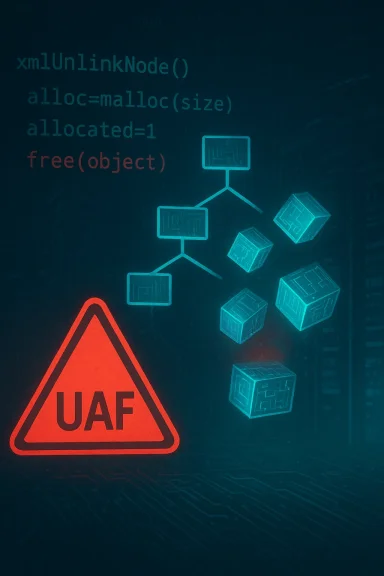
The vulnerability catalogued as CVE‑2023‑45322 is a use‑after‑free (CWE‑416) inside the function xmlUnlinkNode in tree.c. The defect is not a classic memory‑corruption primitive that an attacker can reliably force and weaponize for arbitrary code execution — instead, it only manifests after a particular memory allocation returns failure. The description and status of the issue are recorded in public vulnerability databases.
That “allocation‑failure only” condition is the heart of the debate around severity: upstream maintainers argued an attacker normally cannot control when allocations fail, and therefore the real‑world risk is limited. Security teams, distribution maintainers and industrial users took a more conservative view and fixed or backported the change in distribution packages to avoid any lingering risk. Evidence of fixes and distribution advisories are available from multiple vendor distributors.
A greatly simplified pseudo‑version of the relevant sequence looks like:
Attackers have several avenues to induce allocation failures or to make allocation failures more likely:
Security teams therefore typically treat this type of bug seriously for two reasons:
Three practical lessons for teams:
Recommended actions, in order:
Concluding note: this vulnerability is worth patching now and thinking about long‑term architecture changes to isolate untrusted parsing. The immediate danger is denial of service; the long‑term lesson is that allocation‑failure paths must be treated as first‑class error states during development and code review.
Source: MSRC Security Update Guide - Microsoft Security Response Center
 Background
libxml2 is one of the most widely embedded XML libraries in the open‑source ecosystem. It ships in Linux distributions, is linked into web servers, toolchains and desktop applications, and is used as the XML engine behind countless higher‑level services. A defensive posture in many projects is to treat libxml2 as a trusted component; when it misbehaves, the consequences propagate quickly because XML parsing is often performed in core services and libraries.The vulnerability catalogued as CVE‑2023‑45322 is a use‑after‑free (CWE‑416) inside the function xmlUnlinkNode in tree.c. The defect is not a classic memory‑corruption primitive that an attacker can reliably force and weaponize for arbitrary code execution — instead, it only manifests after a particular memory allocation returns failure. The description and status of the issue are recorded in public vulnerability databases.
That “allocation‑failure only” condition is the heart of the debate around severity: upstream maintainers argued an attacker normally cannot control when allocations fail, and therefore the real‑world risk is limited. Security teams, distribution maintainers and industrial users took a more conservative view and fixed or backported the change in distribution packages to avoid any lingering risk. Evidence of fixes and distribution advisories are available from multiple vendor distributors.
What the bug actually is — technical anatomy
At a high level, xmlUnlinkNode is responsible for detaching a node from its parent and sibling lists within the libxml2 document tree. The bug arises in the control flow that runs when unlinking nodes under low‑memory conditions: if a later allocation fails, libxml2’s error path can free or partially tear down data structures while code later in the same call continues to reference those freed structures — a textbook use‑after‑free.A greatly simplified pseudo‑version of the relevant sequence looks like:
- validate the node pointer
- adjust parent->children and sibling pointers
- possibly perform allocations or operations that may fail (e.g., temporary buffers, structure updates)
- on error, free resources and return
- later code paths assume the node is still valid and access freed memory
Why allocation‑failure bugs are tricky to reason about
- Memory allocation failures (malloc/new returning NULL) are rare on modern desktop and server systems, which often have plentiful RAM or overcommitted virtual memory policies.
- Some environments — tiny embedded devices, containers with strict memory cgroup limits, or deliberately constrained sandboxed parsers — are much more likely to experience allocation failures.
- An attacker with the ability to influence resource pressure (for example by generating many simultaneous requests, or by directing large file uploads to the target process) may be able to induce allocation failures even in otherwise well‑provisioned environments.
- The observed vulnerability can therefore produce different risk profiles depending on deployment: negligible on a beefy, single‑tenant server; significant on a multi‑tenant cloud node, shared service, or a resource‑limited appliance.
xmllint utility with memory limits. The upstream fix was merged after the issue was confirmed.Exploitability and real‑world risk: separating theory from practice
The vendor and some maintainers argued the issue did not merit a CVE because an attacker “typically can't control when memory allocations fail.” That statement is partially true: a remote attacker cannot directly flip a single malloc call from success to failure on demand in most contexts. But cannot control is not the same as cannot influence.Attackers have several avenues to induce allocation failures or to make allocation failures more likely:
- Resource exhaustion: creating enough pressure on memory (or address space) to trigger allocation failures. This can be achieved by high request volumes, memory‑heavy payloads, or repeated allocations across threads and processes.
- Shared tenancy: in multi‑tenant hosts a noisy neighbor can consume or fragment memory, making allocation failures in a victim process more probable.
- Cgroup or container limits: if a service runs inside a container with a low MemoryMax, a single client that sends carefully sized payloads can more easily force out‑of‑memory conditions.
- Heap grooming: in some scenarios, attackers can influence allocator state by controlling the pattern of allocations and frees (especially in long‑lived processes) — this makes allocator behavior more deterministic and increases the chance that a freed region will be reused in a way that turns a use‑after‑free into a more powerful primitive.
Security teams therefore typically treat this type of bug seriously for two reasons:
- Availability: Repeatedly triggering allocation failure can produce sustained or persistent denial of service across a fleet.
- Escalation potential: While the immediate bug may only be a crash on many systems, in the worst case a well‑groomed use‑after‑free can lead to memory corruption that an attacker amplifies into a more serious compromise on vulnerable runtimes.
Where you might care — ecosystem impact
Because libxml2 is a low‑level library used across many packages, the potential blast radius is broad:- Linux distribution packages that embed libxml2 directly (system libraries, desktop stacks).
- Server software and daemons that use libxml2 to parse XML payloads (web services, proxy servers, CI systems).
- Third‑party applications that link libxml2 (document processors, XML toolchains, language bindings).
- Container images that include older libxml2 binaries or rely on base images with outdated packages.
The upstream response and patching
Upstream and distro maintainers treated the report in two parallel ways: first, confirm and reproduce the issue; second, harden the code path so that allocation failures cannot lead to use‑after‑free conditions.- A reproducer was provided in the upstream issue and on security mailing lists; the reproduction uses
xmllintwith constrained memory to exercise the condition. That reproducer made it straightforward for maintainers and distributors to validate the bug and test fixes. - Upstream committed fixes that change the error handling and lifetime management inside xmlUnlinkNode to eliminate the window where freed memory could be accessed later in the same call.
- Distributors released patched packages and advisories; system administrators should prefer vendor packages because they integrate the fix into the shipped ABI and packaging ecosystem. Notable vendor advisories and patches were published for SUSE, Debian and Ubuntu among others.
Practical mitigation and hardening checklist
Whether you are a sysadmin, packager or developer, treat CVE‑2023‑45322 as a precautionary maintenance item: it was fixed upstream and distributions issued patches. Beyond upgrading, consider the following layered mitigations to reduce the chance that a transient allocation failure can be weaponized in your environment.- Upgrade libxml2 to a version that includes the upstream fix or install the vendor security update shipped by your distribution. This is the most direct fix.
- Run parsers that process untrusted XML inside strict resource boundaries:
- Use container / cgroup memory limits with sensible headroom and monitoring.
- Use OS process limits (ulimit) and systemd ResourceControl settings to cap memory for parsing workers.
- Prefer short‑lived, forked helper processes for parsing untrusted documents; if one helper crashes, the supervisor can restart it without affecting the main process.
- Apply time and size limits to XML inputs:
- Reject inputs over a configured size and enforce read timeouts on network connections.
- Limit recursion, entity expansion and other XML features that trigger large allocations.
- Use sandboxing and privilege separation:
- Parse untrusted XML in a low‑privilege user or namespace to reduce the impact of a crash or potential escalation.
- Employ seccomp / ptrace rejects and other OS‑level sandboxing where feasible.
- Monitor and alert on OOM/killed processes and parsing crashes:
- Set up alerts for repeated crashes of parsing processes; a single crash may be transient, but repeated or patterned crashes usually indicate an attack or a faulty workflow.
- Consider hardened allocators and mitigations:
- Hardened memory allocators and heap checking tools can make memory reuse less deterministic and can help detect or block exploitation attempts.
- Address Space Layout Randomization (ASLR) and other standard mitigations remain important, though they are not a substitute for correctness.
Policy and disclosure lessons
CVE‑2023‑45322 also exposes a recurring point of tension in vulnerability triage: when is an edge‑case bug worthy of public tracking with a CVE? Upstream maintainers made an operational judgment — the failure mode depends on allocation failure conditions and therefore they deemed the issue low priority. Security trackers and distribution maintainers disagreed, rightly from an operational risk perspective: availability issues are real, and DoS is a legitimate security impact.Three practical lessons for teams:
- Treat availability‑only bugs seriously when the vulnerable component is in a critical path. A crash loop or the inability to accept connections is a security problem for operations.
- Maintainers should value reproducers and tests: the existence of a simple reproduction case helped distributors validate and patch quickly.
- Vendors and security teams should communicate clearly about scope and mitigations: a vendor statement that an attacker "generally can't control allocation failures" is accurate but incomplete unless accompanied by guidance on where the component is likely to run in low‑memory or multi‑tenant environments.
Decision framework for operators: how to prioritize CVE‑2023‑45322 in your environment
Ask the following questions to decide how urgently to act:- Is libxml2 used in a network‑facing service that parses untrusted XML? If yes, prioritize immediate updates.
- Does the parsing occur inside a resource‑constrained environment (embedded device, small container, low‑memory VM)? If yes, treat the issue as high priority.
- Can an attacker send a high rate of requests or large inputs to the parsing service? If yes, assume the attacker can raise the probability of allocation failures.
- Can you apply a vendor patch quickly? If yes, schedule the patch confidently; if not, implement temporary mitigations (sandboxing, request size limits, process isolation).
- Is libxml2 statically linked into applications you ship to customers? If yes, plan for a rebuild and redeploy of affected binaries.
Final analysis — threat, impact, and recommended action
CVE‑2023‑45322 is not an esoteric academic bug; it is a genuine use‑after‑free that was reproduced, discussed on security mailing lists, and fixed upstream. The fact that a vulnerability requires an allocation failure to trigger does not remove its operational significance: an attacker who can influence memory pressure, or an environment that runs with tight memory quotas, can turn this edge case into a practical denial‑of‑service. Multiple distributions tracked the issue and pushed fixes or advisories, which is the expected and appropriate response for a widely used library.Recommended actions, in order:
- Patch: install the libxml2 update from your distribution or rebuild with the patched upstream source.
- Contain: run XML parsing of untrusted data in isolated processes, with memory limits and short timeouts.
- Monitor: set alerts for crashes, OOM events and anomalous parsing errors to detect potential abuse.
- Harden: apply size and recursion limits on XML inputs, and use sandboxing or privilege separation where practical.
Concluding note: this vulnerability is worth patching now and thinking about long‑term architecture changes to isolate untrusted parsing. The immediate danger is denial of service; the long‑term lesson is that allocation‑failure paths must be treated as first‑class error states during development and code review.
Source: MSRC Security Update Guide - Microsoft Security Response Center
