

Lightbits Labs said on May 28, 2026, that its Lightbits 3.19.1 software has achieved early interoperability with Microsoft’s Windows Server NVMe-over-Fabrics Initiator Preview, allowing Windows Server Insider hosts to connect to NVMe/TCP block storage over standard Ethernet for evaluation. That sentence sounds narrow, almost laboratory-grade. But the larger story is that Windows Server is inching toward a storage model Linux shops have treated as normal for years: fast, disaggregated NVMe without pretending every remote disk is still a SCSI device. The announcement is less a victory lap than a marker on the road to a more modern Windows data path.
For decades, Windows storage has carried the weight of compatibility. That has been one of the platform’s strengths: SANs, HBAs, iSCSI, Fibre Channel, Hyper-V, clustering, backup agents, monitoring tools, and ancient line-of-business applications could all coexist because the abstractions were stable and familiar. But compatibility has a cost, and in storage that cost often shows up as translation, queueing limits, CPU overhead, and architectural compromises.
NVMe-over-Fabrics exists because modern flash stopped behaving like the disks the old storage stack was built around. NVMe was designed for parallelism, low latency, and high command throughput. NVMe-oF extends that model across a network, making remote namespaces look closer to local NVMe devices than to traditional SAN LUNs wrapped in older protocol assumptions.
Microsoft’s preview initiator matters because an inbox Windows initiator changes the deployment conversation. A third-party initiator can solve a technical problem, and several vendors have done real work there, but native support changes what procurement, support, certification, and operations teams are willing to consider. Windows shops generally do not want the storage equivalent of a science project in their most latency-sensitive environments.
That is why Lightbits’ announcement is notable even though it is explicitly early and non-production. The company is not saying Windows Server customers should rip out their SANs tomorrow. It is saying the plumbing is beginning to exist, and Lightbits wants to be among the first storage vendors that can prove its target talks to Microsoft’s emerging native initiator.
The company’s press release frames the milestone as “initial interoperability,” and that cautious phrasing is doing important work. Interoperability in storage is not a checkbox you wave around after one clean connection. It is a long grind through discovery, connection management, multipathing behavior, failure handling, reconnects, queue depths, timeout semantics, firmware variation, networking weirdness, and the grim reality that every customer’s “standard Ethernet” looks a little different under pressure.
Still, early validation has value because protocol adoption is partly social. Storage administrators trust what they can test. Platform teams trust what appears in Microsoft’s own preview builds. Vendors trust what they can reproduce. The Lightbits announcement is therefore a signal to the market: Windows Server is becoming a serious NVMe/TCP host, and Lightbits wants customers to start thinking about that future now.
This is also a competitive positioning move. In a market where every storage vendor claims AI readiness, cloud-like elasticity, and breathtaking IOPS, being early with Windows native NVMe-oF support gives Lightbits a more concrete story. It can point to a specific Microsoft platform capability and say: when this ships, we intend to be there.
SCSI has been extraordinarily durable because it became more than a protocol; it became a lingua franca for enterprise storage. That durability is why so much infrastructure still behaves as though every device is a spinning disk at heart, even when the media underneath is flash capable of absurd levels of parallel work. The abstraction held long after the hardware changed.
NVMe attacks that mismatch directly. It was built around many queues, many commands, and a world where storage can keep up with CPUs and networks in ways old designs did not anticipate. NVMe-oF extends the model outward, letting a host speak NVMe commands across a fabric instead of passing through layers originally shaped by different constraints.
This does not mean SCSI disappears. Enterprise storage rarely dies; it fossilizes into the next decade’s compatibility layer. But the arrival of a Windows Server NVMe-oF initiator preview suggests Microsoft recognizes that the high-performance end of the market no longer wants remote flash to masquerade as something older.
There are faster, more specialized ways to build storage networks. RDMA fabrics can be excellent when engineered well, and Fibre Channel remains deeply entrenched in enterprises that value deterministic storage behavior and have the staff to maintain it. But many organizations have standardized around Ethernet skills, Ethernet tooling, and Ethernet purchasing motions. NVMe/TCP is compelling because it asks fewer of them to change everything at once.
That does not make NVMe/TCP magic. Low latency still requires disciplined network design. Congestion, packet loss, interrupt moderation, CPU placement, offload behavior, switch buffering, and pathing decisions can all turn a promising architecture into a troubleshooting swamp. “Uses Ethernet” should never be confused with “works well on any Ethernet network someone happened to have lying around.”
But the economic appeal is obvious. If Windows Server can consume native NVMe/TCP block storage without proprietary client stacks or exotic adapters, the addressable market expands. A midmarket enterprise running Hyper-V, SQL Server, analytics, or dense file services could eventually consider disaggregated flash without rebuilding its entire data center around a niche fabric.
That is the democratization Lightbits is invoking. The company’s CTO, Abel Gordon, is right to frame this as a step toward bringing high-performance block storage to more Windows environments. The unresolved question is whether the operational experience will be simple enough for mainstream Windows shops once the preview becomes a supported feature.
Storage previews are uniquely dangerous because success can be misleading. A host connects, a namespace appears, a benchmark runs, and the graph looks wonderful. But production storage is not proven by the happy path. It is proven by cable pulls, controller failovers, patch cycles, authentication changes, network brownouts, volume resizes, host crashes, firmware updates, and the dreadful Monday morning after someone changed a switch template.
Microsoft’s Windows Server Insider channel is the right place for this work because initiator behavior has to be exercised by real storage targets before it can mature. Lightbits’ participation gives Microsoft another serious vendor environment to test against. Customers and partners get an early look at the operational model and can discover where documentation, tooling, or assumptions break down.
But nobody should mistake “validated initial connectivity” for “certified production platform.” The latter requires a much broader ecosystem: support statements, compatibility matrices, multipath guidance, cluster validation, backup vendor behavior, monitoring integration, and a clear Microsoft servicing story. The technology may be exciting, but storage administrators are paid to be suspicious for a reason.
A Windows Server feature becomes real when it shows up coherently in the places administrators already live: PowerShell, Event Viewer, Failover Cluster Manager, Windows Admin Center, performance counters, Device Manager, documented registry behavior, and supportable diagnostics. If NVMe-oF remains a feature that requires spelunking through obscure utilities and preview-era caveats, adoption will be limited to specialist teams.
That is why the initiator preview is only the first layer. The surrounding operational model will decide whether NVMe/TCP becomes a mainstream Windows Server storage option or an enthusiast-grade capability used by a narrow set of performance shops. Administrators will want to know how authentication is handled, how discovery is configured, how paths are monitored, how reconnection behaves, and how errors map into familiar Windows logging.
They will also want Microsoft’s guidance on clustering. High-performance block storage in Windows often intersects with Hyper-V, SQL Server, Scale-Out File Server, and failover clustering. A single host mounting a remote namespace is useful for proving a protocol; a supported, resilient, observable cluster is what makes the feature enterprise infrastructure.
But the Hyper-V story will depend on details Microsoft has not fully settled in the public preview narrative. Production virtualization requires predictable behavior under contention, well-understood failover, compatibility with live migration, backup integration through VSS-aware tooling, and clear performance isolation. A fast namespace is not the same thing as a virtualization platform design.
There is also the existing Microsoft storage stack to consider. Windows Server customers already have Storage Spaces Direct, SMB Direct, iSCSI, Fibre Channel, and vendor-specific SAN integrations. NVMe-oF does not merely add another transport; it changes where performance-sensitive shops may draw the line between Windows-native infrastructure and external storage systems.
That could create tension. Microsoft has spent years promoting software-defined storage patterns around Windows Server and Azure Stack-adjacent thinking. Native NVMe-oF makes it easier for external storage platforms to plug into Windows with less legacy baggage. For customers, that is choice. For Microsoft’s own storage strategy, it is a reminder that Windows must participate in industry storage standards even when they compete with preferred architectural patterns.
Not every AI workload needs NVMe-oF. Some are capacity-bound, some are memory-bound, and many are constrained by data governance or application design rather than raw storage throughput. But the pressure is real: as organizations try to serve models, retrieve embeddings, manage feature stores, and feed analytics platforms, the storage layer is being asked to provide lower latency and higher concurrency without becoming a bespoke island.
Lightbits’ own positioning around a KV cache prefetch engine for AI fits this broader theme. The company is arguing that storage vendors can no longer sell only durable blocks; they must help accelerate the data paths around modern inference and analytics workloads. Windows Server is not always the first platform people associate with cutting-edge AI infrastructure, but plenty of enterprises still run critical data services, application tiers, and management planes on Windows.
That is where the interoperability claim becomes strategically useful. If Windows Server can participate more naturally in NVMe/TCP environments, mixed-platform shops get more architectural flexibility. Linux hosts may still dominate many AI clusters, but Windows does not have to remain outside the high-performance storage fabric.
That expectation will force vendors to compete on implementation quality rather than merely on having a Windows story at all. Connection stability, management integration, documentation clarity, and support responsiveness will matter. So will participation in plugfests, certification programs, and real customer pilots that go beyond a press-release connection.
Lightbits benefits from having a coherent NVMe/TCP identity. The company was built around disaggregated NVMe block storage over Ethernet, so this is not a side feature bolted onto a legacy array. That gives it credibility in the conversation, particularly for customers evaluating alternatives to conventional SAN refreshes.
But incumbents will not stand still. Large storage vendors have relationships, support organizations, and installed bases that dwarf smaller specialists. Once Microsoft’s initiator matures, expect the market to become crowded quickly. The real question for Lightbits is whether early technical alignment turns into durable design wins before the giants normalize the feature.
Administrators will want comparisons against iSCSI, Fibre Channel, SMB-based designs, and existing third-party NVMe-oF initiators. They will want to see CPU utilization under load, latency distribution under contention, reconnect behavior during failure, and multi-host scaling. Average IOPS numbers are useful for headlines, but tail latency is where production pain lives.
They will also want to see how Windows behaves when storage is not the only thing happening. A server running SQL Server, Hyper-V, antivirus, monitoring agents, backup software, and a real network security stack is not a clean benchmark host. The storage path must earn its place in that mess.
This is where early interoperability programs can either help or disappoint. If Lightbits and Microsoft use the preview window to publish practical guidance, known limitations, and validated configurations, they can build confidence. If the market gets only aspirational performance language, Windows storage teams will wait.
NVMe/TCP over Ethernet introduces familiar network security questions in a storage-specific form. Who can discover targets? How are hosts identified? How are connections authenticated? How are management planes separated from data planes? What happens when a compromised server can see storage endpoints it should not? How do logs prove what connected, when, and to which namespace?
Windows shops will expect answers that align with existing identity, policy, and monitoring practices. Storage administrators may be comfortable with fabric zoning and storage-side access control, but security teams increasingly want stronger evidence and centralized visibility. Native support gives Microsoft an opportunity to make NVMe-oF observable and governable in Windows-native ways.
The same applies to patching. If the initiator is part of Windows Server, then its fixes and regressions become part of the Windows servicing story. That is good for standardization but also means storage behavior can be affected by cumulative updates. Enterprises will need test rings that include storage fabrics, not just application smoke tests.
But storage is one of the areas where late can be better than reckless. A buggy browser feature is annoying. A buggy storage initiator can corrupt data, strand clusters, or turn a maintenance window into a career-limiting event. The caution embedded in this preview is not merely corporate timidity; it reflects the blast radius of getting the storage stack wrong.
The more interesting criticism is not that Microsoft is late, but that Windows Server customers need clearer roadmaps for storage modernization. Windows Server 2025 brought a renewed focus on native NVMe performance, and now the NVMe-oF initiator preview extends that direction across the network. Customers planning infrastructure refreshes need to know whether this becomes a supported near-term feature, a vNext promise, or a long-running preview.
Microsoft does not need to promise everything at once. It does need to make the path legible. Storage architecture decisions have long lifecycles, and ambiguity pushes enterprises back toward familiar protocols even when better options are emerging.
This is a good moment for labs that mirror real environments. Test with the switches, NICs, firmware, security agents, monitoring tools, and workloads you actually use. Measure not just peak throughput, but recovery behavior and administrative clarity. The question is not whether NVMe/TCP can be fast; it is whether your Windows operations team can run it safely at 2 a.m.
It is also a good time to inventory assumptions. Many organizations have built storage policies around older protocols because Windows made those choices natural. Native NVMe-oF support could reopen design questions around SAN refreshes, virtualization clusters, database platforms, and disaggregated storage for analytics.
The important point is that the preview is an invitation to learn. The worst response would be to ignore it until it ships and then discover that your network, tooling, or operational model is not ready. The second-worst response would be to treat an early connection test as a production endorsement.
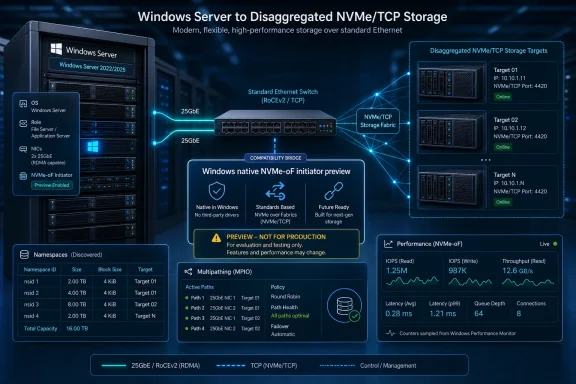 Windows Server Finally Meets the Fabric on Its Own Terms
For decades, Windows storage has carried the weight of compatibility. That has been one of the platform’s strengths: SANs, HBAs, iSCSI, Fibre Channel, Hyper-V, clustering, backup agents, monitoring tools, and ancient line-of-business applications could all coexist because the abstractions were stable and familiar. But compatibility has a cost, and in storage that cost often shows up as translation, queueing limits, CPU overhead, and architectural compromises.NVMe-over-Fabrics exists because modern flash stopped behaving like the disks the old storage stack was built around. NVMe was designed for parallelism, low latency, and high command throughput. NVMe-oF extends that model across a network, making remote namespaces look closer to local NVMe devices than to traditional SAN LUNs wrapped in older protocol assumptions.
Microsoft’s preview initiator matters because an inbox Windows initiator changes the deployment conversation. A third-party initiator can solve a technical problem, and several vendors have done real work there, but native support changes what procurement, support, certification, and operations teams are willing to consider. Windows shops generally do not want the storage equivalent of a science project in their most latency-sensitive environments.
That is why Lightbits’ announcement is notable even though it is explicitly early and non-production. The company is not saying Windows Server customers should rip out their SANs tomorrow. It is saying the plumbing is beginning to exist, and Lightbits wants to be among the first storage vendors that can prove its target talks to Microsoft’s emerging native initiator.
Lightbits Is Selling Validation, Not Just Speed
Lightbits’ pitch has always been that NVMe/TCP can bring much of the performance logic of NVMe-oF to ordinary Ethernet. That matters because Ethernet is everywhere. The expensive part of many high-performance storage transitions is not merely buying faster media; it is changing the operational substrate around it.The company’s press release frames the milestone as “initial interoperability,” and that cautious phrasing is doing important work. Interoperability in storage is not a checkbox you wave around after one clean connection. It is a long grind through discovery, connection management, multipathing behavior, failure handling, reconnects, queue depths, timeout semantics, firmware variation, networking weirdness, and the grim reality that every customer’s “standard Ethernet” looks a little different under pressure.
Still, early validation has value because protocol adoption is partly social. Storage administrators trust what they can test. Platform teams trust what appears in Microsoft’s own preview builds. Vendors trust what they can reproduce. The Lightbits announcement is therefore a signal to the market: Windows Server is becoming a serious NVMe/TCP host, and Lightbits wants customers to start thinking about that future now.
This is also a competitive positioning move. In a market where every storage vendor claims AI readiness, cloud-like elasticity, and breathtaking IOPS, being early with Windows native NVMe-oF support gives Lightbits a more concrete story. It can point to a specific Microsoft platform capability and say: when this ships, we intend to be there.
The Real Break Is with SCSI’s Long Shadow
The most important word in this announcement is not “Lightbits.” It is “native.” For Windows Server environments, native NVMe-oF support would mean less dependence on legacy SCSI-based paths or specialized hardware when connecting to high-performance block storage.SCSI has been extraordinarily durable because it became more than a protocol; it became a lingua franca for enterprise storage. That durability is why so much infrastructure still behaves as though every device is a spinning disk at heart, even when the media underneath is flash capable of absurd levels of parallel work. The abstraction held long after the hardware changed.
NVMe attacks that mismatch directly. It was built around many queues, many commands, and a world where storage can keep up with CPUs and networks in ways old designs did not anticipate. NVMe-oF extends the model outward, letting a host speak NVMe commands across a fabric instead of passing through layers originally shaped by different constraints.
This does not mean SCSI disappears. Enterprise storage rarely dies; it fossilizes into the next decade’s compatibility layer. But the arrival of a Windows Server NVMe-oF initiator preview suggests Microsoft recognizes that the high-performance end of the market no longer wants remote flash to masquerade as something older.
Standard Ethernet Is the Political Win
The phrase “over standard Ethernet” is not marketing filler. It is the center of the argument for NVMe/TCP.There are faster, more specialized ways to build storage networks. RDMA fabrics can be excellent when engineered well, and Fibre Channel remains deeply entrenched in enterprises that value deterministic storage behavior and have the staff to maintain it. But many organizations have standardized around Ethernet skills, Ethernet tooling, and Ethernet purchasing motions. NVMe/TCP is compelling because it asks fewer of them to change everything at once.
That does not make NVMe/TCP magic. Low latency still requires disciplined network design. Congestion, packet loss, interrupt moderation, CPU placement, offload behavior, switch buffering, and pathing decisions can all turn a promising architecture into a troubleshooting swamp. “Uses Ethernet” should never be confused with “works well on any Ethernet network someone happened to have lying around.”
But the economic appeal is obvious. If Windows Server can consume native NVMe/TCP block storage without proprietary client stacks or exotic adapters, the addressable market expands. A midmarket enterprise running Hyper-V, SQL Server, analytics, or dense file services could eventually consider disaggregated flash without rebuilding its entire data center around a niche fabric.
That is the democratization Lightbits is invoking. The company’s CTO, Abel Gordon, is right to frame this as a step toward bringing high-performance block storage to more Windows environments. The unresolved question is whether the operational experience will be simple enough for mainstream Windows shops once the preview becomes a supported feature.
Preview Status Is a Warning Label, Not a Footnote
The release is careful to say this capability is pre-release and not intended for production. That warning deserves more weight than it will probably get in some labs.Storage previews are uniquely dangerous because success can be misleading. A host connects, a namespace appears, a benchmark runs, and the graph looks wonderful. But production storage is not proven by the happy path. It is proven by cable pulls, controller failovers, patch cycles, authentication changes, network brownouts, volume resizes, host crashes, firmware updates, and the dreadful Monday morning after someone changed a switch template.
Microsoft’s Windows Server Insider channel is the right place for this work because initiator behavior has to be exercised by real storage targets before it can mature. Lightbits’ participation gives Microsoft another serious vendor environment to test against. Customers and partners get an early look at the operational model and can discover where documentation, tooling, or assumptions break down.
But nobody should mistake “validated initial connectivity” for “certified production platform.” The latter requires a much broader ecosystem: support statements, compatibility matrices, multipath guidance, cluster validation, backup vendor behavior, monitoring integration, and a clear Microsoft servicing story. The technology may be exciting, but storage administrators are paid to be suspicious for a reason.
Windows Administrators Will Care About the Tools More Than the Acronym
For Linux users, NVMe/TCP has been part of the conversation for years. Windows administrators are a different audience, and Microsoft’s success here will depend as much on management experience as on protocol purity.A Windows Server feature becomes real when it shows up coherently in the places administrators already live: PowerShell, Event Viewer, Failover Cluster Manager, Windows Admin Center, performance counters, Device Manager, documented registry behavior, and supportable diagnostics. If NVMe-oF remains a feature that requires spelunking through obscure utilities and preview-era caveats, adoption will be limited to specialist teams.
That is why the initiator preview is only the first layer. The surrounding operational model will decide whether NVMe/TCP becomes a mainstream Windows Server storage option or an enthusiast-grade capability used by a narrow set of performance shops. Administrators will want to know how authentication is handled, how discovery is configured, how paths are monitored, how reconnection behaves, and how errors map into familiar Windows logging.
They will also want Microsoft’s guidance on clustering. High-performance block storage in Windows often intersects with Hyper-V, SQL Server, Scale-Out File Server, and failover clustering. A single host mounting a remote namespace is useful for proving a protocol; a supported, resilient, observable cluster is what makes the feature enterprise infrastructure.
The Hyper-V Angle Is Obvious but Not Automatic
Any time Windows Server gains a new block storage path, Hyper-V enters the room. The idea of attaching high-performance NVMe/TCP storage to Windows Server hosts and using it for virtual machine workloads is immediately attractive. It could give virtualization teams a way to separate compute and storage while keeping the simplicity of Ethernet and the performance profile of NVMe.But the Hyper-V story will depend on details Microsoft has not fully settled in the public preview narrative. Production virtualization requires predictable behavior under contention, well-understood failover, compatibility with live migration, backup integration through VSS-aware tooling, and clear performance isolation. A fast namespace is not the same thing as a virtualization platform design.
There is also the existing Microsoft storage stack to consider. Windows Server customers already have Storage Spaces Direct, SMB Direct, iSCSI, Fibre Channel, and vendor-specific SAN integrations. NVMe-oF does not merely add another transport; it changes where performance-sensitive shops may draw the line between Windows-native infrastructure and external storage systems.
That could create tension. Microsoft has spent years promoting software-defined storage patterns around Windows Server and Azure Stack-adjacent thinking. Native NVMe-oF makes it easier for external storage platforms to plug into Windows with less legacy baggage. For customers, that is choice. For Microsoft’s own storage strategy, it is a reminder that Windows must participate in industry storage standards even when they compete with preferred architectural patterns.
AI and Analytics Give the Announcement Its Timing
Lightbits’ release leans into performance-sensitive workloads: LLM inference, real-time analytics, and transactional systems. That is not accidental. The current storage conversation is being reshaped by AI infrastructure, where GPUs are expensive, idle time is intolerable, and data pipelines can become the bottleneck faster than procurement teams expect.Not every AI workload needs NVMe-oF. Some are capacity-bound, some are memory-bound, and many are constrained by data governance or application design rather than raw storage throughput. But the pressure is real: as organizations try to serve models, retrieve embeddings, manage feature stores, and feed analytics platforms, the storage layer is being asked to provide lower latency and higher concurrency without becoming a bespoke island.
Lightbits’ own positioning around a KV cache prefetch engine for AI fits this broader theme. The company is arguing that storage vendors can no longer sell only durable blocks; they must help accelerate the data paths around modern inference and analytics workloads. Windows Server is not always the first platform people associate with cutting-edge AI infrastructure, but plenty of enterprises still run critical data services, application tiers, and management planes on Windows.
That is where the interoperability claim becomes strategically useful. If Windows Server can participate more naturally in NVMe/TCP environments, mixed-platform shops get more architectural flexibility. Linux hosts may still dominate many AI clusters, but Windows does not have to remain outside the high-performance storage fabric.
The Vendor Ecosystem Now Has to Prove It Can Behave
A native Microsoft initiator raises the bar for storage vendors. When each vendor ships its own Windows initiator or specialized driver stack, customers expect some friction. When Microsoft ships the client, customers expect the target vendors to interoperate cleanly.That expectation will force vendors to compete on implementation quality rather than merely on having a Windows story at all. Connection stability, management integration, documentation clarity, and support responsiveness will matter. So will participation in plugfests, certification programs, and real customer pilots that go beyond a press-release connection.
Lightbits benefits from having a coherent NVMe/TCP identity. The company was built around disaggregated NVMe block storage over Ethernet, so this is not a side feature bolted onto a legacy array. That gives it credibility in the conversation, particularly for customers evaluating alternatives to conventional SAN refreshes.
But incumbents will not stand still. Large storage vendors have relationships, support organizations, and installed bases that dwarf smaller specialists. Once Microsoft’s initiator matures, expect the market to become crowded quickly. The real question for Lightbits is whether early technical alignment turns into durable design wins before the giants normalize the feature.
The Performance Story Needs Real Windows Numbers
The performance logic of NVMe-oF is strong, but this specific Windows Server preview needs measured evidence. Lightbits’ announcement speaks in architectural terms: lower overhead, better application performance, improved scalability. Those claims are plausible, but they are not a substitute for reproducible Windows benchmarks across realistic workloads.Administrators will want comparisons against iSCSI, Fibre Channel, SMB-based designs, and existing third-party NVMe-oF initiators. They will want to see CPU utilization under load, latency distribution under contention, reconnect behavior during failure, and multi-host scaling. Average IOPS numbers are useful for headlines, but tail latency is where production pain lives.
They will also want to see how Windows behaves when storage is not the only thing happening. A server running SQL Server, Hyper-V, antivirus, monitoring agents, backup software, and a real network security stack is not a clean benchmark host. The storage path must earn its place in that mess.
This is where early interoperability programs can either help or disappoint. If Lightbits and Microsoft use the preview window to publish practical guidance, known limitations, and validated configurations, they can build confidence. If the market gets only aspirational performance language, Windows storage teams will wait.
Security and Operations Cannot Be Deferred
High-performance storage has a habit of treating security as something to be layered on after the performance demo. That approach will not survive contact with modern enterprise risk teams.NVMe/TCP over Ethernet introduces familiar network security questions in a storage-specific form. Who can discover targets? How are hosts identified? How are connections authenticated? How are management planes separated from data planes? What happens when a compromised server can see storage endpoints it should not? How do logs prove what connected, when, and to which namespace?
Windows shops will expect answers that align with existing identity, policy, and monitoring practices. Storage administrators may be comfortable with fabric zoning and storage-side access control, but security teams increasingly want stronger evidence and centralized visibility. Native support gives Microsoft an opportunity to make NVMe-oF observable and governable in Windows-native ways.
The same applies to patching. If the initiator is part of Windows Server, then its fixes and regressions become part of the Windows servicing story. That is good for standardization but also means storage behavior can be affected by cumulative updates. Enterprises will need test rings that include storage fabrics, not just application smoke tests.
Microsoft’s Slow Walk May Be the Right Walk
It is tempting to criticize Microsoft for arriving late. Linux has had NVMe/TCP support for years, and Windows Server customers have had to lean on vendor drivers or alternative protocols while waiting for native functionality. In pure technology terms, Microsoft is not leading here.But storage is one of the areas where late can be better than reckless. A buggy browser feature is annoying. A buggy storage initiator can corrupt data, strand clusters, or turn a maintenance window into a career-limiting event. The caution embedded in this preview is not merely corporate timidity; it reflects the blast radius of getting the storage stack wrong.
The more interesting criticism is not that Microsoft is late, but that Windows Server customers need clearer roadmaps for storage modernization. Windows Server 2025 brought a renewed focus on native NVMe performance, and now the NVMe-oF initiator preview extends that direction across the network. Customers planning infrastructure refreshes need to know whether this becomes a supported near-term feature, a vNext promise, or a long-running preview.
Microsoft does not need to promise everything at once. It does need to make the path legible. Storage architecture decisions have long lifecycles, and ambiguity pushes enterprises back toward familiar protocols even when better options are emerging.
The First Practical Reading for Windows Shops
The near-term action is evaluation, not migration. Lightbits customers and Windows Server Insiders can begin testing the mechanics of connecting Windows hosts to Lightbits NVMe/TCP volumes, but production teams should treat the results as planning data rather than deployment approval.This is a good moment for labs that mirror real environments. Test with the switches, NICs, firmware, security agents, monitoring tools, and workloads you actually use. Measure not just peak throughput, but recovery behavior and administrative clarity. The question is not whether NVMe/TCP can be fast; it is whether your Windows operations team can run it safely at 2 a.m.
It is also a good time to inventory assumptions. Many organizations have built storage policies around older protocols because Windows made those choices natural. Native NVMe-oF support could reopen design questions around SAN refreshes, virtualization clusters, database platforms, and disaggregated storage for analytics.
The important point is that the preview is an invitation to learn. The worst response would be to ignore it until it ships and then discover that your network, tooling, or operational model is not ready. The second-worst response would be to treat an early connection test as a production endorsement.
The Windows Storage Map Just Shifted a Few Degrees
Lightbits’ announcement is small in the way infrastructure milestones often are: a version number, a preview feature, a vendor validation claim, and a reminder not to use it in production. But underneath that modest surface, several practical conclusions are already visible.- Windows Server is moving toward native participation in NVMe-over-Fabrics, starting with preview support for initiator connectivity in Insider builds.
- Lightbits 3.19.1 has been positioned as an early validation point for Windows Server hosts connecting to NVMe/TCP block storage.
- The immediate audience is storage administrators, partners, and customers willing to evaluate the feature, not production teams looking for a supported migration path.
- The long-term value depends less on raw protocol support than on Microsoft’s tooling, diagnostics, clustering guidance, and servicing model.
- Standard Ethernet makes the architecture commercially attractive, but it does not remove the need for disciplined network and storage engineering.
- Vendors that move early may shape customer expectations, but broad adoption will require certification, benchmarks, and operational proof.
References
- Primary source: HPCwire
Published: 2026-05-28T18:40:12.274254
BigDATAwire - Data Science • AI • Advanced Analytics
Inventor of NVMe/TCP & KV Cache accelerator Validates Initial Connectivity to Bring High-Performance Block Storage to Windows Server Environments SAN JOSE, Calif., May 28, 2026 — Lightbits Labs today announced the initial […]www.hpcwire.com - Official source: techcommunity.microsoft.com
Introducing the Windows NVMe-oF Initiator Preview in Windows Server Insiders Builds | Microsoft Community Hub
What Is NVMe-over-Fabrics? NVMe-over-Fabrics (NVMe-oF) extends the NVMe protocol—originally designed for local PCIe-attached SSDs—across a network fabric.... techcommunity.microsoft.com
- Related coverage: lightbitslabs.com
NVMe over TCP Storage for Capital Markets | Lightbits at STAC 2026
Lightbits, inventor of NVMe over TCP, showcases high-performance storage at STAC Summits. Achieve sub-200µs latency and 67% smaller data center footprints.www.lightbitslabs.com - Related coverage: tomshardware.com
- Related coverage: windowscentral.com
Microsoft shuts down another Windows 11 registry hack — native NVMe SSD support has changed but Insiders still have options | Windows Central
Microsoft changes the nvmedisk.sys registry ID tweak.www.windowscentral.com - Related coverage: cozumpark.com
Windows Server’da NVMe-over-Fabrics Dönemi Başlıyor - ÇözümPark
Windows Server’da NVMe-over-Fabrics Dönemi Başlıyorwww.cozumpark.com
- Related coverage: techradar.com
Servers running Windows Server 2025 can now hit insane NVMe speeds previously impossible with old SCSI storage setups | TechRadar
DiskSpd.exe tests show up to 80% improved 4K random read IOPSwww.techradar.com - Related coverage: deskmodder.de
Windows Server 29558 LTSC vNext wurde veröffentlicht - Deskmodder.de
Microsoft hat neben den optionalen Updates für Windows 11 auch eine neue Server LTSC vNext Version veröffentlicht. Es ist die Windows Server 29558 und kommt mit dem erweiterten NVMe-Protokoll NVMe-over-Fabrics (NVMe-oF). NVMe-over-Fabrics (NVMe-oF) Erweitert das NVMe-Protokoll – das ursprünglich...www.deskmodder.de - Related coverage: ntcompatible.com
Windows Server vNext Preview Build 29574: Quick Recovery, NVMe-oF and Clean Install Warning
Windows Server vNext Preview Build 29574 introduces Quick Machine Recovery to automatically fix boot failures and expands network storage options with NVMe-over-Fabrics support over TCP and RDMA.www.ntcompatible.com - Related coverage: app.dealroom.co
Lightbits Labs achieves early interoperability with Microsoft Windows Server NVMe-oF Initiator Preview | Dealroom.co
Lightbits Labs has announced early interoperability with Microsoft's Windows Server NVMe-over-Fabrics Initiator Preview. Available in Lightbits v3.19.1, this milestone will enable storage administrators to deliver high-performance NVMe over TCP block storage to Windows Server Insider hosts...app.dealroom.co - Related coverage: starwindsoftware.com
NVMe-oF (NVMe over Fabrics) Initiator from StarWind
StarWind NVMe-oF Initiator being Windows-Certified is the only solution that offers NVMe-oF connectivity over TCP and RoCE v2 networks for Windows applications www.starwindsoftware.com
- Official source: microsoft.com
Download Windows Server Insider Preview
www.microsoft.com
- Related coverage: docs.amd.com
AMD Technical Information Portal
docs.amd.com
- Official source: learn.microsoft.com
Supported OS Images - Azure Virtual Machines | Microsoft Learn
Get a list of supported operating system images for remote NVMe.learn.microsoft.com - Related coverage: nvmexpress.org
- Related coverage: knowledgebase.starwindsoftware.com
