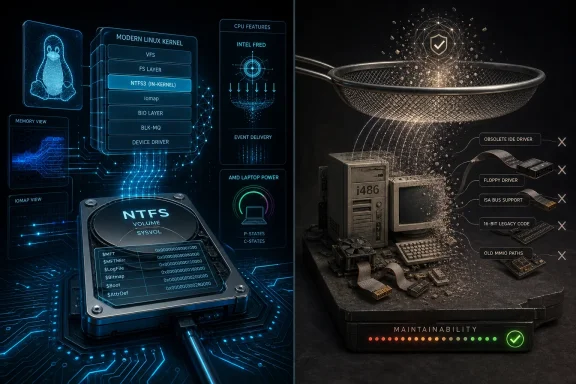
Linux 7.1 was released by Linus Torvalds on June 14, 2026, bringing a rewritten optional NTFS driver, Steam Deck OLED audio fixes, Apple Silicon battery reporting, AMD power-management changes, Intel FRED enablement, and a large purge of obsolete kernel code. The interesting part is not that Linux gained another long list of hardware enablement patches; it always does. The interesting part is that this release reads like a kernel community deciding, with unusual clarity, what is worth carrying forward and what is not.
For Windows users who live in Linux part-time, Linux 7.1 is unusually relevant. NTFS is a Microsoft filesystem, the Steam Deck is a Linux PC with console expectations, Apple Silicon support is a test of whether mainline can absorb vendor-hostile hardware, and the code removals are a reminder that old compatibility has a maintenance bill. This is a release about borders: between Windows and Linux, upstream and downstream, new hardware and old, convenience and maintainability.
The most WindowsForum-relevant change in Linux 7.1 is the arrival of a new optional NTFS driver. Linux has been able to read NTFS for ages, and the ntfs3 driver contributed by Paragon in Linux 5.15 added in-kernel write support. But NTFS on Linux has remained one of those features that technically exists while still carrying an asterisk in the minds of cautious dual-booters.
Linux 7.1 does not immediately throw ntfs3 overboard. The existing ntfs3 driver remains the default, while the new driver can be selected through kernel configuration. That makes this release less a coronation than an audition: the kernel now has a second in-tree path for NTFS that is trying to be more maintainable, more modern, and more aligned with current Linux filesystem infrastructure.
That distinction matters because NTFS is not a hobby filesystem. It is the default language of Windows data volumes, USB disks, external SSDs, and countless “I just need to copy this one thing” recovery sessions. For Linux users who dual-boot with Windows, run rescue environments, or administer mixed fleets, NTFS support is not a symbolic compatibility checkbox. It is the bridge between the world Windows assumes and the one Linux actually inhabits.
The new driver’s lineage is also notable. It comes from Namjae Jeon, already known in kernel circles for work around exFAT and other storage-related code. That does not guarantee perfection, but it does suggest the effort is not a random drive-by submission. The kernel’s filesystem maintainers have learned the hard way that a feature as risky as write support to someone else’s filesystem needs active ownership, not merely a tarball tossed over the wall.
The technical pitch is that this NTFS implementation revives and modernizes the old in-kernel NTFS driver, adding write support and moving toward newer mechanisms such as iomap-based file operations. For ordinary users, the translation is simple: Linux developers are trying to make NTFS feel less like a tolerated foreign object and more like a filesystem the kernel can reason about using its current tools.
That is why the new driver should be welcomed but not romanticized. Anyone who has mounted a Windows partition from Linux knows the familiar caveats: disable Fast Startup if necessary, do not casually write to a hibernated Windows volume, keep backups, and do not confuse filesystem support with immunity from user error. A better kernel driver can reduce friction, but it cannot make dual-boot storage magically risk-free.
Still, this release changes the conversation. For years, Linux users have had to choose between FUSE-based NTFS-3G, which is mature but slower and outside the kernel, and ntfs3, which was exciting but sometimes regarded as under-attended. Linux 7.1 introduces a third option that says the kernel community has not given up on NTFS as a first-class interoperability problem.
That matters for Windows administrators more than many Linux release notes do. Rescue media, forensic workflows, backup appliances, NAS boxes, and recovery scripts often need to handle NTFS volumes without booting Windows. If the new driver matures, the payoff will be less drama in the moments where cross-platform storage is already stressful.
The correct posture is cautious optimism. Linux 7.1 gives testers and distribution maintainers something substantial to evaluate, not a blanket instruction for everyone to remount their family photo archive read-write on day one. The fact that the new driver is optional is not a weakness. It is exactly how a kernel should introduce risky storage plumbing.
For Steam Deck owners who never leave SteamOS, this may sound academic. Valve ships a curated operating system, not a generic rolling kernel, and it can patch around hardware quirks as needed. But the Steam Deck’s cultural significance has always been that it is a PC pretending to be a console, and PCs invite users to install things they were not necessarily meant to install.
That is where upstream support matters. A Fedora, Arch, Debian, or Ubuntu experiment on the Steam Deck OLED should not require users to rediscover a vendor patch trail just to get sound from the speakers. The longer a device depends on downstream fixes, the more its “Linux support” becomes a fragile stack of tribal knowledge.
The Steam Deck OLED fix also illustrates a quiet truth about Linux hardware support: popularity does not automatically produce mainline polish. Even a high-profile Linux gaming device can carry a broken upstream experience if the relevant subsystem, firmware assumptions, topology files, and vendor patches do not line up. The kernel is vast, and regressions can hide in the seams between drivers and product-specific configuration.
Linux 7.1 does not transform the Steam Deck into a generic laptop. It does, however, reduce the distance between Valve’s supported universe and the broader Linux ecosystem. For handheld PCs, that distance is increasingly important as more Windows-first and Linux-curious devices enter the market.
That sounds like a small quality-of-life tweak, and in one sense it is. Laptop users already expect power behavior to change when they unplug. Desktop environments, vendor utilities, and distribution power daemons have been doing some version of this dance for years.
The important shift is where the policy can live. When power-profile switching depends entirely on user-space tools, behavior can vary widely by distribution, desktop environment, or OEM integration. Moving more of that intelligence closer to the kernel driver gives Linux a better chance of behaving consistently across the messy laptop market.
The feature is not enabled by default in Linux 7.1, which is another sign of kernel caution. Users or distributions must opt in, for example through a boot parameter. But the direction is obvious: Linux laptop power management is slowly becoming less of a scavenger hunt and more of a coherent platform feature.
AMD’s Ryzen AI NPU support also improves through the AMDXDNA driver, adding monitoring features such as memory usage queries and power estimate reporting. That is not yet the kind of user-facing AI feature that sells laptops at retail, but it is the substrate such features need. Before Linux desktops can make intelligent use of NPUs, administrators and developers need to see what those accelerators are consuming and how they behave under load.
FRED aims to make some of those transitions cleaner and less wasteful. The benefit is not that your desktop suddenly feels twice as fast. It is that certain interrupt-heavy or request-heavy workloads can gain modest but meaningful improvements, especially on newer Intel systems where the hardware support exists.
Audio production is a useful example because it exposes latency and scheduling problems quickly. A few percentage points in a digital audio workstation benchmark may sound boring until you are the person trying to run a project with low buffer sizes without crackles. Kernel performance work often matters most where failure is audible, visible, or measured in missed frames.
The broader story is that x86 is still evolving in ways operating systems must actively absorb. Windows users are accustomed to firmware updates, chipset drivers, and platform features arriving as part of the PC lifecycle. Linux has to implement the same hardware reality through a public, multi-vendor kernel development process. FRED becoming default is one small moment where the upstream kernel stops merely supporting a CPU feature and starts trusting it.
It is also not solely an Intel story forever. FRED support is expected to matter for future AMD processors as well. That makes Linux 7.1 less about one vendor’s performance checkbox and more about the kernel preparing for a new baseline in x86 privilege-transition handling.
The new macsmc-power driver exposes information such as AC adapter status, battery charge state, voltage, current, temperature, and battery health to the kernel. That is basic laptop plumbing, but basic plumbing is what turns a science project into a daily driver. Power tools, desktop battery indicators, and tuning utilities cannot do serious work if the kernel cannot reliably describe the battery.
The driver also opens the door to controlling charging behavior, including charge limiting. That matters because battery longevity is no longer a niche enthusiast concern. Windows laptops, macOS, and OEM utilities increasingly offer some version of charge thresholds or battery health modes. For Linux on Apple Silicon to feel normal, it must eventually participate in the same expectations.
Audio support on Apple Silicon also moves forward with groundwork for the six-codec speaker arrangement used in some MacBooks. That is a reminder that Apple hardware is not merely “ARM plus a GPU.” It is a stack of custom controllers, unusual audio layouts, platform-specific power behavior, and undocumented decisions. Mainline support advances one subsystem at a time.
For WindowsForum readers, the Apple Silicon work is interesting not because it threatens Windows PCs, but because it shows what modern hardware support really costs. The PC ecosystem is messy, but its conventions are still friendlier to generic operating systems than Apple’s vertically integrated world. Every Apple Silicon improvement in Linux is a small victory over the idea that hardware should only run the software its vendor blesses.
exFAT gets a more immediate improvement through fragmentation reduction, helped by pre-allocation support. That matters because exFAT is common on removable media precisely where users least want to think about filesystem behavior. Cameras, SD cards, USB drives, and cross-platform external disks are boring right up until write performance collapses or a transfer fails.
The arrival of BPF support in io_uring is another developer-facing change with potentially broad consequences. io_uring has become one of Linux’s most important modern I/O interfaces, and BPF brings programmable filtering and control closer to that path. Backup tools, databases, package managers, and synchronization software all live or die by efficient I/O.
The ublk user-space block driver gaining zero-copy I/O support is similarly technical but practical. Reducing CPU overhead and latency in block operations matters for storage stacks that increasingly mix kernel mechanisms with user-space services. Linux has spent years making user-space storage more plausible without surrendering too much performance.
Btrfs also sees its shutdown operation graduate from experimental to stable. That may sound like a minor status change, but status matters when system tools and scripts need to trust behavior. Filesystems are one area where “probably fine” is not good enough; stable interfaces are how cautious administrators decide what can be automated.
The Lenovo work is especially representative. Fan control and monitoring are not glamorous, but they determine whether a laptop feels polished or half-supported. A machine that runs hot, spins fans oddly, or hides thermal data from user-space tools may boot Linux perfectly and still feel unfinished.
The same is true for motherboard sensors. Enthusiasts running ASUS boards with lm_sensors are not asking for a philosophical triumph; they want temperatures, voltages, and fan readings to appear correctly. Hardware health visibility is basic hygiene for overclockers, home-lab builders, workstation users, and anyone debugging instability.
Gaming peripherals get their usual dose of charming specificity. Rock Band instruments, DJ Hero turntables, Winwing throttles, Legion Go controllers, haptics, LEDs, rumble, and force feedback support all reinforce a very Linux idea: if a device speaks USB or Bluetooth and someone cares enough, it may eventually be made to work. This is not corporate platform strategy. It is accreted enthusiasm with patches.
There is also support for audio components in newer laptops, including internal microphone arrays on some Ryzen 6000-era systems and codecs appearing in recent Intel and Dell designs. These details matter because laptop audio remains one of the places where Linux can still feel unpredictable. A working speaker is good; a working mic array in a video-call world is essential.
This is one of the kernel’s more endearing habits. A decade-old integrated GPU can sometimes become more useful because the modern driver stack finally embraces it. Better performance, cleaner support, and Vulkan availability through the Mesa ecosystem can make old hardware feel less abandoned than it did under its original software assumptions.
But the same release also deletes a large amount of old code. That contrast is important. Linux is not simply keeping everything forever; it is choosing which old hardware still has a plausible maintenance story. Some aging AMD graphics parts get a second life because the modern stack can carry them. Other subsystems, such as obsolete networking protocols and ancient drivers, are cut loose.
The new DRM-RAS framework points in the other direction: not nostalgia, but observability for modern GPUs and accelerators. Reliability, Availability, and Serviceability features let drivers expose hardware error counters and reliability information to user space in a more standardized way. That matters in workstations, servers, and accelerator-heavy systems where silent hardware faults are not just annoying but operationally expensive.
Intel’s Xe graphics driver also gains a user-space interface for managing video memory pressure. The practical goal is to reduce crashes and out-of-memory failures when VRAM fills under heavy workloads. This is the sort of plumbing that becomes more important as integrated and discrete GPUs handle heavier desktop compositing, media, compute, and AI-adjacent work.
The stated concern is not merely aesthetic. Obsolete drivers can still attract bug reports, security findings, and automated analysis, including AI-generated reports that may be noisy or low-value. Maintainers then have to triage issues in code no one actively uses, for devices few people can test, in subsystems nobody wants to own.
That is not a sustainable bargain. A kernel that supports everything forever eventually becomes a museum with a scheduler. Linux’s strength has always been breadth, but breadth without maintainership is just deferred risk.
Security also changes the calculus. Dead code is not always harmless code. If a subsystem can be built, loaded, fuzzed, or reached through some unexpected path, it can become part of the attack surface. Removing obsolete code is not as exciting as adding a driver for a new handheld, but it is often the more responsible engineering decision.
The i486 phase-out belongs in the same category. Linux 7.1 begins removing build configuration options for old 486 sub-architectures, though the underlying support is not necessarily gone all at once. The message is plain enough: the kernel is preparing to stop pretending that a 1990s CPU is a reasonable target for a 2026 operating system.
For preservationists, that hurts. For maintainers, it is overdue. There are other operating systems, old kernel branches, emulators, and museum builds for historically interesting machines. Mainline Linux cannot be both the operating system of future accelerators and the permanent caretaker of every bus mouse-era assumption.
This is one of those security changes that can irritate tools before it reassures users. Linux has a long tradition of exposing powerful process introspection interfaces, and administrators often rely on them for debugging, tracing, crash analysis, and recovery. Restricting access can break assumptions in obscure workflows.
But the direction is unsurprising. Modern operating systems are steadily narrowing the gap between “privileged” and “allowed to do anything to any process at any time.” Attackers love overly broad introspection surfaces, and endpoint security models increasingly assume that even privileged contexts should face boundaries.
Windows has gone through its own long evolution here, with protected processes, credential isolation, driver signing, and increasingly aggressive containment around sensitive memory. Linux approaches the problem differently, but the underlying trend is shared. Debugging power is useful; ambient memory access is dangerous.
The practical advice is not panic. Most ordinary users will never notice this change. But tool authors, security teams, and administrators with custom debugging workflows should test Linux 7.1 before assuming old
Ubuntu users, for example, may see Linux 7.1 appear in development builds or mainline kernel packages before it becomes part of a stable distribution release. That is useful for testing hardware enablement and regressions. It is not the same as a recommendation to replace a working kernel on a production laptop because a changelog looks interesting.
The people who should care soonest are the ones with a specific reason. Dual-booters and storage testers may want to evaluate the new NTFS driver on non-critical volumes. Steam Deck OLED experimenters running non-Valve kernels have a direct incentive. Laptop users on supported AMD systems may want to test Dynamic EPP. Administrators with security-sensitive environments may want to validate the
Everyone else can let their distribution do its job. Kernel releases are newsworthy because they define where Linux is going, not because they are all meant to be manually installed by Tuesday afternoon. The healthiest Linux ecosystem is one where upstream moves quickly and downstreams decide carefully.
For Windows users who live in Linux part-time, Linux 7.1 is unusually relevant. NTFS is a Microsoft filesystem, the Steam Deck is a Linux PC with console expectations, Apple Silicon support is a test of whether mainline can absorb vendor-hostile hardware, and the code removals are a reminder that old compatibility has a maintenance bill. This is a release about borders: between Windows and Linux, upstream and downstream, new hardware and old, convenience and maintainability.
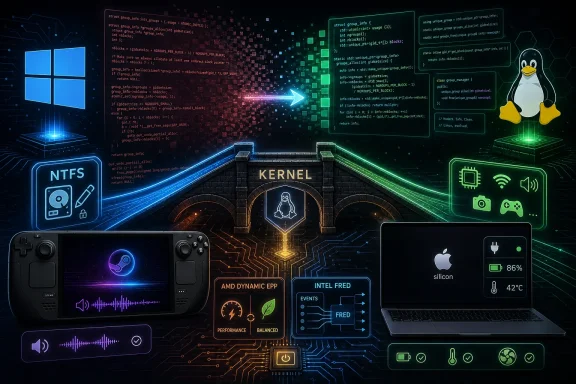 The Kernel’s Windows Problem Gets a Serious Rewrite
The most WindowsForum-relevant change in Linux 7.1 is the arrival of a new optional NTFS driver. Linux has been able to read NTFS for ages, and the ntfs3 driver contributed by Paragon in Linux 5.15 added in-kernel write support. But NTFS on Linux has remained one of those features that technically exists while still carrying an asterisk in the minds of cautious dual-booters.Linux 7.1 does not immediately throw ntfs3 overboard. The existing ntfs3 driver remains the default, while the new driver can be selected through kernel configuration. That makes this release less a coronation than an audition: the kernel now has a second in-tree path for NTFS that is trying to be more maintainable, more modern, and more aligned with current Linux filesystem infrastructure.
That distinction matters because NTFS is not a hobby filesystem. It is the default language of Windows data volumes, USB disks, external SSDs, and countless “I just need to copy this one thing” recovery sessions. For Linux users who dual-boot with Windows, run rescue environments, or administer mixed fleets, NTFS support is not a symbolic compatibility checkbox. It is the bridge between the world Windows assumes and the one Linux actually inhabits.
The new driver’s lineage is also notable. It comes from Namjae Jeon, already known in kernel circles for work around exFAT and other storage-related code. That does not guarantee perfection, but it does suggest the effort is not a random drive-by submission. The kernel’s filesystem maintainers have learned the hard way that a feature as risky as write support to someone else’s filesystem needs active ownership, not merely a tarball tossed over the wall.
The technical pitch is that this NTFS implementation revives and modernizes the old in-kernel NTFS driver, adding write support and moving toward newer mechanisms such as iomap-based file operations. For ordinary users, the translation is simple: Linux developers are trying to make NTFS feel less like a tolerated foreign object and more like a filesystem the kernel can reason about using its current tools.
Compatibility Is Only Useful When Someone Maintains It
There is a temptation to frame the NTFS work as Linux “catching up” to Windows. That is too simple. Windows owns NTFS because Microsoft controls the format, the implementation, and the assumptions around shutdown, hibernation, journaling, and recovery. Linux is doing something more delicate: interoperating with a filesystem whose home turf is elsewhere.That is why the new driver should be welcomed but not romanticized. Anyone who has mounted a Windows partition from Linux knows the familiar caveats: disable Fast Startup if necessary, do not casually write to a hibernated Windows volume, keep backups, and do not confuse filesystem support with immunity from user error. A better kernel driver can reduce friction, but it cannot make dual-boot storage magically risk-free.
Still, this release changes the conversation. For years, Linux users have had to choose between FUSE-based NTFS-3G, which is mature but slower and outside the kernel, and ntfs3, which was exciting but sometimes regarded as under-attended. Linux 7.1 introduces a third option that says the kernel community has not given up on NTFS as a first-class interoperability problem.
That matters for Windows administrators more than many Linux release notes do. Rescue media, forensic workflows, backup appliances, NAS boxes, and recovery scripts often need to handle NTFS volumes without booting Windows. If the new driver matures, the payoff will be less drama in the moments where cross-platform storage is already stressful.
The correct posture is cautious optimism. Linux 7.1 gives testers and distribution maintainers something substantial to evaluate, not a blanket instruction for everyone to remount their family photo archive read-write on day one. The fact that the new driver is optional is not a weakness. It is exactly how a kernel should introduce risky storage plumbing.
Steam Deck OLED Shows the Cost of Living Downstream
The Steam Deck OLED audio fix is a smaller change with a larger lesson. Mainline Linux had reportedly carried broken audio support for the OLED model for roughly two years, while Valve’s downstream SteamOS kernel and some handheld-focused distributions worked around the problem. Linux 7.1 finally fixes the issue upstream.For Steam Deck owners who never leave SteamOS, this may sound academic. Valve ships a curated operating system, not a generic rolling kernel, and it can patch around hardware quirks as needed. But the Steam Deck’s cultural significance has always been that it is a PC pretending to be a console, and PCs invite users to install things they were not necessarily meant to install.
That is where upstream support matters. A Fedora, Arch, Debian, or Ubuntu experiment on the Steam Deck OLED should not require users to rediscover a vendor patch trail just to get sound from the speakers. The longer a device depends on downstream fixes, the more its “Linux support” becomes a fragile stack of tribal knowledge.
The Steam Deck OLED fix also illustrates a quiet truth about Linux hardware support: popularity does not automatically produce mainline polish. Even a high-profile Linux gaming device can carry a broken upstream experience if the relevant subsystem, firmware assumptions, topology files, and vendor patches do not line up. The kernel is vast, and regressions can hide in the seams between drivers and product-specific configuration.
Linux 7.1 does not transform the Steam Deck into a generic laptop. It does, however, reduce the distance between Valve’s supported universe and the broader Linux ecosystem. For handheld PCs, that distance is increasingly important as more Windows-first and Linux-curious devices enter the market.
AMD’s Power Shift Moves Laptop Policy Closer to the Kernel
AMD’s amd-pstate driver gains Dynamic EPP support in Linux 7.1, allowing the system to switch Energy Performance Preference behavior depending on whether a machine is plugged into AC power or running on battery. On wall power, the CPU can favor performance. On battery, it can move toward a more restrained balanced-performance profile without diving straight into a sluggish efficiency mode.That sounds like a small quality-of-life tweak, and in one sense it is. Laptop users already expect power behavior to change when they unplug. Desktop environments, vendor utilities, and distribution power daemons have been doing some version of this dance for years.
The important shift is where the policy can live. When power-profile switching depends entirely on user-space tools, behavior can vary widely by distribution, desktop environment, or OEM integration. Moving more of that intelligence closer to the kernel driver gives Linux a better chance of behaving consistently across the messy laptop market.
The feature is not enabled by default in Linux 7.1, which is another sign of kernel caution. Users or distributions must opt in, for example through a boot parameter. But the direction is obvious: Linux laptop power management is slowly becoming less of a scavenger hunt and more of a coherent platform feature.
AMD’s Ryzen AI NPU support also improves through the AMDXDNA driver, adding monitoring features such as memory usage queries and power estimate reporting. That is not yet the kind of user-facing AI feature that sells laptops at retail, but it is the substrate such features need. Before Linux desktops can make intelligent use of NPUs, administrators and developers need to see what those accelerators are consuming and how they behave under load.
Intel FRED Is the Kind of Performance Work Users Rarely See
Intel’s Flexible Return and Event Delivery, better known as FRED, is enabled by default in Linux 7.1 on supported hardware. FRED is one of those CPU features that sounds obscure until you remember that modern operating systems spend a huge amount of time crossing boundaries between user work and kernel work. Every interrupt, system call, exception, and return path is part of the machinery that makes interactive computing feel immediate rather than chunky.FRED aims to make some of those transitions cleaner and less wasteful. The benefit is not that your desktop suddenly feels twice as fast. It is that certain interrupt-heavy or request-heavy workloads can gain modest but meaningful improvements, especially on newer Intel systems where the hardware support exists.
Audio production is a useful example because it exposes latency and scheduling problems quickly. A few percentage points in a digital audio workstation benchmark may sound boring until you are the person trying to run a project with low buffer sizes without crackles. Kernel performance work often matters most where failure is audible, visible, or measured in missed frames.
The broader story is that x86 is still evolving in ways operating systems must actively absorb. Windows users are accustomed to firmware updates, chipset drivers, and platform features arriving as part of the PC lifecycle. Linux has to implement the same hardware reality through a public, multi-vendor kernel development process. FRED becoming default is one small moment where the upstream kernel stops merely supporting a CPU feature and starts trusting it.
It is also not solely an Intel story forever. FRED support is expected to matter for future AMD processors as well. That makes Linux 7.1 less about one vendor’s performance checkbox and more about the kernel preparing for a new baseline in x86 privilege-transition handling.
Apple Silicon Inches Toward Boring, Which Is the Goal
Linux on Apple Silicon has always been a strange achievement. It is technically impressive, politically unsupported by Apple in the way mainstream PC hardware is supported, and still incomplete enough that ordinary users should not confuse progress with parity. Linux 7.1’s Apple SMC battery reporting work is therefore a meaningful but unglamorous milestone.The new macsmc-power driver exposes information such as AC adapter status, battery charge state, voltage, current, temperature, and battery health to the kernel. That is basic laptop plumbing, but basic plumbing is what turns a science project into a daily driver. Power tools, desktop battery indicators, and tuning utilities cannot do serious work if the kernel cannot reliably describe the battery.
The driver also opens the door to controlling charging behavior, including charge limiting. That matters because battery longevity is no longer a niche enthusiast concern. Windows laptops, macOS, and OEM utilities increasingly offer some version of charge thresholds or battery health modes. For Linux on Apple Silicon to feel normal, it must eventually participate in the same expectations.
Audio support on Apple Silicon also moves forward with groundwork for the six-codec speaker arrangement used in some MacBooks. That is a reminder that Apple hardware is not merely “ARM plus a GPU.” It is a stack of custom controllers, unusual audio layouts, platform-specific power behavior, and undocumented decisions. Mainline support advances one subsystem at a time.
For WindowsForum readers, the Apple Silicon work is interesting not because it threatens Windows PCs, but because it shows what modern hardware support really costs. The PC ecosystem is messy, but its conventions are still friendlier to generic operating systems than Apple’s vertically integrated world. Every Apple Silicon improvement in Linux is a small victory over the idea that hardware should only run the software its vendor blesses.
Filesystem Work Is Quiet Until It Saves Your Data
Beyond NTFS, Linux 7.1 brings a set of filesystem and I/O changes that will not dominate release coverage but will matter to people who push storage hard. EXT4, still the default filesystem for Ubuntu and a major default across the Linux world, mostly receives bug fixes and preparation for a future move of its buffered write path toward iomap. This is groundwork, not fireworks.exFAT gets a more immediate improvement through fragmentation reduction, helped by pre-allocation support. That matters because exFAT is common on removable media precisely where users least want to think about filesystem behavior. Cameras, SD cards, USB drives, and cross-platform external disks are boring right up until write performance collapses or a transfer fails.
The arrival of BPF support in io_uring is another developer-facing change with potentially broad consequences. io_uring has become one of Linux’s most important modern I/O interfaces, and BPF brings programmable filtering and control closer to that path. Backup tools, databases, package managers, and synchronization software all live or die by efficient I/O.
The ublk user-space block driver gaining zero-copy I/O support is similarly technical but practical. Reducing CPU overhead and latency in block operations matters for storage stacks that increasingly mix kernel mechanisms with user-space services. Linux has spent years making user-space storage more plausible without surrendering too much performance.
Btrfs also sees its shutdown operation graduate from experimental to stable. That may sound like a minor status change, but status matters when system tools and scripts need to trust behavior. Filesystems are one area where “probably fine” is not good enough; stable interfaces are how cautious administrators decide what can be automated.
The Hardware Grab Bag Is Actually the Point
Every Linux kernel release contains a hardware grab bag, and Linux 7.1 is no exception. Lenovo Yoga fan control, expanded TUXEDO and Uniwill laptop support, Bitland MIFS WMI functionality for keyboard backlighting and platform profiles, and more ASUS motherboard sensor support all land in this cycle. Individually, these are modest changes. Collectively, they are what desktop Linux users experience as “my machine finally works properly.”The Lenovo work is especially representative. Fan control and monitoring are not glamorous, but they determine whether a laptop feels polished or half-supported. A machine that runs hot, spins fans oddly, or hides thermal data from user-space tools may boot Linux perfectly and still feel unfinished.
The same is true for motherboard sensors. Enthusiasts running ASUS boards with lm_sensors are not asking for a philosophical triumph; they want temperatures, voltages, and fan readings to appear correctly. Hardware health visibility is basic hygiene for overclockers, home-lab builders, workstation users, and anyone debugging instability.
Gaming peripherals get their usual dose of charming specificity. Rock Band instruments, DJ Hero turntables, Winwing throttles, Legion Go controllers, haptics, LEDs, rumble, and force feedback support all reinforce a very Linux idea: if a device speaks USB or Bluetooth and someone cares enough, it may eventually be made to work. This is not corporate platform strategy. It is accreted enthusiasm with patches.
There is also support for audio components in newer laptops, including internal microphone arrays on some Ryzen 6000-era systems and codecs appearing in recent Intel and Dell designs. These details matter because laptop audio remains one of the places where Linux can still feel unpredictable. A working speaker is good; a working mic array in a video-call world is essential.
Old AMD Graphics Get a Better Future Than Old Network Stacks
Linux 7.1 moves more older AMD APUs from the old Radeon driver path toward the modern amdgpu driver. The affected hardware includes A-Series and E-Series era parts from around 2013 and 2014, the sort of budget chips that still turn up in spare desktops, old laptops, garage workstations, and lightweight Linux boxes.This is one of the kernel’s more endearing habits. A decade-old integrated GPU can sometimes become more useful because the modern driver stack finally embraces it. Better performance, cleaner support, and Vulkan availability through the Mesa ecosystem can make old hardware feel less abandoned than it did under its original software assumptions.
But the same release also deletes a large amount of old code. That contrast is important. Linux is not simply keeping everything forever; it is choosing which old hardware still has a plausible maintenance story. Some aging AMD graphics parts get a second life because the modern stack can carry them. Other subsystems, such as obsolete networking protocols and ancient drivers, are cut loose.
The new DRM-RAS framework points in the other direction: not nostalgia, but observability for modern GPUs and accelerators. Reliability, Availability, and Serviceability features let drivers expose hardware error counters and reliability information to user space in a more standardized way. That matters in workstations, servers, and accelerator-heavy systems where silent hardware faults are not just annoying but operationally expensive.
Intel’s Xe graphics driver also gains a user-space interface for managing video memory pressure. The practical goal is to reduce crashes and out-of-memory failures when VRAM fills under heavy workloads. This is the sort of plumbing that becomes more important as integrated and discrete GPUs handle heavier desktop compositing, media, compute, and AI-adjacent work.
The Great Code Purge Is Not Vandalism
Linux 7.1 reportedly removes more than 140,000 lines of legacy code, including old networking drivers and support for technologies such as ISDN, ham radio AX.25 networking, UDP-Lite, CAIF, Bluetooth CMTP, and bus mice. The emotional reaction depends on whether you see old code as heritage or liability. Kernel maintainers increasingly see it as both, and liability is winning.The stated concern is not merely aesthetic. Obsolete drivers can still attract bug reports, security findings, and automated analysis, including AI-generated reports that may be noisy or low-value. Maintainers then have to triage issues in code no one actively uses, for devices few people can test, in subsystems nobody wants to own.
That is not a sustainable bargain. A kernel that supports everything forever eventually becomes a museum with a scheduler. Linux’s strength has always been breadth, but breadth without maintainership is just deferred risk.
Security also changes the calculus. Dead code is not always harmless code. If a subsystem can be built, loaded, fuzzed, or reached through some unexpected path, it can become part of the attack surface. Removing obsolete code is not as exciting as adding a driver for a new handheld, but it is often the more responsible engineering decision.
The i486 phase-out belongs in the same category. Linux 7.1 begins removing build configuration options for old 486 sub-architectures, though the underlying support is not necessarily gone all at once. The message is plain enough: the kernel is preparing to stop pretending that a 1990s CPU is a reasonable target for a 2026 operating system.
For preservationists, that hurts. For maintainers, it is overdue. There are other operating systems, old kernel branches, emulators, and museum builds for historically interesting machines. Mainline Linux cannot be both the operating system of future accelerators and the permanent caretaker of every bus mouse-era assumption.
A Security Change Makes Debugging Less Casual
Linux 7.1 tightens access to another process’s memory through/proc/PID/mem. Earlier kernels allowed sufficiently privileged processes to inspect or modify memory in ways that were powerful but broad. The new behavior requires an active debugging relationship between the processes.This is one of those security changes that can irritate tools before it reassures users. Linux has a long tradition of exposing powerful process introspection interfaces, and administrators often rely on them for debugging, tracing, crash analysis, and recovery. Restricting access can break assumptions in obscure workflows.
But the direction is unsurprising. Modern operating systems are steadily narrowing the gap between “privileged” and “allowed to do anything to any process at any time.” Attackers love overly broad introspection surfaces, and endpoint security models increasingly assume that even privileged contexts should face boundaries.
Windows has gone through its own long evolution here, with protected processes, credential isolation, driver signing, and increasingly aggressive containment around sensitive memory. Linux approaches the problem differently, but the underlying trend is shared. Debugging power is useful; ambient memory access is dangerous.
The practical advice is not panic. Most ordinary users will never notice this change. But tool authors, security teams, and administrators with custom debugging workflows should test Linux 7.1 before assuming old
/proc-based tricks will behave exactly as before.This Release Rewards Testers, Not Thrill-Seekers
Linux 7.1 is out, but that does not mean every Ubuntu, Fedora, Arch, Debian, or Mint user should immediately chase it. Distributions exist partly to absorb kernel churn, apply configuration choices, test interactions, and decide when a new kernel is ready for their users. Mainline kernels are raw material, not always retail product.Ubuntu users, for example, may see Linux 7.1 appear in development builds or mainline kernel packages before it becomes part of a stable distribution release. That is useful for testing hardware enablement and regressions. It is not the same as a recommendation to replace a working kernel on a production laptop because a changelog looks interesting.
The people who should care soonest are the ones with a specific reason. Dual-booters and storage testers may want to evaluate the new NTFS driver on non-critical volumes. Steam Deck OLED experimenters running non-Valve kernels have a direct incentive. Laptop users on supported AMD systems may want to test Dynamic EPP. Administrators with security-sensitive environments may want to validate the
/proc/PID/mem behavior.Everyone else can let their distribution do its job. Kernel releases are newsworthy because they define where Linux is going, not because they are all meant to be manually installed by Tuesday afternoon. The healthiest Linux ecosystem is one where upstream moves quickly and downstreams decide carefully.
The Linux 7.1 Story Fits in a Windows Admin’s Notebook
Linux 7.1 is a broad kernel release, but its most practical consequences are concrete enough to separate from the noise. The release is not merely a performance bump or a hardware dump. It is a maintenance statement with visible user impact.- Linux 7.1 introduces a new optional in-kernel NTFS driver, while the existing ntfs3 driver remains the default for now.
- Steam Deck OLED audio is fixed upstream, reducing the need for Valve-specific or distribution-specific workarounds on mainline kernels.
- AMD laptop power management gains Dynamic EPP support, although users and distributions must opt in before it changes behavior.
- Apple Silicon Linux support becomes more laptop-like through battery and power reporting, even though full parity remains a long-term project.
- The kernel drops a large amount of obsolete legacy code, signaling that unmaintained compatibility is no longer treated as free.
- Security around process memory access tightens, which should interest tool developers and administrators who rely on low-level debugging workflows.
References
- Primary source: OMG! Ubuntu
Published: 2026-06-15T04:00:09.778470
Linux 7.1 brings new NTFS driver, Steam Deck OLED audio fix + more - OMG! Ubuntu
Linux 7.1 arrives with a rewritten NTFS driver, Apple Silicon battery reporting, and Steam Deck OLED audio fixes alongside massive legacy code removals. www.omgubuntu.co.uk
- Related coverage: phoronix.com
Linux 7.1 Fixes Audio For The Steam Deck OLED After Being Broken 2 Years On The Upstream Kernel - Phoronix
It turns out the Steam Deck OLED gaming handheld has not had working audio support with the mainline (upstream) Linux kernel since a change in late 2023 that was merged for Linux 6.8www.phoronix.com
- Related coverage: linuxjournal.com
- Related coverage: tomshardware.com
Linux 7.1 update includes new in-kernel NTFS driver — delivers storage support upgrade for Linux users | Tom's Hardware
New driver is a ground-up rewrite that allows Windows volumes to be accessed directly by the kernel for reads and writes.www.tomshardware.com - Related coverage: techcroute.com
Linux 7.1-rc2 est disponible : corrections importantes pour Steam Deck OLED et AMD - TechCroute.com
Linux 7.1-rc2 corrige enfin le problème audio du Steam Deck OLED et apporte plusieurs améliorations pour les cartes AMD. Découvrez les nouveautés de cette deuxième version candidate. www.techcroute.com
- Related coverage: elchapuzasinformatico.com
La Steam Deck OLED ve resuelto su problema de audio en Linux
La Steam Deck OLED ha visto solventados los problemas de audio cuando se utilizaban versiones de Linux con kernels oficiales. elchapuzasinformatico.com
- Related coverage: linuxdork.com
Linux 7.1-rc1: NTFS Gets a Full Rewrite and the i486 Finally Retires | Linux Dork
Linus Torvalds opened the Linux 7.1 merge window on April 26, 2026. The first release candidate brings a four-year-in-the-making NTFS driver rewrite with full write support, FRED enabled by default, and the long-overdue removal of 486-class CPU support.linuxdork.com
- Related coverage: windowsreport.com
Steam Deck OLED Audio Finally Fixed on Mainline Linux With Kernel
Steam Deck OLED audio finally works on mainline Linux with kernel 7.1, eliminating the need for custom patches. windowsreport.com
- Related coverage: lucaberton.com
NTFS on Linux 7.1: Native Read/Write Support | Luca Berton
Linux 7.1 merges a completely overhauled NTFS driver with native read/write support, replacing the stagnated NTFS3 driver. Four years of development by. lucaberton.com
- Related coverage: linuxiac.com
Linux Kernel 7.1 Merges New NTFS Driver With Full Write Support
A new NTFS driver is now part of Linux kernel 7.1, combining write support, folio conversion, iomap, and userspace utility support.linuxiac.com - Related coverage: linux.org.ru
В состав ядра 7.1 принят новый драйвер NTFS — Ядро Linux — Новости
Линус Торвальдс принял в состав ядра Linux 7.1, релиз которого ожидается в середине июня, набор изменений с новой реализацией драйвера для файловой системы NTFS...www.linux.org.ru - Related coverage: newsminimalist.com
- Related coverage: access.redhat.com
Release Notes - Release Notes for Red Hat Enterprise Linux Server for ARM Development Preview
PDF documentaccess.redhat.com
- Related coverage: docs.huihoo.com
- Related coverage: files.serialport.org