

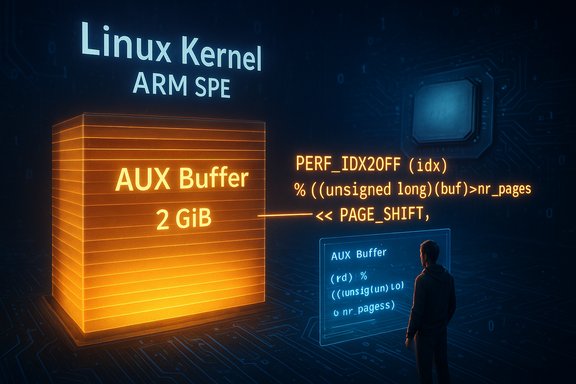
A small, surgical change to the Linux kernel’s ARM SPE perf driver closed CVE-2025-40081 — a numeric overflow in the PERF_IDX2OFF macro that could miscompute buffer offsets for large AUX buffers (>= 2 GiB) and lead to kernel instability. The fix casts the buffer pages count to an unsigned long before the left-shift, preventing a wraparound in the offset calculation; the upstream commit landed across stable branches and has been backported into multiple kernel stable trees.
The Linux perf subsystem supports ARM’s Statistical Profiling Extension (SPE) via the arm_spe driver, which records sampled events into an AUX buffer composed of multiple pages. Converting a free-running index from perf into a buffer offset requires careful arithmetic: the macro PERF_IDX2OFF computes (idx) % ((buf)->nr_pages << PAGE_SHIFT). When (buf)->nr_pages is large and the left shift is evaluated in a narrower integer type, the expression can overflow and wrap, producing a wrong offset that later dereferences an invalid memory location. The kernel patch resolves this by explicitly casting nr_pages to an unsigned long before the shift so that the shift is performed on a sufficiently wide type. This kind of issue — mixed-width arithmetic causing an overflow or wrap during a left shift — is a recurring class of kernel correctness bugs. Upstream maintainers prefer small, targeted changes (a cast or a type-width promotion) that preserve semantics for valid inputs while eliminating a corner-case arithmetic wrap that can cause availability-impacting faults. Similar corrective patterns have been used in other kernel fixes where a cast prevents unexpected truncation or wrap.
For readers wanting technical confirmation: the public stable-tree backport notices and OSV/NVD imports explicitly describe the change and identify the upstream commit(s) that implement the cast; the stable patch announcements include the one-line macro modification showing the casting to unsigned long that prevents the overflow. Administrators should consult their distribution or vendor security tracker to determine the precise package versions that include the backport and follow standard kernel-update procedures.
Source: MSRC Security Update Guide - Microsoft Security Response Center
 Background
The Linux perf subsystem supports ARM’s Statistical Profiling Extension (SPE) via the arm_spe driver, which records sampled events into an AUX buffer composed of multiple pages. Converting a free-running index from perf into a buffer offset requires careful arithmetic: the macro PERF_IDX2OFF computes (idx) % ((buf)->nr_pages << PAGE_SHIFT). When (buf)->nr_pages is large and the left shift is evaluated in a narrower integer type, the expression can overflow and wrap, producing a wrong offset that later dereferences an invalid memory location. The kernel patch resolves this by explicitly casting nr_pages to an unsigned long before the shift so that the shift is performed on a sufficiently wide type. This kind of issue — mixed-width arithmetic causing an overflow or wrap during a left shift — is a recurring class of kernel correctness bugs. Upstream maintainers prefer small, targeted changes (a cast or a type-width promotion) that preserve semantics for valid inputs while eliminating a corner-case arithmetic wrap that can cause availability-impacting faults. Similar corrective patterns have been used in other kernel fixes where a cast prevents unexpected truncation or wrap.What changed (technical overview)
- Vulnerable expression: PERF_IDX2OFF(idx, buf) was defined as
- (idx) % ((buf)->nr_pages << PAGE_SHIFT)
- Problem: if (buf)->nr_pages is a 32-bit type and PAGE_SHIFT is non-zero, the expression (buf)->nr_pages << PAGE_SHIFT can overflow in the narrower type before modulus and produce a truncated, wrapped value.
- Upstream fix (essence): Cast (buf)->nr_pages to unsigned long before the shift:
- (idx) % ((unsigned long)(buf)->nr_pages << PAGE_SHIFT)
Verified facts and commit provenance
- The CVE entry and import records document the change as “Cast nr_pages to unsigned long to avoid overflow when handling large AUX buffer sizes (>= 2 GiB).” Published CVE metadata lists the fix and cites the kernel commits.
- The upstream patch commit id referenced in stable-tree patches is a29fea30dd93da16652930162b177941abd8c75e (appearing in the stable patch announcements). Those announcements include the code diff showing the macro alteration.
Why this matters: the failure mode and real-world impact
At first glance this is not a dramatic memory‑corruption primitive that immediately yields remote code execution. The immediate, realistic outcomes for this class of arithmetic overflow inside kernel buffer-index math are:- Availability impact (high probability): miscomputed offsets are likely to produce out‑of‑range memory accesses, kernel oopses, or panics that bring down the host or take down the perf subsystem. Kernel-level faults are costly because they can require reboots and disrupt all services on the host.
- Local attack vector (practical): triggering the vulnerable path requires the ability to interact with the perf SPE subsystem and exercise AUX buffer handling. On many systems that means a local process or privileged tooling can provoke the condition. For embedded and vendor kernels (Android OEM kernels, appliance images) where perf/SPE may be enabled, the exposure is broader because vendors backport or omit fixes inconsistently.
- Chaining risk (cautious): while the standalone bug is best characterized as an availability problem, local kernel faults are high-value primitives and sometimes appear in multi-stage exploit chains where an attacker with local foothold leverages instability for escalation. Treat such chaining possibilities as speculative until a public PoC demonstrates otherwise.
Affected systems and attack surface
- Any Linux kernel build that includes the arm_spe perf driver (drivers/perf/arm_spe_pmu.c) prior to the stable backport containing the fix is potentially affected. The vulnerability surfaces only when AUX buffer sizes are large enough (the public descriptions note sizes >= 2 GiB) to trigger the arithmetic overflow in the shift expression.
- Typical places to look:
- ARM64-based servers and developer hardware where SPE is enabled.
- Android or embedded device kernels built with ARM SPE support by OEMs.
- Specialized platform images or testing rigs that enable perf/SPE with large AUX buffer allocations.
- Low exposure scenarios: single-user desktop machines that do not enable SPE or where perf is restricted by policy may be lower risk.
- High exposure scenarios: multi-tenant hosts, cloud or hosting providers running ARM64 infrastructure (or running ARM guest instances on hardware that exposes SPE paths), and vendor firmware images that rarely update. Vendor/kernel forks are the most likely to remain vulnerable longer than upstream distributions.
Patch status and distribution propagation
The upstream fix was merged and then cherry-picked into a range of stable kernel branches: maintainer announcements show the patch reviewed for 5.4, 5.10, 5.15, 6.1, 6.6, 6.12, 6.17 stable series, among others. That is standard practice: a minimal change targeting a clear arithmetic correctness issue is easy to backport and thus propagated across many active stable branches. Practically, this means:- Distributions that repackage stable kernels will include the fix once their kernel maintainers pull the corresponding stable-series update or apply the upstream commit.
- Embedded vendors and OEMs must explicitly backport the change into their forks and release updated images; absent such vendor action, devices may remain vulnerable.
- Applying the vendor/distribution kernel package that lists the stable commit or upgrading to a newer kernel version that includes the patch is the definitive remediation.
Recommended remediation and operational playbook
Immediate steps for administrators and device owners:- Inventory
- Detect hosts with ARM SPE/perf enabled: check kernel config or driver presence (look for drivers/perf/arm_spe_pmu.c in the running kernel or modules loaded).
- Identify kernels and versions: capture uname -r and map to vendor/distro advisories.
- Patch
- Apply vendor or distribution kernel updates that include the upstream stable commit; if your distribution’s security tracker lists CVE-2025-40081 and a fixed package, install that package.
- For embedded or OEM devices, request updated kernel images or firmware from the vendor and schedule image upgrades.
- Reboot
- Kernel fixes require a reboot into the patched kernel to take effect.
- Validate
- After patching and rebooting, verify kernel changelogs reference the upstream commit id or the fix description for PERF_IDX2OFF.
- Monitor dmesg/journalctl for kernel oops patterns around perf or arm_spe subsystems.
- Mitigations if patching is delayed
- Restrict access to tracing/perf interfaces if feasible (tighten capability grants, reduce unprivileged access to perf tooling).
- Isolate hosts that are heavily used for developer or perf-enabled workloads.
- For cloud providers, migrate tenants away from vulnerable hosts to patched hosts where possible.
- High priority: multi-tenant hosts, CI runners, and any systems that allow unprivileged processes to interact with perf/SPE.
- Medium priority: developer machines that enable SPE for profiling.
- Low priority: locked-down servers without perf/SPE enabled.
Detection, telemetry, and forensic guidance
Key hunting signals and log patterns:- Kernel oops or panic traces that reference perf, arm_spe, or include bad memory access patterns around perf handler codepaths.
- Unexpected faults triggered during perf recording of SPE or while allocating/handling large AUX buffers.
- Monitor for repeated crashes correlated with perf sampling workloads.
- Confirm the presence of arm_spe support: grep for CONFIG_ARM_SPE or inspect drivers in /sys/devices or kernel config.
- Confirm running kernel and patch level: uname -r; check package changelogs for fix references.
- Inspect kernel logs: journalctl -k | grep -iE "perf|arm_spe|AUX|oops|panic"
Risk assessment: how urgent is this?
- Likelihood of exploitation: low for remote, unauthenticated attacks because the vector requires local interaction with perf/SPE and large AUX buffer sizes. However, the ease of exploitation depends on local policy and whether unprivileged processes can exercise the vulnerable code path.
- Impact if triggered: medium to high for availability — a kernel oops or panic can disrupt services and require a host reboot. In multi-tenant contexts, that translates to broad impact.
- Overall priority: medium to high for environments with ARM SPE enabled or where perf is widely used; medium for general Linux hosts where SPE is not enabled or perf is strictly controlled.
Why a one-line cast fixes so much — the maintainer perspective
Kernel maintainers favor surgical changes for localized arithmetic mistakes for good reasons:- Minimal risk: a small cast change reduces the chance of regressions more than invasive refactors.
- Fast backporting: small diffs are easier to cherry-pick into multiple stable branches and vendor kernels.
- Preserves semantics: the cast ensures the arithmetic behaves as intended for valid inputs without altering higher-level logic.
Special considerations for vendors and embedded images
- OEMs and embedded vendors: confirm whether your kernel trees contain the upstream commit id for this change. If you maintain long-lived device images, schedule a backport and image rebuild that includes the change. Vendors are often the slowest to propagate such fixes, yet they often ship affected configurations (SPE profiling is used in some device-focused telemetry or performance tooling).
- Android devices: many OEMs maintain forks of kernel code; therefore, device fleets may remain exposed until the vendor supplies kernel updates. Device managers should escalate the issue if a vendor update timeline is not forthcoming.
- Cloud providers and hosters: identify ARM64 hosts running SPE-enabled kernels; consider temporary tenant migration strategies if large-scale perf workloads or untrusted workloads are present on vulnerable hosts.
Broader lessons for kernel operators and engineers
- Small arithmetic errors in kernel code matter: left shifts, mixed-width arithmetic, and implicit type promotions are frequent sources of subtle correctness issues that manifest as high-impact faults.
- Give preference to defensive arithmetic: explicit casts and type-width promotions at interfaces where pointer-sized arithmetic or page-shifts occur reduce surprising platform-dependent behavior.
- Maintain an inventory of vendor/kernel forks: embedded and OEM kernels are frequent blind spots in security posture because they lag upstream patches.
- Adopt observability and crash telemetry best practices: early detection of perf or SPE-related oopses lets operators triage and prioritize patches before they become operational incidents.
Conclusion
CVE-2025-40081 is a textbook example of a kernel correctness bug that is easily fixed but potentially impactful if left unpatched. The upstream change is intentionally minimal — casting nr_pages to unsigned long in PERF_IDX2OFF — and that minimalism allowed rapid backporting across stable kernel series. Administrators should locate affected hosts (systems with arm_spe/perf enabled or large AUX buffer usage), apply vendor or distribution kernel updates that include the stable commit, and reboot into the patched kernel. For embedded images and vendor kernels, actively verify vendor backports and insist on patched firmware where necessary. While there is no public evidence of active exploitation at the time of disclosure, the operational cost of kernel oopses is high, and the recommended response is straightforward: patch promptly, validate, and monitor.For readers wanting technical confirmation: the public stable-tree backport notices and OSV/NVD imports explicitly describe the change and identify the upstream commit(s) that implement the cast; the stable patch announcements include the one-line macro modification showing the casting to unsigned long that prevents the overflow. Administrators should consult their distribution or vendor security tracker to determine the precise package versions that include the backport and follow standard kernel-update procedures.
Source: MSRC Security Update Guide - Microsoft Security Response Center
