

CVE-2026-53357, published by NVD on July 2, 2026 after disclosure from kernel.org, fixes a Linux kernel Bluetooth L2CAP use-after-free race in which a listening socket close can collide with an HCI disconnect path and touch already-freed socket and channel objects. The bug is not a Windows flaw, but it matters to WindowsForum readers because modern fleets increasingly mix Windows endpoints, Linux servers, WSL-adjacent workflows, embedded Linux appliances, and Bluetooth-capable edge devices. Its lesson is larger than one kernel patch: wireless stacks keep turning ordinary cleanup code into security-sensitive concurrency code. The uncomfortable part is that this one survived earlier fixes in the same neighborhood.
The vulnerability lives in the Linux kernel’s Bluetooth L2CAP socket handling, specifically around
That is the sort of bug description that can make eyes glaze over: child sockets, accept queues, channel references, locks, HCI workers. But the shape is familiar to anyone who has debugged kernel networking or driver code. Two different subsystems believe they are performing responsible cleanup, and the object they both touch is only safe if the lifetime rules are exact.
The reported failure mode is a slab use-after-free detected by KASAN, the kernel’s memory error detector. The crashing stack runs through
That means the core bug is not “Bluetooth is dangerous” in the vague consumer-electronics sense. It is that the kernel’s internal ownership model let one path continue using a socket and its L2CAP channel after another path had already released them.
The CVE description explicitly distinguishes this bug from commit
They simply did not cover the HCI-disconnect path running from
That distinction matters because it is the difference between patching a symptom and closing a lifetime hole. The earlier fixes dealt with races between userspace-facing socket operations. CVE-2026-53357 shows that the Bluetooth controller can create a separate teardown path that does not politely line up behind the same assumptions.
This is a classic kernel maintenance trap. A developer can fix the visible race, add a lock, pass regression tests, and still leave a second actor in the system with the ability to invalidate the same object. In code that bridges userspace sockets, protocol state machines, and hardware-driven events, the number of “same object, different owner” paths multiplies quickly.
That is the delicate moment. A pointer has been handed back, but the lifetime guarantee that should travel with that pointer is missing or insufficient. Another thread can therefore run teardown code and free the object while cleanup code still expects it to be valid.
On the other side,
But a concurrent HCI disconnect can drive
The fix takes the reference “at the source.”
That is not just a patch; it is a map of the kernel developer’s constraints. The fix cannot simply grab every lock and call it a day, because lock ordering matters. The description notes that
This is where kernel security gets less cinematic and more consequential. The obvious fix — “take more locks” — can trade a use-after-free for a deadlock. The safe fix often has to combine short critical sections, conditional reference acquisition, and careful avoidance of duplicate teardown.
For administrators reading a CVE feed, that nuance is easy to miss. A use-after-free sounds like a memory safety bug, which it is. But the remediation is fundamentally about object lifetime design: who owns a socket, who owns a channel, when a pointer can be returned, and what happens if hardware-driven cleanup arrives mid-flight.
This has become a recurring operational problem for vulnerability management teams. Linux kernel CVEs frequently appear with rich upstream descriptions and patch references before downstream vendors have issued their own advisories, severity labels, or package updates. A scanner that treats “no CVSS score yet” as “not important yet” is doing policy by accident.
The CVE description includes unusually useful testing detail. Before the change, an unprivileged listen/close versus HCI-disconnect race reportedly produced 12 use-after-free reports per run under KASAN/SMP. After the patch, the same testing produced zero reports over more than 1,600 raced iterations and no lockdep warning.
That does not automatically mean a practical exploit exists. It does mean the race was reproducible enough for kernel developers to validate the bug and the fix under stress. For defenders, reproducibility in a kernel memory-safety bug is not something to shrug off.
This is where risk modeling gets messy. Bluetooth is both local and remote. A radio-adjacent attacker may be physically nearby, while a local user or sandboxed process may be able to use Bluetooth sockets depending on the system’s configuration, permissions, namespaces, and distribution policies.
Servers in racks usually do not expose meaningful Bluetooth attack surface, though exceptions exist. Developer laptops, kiosks, point-of-sale devices, medical carts, industrial tablets, Linux-based appliances, and IoT gateways are different. They often ship with Bluetooth hardware enabled because users expect it, integrators forget it, or the platform vendor treats it as a standard peripheral.
The practical risk is therefore uneven. A hardened Linux server with no Bluetooth controller loaded is a different case from a desktop distribution on a laptop carried through airports, offices, and conferences. Embedded Linux devices are their own category because they often lag kernel patching while leaving radios enabled for provisioning, diagnostics, or companion-device features.
Windows environments are rarely Windows-only anymore. They include Linux containers, Linux build systems, developer workstations, dual-boot machines, WSL-driven workflows, network appliances, Android-based handhelds, Debian-derived edge boxes, and vendor-supplied Linux devices that rarely appear in the same patch dashboard as domain-joined laptops.
CVE-2026-53357 is not about WSL itself; WSL does not make the Windows Bluetooth stack become the Linux kernel Bluetooth stack. But it is about the same organizations that use Windows as their desktop standard while quietly depending on Linux at the edge and in infrastructure.
For IT pros, the immediate question is not “does this affect Windows?” It is “where do we have Linux kernels with Bluetooth enabled, and who is responsible for updating them?” That second question is usually harder to answer.
The affected version metadata indicates the vulnerable code path goes back to Linux 5.7-era changes, with later stable branches receiving their own fixed commits. In kernel CVE language, commit hashes often matter more than neat version labels. A vendor kernel may be “5.15” or “6.1” on paper while carrying thousands of backports that make simple version comparison unreliable.
This is why enterprise Linux patching cannot stop at upstream version strings. Distribution advisories, vendor package versions, and device firmware releases are the operational truth. A scanner that only says “kernel before X” may be misleading when the vendor has backported the fix without changing the major kernel version.
For self-built kernels, the answer is more direct: verify that the relevant stable patch is present in the source tree you ship. For distribution kernels, wait for and apply the vendor update unless you have the appetite to maintain your own kernel backports.
L2CAP, the Logical Link Control and Adaptation Protocol, is one of Bluetooth’s core transport layers. It is responsible for multiplexing higher-level protocols over a Bluetooth connection. That makes it plumbing — and security bugs in plumbing tend to be underestimated because the component name does not sound user-facing.
The Bluetooth stack’s job is also inherently concurrent. Userspace can open and close sockets. Peers can connect and disconnect. Hardware can report events. Workers can run asynchronously. Timers can fire. Cleanup paths can cascade through callbacks.
That is why a listening-socket close can become a security boundary. The code is not merely disposing of an object; it is resolving the final ownership of objects still visible to multiple asynchronous actors.
The Linux kernel community is actively working on memory-safety improvements, including more Rust infrastructure and stronger analysis tooling, but the Bluetooth stack at issue here is still traditional C kernel code. KASAN and lockdep help find and validate these problems. They do not remove the need for developers to reason through every possible interleaving.
That is what makes the CVE’s testing note encouraging. The fix was not just “builds on my machine.” It was raced more than 1,600 times after the patch with no KASAN report and no lockdep complaint, according to the record. That is not a proof of perfection, but it is the right kind of evidence for this class of bug.
The broader industry point is less comforting. We keep asking general-purpose operating systems to support complex wireless stacks, aggressive power management, hotplug behavior, low-latency user interactions, and ancient compatibility surfaces. The number of teardown races hiding inside that combination is not going to drop to zero by policy memo.
Where patching is delayed, reducing exposure means disabling Bluetooth where it is not needed. That is especially reasonable on servers, fixed-function appliances, and fleet devices that do not require local wireless peripherals. If Bluetooth is needed only for provisioning, consider whether it can be disabled after enrollment.
Administrators should also remember that Bluetooth support can be present even when nobody thinks of the machine as a Bluetooth device. Mini PCs, laptops repurposed as servers, industrial systems, and USB dongles can all bring the stack into scope. Kernel modules and hardware inventory matter more than assumptions.
For vulnerability teams, the absence of a NVD score at publication should not pause triage. Treat the upstream kernel fix and vendor advisories as the authoritative path. The operational priority should be based on exposure: Bluetooth enabled, untrusted local users, physical accessibility, and whether the device belongs to a class that is difficult to patch later.
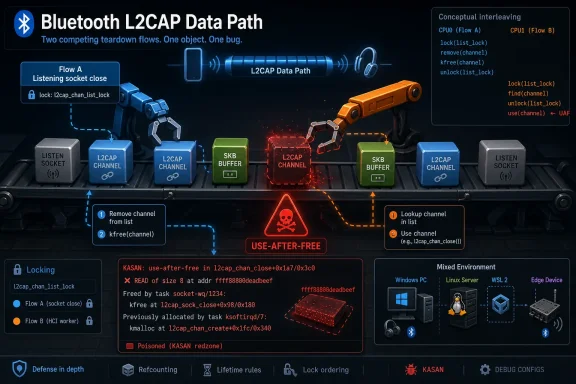 A Bluetooth Bug That Looks Small Until You Follow the Race
The vulnerability lives in the Linux kernel’s Bluetooth L2CAP socket handling, specifically around l2cap_sock_cleanup_listen() and l2cap_conn_del(). In plain English, one code path is cleaning up child sockets from a listening Bluetooth socket while another path, triggered by a hardware controller disconnect, is tearing down the underlying connection and freeing related objects.That is the sort of bug description that can make eyes glaze over: child sockets, accept queues, channel references, locks, HCI workers. But the shape is familiar to anyone who has debugged kernel networking or driver code. Two different subsystems believe they are performing responsible cleanup, and the object they both touch is only safe if the lifetime rules are exact.
The reported failure mode is a slab use-after-free detected by KASAN, the kernel’s memory error detector. The crashing stack runs through
l2cap_sock_kill, l2cap_sock_cleanup_listen, and the close system call. The freeing path runs through l2cap_conn_del, l2cap_sock_close_cb, and l2cap_sock_kill.That means the core bug is not “Bluetooth is dangerous” in the vague consumer-electronics sense. It is that the kernel’s internal ownership model let one path continue using a socket and its L2CAP channel after another path had already released them.
The Kernel Fixed the Previous Race, Not This One
The most revealing part of CVE-2026-53357 is not that a race existed. It is that the affected code had already been recently repaired for adjacent races.The CVE description explicitly distinguishes this bug from commit
e83f5e24da741, which serialized access to the Bluetooth accept queue, and from CVE-2025-39860, which addressed a userspace close() versus accept() race by calling cleanup under the socket lock in l2cap_sock_release(). Those were not irrelevant fixes. They were real improvements in the same area.They simply did not cover the HCI-disconnect path running from
hci_rx_work.That distinction matters because it is the difference between patching a symptom and closing a lifetime hole. The earlier fixes dealt with races between userspace-facing socket operations. CVE-2026-53357 shows that the Bluetooth controller can create a separate teardown path that does not politely line up behind the same assumptions.
This is a classic kernel maintenance trap. A developer can fix the visible race, add a lock, pass regression tests, and still leave a second actor in the system with the ability to invalidate the same object. In code that bridges userspace sockets, protocol state machines, and hardware-driven events, the number of “same object, different owner” paths multiplies quickly.
The Accept Queue Was the Crime Scene
The vulnerable sequence begins withbt_accept_dequeue(), which removes a child socket that has not yet been accepted from its parent socket’s accept queue. According to the CVE record, it called release_sock() before returning, leaving the returned socket unlocked and without a caller reference.That is the delicate moment. A pointer has been handed back, but the lifetime guarantee that should travel with that pointer is missing or insufficient. Another thread can therefore run teardown code and free the object while cleanup code still expects it to be valid.
On the other side,
l2cap_sock_cleanup_listen() walks children during listening-socket close. That sounds mundane. Closing a listening socket should clean up pending children.But a concurrent HCI disconnect can drive
l2cap_conn_del(), which deletes the L2CAP channel and kills the child socket. Once that happens, cleanup code walking the same logical children can end up using both a freed socket and a freed channel. The bug is not in an exotic ioctl or an obscure optional module; it is in the cleanup behavior that happens when a Bluetooth listening socket is closed at the wrong time.The fix takes the reference “at the source.”
bt_accept_dequeue() now performs sock_hold() while the socket is still locked, before releasing it; callers then sock_put() when done. That is the kernel equivalent of tightening the handoff: if a function returns an object to a caller, it must ensure the object cannot vanish before the caller has a chance to use it.Reference Counts Beat Wishful Locking
The CVE text also describes a second part of the fix:cleanup_listen() pins the L2CAP channel with l2cap_chan_hold_unless_zero() under a brief child socket lock, drops that lock before taking the channel lock, and skips a duplicate l2cap_sock_kill() if the socket is already marked dead.That is not just a patch; it is a map of the kernel developer’s constraints. The fix cannot simply grab every lock and call it a day, because lock ordering matters. The description notes that
conn->lock is not taken because doing so would invert the existing order of conn->lock, chan->lock, and sk_lock, creating a lockdep problem.This is where kernel security gets less cinematic and more consequential. The obvious fix — “take more locks” — can trade a use-after-free for a deadlock. The safe fix often has to combine short critical sections, conditional reference acquisition, and careful avoidance of duplicate teardown.
For administrators reading a CVE feed, that nuance is easy to miss. A use-after-free sounds like a memory safety bug, which it is. But the remediation is fundamentally about object lifetime design: who owns a socket, who owns a channel, when a pointer can be returned, and what happens if hardware-driven cleanup arrives mid-flight.
NVD Has the Record, But Not the Risk Rating
As of the CVE’s publication on July 2, 2026, the NVD entry did not include a CVSS 4.0, CVSS 3.x, or CVSS 2.0 base score from NIST. That absence should not be mistaken for safety. It means enrichment had not yet caught up with the record.This has become a recurring operational problem for vulnerability management teams. Linux kernel CVEs frequently appear with rich upstream descriptions and patch references before downstream vendors have issued their own advisories, severity labels, or package updates. A scanner that treats “no CVSS score yet” as “not important yet” is doing policy by accident.
The CVE description includes unusually useful testing detail. Before the change, an unprivileged listen/close versus HCI-disconnect race reportedly produced 12 use-after-free reports per run under KASAN/SMP. After the patch, the same testing produced zero reports over more than 1,600 raced iterations and no lockdep warning.
That does not automatically mean a practical exploit exists. It does mean the race was reproducible enough for kernel developers to validate the bug and the fix under stress. For defenders, reproducibility in a kernel memory-safety bug is not something to shrug off.
The Attack Surface Is Local, Wireless, and Awkward
The CVE text says the reproducer involved an unprivileged listen/close race and an HCI disconnect. That suggests an attacker may not need root privileges to exercise the socket-side behavior, but exploitation would still depend on access to the relevant Bluetooth functionality and on causing or racing a disconnect condition.This is where risk modeling gets messy. Bluetooth is both local and remote. A radio-adjacent attacker may be physically nearby, while a local user or sandboxed process may be able to use Bluetooth sockets depending on the system’s configuration, permissions, namespaces, and distribution policies.
Servers in racks usually do not expose meaningful Bluetooth attack surface, though exceptions exist. Developer laptops, kiosks, point-of-sale devices, medical carts, industrial tablets, Linux-based appliances, and IoT gateways are different. They often ship with Bluetooth hardware enabled because users expect it, integrators forget it, or the platform vendor treats it as a standard peripheral.
The practical risk is therefore uneven. A hardened Linux server with no Bluetooth controller loaded is a different case from a desktop distribution on a laptop carried through airports, offices, and conferences. Embedded Linux devices are their own category because they often lag kernel patching while leaving radios enabled for provisioning, diagnostics, or companion-device features.
Windows Shops Still Own Linux Bluetooth Risk
It would be easy for a Windows-focused audience to read “Linux kernel Bluetooth” and mentally file this under somebody else’s problem. That would be tidy, and often wrong.Windows environments are rarely Windows-only anymore. They include Linux containers, Linux build systems, developer workstations, dual-boot machines, WSL-driven workflows, network appliances, Android-based handhelds, Debian-derived edge boxes, and vendor-supplied Linux devices that rarely appear in the same patch dashboard as domain-joined laptops.
CVE-2026-53357 is not about WSL itself; WSL does not make the Windows Bluetooth stack become the Linux kernel Bluetooth stack. But it is about the same organizations that use Windows as their desktop standard while quietly depending on Linux at the edge and in infrastructure.
For IT pros, the immediate question is not “does this affect Windows?” It is “where do we have Linux kernels with Bluetooth enabled, and who is responsible for updating them?” That second question is usually harder to answer.
Stable Kernel Backports Tell the Real Story
The CVE record lists multiple stable kernel commit references, which means the fix has been backported across supported Linux kernel lines rather than merely landing in a development branch. That is important because many affected devices will never run the newest upstream kernel.The affected version metadata indicates the vulnerable code path goes back to Linux 5.7-era changes, with later stable branches receiving their own fixed commits. In kernel CVE language, commit hashes often matter more than neat version labels. A vendor kernel may be “5.15” or “6.1” on paper while carrying thousands of backports that make simple version comparison unreliable.
This is why enterprise Linux patching cannot stop at upstream version strings. Distribution advisories, vendor package versions, and device firmware releases are the operational truth. A scanner that only says “kernel before X” may be misleading when the vendor has backported the fix without changing the major kernel version.
For self-built kernels, the answer is more direct: verify that the relevant stable patch is present in the source tree you ship. For distribution kernels, wait for and apply the vendor update unless you have the appetite to maintain your own kernel backports.
Bluetooth Keeps Being a Protocol Stack, Not a Peripheral
Bluetooth has a consumer reputation: headphones, keyboards, mice, phones. In the kernel, it is a protocol stack with sockets, channels, queues, timers, worker threads, and controller events. CVE-2026-53357 sits precisely at that intersection.L2CAP, the Logical Link Control and Adaptation Protocol, is one of Bluetooth’s core transport layers. It is responsible for multiplexing higher-level protocols over a Bluetooth connection. That makes it plumbing — and security bugs in plumbing tend to be underestimated because the component name does not sound user-facing.
The Bluetooth stack’s job is also inherently concurrent. Userspace can open and close sockets. Peers can connect and disconnect. Hardware can report events. Workers can run asynchronously. Timers can fire. Cleanup paths can cascade through callbacks.
That is why a listening-socket close can become a security boundary. The code is not merely disposing of an object; it is resolving the final ownership of objects still visible to multiple asynchronous actors.
The Patch Is a Reminder That Memory Safety Is Still a Kernel Tax
Use-after-free bugs are the recurring tax of systems code written in C. Reference counting and locking can make C kernel code robust, but only when every code path participates in the same ownership discipline. One missing reference at a handoff point is enough.The Linux kernel community is actively working on memory-safety improvements, including more Rust infrastructure and stronger analysis tooling, but the Bluetooth stack at issue here is still traditional C kernel code. KASAN and lockdep help find and validate these problems. They do not remove the need for developers to reason through every possible interleaving.
That is what makes the CVE’s testing note encouraging. The fix was not just “builds on my machine.” It was raced more than 1,600 times after the patch with no KASAN report and no lockdep complaint, according to the record. That is not a proof of perfection, but it is the right kind of evidence for this class of bug.
The broader industry point is less comforting. We keep asking general-purpose operating systems to support complex wireless stacks, aggressive power management, hotplug behavior, low-latency user interactions, and ancient compatibility surfaces. The number of teardown races hiding inside that combination is not going to drop to zero by policy memo.
The Right Mitigation Is Boring, Which Is Why It Works
For most users, the fix is to install the kernel update supplied by their distribution or device vendor. There is no elegant registry tweak, no magic Bluetooth daemon restart, and no sysadmin incantation that changes the underlying object lifetime rules in the kernel.Where patching is delayed, reducing exposure means disabling Bluetooth where it is not needed. That is especially reasonable on servers, fixed-function appliances, and fleet devices that do not require local wireless peripherals. If Bluetooth is needed only for provisioning, consider whether it can be disabled after enrollment.
Administrators should also remember that Bluetooth support can be present even when nobody thinks of the machine as a Bluetooth device. Mini PCs, laptops repurposed as servers, industrial systems, and USB dongles can all bring the stack into scope. Kernel modules and hardware inventory matter more than assumptions.
For vulnerability teams, the absence of a NVD score at publication should not pause triage. Treat the upstream kernel fix and vendor advisories as the authoritative path. The operational priority should be based on exposure: Bluetooth enabled, untrusted local users, physical accessibility, and whether the device belongs to a class that is difficult to patch later.
The Signal Hidden in This Bluetooth CVE
CVE-2026-53357 is not the sort of vulnerability that should send every organization into emergency response mode. It is the sort that should make teams tighten the gap between vulnerability intake and real asset knowledge.- Systems that do not expose Bluetooth are unlikely to face the same practical risk as laptops, kiosks, embedded devices, and edge appliances with active controllers.
- The safest remediation is to consume the fixed kernel from the relevant Linux distribution, device vendor, or stable kernel branch rather than relying on version-number guesswork.
- The lack of an NVD severity score at publication is not evidence that the bug is low-risk; it is evidence that enrichment can lag behind upstream disclosure.
- The bug survived earlier nearby fixes because the HCI disconnect path created a separate teardown race outside the previously addressed userspace close and accept cases.
- Disabling Bluetooth remains a valid compensating control on systems where the radio is unnecessary or only used during initial provisioning.
- Mixed Windows and Linux estates should track this as a Linux kernel exposure, not a Windows flaw, while still recognizing that many Windows-run organizations own Linux devices in less visible corners of the fleet.
References
- Primary source: NVD / Linux Kernel
Published: 2026-07-03T01:02:18-07:00
NVD - CVE-2026-53357
 nvd.nist.gov
- Security advisory: MSRC
Published: 2026-07-03T01:02:18-07:00
Original feed URL
Security Update Guide - Microsoft Security Response Center
 msrc.microsoft.com
- Related coverage: labs.cloudsecurityalliance.org
NVD Enrichment Triage: Enterprise Vulnerability Programs Must Adapt
PDF documentlabs.cloudsecurityalliance.org
- Related coverage: support.bull.com
