

Linux’s moment of plausibility for mainstream PC gaming has arrived not because one hero fixed every problem, but because a handful of engineering wins, ecosystem signals and market forces have removed many of the old, practical barriers that kept most gamers tethered to Windows. The question today is no longer strictly “can Linux run my games?” but “what would it take for me to live without Windows?” — and for many players, the answer is finally becoming “not as much as it used to be.” rview
Windows still rules the roost in raw market share. Valve’s own Steam Hardware & Software Survey for January 2026 shows Windows 11 at 66.71% of surveyed Steam users and Windows 10 at 27.79%, leaving Linux with a single-digit slice of the platform overall (Linux ~3.38% in the same survey). These Steam numbers are published on Valve’s survey page and reproduced by multiple outlets.
Microsoft’s formal end-of-support timetable also changed the calculus for some users: Windows 10 reached its consumer end-of-support on October 14, 2025, a milestone that pushed owners of older hardware to evaluate alternatives. That calendar pressure — combined with Valve’s compatibility work, better open-source drivers, and a successful Linux-first hardware product — is what makes the present moment different from previous Linux “waves.”
But context matters. Market share is not destiny. Windows remains the default for most triple‑A development pipelines, middleware (includingtions), and commercial tooling. The shift we’re seeing is incremental and practical: Valve’s Proton and SteamOS plus the Steam Deck have turned Linux from an academic exercise into an engineering and commercial priority for publishers and OEMs alike.
That said, Windows remains the dominant, safest bet for maximal compatibility across every live‑service title, middleware and enterprise toolchain. The final big gate to broad mainstream parity is not purely technical anymore; it’s commercial: will publishers and anti‑cheat vendors consistently opt into Proton flows? If the answer becomes “yes” at scale, Linux will cease being an alternative and will become one of the two mainstream PC gaming platforms that developers treat as first‑class.
For now, treat Linux as a second mainstream platform — increasingly essential for developers and a realistic, if not universal, option for gamers. The tectonic plates are shifting, and the next 12–24 months of publisher opt‑ins, Proton improvements and OEM SteamOS hardware will determine whether Linux becomes merely a strong second or truly a coequal for mainstream PC gaming.
Source: Outlook Respawn Linux vs Windows: A PC Gaming Inflection Point | Outlook Respawn
Windows still rules the roost in raw market share. Valve’s own Steam Hardware & Software Survey for January 2026 shows Windows 11 at 66.71% of surveyed Steam users and Windows 10 at 27.79%, leaving Linux with a single-digit slice of the platform overall (Linux ~3.38% in the same survey). These Steam numbers are published on Valve’s survey page and reproduced by multiple outlets.
Microsoft’s formal end-of-support timetable also changed the calculus for some users: Windows 10 reached its consumer end-of-support on October 14, 2025, a milestone that pushed owners of older hardware to evaluate alternatives. That calendar pressure — combined with Valve’s compatibility work, better open-source drivers, and a successful Linux-first hardware product — is what makes the present moment different from previous Linux “waves.”
But context matters. Market share is not destiny. Windows remains the default for most triple‑A development pipelines, middleware (includingtions), and commercial tooling. The shift we’re seeing is incremental and practical: Valve’s Proton and SteamOS plus the Steam Deck have turned Linux from an academic exercise into an engineering and commercial priority for publishers and OEMs alike.
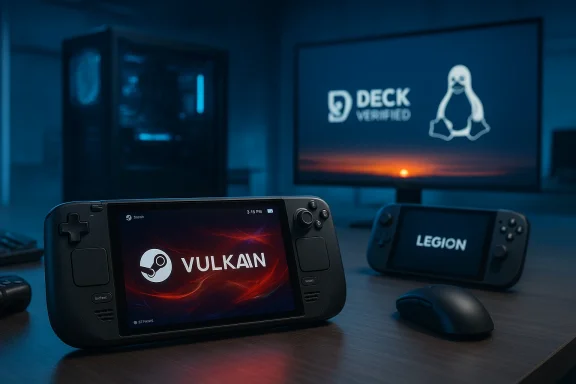 Why now? The three forces that changed the calculus
1) Compatibility engineering: Proton, DXVK and VKD3D matured
Valve’s Proton — the Wine-based compatibility layer that maps Windows graphics and kernel calls into Linux-friendly APIs and Vulkan — is no longer a proof-of-concept. Over multiple major updates (Proton 9/10 and community GE-Proton builds), Proton’s subcomponents such as DXVK and VKD3D‑Proton have improved robustness and performance across a wide catalog of titles. Community-maintained builds and Valve’s upstream work mean many Windows-only games now just run on SteamOS and other Linux distributions. Recent Proton 10.x releases incorporated critical fixes and broader compatibility updates that reduced “launch” failure modes for many modern titles.2) A shipping, mass-market Linux device: the Steam Deck validated the model
The Steam Deck did something the free‑software world struggled to do for decades: provide a polished, supported, end‑user Linux device that people bought because it played games, not to “experiment with a distro.” Valve has described Deck shipments as “multiple millions,” and independent analysts consistently place the device in the low‑millions range. Those sales numbers matter because they created a measurable user base that developers and middleware vendors could no longer ignore. Even conservative external estimates cluster around 3–5 million Steam Deck units, and industry research firms treat the Deck as the dominant product within the nascent handheld PC category. That scale reshaped incentives in a way decades of blog posts could not.3) Vendor and OEM signals: SteamOS is moving beyond Valve
OEMs are shipping SteamOS variants of premium handhelds (for example, Lenovo announced a Legion Go 2 “Powered by SteamOS” at CES 2026), which signals that Linux as a gaming-first OS is becoming part of device roadmaps rather than a curiosity. Hardware vendors now see a market for Linux-first handhelds and are designing support accordingly — another practical lever pushing the ecosystem forward.Technical foundations: where Linux shines — and where it doesn’t
The graphics stack and driver landscape
- Vulkan + Mesa (RADV, ANV) + modern open drivers: Linux benefits from modern, highly optimized open-source drivers (Mesa), which on AMD and Intel hardware can yield very competitive performance. For Vulkan-first or Vulkan-ported workloads, translation overhead is smaller and sometimes measurably better than older DirectX paths.
- DXVK / VKD3D‑Proton: These translation layers map DirectX 9/11/12 to Vulkan and are central to Proton’s success. Continuous updates to DXVK and VKD3D have closed many gaps in fidelity and features, which directly improves compatibility for demanding titles.
Real‑world performance: parity in many scenarios
Independent bench tests and community hands‑on comparisons show that Linux can match — and in constrained, thermally-limited environments sometimes exceed — Windows performance for many games. Enthusiast benchmarking (Framework 13 laptop comparisons, Steam Deck and handheld reviews) found that Linux delivered cleaner frame-time graphs and improved minimums in shader-heavy scenes, particularly when Windows’ background services and unpredictable system overhead were factors. Gains are not universal — Windows still leads in some titles and driver‑specific contexts — but the consistency and frequency of parity are now high enough to make Linux a legitimate practical choice for many gamers.Remaining technical gaps
- Driver regressions and compatibility: Linux’s performance depend heavily on specific kernel, Mesa, and firmware versions. A single upstream regression or a mismatched driver stack can produce game-breaking bugs, so stability across distributions and hardware revisions remains a challenge.
- Specialized Windows features: APIs like DirectML-edge features or some vendor-specific graphics extensions sometimes lack one-for-one equivalents on Linux, which matters for niche workloads (certain advanced ray-tracing features, vendor SDKs, or machine‑learning integrations).
- Enterprise tooling and closed‑source middleware: Many companies and studios still rely on Windows-specific QA tooling, telemetry libraries, and packaging pipelines that are non-trivial to port or emulate.
Multiplayer and anti‑cheat: the final gating factor for mainstream parity
Arguably the single largest blocker to “switching” for many gamers has been multiplayer anti‑cheat systems. The landscape here is nuanced:- Anti‑cheat vendors (notably BattlEye and Easy Anti‑Cheat) developed Proton-friendly modules and Valve publicly worked with them early in the Deck’s lifecycle to enable Proton-compatible flows. That engineering foundation exists; the technical capability to run many anti‑cheat systems on Proton is real.
- But vendor support alone does not enable gameplay. Developers and publishers must opt in, integrate or enable the Linux/Proton anti‑cheat pathway for their titles. Some studios have chosen not to, citing security posture and maintenance concerns; others have enabled it and released Linux‑friendly multiplayer experiences. The result is a mixed catalog: many single‑player and indie multiplayer titles work, while a handful of high‑profile competitive and live‑service games remain blocked by policy choices rather than immutable technical limits.
- Some big live‑service titles remain inaccessible on Steam Deck/Proton because the publisher has not enabled or opted into the Proton anti‑cheat runtime, or because the anti‑cheat requires kernel‑level hooks that the Linux version foregoes.
- Other publishers have enabled Linux‑compatible anti‑cheat support, allowing titles with EAC/BattlEye to run under Proton once the developer toggled the option or shipped a small compatibility update. That demonstrates the difference between “can be done” and “is done.”
Ecosystem and commercial signals that matter to developers and publishers
- Deck Verified and compatibility telemetry: Valve’s Deck Verified rollout and Steam’s telemetry provide visible incentives; titles with good Deck/SteamOS marks achieve better discoverability and a clearer customer experience.
- Developer tooling: Small investments in CI to test Windows builds on Proton, or to validate native Linux builds, yield outsized returns on device reach and long‑tail sales — particularly given the Deck’s install base and the rising fleet of SteamOS OEM handhelds.
- Economics and QA burdens: For large live‑service publishers, the cost of additional QA matrixes (Windows x driver set x anti‑cheat integration) is the real friction, not lack of a technical path. As Linux market share grows on Steam — even by single percentage points — that QA argument weakens slowly but materially.
Practical advice: what gamers, developers and OEMs should do next
For gamers
- Test before you switch: Use ProtonDB, Deck Verified, and the Steam Survey signals to check your top-play titles. Single‑player and indie catalogs are largely safe bets; the major caveat is some competitive, anti‑cheat-protected multiplayer titles.
- Try a secondary system: If you’re curious but depend on a few Windows-only online titles, dual‑boot or keep a lightweight Windows partition for those exceptions.
- Consider handhelds: If portability and battery/thermal efficiency matter, SteamOS handhelds (Deck, Lenovo Legion Go 2 SteamOS, and others) give a polished, Linux-native experience that often outperforms Windows in thermally constrained settings.
For developers and publishers
- Add Proton/SteamOS to CI and test regularly.
- Engage early with anti‑cheat vendors to enable Proton paths — it’s often a configuration or opt‑in step rather than an enormous engineering rewrite.
- Publish compatibility notes and test data: transparent Deck Verified results and Proton test runs reduce user frustration and returns.
- Prioritize native Linux ports for titles where long‑tail sales justify the investment; where native ports aren’t feasible, validate Proton usage and declare support explicitly.
For OEMs and IT buyers
- Evaluate SteamOS for public deployments (cafés, labs) where licensing costs and maintenance benefits are meaningful. SteamOS reduces desktop Windows licensing cost, but ensure multiplayer/anti-cheat coverage matches your use-case.
- Track Valve/third‑party handheld offerings for high-quality, supported Linux devices as an alternative for niche workloads (mobile gaming rigs, kiosk setups).
Strengths, risks and where the narrative could overreach
Notable strengths
- Compatibility has improved dramatically. Proton 10.x and community builds, combined with DXVK and VKD3D maturation, produce real, tangible coverage across Steam’s catalog.
- A shipping consumer device changed incentives. The Steam Deck’s commercial success made Linux gaming a business problem for middleware vendors and publishers, not an academic experiment.
- Performance parity is common. Benchmarks and community tests show Linux often matches Windows, and can even excel in thermal/TDP constrained scenarios thanks to a leaner runtime and modern graphics stacks.
Material risks and caveats
- Anti‑cheat remains a gate for some major multiplayer titles. While the technical capability exists, developer opt‑in is inconsistent. This is an ecosystem governance problem as much as a technical one.
- Stability across kernels, Mesa and firmware is variable. For stable, enterprise-grade rollouts, vendors still need to commit to long‑term maintenance of specific hardware‑software stacks.
- Windows tooling and enterprise inertia are powerful. Game engines, telemetry, and some middleware remain Windows-first; large studios will not abandon those investments hastily.
- Selective sources and community tests can overstate wins. Many of the benchmark datapoints that show Linux outperforming Windows are conditional on precise kernel/Mesa/driver/revision combinations. Those are real gains, but they are not universal or guaranteed across all hardware.
Where to watch next — three practical indicators
- Steam Hardware Survey trends: look for sustained month‑over‑month Linux growth rather than single spikes; the Steam page is the canonical monthly readout.
- ProtonDB and Deck Verified metrics: improvements in the percentage of the catalog that’s Gold/Platinum or listed as Deck Verified will track real user experience gains.
- Anti‑cheat vendors: when a major multiplayer publisher publicly enables EAC/BattlEye for Proton, expect an immediate uptick for that franchise’s Deck/Linux playability and broader developer confidence.
Conclusion — is Linux “ready” for mainstream PC gaming?
Ready is a spectrum, not a binary. For a growing segment of players — single‑player fans, indie enthusiasts, handheld-first purchasers and those who value a lean, privacy‑leaning runtime — Linux is now a practical, modern and compelling choice. Proton, SteamOS and the Steam Deck turned an engineering possibility into a consumer reality, and major OEMs are following suit. The ecosystem has moved from “it works sometimes” to “it works often, and in predictable ways.”That said, Windows remains the dominant, safest bet for maximal compatibility across every live‑service title, middleware and enterprise toolchain. The final big gate to broad mainstream parity is not purely technical anymore; it’s commercial: will publishers and anti‑cheat vendors consistently opt into Proton flows? If the answer becomes “yes” at scale, Linux will cease being an alternative and will become one of the two mainstream PC gaming platforms that developers treat as first‑class.
For now, treat Linux as a second mainstream platform — increasingly essential for developers and a realistic, if not universal, option for gamers. The tectonic plates are shifting, and the next 12–24 months of publisher opt‑ins, Proton improvements and OEM SteamOS hardware will determine whether Linux becomes merely a strong second or truly a coequal for mainstream PC gaming.
Source: Outlook Respawn Linux vs Windows: A PC Gaming Inflection Point | Outlook Respawn
