

Linux gaming has quietly left the back room and is now sitting at the main table — not because a single miracle patch fixed everything, but because several deliberate engineering bets (and one wildly successful handheld) finally made the math add up. Valve’s Steam Deck, the maturation of Proton and the Vulkan graphics stack, and a market-wide moment around Windows 10’s end of support have combined to push Linux from a niche tinkerer’s hobby into a real alternative for many gamers. That doesn’t mean Windows is doomed overnight — far from it — but the tectonic plates under PC gaming are shifting, and developers, platform holders, and players should take note. (store.steampowered.com)
Before we dig into the how and why, the headline numbers worth anchoring the discussion to are few but consequential. Valve’s own Steam Hardware & Software Survey shows Linux-powered systems now represent a little over three percent of surveyed Steam users — a small slice, but one that represents millions of players on a platform with over one hundred million users. (store.steampowered.com)
At the same time, Valve has repeatedly described the Steam Deck’s installed base as “multiple millions,” and independent analyst estimates place the device in the low‑millions range (estimates vary; most public figures fall roughly between three and five million units sold). The Deck’s existence turned SteamOS and Proton from dev‑only curiosities into mainstream priorities for both Valve and an increasing number of developers.
Finally, the calendar amplified the moment: Microsoft ended mainstream free support for Windows 10 on October 14, 2025, prompting a portion of the Windows userbase — particularly owners of older hardware that won’t meet Windows 11’s requirements — to evaluate alternatives. That practical migration pressure matters because for many gamers the question has shifted from “can Linux run my games?” to “what would it take for me to live without Windows?”
That shift matters for three reasons:
This is a user experience that matters in conversion: players who can buy a game and know it will run on their handheld are more likely to adopt the platform. The momentum here is not measured only in percentage points of Steam’s user share — it’s measured in the confidence barrier that drops for ordinary buyers. (store.steampowered.com)
Multiple community and industry trackers now show a dramatic rise in the number of Windows games that will at least launch under Proton. Interpretations of those numbers vary — “launch” is not the same as “perfect, native‑quality play” — but the trend is unmistakable: the percent of the Steam catalog that can be started and played to some degree on Linux has climbed sharply.
That reduces the “why would a dev invest in Linux?” argument. If a title runs well on a Deck or a Linux workstation with reasonable engineering effort, the ROI starts to look attractive.
Let’s walk through the math transparently:
None of this guarantees Linux will “replace Windows” for games. Windows’ entrenched developer tools, enterprise reach, and sheer installed base remain powerful anchors. What’s changed is that Linux has practical parity in many use cases and a visible growth path in others, especially handhelds and low‑power platforms. For gamers and developers, the smart play is to treat Linux as a second mainstream platform — not a fringe hobby, not yet the default, but an increasingly essential channel in an increasingly plural operating‑system landscape. (store.steampowered.com)
Source: Geeky Gadgets Microsoft's Edge Fades as Steam Deck & Proton Push Linux Gaming into the Mainstream
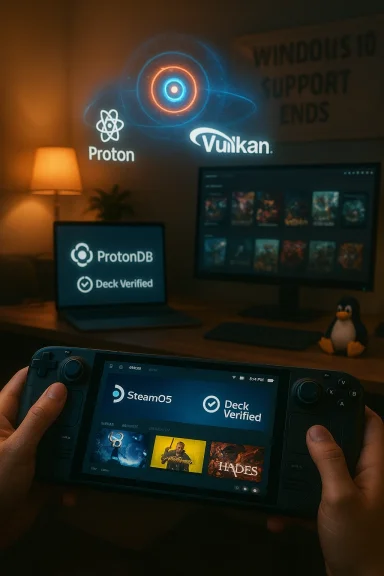 Background: the data points that matter
Before we dig into the how and why, the headline numbers worth anchoring the discussion to are few but consequential. Valve’s own Steam Hardware & Software Survey shows Linux-powered systems now represent a little over three percent of surveyed Steam users — a small slice, but one that represents millions of players on a platform with over one hundred million users. (store.steampowered.com)At the same time, Valve has repeatedly described the Steam Deck’s installed base as “multiple millions,” and independent analyst estimates place the device in the low‑millions range (estimates vary; most public figures fall roughly between three and five million units sold). The Deck’s existence turned SteamOS and Proton from dev‑only curiosities into mainstream priorities for both Valve and an increasing number of developers.
Finally, the calendar amplified the moment: Microsoft ended mainstream free support for Windows 10 on October 14, 2025, prompting a portion of the Windows userbase — particularly owners of older hardware that won’t meet Windows 11’s requirements — to evaluate alternatives. That practical migration pressure matters because for many gamers the question has shifted from “can Linux run my games?” to “what would it take for me to live without Windows?”
Why the Steam Deck changed the calculus
A shipping product beats a theoretical platform
Hardware touches people. Software roadmaps do not. The Steam Deck did something the Linux desktop ecosystem had not: it made Linux gaming a mass-market, supported, packaged experience. For players who had never installed a distro or worried about drivers, the Deck delivered a console‑like ownership model with the ability to access the full Steam library through SteamOS and Proton.That shift matters for three reasons:
- It drives telemetry and real‑world testing at scale; developers can see how games behave on a consistent environment.
- It creates a target specification for performance and power draw that developers can optimize for.
- It normalizes the user experience of “Linux = gaming device” in mainstream conversation, making support requests and bug reports subject to broader, more rapid fixes.
SteamOS + Big Picture + Deck Verified: a bundled experience
SteamOS (and Valve’s “Deck Verified” program) turn compatibility into a consumer product feature. Rather than leaving consumers to decipher forum threads, Valve publishes a straightforward verification matrix for titles that “just work,” those that “work with tweaks,” and those that fail in the current environment. That curation lowers the churn for end users and gives developers both guidance and incentive to test against the Deck and SteamOS.This is a user experience that matters in conversion: players who can buy a game and know it will run on their handheld are more likely to adopt the platform. The momentum here is not measured only in percentage points of Steam’s user share — it’s measured in the confidence barrier that drops for ordinary buyers. (store.steampowered.com)
The technology stack: Proton, Vulkan, and the modern graphics pipeline
Proton: the compatibility layer that reframed possibility
Proton is not magic; it’s engineering. By building on Wine and integrating translation layers for DirectX APIs (DXVK for Direct3D 9/10/11, vkd3d‑proton for Direct3D 12), Valve and contributors created a practical path for Windows games to run on Linux with minimal intervention. Proton’s constant iterative improvements — including rebases onto newer Wine releases and targeted fixes for popular titles — removed many of the barriers that historically kept major games Windows‑exclusive.Multiple community and industry trackers now show a dramatic rise in the number of Windows games that will at least launch under Proton. Interpretations of those numbers vary — “launch” is not the same as “perfect, native‑quality play” — but the trend is unmistakable: the percent of the Steam catalog that can be started and played to some degree on Linux has climbed sharply.
Vulkan: lowering the translation overhead
Vulkan, the cross‑platform, low‑overhead graphics API, is a crucial enabler. Unlike Direct3D, which is a Microsoft product tightly coupled to Windows, Vulkan runs on Linux natively and gives developers the GPU‑level control needed to maintain performance parity. Translating Direct3D calls to Vulkan (via DXVK/vkd3d) is computationally expensive, but it’s become efficient enough — and the driver ecosystems (AMD’s open stack, Intel’s open drivers, and the slowly improving NVIDIA stack) are mature enough — that the performance delta for many titles is small or even negligible.That reduces the “why would a dev invest in Linux?” argument. If a title runs well on a Deck or a Linux workstation with reasonable engineering effort, the ROI starts to look attractive.
The numbers: what “3% on Steam” actually means
On paper, Linux’s share of Steam users moving from roughly 1–2% to over 3% looks small; in practice, on a platform with well over 100 million monthly users, a single percentage point is millions of people. Valve’s own Steam Hardware & Software Survey registered Linux at about 3.05–3.58% in late 2025 depending on the month surveyed — a steady upward trend that corresponds with Deck adoption and improvements to Proton. (store.steampowered.com)Let’s walk through the math transparently:
- Steam’s scale: with an estimated 120–132 million monthly active users in recent reporting cycles, each percentage point of platform share represents more than a million users.
- Linux share: at ~3%, that implies somewhere in the neighborhood of 3–4 million Steam users operating on Linux at least some of the time. (store.steampowered.com)
- Claim scrutiny: You will see higher headline figures in some coverage — “6–7 million Linux gamers on Steam.” Those larger figures often arise from combining different datasets (e.g., Deck unit estimates, global account counts, and peripheral Linux installs) or projecting future growth. They are plausible under optimistic assumptions but not directly supported by Valve’s voluntary survey alone. Treat single‑number claims as estimates, not authoritative facts.
Strengths that make Linux seriously competitive — and why they matter
- Cost and openness. For users constrained by upgrade costs or hardware compatibility with Windows 11, a modern Linux distro offers security and functionality without a Microsoft upgrade cycle. That makes it an appealing alternative for budget‑conscious gamers and those running older machines.
- A focused low‑power sweet spot. SteamOS and Valve’s optimizations make Linux efficient on handheld and lower‑power hardware, where Windows’ power management and background services can be wasteful. For handheld form factors, Linux can actually outperform Windows for the same silicon.
- Compatibility momentum. Community and industry trackers (ProtonDB, Boiling Steam, Deck Verified) show a growing fraction of the Steam catalog running on Linux to varying degrees — meaning users can expect increasingly predictable outcomes when switching.
- Tooling and packaging improvements. Improvements in distribution packaging (Flatpak for sandboxed app delivery), runtime libraries, and developer tooling (Steamworks support and documentation for Proton) reduce friction for developers and users alike.
The thorniest obstacles (short‑to‑mid term)
Anti‑cheat and multiplayer: the hard engineering boundary
The single most persistent practical blocker is anti‑cheat. Many popular multiplayer games rely on kernel‑level anti‑cheat drivers or Windows‑specific protections that vendors are reluctant to port, because doing so changes the threat model and can reduce effectiveness. While companies like Epic (Easy Anti‑Cheat) and BattlEye have developed paths to support Proton and Valve’s runtimes, publishers must opt in — and many are cautious. The result is patchwork support: some online titles work, many don’t, and the most competitive esports titles remain, for now, Windows‑centric.Edge cases, regressions, and the “it works for me” problem
Compatibility statistics depend heavily on definitions. “Launches” is not the same as “plays well,” and a title classified as playable might still suffer graphical glitches, performance variance, or UI bugs on certain hardware. Because much of the data is community‑sourced (ProtonDB) or curated for a specific device class (Deck Verified), broader desktop experiences can differ. This creates an expectation gap for less technical users and increases support burden for developers.Fragmentation of Linux distributions and drivers
Windows has the advantage of a single official binary target and vendor drivers tested against it. Linux has many distributions, kernel versions, and user configurations — and while Valve’s SteamOS does a lot to concentrate the target on the Deck, desktop Linux remains heterogeneous. That raises QA costs for developers who want to guarantee a seamless experience across the entire Linux ecosystem. Driver maturity for NVIDIA, AMD, and Intel has improved dramatically, but nuances remain, especially with cutting‑edge GPU features.Developer incentives and the business case
Even if Proton makes two‑thirds or more of the catalog launchable, developers still prioritize where they see the largest revenue and lowest support costs. Windows remains the highest revenue and lowest‑friction platform for many AAA publishers. For Linux to claim parity, it needs a sustained cycle of developer investment and publisher certification — a process Valve has accelerated but cannot control alone.What this means for Microsoft, game developers, and the wider industry
For Microsoft
Windows is not about to lose its crown — the installed base, enterprise dependencies, and tooling ecosystem preserve that dominance. But the Deck and the Linux momentum expose vulnerability in certain markets: handhelds, livingroom PCs, and price‑sensitive segments where Microsoft can’t rely on Windows 11’s upgrade funnel. The risk for Microsoft is twofold: losing mindshare among enthusiasts and ceding control of the lightweight and portable gaming segment to platforms where Microsoft’s operating system is less dominant. Microsoft’s strategic responses will likely range from better hardware and software partnerships to deeper integration with cloud‑based play services.For game developers and publishers
The calculus has shifted from “support Linux only if you must” to “support Linux because it’s a strategic channel.” Supporting Proton and SteamOS is not the same as producing a native Linux port, but the overhead of testing and certifying for Proton is lower than it would have been five years ago. For indies and many mid‑tier titles, the incremental revenue from Deck and Linux users can now justify the extra engineering. For AAA publishers, anti‑cheat and certification remain the major gating factors.For the wider ecosystem
Open standards and cross‑platform APIs (Vulkan, open drivers, and containerized packaging) can only help. The industry should watch three practical levers closely:- Tooling that makes Proton/SteamOS QA frictionless and automatable.
- Anti‑cheat vendor decisions to provide secure, cross‑platform runtimes that publishers can trust.
- Continued maturation of the driver and kernel space to minimize hardware regressions.
What to watch next (practical signals)
- Steam Hardware Survey trends: incremental month‑to‑month gains in Linux share are more meaningful than rare spikes. Track the Survey to see whether Deck sales and Linux installs produce sustained growth. (store.steampowered.com)
- Proton & ProtonDB metrics: improvements to launch and playability percentages will signal whether the compatibility stack is getting broadly better or whether gains are limited to high‑visibility titles.
- Anti‑cheat vendor announcements and publisher opt‑ins: these are the gating events for big multiplayer titles. When a major publisher enables Proton/EAC or BattlEye support, expect a meaningful uptick in Linux multiplayer viability.
- Valve’s hardware roadmap: Valve’s decisions to expand beyond the Deck into living‑room hardware or micro‑consoles will create additional demand signals for developers to invest in Linux-first QA. Recent Valve moves indicate such exploration is ongoing.
Practical advice for readers (gamers, developers, and sysadmins)
- If you’re a gamer considering the switch: test your library on ProtonDB and check Deck Verified status for priority titles. For multiplayer titles, confirm anti‑cheat support before buying. Expect most single‑player and many indie/mid‑tier games to run well, but keep realistic expectations for the largest online multiplayer franchises.
- If you’re a developer: invest in CI that tests builds under Proton and validate on SteamOS hardware where feasible. Support for Proton often requires only modest engineering investment but yields outsized adoption on Deck and Linux desktops. Document known issues, and work with anti‑cheat vendors early if your game depends on secure online play.
- If you’re a sysadmin or curator for a gaming café or lab: SteamOS offers a low‑maintenance profile for shared hardware. The cost savings on licensing and the streamlined maintenance path can justify desktop Linux for public gaming deployments, especially for single‑player and local co‑op titles. (store.steampowered.com)
Conclusion: an ecosystem in motion, not a singular triumph
Linux gaming in 2026 is not an overnight revolution — it’s the product of incremental engineering, an unusually effective piece of hardware in the Steam Deck, and a confluence of market conditions (including Windows 10’s end of free support) that made the timing right. The headline numbers — Linux breaking the 3% mark on Steam, Proton enabling the majority of catalog titles to at least launch, and analyst estimates putting the Deck in the low‑millions of units — are important because they change incentives. Developers will invest more. Anti‑cheat vendors will be pressured to offer better cross‑platform support. Microsoft will watch and adjust.None of this guarantees Linux will “replace Windows” for games. Windows’ entrenched developer tools, enterprise reach, and sheer installed base remain powerful anchors. What’s changed is that Linux has practical parity in many use cases and a visible growth path in others, especially handhelds and low‑power platforms. For gamers and developers, the smart play is to treat Linux as a second mainstream platform — not a fringe hobby, not yet the default, but an increasingly essential channel in an increasingly plural operating‑system landscape. (store.steampowered.com)
Source: Geeky Gadgets Microsoft's Edge Fades as Steam Deck & Proton Push Linux Gaming into the Mainstream
