

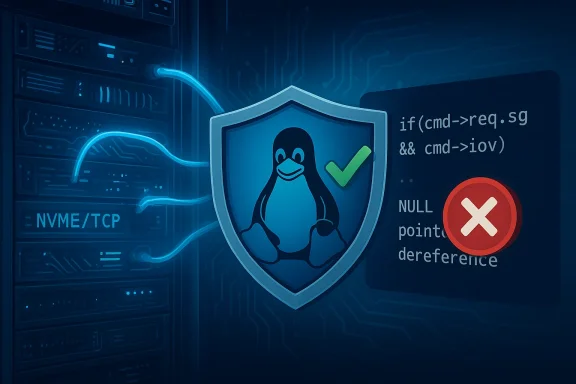
A small defensive change landed upstream this month that closes a straightforward—but impactful—NULL-pointer weakness in the Linux kernel’s NVMe-over-TCP target code. Left unpatched, the bug allows crafted NVMe/TCP traffic to cause a kernel NULL-pointer dereference and crash the host, producing total loss of availability for the target system. The fix is simple and surgical: upstream added checks to ensure internal command data pointers are initialized before they are dereferenced. For any organization running the kernel NVMe target (nvmet) or exposing NVMe/TCP services, this is a practical, high‑priority availability bug to address.
Background / Overview
NVMe-over-TCP (NVMe/TCP) brings the NVMe storage protocol over standard TCP/IP, enabling network‑attached block storage without specialized RDMA hardware. On Linux, the target side that listens for incoming NVMe/TCP sessions is provided by the kernel’s nvmet subsystem and the nvmet‑tcp transport driver. This stack accepts TCP connections from an NVMe host/initiator and processes a layered set of PDUs (protocol data units) used by NVMe‑oF.The vulnerability in this advisory lives in the nvmet‑tcp code path that handles host‑to‑controller data PDUs (H2C_DATA). A recent upstream correction identified that some internal command structures—specifically the scatter/gather list and the iovec pointer associated with a command—were not always validated before being used. Under certain timing and protocol conditions an H2C_DATA PDU can be processed when those pointers are NULL, and the code dereferences them, causing a kernel‑level NULL pointer dereference and a panic/crash.
This is an availability (denial‑of‑service) issue, not a memory corruption that directly enables code execution. The practical impact is severe: a remote actor that can open an NVMe/TCP session (or otherwise send crafted PDUs to an exposed nvmet listener) can crash the kernel and take the target offline.
What changed upstream (technical summary)
Upstream developers added defensive checks in the nvmet_tcp H2C data handler to verify that the command’s data structures are initialized before calling the routine that builds the PDU iovec. Concretely, the patched code:- Verifies both the command’s scatter/gather request pointer and the command’s iovec pointer are non‑NULL before proceeding.
- Logs an error if the PDU arrives for a command in an invalid/partially initialized state, and aborts protocol processing for that packet rather than dereferencing NULL.
- In other words, instead of dereferencing potentially NULL pointers inside nvmet_tcp_build_pdu_iovec(), the code now detects uninitialized/invalid command state, prints an error, and rejects the malformed/ill‑timed packet.
How the bug works (step‑by‑step)
To understand the exploit surface, it helps to look at the NVMe/TCP protocol flow and the code’s expectations:- NVMe/TCP uses an initial exchange (ICREQ/ICRESP) and subsequent CONNECT and command PDUs. The target tracks per‑command structures that represent outstanding requests.
- When an H2C_DATA PDU arrives, the target code expects the corresponding command slot and its associated buffers to be allocated and initialized (these include a scatter/gather list, cmd->req.sg, and an iovec pointer, cmd->iov).
- The vulnerable code called nvmet_tcp_build_pdu_iovec() and assumed both pointers existed. In several edge cases they did not:
- If an H2C_DATA PDU arrives before a CONNECT (for example, immediately after ICREQ/ICRESP) the command structures are uninitialized → both pointers NULL.
- If the PDU belongs to a READ command, the scatter/gather list may be allocated but the iovec not set → one pointer NULL.
- If the PDU references an unused/uninitialized command slot the pointers are NULL.
- When the code dereferences a NULL pointer in kernel context the result is a NULL pointer dereference and a kernel panic/crash, producing complete unavailability of the target system.
Attack scenarios and threat model
Who can exploit this, and under what conditions?- Attacker position: The attacker needs to be able to send NVMe/TCP PDUs to the target’s nvmet listener. That means either:
- They can open a TCP connection to an exposed nvmet port (typical default I/O port is 4420; discovery may use 8009), or
- They are a malicious or compromised host that the nvmet target already accepts connections from (for example, in multi‑tenant environments or when discovery/control interfaces are exposed).
- Authentication: NVMe/TCP session setup has a protocol handshake, but the bug can be triggered by sending an H2C_DATA PDU at the wrong time in the handshake sequence (for example, before CONNECT completes). In practical terms this can often be done by any TCP peer that can reach the listening port; the attacker does not need local root on the target host, but they do need TCP connectivity to the nvmet service.
- Complexity: Crafting an H2C_DATA PDU requires some knowledge of the NVMe/TCP PDU layout, but the protocol is well documented and the attack vectors described by maintainers show three straightforward cases. For a skilled network attacker or researcher with access to raw TCP sockets, creating a PDU that triggers the code path is feasible.
- Impact: Successful trigger produces a kernel NULL dereference and panic → full system crash / host reboot while the attack is in progress (sustained denial), or persistent outage if the system fails to recover without operator intervention.
Verified facts and cross‑checks
The technical description above is confirmed by the upstream patch notes and by multiple vulnerability trackers and vendor advisories. The patch inserted explicit validation checks for the command data pointers and added an error case that logs a message and aborts processing of malformed H2C_DATA PDUs, which prevents the kernel from dereferencing NULL.Multiple independent vulnerability databases and Linux distribution trackers recorded the CVE and the same technical cause/mitigation (NULL pointer dereference in nvmet_tcp_build_pdu_iovec; added checks of cmd->req.sg and cmd->iov). Across entries there is consensus on the root cause: the nvmet target code dereferences command pointers without validating them, and the fix is to validate those pointers before use.
Caveat: public vulnerability sources sometimes differ in how they rate attack complexity and attack vector (local vs. network). The most conservative operational posture treats the flaw as remote when NVMe/TCP is listening on a network interface reachable by an attacker, and prioritizes patching and access controls accordingly.
Practical impact (what administrators should expect)
- Immediate effect of successful exploitation: kernel panic and host crash. That means a full reboot and interruption of all hosted services, storage workloads, and any VMs or containers running on the host.
- Secondary effects:
- Data transfer/in‑flight operations will be interrupted—depending on the storage stack and journaling, this can cause application errors or require recovery after reboot.
- If the administrative host running nvmet is a hypervisor or storage controller, multiple tenants/customers could be affected.
- Repeated or automated attacks can cause repeated downtime and operational disruption.
- Not an immediate RCE or memory‑corruption exploit (no evidence the bug leads to code execution). The primary risk is high‑severity availability loss rather than remote code execution or privilege escalation.
Detection and indicators
The upstream fix introduces logging on the invalid PDU path. After the fix you may see kernel log messages flagged when malformed PDUs arrive. Administrators can proactively search logs for these indicators; even pre‑fix, malformed PDUs and failed builds will sometimes leave traces.Useful quick checks:
- Kernel logs (dmesg / journalctl) for NVMe/TCP PDU handling errors. Look for messages containing “H2CData PDU” or an explicit “H2CData PDU received for invalid command state” style error; similar diagnostic strings are produced by the patched code when a PDU is rejected.
- Unexpected kernel panics with call traces referencing nvmet_tcp, nvmet_tcp_build_pdu_iovec, or nvmet_tcp_io_work indicate this code path was hit and may point to this vulnerability being triggered.
- Review network connection patterns to the NVMe/TCP ports (default I/O port commonly 4420; discovery uses 8009). Unusual or repeated TCP connect attempts to those ports from untrusted hosts are suspicious.
- List nvmet ports and their configuration in sysfs (/sys/kernel/config/nvmet/ports/*) to find which addresses are listening and on which interface/port.
- Check whether nvmet transport is present and enabled:
- lsmod | grep -E 'nvmet|nvme'
- grep CONFIG_NVME_TARGET /boot/config-$(uname -r) (or inspect kernel config)
- List nvmet configuration:
- ls /sys/kernel/config/nvmet
- ls /sys/kernel/config/nvmet/ports
- Check listening ports (from the target host):
- ss -lntp | grep -E '4420|8009|nvmet'
- Search logs:
- dmesg | grep -i 'H2CData'
- journalctl -k | grep -i 'nvmet|H2CData'
Immediate mitigations and remediation steps
If you run any services that use the kernel nvmet target (for example, exposing NVMe/TCP I/O controllers), follow this prioritized mitigation checklist.- Patch as soon as possible (recommended)
- Apply vendor/distro kernel updates that include the upstream fix. This is the definitive remediation.
- When vendors publish backported stable kernel updates, apply them according to your change control. For many distributions, kernel updates that carry the patch are available shortly after upstream stable releases.
- If you cannot patch immediately — reduce exposure
- Block external access to NVMe/TCP ports at the network perimeter and host firewall.
- Default I/O port: TCP 4420 (commonly used for NVMe/TCP I/O controllers).
- Discovery port: TCP 8009 (discovery controllers); also consider blocking if not needed.
- Place any NVMe target interfaces on an isolated management/storage VLAN that is not reachable from untrusted hosts.
- If the NVMe target service is not in use, consider disabling it:
- Remove configured nvmet ports from sysfs (unlink the port to subsystem entries).
- Unload or blacklist the nvmet_tcp kernel module (careful: this will break active storage; ensure you unmount or stop dependent services first).
- Example (safe steps):
- Gracefully stop services using the NVMe target and ensure clients are disconnected.
- Remove /sys/kernel/config/nvmet/ports/* entries for any port.
- rmmod nvmet_tcp (may fail if in use; verify no dependencies).
- Note: removing kernel modules and stopping a storage target can be disruptive—coordinate with application owners.
- Block external access to NVMe/TCP ports at the network perimeter and host firewall.
- Add monitoring and detection
- Monitor kernel logs for the new error messages the patch emits; these are also useful to detect attempted exploit attempts.
- Track inbound TCP connects to NVMe/TCP ports from unusual or untrusted IP addresses.
- Alert on repeated partial handshake attempts or malformed PDU patterns.
- Hardening for the future
- Network segmentation: isolate storage networks and management interfaces; never expose NVMe/TCP to the public internet.
- Host security: limit which initiator hosts are allowed to connect; use access control lists where supported.
- Test patching in staging to ensure there are no regressions.
Step‑by‑step checklist for sysadmins
- Inventory
- Identify hosts running the nvmet target (check for modules, sysfs config, and listening ports).
- If you run storage appliances or virtualization hosts, verify whether they expose NVMe/TCP.
- Apply updates
- Prioritize kernel updates from your vendor. Test and deploy a patched kernel that includes the upstream fix.
- Short‑term blocking (if patch delayed)
- Block TCP 4420 and 8009 at the perimeter or host firewall for any host that should not accept NVMe/TCP from untrusted networks.
- If you must take the target offline
- Coordinate an outage window, gracefully disconnect NVMe initiators, unbind or remove the nvmet ports from /sys/kernel/config/nvmet, then unload the nvmet_tcp module.
- Validate
- After patching, verify that logs no longer show the previously logged error paths for malformed H2C PDUs, and validate that attempted malformed traffic no longer produces crashes.
Risk analysis — strengths of the fix and residual concerns
Strengths- The upstream patch is minimal and targeted: it addresses the root cause (missing pointer validation) without major refactors or protocol changes.
- Adding input/state validation is a robust, low‑risk fix pattern that prevents the crash scenario.
- The fix produces a detectable logging event when malformed PDUs arrive, which improves observability.
- Operational exposure: many deployments assume storage transports are safe on their internal networks. If NVMe/TCP ports are inadvertently reachable (cloud tenants, poorly segmented storage networks, misconfigured firewalls), the attack surface is significant because the exploit requires only TCP connectivity to nvmet.
- Patch distribution: kernel fixes propagate via vendor/distribution kernels; older long‑term kernels used in appliances or vendors’ embedded systems may require backports. Administrators should confirm their vendor’s advisories and timelines.
- Attack surface of protocol stacks: this bug is one among several that arise when network protocols carry structured PDUs with complex state transitions. It underscores the need for robust state validation and fuzz testing of protocol parsers.
Final recommendations (what to do now)
- Treat this CVE as a high‑priority availability risk for any system that runs the nvmet target and exposes NVMe/TCP to networks where attackers could connect.
- Apply official kernel updates from your Linux distribution as your primary remediation path.
- If you cannot patch within your maintenance window, implement network controls to block NVMe/TCP ports (4420, 8009 where applicable) and isolate storage networks from untrusted hosts.
- Add log monitoring for NVMe/TCP errors and configure alerts for repeated malformed PDUs or kernel messages referencing nvmet_tcp.
- Review deployment architecture: ensure storage control planes and NVMe/TCP listeners are not exposed to general-purpose networks or the broader internet.
Bigger picture: why this matters
This CVE is a textbook example of a simple memory‑safety issue creating a disproportionate impact. The kernel is the obvious place where a NULL dereference is fatal, and transport protocols that accept structured PDUs are natural targets for malformed packet attacks. The fix is small and effective, but the incident highlights three enduring priorities for infrastructure teams:- Never expose storage transport endpoints to untrusted networks—treat them as management/isolated resources.
- Rapidly apply vetted security updates for kernel subsystems handling network protocols.
- Improve observability: when defensive checks are added upstream, they often include logging that yields detection opportunities—use that to turn bugs into actionable telemetry.
Source: MSRC Security Update Guide - Microsoft Security Response Center
