

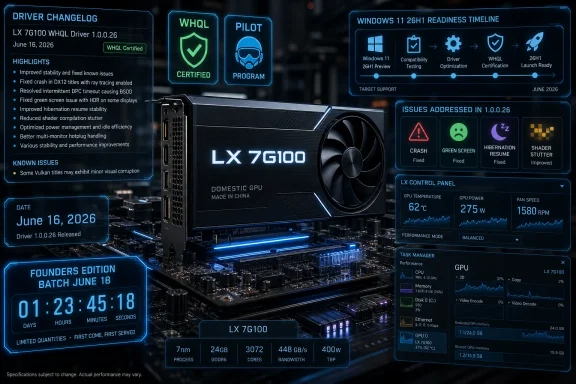
Lisuan released new Windows drivers for the LX 7G100 graphics card on June 16, 2026, adding Windows 11 26H1 support, fixing multiple game crashes and rendering bugs, and preparing the Chinese-market GPU for a second Founders Edition sales batch on June 18. The update is not just a maintenance drop. It is the first real public test of whether a new GPU vendor can move at the brutal cadence Windows gaming demands.
The hardware story was always the easy part to market: a domestic Chinese gaming card, 12GB of GDDR6, a modern Windows driver, and a price meant to make the product feel like a serious entrant rather than a lab curiosity. But the driver changelog tells the more important story. Lisuan is discovering, in public, that building a GPU is only the beginning; shipping a Windows gaming platform means entering a never-ending argument with APIs, engines, launchers, codecs, hibernation states, shader compilers, and impatient players.
The LX 7G100 arrived with the kind of symbolic baggage that makes any product harder to judge cleanly. It is being discussed not only as a graphics card, but as a marker of Chinese semiconductor ambition, an answer to dependency on foreign GPU suppliers, and a proof point for the claim that a new architecture can join the Windows gaming ecosystem without years of consumer-market scar tissue.
That is why this driver release matters more than its version numbers suggest. Lisuan’s driver center now lists WHQL Release v29.0.2260.186 and Pilot Release v30.0.2260.214, both published on June 16 as roughly 215MB downloads. The WHQL badge signals a baseline of Windows compatibility, but the Pilot driver is where the company is doing the heavier practical work.
The headline addition is support for Windows 11 26H1. That is notable because it puts Lisuan in the future-facing Windows conversation, not merely the “can it run today’s OS?” conversation. It also adds support for Windows 10 Enterprise build 17763, which matters for controlled deployments and older enterprise images that linger long after consumer support narratives have moved on.
The consumer-facing fixes are even more telling. Lisuan added VLC playback support, GPU temperature and power-consumption readouts in its control panel, automatic driver-update detection, and a fix for abnormal GPU temperature readings in Windows Task Manager. These are not glamorous features, but they are the table stakes that make a graphics card feel like a product instead of a development board.
Lisuan says it fixed random green-screen playback problems in the Douyin client, random crashes when playing H.264 streams in Edge, random white screens after S4 hibernation on some motherboards, and abnormal playback in certain in-game animated videos. None of those fixes will win a benchmark chart, but each one attacks the kind of daily annoyance that causes users to remove a card and reinstall something boring.
That is the burden facing any new Windows GPU vendor. Nvidia, AMD, and Intel are not merely selling silicon; they are selling accumulated compatibility. Their drivers embody years of workarounds for game engines, motherboard firmware, Windows compositor behavior, video pipelines, and developer mistakes that users will always blame on the GPU vendor.
Lisuan’s Windows 11 26H1 support therefore has two meanings. On paper, it says the company is keeping up with Microsoft’s platform schedule. In practice, it says Lisuan understands that Windows users do not grade new hardware on ideology or ambition once the system is under their desk; they grade it on whether Edge crashes, whether Task Manager reports sensible temperatures, and whether the machine wakes from hibernation without a white screen.
That is a useful spread of issues because it cuts across old games, new games, DirectX 11, DirectX 12, upscalers, benchmarks, and engines with very different assumptions about GPU behavior. A driver team that can make progress across that range is doing more than chasing one demo. It is building the messy compatibility database that every GPU platform needs.
But the same list also reveals the scale of the climb. Rendering fixes are listed for CrossFire, Far Cry 6, Wuthering Waves, and Legend of Ymir. Shader compilation optimizations target Hogwarts Legacy and Monster Hunter Wilds, while performance optimizations cover CrossFire, Black Myth: Wukong, VALORANT, World of Warcraft DX11, and Far Cry 6.
The pattern is familiar to anyone who watched Intel’s Arc launch mature from awkward curiosity to credible budget option. Early hardware rarely fails in just one way. It fails at launch, then at shader compilation, then in cutscenes, then in one rendering path, then in a specific upscaler mode, then in a popular game’s benchmark sequence. The work is not glamorous, but it is cumulative.
Graphics issues remain in Assassin’s Creed Odyssey, Dragon’s Dogma 2, Forza Horizon 6, Borderlands 4, StarCraft II, A Chinese Ghost Story, and Rainbow Six Siege. Rainbow Six Siege is listed as launching with errors and graphical problems, which is the kind of caveat that matters deeply for competitive players. A game that launches but cannot be trusted is not meaningfully supported for many users.
Still, the known-issues page is also a sign of maturity. New vendors often make the mistake of hiding instability behind vague claims of broad support. Lisuan’s explicit accounting of non-launching games and graphical defects gives buyers, reviewers, and early adopters a clearer picture of risk.
For WindowsForum readers, that matters. Enthusiasts may enjoy testing exotic hardware, but sysadmins and IT buyers think in terms of support debt. A public known-issues list does not eliminate that debt, but it at least tells users where the cliffs are.
That price invites comparisons Lisuan may not enjoy. In raw consumer value terms, buyers will naturally look toward established Nvidia, AMD, and Intel cards that offer stronger game compatibility, richer software ecosystems, and known resale value. A new entrant asking real money does not get graded on a curve forever.
But this is not a purely normal consumer GPU launch. The Founders Edition appears to be as much a statement product as a mass-market value proposition. Early buyers are paying not only for frames per second, but for participation in a platform experiment.
That distinction can sustain a first wave of interest, especially in a domestic market where technology sovereignty has political and industrial value. It cannot sustain a gaming GPU business indefinitely. By the third or fourth driver cycle, the question becomes less “Isn’t it impressive this exists?” and more “Can I recommend it to someone who just wants to play?”
But WHQL is not a guarantee of a good gaming experience. It does not mean every DirectX 12 title behaves properly, every shader compiles quickly, every video path is clean, or every sleep-state transition survives a messy motherboard ecosystem. It is a floor, not a ceiling.
That distinction is especially important for readers accustomed to mature GPU brands. When Nvidia releases a Game Ready driver or AMD posts an Adrenalin update, users may complain about bugs, but they are operating inside a vast compatibility machine. Profiles, engine relationships, developer outreach, telemetry, beta channels, and years of accumulated fixes all sit behind the release notes.
Lisuan is trying to build that machine in public. The v30 Pilot driver is proof of activity, not proof of arrival. The company’s credibility will depend on whether each release narrows the known-issues list faster than new games and Windows changes expand it.
That matters because Microsoft’s graphics stack keeps moving. Driver models, display behavior, security expectations, video pipelines, and Windows Update delivery all evolve. A new GPU vendor that falls behind the Windows cadence becomes irrelevant quickly, especially if gamers must choose between updating their OS and keeping their graphics card stable.
The Windows 10 Enterprise build 17763 support is a different kind of signal. That build corresponds to the Windows 10 version 1809 era, still familiar in long-lived enterprise environments and specialized deployments. Supporting it suggests Lisuan is thinking beyond hobbyists and reviewers, even if the LX 7G100 itself is primarily a gaming card.
This dual posture is interesting. On one side, Lisuan wants the attention that comes with modern Windows 11 support and high-profile game fixes. On the other, it wants enough legacy compatibility to be taken seriously in controlled Windows environments. That is exactly the tension every GPU vendor faces once it grows beyond demos.
The fix for abnormal GPU temperature readings in Windows Task Manager is similarly important. Task Manager has become a first-line diagnostic tool for ordinary users. If it reports nonsense, the vendor’s credibility takes a hit before anyone opens a specialist utility.
Automatic driver update detection is another small but necessary step. Early adopters will manually check driver pages; normal users will not. A new vendor with fast-moving compatibility fixes needs a path to get those fixes in front of users before frustration hardens into reputation.
This is where Lisuan’s challenge overlaps with Intel’s Arc learning curve. Performance matters, but software confidence matters more in the first year. A card with uneven performance can survive if users believe the next driver will help; a card with opaque software and silent fixes cannot.
Lisuan says the Pilot driver fixes crashes when enabling FSR in Split Fiction and Death Stranding, and fixes XeSS activation in Black Myth: Wukong. That is an awkward but unavoidable arena for a new GPU vendor. Gamers increasingly expect upscaling options to work, even when those technologies originated from or are associated with rival GPU ecosystems.
This is the trap of modern PC graphics. Supporting DirectX 12 is not enough. A credible gaming GPU must behave well with AMD FSR, Intel XeSS, game-specific shader caching, Unreal Engine behavior, older DX11 renderers, browser video decode, and whatever combination of launcher, overlay, and capture tool the user happens to run.
Lisuan’s driver notes show that the company is meeting this complexity one bug at a time. That is how every GPU vendor does it. The difference is that Nvidia and AMD’s work is largely hidden by decades of accumulated fixes, while Lisuan’s is visible in a first-generation public changelog.
For a technically adventurous buyer, the LX 7G100 may be fascinating. It offers a new architecture, a real Windows driver track, 12GB of memory, and a front-row seat to the maturation of a domestic GPU platform. For a normal gamer, the calculus is less forgiving.
Game launch failures are not abstract. If your favorite title is on the cannot-launch list, the card is effectively incompatible with your library. If your preferred competitive game has rendering errors, the card is a liability rather than a bargain.
That is why the driver cadence will matter as much as benchmark numbers. Lisuan does not need to beat Nvidia or AMD immediately to remain interesting. It does need to show that each month brings concrete reductions in broken games, smoother shader behavior, better telemetry, and fewer Windows integration oddities.
That is not a criticism. It is the reality of platform building. A GPU is not a single product but a promise to keep translating the chaos of PC software into predictable pixels.
Lisuan’s TrueGPU architecture may be the technical foundation, but the driver stack is the customer experience. If shader compilation stalls in Monster Hunter Wilds, if Far Cry 6 renders incorrectly, if a Windows sleep state produces a white screen, users do not care how novel the architecture is. They care that the system they paid for feels less reliable than the one it replaced.
This is why the June 16 driver release is more meaningful than a spec-sheet update. It shows Lisuan doing the slow work. The question is whether the company can do it fast enough, broadly enough, and transparently enough to turn early curiosity into durable trust.
The hardware story was always the easy part to market: a domestic Chinese gaming card, 12GB of GDDR6, a modern Windows driver, and a price meant to make the product feel like a serious entrant rather than a lab curiosity. But the driver changelog tells the more important story. Lisuan is discovering, in public, that building a GPU is only the beginning; shipping a Windows gaming platform means entering a never-ending argument with APIs, engines, launchers, codecs, hibernation states, shader compilers, and impatient players.
 Lisuan’s First Real Product Moment Is a Driver, Not a GPU
The LX 7G100 arrived with the kind of symbolic baggage that makes any product harder to judge cleanly. It is being discussed not only as a graphics card, but as a marker of Chinese semiconductor ambition, an answer to dependency on foreign GPU suppliers, and a proof point for the claim that a new architecture can join the Windows gaming ecosystem without years of consumer-market scar tissue.That is why this driver release matters more than its version numbers suggest. Lisuan’s driver center now lists WHQL Release v29.0.2260.186 and Pilot Release v30.0.2260.214, both published on June 16 as roughly 215MB downloads. The WHQL badge signals a baseline of Windows compatibility, but the Pilot driver is where the company is doing the heavier practical work.
The headline addition is support for Windows 11 26H1. That is notable because it puts Lisuan in the future-facing Windows conversation, not merely the “can it run today’s OS?” conversation. It also adds support for Windows 10 Enterprise build 17763, which matters for controlled deployments and older enterprise images that linger long after consumer support narratives have moved on.
The consumer-facing fixes are even more telling. Lisuan added VLC playback support, GPU temperature and power-consumption readouts in its control panel, automatic driver-update detection, and a fix for abnormal GPU temperature readings in Windows Task Manager. These are not glamorous features, but they are the table stakes that make a graphics card feel like a product instead of a development board.
Windows Compatibility Is the Price of Admission
A modern Windows GPU has to pass several different tests at once. It has to render games, decode video, survive sleep and hibernation transitions, expose telemetry correctly to Windows, and coexist with browser video playback, game launchers, overlay software, and update infrastructure. The LX 7G100’s new driver changelog reads like a tour of that invisible workload.Lisuan says it fixed random green-screen playback problems in the Douyin client, random crashes when playing H.264 streams in Edge, random white screens after S4 hibernation on some motherboards, and abnormal playback in certain in-game animated videos. None of those fixes will win a benchmark chart, but each one attacks the kind of daily annoyance that causes users to remove a card and reinstall something boring.
That is the burden facing any new Windows GPU vendor. Nvidia, AMD, and Intel are not merely selling silicon; they are selling accumulated compatibility. Their drivers embody years of workarounds for game engines, motherboard firmware, Windows compositor behavior, video pipelines, and developer mistakes that users will always blame on the GPU vendor.
Lisuan’s Windows 11 26H1 support therefore has two meanings. On paper, it says the company is keeping up with Microsoft’s platform schedule. In practice, it says Lisuan understands that Windows users do not grade new hardware on ideology or ambition once the system is under their desk; they grade it on whether Edge crashes, whether Task Manager reports sensible temperatures, and whether the machine wakes from hibernation without a white screen.
The Game Fixes Show Progress and Exposure at the Same Time
The Pilot driver’s game list is long enough to look encouraging and rough enough to be sobering. Lisuan says it fixed launch failures in Neverness to Everness, Heroes of Might and Magic III HD, Might and Magic: Olden Era, and Mount & Blade II: Bannerlord. It also fixed Overwatch failing to run in DX12 mode, Call of Duty: Modern Warfare 2022 benchmark crashes, FSR-related crashes in Split Fiction and Death Stranding, XeSS activation in Black Myth: Wukong, and DX11 startup crashes in Shadow of the Tomb Raider.That is a useful spread of issues because it cuts across old games, new games, DirectX 11, DirectX 12, upscalers, benchmarks, and engines with very different assumptions about GPU behavior. A driver team that can make progress across that range is doing more than chasing one demo. It is building the messy compatibility database that every GPU platform needs.
But the same list also reveals the scale of the climb. Rendering fixes are listed for CrossFire, Far Cry 6, Wuthering Waves, and Legend of Ymir. Shader compilation optimizations target Hogwarts Legacy and Monster Hunter Wilds, while performance optimizations cover CrossFire, Black Myth: Wukong, VALORANT, World of Warcraft DX11, and Far Cry 6.
The pattern is familiar to anyone who watched Intel’s Arc launch mature from awkward curiosity to credible budget option. Early hardware rarely fails in just one way. It fails at launch, then at shader compilation, then in cutscenes, then in one rendering path, then in a specific upscaler mode, then in a popular game’s benchmark sequence. The work is not glamorous, but it is cumulative.
The Known-Issues List Is the More Honest Benchmark
Lisuan’s known-issues list is where the marketing glow fades and the engineering reality becomes useful. The company currently lists Warhammer 40,000: Space Marine 2, Apex Legends in DX12, Battlefield 6, Indiana Jones, Death Stranding 2, The Last of Us Part II, and Little Nightmares 3 as games that cannot launch. That is not a footnote; it is a warning label for anyone expecting a plug-and-play GeForce alternative.Graphics issues remain in Assassin’s Creed Odyssey, Dragon’s Dogma 2, Forza Horizon 6, Borderlands 4, StarCraft II, A Chinese Ghost Story, and Rainbow Six Siege. Rainbow Six Siege is listed as launching with errors and graphical problems, which is the kind of caveat that matters deeply for competitive players. A game that launches but cannot be trusted is not meaningfully supported for many users.
Still, the known-issues page is also a sign of maturity. New vendors often make the mistake of hiding instability behind vague claims of broad support. Lisuan’s explicit accounting of non-launching games and graphical defects gives buyers, reviewers, and early adopters a clearer picture of risk.
For WindowsForum readers, that matters. Enthusiasts may enjoy testing exotic hardware, but sysadmins and IT buyers think in terms of support debt. A public known-issues list does not eliminate that debt, but it at least tells users where the cliffs are.
The Second Batch Is Arriving Before the Platform Is Finished
The timing is aggressive. The second Founders Edition batch is scheduled for June 18 at 20:00 China time, only two days after the driver packages were published. The card is priced at 3,299 yuan, roughly in the high-$400 range depending on exchange rate assumptions, which places it in a brutally competitive zone.That price invites comparisons Lisuan may not enjoy. In raw consumer value terms, buyers will naturally look toward established Nvidia, AMD, and Intel cards that offer stronger game compatibility, richer software ecosystems, and known resale value. A new entrant asking real money does not get graded on a curve forever.
But this is not a purely normal consumer GPU launch. The Founders Edition appears to be as much a statement product as a mass-market value proposition. Early buyers are paying not only for frames per second, but for participation in a platform experiment.
That distinction can sustain a first wave of interest, especially in a domestic market where technology sovereignty has political and industrial value. It cannot sustain a gaming GPU business indefinitely. By the third or fourth driver cycle, the question becomes less “Isn’t it impressive this exists?” and more “Can I recommend it to someone who just wants to play?”
WHQL Was a Milestone, Not a Moat
Lisuan’s WHQL certification is important because it moves the company past a credibility threshold. Windows Hardware Quality Labs certification means the driver has cleared Microsoft’s formal compatibility process, which helps with installation trust, driver signing, and the basic confidence that Windows will treat the device as a legitimate participant in the platform.But WHQL is not a guarantee of a good gaming experience. It does not mean every DirectX 12 title behaves properly, every shader compiles quickly, every video path is clean, or every sleep-state transition survives a messy motherboard ecosystem. It is a floor, not a ceiling.
That distinction is especially important for readers accustomed to mature GPU brands. When Nvidia releases a Game Ready driver or AMD posts an Adrenalin update, users may complain about bugs, but they are operating inside a vast compatibility machine. Profiles, engine relationships, developer outreach, telemetry, beta channels, and years of accumulated fixes all sit behind the release notes.
Lisuan is trying to build that machine in public. The v30 Pilot driver is proof of activity, not proof of arrival. The company’s credibility will depend on whether each release narrows the known-issues list faster than new games and Windows changes expand it.
Windows 11 26H1 Support Is a Signal to Microsoft’s Ecosystem
The Windows 11 26H1 support line is easy to overread and easy to underread. It does not make the LX 7G100 a mainstream recommendation overnight. It does, however, show that Lisuan is not merely chasing compatibility with last year’s Windows builds.That matters because Microsoft’s graphics stack keeps moving. Driver models, display behavior, security expectations, video pipelines, and Windows Update delivery all evolve. A new GPU vendor that falls behind the Windows cadence becomes irrelevant quickly, especially if gamers must choose between updating their OS and keeping their graphics card stable.
The Windows 10 Enterprise build 17763 support is a different kind of signal. That build corresponds to the Windows 10 version 1809 era, still familiar in long-lived enterprise environments and specialized deployments. Supporting it suggests Lisuan is thinking beyond hobbyists and reviewers, even if the LX 7G100 itself is primarily a gaming card.
This dual posture is interesting. On one side, Lisuan wants the attention that comes with modern Windows 11 support and high-profile game fixes. On the other, it wants enough legacy compatibility to be taken seriously in controlled Windows environments. That is exactly the tension every GPU vendor faces once it grows beyond demos.
The Control Panel Matters More Than It Sounds
Adding temperature and power-consumption readouts to the control panel sounds mundane, but it is the sort of software polish that separates a finished product from a board with drivers. Enthusiasts expect to see thermals, power behavior, clocks, and update status. If a GPU vendor does not expose basic telemetry cleanly, users assume the platform is immature even when the card is functioning.The fix for abnormal GPU temperature readings in Windows Task Manager is similarly important. Task Manager has become a first-line diagnostic tool for ordinary users. If it reports nonsense, the vendor’s credibility takes a hit before anyone opens a specialist utility.
Automatic driver update detection is another small but necessary step. Early adopters will manually check driver pages; normal users will not. A new vendor with fast-moving compatibility fixes needs a path to get those fixes in front of users before frustration hardens into reputation.
This is where Lisuan’s challenge overlaps with Intel’s Arc learning curve. Performance matters, but software confidence matters more in the first year. A card with uneven performance can survive if users believe the next driver will help; a card with opaque software and silent fixes cannot.
The Upscaler Fixes Reveal the Modern GPU Trap
The fixes involving FSR and XeSS are especially revealing. In older eras, a GPU compatibility story could be framed around DirectX versions and raw rendering correctness. Modern games are layered with upscalers, frame generation systems, shader compilation pipelines, anti-cheat, overlays, video cutscenes, and engine-specific rendering paths.Lisuan says the Pilot driver fixes crashes when enabling FSR in Split Fiction and Death Stranding, and fixes XeSS activation in Black Myth: Wukong. That is an awkward but unavoidable arena for a new GPU vendor. Gamers increasingly expect upscaling options to work, even when those technologies originated from or are associated with rival GPU ecosystems.
This is the trap of modern PC graphics. Supporting DirectX 12 is not enough. A credible gaming GPU must behave well with AMD FSR, Intel XeSS, game-specific shader caching, Unreal Engine behavior, older DX11 renderers, browser video decode, and whatever combination of launcher, overlay, and capture tool the user happens to run.
Lisuan’s driver notes show that the company is meeting this complexity one bug at a time. That is how every GPU vendor does it. The difference is that Nvidia and AMD’s work is largely hidden by decades of accumulated fixes, while Lisuan’s is visible in a first-generation public changelog.
Performance Is Not the Only Reason Buyers May Hesitate
The LX 7G100’s reported positioning has invited comparisons with older mainstream cards and current lower-midrange alternatives. That is inevitable at 3,299 yuan. Once a product approaches the price territory of established GPUs, curiosity has to compete with value.For a technically adventurous buyer, the LX 7G100 may be fascinating. It offers a new architecture, a real Windows driver track, 12GB of memory, and a front-row seat to the maturation of a domestic GPU platform. For a normal gamer, the calculus is less forgiving.
Game launch failures are not abstract. If your favorite title is on the cannot-launch list, the card is effectively incompatible with your library. If your preferred competitive game has rendering errors, the card is a liability rather than a bargain.
That is why the driver cadence will matter as much as benchmark numbers. Lisuan does not need to beat Nvidia or AMD immediately to remain interesting. It does need to show that each month brings concrete reductions in broken games, smoother shader behavior, better telemetry, and fewer Windows integration oddities.
China’s GPU Ambition Runs Through Boring Windows Bugs
The geopolitical frame around Chinese GPUs is unavoidable, but it can obscure the practical engineering story. The road to a credible domestic gaming GPU does not run only through process nodes, memory buses, or architecture slides. It runs through boring, humiliating bugs in Edge video playback and hibernation resume.That is not a criticism. It is the reality of platform building. A GPU is not a single product but a promise to keep translating the chaos of PC software into predictable pixels.
Lisuan’s TrueGPU architecture may be the technical foundation, but the driver stack is the customer experience. If shader compilation stalls in Monster Hunter Wilds, if Far Cry 6 renders incorrectly, if a Windows sleep state produces a white screen, users do not care how novel the architecture is. They care that the system they paid for feels less reliable than the one it replaced.
This is why the June 16 driver release is more meaningful than a spec-sheet update. It shows Lisuan doing the slow work. The question is whether the company can do it fast enough, broadly enough, and transparently enough to turn early curiosity into durable trust.
The June Driver Drop Makes the LX 7G100 Easier to Judge
The most useful thing about this update is that it replaces hype with evidence. Lisuan is fixing real bugs, adding real Windows support, and documenting real limitations. That gives buyers and observers a sharper view of where the LX 7G100 stands today.- The June 16 Pilot driver adds Windows 11 26H1 support and broadens compatibility beyond the launch driver baseline.
- The update fixes multiple game launch, crash, rendering, shader compilation, video playback, telemetry, and hibernation problems.
- The known-issues list remains substantial, with several major games still unable to launch or suffering visible graphics problems.
- The second Founders Edition batch arrives before the software stack can be considered mature by mainstream GPU standards.
- WHQL certification gives Lisuan credibility on Windows, but it does not replace the long game of per-title optimization and support.
- The LX 7G100 is still best understood as an early-adopter product rather than a safe general recommendation for ordinary gamers.
References
- Primary source: videocardz.com
Published: Wed, 17 Jun 2026 20:53:07 GMT
- Related coverage: lisuantech.com

LX 7G100-砺算科技
www.lisuantech.com
- Related coverage: techspot.com
China built a gaming GPU: Lisuan's LX 7G100 performs like an RTX 3060 but costs almost $500 | TechSpot
A review of the Founder Edition model on BiliBili shows the 12GB card running a range of modern titles, which is an achievement in itself for a...www.techspot.com - Related coverage: gpuvec.com
Lisuan LX 7G100 GPU Specs & Cloud Pricing | 2026
Lisuan LX 7G100 specs: 0 CUDA cores, 12GB VRAM. Compare cloud rental prices for AI/ML workloads.gpuvec.com - Related coverage: tomshardware.com
First ARM-supported 3D driver for discrete gaming GPUs emerges from China — Lisuan 7G106 runs 3DMark on a Windows 11 ARM machine | Tom's Hardware
Nvidia, AMD, and Intel have yet to introduce ARM support for their discrete GPUswww.tomshardware.com - Related coverage: digitalcitizen.life
Lisuan’s LX 7G100 sells out first batch after 30,000 preorders as driver and game guide arrive
Lisuan’s LX 7G100 graphics card has sold out its first preorder batch after reaching 30,000 preorders, giving China’s new gaming GPU maker an early demand signal despite mixed first impressions from reviews. The company has also released WHQL Windows drivers and an official recommended settings...www.digitalcitizen.life
- Related coverage: windowscentral.com
This new Chinese graphics card supports Windows on ARM | Windows Central
Lisuan’s 7G106 discrete GPU is a notable development for Windows on ARM, offering dedicated graphics power in a space long dominated by integrated solutions. It could open the door to more capable ARM‑based PCs.www.windowscentral.com
