

LoopUp and Digicel have partnered to sell Microsoft Teams telephony to enterprise customers across the Caribbean, making what the companies describe as the region’s first Microsoft-certified Operator Connect service available through Digicel Business in the Caribbean markets where Digicel operates. The deal is not just another unified-communications reseller arrangement; it is a bid to make Teams the front end for business calling in a region where multinational companies often still have to stitch together country-by-country telecoms contracts. For Caribbean enterprises, and for global companies with Caribbean offices, the practical promise is a single managed route into Teams calling without building and operating the voice plumbing themselves. The strategic wager is larger: Microsoft Teams has become important enough that regional telecoms providers now have to meet customers inside Teams rather than ask Teams users to come back to the old phone system.
The most important part of the LoopUp-Digicel announcement is not the word “Teams.” Microsoft Teams is already widely used for internal communications across the kinds of organizations Digicel serves, including financial services, hospitality, government and energy. The more consequential part is that Digicel Business is now taking a Microsoft-certified Operator Connect service to enterprise customers across the region, using LoopUp’s platform rather than asking each customer to design a bespoke telecoms integration.
That matters because Teams without public calling is still only part of the communications stack. It can host meetings, chat, collaboration and internal calls, but the moment a customer, citizen, hotel guest, supplier or regulator dials a public phone number, the enterprise is back in the world of carriers, numbering, emergency calling, billing, porting and local support. Operator Connect is Microsoft’s attempt to make that transition feel less like a systems-integration project and more like turning on a managed service.
Under the agreement described by IT Brief UK and by Digicel’s own announcement, Digicel will sell LoopUp’s Operator Connect telephony platform and service to enterprise customers in the Caribbean markets where Digicel operates. Users will be able to make and receive calls through Teams on supported devices, while companies manage telephony alongside workplace messaging and meetings. That is the sales pitch in one sentence: the phone system stops being a separate estate and becomes another governed workload inside the Teams environment.
The companies are also presenting the launch as a regional first: the first Microsoft-certified Operator Connect service available across the Caribbean. The wording is important. This is not a claim that Caribbean businesses have never used Teams calling, cloud PBX, SIP trunking or Microsoft voice integrations before. It is a claim about a certified Operator Connect service being available regionally through this partnership, with Digicel providing the local enterprise route to market and LoopUp providing the cloud telephony platform.
That distinction is where the story becomes interesting for IT buyers. Many enterprises have already found a way to connect Teams to the public switched telephone network, whether through Direct Routing, a local carrier, a managed services provider, or some combination of all three. The new proposition is that Digicel Business and LoopUp want to replace the patchwork with a managed, Microsoft-certified deployment model that spans the region and plugs into LoopUp’s broader multinational coverage.
That is the pain point LoopUp is trying to exploit. IT Brief UK’s source material frames the problem as separate carrier contracts, local support arrangements and different management systems for fixed-line and business calling services. LoopUp’s model is designed to replace those country-by-country arrangements with a single cloud telephony service linked to Teams, reducing the burden of managing multiple suppliers and removing the need for legacy on-premise phone equipment.
That does not mean telecom complexity disappears. It means more of it is absorbed by the operator and platform provider. Phone numbers still have to be acquired, ported, assigned and supported. Emergency calling still has to be handled correctly. Local service quality still matters, especially for businesses where voice calls are tied to bookings, customer support, dispatch, security, healthcare, public services or regulated communications. The difference is that the enterprise customer is being offered one managed operating model rather than a different technical answer in every country.
Digicel’s role is central because multinational cloud telephony is rarely won only in a global procurement spreadsheet. Local support and network reach still matter. Digicel serves about nine million customers across mobile, home and business services, and its business division works with thousands of organizations across the region. It also operates in 25 markets across the Caribbean, Central America and South America, giving LoopUp a route into Caribbean markets through a regional communications provider that already has enterprise relationships.
For Digicel, the partnership adds a business voice product to its cloud services portfolio. That is not a trivial portfolio extension. It moves Digicel Business deeper into the managed Microsoft ecosystem, where customer conversations are increasingly about Teams, Microsoft 365, Azure-adjacent services, security, endpoint management and cloud communications rather than isolated mobile or fixed-line contracts. The carrier is effectively saying that enterprise voice is no longer a standalone product category; it is part of the workplace platform.
That middle position explains why the LoopUp-Digicel deal is aimed at enterprise customers rather than casual small-business buyers. Operator Connect lets a certified third-party operator handle PSTN access, phone numbers, support and related telephone service obligations, while the Teams admin experience remains the place where numbers can be viewed and assigned. Microsoft’s model is not that the customer builds the interconnect; it is that the customer chooses a certified operator that has already completed the integration with Microsoft.
In practice, that changes who owns the hardest parts of the deployment. With Direct Routing, the customer, integrator or service provider has to deal with session border controllers, routing policies, certificates, DNS, carrier interconnects and ongoing voice troubleshooting. That can be the right model when an enterprise has unusual requirements, legacy PBX dependencies, analog devices, overhead paging, remote branches or a strong need to retain a particular PSTN arrangement. But it is not the lowest-friction route for every organization.
Operator Connect is designed for organizations that want carrier-managed PSTN connectivity inside Teams without building and managing the links themselves. That maps closely to the source material’s description of the LoopUp-Digicel service: integrating telephony directly into Teams so organizations can bring business calling into Microsoft’s certified deployment model. The value proposition is operational discipline as much as technical capability.
For Caribbean enterprises, the table explains the commercial opening. If Microsoft Calling Plan coverage, carrier preference, local support or regional numbering requirements do not neatly solve the problem, Operator Connect becomes attractive. If Direct Routing feels too custom or too infrastructure-heavy, Operator Connect offers a more standardized path. The LoopUp-Digicel partnership is effectively positioning itself in that gap.
The caveat is that “simpler” does not mean “automatic.” Microsoft’s configuration guidance still expects administrators to assign the necessary Teams Phone licensing, ensure users are in the appropriate Teams mode, acquire or port numbers through the operator, and assign those numbers in the Teams admin center or with PowerShell. The service can remove much of the telecom integration burden, but it does not remove the need for tenant governance, migration planning, user readiness and support ownership.
That quote captures LoopUp’s actual target customer better than a generic “cloud telephony” label does. LoopUp is based in London and focuses on cloud telephony for multinational businesses. It says its service now offers phone numbers and cloud-based public switched telephone network replacement in more than 100 countries. The Caribbean launch is therefore not only a local service announcement; it is a coverage story for enterprises that want one Teams telephony operating model across headquarters, regional offices and branch locations.
The value of that consistency is easy to underestimate until something breaks. Voice systems generate operational edge cases: number porting delays, emergency address records, caller ID behavior, call queues, auto attendants, contact-center integrations, desk-phone firmware, receptionist workflows, local dialing habits, regulatory constraints and user expectations that are often invisible during a clean slide-deck demo. A single multinational contract does not magically erase those details, but it can give IT leaders one escalation path and one design pattern.
Digicel’s counterweight is local accountability. Liam Donnelly, Chief Business Officer of Digicel Group, said customers are asking for “smarter, simpler ways to communicate” and that “Microsoft Teams has become the platform of choice for many of them.” He described the partnership as a way to give enterprise customers a seamless, fully managed Teams telephony experience, “regionwide and now globally,” using the Microsoft-certified Operator Connect approach and backed by Digicel’s local support and network reach.
The phrase “local support” is doing more work than it may appear to. In telecoms, especially across distributed island markets, enterprises care about who answers the phone when the phone system itself is the problem. They care about in-country provisioning, number availability, porting from existing providers, service restoration and the practical realities of dealing with regulated voice services. LoopUp brings the multinational platform; Digicel brings the regional customer base and the local operating credibility.
That is why the partnership is not simply LoopUp selling directly into new countries. For LoopUp, Digicel provides a route into Caribbean markets through an established regional communications provider. For Digicel, LoopUp provides a Microsoft Teams telephony platform that extends the carrier’s cloud services portfolio without Digicel having to present the service as a homegrown global cloud voice platform. Each side is filling the other’s credibility gap.
Legacy PBX environments often survive because they work, not because anyone loves them. They support desk phones, hunt groups, reception desks, analog endpoints, lifts, alarms, fax lines, paging systems and industry-specific workflows that are expensive or annoying to replace. They also tend to be deeply embedded in office habits. The reason cloud telephony migrations take longer than chat or meeting deployments is that a phone number is both a technical object and a business promise.
But the economics of maintaining separate communications silos are getting harder to defend. Once an organization already pays for Microsoft 365, trains users on Teams, manages identity through Microsoft’s cloud, and conducts meetings and messaging inside Teams, the old PBX becomes another estate to patch, support, contract, audit and explain. Voice is not always the largest cost line, but it is often one of the messiest.
Operator Connect is designed to make that mess less visible to the enterprise. Instead of each country running its own fixed-line arrangement and phone system, the organization can consolidate calling into Teams while relying on a certified operator to provide PSTN access and support. For the Caribbean, where Digicel Business already serves organizations in sectors that tend to prize reliability and local support, that proposition has obvious appeal.
The risk is that buyers mistake platform consolidation for process simplification. Moving calls into Teams still requires decisions about call queues, auto attendants, shared numbers, emergency calling, compliance recording, retention, desk phones, receptionist consoles, contact centers, user adoption and outage procedures. The PBX may be old, but it often encodes decades of operational knowledge. A successful Teams telephony migration extracts that knowledge before it retires the hardware.
That is why this kind of partnership matters beyond Digicel and LoopUp. It demonstrates how Microsoft’s ecosystem strategy works in practice: make Teams the control surface, let operators provide certified connectivity, and give enterprises enough admin-center integration to feel like voice has joined the cloud workplace rather than remained outside it. Microsoft’s role is not invisible, but it is not the retail seller in the same way it would be with Calling Plans.
For carriers, this creates both opportunity and pressure. The opportunity is to stay relevant as business communications move into Teams. The pressure is that the carrier’s product becomes more tightly coupled to Microsoft’s user experience, licensing model, admin workflows and roadmap. If customers increasingly ask for Teams-native calling, the carrier that cannot provide it risks being reduced to underlying connectivity or displaced by a provider that can.
Digicel appears to understand that shift. The company is not presenting the service merely as SIP trunking with a Microsoft badge. It is presenting a managed Teams telephony experience for enterprise customers across the region, tied to its cloud services portfolio and local support capabilities. That is a much more defensible position than trying to protect the old boundary between “collaboration software” and “telephony.”
LoopUp benefits from the same platform logic from the opposite direction. Its multinational proposition becomes more valuable when local operators expand its reach into regions where customers need in-country support and numbering. The more multinational customers standardize on Teams Phone, the more they need coverage in markets that global-first providers may have struggled to serve consistently. The Caribbean is exactly the kind of region where a global platform needs a credible regional partner.
Microsoft’s Operator Connect guidance makes clear that administrators still need to assign the appropriate Phone System capability, acquire numbers from the operator, and assign those numbers to users in the Teams admin center or through PowerShell. If moving from Direct Routing, administrators must coordinate number migration and remove existing routing configuration where appropriate. These are not exotic tasks, but they are production voice tasks, and production voice has a low tolerance for casual change control.
The most important planning question is not “Can we turn this on?” It is “Which calling estate are we replacing, and what business processes depend on it?” A simple office-user migration is very different from a hotel front desk, government hotline, bank branch, energy operations site or healthcare-adjacent workflow. The user interface may be Teams in all cases, but the operational blast radius varies enormously.
Enterprises should also avoid treating “any supported device” as a substitute for endpoint planning. A Teams user may be happy taking calls on a laptop headset. A receptionist may need a certified desk phone or console workflow. A shared space may need meeting-room device support. A field worker may need mobile behavior to be predictable. The endpoint strategy is part of the migration, not an accessory.
The Caribbean setting raises the stakes because regional consistency is difficult. Customers with operations in multiple countries often want a single contract and unified management, but they also need local behavior to be correct. A bank branch, resort, government office or energy site cannot treat voice as a generic cloud workload if local calling patterns, customer expectations or regulatory requirements differ. The provider must make the service feel global to IT and local to the business.
This is where Digicel’s market presence matters. The company’s network presence across 25 markets in the Caribbean, Central America and South America is not the same thing as saying the Operator Connect offer instantly behaves identically in every location. But it does mean Digicel Business has the regional relationships and enterprise support footprint that a London-based cloud telephony specialist would struggle to replicate alone. The partnership is designed to combine LoopUp’s multinational platform with Digicel’s in-country network and support presence.
There is also a competitive implication. Once a regional operator offers Microsoft-certified Teams telephony, other carriers and managed service providers in nearby markets will face a clearer benchmark. Enterprise customers will ask whether their provider can bring calling into Teams under a certified model, whether they can support multi-country operations, and whether they can reduce the number of telecoms suppliers the customer has to manage. The answer may not always be Operator Connect, but the question will increasingly start there.
That does not mean Direct Routing disappears. For complex environments, Direct Routing remains valuable precisely because it can accommodate edge cases and existing operators. But the burden of proof shifts. If Operator Connect can provide enough coverage, support and manageability for mainstream enterprise users, then custom voice infrastructure becomes something to justify rather than the default path.
Exceptions are expensive. They require separate support documentation, local carrier contacts, different provisioning processes, distinct contracts, special user training and occasional workarounds for features that the rest of the company takes for granted. In isolation, each exception looks manageable. Across enough countries, the exceptions become the operating model.
A single cloud telephony service linked to Teams promises to reduce those exceptions. The headquarters IT team gets a more consistent administrative view. Regional offices get local service through Digicel rather than being forced into a distant support model. Users get calling inside the same platform they use for messaging and meetings. Procurement gets fewer supplier relationships to manage, at least in theory.
The phrase “in theory” matters because consolidation projects can also create new dependencies. A single provider model is simpler until that provider has a service issue, commercial dispute or coverage limitation. A Teams-centric model is cleaner until the Teams client, identity layer, network path or Microsoft service health becomes part of the voice incident. The right lesson is not that consolidation is risk-free; it is that the risks become more centralized and therefore must be governed more deliberately.
For many enterprises, that is still an improvement. Fragmented telecoms estates hide risk in local arrangements that headquarters may not fully understand. A centralized Teams telephony model exposes more of the estate to common policy, reporting, licensing and support processes. That visibility can be uncomfortable, but it is usually the prerequisite for modernization.
Which Digicel Business customers can buy the service? Which Caribbean markets are included at launch, and which are planned later? How will number porting work from non-Digicel providers? Which existing Digicel numbers can be retained? How are emergency addresses handled? What service-level commitments apply? How are incidents triaged between Digicel, LoopUp and Microsoft? How are regulated or recorded calling scenarios supported? Those are the questions that separate a strategic announcement from a production deployment.
Microsoft’s model also creates a governance boundary that buyers need to understand. Operator Connect providers deliver PSTN access, phone numbers and operator-side support, while Microsoft Teams remains the client and administrative environment. If a user cannot make a call, the root cause may sit in the Teams client, the tenant configuration, a licensing assignment, a local network, the operator’s service, Microsoft’s cloud, or an endpoint. A fully managed service should simplify escalation, but it cannot repeal the layered nature of cloud voice.
Cost is another area where simplicity needs inspection. The source material says the service is aimed at businesses seeking to avoid dealing with multiple telecoms providers across different countries and that the model can reduce supplier-management burden and remove the need for legacy on-premise phone equipment. Those are real savings categories. But buyers should compare them against Teams Phone licensing, operator charges, porting costs, endpoint replacement, professional services, training, support changes and any parallel-run period during migration.
The strongest business case will likely be operational rather than purely per-minute. If the service lets a multinational retire PBX hardware, reduce country-by-country carrier management, standardize calling policy, simplify onboarding, improve support and give users one communications interface, the value may be broader than the telecom bill. If the project is treated merely as a cheaper way to place calls, the organization may underinvest in the work required to make it successful.
The first practical lesson is that Teams Phone is not just an application toggle. It depends on licensing, tenant policy, network quality, endpoint readiness, user training and operator coordination. A Caribbean rollout through Digicel Business may reduce the telecom-integration burden, but it does not remove the Microsoft 365 governance burden.
The second lesson is that cloud voice raises the importance of endpoint standardization. If users are expected to make and receive business calls through Teams, the Windows PC, headset, Teams client, audio drivers, device management policy and update cadence all become part of the phone system. That can be a support improvement if managed well. It can also turn every flaky headset and overloaded laptop into a perceived phone outage.
The third lesson is that voice migrations are political. Departments often have strong opinions about reception workflows, shared numbers, opening hours, call forwarding, voicemail, hunt groups and escalation paths. The technical migration may be straightforward compared with getting the business to agree on what the new call flows should be. Admins who treat the PBX as just hardware may discover too late that it was also an undocumented map of how the company works.
The fourth lesson is that regional support still matters in a cloud project. Digicel’s presence is part of the value proposition because enterprises do not want a cloud-only answer to a local voice problem. When a number port stalls or a customer-facing line behaves unexpectedly, local accountability becomes a feature.
The concrete points are these:
If LoopUp and Digicel execute well, Caribbean enterprises will get a cleaner path away from legacy PBX systems and fragmented carrier arrangements without losing the regional support they still need. If they stumble, it will likely be on the familiar rocks of voice migration: porting, support boundaries, local requirements, endpoint readiness and user expectations. Either way, the direction is clear. Business telephony is no longer orbiting Teams from the outside; in more markets, including the Caribbean, it is being pulled directly into Microsoft’s workplace gravity.
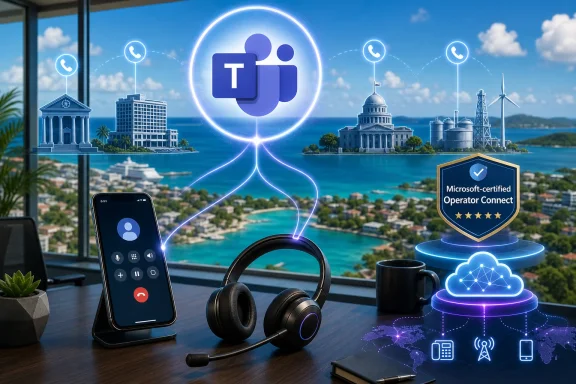 Digicel Is Turning Teams Into a Regional Voice Product, Not Just a Collaboration App
The most important part of the LoopUp-Digicel announcement is not the word “Teams.” Microsoft Teams is already widely used for internal communications across the kinds of organizations Digicel serves, including financial services, hospitality, government and energy. The more consequential part is that Digicel Business is now taking a Microsoft-certified Operator Connect service to enterprise customers across the region, using LoopUp’s platform rather than asking each customer to design a bespoke telecoms integration.That matters because Teams without public calling is still only part of the communications stack. It can host meetings, chat, collaboration and internal calls, but the moment a customer, citizen, hotel guest, supplier or regulator dials a public phone number, the enterprise is back in the world of carriers, numbering, emergency calling, billing, porting and local support. Operator Connect is Microsoft’s attempt to make that transition feel less like a systems-integration project and more like turning on a managed service.
Under the agreement described by IT Brief UK and by Digicel’s own announcement, Digicel will sell LoopUp’s Operator Connect telephony platform and service to enterprise customers in the Caribbean markets where Digicel operates. Users will be able to make and receive calls through Teams on supported devices, while companies manage telephony alongside workplace messaging and meetings. That is the sales pitch in one sentence: the phone system stops being a separate estate and becomes another governed workload inside the Teams environment.
The companies are also presenting the launch as a regional first: the first Microsoft-certified Operator Connect service available across the Caribbean. The wording is important. This is not a claim that Caribbean businesses have never used Teams calling, cloud PBX, SIP trunking or Microsoft voice integrations before. It is a claim about a certified Operator Connect service being available regionally through this partnership, with Digicel providing the local enterprise route to market and LoopUp providing the cloud telephony platform.
That distinction is where the story becomes interesting for IT buyers. Many enterprises have already found a way to connect Teams to the public switched telephone network, whether through Direct Routing, a local carrier, a managed services provider, or some combination of all three. The new proposition is that Digicel Business and LoopUp want to replace the patchwork with a managed, Microsoft-certified deployment model that spans the region and plugs into LoopUp’s broader multinational coverage.
The Caribbean Problem Is Not Teams Adoption — It Is Telecom Fragmentation
The deal reflects a simple enterprise reality: companies do not experience the Caribbean as one telecom market. They experience it as a set of national and local operating environments, each with its own numbers, support arrangements, legacy contracts, carrier relationships, regulations, service expectations and migration headaches. A hotel group, bank, energy company or government-adjacent contractor with offices in multiple Caribbean countries may have standardized on Microsoft 365 and Teams internally, but its calling environment can still look like a historical archive.That is the pain point LoopUp is trying to exploit. IT Brief UK’s source material frames the problem as separate carrier contracts, local support arrangements and different management systems for fixed-line and business calling services. LoopUp’s model is designed to replace those country-by-country arrangements with a single cloud telephony service linked to Teams, reducing the burden of managing multiple suppliers and removing the need for legacy on-premise phone equipment.
That does not mean telecom complexity disappears. It means more of it is absorbed by the operator and platform provider. Phone numbers still have to be acquired, ported, assigned and supported. Emergency calling still has to be handled correctly. Local service quality still matters, especially for businesses where voice calls are tied to bookings, customer support, dispatch, security, healthcare, public services or regulated communications. The difference is that the enterprise customer is being offered one managed operating model rather than a different technical answer in every country.
Digicel’s role is central because multinational cloud telephony is rarely won only in a global procurement spreadsheet. Local support and network reach still matter. Digicel serves about nine million customers across mobile, home and business services, and its business division works with thousands of organizations across the region. It also operates in 25 markets across the Caribbean, Central America and South America, giving LoopUp a route into Caribbean markets through a regional communications provider that already has enterprise relationships.
For Digicel, the partnership adds a business voice product to its cloud services portfolio. That is not a trivial portfolio extension. It moves Digicel Business deeper into the managed Microsoft ecosystem, where customer conversations are increasingly about Teams, Microsoft 365, Azure-adjacent services, security, endpoint management and cloud communications rather than isolated mobile or fixed-line contracts. The carrier is effectively saying that enterprise voice is no longer a standalone product category; it is part of the workplace platform.
Operator Connect Is Microsoft’s Compromise Between Carrier Choice and Cloud Control
Microsoft’s own documentation describes Teams Phone as supporting several ways to connect to the public telephone network. Calling Plans put Microsoft in the role of PSTN provider where available. Direct Routing lets organizations use a chosen operator through a certified session border controller. Teams Phone Mobile ties a user’s mobile SIM and Teams number together through a participating mobile operator. Operator Connect sits between the simplicity of Microsoft-provided calling and the flexibility of Direct Routing.That middle position explains why the LoopUp-Digicel deal is aimed at enterprise customers rather than casual small-business buyers. Operator Connect lets a certified third-party operator handle PSTN access, phone numbers, support and related telephone service obligations, while the Teams admin experience remains the place where numbers can be viewed and assigned. Microsoft’s model is not that the customer builds the interconnect; it is that the customer chooses a certified operator that has already completed the integration with Microsoft.
In practice, that changes who owns the hardest parts of the deployment. With Direct Routing, the customer, integrator or service provider has to deal with session border controllers, routing policies, certificates, DNS, carrier interconnects and ongoing voice troubleshooting. That can be the right model when an enterprise has unusual requirements, legacy PBX dependencies, analog devices, overhead paging, remote branches or a strong need to retain a particular PSTN arrangement. But it is not the lowest-friction route for every organization.
Operator Connect is designed for organizations that want carrier-managed PSTN connectivity inside Teams without building and managing the links themselves. That maps closely to the source material’s description of the LoopUp-Digicel service: integrating telephony directly into Teams so organizations can bring business calling into Microsoft’s certified deployment model. The value proposition is operational discipline as much as technical capability.
| Teams calling route | PSTN provider | Customer infrastructure burden | Number source | Best fit suggested by Microsoft’s model |
|---|---|---|---|---|
| Microsoft Calling Plan | Microsoft | Low | Microsoft | Regions where Calling Plan is available and Microsoft-managed PSTN is acceptable |
| Operator Connect | Certified third-party operator | Low | Operator Connect provider | Organizations wanting a certified carrier-managed route into Teams |
| Teams Phone Mobile | Certified mobile operator | Low to moderate | Mobile operator | Users whose mobile number should also function as their Teams number |
| Direct Routing | Any PSTN operator | Higher | Chosen operator | Complex environments, retained carriers, PBX interoperability or special routing needs |
The caveat is that “simpler” does not mean “automatic.” Microsoft’s configuration guidance still expects administrators to assign the necessary Teams Phone licensing, ensure users are in the appropriate Teams mode, acquire or port numbers through the operator, and assign those numbers in the Teams admin center or with PowerShell. The service can remove much of the telecom integration burden, but it does not remove the need for tenant governance, migration planning, user readiness and support ownership.
The Sales Pitch Is Global Consistency With Local Accountability
Steve Flavell, Co-Chief Executive Officer of LoopUp, framed the Digicel agreement as part of the company’s international expansion. “Partnering with Digicel is a significant milestone in LoopUp’s international expansion,” Flavell said. “Not only are we bringing the first Operator Connect capability to the region with Digicel, but we’re also extending our market-leading global country coverage for our multinational enterprise customers, who are headquartered elsewhere in the world but have operations throughout the region.”That quote captures LoopUp’s actual target customer better than a generic “cloud telephony” label does. LoopUp is based in London and focuses on cloud telephony for multinational businesses. It says its service now offers phone numbers and cloud-based public switched telephone network replacement in more than 100 countries. The Caribbean launch is therefore not only a local service announcement; it is a coverage story for enterprises that want one Teams telephony operating model across headquarters, regional offices and branch locations.
The value of that consistency is easy to underestimate until something breaks. Voice systems generate operational edge cases: number porting delays, emergency address records, caller ID behavior, call queues, auto attendants, contact-center integrations, desk-phone firmware, receptionist workflows, local dialing habits, regulatory constraints and user expectations that are often invisible during a clean slide-deck demo. A single multinational contract does not magically erase those details, but it can give IT leaders one escalation path and one design pattern.
Digicel’s counterweight is local accountability. Liam Donnelly, Chief Business Officer of Digicel Group, said customers are asking for “smarter, simpler ways to communicate” and that “Microsoft Teams has become the platform of choice for many of them.” He described the partnership as a way to give enterprise customers a seamless, fully managed Teams telephony experience, “regionwide and now globally,” using the Microsoft-certified Operator Connect approach and backed by Digicel’s local support and network reach.
The phrase “local support” is doing more work than it may appear to. In telecoms, especially across distributed island markets, enterprises care about who answers the phone when the phone system itself is the problem. They care about in-country provisioning, number availability, porting from existing providers, service restoration and the practical realities of dealing with regulated voice services. LoopUp brings the multinational platform; Digicel brings the regional customer base and the local operating credibility.
That is why the partnership is not simply LoopUp selling directly into new countries. For LoopUp, Digicel provides a route into Caribbean markets through an established regional communications provider. For Digicel, LoopUp provides a Microsoft Teams telephony platform that extends the carrier’s cloud services portfolio without Digicel having to present the service as a homegrown global cloud voice platform. Each side is filling the other’s credibility gap.
The PBX Is Not Dead, but Its Strategic Budget Is Shrinking
The source material says customers are increasingly looking to move away from legacy private branch exchange systems and shift voice services to cloud-based platforms. That is a familiar line, but it is worth reading carefully. The important claim is not that every PBX disappears overnight. It is that the strategic center of gravity for business communications has shifted away from dedicated phone systems and toward cloud workplace platforms.Legacy PBX environments often survive because they work, not because anyone loves them. They support desk phones, hunt groups, reception desks, analog endpoints, lifts, alarms, fax lines, paging systems and industry-specific workflows that are expensive or annoying to replace. They also tend to be deeply embedded in office habits. The reason cloud telephony migrations take longer than chat or meeting deployments is that a phone number is both a technical object and a business promise.
But the economics of maintaining separate communications silos are getting harder to defend. Once an organization already pays for Microsoft 365, trains users on Teams, manages identity through Microsoft’s cloud, and conducts meetings and messaging inside Teams, the old PBX becomes another estate to patch, support, contract, audit and explain. Voice is not always the largest cost line, but it is often one of the messiest.
Operator Connect is designed to make that mess less visible to the enterprise. Instead of each country running its own fixed-line arrangement and phone system, the organization can consolidate calling into Teams while relying on a certified operator to provide PSTN access and support. For the Caribbean, where Digicel Business already serves organizations in sectors that tend to prize reliability and local support, that proposition has obvious appeal.
The risk is that buyers mistake platform consolidation for process simplification. Moving calls into Teams still requires decisions about call queues, auto attendants, shared numbers, emergency calling, compliance recording, retention, desk phones, receptionist consoles, contact centers, user adoption and outage procedures. The PBX may be old, but it often encodes decades of operational knowledge. A successful Teams telephony migration extracts that knowledge before it retires the hardware.
Microsoft Wins Even When the Carrier Keeps the Customer
This is the broader platform story behind the announcement. Microsoft does not need to become the phone company in every Caribbean market to win more of the communications stack. It needs Teams to become the interface where work calls happen, while certified operators handle the regulated PSTN pieces. Operator Connect is the mechanism that lets Microsoft extend Teams Phone without taking on every carrier function itself.That is why this kind of partnership matters beyond Digicel and LoopUp. It demonstrates how Microsoft’s ecosystem strategy works in practice: make Teams the control surface, let operators provide certified connectivity, and give enterprises enough admin-center integration to feel like voice has joined the cloud workplace rather than remained outside it. Microsoft’s role is not invisible, but it is not the retail seller in the same way it would be with Calling Plans.
For carriers, this creates both opportunity and pressure. The opportunity is to stay relevant as business communications move into Teams. The pressure is that the carrier’s product becomes more tightly coupled to Microsoft’s user experience, licensing model, admin workflows and roadmap. If customers increasingly ask for Teams-native calling, the carrier that cannot provide it risks being reduced to underlying connectivity or displaced by a provider that can.
Digicel appears to understand that shift. The company is not presenting the service merely as SIP trunking with a Microsoft badge. It is presenting a managed Teams telephony experience for enterprise customers across the region, tied to its cloud services portfolio and local support capabilities. That is a much more defensible position than trying to protect the old boundary between “collaboration software” and “telephony.”
LoopUp benefits from the same platform logic from the opposite direction. Its multinational proposition becomes more valuable when local operators expand its reach into regions where customers need in-country support and numbering. The more multinational customers standardize on Teams Phone, the more they need coverage in markets that global-first providers may have struggled to serve consistently. The Caribbean is exactly the kind of region where a global platform needs a credible regional partner.
The Admin Work Moves From Rack Rooms to Tenant Governance
For Windows and Microsoft 365 administrators, the LoopUp-Digicel launch should be read less as a shiny new product and more as a migration option. The work does not vanish; it changes shape. Instead of maintaining PBX hardware or shepherding a custom Direct Routing environment, admins must govern Teams Phone licensing, tenant configuration, number assignment, emergency calling, support handoffs and user experience.Microsoft’s Operator Connect guidance makes clear that administrators still need to assign the appropriate Phone System capability, acquire numbers from the operator, and assign those numbers to users in the Teams admin center or through PowerShell. If moving from Direct Routing, administrators must coordinate number migration and remove existing routing configuration where appropriate. These are not exotic tasks, but they are production voice tasks, and production voice has a low tolerance for casual change control.
The most important planning question is not “Can we turn this on?” It is “Which calling estate are we replacing, and what business processes depend on it?” A simple office-user migration is very different from a hotel front desk, government hotline, bank branch, energy operations site or healthcare-adjacent workflow. The user interface may be Teams in all cases, but the operational blast radius varies enormously.
Enterprises should also avoid treating “any supported device” as a substitute for endpoint planning. A Teams user may be happy taking calls on a laptop headset. A receptionist may need a certified desk phone or console workflow. A shared space may need meeting-room device support. A field worker may need mobile behavior to be predictable. The endpoint strategy is part of the migration, not an accessory.
Action checklist for admins
- Inventory existing PBX, fixed-line, SIP trunking and Direct Routing arrangements by country, site and business owner before discussing number migration.
- Identify which users need Teams Phone capability, which numbers must be ported, and which service numbers support queues, auto attendants or shared functions.
- Confirm with Digicel Business and LoopUp how emergency calling, number porting, local support, billing and escalation will work in each target market.
- Validate Teams tenant readiness, including user mode, licensing, voice policies, dial plans, call queues, auto attendants and delegated admin responsibilities.
- Pilot with a contained user group and at least one real business call flow before migrating customer-facing or regulated numbers.
- Document the rollback and support model so help desks know when to escalate to internal Teams admins, Digicel, LoopUp or Microsoft.
The Caribbean Rollout Is a Test of Whether “One Cloud Voice Service” Survives Local Reality
The companies describe the offering in terms of regional rollout, global coverage and simpler management. Those claims are plausible, but the test will be operational rather than rhetorical. Enterprises will judge the service on number availability, porting performance, support responsiveness, call quality, emergency-calling handling, administrative clarity and how well the product copes with the messy middle of migration.The Caribbean setting raises the stakes because regional consistency is difficult. Customers with operations in multiple countries often want a single contract and unified management, but they also need local behavior to be correct. A bank branch, resort, government office or energy site cannot treat voice as a generic cloud workload if local calling patterns, customer expectations or regulatory requirements differ. The provider must make the service feel global to IT and local to the business.
This is where Digicel’s market presence matters. The company’s network presence across 25 markets in the Caribbean, Central America and South America is not the same thing as saying the Operator Connect offer instantly behaves identically in every location. But it does mean Digicel Business has the regional relationships and enterprise support footprint that a London-based cloud telephony specialist would struggle to replicate alone. The partnership is designed to combine LoopUp’s multinational platform with Digicel’s in-country network and support presence.
There is also a competitive implication. Once a regional operator offers Microsoft-certified Teams telephony, other carriers and managed service providers in nearby markets will face a clearer benchmark. Enterprise customers will ask whether their provider can bring calling into Teams under a certified model, whether they can support multi-country operations, and whether they can reduce the number of telecoms suppliers the customer has to manage. The answer may not always be Operator Connect, but the question will increasingly start there.
That does not mean Direct Routing disappears. For complex environments, Direct Routing remains valuable precisely because it can accommodate edge cases and existing operators. But the burden of proof shifts. If Operator Connect can provide enough coverage, support and manageability for mainstream enterprise users, then custom voice infrastructure becomes something to justify rather than the default path.
The Real Buyer Is the Multinational That Is Tired of Exceptions
LoopUp’s emphasis on multinational enterprise customers headquartered elsewhere but operating throughout the region is revealing. The most enthusiastic buyer for this service may not be a company whose entire footprint is in one Caribbean market. It may be a global company that has already standardized on Teams Phone in larger markets and now wants its Caribbean offices to stop being the exception.Exceptions are expensive. They require separate support documentation, local carrier contacts, different provisioning processes, distinct contracts, special user training and occasional workarounds for features that the rest of the company takes for granted. In isolation, each exception looks manageable. Across enough countries, the exceptions become the operating model.
A single cloud telephony service linked to Teams promises to reduce those exceptions. The headquarters IT team gets a more consistent administrative view. Regional offices get local service through Digicel rather than being forced into a distant support model. Users get calling inside the same platform they use for messaging and meetings. Procurement gets fewer supplier relationships to manage, at least in theory.
The phrase “in theory” matters because consolidation projects can also create new dependencies. A single provider model is simpler until that provider has a service issue, commercial dispute or coverage limitation. A Teams-centric model is cleaner until the Teams client, identity layer, network path or Microsoft service health becomes part of the voice incident. The right lesson is not that consolidation is risk-free; it is that the risks become more centralized and therefore must be governed more deliberately.
For many enterprises, that is still an improvement. Fragmented telecoms estates hide risk in local arrangements that headquarters may not fully understand. A centralized Teams telephony model exposes more of the estate to common policy, reporting, licensing and support processes. That visibility can be uncomfortable, but it is usually the prerequisite for modernization.
The Fine Print Is Where Teams Telephony Projects Succeed or Fail
The announcement’s language is understandably polished: seamless, fully managed, Microsoft-certified, simpler, cost-effective, regionwide and global. Those are not meaningless words, but they are not a migration plan. The fine print for customers starts with scope.Which Digicel Business customers can buy the service? Which Caribbean markets are included at launch, and which are planned later? How will number porting work from non-Digicel providers? Which existing Digicel numbers can be retained? How are emergency addresses handled? What service-level commitments apply? How are incidents triaged between Digicel, LoopUp and Microsoft? How are regulated or recorded calling scenarios supported? Those are the questions that separate a strategic announcement from a production deployment.
Microsoft’s model also creates a governance boundary that buyers need to understand. Operator Connect providers deliver PSTN access, phone numbers and operator-side support, while Microsoft Teams remains the client and administrative environment. If a user cannot make a call, the root cause may sit in the Teams client, the tenant configuration, a licensing assignment, a local network, the operator’s service, Microsoft’s cloud, or an endpoint. A fully managed service should simplify escalation, but it cannot repeal the layered nature of cloud voice.
Cost is another area where simplicity needs inspection. The source material says the service is aimed at businesses seeking to avoid dealing with multiple telecoms providers across different countries and that the model can reduce supplier-management burden and remove the need for legacy on-premise phone equipment. Those are real savings categories. But buyers should compare them against Teams Phone licensing, operator charges, porting costs, endpoint replacement, professional services, training, support changes and any parallel-run period during migration.
The strongest business case will likely be operational rather than purely per-minute. If the service lets a multinational retire PBX hardware, reduce country-by-country carrier management, standardize calling policy, simplify onboarding, improve support and give users one communications interface, the value may be broader than the telecom bill. If the project is treated merely as a cheaper way to place calls, the organization may underinvest in the work required to make it successful.
What Windows-Centric IT Shops Should Notice Before the First Number Ports
For WindowsForum.com readers, the LoopUp-Digicel announcement sits squarely in the Microsoft 365 operations world. This is not a Windows desktop feature, but it will affect the same administrators who manage identity, endpoints, Teams clients, Microsoft 365 licensing, conditional access, Intune policies, network readiness and user support. Teams telephony projects become visible at the desktop when the headset does not work, the Teams client misbehaves, a user cannot dial externally, or a call queue rings the wrong people.The first practical lesson is that Teams Phone is not just an application toggle. It depends on licensing, tenant policy, network quality, endpoint readiness, user training and operator coordination. A Caribbean rollout through Digicel Business may reduce the telecom-integration burden, but it does not remove the Microsoft 365 governance burden.
The second lesson is that cloud voice raises the importance of endpoint standardization. If users are expected to make and receive business calls through Teams, the Windows PC, headset, Teams client, audio drivers, device management policy and update cadence all become part of the phone system. That can be a support improvement if managed well. It can also turn every flaky headset and overloaded laptop into a perceived phone outage.
The third lesson is that voice migrations are political. Departments often have strong opinions about reception workflows, shared numbers, opening hours, call forwarding, voicemail, hunt groups and escalation paths. The technical migration may be straightforward compared with getting the business to agree on what the new call flows should be. Admins who treat the PBX as just hardware may discover too late that it was also an undocumented map of how the company works.
The fourth lesson is that regional support still matters in a cloud project. Digicel’s presence is part of the value proposition because enterprises do not want a cloud-only answer to a local voice problem. When a number port stalls or a customer-facing line behaves unexpectedly, local accountability becomes a feature.
The Signal Beneath the Announcement
The LoopUp-Digicel deal is ultimately a signal about where enterprise communications is heading in the Caribbean and similar multi-market regions. The phone system is being absorbed into the collaboration suite, but not in a way that eliminates telecom providers. Instead, the winning model appears to be Microsoft at the user and admin layer, certified operators at the PSTN layer, and managed service providers or regional carriers handling the messy translation between the two.The concrete points are these:
- Digicel will sell LoopUp’s Operator Connect telephony platform and service to enterprise customers in Caribbean markets where it operates.
- The companies describe the offering as the first Microsoft-certified Operator Connect service available across the Caribbean region.
- The service is meant to let users make and receive calls through Teams while companies manage telephony alongside messaging and meetings.
- LoopUp says the launch extends its Operator Connect coverage to more than 100 countries for multinational customers.
- Digicel Business gains a cloud voice product for enterprise customers, while LoopUp gains a regional route to market through an established communications provider.
- Admins should treat the offer as a governed voice migration, not merely a Teams feature activation.
If LoopUp and Digicel execute well, Caribbean enterprises will get a cleaner path away from legacy PBX systems and fragmented carrier arrangements without losing the regional support they still need. If they stumble, it will likely be on the familiar rocks of voice migration: porting, support boundaries, local requirements, endpoint readiness and user expectations. Either way, the direction is clear. Business telephony is no longer orbiting Teams from the outside; in more markets, including the Caribbean, it is being pulled directly into Microsoft’s workplace gravity.
References
- Primary source: IT Brief UK
Published: Thu, 09 Jul 2026 10:31:06 GMT
Loading…
itbrief.co.uk - Related coverage: corporate.digicelgroup.com
Loading…
corporate.digicelgroup.com - Related coverage: loopup.com
Loading…
loopup.com - Related coverage: learn.loopup.com
Loading…
learn.loopup.com - Related coverage: linkedin.com
Loading…
www.linkedin.com - Related coverage: investegate.co.uk
Loading…
www.investegate.co.uk
- Related coverage: twilio.com
Loading…
www.twilio.com