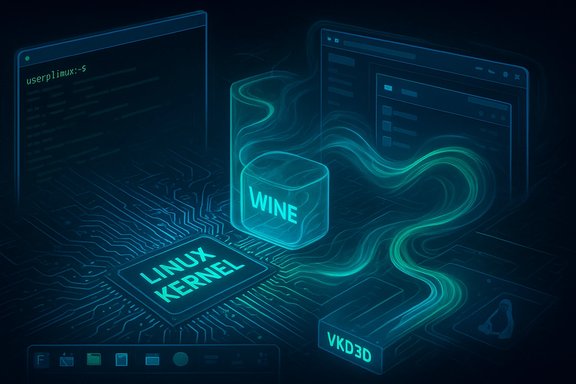
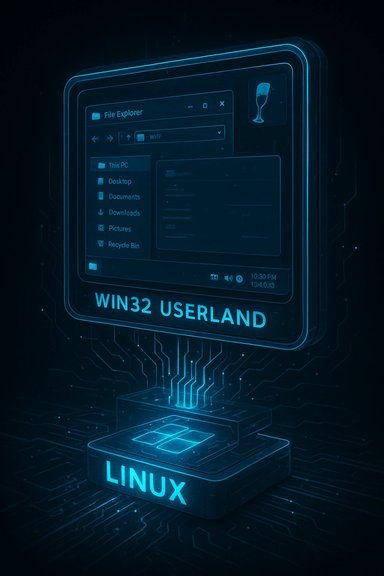
Loss32 is a deliberately provocative thought experiment: what if a Linux distribution were not merely capable of running Windows programs, but was built from the ground up to be a Win32 runtime with the Linux kernel as its substrate? The idea — sketched by a developer who goes by the handle Hikari no Yume and presented at a recent Chaos Communication Congress — proposes running the entire user environment (desktop, window manager, file manager, configuration tools) inside WINE, with Linux reduced to the kernel and minimal plumbing that exposes hardware and device drivers. What reads like gleeful OS heresy also surfaces real engineering rationales and trade-offs worth examining closely.
Loss32 reframes a longstanding compatibility problem. Historically, attempt after attempt has tried to bridge the gap between Windows binaries and non‑Windows kernels: Wine implements the Windows API in user space; Longene attempted to fold Windows kernel semantics into Linux; ReactOS aims to reimplement Windows NT semantics directly. Loss32’s novel twist is to invert expectations — the desktop, apps, and userland are Windows binaries running under a single, dominant WINE layer, with Linux furnishing just the kernel services and device access. The idea is deliberately provocative because it rejects the conventional distribution model — kernel + GNU userland + X11/Wayland + Linux desktop — and instead asks whether the Linux kernel could be treated as a minimal, vendor-neutral hardware abstraction layer for a Win32-first userland. That leads to immediate questions about why one would do this, and whether the technical and legal obstacles are surmountable.
WINE and Valve’s Proton have matured enough that sizable portions of the Windows software and gaming ecosystem already run acceptably on Linux-based systems, and community databases such as ProtonDB reflect thousands of successful reports. Valve’s investment in translating modern graphics APIs (e.g., DX12 → Vulkan via VKD3D‑Proton) and the proliferation of compatibility tools have sharply reduced the “it will never run” barrier. These advances make a Win32-first userland plausibly usable beyond niche experiments.
The architecture is feasible in parts: WINE, Proton, VKD3D, and emulation projects already provide the major building blocks. Past efforts such as WABI, Longene, and BoxedWine demonstrate the components can be assembled in different ways, albeit with caveats and limitations. But the big practical issues — driver semantics, kernel-mode expectations, sandboxing complexity, anti-cheat and DRM, and maintenance burden — are nontrivial and will define whether Loss32 becomes an elegant niche or a brittle curiosity. If Loss32 moves from idea to prototype, it will teach the broader community a lot about the real costs and benefits of making Win32 the first-class userland on Linux. Even if it never ships as a mainstream distro, Loss32 could still accelerate compatibility work that benefits everyone: more robust WINE/Proton, better cross‑architecture emulation, and improved ways to marry Linux kernels with foreign userlands. That, alone, would make the experiment worthwhile.
Source: theregister.com Loss32: An idea for a Linux designed around Win32 apps
 Background / Overview
Loss32 reframes a longstanding compatibility problem. Historically, attempt after attempt has tried to bridge the gap between Windows binaries and non‑Windows kernels: Wine implements the Windows API in user space; Longene attempted to fold Windows kernel semantics into Linux; ReactOS aims to reimplement Windows NT semantics directly. Loss32’s novel twist is to invert expectations — the desktop, apps, and userland are Windows binaries running under a single, dominant WINE layer, with Linux furnishing just the kernel services and device access. The idea is deliberately provocative because it rejects the conventional distribution model — kernel + GNU userland + X11/Wayland + Linux desktop — and instead asks whether the Linux kernel could be treated as a minimal, vendor-neutral hardware abstraction layer for a Win32-first userland. That leads to immediate questions about why one would do this, and whether the technical and legal obstacles are surmountable.Why Loss32 is more than an academic joke
The practical attraction: a stable ABI and a massive app ecosystem
A principal practical appeal of Loss32 is the Win32 ecosystem itself. Decades of Windows software, toolchains, and commercial applications exist as binary artifacts that are economically expensive to recompile or port. For users whose workflows rely on Windows-only apps — especially proprietary productivity suites, legacy business software, or games — a seamless binary-level experience is attractive.WINE and Valve’s Proton have matured enough that sizable portions of the Windows software and gaming ecosystem already run acceptably on Linux-based systems, and community databases such as ProtonDB reflect thousands of successful reports. Valve’s investment in translating modern graphics APIs (e.g., DX12 → Vulkan via VKD3D‑Proton) and the proliferation of compatibility tools have sharply reduced the “it will never run” barrier. These advances make a Win32-first userland plausibly usable beyond niche experiments.
Lowering the surface area of Linux
A Loss32 system could intentionally reduce the amount of Linux-specific userland code that needs to be maintained. Rather than shipping millions of lines of GNU utilities, daemons, and desktop components, the distribution would maintain a carefully curated minimal host: init (or systemd-lite), drivers, kernel modules, and a thin management layer to expose devices and security primitives to the Win32 environment. That simplification could reduce packaging overhead, shrink attack surface in some dimensions, and align maintenance effort toward keeping WINE compatible with the widest possible Windows binaries.Historical precedents that show it’s not impossible
Loss32 isn’t conjuring new magic. Past projects prove parts of the idea viable:- Sun/Caldera’s WABI delivered Win16 support on UNIX workstations and early Linux, demonstrating a commercial path to making Windows binaries useful on non‑Windows platforms.
- Longene attempted to implement Windows kernel semantics inside (or alongside) the Linux kernel to run Windows binaries more natively.
- BoxedWine demonstrated an emulator approach that runs an unmodified Wine in a tightly controlled environment, providing a route to restore compatibility for older binaries and different CPU architectures.
Architecture: what Loss32 would look like in practice
Core components
A plausible Loss32 prototype would need these layers:- Linux kernel (modern, with up-to-date drivers): provides process scheduling, memory management, and kernel-mode device drivers.
- WINE (massive fork or curated runtime): runs as a privileged userspace runtime, hosting the entire Win32 userland (explorer/shell, desktop environment, system services).
- Hardware-to-WINE bridge: a thin compatibility layer that translates Linux kernel devices and event streams into interfaces expected by Windows binaries (e.g., mapping Linux DRM/KMS + Vulkan to Windows Direct3D backends via existing translation layers).
- Init and service orchestrator: manages WINE as the dominant “userland”, sets up containerization for sandboxing, and provides tooling for updates and package distribution.
- Fallback emulation/translators: for cross‑architecture cases (ARM host running x86 binaries), include solutions like FEX or BoxedWine/QEMU to translate CPU instruction sets.
Boot and filesystem considerations
Loss32 advocates have floated unconventional deployment ideas — for instance, booting from NTFS to make the system more friendly to dual‑boot Windows users or to reuse Windows partitions. Booting Linux from an NTFS-based volume is technically possible with the right bootloader and initramfs hooks that load kernel and initrd from an NTFS partition and then mount the real root filesystem; community examples show prototypical approaches. However, this adds boot fragility and complicates tools like fsck and kernel upgrades.Strengths and practical benefits
- Application compatibility: By making Win32 the first-class citizen, native Windows binaries — both legacy and modern — become the supported apps. For users and organizations trapped by Windows-only software, the friction is reduced.
- Game and multimedia performance: Modern WINE/Proton work, coupled with vkd3d and VK translation layers, can deliver near-native gaming performance for many titles; Loss32 could tune the host specifically for those use cases.
- Simplified user experience for Windows migrants: Users who desire Linux’s kernel freedoms but prefer Windows applications could get an environment that “just works” for their apps without manual compatibility work.
- Focused maintenance: Instead of maintaining a vast GNU/Linux userland for broad POSIX apps, Loss32 maintainers could concentrate on WINE compatibility and driver robustness, potentially speeding iterative improvements on the Win32 surface.
Major technical challenges and risks
1) Driver and kernel-mode code: the Achilles’ heel
Windows applications rely heavily on kernel-mode drivers (graphics, networking, input, filesystem filters). Emulating or replacing kernel-mode Windows behavior in user space is hazardous and complex. Projects like Longene tried to implement Windows kernel semantics inside Linux and ran into substantial complexity. Supporting third-party Windows drivers — which may assume NT kernel internals — is particularly unsafe and impractical without full NT kernel semantics. That leaves Loss32 dependent on Linux drivers and translation bridges for critical subsystems, which is workable but not trivial.2) Anti-cheat, DRM and privileged software
Commercial anti-cheat systems and DRM commonly integrate kernel-mode components or expect Windows-specific driver behaviors. Those subsystems often fail on compatibility layers, and they may refuse to run for security reasons. For a Loss32 distribution targeting gamers, anti-cheat incompatibilities will remain a major blocker for many popular live-service titles.3) Security surface and sandboxing complexity
Running everything under a broad WINE instance increases the blast radius of application compromises. A carefully engineered Loss32 would require robust sandboxing (containers, seccomp, mandatory access controls), but the semantics of Windows applications — which often expect low-level kernel access — complicate sandbox design. Balancing compatibility with robust isolation is a hard engineering trade-off.4) ABI drift, maintenance burden, and testing matrix
Win32 and Windows internals evolve. WINE and Proton have done remarkable work to track those changes, but a Win32-first distro would be committing to continuous work: keeping WINE, vkd3d, DXVK, and graphics drivers in lockstep with evolving Windows expectations. The testing matrix (Windows app versions × WINE versions × hardware × host kernel) is enormous and costly to maintain.5) Legal and IP considerations
Reimplementing Windows APIs is legal in many jurisdictions when done from clean-room reverse engineering, but there are risks. Trademarks and third-party licensing (some Windows components or drivers) could create legal friction. Additionally, packaging proprietary Windows binaries or redistributing licensed software would create complex compliance issues.Gaming, Proton, and real-world feasibility
Valve’s Proton work shows the ecosystem is shifting: Proton bundles WINE, DXVK, VKD3D-Proton and Valve-sponsored enhancements that translate Direct3D calls to Vulkan efficiently. The result is tangible: thousands of Windows games now run well on Linux hardware, and community databases reflect that momentum. For Loss32, gaming is the most commercially viable single-use case where Win32-first design makes sense — a distribution tailored specifically to run Windows games with minimal friction could grab an identifiable niche. However, anti-cheat and live-service titles represent a continuing incompatibility class. Even with Proton’s improvements, several widely played titles are still borked because anti-cheat drivers either refuse to operate in compatibility layers or detect them as tampering vectors. Loss32 would inherit the same limitations.Implementation roadmap: a pragmatic way to prototype Loss32
- Build a minimal host kernel image with current upstream drivers, an initramfs that exposes necessary kernel interfaces, and a secure boot path that can load a WINE-dominant userspace.
- Create a hardened WINE bundle (a curated Proton-like stack) that includes VKD3D, DXVK, and required GUI/COM plumbing, and make WINE act as PID 1’s user-interaction layer.
- Implement a small management daemon that exposes hardware capabilities to WINE (audio, input, display), and mediates updates and sandboxing policies.
- Provide optional CPU translation (FEX or BoxedWine/QEMU) for ARM hosts that must run x86‑64 binaries, with performance-critical paths (GPU, input) routed through native code.
- Execute real‑world validation: test a defined compatibility list (games, productivity suites, legacy business apps), instrument crashes and undefined behaviors, and iterate on WINE patches or kernel bridges.
Long-term considerations and ecosystem impacts
Interoperability with Linux-native software
A Loss32 distro would not be a drop-in replacement for a traditional GNU/Linux environment. Native Linux CLI tooling, package managers, and server stacks would be secondary citizens. For users needing both Windows and Linux workloads, dual-boot or containerized Linux environments would remain necessary, unless Loss32 included a POSIX compatibility layer inside the Win32 space — which recreates the original problem.Community and upstream collaboration
Loss32 would need close collaboration with WINE/Proton upstreams, GPU driver vendors, and kernel maintainers. Without buy-in from graphics vendors (for bug fixes and driver tuning) and WINE contributors, performance and compatibility will lag. There are positive precedents — Valve’s contributions to Proton and VKD3D have accelerated compatibility — but those tacit partnerships are not automatic.Security patching and update model
Because Loss32 would concentrate much of the user experience in a single compatibility layer, security updates for the WINE runtime become critical. The update model must be robust and automatic; a compromised or buggy WINE/COM stack could render many apps vulnerable simultaneously. Sandboxing, least-privilege defaults, and per-application policy enforcement must be core features, not afterthoughts.Which claims are speculative and require caution
- The idea that Loss32 could fully replace a standard desktop for all users is speculative; real-world testing is needed to quantify compatibility coverage for complex enterprise apps and anti-cheat systems.
- The claim that one could “boot direct from NTFS” is technically feasible in carefully engineered setups, but it is not advisable for general-purpose distributions because of boot fragility and tooling mismatches; community examples demonstrate techniques but also cautionary trade-offs.
- Legal and trademark problems are context-dependent and require counsel; while API reimplementation has legal precedents, distribution of proprietary Windows components or drivers would create complications.
Where Loss32 might make sense
- As a niche distribution targeted at gamers who want a single-boot machine that "just runs" Windows games with minimal fuss, where anti-cheat coverage is not required.
- As a migration bridge in enterprise contexts where legacy Windows-only apps must run while operations modernize; Loss32 could be used in controlled, supportable deployments.
- As a research platform for exploring compatibility trade-offs: the project could produce valuable patches and learnings for WINE and Proton even if it never becomes a mainstream distro.
Final verdict: inspired madness or useful experiment?
Loss32 sits at the intersection of bold systems thinking and practical engineering risk. Its strengths are clear: it leans into an existing, enormous Win32 binary ecosystem and asks whether Linux can play the role of a stable, hardware-focused substrate. In the short term, the idea is best treated as a targeted experiment — a prototype for specific use cases like gaming or controlled application migration — rather than a general-purpose desktop replacement.The architecture is feasible in parts: WINE, Proton, VKD3D, and emulation projects already provide the major building blocks. Past efforts such as WABI, Longene, and BoxedWine demonstrate the components can be assembled in different ways, albeit with caveats and limitations. But the big practical issues — driver semantics, kernel-mode expectations, sandboxing complexity, anti-cheat and DRM, and maintenance burden — are nontrivial and will define whether Loss32 becomes an elegant niche or a brittle curiosity. If Loss32 moves from idea to prototype, it will teach the broader community a lot about the real costs and benefits of making Win32 the first-class userland on Linux. Even if it never ships as a mainstream distro, Loss32 could still accelerate compatibility work that benefits everyone: more robust WINE/Proton, better cross‑architecture emulation, and improved ways to marry Linux kernels with foreign userlands. That, alone, would make the experiment worthwhile.
Source: theregister.com Loss32: An idea for a Linux designed around Win32 apps