

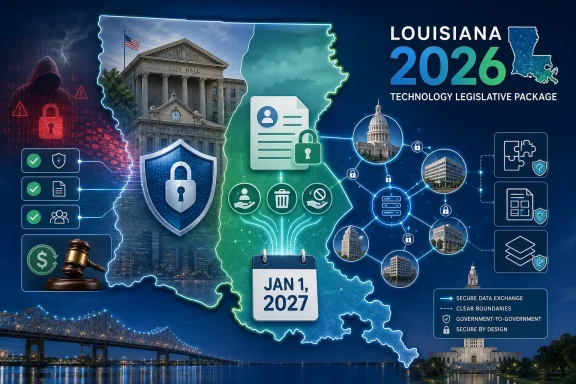
Louisiana’s 2026 legislative session produced a trio of technology laws, signed in May, that will reshape how local governments obtain cyber help after incidents, how companies handle residents’ personal data, and how state agencies share information. The package is not a single grand digital-government overhaul, but it behaves like one. Baton Rouge is tying cybersecurity, privacy, and data exchange into the same governing premise: public institutions and private data handlers can no longer treat information risk as an informal back-office matter.
The most immediate pressure falls on Louisiana’s local governments, not on the state’s largest agencies or biggest companies. Senate Bill 75 gives the Governor’s Office of Homeland Security and Emergency Preparedness the job of writing cybersecurity standards for local governmental subdivisions and political subdivisions that want state assistance after a cyber incident.
That wording matters. The law does not merely encourage cities, parishes, school boards, and other local bodies to improve security. It creates a future eligibility framework for state-backed incident response, and it tells local governments that the cheapest time to meet a baseline is before ransomware hits the file server.
The political move is subtle but consequential. Louisiana is not saying that a noncompliant parish will be abandoned during an emergency. It is saying the state may still show up — and then make the noncompliant local government responsible for reimbursing the costs associated with the help it receives.
That changes the economics of neglect. For years, small public entities have faced the worst combination in cybersecurity: limited budgets, thin staffing, aging systems, and high exposure. SB 75 does not solve that imbalance by itself, but it makes clear that “we will call the state when things go bad” is no longer a complete cyber strategy.
That is the real leverage in the bill. Cybersecurity mandates can sound abstract until they become procurement requirements, insurance conditions, grant prerequisites, or post-incident bills. Louisiana has chosen the post-incident lever, which may prove more persuasive than another voluntary best-practices memo.
The law also leaves room for GOHSEP to shape the details. It directs the office to establish rules that include technical management practices assuring compliance with national cybersecurity standards. That phrase could point toward familiar frameworks such as the NIST Cybersecurity Framework, CIS Controls, or other nationally recognized benchmarks, but the statute itself leaves the implementation work to rulemaking.
That flexibility is both necessary and risky. Cyber standards age quickly, and a statute that hard-codes controls can become obsolete before the ink dries. But local governments will need clarity soon, because “national cybersecurity standards” can mean different levels of effort depending on who is interpreting the phrase and how much money is available.
Instead, the state is preserving its ability to respond while reserving the right to shift costs. That distinction will matter during the first major incident after the rules are written. If a local government has ignored required standards, the conversation will not be about whether the state can help; it will be about who pays for the people, tools, and recovery work.
For local officials, the message is uncomfortable but fair. If the state is going to be the backstop, the state wants a say in minimum readiness. If public money is going to absorb the cost of repeated preventable failures, Baton Rouge wants leverage before the next breach.
The danger is that reimbursement risk could punish the same communities least able to comply. Rural parishes and small municipalities are often the places where a single IT generalist handles everything from password resets to police department software. If Louisiana writes standards without matching assistance, the law could become a penalty system for under-resourced governments rather than a genuine improvement program.
The governor signed SB 386 on May 29, and the law takes effect January 1, 2027. That date is important because some early shorthand descriptions of the bill have referred simply to “Jan. 1,” leaving the year ambiguous. Businesses should treat 2026 as the preparation window, not the compliance finish line.
Louisiana is joining a wave of states that have moved into the vacuum left by Congress’s long failure to pass a comprehensive federal privacy law. The result is a patchwork, but not a random one. Most of these laws converge around a recognizable set of consumer rights, controller obligations, attorney general enforcement, and special treatment for sensitive data.
The Louisiana version follows that general model while adding the state’s own thresholds and enforcement posture. For residents, the law promises more control over data that has often moved invisibly through advertising, analytics, brokerage, and platform ecosystems. For companies, it means another state regime to map into privacy operations that are already fragmented across the country.
That principle, if taken seriously, challenges the default behavior of modern data collection. Too many systems are built around hoarding: collect now, find a use later, feed analytics, train models, enrich profiles, sell segments, or keep data indefinitely because storage is cheap. Privacy law is slowly trying to reverse that presumption.
The enforcement challenge is obvious. “Reasonably necessary” is a standard, not a bright line. A company can always argue that more telemetry improves fraud detection, personalization, safety, or product development.
But standards can still change behavior. Lawyers, engineers, and product teams will need to document why data is collected, how long it is retained, whether it is sensitive, whether it is sold, and whether consumers have been given required notices. In privacy compliance, paperwork is not the whole game, but the paperwork often reveals whether a company has bothered to understand its own data flows.
For businesses, that will be reassuring. Attorney general enforcement tends to be more predictable than a universe of private lawsuits, at least in theory. Companies can build compliance programs around regulatory expectations rather than class-action exposure after every alleged misstep.
For consumers, the trade-off is less satisfying. A right that depends entirely on state enforcement can be powerful when the attorney general is active, resourced, and interested. It can be thin when enforcement priorities shift or the office focuses only on the most egregious cases.
That tension is now baked into American state privacy law. Legislatures want to say residents have rights, but many remain wary of unleashing private rights of action that business groups describe as litigation magnets. Louisiana chose the mainstream route: rights on paper, centralized enforcement in practice.
The compact authorizes a single legal and technical framework for secure, privacy-compliant interagency data sharing among participating agencies. The Office of Technology Services will administer the compact and develop a standardized agreement. Participating agencies will advise on the framework, review changes as laws and security requirements evolve, and recommend updates.
This is the kind of government plumbing that rarely excites the public until it fails. Agencies need to share data for benefits administration, fraud prevention, emergency response, workforce programs, health services, and planning. But without common rules, each exchange can become a bespoke negotiation among lawyers, technologists, records officers, and program managers.
A statewide compact promises to reduce that friction. It can establish who may access data, for what purpose, under what safeguards, and with what continuing obligations. If done well, it creates a repeatable governance model instead of forcing every agency to reinvent the same agreement.
That approach lowers the political temperature. A mandatory statewide data-sharing scheme would invite predictable concerns about centralization, mission creep, and loss of agency control. By keeping participation voluntary, Louisiana is making the compact easier to adopt and easier to defend.
The trade-off is uneven uptake. Voluntary frameworks succeed when the default agreement is genuinely useful, the administrator is trusted, and agencies see participation as reducing risk rather than adding bureaucracy. If the compact becomes a slow approval layer, agencies will route around it.
The Office of Technology Services therefore has a delicate job. It must make the framework strong enough to satisfy privacy and security requirements, but practical enough that agencies use it. The compact will live or die not in statutory text, but in templates, review timelines, identity controls, audit expectations, and the mundane experience of whether program staff can get lawful work done.
In practice, those are not separate domains. A local government cannot protect residents if it does not know what systems it runs, what data it holds, who can access it, and how it would recover after compromise. A privacy law cannot mean much if businesses collect less data on paper but fail to secure what remains. A data exchange compact cannot be privacy-compliant unless access, purpose limitation, retention, and security are engineered into the process.
Louisiana’s session reflects that convergence. The state is not merely telling local governments to defend networks. It is telling agencies and businesses to justify data movement. It is acknowledging that the public sector’s digital operations now depend on governance frameworks as much as hardware and software.
This is the larger shift IT pros should notice. The next phase of cyber policy is not just incident reporting or ransomware response. It is the administrative normalization of cybersecurity and privacy as routine conditions of doing public business.
SB 75 increases the pressure without, in the law itself, guaranteeing the resources. That is not unusual for state cybersecurity policy, but it is the place where rhetoric meets the help desk. A checklist that looks reasonable in Baton Rouge can look very different in a town whose technology budget is consumed by keeping essential systems online.
The best version of the law would pair standards with templates, shared services, grant guidance, procurement help, and practical technical support. Many small governments do not need a consultant to tell them that multifactor authentication is good. They need help implementing it across legacy systems, remote access tools, public-safety applications, and vendor-managed platforms.
The worst version would become a post-breach blame instrument. After an incident, state officials could point to noncompliance and send a bill, while local leaders argue they never had realistic means to comply. Louisiana’s rulemaking process should be judged by whether it reduces that conflict before it starts.
The law’s thresholds mean it will not apply to every small Louisiana business. But many companies outside Louisiana will still need to pay attention if they conduct business in the state or offer products and services consumed by residents while meeting the statutory thresholds. State privacy laws are territorial in practical effect even when companies think of themselves as national or digital-first.
For larger organizations, Louisiana may be one more line in an already crowded matrix. That can produce privacy fatigue, but it also creates an argument for building a unified privacy architecture rather than state-by-state improvisation. If a company can honor access, deletion, correction, portability, and opt-out rights across multiple jurisdictions, Louisiana becomes an incremental update rather than a fire drill.
For smaller covered entities, the challenge may be more basic. They will need to know where personal data lives, whether processors are involved, whether data is sold, whether sensitive data receives special handling, and whether consumer requests can be authenticated and fulfilled within required timelines. Privacy compliance begins with inventory, and inventory is often where the fantasy of control collapses.
That approach has benefits. States can move faster than Congress, test policy models, and respond to local pressures. A state that has watched school districts, municipalities, hospitals, or agencies struggle with cyber incidents does not need a federal grand bargain to act.
But the patchwork is becoming a compliance architecture of its own. Businesses must track different thresholds, exemptions, cure periods, definitions, consumer rights, appeal processes, sensitive-data rules, and enforcement structures. Local governments must navigate state cyber expectations, federal grant requirements, insurance demands, and sector-specific obligations.
The absence of federal uniformity does not mean the absence of law. It means more law, with more variation. Louisiana has now added its own terms to that landscape.
The compact attempts to occupy the narrow middle ground. It promises secure, privacy-compliant sharing through a single framework while preserving agency ownership and voluntary participation. That is sensible public-sector design, assuming the framework is actually used.
The most important details will be operational. Does the compact require clear purpose statements for every exchange? Does it define minimum security controls? Does it address audit logs, access reviews, breach notification, retention, and redisclosure? Does it make room for sensitive programs where confidentiality rules are stricter than ordinary administrative data?
If Louisiana answers those questions well, SB 233 could become a quiet modernization engine. If it answers them poorly, the compact risks becoming another governance artifact: technically available, rarely used, and cited mostly in slide decks.
That bargain is pragmatic. It recognizes that absolutist approaches rarely survive contact with government operations. The state cannot abandon a hacked parish, cannot regulate every data practice through private lawsuits, and cannot force every agency into a one-size-fits-all exchange.
But pragmatism is not the same as weakness. The package creates pressure points across the ecosystem. It tells local governments to prepare, businesses to minimize and account for data, and agencies to share information through a controlled framework rather than ad hoc trust.
The next year will determine whether the laws become meaningful infrastructure or merely another layer of compliance language. Rulemaking for SB 75, preparation for SB 386, and administrative design for SB 233 will carry more weight than the signing ceremonies.
 Louisiana Turns Cyber Help Into a Compliance Test
The most immediate pressure falls on Louisiana’s local governments, not on the state’s largest agencies or biggest companies. Senate Bill 75 gives the Governor’s Office of Homeland Security and Emergency Preparedness the job of writing cybersecurity standards for local governmental subdivisions and political subdivisions that want state assistance after a cyber incident.That wording matters. The law does not merely encourage cities, parishes, school boards, and other local bodies to improve security. It creates a future eligibility framework for state-backed incident response, and it tells local governments that the cheapest time to meet a baseline is before ransomware hits the file server.
The political move is subtle but consequential. Louisiana is not saying that a noncompliant parish will be abandoned during an emergency. It is saying the state may still show up — and then make the noncompliant local government responsible for reimbursing the costs associated with the help it receives.
That changes the economics of neglect. For years, small public entities have faced the worst combination in cybersecurity: limited budgets, thin staffing, aging systems, and high exposure. SB 75 does not solve that imbalance by itself, but it makes clear that “we will call the state when things go bad” is no longer a complete cyber strategy.
The Ransomware Era Finally Reaches the Appropriations Table
The practical audience for SB 75 is the mayor, parish president, superintendent, clerk, sheriff, or local IT director who has been trying to turn cybersecurity from a line-item nuisance into a governing priority. A state standard, especially one backed by possible reimbursement consequences, gives those officials a new argument in budget season.That is the real leverage in the bill. Cybersecurity mandates can sound abstract until they become procurement requirements, insurance conditions, grant prerequisites, or post-incident bills. Louisiana has chosen the post-incident lever, which may prove more persuasive than another voluntary best-practices memo.
The law also leaves room for GOHSEP to shape the details. It directs the office to establish rules that include technical management practices assuring compliance with national cybersecurity standards. That phrase could point toward familiar frameworks such as the NIST Cybersecurity Framework, CIS Controls, or other nationally recognized benchmarks, but the statute itself leaves the implementation work to rulemaking.
That flexibility is both necessary and risky. Cyber standards age quickly, and a statute that hard-codes controls can become obsolete before the ink dries. But local governments will need clarity soon, because “national cybersecurity standards” can mean different levels of effort depending on who is interpreting the phrase and how much money is available.
The State Is Not Promising Rescue Without Conditions
The most politically careful part of SB 75 is its refusal to cut off emergency aid outright. Louisiana has avoided the harshest version of a compliance regime, where a city that fails to meet a checklist might be denied assistance during an active attack. That would be both morally ugly and operationally self-defeating, because malware does not respect municipal boundaries.Instead, the state is preserving its ability to respond while reserving the right to shift costs. That distinction will matter during the first major incident after the rules are written. If a local government has ignored required standards, the conversation will not be about whether the state can help; it will be about who pays for the people, tools, and recovery work.
For local officials, the message is uncomfortable but fair. If the state is going to be the backstop, the state wants a say in minimum readiness. If public money is going to absorb the cost of repeated preventable failures, Baton Rouge wants leverage before the next breach.
The danger is that reimbursement risk could punish the same communities least able to comply. Rural parishes and small municipalities are often the places where a single IT generalist handles everything from password resets to police department software. If Louisiana writes standards without matching assistance, the law could become a penalty system for under-resourced governments rather than a genuine improvement program.
Privacy Arrives as a Consumer Right, Not a Slogan
The second major piece, Senate Bill 386, is more familiar in national context but no less significant for Louisiana residents. The Louisiana Data Privacy Act creates rights for consumers to access, correct, delete, and obtain copies of personal information, while allowing opt-outs from certain uses of personal data.The governor signed SB 386 on May 29, and the law takes effect January 1, 2027. That date is important because some early shorthand descriptions of the bill have referred simply to “Jan. 1,” leaving the year ambiguous. Businesses should treat 2026 as the preparation window, not the compliance finish line.
Louisiana is joining a wave of states that have moved into the vacuum left by Congress’s long failure to pass a comprehensive federal privacy law. The result is a patchwork, but not a random one. Most of these laws converge around a recognizable set of consumer rights, controller obligations, attorney general enforcement, and special treatment for sensitive data.
The Louisiana version follows that general model while adding the state’s own thresholds and enforcement posture. For residents, the law promises more control over data that has often moved invisibly through advertising, analytics, brokerage, and platform ecosystems. For companies, it means another state regime to map into privacy operations that are already fragmented across the country.
Data Minimization Is the Quiet Center of the Law
The headline rights in privacy laws are usually the ones consumers can understand immediately: access, deletion, correction, portability, and opt-out. Those are important, but the deeper change in SB 386 is its data minimization language. Covered controllers are told to limit collection to what is adequate, relevant, and reasonably necessary for disclosed purposes.That principle, if taken seriously, challenges the default behavior of modern data collection. Too many systems are built around hoarding: collect now, find a use later, feed analytics, train models, enrich profiles, sell segments, or keep data indefinitely because storage is cheap. Privacy law is slowly trying to reverse that presumption.
The enforcement challenge is obvious. “Reasonably necessary” is a standard, not a bright line. A company can always argue that more telemetry improves fraud detection, personalization, safety, or product development.
But standards can still change behavior. Lawyers, engineers, and product teams will need to document why data is collected, how long it is retained, whether it is sensitive, whether it is sold, and whether consumers have been given required notices. In privacy compliance, paperwork is not the whole game, but the paperwork often reveals whether a company has bothered to understand its own data flows.
Louisiana’s Law Gives the Attorney General the Steering Wheel
SB 386 places enforcement with the state attorney general and treats violations as unfair or deceptive trade practices. That is a common state privacy-law design, and it tells us something about the political compromise behind the bill. Louisiana is creating consumer rights, but it is not creating a broad private litigation machine.For businesses, that will be reassuring. Attorney general enforcement tends to be more predictable than a universe of private lawsuits, at least in theory. Companies can build compliance programs around regulatory expectations rather than class-action exposure after every alleged misstep.
For consumers, the trade-off is less satisfying. A right that depends entirely on state enforcement can be powerful when the attorney general is active, resourced, and interested. It can be thin when enforcement priorities shift or the office focuses only on the most egregious cases.
That tension is now baked into American state privacy law. Legislatures want to say residents have rights, but many remain wary of unleashing private rights of action that business groups describe as litigation magnets. Louisiana chose the mainstream route: rights on paper, centralized enforcement in practice.
The Data Exchange Compact Is the Least Flashy and Most Structural Move
Senate Bill 233, establishing the Louisiana Statewide Data Exchange Compact, will not generate the same consumer-facing attention as privacy rights or the same local-government anxiety as cybersecurity reimbursement. But it may have the longest institutional tail.The compact authorizes a single legal and technical framework for secure, privacy-compliant interagency data sharing among participating agencies. The Office of Technology Services will administer the compact and develop a standardized agreement. Participating agencies will advise on the framework, review changes as laws and security requirements evolve, and recommend updates.
This is the kind of government plumbing that rarely excites the public until it fails. Agencies need to share data for benefits administration, fraud prevention, emergency response, workforce programs, health services, and planning. But without common rules, each exchange can become a bespoke negotiation among lawyers, technologists, records officers, and program managers.
A statewide compact promises to reduce that friction. It can establish who may access data, for what purpose, under what safeguards, and with what continuing obligations. If done well, it creates a repeatable governance model instead of forcing every agency to reinvent the same agreement.
Voluntary Participation Keeps the Compact Politically Safe
The compact’s voluntary design is no accident. Agencies may participate, withdraw, or pursue another approach if the framework no longer fits particular data-sharing needs. They also retain ownership of information they choose to share.That approach lowers the political temperature. A mandatory statewide data-sharing scheme would invite predictable concerns about centralization, mission creep, and loss of agency control. By keeping participation voluntary, Louisiana is making the compact easier to adopt and easier to defend.
The trade-off is uneven uptake. Voluntary frameworks succeed when the default agreement is genuinely useful, the administrator is trusted, and agencies see participation as reducing risk rather than adding bureaucracy. If the compact becomes a slow approval layer, agencies will route around it.
The Office of Technology Services therefore has a delicate job. It must make the framework strong enough to satisfy privacy and security requirements, but practical enough that agencies use it. The compact will live or die not in statutory text, but in templates, review timelines, identity controls, audit expectations, and the mundane experience of whether program staff can get lawful work done.
Cybersecurity and Privacy Are Now the Same Governance Problem
Taken together, the three laws show a state government trying to connect pieces that have traditionally been handled separately. Cybersecurity is often managed as an IT risk. Consumer privacy is often treated as a legal compliance issue. Interagency data sharing is often framed as administrative modernization.In practice, those are not separate domains. A local government cannot protect residents if it does not know what systems it runs, what data it holds, who can access it, and how it would recover after compromise. A privacy law cannot mean much if businesses collect less data on paper but fail to secure what remains. A data exchange compact cannot be privacy-compliant unless access, purpose limitation, retention, and security are engineered into the process.
Louisiana’s session reflects that convergence. The state is not merely telling local governments to defend networks. It is telling agencies and businesses to justify data movement. It is acknowledging that the public sector’s digital operations now depend on governance frameworks as much as hardware and software.
This is the larger shift IT pros should notice. The next phase of cyber policy is not just incident reporting or ransomware response. It is the administrative normalization of cybersecurity and privacy as routine conditions of doing public business.
The Local Government Burden Will Be the First Stress Test
The hardest implementation question remains money. Local governments do not lack cyber problems because they have ignored newspaper headlines. They lack modern defenses because the costs of identity management, endpoint detection, backups, logging, network segmentation, staff training, vendor review, and incident planning compete with roads, drainage, public safety, payroll, and utilities.SB 75 increases the pressure without, in the law itself, guaranteeing the resources. That is not unusual for state cybersecurity policy, but it is the place where rhetoric meets the help desk. A checklist that looks reasonable in Baton Rouge can look very different in a town whose technology budget is consumed by keeping essential systems online.
The best version of the law would pair standards with templates, shared services, grant guidance, procurement help, and practical technical support. Many small governments do not need a consultant to tell them that multifactor authentication is good. They need help implementing it across legacy systems, remote access tools, public-safety applications, and vendor-managed platforms.
The worst version would become a post-breach blame instrument. After an incident, state officials could point to noncompliance and send a bill, while local leaders argue they never had realistic means to comply. Louisiana’s rulemaking process should be judged by whether it reduces that conflict before it starts.
The Private Sector Gets a Countdown Clock
For companies subject to SB 386, the compliance calendar is now real. January 1, 2027 is close enough that privacy teams should already be mapping applicability, data inventories, consumer request workflows, vendor contracts, sensitive-data practices, opt-out mechanisms, and notice language.The law’s thresholds mean it will not apply to every small Louisiana business. But many companies outside Louisiana will still need to pay attention if they conduct business in the state or offer products and services consumed by residents while meeting the statutory thresholds. State privacy laws are territorial in practical effect even when companies think of themselves as national or digital-first.
For larger organizations, Louisiana may be one more line in an already crowded matrix. That can produce privacy fatigue, but it also creates an argument for building a unified privacy architecture rather than state-by-state improvisation. If a company can honor access, deletion, correction, portability, and opt-out rights across multiple jurisdictions, Louisiana becomes an incremental update rather than a fire drill.
For smaller covered entities, the challenge may be more basic. They will need to know where personal data lives, whether processors are involved, whether data is sold, whether sensitive data receives special handling, and whether consumer requests can be authenticated and fulfilled within required timelines. Privacy compliance begins with inventory, and inventory is often where the fantasy of control collapses.
The National Patchwork Keeps Growing Because Washington Keeps Waiting
Louisiana’s move is part of a broader national pattern. States are no longer waiting for Congress to settle the privacy question or dictate a uniform cyber baseline for local government. They are filling the gap with their own laws, their own enforcement mechanisms, and their own definitions.That approach has benefits. States can move faster than Congress, test policy models, and respond to local pressures. A state that has watched school districts, municipalities, hospitals, or agencies struggle with cyber incidents does not need a federal grand bargain to act.
But the patchwork is becoming a compliance architecture of its own. Businesses must track different thresholds, exemptions, cure periods, definitions, consumer rights, appeal processes, sensitive-data rules, and enforcement structures. Local governments must navigate state cyber expectations, federal grant requirements, insurance demands, and sector-specific obligations.
The absence of federal uniformity does not mean the absence of law. It means more law, with more variation. Louisiana has now added its own terms to that landscape.
The Compact Could Become a Model or a Filing Cabinet
The Statewide Data Exchange Compact deserves attention because data sharing is often where digital government either advances or stalls. Citizens experience government as fragmented when agencies cannot share information efficiently. They experience government as intrusive when agencies share too much, too casually, or without meaningful limits.The compact attempts to occupy the narrow middle ground. It promises secure, privacy-compliant sharing through a single framework while preserving agency ownership and voluntary participation. That is sensible public-sector design, assuming the framework is actually used.
The most important details will be operational. Does the compact require clear purpose statements for every exchange? Does it define minimum security controls? Does it address audit logs, access reviews, breach notification, retention, and redisclosure? Does it make room for sensitive programs where confidentiality rules are stricter than ordinary administrative data?
If Louisiana answers those questions well, SB 233 could become a quiet modernization engine. If it answers them poorly, the compact risks becoming another governance artifact: technically available, rarely used, and cited mostly in slide decks.
The New Louisiana Bargain Is Readiness Before Rescue
Louisiana’s legislative package is best understood as a bargain. Local governments can still ask the state for help after a cyber incident, but they will be expected to meet baseline standards. Consumers will gain formal privacy rights, but enforcement will run through the attorney general rather than private lawsuits. Agencies will get a standardized path for sharing data, but participation remains voluntary and ownership stays with the source agency.That bargain is pragmatic. It recognizes that absolutist approaches rarely survive contact with government operations. The state cannot abandon a hacked parish, cannot regulate every data practice through private lawsuits, and cannot force every agency into a one-size-fits-all exchange.
But pragmatism is not the same as weakness. The package creates pressure points across the ecosystem. It tells local governments to prepare, businesses to minimize and account for data, and agencies to share information through a controlled framework rather than ad hoc trust.
The next year will determine whether the laws become meaningful infrastructure or merely another layer of compliance language. Rulemaking for SB 75, preparation for SB 386, and administrative design for SB 233 will carry more weight than the signing ceremonies.
The Fine Print Is Where the Real Policy Will Be Written
The most concrete consequences now fall into a few practical buckets, and none of them can be deferred until the first incident or the final weeks before the privacy law takes effect.- Local governments should assume that future state cyber assistance will come with eligibility standards and possible cost consequences for noncompliance.
- GOHSEP’s rulemaking will determine whether SB 75 becomes a usable readiness program or an unfunded compliance trap for smaller public entities.
- Businesses covered by the Louisiana Data Privacy Act should use 2026 to build consumer request workflows, data inventories, opt-out mechanisms, and sensitive-data notices before the January 1, 2027 effective date.
- State agencies considering the Data Exchange Compact should evaluate whether standardized agreements can replace slow one-off sharing arrangements without weakening confidentiality protections.
- Louisiana residents should expect more formal rights over personal data, but the strength of those rights will depend heavily on attorney general enforcement and business compliance culture.
References
- Primary source: govtech.com
Published: Tue, 23 Jun 2026 22:26:41 GMT
Louisiana Legislative Session Yields Cyber, Privacy Laws
New bills signed by the governor this spring tie local cyber preparedness to state assistance and give residents more control over personal data. A third codifies secure data sharing among agencies.www.govtech.com - Related coverage: recordinglaw.com
Louisiana Data Privacy Laws: Comprehensive Guide (2026) | Recording Law
Louisiana passed the Data Privacy Act (SB 386) in 2026, effective Jan. 1, 2027. Learn breach notification rules, children's online protections, and federal privacy laws that apply now.www.recordinglaw.com - Related coverage: insideprivacy.com
Louisiana Enacts Comprehensive Privacy Law | Inside Privacy
On May 29, 2026, the Governor of Louisiana signed into law SB 386, the Louisiana Data Privacy Act (“LDPA”). Louisiana joins Alabama and Oklahoma as thewww.insideprivacy.com - Related coverage: joneswalker.com
Louisiana Becomes the Twenty-Second Privacy State (and Almost the Second to Embed AI in Its Processor Duty) | Jones Walker LLP
Louisiana now has a consumer data privacy law. Senate Bill 386 (the “Louisiana Data Privacy Act”) was signed into law by Governor Jeff Landry on May 29, 2026, making the state the twenty-second to…www.joneswalker.com - Related coverage: codamail.com
US State Privacy Laws Overview - Privacy Law Directory
A comprehensive guide to all 23 US states with comprehensive consumer privacy laws as of June 2026, including CCPA, VCDPA, CPA, TDPSA, and 19 others. Covers comparison tables, sector-specific laws like Illinois BIPA and Washington MHMDA, and key enforcement trends.codamail.com
- Related coverage: bsa.org
US: BSA Letter on LA SB 386, The Louisiana Data Privacy Act
BSA supports strong privacy protections for consumers. We appreciate your work to advance comprehensive consumer privacy legislation through Senate Bill 386, the Louisiana Data Privacy Act.www.bsa.org
- Related coverage: clym.io
Louisiana Data Privacy Act: 2027 Compliance Guide | Clym
Louisiana's Data Privacy Act takes effect January 1, 2027. Learn who it applies to, how it compares to CCPA, and what your business needs to do to prepare.www.clym.io
- Related coverage: privacyon.com
How to Opt Out of Data Brokers in Louisiana | PrivacyOn | PrivacyOn
Louisiana's Data Privacy Act is coming in 2027. Learn how to remove your personal data from brokers today with this step-by-step guide for Louisiana residents.www.privacyon.com - Related coverage: dataguidance.com
DataGuidance
Essential Privacy and Regulatory Research at Your Fingertips. Find everything you need to stay up-to-date on evolving privacy & security regulations around the worldwww.dataguidance.com - Related coverage: bassberry.com
Louisiana Joins the Second Line of States with Comprehensive Privacy Laws | Bass, Berry & Sims PLC
Key Takeaways The Louisiana Data Privacy Act (LDPA) takes effect on January 1, 2027, and applies to businesses meeting specific thresholds for annual gross revenue, consumer data volume, or revenue derived from selling personal data. Louisiana is among a small group of states that restricts the...www.bassberry.com
